How to Ship Internationally for Modern Merch Teams
You've got a launch date, a recipient spreadsheet, and a warehouse full of custom hoodies. The team is spread across continents, the event is fixed, and somebody has just asked whether “worldwide shipping” includes customs, taxes, returns, and the package that gets held in Frankfurt. Learning how to ship internationally stops being a carrier-selection exercise and becomes merch operations.
International fulfillment for internet-native teams has different constraints from ordinary e-commerce. You're shipping branded apparel to distributed recipients, often on a deadline, while protecting a premium unboxing experience. The shipment can be small, the SKU list can be messy, and one missing customs field can create more work than the production itself.
Table of Contents
- Build for the route, not the photo
- Labels carry operational meaning
- Track the event, not just the number
Why International Shipping Breaks for Merch Teams
A global merch drop can fail long before a courier misses a connection. The classic pattern is a batch of cotton tees moving through Europe with an inaccurate classification, vague descriptions, or inconsistent values. Customs officers don't see “team drop” or “launch moment.” They see line items that must match the paperwork, the goods, and destination-country rules.
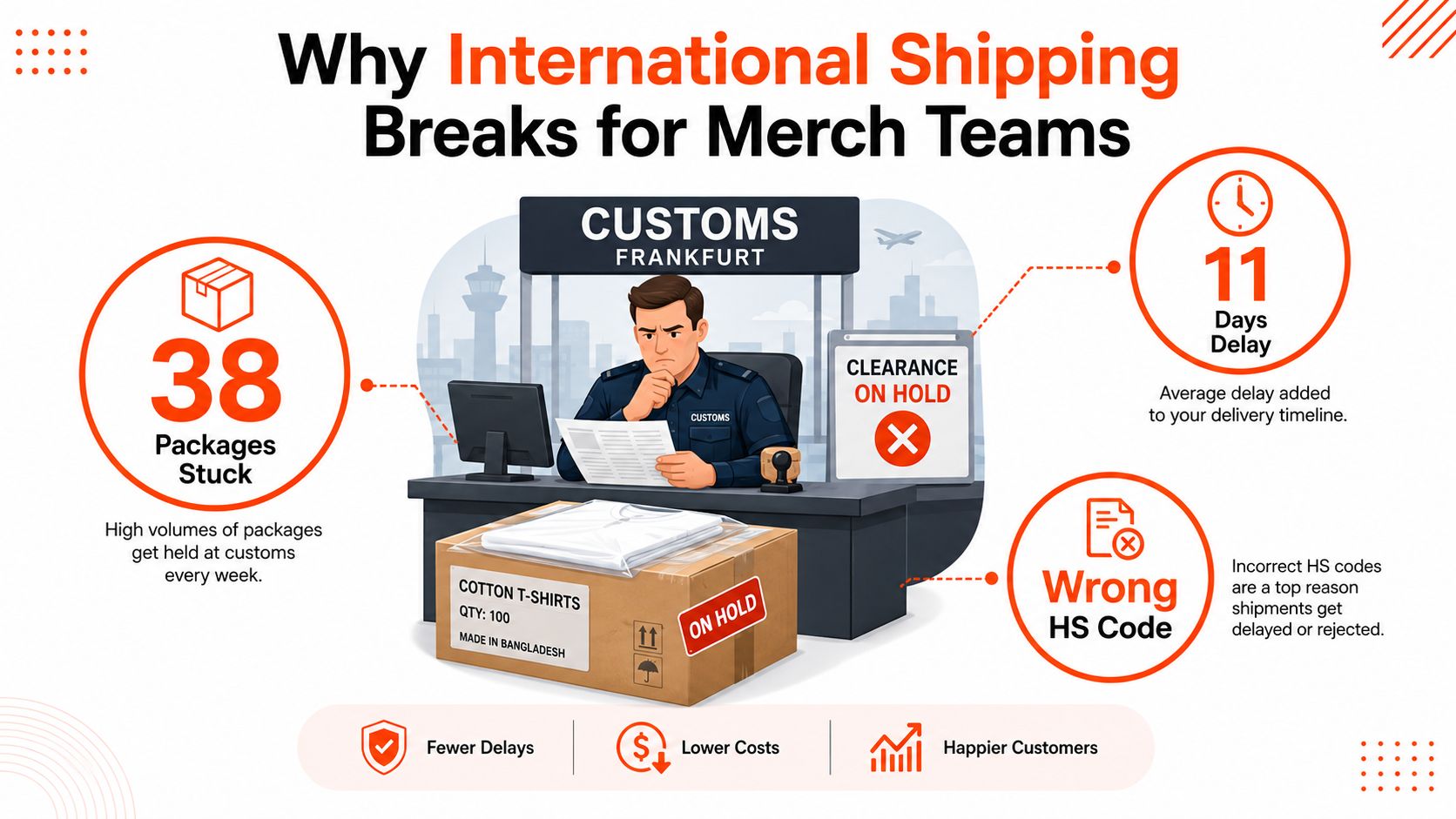
Merch teams face three pressures that generic shipping guides usually miss:
- Distributed recipient lists: One order may contain addresses across many countries, each with different import requirements, tax treatment, and delivery constraints.
- Tight launch windows: A late parcel can miss a conference, onboarding date, creator campaign, or community reveal. Delay doesn't just affect freight. It can force refunds, replacements, or a rushed second shipment.
- Branded unboxing expectations: A premium mailer, inserts, tissue, and careful folding matter to the recipient. Bulk shipping improves economics, but aggressive consolidation can compromise the moment the customer experiences.
Operator rule: A merch drop isn't one shipment. It's a group of customs events connected to one brand promise.
The World Bank tracks average export customs-clearance time in days through its customs duration dataset. Customs-operation research cited in that baseline found a median process time of 10 days, increasing to 14 to 19 days when declarations were amended, inspected, or rejected. Another trade study found stopped consignments represented about 22% of consignments but generated roughly 61% of total delays. Those figures explain why accurate classification and complete paperwork matter more than shaving a little time off the transport leg.
The operational stakes are straightforward. Duty underpayment can turn into recipient-side fees. An incorrect Incoterm can create a surprise bill at delivery. Missing tax or customs data can hold parcels that looked perfectly fine when they left the origin warehouse. Before promising a launch date, define who pays, who imports, what each SKU is, and how the recipient gets help when a parcel stops moving. Teams can also review Banger's worldwide custom merch shipping FAQ for destination and fulfillment questions.
Picking the Right Fulfillment Model
There are three models worth considering for distributed merch programs. None wins universally. The right choice depends on drop size, geographic spread, deadline pressure, and how much control the brand needs over every package.
Bulk ship-to-hub
You consolidate inventory and send it to a regional 3PL or partner warehouse. That hub handles local pick, pack, and last-mile delivery. Bulk shipping usually gives you better per-unit economics and tighter control over packaging because the team can build the unboxing in one place.
The downside is concentration risk. A customs hold, inbound receiving delay, or inventory mismatch at the hub affects an entire region. This model also makes less sense when recipients are scattered and the drop doesn't justify regional inventory.
Blind multi-address
The origin team pre-sorts units, creates a label for every recipient, and hands the parcels to a courier. Recipients get the intended branded experience without an extra warehouse touch, and the merch lead can ship one production run to many destinations.
Labor becomes the tax. Address formatting, label placement, customs data, and exception handling all happen at origin. Each parcel also carries its own import exposure, so a mistake can repeat across the list instead of affecting one consolidated shipment.
On-demand
An API-driven network prints and ships near the recipient. Providers such as Printful and Gelato fit this model. It moves fixed inventory investment toward variable operating cost and can make replenishment easier for evergreen programs.
You give up some control over blanks, materials, decoration consistency, and color fidelity. On-demand works better for repeatable basics than for a tightly art-directed capsule where fabric handfeel and finishing details are the product.
| Model | Best For | Per-Unit Cost | Speed | Brand Control | Risk |
|---|---|---|---|---|---|
| Bulk ship-to-hub | Regional drops and larger batches | Usually lower at scale | Depends on inbound receiving and local fulfillment | High | Hub concentration and inventory exposure |
| Blind multi-address | One global launch with curated recipients | Can rise with address and labeling labor | Direct from origin | High if pre-sorted correctly | Repeated customs and data errors |
| On-demand | Evergreen catalogs and replenishment | Variable and often less predictable | Depends on network location | Moderate | Blank, color, and decoration variability |
For workflow planning, teams comparing logistics data and operational tooling can explore the Flexport Claude setup from Menza. The decision rule is simple: use a hub when recipients cluster, blind multi-address when brand control and one-time launch timing matter, and on-demand when the catalog needs to stay live without holding much stock. If the drop is both geographically broad and highly premium, split the model by region instead of forcing one answer worldwide. More practical options are outlined in Banger's merch fulfillment services guide.
Customs Paperwork That Actually Clears
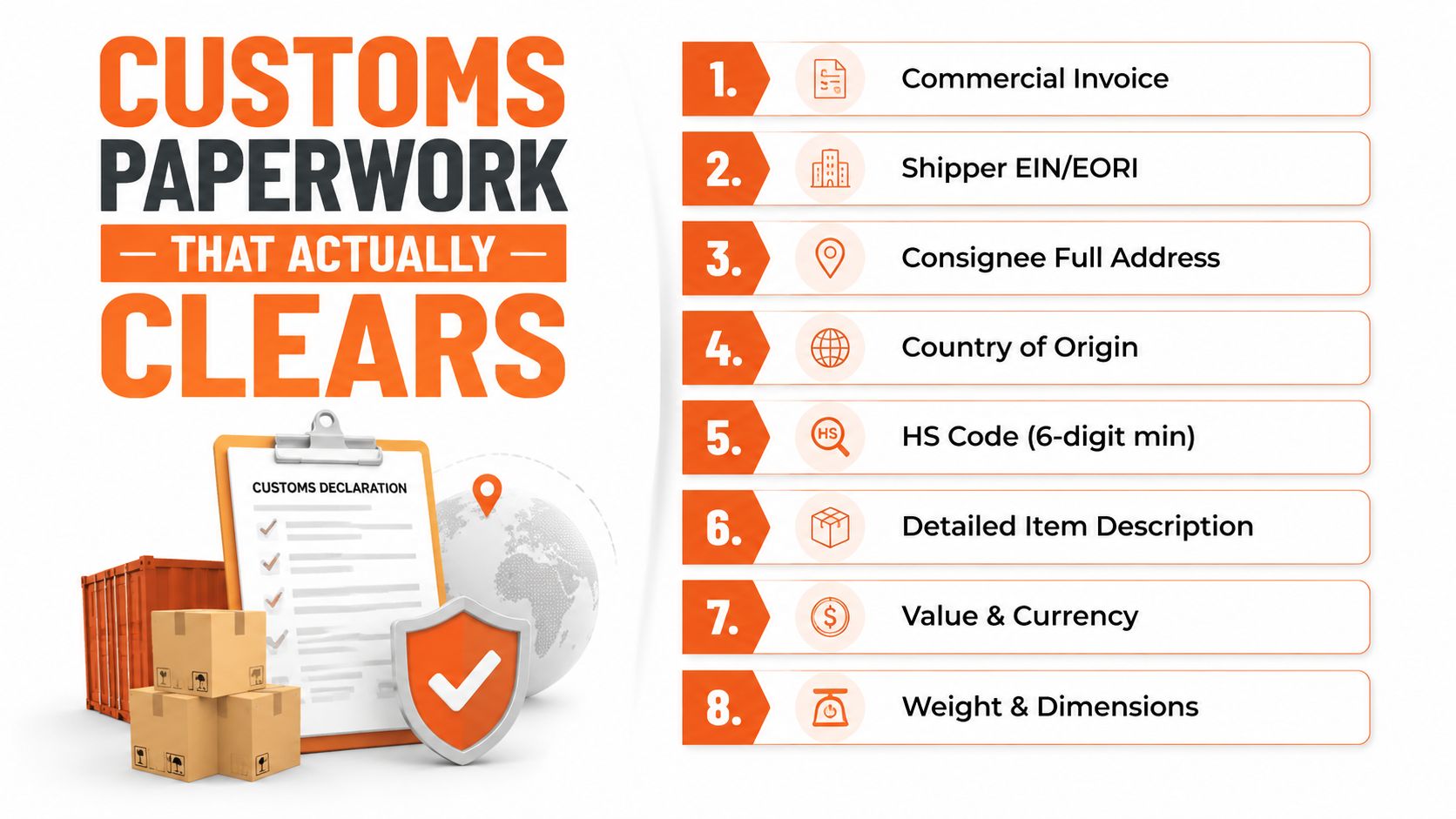
Customs paperwork should be built at SKU level, not improvised after production. Start with a commercial invoice that lets an officer understand what is moving, who owns it, and how the declared value was calculated.
Build the invoice line by line
Use a consistent record for every item:
- Shipper identity: Add the legal shipper name and the applicable EIN or EORI. Missing or mismatched identity data makes it harder to establish who is exporting.
- Consignee details: Include the recipient's full name, address, postal code, phone number, and email where required. An incomplete address can block delivery even when customs has released the parcel.
- Specific description: Write “organic cotton crew-neck T-shirt,” not “merchandise” or “samples.” Vague descriptions don't give customs enough information for valuation or classification.
- Country of origin: Record where the product was manufactured, not where the artwork was created or where the order was packed. Origin affects customs treatment.
- HS code: Include at least the global six-digit HS classification. The U.S. International Trade Administration commercial invoice guidance confirms that an invoice may include the HS code, while destination markets can require more detailed mapping.
- Value and currency: State unit value, total value, and currency. The line totals must reconcile with the invoice total.
- Incoterm and export reason: State who handles import costs and whether the shipment is a sale, gift, return, or other permitted purpose.
The Harmonized System code is the control point. Classify each SKU before shipment and place the code beside the product description. Apparel variations can matter, including fiber composition, construction, accessories, and decoration. A tee, hoodie, cap, tote, and notebook shouldn't share a generic code because they belong to one branded drop.
DHL's classification guidance treats the six-digit HS code as the worldwide minimum, but many destinations require eight- or ten-digit detail. Use the destination-country tariff schedule or a qualified customs broker when the product isn't obvious. Don't guess based on a supplier's old invoice.
Add the registrations and tax data
An EORI may be needed for customs activity involving the UK or EU. For eligible EU B2C parcels, IOSS can support VAT collection and customs handling for consignments under €150, but it doesn't remove the need for accurate declarations. The EU's low-value treatment also changed on 1 July 2026. Shipments with an intrinsic value of €150 or below no longer receive the customs-duty exemption and are subject to a fixed €3 customs duty per line item, while VAT and customs declarations still apply, as described by UPS's de minimis guidance.
Before release, run a human QA check. Compare the invoice with the packing list, SKU master, weights, quantities, unit values, origin, and destination. For a practical explanation of why incomplete documents create customs delays for personal effects, Dutiful's clearance guide is useful context. The three errors worth catching every time are a missing Incoterm, a vague product description, and a total that doesn't match its line items.
DDP vs DDU and the Landed Cost Decision
The cheapest freight quote often isn't the cheapest delivered order. Landed cost includes transport plus the import charges and operational fees that determine whether the recipient receives the parcel smoothly or gets asked to pay before release.
Under Delivered Duty Paid, the seller takes responsibility for import duties, taxes, and clearance costs. Under Delivered at Place, commonly described in shipping workflows as DAP or DDU, the recipient generally pays import charges on arrival. The DDP and DAP explanation from Trade Finance Global covers the contractual split, but the practical impact is what matters: the term changes the buyer journey.
| Factor | DDP | DDU |
|---|---|---|
| Import duties | Seller pays | Recipient pays |
| VAT or GST handling | Seller models and collects or absorbs it | Recipient is charged under destination rules |
| Clearance responsibility | Seller or appointed partner | Buyer, recipient, or their broker |
| Checkout experience | More predictable | Lower initial quote, less predictable final bill |
| Best fit | Consumer drops and time-sensitive gifting | B2B shipments and recipients with broker support |
| Main failure mode | Seller underprices the landed cost | Recipient refuses or delays delivery |
For consumer merch, DDP usually protects the launch better because the recipient sees a known cost and doesn't have to make a second payment decision at the door. DDU can work for a business recipient that has an established importer, broker, or finance process. It tends to work poorly when the parcel is a gift, an employee shipment, or a creator package sent to a home address.
Model duties, domestic VAT or GST, brokerage, fuel surcharges, remote-area fees, and currency conversion before quoting. The OECD notes that international parcels may face customs duties plus domestic VAT or GST depending on destination rules. The IPC shopper research referenced in the brief reports that clear delivery-charge information before purchase is essential for 61% of consumers, while surprise charges can lead to reconsidered purchases and refused deliveries.
Landed-cost test: If the recipient can't tell who pays import charges before the order ships, the shipment isn't ready.
For most consumer drops below the EU's €150 IOSS threshold, use DDP where the destination setup allows it and price the full path. Use DDU for B2B or higher-value shipments only when the recipient knowingly has the infrastructure to clear and pay. Keep the commercial decision visible in the invoice and recipient communication. Banger's import duties and customs fees FAQ is a useful reference when setting expectations.
Packaging, Labels, Insurance, and Tracking
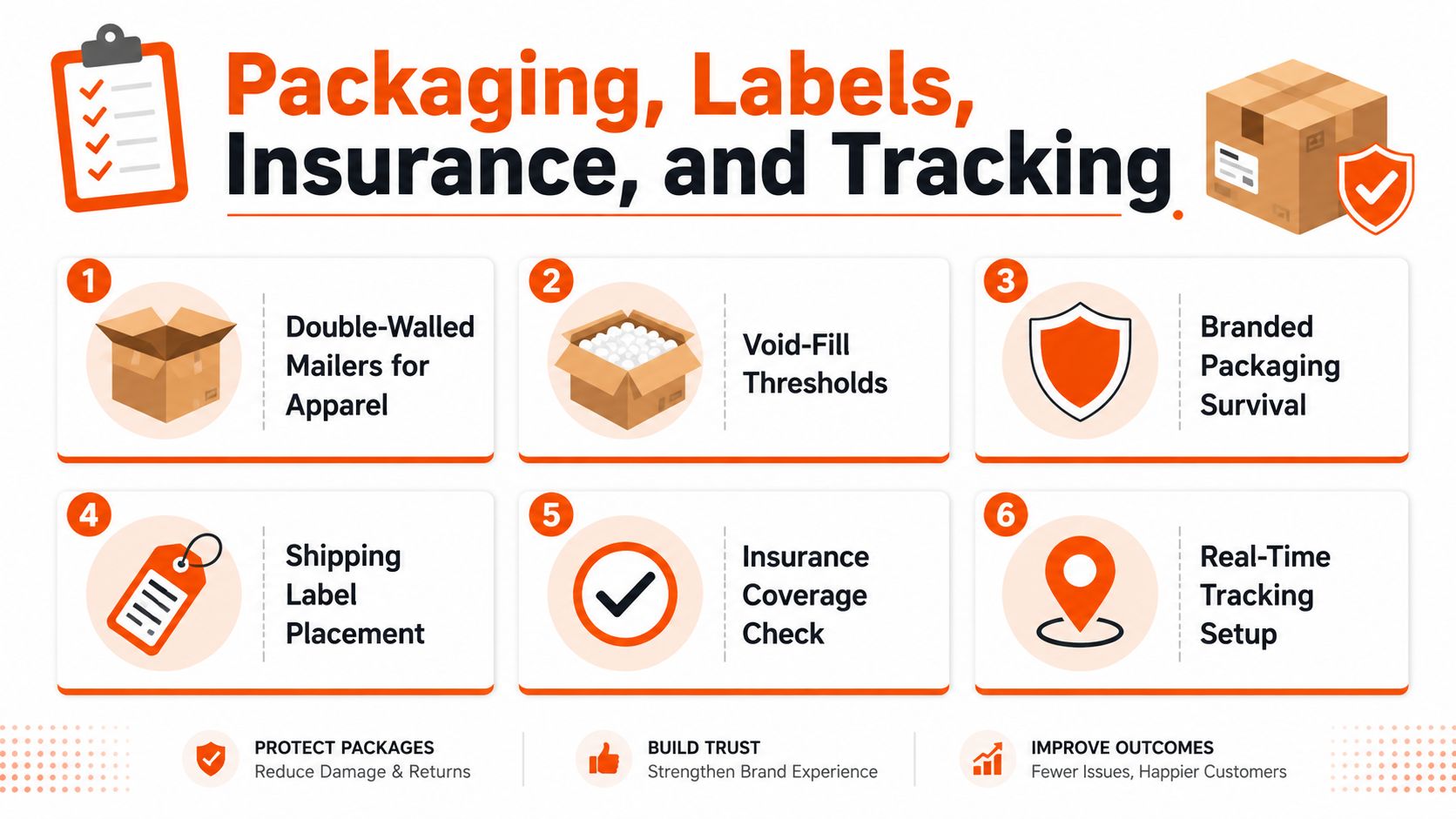
Paperwork can be perfect and the parcel can still arrive crushed, unscannable, or impossible to claim. Packaging and tracking are the physical controls that protect the work done by production, customs, and fulfillment.
Build for the route, not the photo
Apparel usually needs less internal protection than ceramics or drinkware, but premium packaging still has to survive sorting, compression, moisture, and repeated handling. Use a strong outer mailer or box, protect folded garments from abrasion and water, and leave enough structure that the branded package doesn't collapse under other freight.
Void fill should stop movement without turning the parcel into a bulky cube. For a high-touch drop, test the full packed unit, including tissue, inserts, stickers, and any rigid product. A beautiful unboxing that arrives wrinkled or torn is still a failed brand interaction. Banger's custom apparel packaging guide covers the design layer, but the test should happen with the actual carrier packaging and route.
Labels carry operational meaning
Place the shipping label on the flattest visible surface and keep barcodes away from seams, folds, tape, and glossy finishes. Include the commercial invoice in the carrier pouch when required. Postal workflows may also require CN22 or CN23 customs declarations, depending on the shipment and service.
Don't assume a branded label can replace a customs document. The product description, value, origin, weight, and HS data still need to be readable and consistent. Restricted-goods rules vary by carrier and destination. DHL's international prohibited-goods rules include live animals, cash, precious metals, complete weapons and firearm replicas, ammunition and explosives, human remains, illegal goods, counterfeit goods, loose precious or semi-precious stones, and cannabis and its derivatives. Check the actual carrier policy before adding batteries, liquids, food, or unusual accessories. Teams handling regulated battery labels can also review recycling shipping label help from Reworx Recycling.
Track the event, not just the number
Choose a service that provides origin acceptance, export processing, arrival, customs status, out-for-delivery movement, and proof of delivery. When the tracking feed only says “in transit,” the merch lead can't distinguish a missed scan from a customs hold.
Insurance deserves the same scrutiny. Confirm whether coverage follows declared value, whether packaging standards are conditions of the claim, and what evidence the courier needs. Keep product photos, packing records, the invoice, and delivery proof attached to the order. Before release, verify the address, label scan, invoice pouch, restricted-item status, package integrity, and tracking assignment.
What to Do When a Shipment Gets Stuck
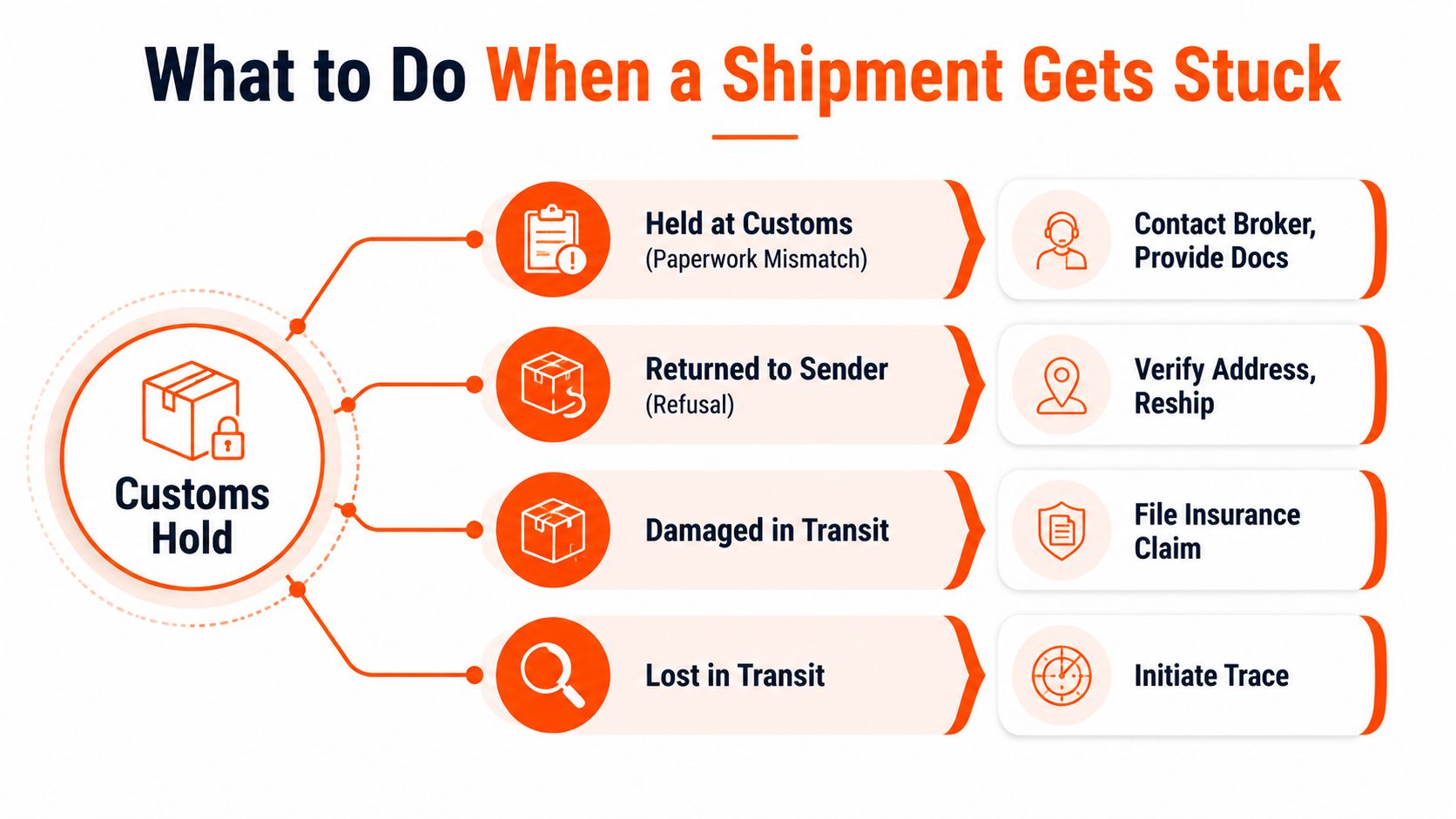
A customs hold isn't a black box. It's a diagnosis problem, and the tracking language usually points to the next owner.
Held at customs
A hold commonly means the carrier or broker needs clarification, a document, a payment, or an inspection. Start with the commercial invoice, then check the HS code, declared value, and product description. Contact the carrier's brokerage team or appointed broker and provide the corrected document through the channel they specify.
Customs-operation research cited by the World Bank baseline found a median clearance process of 10 days, with amended, inspected, or rejected declarations reaching 14 to 19 days. The FedEx explanation of shipments stuck in customs groups common causes into physical examination, duties and taxes, and documentation or clearance issues. Those causes need different responses, so don't send the same generic “please release” message to every case.
Returned to sender
A return usually points to refusal, an undeliverable address, unpaid import charges, or a carrier exception. Confirm the address and recipient contact details first. If the parcel was refused because of DDU charges, reshipping without changing the Incoterm will repeat the failure.
No scans or a loss event
If the parcel has stopped generating movement, ask the carrier to open a trace and provide the last physical scan. A missing scan isn't proof of loss, but it does identify when the investigation should move from customer support to the carrier. If the package is damaged, preserve the outer packaging and photographs before filing an insurance claim.
Use a fixed triage order
- Read the latest event: Identify whether the parcel is awaiting documents, payment, inspection, delivery, or return.
- Check the invoice: Compare consignee data, description, origin, quantity, currency, values, and Incoterm.
- Validate classification: Confirm the line-item HS code and destination-country granularity.
- Reconcile value: Make sure the declared value matches the invoice and packing list.
- Check restrictions: Review the destination and carrier rules for the actual product, materials, and decoration.
- Assign the owner: The carrier handles transport events, the broker handles clearance, and the customs authority controls examination or seizure.
Fixable errors include incomplete addresses, missing documents, and inconsistent values. Prohibited goods, deliberate under-declaration, or a shipment that can't legally enter the destination market may become a write-off. Keep an exception log by country and SKU so the next drop starts with known fixes, not a fresh fire drill. Teams managing storage and exception inventory can also reference Banger's merch fulfillment storage FAQ.
Returns, 2026 Rule Changes, and Shipping Smarter
Returns create a second customs event, so a good policy needs more than a domestic return address. Decide whether recipients return to the origin, a regional hub, or a local partner. Define who handles return duties, what paperwork identifies the parcel as a return, and whether an RMA prevents the brand from paying import costs twice.
For distributed team drops, consolidated returns to a hub are often easier to control than reverse logistics from every recipient. That approach reduces the number of separate customs conversations, but it requires clear deadlines, address instructions, and a process for inspecting returned garments. Don't promise a free return until the destination-country cost and documentation are modeled.
The 2026 de minimis changes make small parcels less frictionless. In the United States, a February 2026 executive action stated that duty-free de minimis no longer applies to covered shipments regardless of value, origin, transport mode, or entry method. It also stated that non-postal shipments are subject to applicable duties, taxes, fees, and charges, as detailed in the White House order on de minimis treatment. A separate transition applies to qualifying international postal shipments until a new postal entry process takes effect, with later guidance describing informal Entry Type 11 treatment and a $2,500 valuation ceiling, as summarized by Strix Smart's postal guidance.
For the EU, the €150 low-value duty exemption ended on 1 July 2026, and the fixed €3 per-line-item duty now applies under the stated rule. That shifts the economics toward accurate DDP pricing, tax readiness, and regional fulfillment rather than assuming every small package will clear cheaply.
2026 readiness checklist
- Recipient data: Validate every address, phone number, country, and importer requirement before production.
- SKU controls: Store HS code, origin, material composition, unit value, weight, and dimensions in one master record.
- Cost model: Quote freight, duties, VAT or GST, brokerage, surcharges, returns, and currency conversion.
- Routing: Use hubs or micro-warehousing near recipient clusters where repeated cross-border parcels create unnecessary exposure.
- SOPs: Keep one repeatable process for invoice QA, label scans, exception ownership, and recipient updates.
Banger can take on product, customization, branded packaging, multi-address shipping, and worldwide fulfillment for teams that don't want to operate this layer internally. Its fulfillment setup supports single or multiple destinations in one order, with DDP available to the US, UK, Canada, Australia, Switzerland, and Norway.
If your next team drop needs premium blanks, French atelier production, branded packaging, and multi-address worldwide fulfillment, Banger can handle the operational path from product preview through delivery. Request a quote, share your recipient map and launch date, and build merch people will keep wearing.