How to Design Custom Pet Merch That Actually Sells
You've got a pet product idea, a clean logo, and a mockup that looks great on screen. Then the sample arrives. The fabric feels flimsy, the print cracks after washing, the harness hardware looks generic, and the packaging says “warehouse filler” instead of “brand people want to keep.”
That gap is where most custom pet merch loses. Pet owners will buy something emotional once. They'll reorder products that are useful, durable, easy to wash, and good enough to leave visible in the home. Treat the line like a real apparel build, not a novelty upload, and the decisions around product, decoration, minimums, and fulfillment become much clearer.
Table of Contents
Why Most Custom Pet Merch Fails Before It Ships
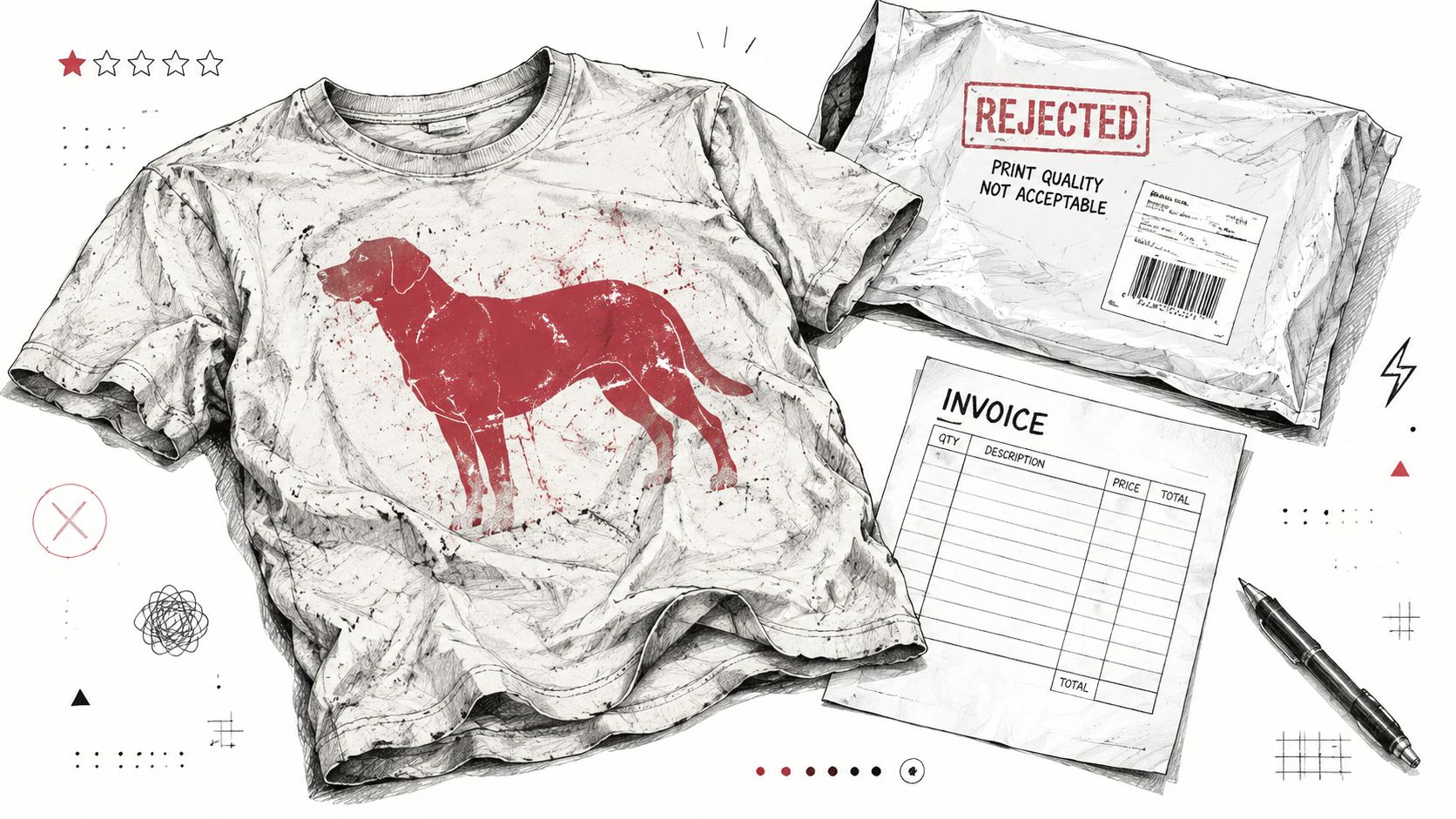
The common failure starts with a generic breed graphic on a thin tee. The design may be charming, but the product underneath it has no point of view. A stock silhouette on low-weight cotton, packed in a plain poly mailer and shipped by an anonymous third party, creates a product that feels disposable before the customer even touches it.
That's why premium pet merch is a production problem first. The blank has to tolerate claws, hair, friction, moisture, and repeated washing. The decoration has to stay legible after real use. The packaging has to preserve the product's perceived value instead of announcing that the brand optimized for the lowest possible unit cost.
The pet economy gives you room to build properly
This isn't a tiny novelty niche. U.S. consumers spent $158 billion on pets in 2024, including $34.4 billion on supplies, live animals, and over-the-counter medicine, and the U.S. industry is projected to reach $165 billion in 2026, according to the American Pet Products Association industry data. Globally, the broader pet products market was estimated at $156.98 billion in 2025 and is forecast to reach $266.73 billion by 2030, implying an 11.1% CAGR in the same source.
Custom products sit inside that larger spending pool. The opportunity isn't just to print a pet's face on a product. It's to create an object owners are happy to use every day, photograph, gift, and buy again.
Design for the wash cycle, not the mockup
Before approving artwork, establish a product standard:
- Blank quality: Choose fabric and construction that can handle pet contact and regular laundering.
- Decoration durability: Test the actual print, embroidery, patch, or label on the finished substrate.
- Finishing: Treat labels, inserts, and packaging as part of the product, not optional extras.
- Reorder logic: Build a recognizable product family so a successful first item can lead to adjacent purchases.
The market's personalization signal is strong. A trend analysis reports that the global custom pet products market was valued at $8.5 billion in 2025 and is forecast to reach $12.7 billion by 2030, while its survey found that over 80% of pet owners were more likely to buy customized products than standard ones, 80% would pay extra for personalized products, and 62% had already purchased at least one personalized pet product in the past year. Those figures come from Printify's custom pet merchandise market analysis.
Operator's rule: If the item only looks premium in a product preview, it isn't premium yet.
Picking the Right Pet Products and Premium Blanks
Start with the use case, then choose the object. A founder giveaway, a subscription-box item, and a boutique retail product shouldn't share the same blank just because the artwork is identical.
For human apparel, look for mid-weight ringspun cotton or a cotton and recycled-polyester blend with enough body to hold embroidery and screen printing cleanly. A practical apparel range is 180 to 220 GSM, especially for tees, sweatshirts, and matching owner-and-pet capsules. The fabric should resist sheering, keep its shape, and present a stable surface for decoration.
For products pets wear, construction matters more than the logo. Specify reinforced bar-tacks at stress points, adjustable webbing, and hardware suited to the animal's size. Lightweight YKK acetal buckles make sense for smaller dogs. Larger breeds need stronger D-rings and wider webbing. Ask the supplier how the hardware, stitching, and adjustment points behave under pulling, twisting, and repeated wet-dry cycles.
Build a product stack with a reason to exist
A strong line usually combines one hero wearable with a few practical or giftable extensions:
- Apparel: Mid-weight tees, hoodies, and sweatshirts for owners, with graphics that connect to the pet product without copying it.
- Walk gear: Bandanas, collars, harnesses, leashes, and treat bags where fit, hardware, and seam strength carry the experience.
- Home and gifting: Ceramic mugs with sublimation coating, stainless bowls with food-safe finishes, double-walled tumblers, and heavy canvas totes.
- Low-cost identity items: Stickers and decals that let customers participate without buying a full apparel piece. For a focused visual reference, browse these rescue dog vinyl decals from Custom Sticker Shop.
Don't choose products because they're easy to upload. Choose them because they extend the same brand idea across a routine. A walking product creates daily visibility. A bowl lives in the kitchen. A hoodie gives the owner a reason to wear the brand outside the home.
Sample the physical blank
Vendor photography hides weave weight, seam construction, and hardware quality. Request a swatch kit, then order a wear-test sample before you commit to a production run. For apparel, compare the collar, shoulder seam, hem, and print surface. For harnesses and collars, inspect bar-tacks, adjustment range, buckle alignment, and edge finishing.
Your product decisions should sit beside a blank-quality reference such as this guide to premium blank T-shirts, especially when an owner-facing tee is part of the collection.
Decoration Methods That Hold Up to Real Use
Decoration isn't an aesthetic preference. It's a trade-off between fabric, quantity, artwork, handling, and the abuse the product will take.
Screen printing remains the workhorse for cotton and cotton-blend tees, totes, and bandanas. Properly cured plastisol can handle repeated washing, and the method becomes economically attractive at larger runs. It's the right default for bold, limited-color artwork on stable fabric.
Embroidery gives pet merch an immediate premium signal and can last for the life of the garment. It works especially well on caps, heavy sweatshirts, patches, and structured accessories. Dense artwork needs a digitization review, and stitch counts above 7,000 should trigger a quote review because thread volume and production time rise quickly.
Match the method to the job
| Method | Best use | Main strength | Main limitation |
|---|---|---|---|
| Screen printing | Tees, totes, bandanas | Strong wash performance and efficient larger runs | Less suited to photographic detail |
| Embroidery | Caps, patches, heavy garments | Long wear life and tactile finish | Dense artwork needs careful digitization |
| DTG | Small runs and photographic art | Full-color detail without traditional screens | Needs pre-treated cotton and can wear faster than screen print |
| DTF | Flexible small-run graphics | Works across more garment surfaces | Finish and hand feel need physical approval |
| Sublimation | Polyester or polymer-coated items | Full-color integration into the substrate | Locked to compatible blanks |
| Heat transfer vinyl | Names and numbers | Good for simple personalization | Weak choice for primary brand decoration |
| Woven labels and rubberized patches | Secondary branding | Adds depth without covering the whole product | Requires thoughtful placement |
For low quantities, DTG and DTF are useful bridges. For high-contact items, don't approve a method from a digital mockup alone. Wash the sample, flex it, inspect the edges, and check whether the decoration still feels intentional.
Sublimation belongs on polyester or polymer-coated blanks such as mugs and tumblers. For a deeper look at where the process fits in apparel, use this guide to sublimation printing on apparel.
The right question isn't “Which technique looks coolest?” It's “Which technique still looks right after the customer uses the product?”
Branding Details and Unboxing That Justify the Price
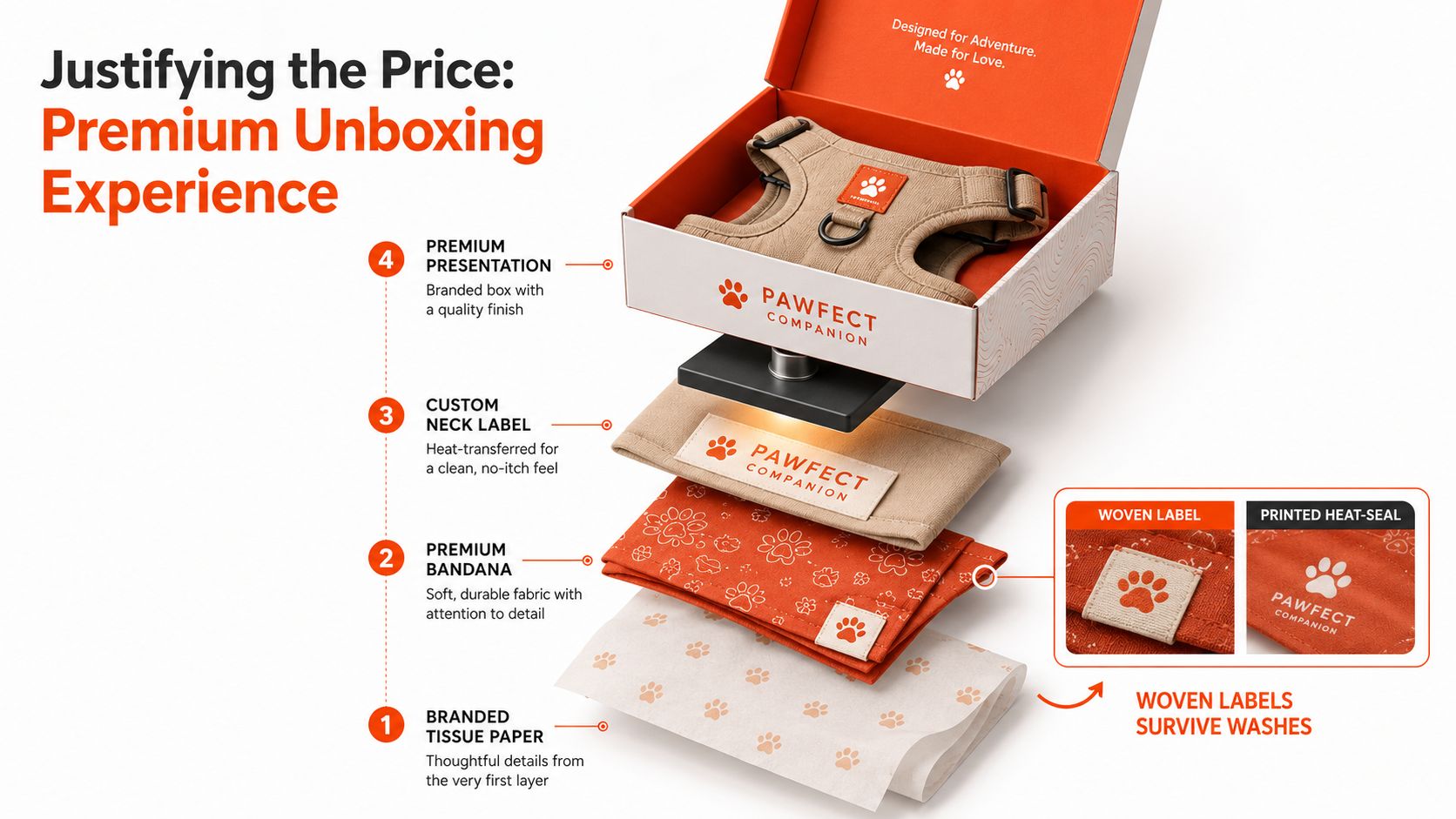
Finishing is the cheapest place to make a product feel considered. A custom label, clean care card, and decent wrap can change the customer's reading of the entire object before they inspect the decoration.
Use woven labels instead of printed heat-seal tags on bandanas, harnesses, and other products that see washing and friction. Add a heat-transfer neck label to owner apparel so the inside stays clean and comfortable. The goal is consistency. The customer should recognize the brand at the collar, on the exterior, and in the package.
Make every layer earn its place
A practical finishing system can include:
- Care card: Use cotton stock and include one useful product fact, such as the recommended wash approach.
- Hangtag: Make it retail-ready and let it function as a visible price chip.
- Tissue or belly band: Give giftable products a clean first reveal without burying them in excessive packaging.
- Insert: Show the dog or cat sketch used in the build, so the customer sees the creative connection.
- Drawstring pouch: Reserve cotton pouches for premium drops or accessories where the pouch has a second life.
Packaging should photograph well. Undyed kraft mailers, sticker seals, printed tissue, and a restrained insert create a visual system without turning the unboxing into theater. If gifting is part of the purchase, practical wrapping guidance such as these options to increase customer loyalty with wrapping can help you build a more deliberate presentation.
Margin move: A better finish can justify a higher perceived value without changing the core product silhouette.
The packaging system should also be operationally sane. Confirm the packed dimensions, whether the insert bends or creases, and how long the team needs to assemble each order. The best unboxing concept is useless if it creates fulfillment errors or turns a simple shipment into a manual project.
For broader packaging decisions, compare materials and assembly options in this guide to custom apparel packaging.
MOQs, Pricing, and Lead Times by Production Method
Production method changes the minimum order, the approval process, and the cash tied up in inventory. Don't ask for “the MOQ” as if every decoration route shares one number.
One supplier benchmark states that screen printing and embroidery require 100 pieces per style, while DTG and DTF can start at 12 pieces. Cut-and-sew begins at 300 to 500 pieces, depending on the garment. Those are method-specific mechanics from MFG Merch's production overview, not universal rules for every factory.
Three routes worth comparing
Cut-and-sew gives you the most control over silhouette, fabric, trims, and private-label details. It also asks for the strongest commitment. Use it when the product itself is the brand asset, not when you're still testing whether a graphic resonates.
Stock blanks with screen print or embroidery are usually the cleanest route for a first serious drop. You can move faster, control the decorated surface, and reserve custom development for the details customers notice.
DTG and DTF work as low-run bridges when you need photo-grade art or a small pilot. They're useful for testing a pet portrait concept, a community drop, or a limited creator collaboration without ordering a large quantity.
Price the landed unit, not the factory quote
Your real cost includes the blank, decoration, labels, packaging, inspection, freight, duties where applicable, storage, pick-and-pack, and customer shipping. A cheap factory price can become an expensive product after every handoff.
Lead time also needs a precise definition. In apparel logistics, it means the full span from receiving the order to shipping the goods to the customer. A World Bank apparel GVC analysis breaks the chain into multiple time blocks, including about 21 days, 20 days for garment production, and 25 days for shipping to the importer, illustrating how international orders accumulate delay across handoffs. See the World Bank apparel GVC analysis for the chain structure.
A second independent benchmark places standard bulk custom orders at 7 to 15 business days after artwork approval, while another supplier lists 8 to 15 business days on average plus shipping. Those ranges come from Australian Merch Co's quote guidance. Get the clock-start point in writing, and separate production time from freight time.
For very small launches, this overview of custom apparel with no minimum is useful context, but still request a physical sample before treating a low MOQ as a low-risk decision.
Sustainability, Fulfillment, and Use Case Selection
The right build depends on where the product will live. Retail customers, subscription members, event attendees, and internal teams don't assign value to the same material choices.
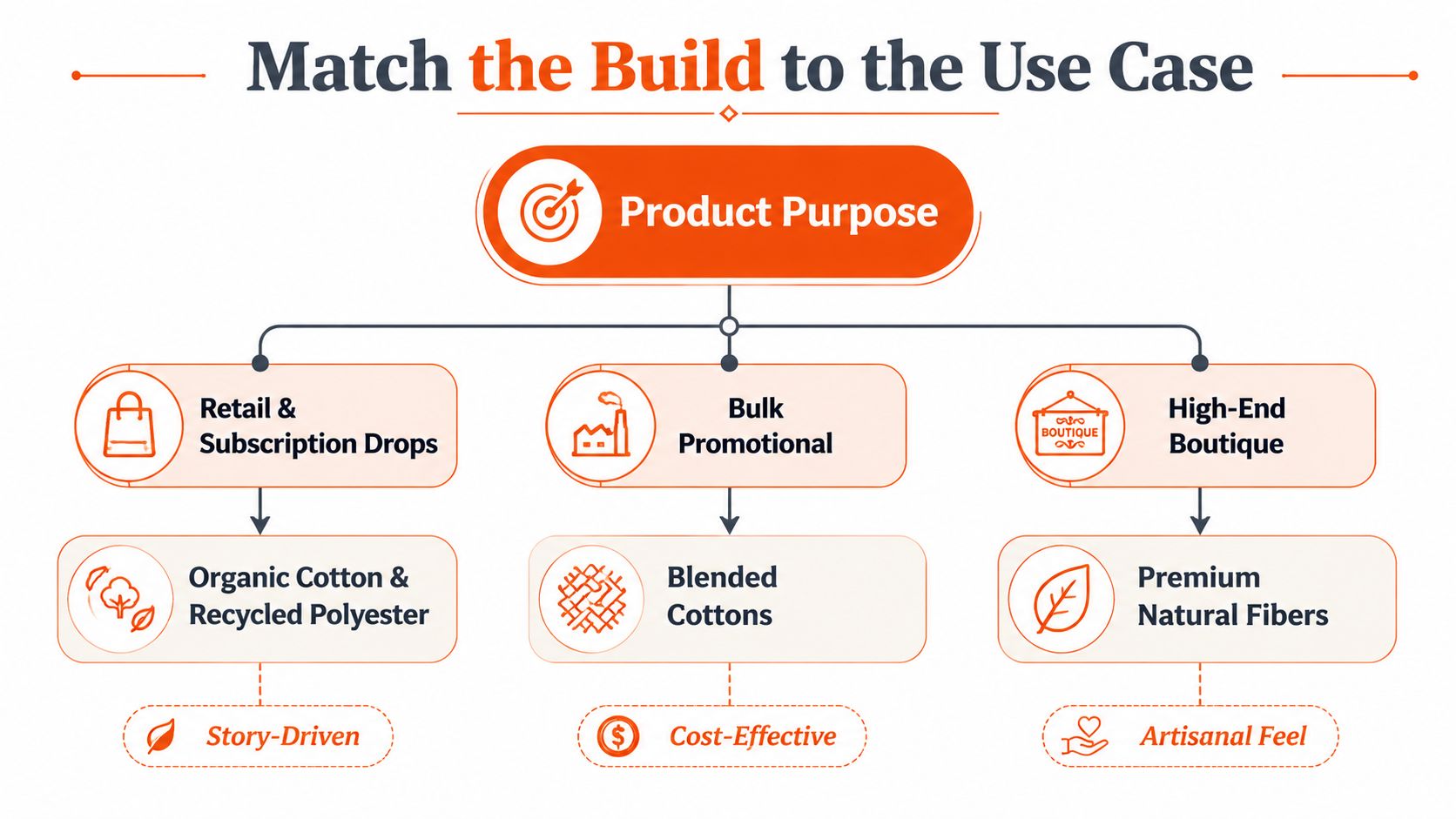
For retail and subscription drops, organic cotton tees and recycled-polyester harnesses give you a product story that can appear on the hangtag, product page, and insert. For founder merch and event giveaways, blended cottons and standard polyester webbing can be sensible when cost per impression matters more than fiber origin. Neither route is automatically correct. The mistake is making the claim before deciding who receives the item and how they'll use it.
Choose the channel before the specification
A simple decision tree helps:
- Retail or subscription: Prioritize tactile fabric, durable decoration, verified material claims, and packaging that supports gifting.
- Bulk promotion: Favor repeatable blanks, efficient decoration, compact packaging, and simple size or SKU architecture.
- High-end boutique: Push natural fibers, custom trims, refined labels, and a product silhouette that feels distinct without a loud logo.
Use recycled mailers, FSC tags, and soy inks as a baseline, then verify every claim with supplier documentation. Don't call a product recycled because the packaging is recycled. Keep the material story specific to the component it describes.
Fulfillment changes the product decision
A bulk B2B order can ship to one warehouse or one client address. A DTC line needs reliable picking, packing, personalization handling, returns processing, and inventory visibility. Fulfillment benchmarks report a typical brand SKU count of 25 to 300, average pick-and-pack cost of about $3.25 per order, and total fulfillment cost of roughly $8.50 to $16.00 per order including shipping, according to Hold.co's pet products industry benchmarks.
The same benchmark reports an industry-average return rate of 6.5%. It also identifies same-day to 48-hour order-to-ship performance as the operational target and says OTIF should exceed 95%. Those thresholds matter because pet apparel creates fit questions, while personalized products can be harder to resell after a return.
Pick the channel first, then reverse-engineer the blank, decoration, packaging, and unit cost. For Shopify brands, this guide to smart Shopify order fulfillment offers useful operational context. A focused review of merch fulfillment services can help you compare storage and distribution models before you lock the product architecture.
Your Pet Merch Build Checklist and Next Step
Treat the first order as a pilot. You're not trying to prove that every pet owner wants everything. You're trying to learn which product, finish, and use case earns a reorder.
Write the specification before requesting final pricing:
- Lock the blank type. Record fabric composition, construction, and GSM for apparel. For pet wearables, document webbing width, hardware, adjustment range, and stress-point reinforcement.
- Match decoration to the substrate. Note whether the artwork needs screen printing, embroidery, DTG, DTF, sublimation, or a patch. Include the Pantone reference for embroidery and confirm the approved thread colors.
- Approve the physical sample. Test fit, seams, hardware, print edges, embroidery density, and wash performance. For apparel, validate neck, chest, and back length against the size chart.
- Specify the finishing package. List woven labels, heat-transfer neck labels, care cards, hangtags, tissue, mailers, inserts, and any pouch. Don't leave packaging to the fulfillment team's default.
- Agree on the MOQ tier. Confirm whether the minimum applies per style, color, decoration method, or total order. Ask what changes if you move from stock blanks to cut-and-sew.
- Verify sustainability claims. Request documentation for recycled content, organic fibers, FSC paper, inks, and packaging. Put the verified claim on the product page, not a broader claim the supplier can't support.
- Select fulfillment before production. Decide whether inventory goes to a warehouse, a 3PL, a Shopify operation, or directly to multiple recipients. Model pick-and-pack, shipping, returns, and personalization handling.
- Run a controlled test. Request a tech pack sample, a 10-unit wear-test swatch, or freight quotes from one domestic and one overseas partner before approving the full run.
Your second order should depend on returns data, wash feedback, fit comments, and unboxing reactions. Gut feel belongs in the concept phase. Reorders should follow evidence.
The best custom pet merch feels less like branded novelty and more like a well-made part of someone's daily routine. Build the first drop with that standard, and you'll learn faster without teaching customers to expect disposable quality.
Banger helps internet-native teams build custom apparel, accessories, packaging, and limited collections with premium European blanks, French atelier production, low minimums, and worldwide fulfillment. Visit Banger to request a product preview and start a pet merch build that people will use, keep, and reorder.