Custom Embroidered Patches: The Definitive Guide for Teams
Another box of event merch shows up. The tee is thin, the print feels temporary, and the branded extra is usually a sticker, a cheap tote, or something headed straight for a drawer.
A good patch does the opposite. It gives a garment weight, texture, and a sense of belonging. When custom embroidered patches are designed well, they feel less like promo and more like a piece from a label that understands culture. That's why teams building real identity around a product, a community, or a launch keep coming back to patches.
Table of Contents
More Than Merch The Art of the Custom Patch
Most bad merch fails for the same reason. The brand gets applied to an object, but nobody asks whether the object deserves to exist in the first place.
Patches work when they feel intentional. They carry some of the language of uniforms, sports, workwear, and streetwear all at once. That mix matters. A patch can signal membership without looking like a corporate handout, which is exactly why founders, community teams, and creative leads keep reaching for them.
The shift isn't imaginary. The global embroidered badges and patches market was valued at USD 99.89 million in 2023 and is projected to grow at a CAGR of 10.48% through 2029, driven by demand from apparel, military, sports, and promotional product sectors, according to TechSci Research's embroidered badges and patches market report. That growth tracks with what's happening on the ground. Teams want branding that feels tactile, durable, and attached to something people will keep wearing.
Why patches feel more permanent
Print sits on top. A patch feels built in.
That's the difference between a throwaway conference extra and a garment detail someone notices. Even when the logo is simple, the raised texture, edge finish, and placement change the read. On a heavyweight hoodie, chore jacket, cap, or tote, the patch becomes part of the product design.
A patch can carry the same logo as a screen print and still feel like a different brand decision entirely.
That's also why patch style matters so much. If you choose the wrong construction, the result can look generic fast. If you choose the right one, even a minimal mark gains presence.
The best patches behave like product design
Fashion-grade patches don't start with “How do we fit the logo?” They start with “What should this piece feel like?”
For a startup offsite, that might mean a clean embroidered chest patch on a structured overshirt. For a community drop, it could mean a larger back application with a bolder silhouette. For a more nostalgic look, chenille embroidery patches can pull a garment closer to varsity and vintage references.
A strong patch does three things well:
- Creates texture: It gives flat branding a physical point of view.
- Signals intent: It looks designed, not merely added.
- Ages better: It usually keeps its relevance longer than trend-chasing promo items.
That's the line between merch and wardrobe. Good custom embroidered patches sit on the wardrobe side.
Choosing Your Patch Style Embroidered Woven and More
The first mistake teams make is treating “patch” as one category. It isn't. Different patch types solve different design problems, and the wrong choice can wreck a good logo.
What embroidered patches do best
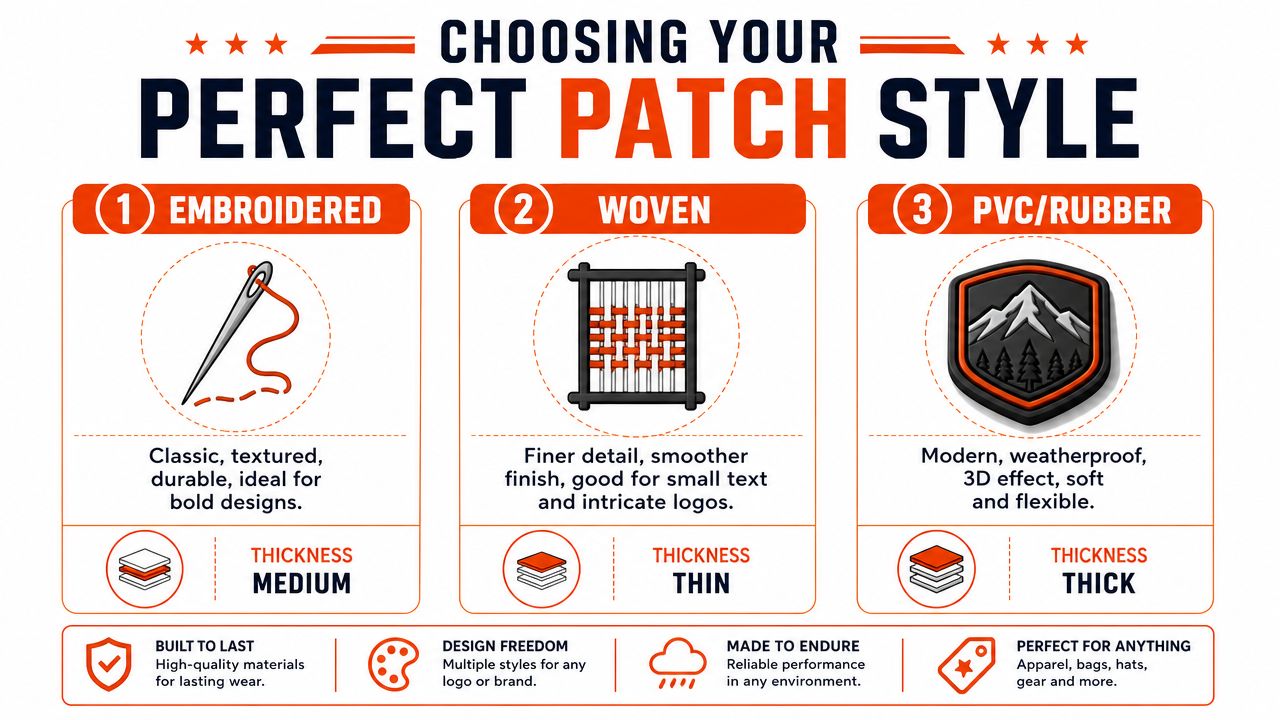
Embroidered is the classic. It's textured, dimensional, and familiar in the best way. If your logo is bold, your typography is simple, and your shape is clean, embroidered patches usually give the strongest physical presence.
They're especially good for:
- Bold icons: Symbols, mascots, monograms, and shield shapes
- Streetwear-style branding: Designs that benefit from visible thread and raised texture
- Uniform references: Team jackets, caps, work shirts, and utility pieces
If you want that traditional stitched look, this is the lane. It's also the patch style commonly envisioned when considering custom embroidered patches or broader custom embroidery services.
When woven beats embroidered
This is the trade-off people gloss over, and it's the one that matters most in production.
Embroidered patches can't reproduce text smaller than about 4mm or lines thinner than 1mm without getting blurry. Woven patches can achieve legible text down to about 2mm, which makes woven the better option for detailed logos and small typography, as explained in New York Custom Labels' custom patches design guide.
That means if your mark includes tiny type, intricate linework, or dense geometry, embroidered can actively make it worse.
Practical rule: If the identity depends on fine detail, don't force it into embroidery just because embroidery sounds more premium.
Woven patches look flatter and smoother than embroidered ones. They don't have the same chunky thread texture, but that's exactly why they hold detail better. For some brands, especially software, fintech, and internet-native teams using sharp type systems, woven often produces the cleaner result.
Other patch styles worth knowing
Chenille works when you want softness, volume, and a vintage sports read. It's less about precision and more about attitude. Great for statement letters and larger graphic shapes.
PVC or rubber patches push in a different direction. They feel more technical, more weather-ready, and a little more hardware-like. On bags, outerwear, and utility gear, that can make sense.
Here's the quick comparison:
| Patch Type | Best For | Aesthetic | Min. Text/Detail |
|---|---|---|---|
| Embroidered | Bold logos, classic team insignia, textured branding | Raised, traditional, tactile | Best with larger text and simpler detail |
| Woven | Intricate logos, fine typography, dense artwork | Smooth, precise, flatter | About 2mm text for fine detail |
| Chenille | Varsity letters, nostalgic graphics, statement patches | Fuzzy, soft, vintage | Better for large simple forms |
| PVC/Rubber | Outdoor gear, bags, technical branding | Modern, flexible, dimensional | Better for clean graphic shapes |
The key decision isn't “Which patch is coolest?” It's “Which patch lets this artwork survive contact with reality?”
Designing for Production The Technical Specs
A patch design can look perfect on a screen and still fail in production. Thread has limits. Edge finishing changes proportions. Tiny decisions become visible fast.
The non-negotiables
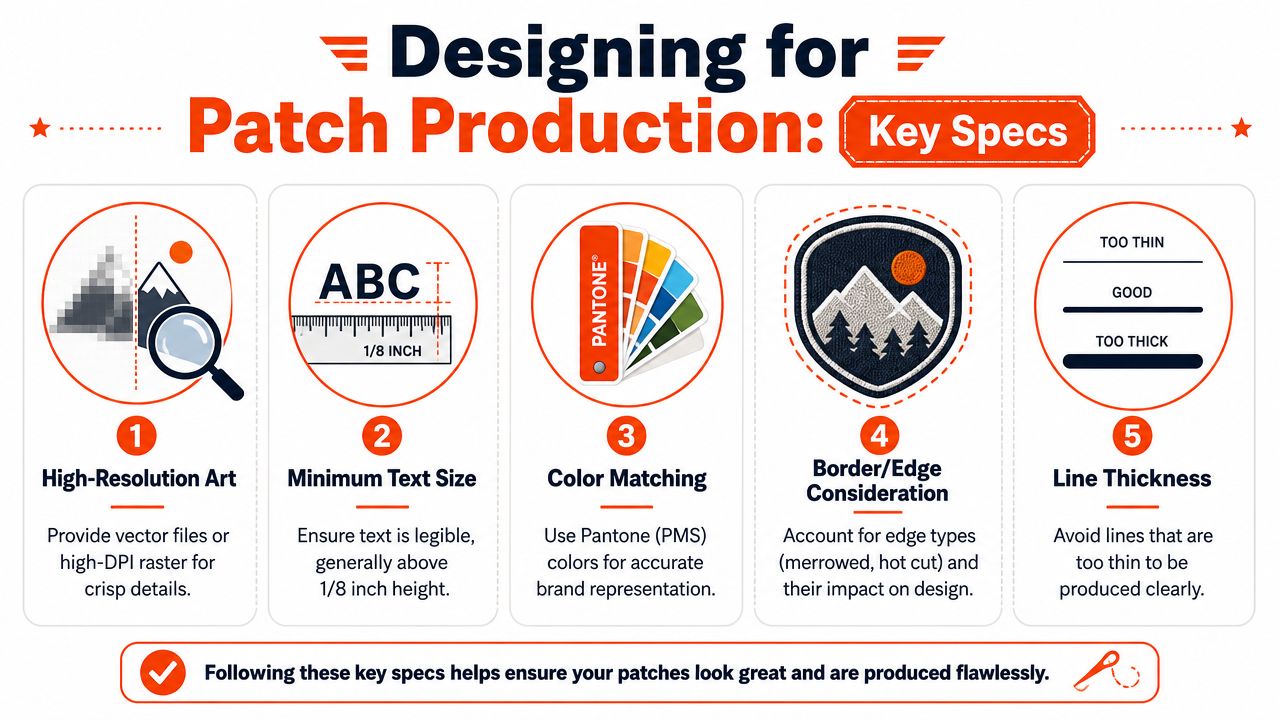
For embroidered patches, minimum text height should be 0.25 inches (6mm) if you want legibility, and artwork should be at least 300 dpi, because lower-resolution files degrade stitch clarity and color definition, as noted in Apliiq's artwork guide for custom embroidered patches.
That one line explains a lot of bad patch outcomes. The logo wasn't “slightly off.” The file or scale was wrong from the start.
Use this as a pre-production filter:
- Text size: Anything below 6mm is risky for embroidery readability.
- Artwork resolution: Send vector files when possible, or high-resolution raster art at 300 dpi minimum.
- Line discipline: Thin details that look elegant on a Figma board can collapse into thread noise on fabric.
If a design depends on tiny legal copy, dense subtext, or hairline separators, simplify it or move to woven.
Coverage edge finish and artwork discipline
Coverage changes the whole feel. A partially embroidered patch lets the twill backing show through, which creates contrast and usually keeps the piece lighter visually. A fully covered patch gives you a denser, more premium surface.
There's a trade-off, though. More stitch coverage usually means more machine time, more thread, and more cost. That's why teams should choose full coverage because it serves the look, not because it sounds expensive.
Clean patch design usually means removing detail, not adding it.
Edge finish matters too. A merrowed border feels classic and slightly thicker. A hot-cut edge looks sharper and more modern, especially for irregular silhouettes. If the patch shape is part of the brand language, the border decision isn't secondary.
A useful production checklist looks like this:
- Start with the silhouette: Circle, shield, rectangle, custom contour. This affects how the patch reads from a distance.
- Edit the logo for thread: Remove micro-details that won't survive stitching.
- Decide on coverage intentionally: Leave backing visible for contrast, or go full embroidery for density.
- Match the edge to the brand: Merrowed for heritage, hot cut for cleaner geometry.
- Review on the garment, not in isolation: A patch that looks right alone can still feel undersized or misplaced on the actual piece.
Teams that need help translating a logo into something stitchable usually benefit from actual custom design services, not just a quote form and a hope-for-the-best workflow.
Attachment Methods and Garment Care
A strong patch can still be ruined by a weak application. Attachment method decides whether the piece feels temporary, modular, or built to last.
How to attach a patch
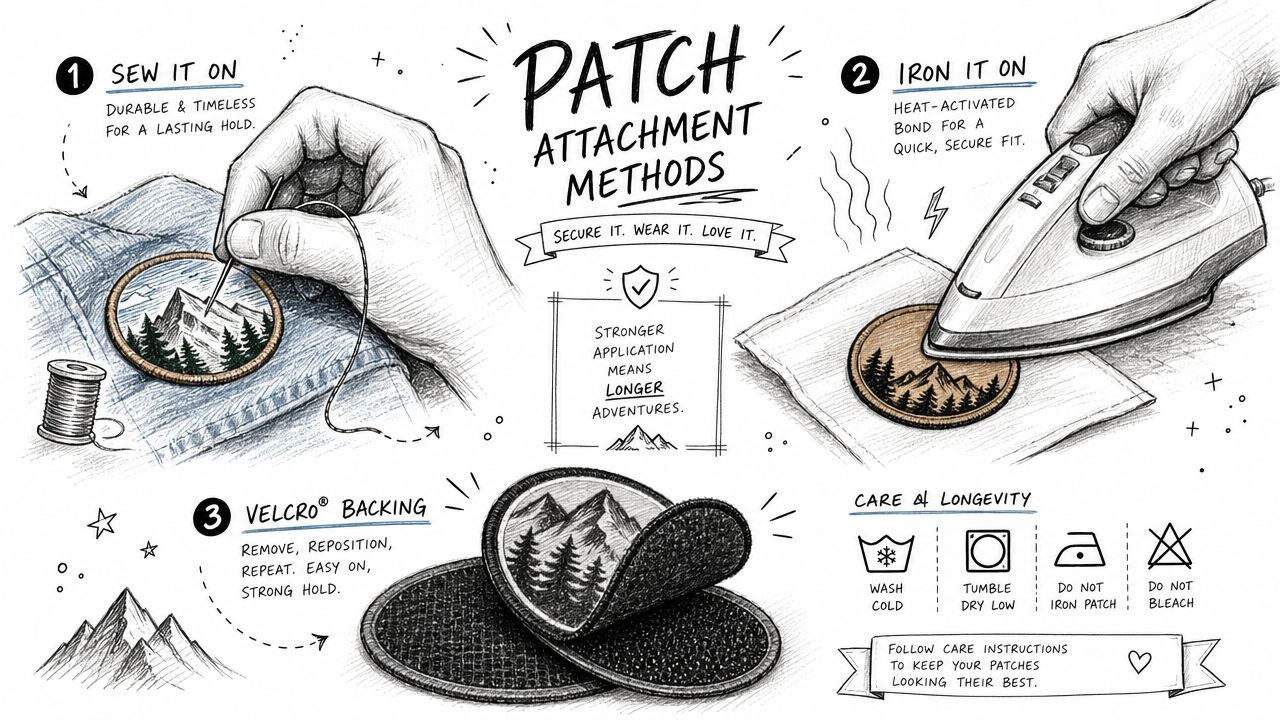
Sew-on is the cleanest long-term answer for most apparel. It's the most secure, it wears naturally with the garment, and it usually looks the most intentional on jackets, overshirts, hoodies, and caps.
Iron-on is easier, especially for event kits or quicker fulfillment setups. But it reads more temporary, and the result depends heavily on fabric choice, pressure, and application consistency. It's fine for the right use case. It's not my first choice for premium pieces.
Velcro has a real place too. On bags, tactical-inspired outerwear, and modular gear, it gives flexibility and lets people swap identities or campaign-specific patches without committing permanently.
A simple decision framework:
- Choose sew-on for fashion-grade apparel and long-term wear
- Choose iron-on for convenience-first distribution and lighter commitment
- Choose Velcro when interchangeability is part of the product idea
For actual garment placement, proportions matter as much as backing. Chest, sleeve, cap front, side panel, and bag placements all read differently, and a patch that feels balanced on a tote can look awkward on a hoodie. A practical embroidery placement guide helps avoid that mismatch.
How to wash it without ruining it
Durability is one of the reasons patches keep outperforming cheaper add-ons. Properly made embroidered patches can withstand 30–70 wash cycles at 40–45°C (104–113°F), according to NW Custom Apparel's embroidered patch durability reference.
That doesn't mean you should abuse them. Good care still matters.
Wash the garment like it deserves to stay in rotation, not like a gym rag.
A few habits help:
- Use moderate wash settings: Stay within the temperature range the patch is built to handle.
- Avoid harsh treatment: Aggressive detergents and rough drying can shorten the life of both the garment and the patch.
- Turn garments inside out when possible: It reduces abrasion on the patch face.
- Air dry when you can: Less heat usually means less stress on the application.
Premium merch only feels premium if it survives real life. Attachment and care are part of the design, not afterthoughts.
Understanding Patch Pricing and Production Timelines
Patch pricing looks random until you know what's driving it. Then it gets pretty rational, fast.
What actually changes the price
The main variables are size, stitch coverage, design complexity, and quantity. Bigger patches use more material and thread. Denser embroidery takes longer to run. Specialty constructions add complexity.
The cost range for custom embroidered patches typically runs from $0.30 to $5.00 per unit, with examples like a 2-inch patch around $1.39 and a 6.5-inch patch at $5.00 each, based on Maggie Frame Store's breakdown of custom patch pricing.
That range is wide for a reason. A simple small patch and a large fully stitched piece are basically different products.
A few things that usually push pricing upward:
- Larger physical size
- Higher stitch density or full coverage
- Complex artwork
- Specialty styles like 3D puff, chenille, or bullion
- Low order volumes
Why quantity changes everything
Patches benefit from setup costs being spread across the run. That's why volume has such a dramatic effect on unit economics.
The same pricing reference notes that 1,000-unit orders can drop as low as $0.33 per patch. That doesn't mean everyone should order 1,000. It means teams should decide whether they're optimizing for flexibility or unit cost.
If you're ordering for a single event, a product launch, or a small team drop, lower volumes can be the right call even if unit pricing is worse. If you're building an evergreen uniform program or repeat onboarding kit, larger runs usually make more sense.
Here's the useful budgeting mindset:
| Cost Driver | What It Does | Budget Effect |
|---|---|---|
| Patch size | Increases thread and material use | Larger patches usually cost more |
| Stitch coverage | Extends runtime and density | Full coverage tends to raise cost |
| Design complexity | Adds production difficulty | Intricate builds price higher |
| Order quantity | Spreads setup across units | Larger runs reduce per-unit cost |
Production timing matters just as much as sticker price. Fast-moving teams don't want a vendor who disappears into a black box after quoting. If you're comparing suppliers, look for clear proofing, realistic approvals, and a turnaround that can support launch calendars. For teams on a deadline, custom merch quote timing is often the first signal of whether the rest of the production process will be organized.
How to Order Custom Patches with Banger
The ordering experience matters more than many organizations expect. A patch project usually breaks when there's too much back-and-forth, no visual proofing, or minimums that don't align with a smaller launch.
A cleaner process for modern teams
The useful version is simple. Pick the garment or accessory, upload the artwork, define quantities, and get a preview before anything goes into production.
That workflow is a much better fit for startup teams, creator drops, and distributed communities than the old model of “submit a form, wait, and maybe get a vague answer.” It also matters when you're pairing patches with premium blanks, heavier outerwear, caps, bags, or broader branded apparel systems rather than buying standalone promo items.
Banger is built around that kind of speed and clarity. The process is straightforward: choose products, upload your logo, and get a free quote with a product preview in 24 hours. After approval, production and worldwide delivery run in 10 to 15 business days end to end, with low minimums that fit smaller apparel runs and team drops. The setup also includes direct factory pricing, French atelier production, and fulfillment that works for global teams.
Why low minimums matter more than people admit
A lot of teams don't need a huge run. They need a sharp first batch, fast.
That's especially true for internal launches, community rewards, recruiting kits, founder gifts, conference capsules, and test drops. The market is moving in that direction too. Some suppliers now offer micro-orders, and the pricing shows how steep small runs can be at first. A 5-piece order might start around $23.55 per unit, while a 10-piece order can drop to around $13.07 per unit, a 45% reduction with just 5 more units, according to Panda Patches' no-minimum custom patch pricing page.
That gap is exactly why transparent quoting matters. Teams need to know whether they're paying for true flexibility, or just getting trapped in unclear pricing tiers.
A strong ordering flow should give you:
- A fast visual preview: So you can judge scale, placement, and patch type before production
- Real minimums that fit modern teams: Especially if you're testing demand or ordering for a smaller group
- Product guidance, not just order taking: The embroidered vs. woven call still matters here
- Global fulfillment options: Important if your team lives in multiple cities and time zones
Later in the process, seeing the product in motion helps. This gives a better sense of how the merch workflow comes together.
If you want fashion-grade patches on garments people will keep wearing, the bar is simple. Good materials, correct patch construction, clear proofing, realistic minimums, and a production partner that understands both apparel and internet culture. That combination is still rarer than it should be.
If you're building a team drop, onboarding kit, event giveaway, or community merch line, Banger makes it easier to get there without settling for generic promo gear. You can request a quote, get product previews within 24h, and build merch your team wants to wear.