What Is DTF Printing: Pros, Cons, & Comparison
You're probably here because you need merch soon, someone asked whether the job should be screen print, DTG, or DTF, and the answers you found all sound like printer manuals written by people who've never cared how a hoodie looks on a body.
That's the core problem. Most guides explain the machinery. They don't explain taste. They don't explain why one print ends up feeling like a brand piece and another feels like conference leftovers.
If you've been asking what is DTF printing, the short answer is simple: it's a method where a design is printed onto a special film, coated with adhesive powder, cured with heat, then pressed onto a garment. Done well, it gives you sharp detail, strong color, and flexibility across different fabrics. Done badly, it looks cheap fast.
Table of Contents
- It starts on film, not fabric
- The adhesive stage is where a lot can go wrong
- Pressing is the finish, not the shortcut
- Print Method Comparison DTF vs DTG vs Screen Printing
- How to read the table like a buyer, not a printer
- Good DTF looks intentional
- Durability depends on the garment, not just the transfer
- Care instructions that actually help
- Is DTF printing good for premium merch
- Does DTF feel plastic
- Is DTF better than DTG
- Can DTF be used for sportswear
- Is DTF good for small runs
Your Merch Deserves Better Than a Guess
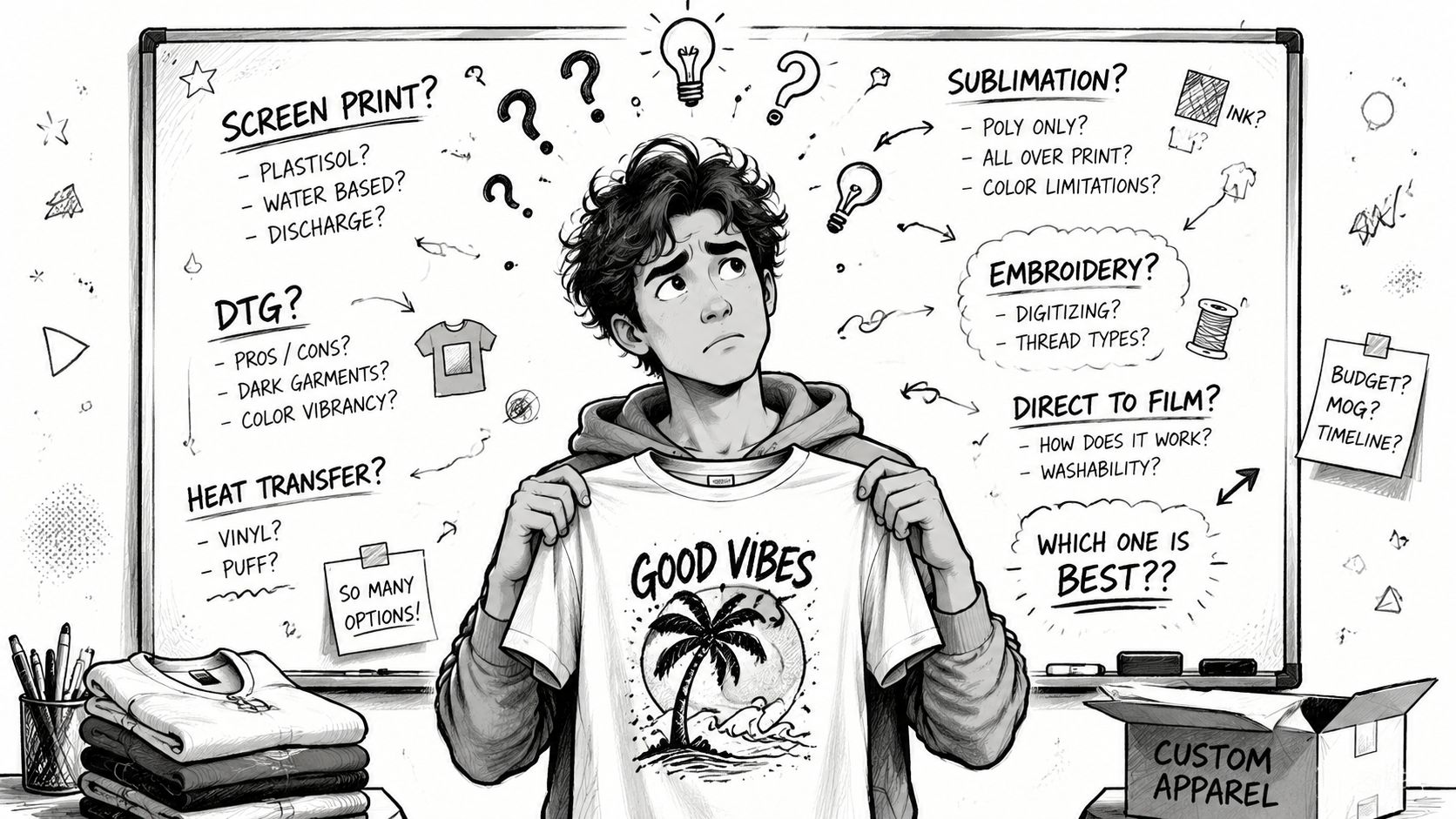
Most merch decisions get made backwards. The team picks a blank, uploads a logo, then treats the print method like a minor production detail. It isn't. The print method is often the difference between something people wear on repeat and something that never leaves the tote bag.
That matters more now because DTF isn't some fringe technique anymore. The Direct-to-Film printing market was estimated at $2.72 billion in 2024 and is projected to grow to $3.92 billion by 2030, with 70% of printing shops now offering DTF as a default service, according to DTF printing industry statistics. In other words, it has moved from niche to standard.
Why the print method changes the whole piece
A clean graphic can still die in production. Colors can sit too heavily. Edges can feel stiff. A black hoodie can make weak printing look even worse.
DTF printing gives brands a modern option because it handles detailed artwork well and works across a broad mix of garments. That's useful when a drop includes heavyweight cotton tees, poly blends, nylon pieces, or darker bases that would expose every flaw.
Practical rule: Don't ask which method is newest. Ask which method gives your artwork the right hand feel, finish, and longevity on the specific garment you chose.
The fear nobody says out loud
The usual question is technical. The real question is aesthetic. Will this look cheap?
That's why understanding the production method matters before you approve anything. If you're still at the stage of choosing the right garments and decoration plan, this guide on how to create merchandise is a useful place to tighten the brief before production starts.
The DTF Printing Process Step by Step
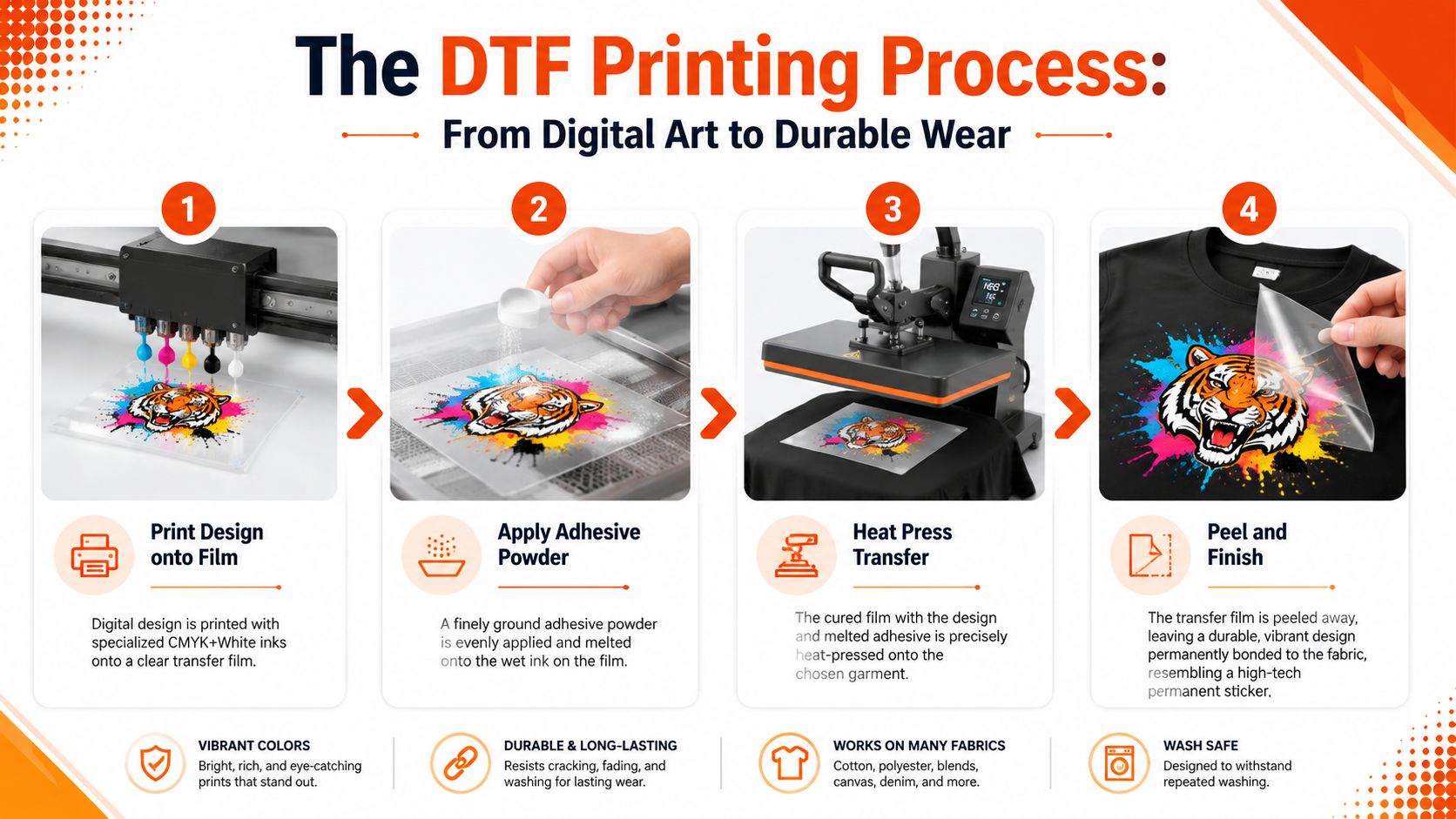
DTF is easiest to understand if you think of it as a high-detail fabric transfer system. The artwork isn't printed directly onto the shirt first. It's built on film, prepared with adhesive, then bonded to the garment under heat and pressure.
It starts on film, not fabric
The design is printed onto specialized PET film using CMYK + white pigment-based inks. The color layers go down first, then the white layer is printed last so it acts as an opaque backing. That white backing is what helps bright artwork stay visible on dark garments, as explained in this overview of how DTF printer specifications work.
This is also why DTF can carry complicated artwork better than many people expect. Small details, layered colors, and bold contrast don't get lost as easily.
For a quick visual walkthrough, this demo helps:
The adhesive stage is where a lot can go wrong
While the ink is still wet, TPU hot-melt adhesive powder is applied across the printed area. Then the excess is removed. If that powder is uneven, clumped, or poorly melted later, the final print won't feel refined.
The transfer is then cured with heat so the adhesive fuses correctly. This stage matters more than beginner guides admit. DTF isn't magic. It's a precise workflow, and the finish quality depends on how carefully each step is handled.
A solid mental model is this:
- Print the artwork onto PET film with color and white ink layers.
- Add adhesive powder while the ink is still tacky.
- Cure the transfer so the adhesive activates properly.
- Heat press the design onto the garment.
- Peel the film and finish the piece.
Pressing is the finish, not the shortcut
Once cured, the transfer is pressed onto the garment. That final press turns the prepared transfer into the finished print. Good operators dial this in for fabric type, artwork density, and desired finish rather than treating every hoodie and tee the same way.
If you want a broader breakdown of where DTF sits alongside other decoration methods, this guide to merch printing techniques is worth keeping open while you spec a project.
DTF works best when you treat it like a production craft, not a file upload service.
DTF vs DTG vs Screen Printing
No print method wins every job. The right choice depends on garment, artwork, quantity, and the level of finish you want.
Print Method Comparison DTF vs DTG vs Screen Printing
| Criteria | DTF (Direct-to-Film) | DTG (Direct-to-Garment) | Screen Printing |
|---|---|---|---|
| Fabric compatibility | Strong across cotton, polyester blends, nylon, and other mixed materials | Best on cotton-rich garments | Strong, but depends on garment and ink setup |
| Hand feel | Soft enough when done well, but still a transfer with some surface presence | Usually softer on cotton because ink sits more naturally in the fabric | Varies by ink deposit and design size |
| Color vibrancy and detail | Excellent for detailed multi-color graphics, especially on dark garments | Very good detail, especially on cotton | Excellent for bold graphics, less flexible for highly complex small runs |
| Durability | Strong when produced well and matched to the right garment | Good on suitable garments and proper care | Strong, especially for simple graphic work |
| Ideal order size | Small to medium runs, mixed garment programs, complex art | Small runs on cotton-rich blanks | Larger runs, especially simple designs |
| Best use case | Detailed logos, multi-color artwork, varied fabrics | Soft prints on premium cotton tees | High-volume event tees and classic spot-color graphics |
| Main drawback | Finish can feel cheap if materials and pressing are poor | Less versatile across fabric types | Less flexible for frequent artwork changes and smaller mixed orders |
How to read the table like a buyer, not a printer
DTF wins when the brief is messy in a good way. A founder wants black hoodies, off-white tees, maybe a nylon layer, and the graphic has gradients or fine detail. That's where DTF feels modern and useful.
DTG usually makes the strongest case when the garment is cotton-rich and you want the print to feel as integrated into the fabric as possible. For minimal graphics on premium tees, that softer finish can matter.
Screen printing still owns a very specific lane. If you're producing a large run of straightforward artwork, especially simple spot-color designs, it's often the cleanest economic choice. It also has a visual language of its own that a lot of brands still want.
For a more general buying lens on apparel decoration, this breakdown of custom shirt printing helps clarify where each method fits.
Choose DTF when flexibility matters. Choose DTG when softness on cotton matters most. Choose screen printing when volume and graphic simplicity define the job.
When to Choose DTF Printing for Your Merch
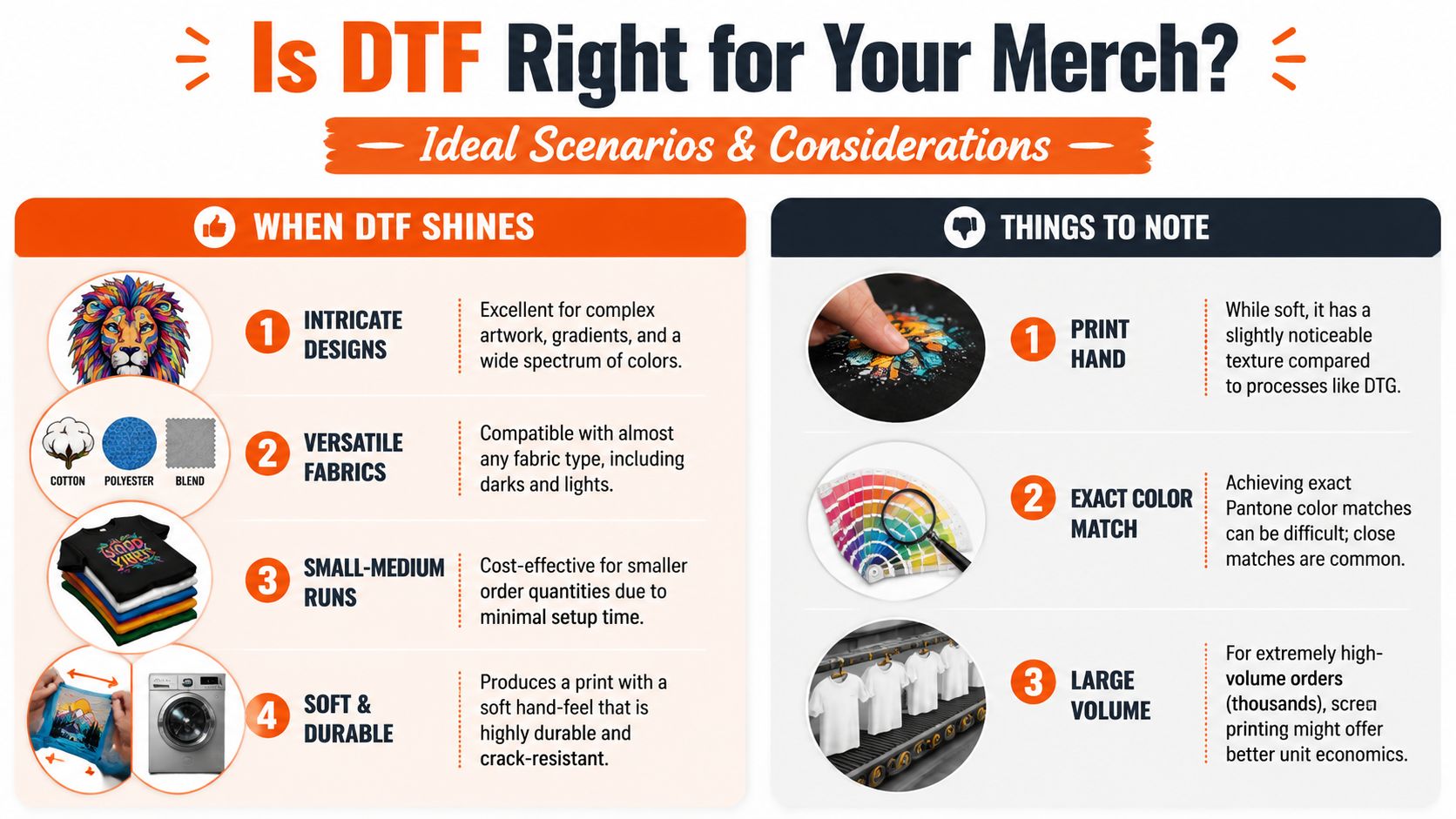
DTF is at its best when the artwork is detailed, the garment mix isn't simple, and you care about getting strong color on darker pieces without building a bulky print.
Where DTF looks especially strong
One reason brands keep choosing it is versatility. A history of the technique from DecoNetwork's DTF overview notes that DTF works effectively across cotton, polyester blends, nylon, and silk, while DTG is primarily limited to cotton-rich garments. That range matters if your merch line isn't just basic tees.
DTF is a strong fit when you need:
- Complex artwork: Multi-color graphics, detailed logos, gradients, and small visual elements hold up well.
- Dark garments: The white backing helps artwork stay punchy on black, navy, forest, and other deeper tones.
- Mixed fabrics: Tees, hoodies, overshirts, and synthetic pieces can live in the same program without forcing one compromise method.
- Smaller drops: If you're not ordering a huge single-design run, DTF gives more freedom.
If you're evaluating fulfillment models alongside print methods, this page on PuppetVendors print on demand is useful for understanding how different production setups affect flexibility and turnaround.
Where another method may be smarter
DTF isn't the answer every time.
If the job is a massive quantity of simple one-color event tees, screen printing often makes more sense. If the brief is a premium cotton tee with a subtle graphic where softness matters above everything else, DTG can be the cleaner pick.
There's also a taste issue. Some designs shouldn't be transferred at all. If the artwork calls for all-over coverage or a polyester-first application style, it's worth looking at sublimation printing for apparel instead of forcing DTF into the wrong role.
The Real Story on DTF Quality Durability and Care
People talk about DTF like it has one universal finish. It doesn't. There's a huge execution gap between a good DTF print and a forgettable one.
Good DTF looks intentional
A strong DTF result has clean edges, solid opacity, and a surface that feels deliberate, not rubbery. The artwork should sit with confidence on the garment, not feel like a laminated patch fighting the fabric.
That comes down to materials and operator discipline. Cheap film, weak powder, sloppy curing, or aggressive pressing can flatten the design's character fast. Two shops can use “DTF” and produce pieces that feel miles apart.
A premium result doesn't come from the acronym. It comes from the choices made at every stage of production.
Durability depends on the garment, not just the transfer
This is the part most beginner content skips. DTF is versatile, but performance on every fabric isn't identical over time.
On high-synthetic performance fabrics with 80%+ polyester, lower-quality adhesive can become brittle after 50+ wash cycles, which can lead to micro-cracking. Skilled production partners reduce that risk with better powder formulations and tighter curing methods.
That doesn't mean DTF is fragile. It means fabric choice and production quality matter. A lifestyle hoodie and a performance jersey don't behave the same way. Teams ordering athletic merch should ask harder questions than “Can you print on polyester?”
Care instructions that actually help
The simplest way to preserve a good DTF print is basic garment care. Nothing dramatic. Just disciplined.
- Wash inside out: This reduces direct abrasion on the printed surface.
- Use cooler settings: High heat is rough on decorated garments in general.
- Skip aggressive drying: Lower heat is safer than blasting prints in a hot cycle.
- Don't iron directly on the print: If pressing is needed, protect the decorated area.
Those habits matter because even strong decoration benefits from sane care. If your team is receiving fashion-grade merch, it should be treated like real apparel, not disposable promo gear.
How to Order DTF Merch That Doesnt Suck
The easiest way to get bad DTF merch is to treat it like a commodity purchase. Upload file. Pick cheapest blank. Approve mockup. Hope for the best.
That's how teams end up with graphics that are technically correct and aesthetically dead.
Ask better questions before production starts
A good supplier should be able to talk clearly about the garment, the artwork, and the finish. Not just the print method.
Ask things like:
- What blank are you recommending: A detailed front print behaves differently on a lightweight tee than on a dense heavyweight hoodie.
- How will the print feel on this fabric: “Works on polyester” isn't enough. Ask about finish and wear.
- Can I see a proof that reflects production reality: A flat digital mockup doesn't tell you much about hand feel or scale.
- Who handles color separation and print prep: DTF requires specialized RIP software and setup discipline, not just a nice PNG.
Why full-stack production usually wins
A lot of beginner guides pitch DTF as simple for small runs, but the hidden operational costs are real. These include mandatory RIP software for color management at $200 to $500 per year and the time-heavy process of powdering and curing, which is why an end-to-end partner is often more cost-effective for many operations.
That matters because most internet-native teams don't want to become print technicians. They want clean execution, premium blanks, reliable proofs, and production that doesn't fall apart when quantities are modest or garments vary.
If your team needs help tightening artwork before it ever reaches production, it's smart to work with partners that also offer custom design services, not just printing.
The best merch buyers don't shop for printing alone. They shop for judgment.
Common DTF Printing Questions
Is DTF printing good for premium merch
Yes, if the garment is right and the production quality is high. DTF can look polished, graphic, and fashion-forward. It starts looking cheap when the blank is weak, the artwork is oversized for the piece, or the transfer feels overly thick.
Does DTF feel plastic
Sometimes, a little. That's the honest answer. Compared with DTG on a soft cotton tee, DTF usually has more surface presence. But good execution keeps that texture controlled rather than clunky.
Is DTF better than DTG
Neither is “better” in every scenario. DTF is more versatile across fabric types. DTG often feels more natural on cotton-rich garments. The right answer depends on the piece you're making.
Can DTF be used for sportswear
Yes, but you will need a competent production partner. High-synthetic athletic garments need more care in how the transfer is formulated and cured if you want strong long-term performance.
Is DTF good for small runs
Often, yes. It's a practical option when you need strong graphics without the setup logic of screen printing. The catch is that the production still needs real technical control behind the scenes.
If you want custom merch that feels like real apparel instead of generic giveaway stock, Banger is built for that. Premium blanks, French ateliers, low minimums, worldwide fulfillment, and product previews within 24h. Request a quote and build merch your team will want to wear.