Thoughtful Gifts for Employees Who Are Leaving: 2026 Guide
Most advice on gifts for employees who are leaving is stuck in office-manager autopilot. Mug, card, flowers, gift card, done. That's exactly how you end up with a farewell that feels less like appreciation and more like a rushed admin task.
The problem isn't that companies give gifts. It's that they give lazy ones. A farewell gift is the last physical expression of your culture that someone takes with them. If it feels generic, the ending feels generic too. If it feels specific, useful, and well made, people remember that.
For teams that care about brand, retention, alumni goodwill, and not looking painfully corporate on the way out, this is worth getting right.
Table of Contents
- The issue isn't gifting, it's generic gifting
- The final touchpoint is still part of employee experience
- What works instead
- Start with fairness, not vibes
- Then match the gift to the exit context
- The four filters to use every time
- Big logo energy is the problem
- What good customization looks like
- Personalization should answer one question
- Should the team pool money or should the company pay?
- What if the employee is leaving after a short tenure?
- Should you give branded merch to someone who's leaving?
- What if the departure is awkward or not on great terms?
- Are gift cards a bad idea?
- Why does this matter so much anyway?
Why Most Farewell Gifts End Up in a Drawer
The popular advice says any gift is better than no gift. That's wrong.
A bad farewell gift can be worse than skipping the gift entirely, because it exposes how little thought went into the moment. People can tell the difference between “we wanted to thank you” and “someone ordered the default option from the company playbook.”
A Snappy survey reported by SHRM found that more than 8 in 10 U.S. employees have received a workplace gift they didn't want, and 9 in 10 of those recipients pretended to like it. That's not a small miss. That's a system failure.
The issue isn't gifting, it's generic gifting
Most farewell gifts fail for three reasons:
- They're too branded: the company logo matters more than whether the person would ever use the item.
- They're too standardized: everyone gets the same thing, regardless of role, tenure, or next step.
- They're too disconnected from real life: the gift makes sense in an HR spreadsheet, not in a person's apartment, bag, or wardrobe.
That last part matters most. Once someone leaves, the gift has to survive outside the office. If it only works inside company culture, it's already dead.
A farewell gift should still make sense the day after their Slack access disappears.
The final touchpoint is still part of employee experience
Plenty of teams obsess over first impressions and forget the exit. That's backwards. Offboarding has memory power. The last interaction tends to stick, especially when it's tangible.
That's why farewell gifting belongs in the same conversation as onboarding, recognition, and culture design. If you already care about thoughtful first-day experiences, the same standard should apply on the way out. The logic is similar to what strong teams already apply with welcome gifts for new employees. The difference is emotional timing. A departure gift carries more weight because it closes the story.
What works instead
The best gifts for employees who are leaving feel personal without trying too hard. They acknowledge the person, not just the process. They don't scream company property. They don't create disposal work.
A good farewell gift says, “we know you.”
A bad one says, “someone had budget left.”
The Framework for Choosing a Great Farewell Gift
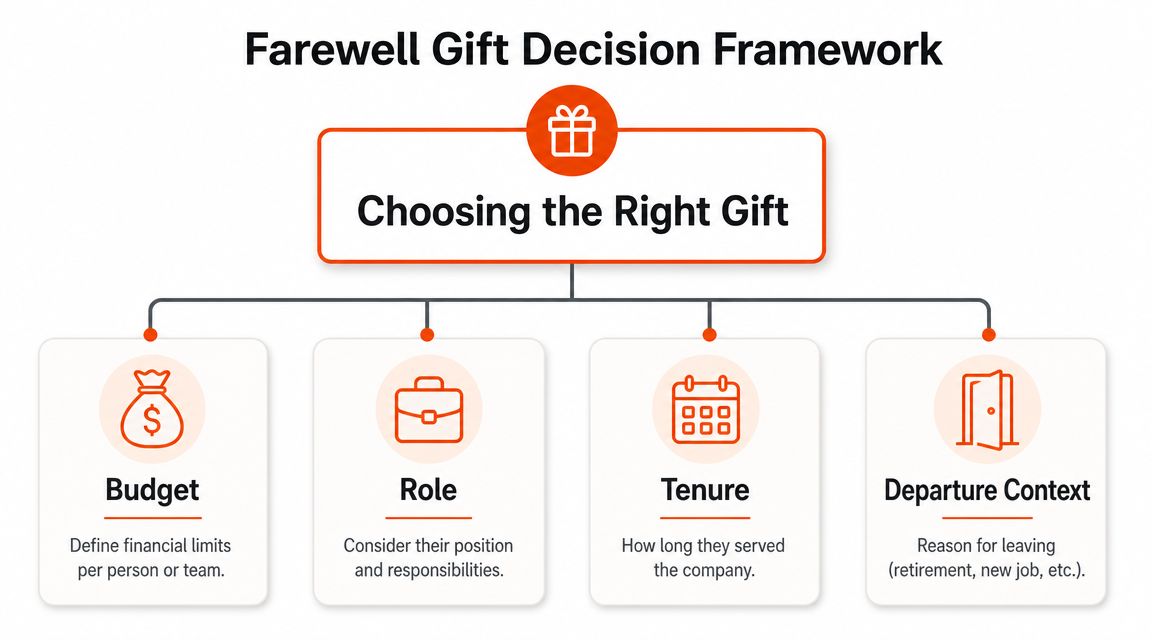
Good gifting gets easier once you stop treating it like a taste test and start treating it like a decision framework.
People often get stuck because they try to jump straight to the item. Hoodie or notebook. Wine or plant. Gift card or backpack. That's the wrong starting point. First define the shape of the decision, then choose the object.
Start with fairness, not vibes
You need a budget logic people can defend internally. One useful model comes from this farewell gifting guide, which recommends $25-$40 for short-tenure or entry-level leavers, $40-$75 for mid-level employees, and $75-$150+ for senior or long-tenured employees. The same guidance makes the point clear. Spend more on quality and customization than on stuffing multiple forgettable items into a bundle.
A simple decision table helps:
| Situation | Budget lens | Better move | Common mistake |
|---|---|---|---|
| Short tenure, junior role | Keep it modest | Choose one useful item plus a note | Buying a cheap set of random branded fillers |
| Mid-level employee | Balance quality and relevance | Upgrade something they'll actually keep | Splitting budget across too many low-value items |
| Senior or long-tenured employee | Signal weight and respect | Pick a premium item with subtle personalization | Overspending on something flashy but impersonal |
If you're shipping to remote hires or alumni across regions, operational consistency matters too. That's where merch fulfillment services become part of the planning, not just the execution.
Then match the gift to the exit context
Role and tenure matter, but departure context is where most gifting programs either get smart or fall apart.
A few examples:
- New job at another company: choose something useful for their next chapter, not a nostalgia object they'll never touch.
- Relocation: pick items that travel well and don't create baggage, physical or metaphorical.
- Parental leave transition or career break: favor comfort, utility, and a calm tone over performative celebration.
- Retirement: go more memory-rich, but still keep practicality in the mix.
Practical rule: If you can't explain why this specific gift makes sense for this specific person in one sentence, it's probably too generic.
The four filters to use every time
Before approving any farewell gift, run it through these:
- Would they choose this for themselves? Not exactly, but close enough.
- Will it still be useful after they leave? Post-exit utility matters more than office relevance.
- Does the value feel proportionate? Too cheap feels careless. Too expensive can feel awkward.
- Can we deliver it cleanly? A great gift with messy shipping still lands badly.
That's the whole job. Not “find something nice.” Find something appropriate, useful, well made, and easy to execute.
Gift Ideas That People Actually Want
Most lists of gifts for employees who are leaving still push the same tired lineup: mug, desk plant, card, bottle, generic gift basket, logo hoodie. That's not a curated farewell. That's a clearance aisle with better formatting.
The better way to think about farewell gifts is by how they live after the exit. Indeed's guidance on going-away gifts highlights a real gap here: a lot of employees don't want more “swag,” and the best gifts often optimize for post-exit utility rather than company visibility.
Here's the stack that tends to work.
The upgrade
This is the safest category because it starts with things people already use.
Instead of giving a generic tote, give a better tote. Instead of a basic water bottle, choose one that feels durable and clean. Instead of another cheap notebook, pick one with paper and binding that don't feel like conference leftovers.
Good upgrade gifts usually share three traits:
- They replace something ordinary: a daily-use item is enhanced.
- They travel well: easy to carry, easy to keep.
- They don't require explanation: the value is obvious the second someone touches it.
This category works especially well when you know the person's habits but not their tastes in detail.
The next chapter gift
Farewell gifting gets interesting. The gift connects to what's next, not just what's ending.
If someone's moving to a new city, think practical travel gear, a premium weekender, or a useful home item that isn't dead weight. If they're joining another startup, a refined desk accessory or bag makes more sense than a commemorative plaque. If they're taking time off, comfort wins. Soft apparel, a quality blanket, a wellness-leaning item, something that doesn't demand performative ambition.
That shift matters more than people think. You're not trying to keep your brand visible in their life at all costs. You're trying to send them off well.
For teams that care about waste and long-term usefulness, it's also worth looking at environmentally friendly promotional items as a filter, not just a category.
The wardrobe staple
Apparel can be one of the best farewell gifts. It can also be one of the worst.
The difference is whether it feels like real clothing or obvious company merch. If the fabric is bad, the fit is off, or the branding is loud, the piece is done. It won't become a keepsake. It'll become sleepwear at best.
What works:
- heavyweight hoodies
- clean crewnecks
- premium caps
- understated outerwear
- well-made tote bags with subtle treatment
What fails:
- thin tees with giant front logos
- event leftovers repurposed as “gifts”
- random size guessing with no backup plan
- colors nobody would willingly wear
A solid apparel gift should pass a simple test: would they still wear it if nobody knew where it came from?
A quick visual reference helps here:
What to skip
Some items miss even when the intention is good.
| Gift type | Why it often fails | Better replacement |
|---|---|---|
| Generic mug | They already have too many | Upgrade drinkware or skip drinkware entirely |
| Basic gift basket | Feels outsourced and forgettable | One stronger item plus a note |
| Loud branded apparel | Feels like marketing inventory | Minimal, wearable apparel |
| Desk decor | Often tied to office life they're leaving | Travel, home, or wardrobe utility |
If the gift mainly serves the company's visibility, it's not a farewell gift. It's leftover branding.
Personalize It Like You Mean It
Personalization doesn't mean slapping someone's name on a thing and calling it thoughtful. That's how you get products that feel customized in the worst possible way.
Real personalization is quieter. It shows up in the choices, the finish, and the details people only notice once they're holding the item.

Big logo energy is the problem
Most corporate gifting mistakes come from confusing branding with meaning.
A cheap tee with a giant logo isn't personal. It's inventory. Same for a hoodie with the company name across the chest in a font nobody would wear outside an offsite. The louder the branding, the less likely the item survives post-exit life.
That's why subtle customization usually lands better:
- tonal embroidery on a sleeve or cuff
- a small chest mark instead of a full-front print
- custom woven neck labels
- inside-tag messages
- initials, team references, or dates placed discreetly
The item should feel like a premium object first. Brand expression comes second.
What good customization looks like
A strong farewell piece usually has one visible detail and one hidden detail.
The visible detail gives the item identity. A tonal embroidery, a tiny patch, a clean monogram, something restrained. The hidden detail carries the emotional weight. An inside label with a phrase the team used. A short line tied to a launch, a project, or a shared joke. Something only the recipient fully gets.
That's the difference between merch and memory.
If you're planning custom apparel or accessories, the quality of those finishing choices matters as much as the product itself. Teams sorting through options usually benefit from looking at a dedicated custom merch design FAQ before approving artwork, placement, and finishing details.
Small details feel expensive because they require intention, not because they shout.
Personalization should answer one question
Why this gift for this person?
Not why this item for the budget. Not why this supplier for procurement. Why this specific object fits this specific human. Once you can answer that clearly, customization becomes easy. You stop adding decoration and start adding relevance.
That's when gifts for employees who are leaving stop feeling ceremonial and start feeling real.
Nailing the Unboxing and Global Delivery
A farewell gift can be perfectly chosen and still land badly if the delivery is messy.
This is where a lot of distributed teams lose the plot. They spend time picking the item, then treat shipping like a side quest. Wrong address, customs issue, cheap mailer, no note, no tracking update. Suddenly the “thoughtful” gift shows up late in a crushed box after the employee's last day. Not ideal.
For remote and international teams, BambooHR's discussion of gift ideas for direct reports points to a real operational gap: teams often need guidance on how to ship gifts, handle duties, and choose items that survive cross-border delivery, especially now that hybrid work makes this normal.
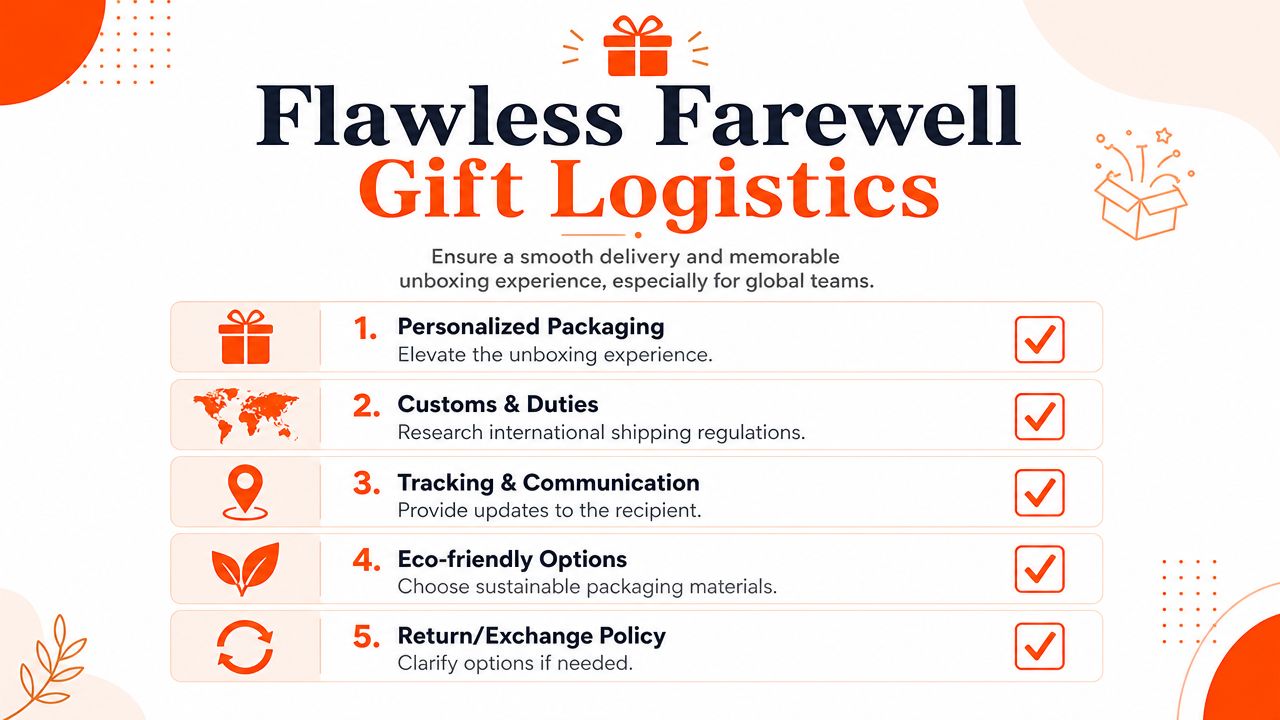
The logistics questions that matter
Before you send anything, answer these:
- Where should it go? Home address usually beats office address for departing employees.
- Will this cross a border well? Fragile, oversized, or high-hassle items create avoidable problems.
- Who handles duties and taxes? Don't make the recipient pay surprise fees for their own farewell gift.
- Can you track it cleanly? A missed delivery kills momentum fast.
If you're coordinating shipments across regions, a practical reference is this worldwide custom merch shipping FAQ, especially for multi-address orders and delivery planning.
Make the package feel intentional
Unboxing is part of the gift. It doesn't need to be theatrical, but it should feel considered.
A solid farewell package usually includes:
- A clean outer shipper: no battered retail leftovers
- Tissue or simple wrap: enough to create a sense of occasion
- A personal note: not optional
- One strong item: maybe two, but only if they belong together
What you want is calm competence. Open the box, see that someone thought this through, feel appreciated.
The best unboxing experiences don't feel extravagant. They feel finished.
Choose items that travel well
The globally shippable shortlist is pretty straightforward:
| Safer for global delivery | Higher-risk for global delivery |
|---|---|
| Apparel | Breakable glassware |
| Caps and beanies | Heavy bundled gift baskets |
| Totes and bags | Fresh food items |
| Flat paper goods with a premium item | Highly fragile decor |
If your team is international, don't force an in-office farewell ritual onto a distributed setup. Design for the reality you have. That means fewer fragile items, better address collection, clear shipping ownership, and packaging that still feels good when it lands on a doorstep instead of a conference room table.
Writing a Farewell Message That Feels Human
A good gift with a dead corporate note still feels dead.
Most farewell messages fail because they sound like they were approved by legal, HR, and a robot. “Wishing you all the best in your future endeavors” isn't offensive. It's just empty. Nobody keeps that line.
Use a simple formula:
- mention something specific they did
- name the effect it had on the team
- connect it to what's next
- end like a person, not a policy document
Here's the difference.
Stiff version:
“We appreciate your contributions to the organization and wish you success in your future endeavors.”
Better:
“Thanks for bringing calm to every messy launch and making the team sharper in the process. Your next team is getting someone unusually reliable, and we'll miss working with you.”
Another one:
“You made this place better in ways that won't fit on a leaving card. Thanks for the judgment, the speed, and the taste. Excited to see what you build next.”
Short beats long. Specific beats polished. If the note could be sent to five different people unchanged, rewrite it.
Farewell Gifting FAQs
Should the team pool money or should the company pay?
If it's an official farewell, the company should cover the core gift. Team contributions can be optional for extras, but nobody should feel pressured to chip in just to make the moment feel complete.
What if the employee is leaving after a short tenure?
Keep it simple and proportionate. You don't need to manufacture sentiment. A well-chosen small gift and a sincere note are enough if the experience was brief but positive.
Should you give branded merch to someone who's leaving?
Sometimes, yes. But only if it passes as something they'd want to wear or use after they've left. Subtle, premium, and useful beats loud and heavily logoed every time.
What if the departure is awkward or not on great terms?
Don't force warmth that doesn't exist. Keep it respectful, restrained, and professional. You can still acknowledge the transition without pretending it was an emotional chapter.
Are gift cards a bad idea?
Not always. They're just easy to do badly. If you have very little information about the person, a gift card can be practical. It just won't feel memorable unless it's paired with a real note and delivered with some care.
Why does this matter so much anyway?
Because lifecycle gifts shape how people remember a company. A recent poll reported by HCMag found that 72% of employees said receiving meaningful anniversary gifts would make them more likely to stay. That same logic carries into departures. People read gifts at key moments as signals of whether the company valued them.
A farewell gift won't rewrite someone's entire experience. But it will sharpen the final impression, and final impressions travel.
If you want to build gifts for employees who are leaving that feel premium, wearable, and easy to ship worldwide, Banger is worth a look. The focus is simple: custom merch people want to keep, with strong materials, thoughtful finishing, and fulfillment that works for distributed teams. Explore the catalog, request a quote, and build merch your team will want to wear.