How to Launch Anime Inspired Apparel Without Legal Drama
Most advice about anime inspired apparel starts in the wrong place. Teams obsess over printing methods and mockups, then discover too late that the design they love can't legally be sold, or that the artwork is so loud nobody wears it twice. If you want a drop that survives beyond the first hype spike, start with licensing, then design for repeat wear, then choose production that matches the lane you're in.
The market reality backs that up. Anime merchandising is projected to grow from US$10.7 billion in 2026 to US$19.8 billion by 2033, with apparel and accessories called out as the fastest-growing segment at a 13.9% CAGR and US$5.9 billion by 2033 (Persistence Market Research). That's not a niche side quest. It's a serious category where the winners make smart legal choices, then ship clothing people want to wear.
Table of Contents
The Real Reason Most Anime Inspired Apparel Drops Fail
The biggest mistake is not bad art. It's bad rights management. Teams fall in love with a character, commission a loud graphic, and assume the only question left is whether the print should be screen printed or embroidered. That's backwards. If you don't know whether you're doing an official collaboration, a licensed partnership, or an original anime aesthetic piece, you're gambling with takedowns, marketplace bans, and dead stock.
Start with the lane, not the mockup
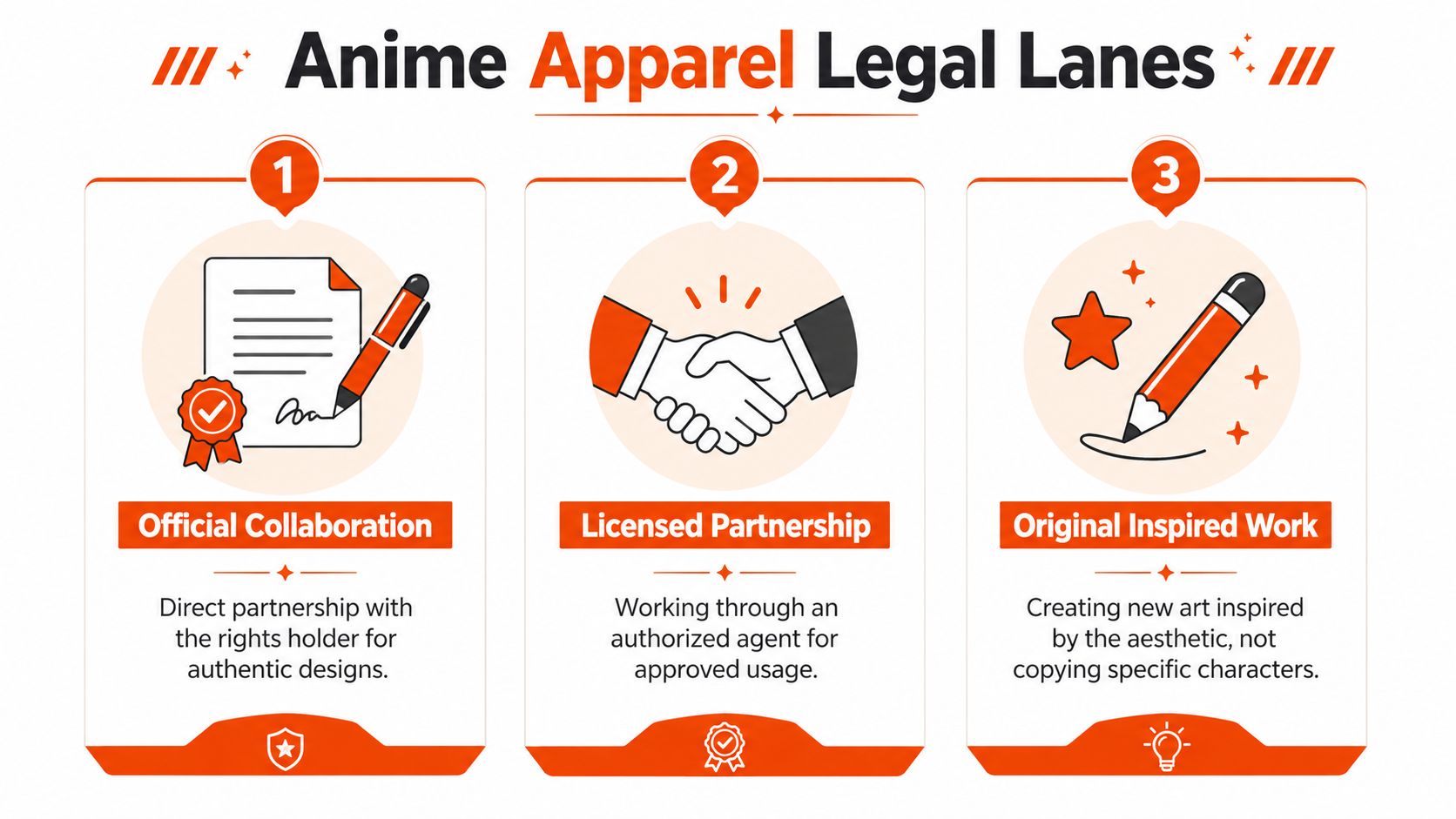
A drop usually belongs in one of three buckets. If you have the rights holder involved, you're in official collaboration territory. If you're working through an authorized agent, you're in a licensed partnership. If you're drawing from the visual language of anime without copying protected characters, logos, or signature scenes, you're making original work with anime influence.
That choice changes everything downstream. It affects what can be printed, how much risk you carry, where you can sell, and how aggressive the artwork can be. It also changes who needs to review the concept before a single blank gets ordered.
Practical rule: if the design only works because fans instantly recognize a specific character, you're probably too close to the edge.
Teams don't fail because they can't make a good hoodie. They fail because they confuse fan enthusiasm with a right to sell. If you want a simpler starting point for small-batch launches, a resource like custom apparel with no minimum helps teams think about production flexibility without committing to oversized inventory.
The right move is to decide your lane first, then build the drop around that lane. That keeps the creative brief honest, the legal review tighter, and the production plan a lot less expensive.
Licensing, Fan Art, and Original Anime Aesthetic Work
There are three clean ways to approach anime inspired apparel, and only one of them is casual enough to treat like a normal merch project. If you get this wrong, the rest of the process doesn't matter.
Know what belongs where
Official collaboration means the rights holder is directly involved. That's the safest path for recognizable characters, logos, and scenes. Licensed partnership means you're working through an authorized agent with permission to use protected assets. Original anime aesthetic work means the clothing feels anime-adjacent, but the art doesn't copy protected expression.
The line matters because copyright and trademark protect different things. You can't just redraw a beloved character with tiny changes and call it original. You also can't slap a franchise logo on a sleeve because the rest of the garment feels “inspired.” Fan art sales on most platforms are restricted for a reason, and that reason is usually enforcement, not aesthetics.
Use a simple decision matrix
Ask three questions before you approve a concept.
- Do I have rights or written permission? If yes, you can build around protected IP. If no, stop pretending you do.
- Would a fan recognize a specific character, logo, or scene in one second? If yes, the design is probably too close.
- Can the garment stand on silhouette, color, and motif alone? If yes, you're in safer original-aesthetic territory.
That last one is where a lot of good drops live. You can borrow mood, rhythm, and visual cues without borrowing protected expression. If you want a deeper cultural lens on Japanese motifs before you sketch, Japanese tattoo symbols explained is a useful reference point for reading symbolism without flattening it into costume graphics.
Do the diligence before you sample
Search trademark databases, check whether similar collaborations already exist, and look at how the franchise handles licensed products in market. If you see an active collaboration, don't assume that means open season. It usually means the rights holder is paying attention.
For teams that want help translating a concept into a production-ready brief, a service like custom design services can keep the visual direction aligned with what's manufacturable. The smartest merch partner isn't the one that says yes to everything. It's the one that tells you when a design needs to be reworked before it becomes expensive inventory.
Designing Anime Inspired Apparel People Actually Wear
Bad anime apparel looks like a poster stapled to a shirt. Good anime apparel looks like streetwear first, fandom second. That's the difference between something people wear once for a photo and something they reach for all season.
Build around silhouette and restraint
Start with the garment shape. Hoodies, heavyweight tees, overshirts, cargo pants, and layered pieces give you room to create a fashion object instead of a souvenir. Once the silhouette is right, pull the visual language back. Tonal embroidery, small sleeve hits, patchwork, jacquard texture, and subtle chest placement usually outlast a giant front print.
The market is already signaling that this direction works. Independent coverage notes that anime-inspired fashion has moved from cosplay into mainstream streetwear, with minimalist approaches leaning on line art, tiny embroidery, tonal motifs, and neutral palettes rather than loud character prints (Mathrubhumi). That's the lane for adults who like anime cues but don't want costume energy.
Pick a color story that feels wearable
You don't need to paint the whole garment in fandom colors. Pick one strong accent, then let the rest breathe. Black, washed charcoal, bone, olive, and muted navy work because they read like normal wardrobe pieces, not fan convention merch. Put the hero detail where a person notices it after a second, not immediately from across the room.
Good design hides a little, then rewards a closer look.
That's especially true if you're aiming at startup teams, creators, or Web3 communities. They don't want a mascot tee. They want a piece that fits into a rotation with denim, outerwear, and sneakers.
Before you approve a concept, run this checklist:
- Who's wearing it? Be honest about age, style, and how fashion-forward the audience is.
- Where does it get worn? Office, event floor, street, gym, or just online photos?
- Will it hold up on repeat wear? If not, the design is too dependent on novelty.
- What's the hero? One motif should lead. Everything else should support it.
For premium blanks that support this kind of restraint, the right fabric and fit matter more than adding another graphic layer, and a guide like premium blank t-shirts helps teams think about the base garment before they chase decoration. If the blank feels cheap, the whole piece feels cheap, no matter how smart the art is.
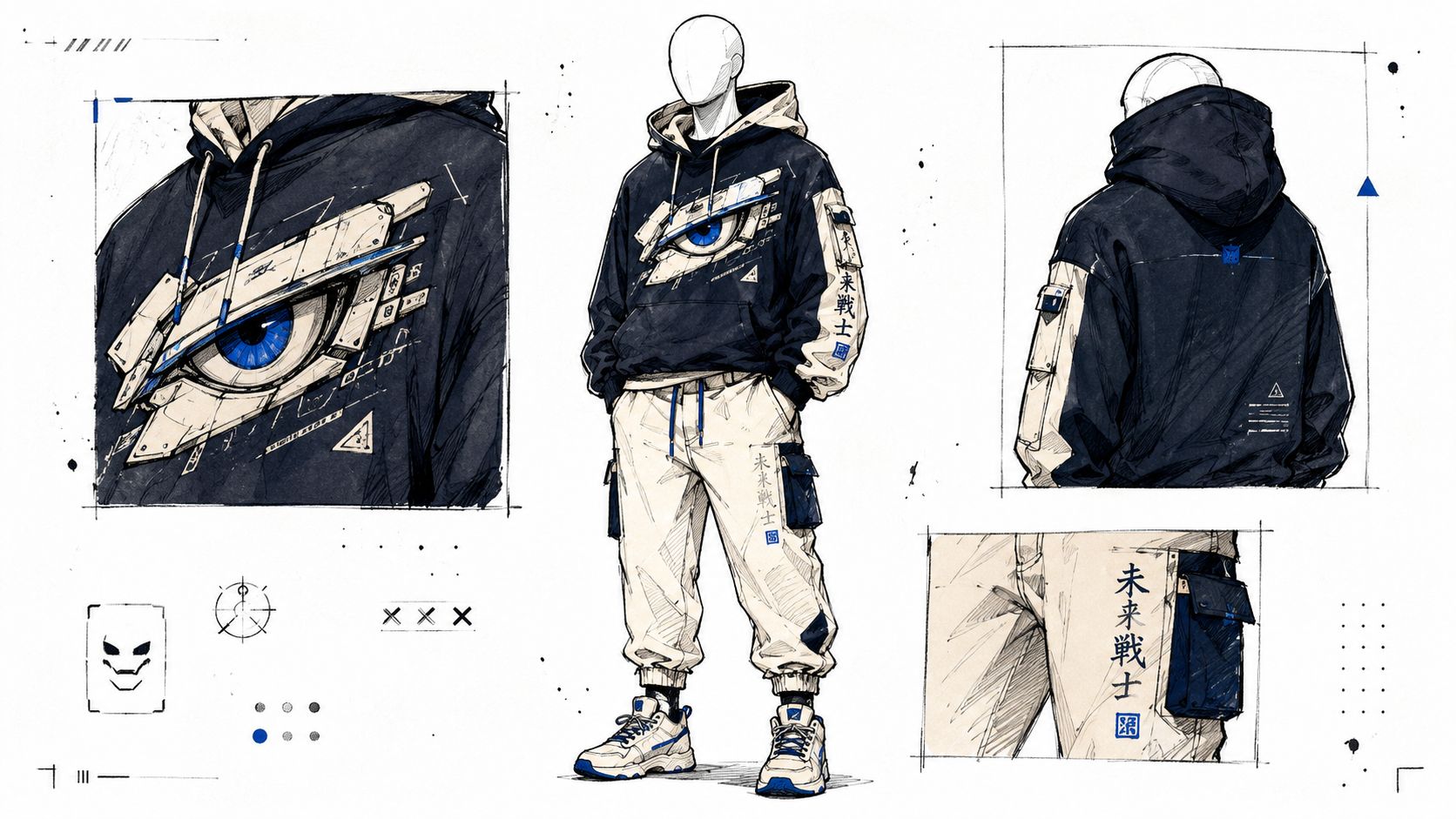
Printing Techniques, Embroidery, and Customization for Anime Designs
Production choice should follow the art, not the other way around. A line-art sleeve hit, a full-color illustration, and a tonal logo patch all want different methods. If you try to force everything through one process, the garment starts looking generic fast.
Match the method to the visual
Embroidery works best for symbols, minimal icons, name tags, and line-art motifs. Flat embroidery gives a clean finish, 3D embroidery adds shape to logos and emblems, and chenille is better when you want a varsity or patch feel. It sits well on premium blanks and usually reads as refined, not loud.
Screen printing is still the go-to for bold graphics and larger placements with strong color blocking. It handles crisp anime illustrations when you want a clear front graphic, but the art has to be designed for the garment, not just dropped on top of it.
DTG is useful when the concept calls for full-color artwork with softer hand feel and more image detail. DTF is practical when you need more flexibility across garment types or want a transfer-based route with sharp color. Sublimation suits synthetic pieces and all-over designs. Pad printing is a smaller, more specialized move for objects or tiny branded details. Woven or screen-printed labels finish the garment cleanly without shouting.
| Technique | Best for anime designs | Typical order size | Feel on garment |
|---|---|---|---|
| Embroidery | Symbols, line art, sleeve hits | Small to mid-run | Textured, premium |
| Screen printing | Bold illustrations, character graphics | Mid to larger runs | Soft to slightly heavier depending on ink |
| DTG | Full-color artwork, detailed prints | Small to mid-run | Light and direct |
| DTF | Versatile graphics across fabrics | Small to mid-run | Smooth transfer feel |
| Sublimation | All-over patterns, synthetic garments | Usually planned runs | Integrated into fabric |
| Woven labels | Branding, finishing, trims | Any run | Clean, subtle |
| Pad printing | Small branded accents | Small runs or accessories | Tight, precise |
For teams exploring flexible fulfillment models, a consignment POD solution for Shopify can work as a reference point for lower-risk sales setups, but it won't replace proper design discipline. Print-on-demand is useful when you're testing demand. It's not a shortcut for weak art or sloppy licensing.
Finish the garment like a real product
The stuff people notice on repeat wear is rarely the main print. It's the custom neck label, the woven hem tag, the embroidered name tag, and whether the packaging feels considered. Those details separate a decent drop from a forgettable one.
For the technical side of transfer-based printing, what is DTF printing is a good reference if you need to understand when a transfer route makes more sense than direct printing. In practice, I'd use embroidery for subtle anime cues, screen print for bold editorial graphics, and DTG or DTF when the artwork needs more color complexity than embroidery can carry.
Blanks, MOQs, and Cut and Sew for Limited Drops
The sourcing decision is simple. If speed matters more than total control, use premium blanks. If the capsule itself is the brand statement, go cut and sew. Too many teams overbuild too early, then sit on inventory because they wanted a custom silhouette before they'd proven the audience.
Blanks win when you want speed and low risk
Catalog blanks make sense for hoodies, tees, caps, and layers where the decoration carries the idea. Premium European sourcing is a strong fit here because the base garment already feels intentional. The practical upside is obvious, lower risk, less development time, and fewer ways for the project to go sideways.
Cut and sew wins when the garment is the story
If the silhouette, trim package, and fabric choice are part of the concept, cut and sew is the right move. That's how you build a private-label capsule that feels like a real fashion line, not just merch with extra steps. The trade-off is slower development and higher commitment, so it only makes sense when the design needs total control.
Rule of thumb: use blanks when the artwork is the hero, use cut and sew when the garment itself is the hero.
Premium blanks worth looking at include heavyweight hoodies in the 400-500 GSM range, organic cotton tees, and recycled fleece. Pay attention to the hand feel, neckline recovery, color consistency, and whether the fit matches the audience. A beautiful mockup won't save a boxy body or sloppy collar.
For a deeper sourcing breakdown, cut and sew apparel is the cleanest next step if you're deciding whether your anime inspired apparel needs a custom build or just better customization on a solid blank. Banger is one option here for teams that want custom cut-and-sew manufacturing alongside premium blanks, plus in-house design support when the catalog doesn't fit the concept.
Packaging, Unboxing, and Fulfillment for a Real Team Drop
A good drop doesn't end when the garment is packed. It ends when the person opens it, likes it enough to keep it on the chair, and wears it again next week. That only happens when packaging and fulfillment are part of the merch plan, not an afterthought.
I've seen this work best on distributed team drops and conference rewards. The order ships in branded mailer boxes, with tissue, stickers, and a short insert that explains the story behind the piece. The inside lid carries a clean graphic or one-line message. The tissue stamp does the branding without clutter. The care card tells people how to wash the garment so it lasts.
Multi-address shipping matters more than most founders expect. Once you're sending to employees, speakers, creators, or community members in different places, you need SKU mapping, clean address intake, and a reorder flow that doesn't require chasing every recipient manually. Worldwide delivery with duties included for the US, UK, Canada, Australia, Switzerland, and Norway removes a lot of friction, especially when the drop is tied to a launch or event.
For the operational side, treat the unboxing like a brand asset. A nice garment inside a generic poly bag feels unfinished. A considered box with consistent packaging language feels like a real collection.
If the drop is tied to a launch, the playbook in mastering Meta ads for product launches is useful background for timing, waitlists, and announcement sequencing, even if your main channel is community or email. The point is the same. Build anticipation, ship cleanly, then reorder the winners instead of guessing twice.
Launching the Drop and Teaming Up With Banger
Don't launch everything at once. Tease one hero piece, open a waitlist, then release a small batch and watch what gets worn, not just what gets clicked. If a design keeps showing up in photos, that's the one to restock. If it only lives in mockups, kill it.
The cleanest path is straightforward. Choose products, upload the logo or hand off the concept, get a free no-commitment quote with a full product preview in 24 hours, approve the e-proof with real photos from French ateliers, then ship worldwide in 10 to 15 business days. Direct factory pricing, low minimums, custom sourcing, and crypto or fiat payment make that flow workable for startups, creators, and internet-native teams.
Build merch your team wants to wear, then use Banger to turn the approved concept into something you can quote, preview, and ship without turning the project into a licensing mess. Request a quote, explore the catalog, and launch the next drop with a cleaner process than the usual fan art gamble.