Merch Production Timeline Guide for Custom Apparel Teams
Your launch date is real, even when the merch isn't. The deck's ready, the founder wants boxes on desks by the event, and the supplier just slid the ship date again. That's usually the moment teams realize the production timeline isn't a spreadsheet detail, it's the thing deciding whether the drop lands on time or shows up after the moment already passed.
Most merch teams don't lose time because they picked the wrong hoodie or the wrong print method. They lose time because they treated sampling, approvals, freight, and reorders like one blob. Direct factory flow, clean approvals, and tight milestone control are what keep a team drop from turning into a postmortem.
Table of Contents
- Rush buys time, and costs flexibility
- Reorders are faster because the hard decisions already happened
Why Most Merch Production Timelines Slip
A brand lead gets the mockup approved on Monday, and by Friday the supplier has moved the ship date by five business days. That's not a factory failure. That's a coordination failure, because someone assumed the first e-proof was the same thing as a release-ready file, and someone else treated freight like a footnote.
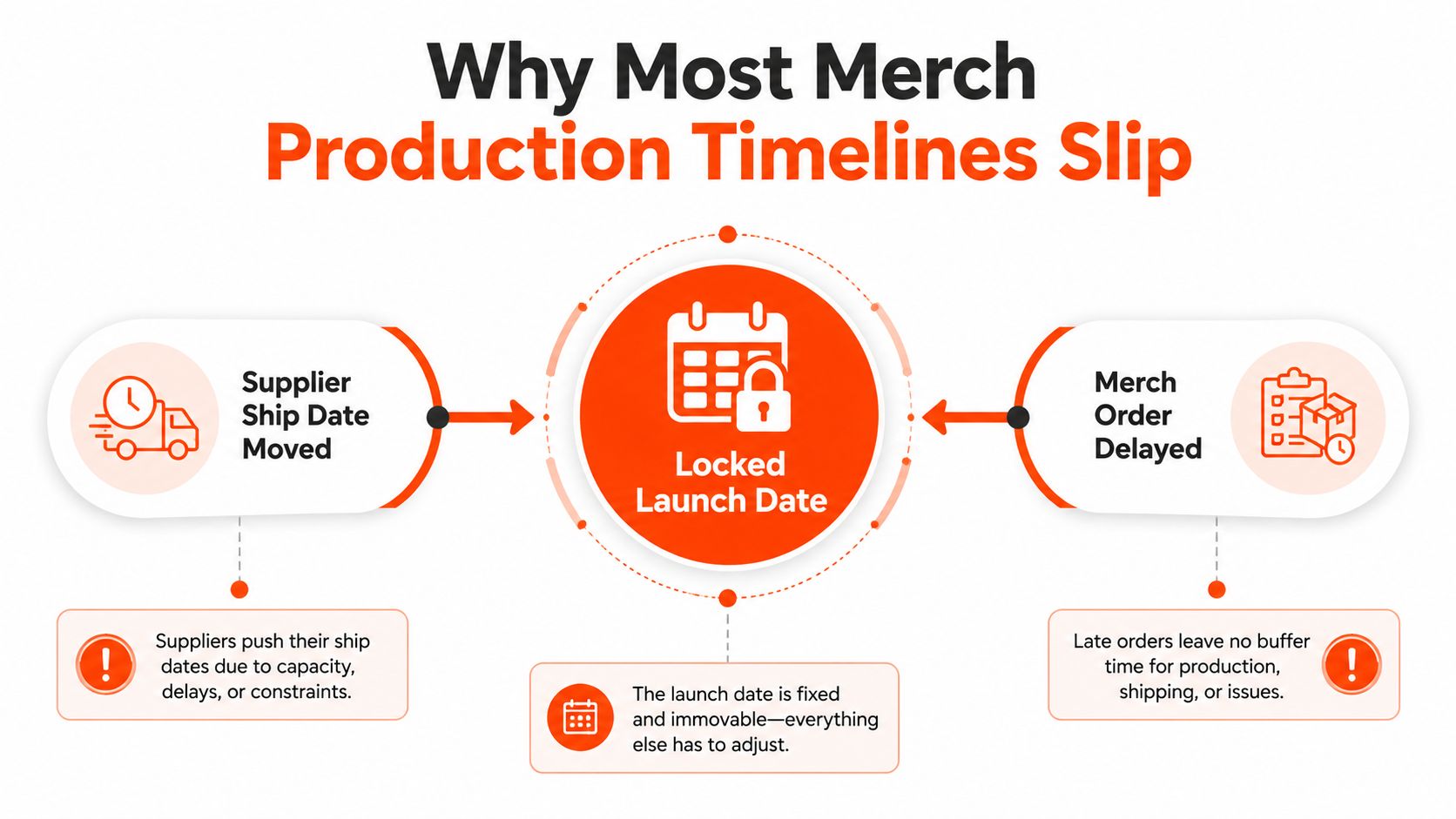
The usual slip points are boring, and that's the problem
The first miss is almost always sampling. Teams want to save time by skipping the gate, but that just pushes uncertainty deeper into the calendar. If the first real garment check happens late, every correction becomes expensive and slow.
The second miss is freight. A lot of teams treat shipping as the last box to tick instead of a separate critical path, which is how a perfectly good production run still misses launch. For physical goods, lead time is not just manufacturing, it's sample time, production time, and shipping time together, and that extra layer is where schedules break. If you want a clean framework for tracking that last mile, the on time delivery tracking guide is a useful reference.
Practical rule: if the launch date matters, freight gets its own owner and its own checkpoint.
The third miss is approvals. A digital mockup is useful, but it doesn't protect the calendar the way a real photo BAT does. Until the team signs off on the actual blank, real placement, and real color in the atelier, the order is still exposed to rework.
There's also the silent killer, which is file drift. A logo gets redrawn after screens are plated, a sizing note changes after the size run is set, or a stakeholder adds one more revision when the factory is already locked. If you're trying to keep that from happening, the basic intake flow in the custom merch quote time guide is the kind of process discipline worth copying.
A real timeline is a control system
The reason good merch operators ship on time is simple. They don't treat the production timeline like a wish list. They treat it like a live system with gates, owners, and consequences when one step slips.
That mindset matters because one upstream change can reset three downstream tasks. A color tweak can trigger a new sample. A sample can delay production release. A delayed release can push freight into a worse lane.
The teams that stay calm are the ones who name bottleneck early. That means closing the design question, locking sourcing, and separating approval from execution before anyone promises a date in public.
The Six Stages of a Reliable Production Timeline
A clean production timeline starts with data, not optimism. If the BOM is messy, the lead times are stale, or the routing is incomplete, every later promise gets shaky. Before anyone commits to a launch date, the team needs baseline quantities, decoration methods, blanks, and real lead times on paper.
Stage 1 to Stage 3 set the date
Data Gathering. Confirm sizes, SKUs, blank availability, decoration method, and supplier lead times. This stage gates whether the plan is even real.
Forecast or Order Plan. Decide what needs to land, when it needs to land, and how much buffer the launch can tolerate. For stocked items, a 13-week forecast is a common planning horizon in manufacturing operations, because it gives enough visibility to sequence capacity without freezing assumptions too early. That guidance comes from a practical production planning framework that also emphasizes rough-cut capacity checks and finite scheduling at the work-center level (production plan methodology).
Master Schedule. Turn demand into a date-backed plan with a target ship date, then check it against actual capacity. If the target date can't survive the resource check, it's not a valid date.
Do this first: close the data gaps before you talk about speed. Bad inputs make every timeline lie.
Stage 4 to Stage 6 are where execution gets real
Sourcing and Capacity Checks. Validate fabrics, trims, and any special components before release. Teams stop pretending the plan is fixed and find out whether the materials can support it.
Finite Scheduling. Lock the atelier, print, embroidery, or cut-and-sew sequence at the work-center level. This is the stage that respects constraints like changeovers, tool use, operator skill, and maintenance windows.
Execution with Live Sensing. Move the order through production, QC, logistics, and delivery while watching the floor, not just the calendar. If something shifts, the plan should adapt instead of pretending nothing happened.
Trim Sourcing: If a special label, zipper, or finishing detail isn't in stock, the early warning sign is a sourcing team that keeps saying “pending.” The cheapest mitigation is to pre-approve a backup trim before the main one is locked.
Sample Revision: If the first sample exposes fit or placement issues, the risk is usually revision creep. The fallback is to isolate one change at a time so you don't reopen the whole tech stack.
Freight Mode Change: If air freight gets bumped and the shipment slides to sea, the calendar gets wider fast. The mitigation is to keep freight as a separate critical path, not bundled into production optimism.
Stakeholder Change: If a new approver shows up late, the early warning sign is fresh comments on files that were already signed off. The fallback is a hard sign-off log, so the team knows what was approved.
The useful lesson is blunt. You don't commit to a ship date until sampling and sourcing gates are closed. After that, the job is execution, not guessing. If you need a practical reference for how a design-led merch workflow fits into that structure, the custom design services overview is a good internal benchmark.
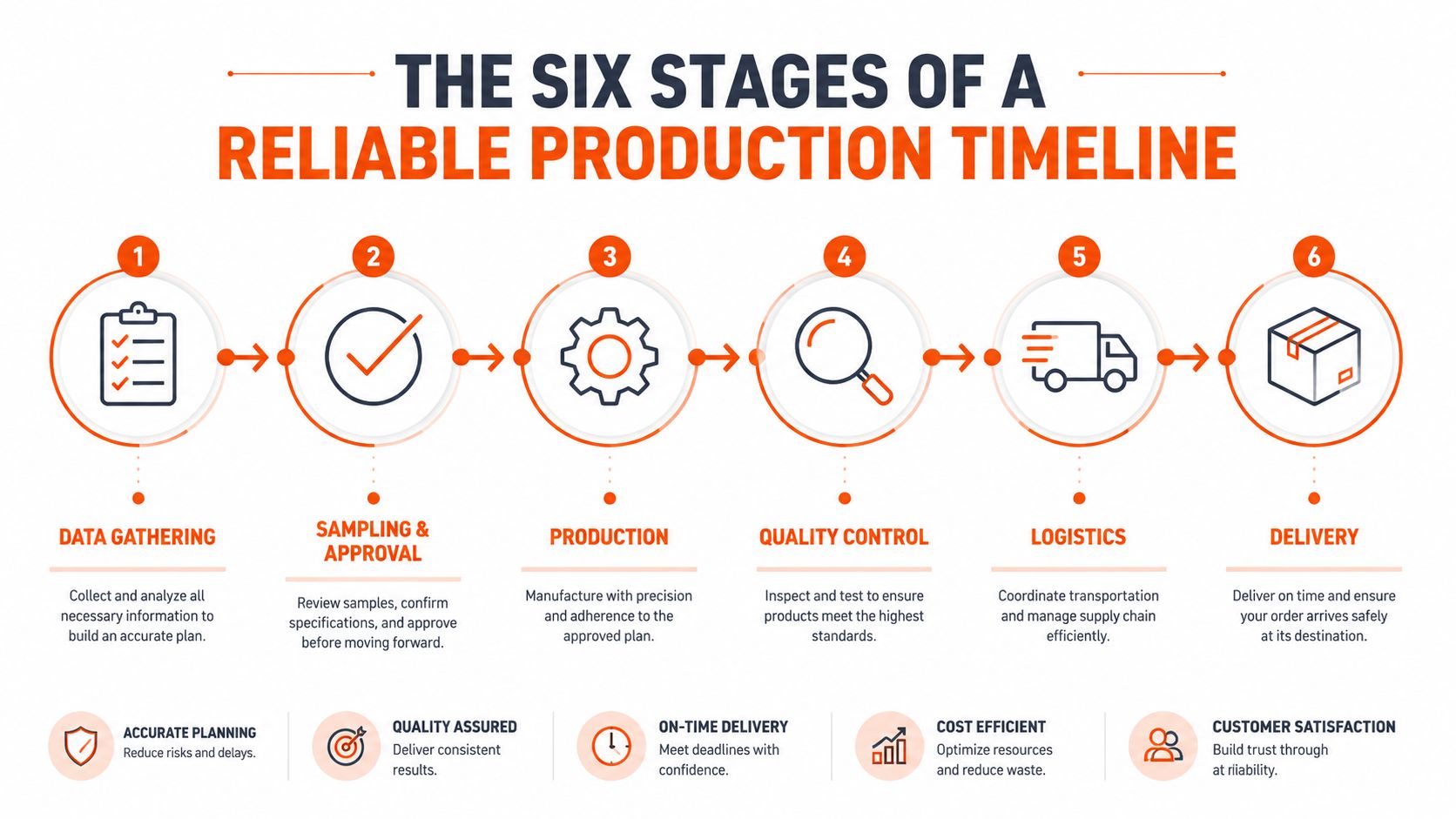
A decent timeline doc should name an owner for each gate, because “everyone” owns nothing. If a stage stalls, the owner should know whether the fix is a file update, a sourcing change, or a schedule reset.
For teams trying to tighten process without adding ceremony, improve operational efficiency becomes more than a slogan. The goal isn't more meetings. It's fewer surprises between handoff points.
Sample Timelines for Common Merch Orders
Theory is tidy, but buyers plan against reference calendars. A hoodie drop, a 40-person startup kit, and a cut-and-sew capsule don't live on the same clock, even if all three look like “merch” on the brief. The fastest way to make a sane plan is to match the order to the closest production profile.
For a standard custom apparel drop, the pattern is usually design lock, sampling, bulk production, QC, then fulfillment. That's the same skeleton you'd use for tees, hoodies, or totes, just with different pressure points depending on decoration method and blank availability. If you're choosing blanks, the premium blank t-shirts guide is the right place to start before you promise fabric quality to a client or founder.
Common merch order profiles
| Order Type | Design + Sampling | Sourcing + Production | QC + Fulfillment | Total End-to-End |
|---|---|---|---|---|
| Standard custom apparel drop | Moderate, with one approval loop | Straightforward if blanks are in stock | Routine if decoration is simple | Often lands in the short-to-mid range once approvals are clean |
| Small team kit | Fast on paper, slower if SKUs multiply | Can stretch when sizes and items vary | Light assembly, but more touchpoints | Usually tighter if the kit is standardized |
| Fully custom cut and sew capsule | Longer, because the sample is the gate | Heavier, because materials and trims matter | More hands-on, because finish details matter | The longest path in this group |
| Multi-address event shipment | Fast on production, complex on fulfillment | Depends on packing and address handling | Heavy on logistics, not just manufacturing | Often delayed by shipping orchestration |
| High-touch gifting run | Moderate, but personalization adds friction | Depends on packaging and name-level changes | QC matters more because mistakes are visible | Can slip if data is late |
The table above is meant to be a planning tool, not a fantasy promise. A small team kit looks quick until someone adds three garment styles, two print placements, and custom inserts. Then the calendar starts behaving like a much bigger order.
For teams that want an actual template to map these dates cleanly, a template to organize deadlines is useful because it forces ownership and sequencing instead of vague “ETA” language. That's the entire game in merch, remove ambiguity early.
Match the plan to the order, not the other way around
A founder-friendly merch order needs different slack than a conference shipment. A gift box run needs packaging review earlier than a standard screen-print drop. A cut-and-sew capsule needs sourcing locked before anyone starts bragging about launch week.
If you're deciding whether a project can make a date, the answer usually sits in the riskiest stage, not the fastest one. The team that understands that doesn't overpromise. It scopes the order and protects the one thing everyone cares about, the launch.
Approval Workflows That Actually Protect the Date
Most merch delays don't start in production. They start in approvals. A team thinks they've finished the design phase, then someone asks for one more font tweak after the e-proof is already circulating, and the whole date slips because no one treated the approval chain like a release gate.
The only approval that really matters
A kickoff brief should lock quantities, blank choice, and decoration method before the first mockup leaves the desk. After that comes the digital mockup, then the refined e-proof on the blank, then the photo BAT from the atelier. That BAT, Bon à Tirer, is the point where the team sees the design as it will ship.
Simple rule: the BAT is the contract, the mockup is just the draft.
If you skip the photo check, you're approving a guess. If you approve the wrong color on screen, the factory still has to recover from it later. If you sign off on the wrong placement, someone is opening a rework loop that eats the calendar.
The approval chain should be owned by one person on the client side and one person on the production side. Too many cooks create revision drift, and revision drift is how a clean order turns into file archaeology. The moment the BAT is signed, that sign-off should live with the order file and trigger production release.
What gets re-run when approval is missed
If the logo changes after the BAT, the artwork gets rechecked. If the garment blank changes, the proof gets redone. If the trim or label spec changes, the production file gets reopened and the team loses the advantage of the original approval.
That's why the approval ladder should be short. Nobody needs six rounds of feedback to tell whether the logo is centered. They need one clean look at the garment, on the actual blank, in the factory condition that matters.
This is also where a lot of teams save themselves by using a merch partner that handles design, customization, and production in one flow. Banger is one option that does that, with atelier-based production and real-photo approvals built into the workflow, which cuts down the number of handoffs that can blow up a launch.
For a tighter internal reference on how this approval stage should work in practice, the merch eProof approval guide is worth keeping in the order thread.
Rush and Reorder Timelines Without the Guesswork
Rush and reorder are not the same move. A rush is about compressing uncertainty on a first run. A reorder is about skipping work because the files, blank, and decoration setup already exist. Teams that mix them up end up paying for speed they don't need.
Rush buys time, and costs flexibility
Rush jobs can compress sampling, production, or both, but they almost always come with trade-offs. Decoration choices can narrow. Blank availability can shrink. Sample cycles can get tight enough that a color drift or placement issue becomes harder to catch before it ships.
That's why rush only makes sense when the date is more valuable than the ideal configuration. If the launch is fixed and the merch is part of the event, rush can save the moment. If the date is soft, moving the launch is usually smarter than paying to force the calendar.
Reorders are faster because the hard decisions already happened
Reorders move quicker when the design is already approved and the blank is still available. That's the benefit of doing the hard work once. You're not re-litigating artwork, garment specs, or decoration method, you're just re-running a known file set.
Operational truth: reorders are fast when the first order was disciplined.
The cleanest reorder path is the one where the team didn't mess with the core files after approval. Once the design system is stable, production can move without a fresh sample loop. That's why great merch programs build repeatability into the first run instead of treating reorders as an afterthought.
If you need a quick decision rule, use this one. Rush is for protected moments. Reorder is for known assets. If the brief is still changing, neither one is really fast.
For a practical view of faster fulfillment expectations, the fast turnaround merch guide is the right comparison point. It helps separate real speed from calendar fantasy.
Risk and Contingency Planning for Merch Drops
Every merch production timeline hits the same failure modes. Trim sourcing stretches. A sample needs a second revision. Freight changes lanes. A stakeholder decides the logo should be “more premium” after the order is already in motion. The teams that survive these shifts don't get lucky, they build fallback paths.
The four risks that deserve actual backup plans
The two moves that save the most drops are boring, and that's why they work. Build slack around sampling and freight. Keep a pre-approved backup blank in the catalog so one sourcing issue doesn't force a full reset.
Contingency is a habit, not a rescue
A good merch program doesn't wait for trouble before it starts asking backup questions. It assumes the first sample might not be final. It assumes shipping can change. It assumes a stakeholder will want one more review at the worst possible time.
That sounds pessimistic until you've shipped enough team drops. Then it just sounds like experience. The best timeline is the one that expects friction and still lands on the date.
If you want fewer fire drills, don't add more meetings. Add more pre-approval and more backup options. That's what keeps a launch date intact when the world starts making edits.
Building Merch Your Team Will Actually Wear on Time
The point of a production timeline isn't bureaucracy. It's getting the merch there before the moment it was made for. Launch week, conference day, customer summit, community drop, holiday gifting, all of it depends on the same basic thing, the order has to land while people still care.
That's where the direct factory model matters. When one operator handles design, customization, production, and worldwide fulfillment, you remove a bunch of handoffs that usually create delay. You also get cleaner accountability, which is why premium teams care less about “speed” in the abstract and more about fewer people touching the file before it ships.
The other reason teams miss dates is that they design for the calendar instead of the wardrobe. Good merch should feel like something people want to wear, not something they grab out of obligation. That only happens when the timeline protects quality, approvals, and finishing details instead of smashing them to hit a slide deck promise.
Banger sits in that lane for teams that want custom apparel, premium blanks, French atelier production, and worldwide fulfillment in one workflow. The point isn't just to ship faster, it's to make the schedule simple enough that the merch can arrive when the moment still matters.
If you're planning a team drop, conference kit, or founder gift run, Banger can help you map the timeline, preview the product, and keep the approvals tight enough to protect the launch date. Send the brief, get the preview moving, and build merch your team will wear instead of another box nobody opens.