10 Customer Appreciation Gift Ideas for Modern Brands
Most branded gifts fail before they're opened. They feel disposable, generic, or awkward to use, so the recipient files them with the rest of the forgettable swag. The popular advice is to buy something with a logo and call it appreciation. That's backwards. A strong customer appreciation gift should be useful, wearable, well-designed, aligned with the recipient, and simple for a distributed marketing team to execute.
The best ideas aren't necessarily the most expensive. Research on customer-firm relationships found that unconditional gifts can strengthen the relationship across gift values, which supports a practical principle: relevance, timing, and sincerity matter more than turning every thank-you into a major purchase. Research on unconditional customer gifts backs the case for thoughtful, low-friction gestures instead of oversized boxes filled with filler.
This list organizes customer appreciation gift ideas around the decisions teams make: budget, occasion, recipient tier, customization, timing, packaging, and fulfillment. You'll find apparel drops, tech accessories, drinkware, seasonal capsules, collaborative releases, and multi-address kits that can work for startups, fintech brands, creators, crypto communities, and modern customer programs.
The right partner also matters. Banger helps teams select products, customize them through French production ateliers, create branded packaging, and coordinate worldwide fulfillment. If you're comparing customer thank-you gestures with other relationship milestones, you can also compare seven house closing gifts to see how usefulness and context change the perceived value of a present.
Table of Contents
1. Custom Team Apparel Drops
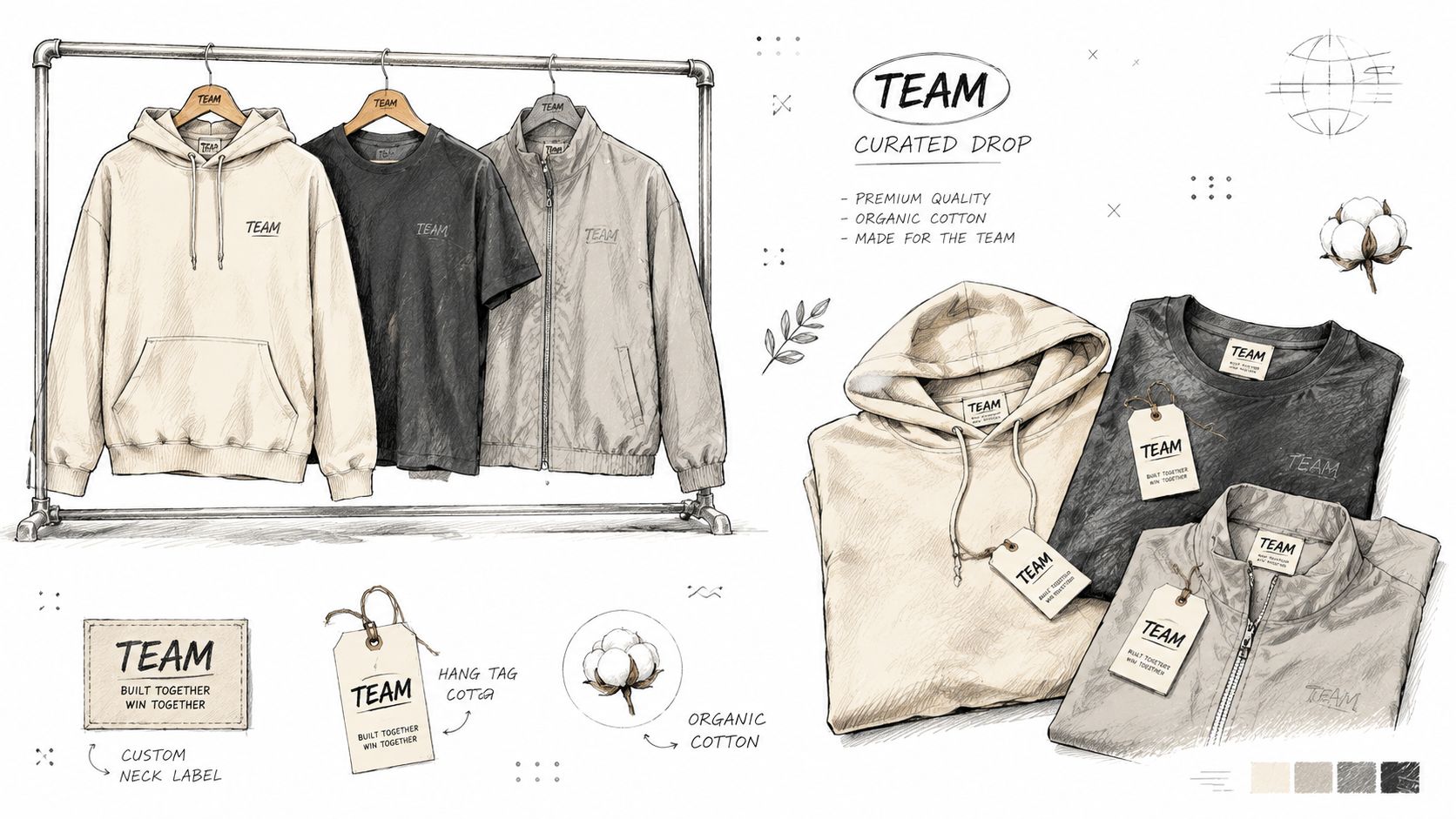
A curated apparel drop turns a customer gift into something closer to a fashion release than a promotional giveaway. A heavyweight hoodie, premium T-shirt, or lightweight jacket can reflect the culture around a product, especially when the design feels considered beyond a logo placed on the chest.
Think of a Figma team wearing coordinated hoodies at design conferences, a Binance community drop marking a protocol milestone, or a startup founder giving custom jackets to early employees and long-term supporters. The specific garment should match the relationship. A relaxed tee works for a broad customer community. A jacket or structured overshirt feels more appropriate for a smaller VIP group.
Build around one hero piece
Start with one hero garment rather than a full line. A premium hoodie or well-cut tee gives the design room to breathe and makes production, sizing, and fulfillment easier to manage. European-sourced organic cotton and substantial fabric weight can help the piece feel like clothing someone chose, not an object they were handed.
Color matters just as much as logo placement. Coordinate the palette with the brand, but avoid forcing every product into exact corporate colors if those shades look loud or difficult to wear.
Custom woven labels, embroidered name tags, and refined neck treatments add more perceived value than covering the garment in graphics. Banger's guide to choosing a team apparel supplier is useful when you're comparing blanks, production, customization, and repeat-order capability.
Pair the garment with a branded mailer, tissue paper, stickers, and a short personal note. Seasonal drops also give customers a reason to stay engaged with the brand instead of receiving one isolated item and never hearing from you again.
2. Premium Tech Accessories With Custom Branding
Tech accessories work when they solve a problem the recipient already has. A leather laptop sleeve protects a device. A wireless charger clears desk clutter. A USB-C cable, phone stand, or cable organizer earns its place because it gets used repeatedly.
That utility makes this category especially relevant for fintech, SaaS, AI, and crypto companies whose customers spend much of the day around screens. A fintech brand might send a custom laptop sleeve to account holders. An AI startup could gift engraved wireless chargers to enterprise clients. A crypto exchange might reserve custom leather wallets for VIP users.
Keep the branding quiet
Material quality should do most of the talking. Embossing, laser engraving, and small woven labels usually feel more premium than a large printed logo. Choose colors that complement the brand without making the item look like a permanent advertisement.
Add a small card explaining what the accessory is for and how to care for it. This detail is easy to miss, but it helps the recipient understand the product and signals that the item was selected rather than pulled from a generic catalog.
Practical rule: If the product wouldn't be useful without the logo, it probably isn't useful enough to send.
A branded tech kit can also work well when the pieces belong together, such as a sleeve, cable organizer, and charging accessory. Keep the set focused. Too many components create packaging bulk and increase the chance that some pieces go unused. For more product directions, browse these tech swag ideas, then compare materials, finish, and actual daily utility before choosing.
For wearable tech audiences, a subtle accessory can also complement a broader customer program. A 2026 silicone watch band guide offers another example of how a small functional item can carry identity without relying on oversized branding.
3. Capsule Seasonal Collections
Seasonal collections create a natural reason to send appreciation gifts at different points in the year. A winter capsule might combine a hoodie and beanie. A summer release could pair a tee with a cap. A spring collection might use a lightweight jacket and bucket hat.
The value is in the coordination. Three related pieces feel like a designed collection, while unrelated items often look like leftovers assembled into a box. A creator can release a seasonal capsule through Discord. A startup can prepare quarterly collections for brand ambassadors. A DTC brand can use drop-style releases to reward loyal customers without making every gift identical.
Use scarcity without creating frustration
Announce the launch date early enough for recipients to understand the moment. Limited quantities can create energy, but scarcity only works when the product feels worth keeping. Don't restrict availability around a weak design and expect the deadline to create desire.
Keep the visual system consistent across seasons. Reuse a successful graphic, label treatment, or silhouette in a new colorway so customers recognize the brand while still receiving something fresh. A stable palette also makes inventory and future reorders easier to manage.
Coordinate the release with a community event, product milestone, creator livestream, or customer anniversary. The gift then becomes part of a story rather than an unexplained package.
Plan the operational side
Seasonal apparel requires more attention to sizing, weather, and delivery windows than a one-size accessory. Collect size information before production when possible, and avoid shipping a winter item after the season has ended. If customers live across climates, offer a choice between a seasonal garment and a more neutral everyday piece.
The best capsule programs balance novelty with repeatability. Make each drop distinct enough to feel special, but structured enough that your team can reproduce the workflow without rebuilding it from scratch.
4. Branded Drinkware and Daily Essentials
Drinkware is a dependable choice when the product quality matches the frequency of use. A stainless steel bottle, insulated tumbler, travel thermos, or ceramic mug can fit into a workday without asking the recipient to change their habits.
A conference team might give attendees a durable bottle. A SaaS company could send insulated tumblers to enterprise customers after a major renewal. A fitness startup might thank beta testers with water bottles designed for commutes and training sessions. These examples work because the product fits the customer's routine.
Choose finish and function together
Matte finishes tend to feel calmer and more considered than glossy surfaces. Laser engraving can create subtle branding that holds up through regular use, while full-wrap printing makes sense when the visual identity depends on a larger illustration or pattern.
Insulation quality is a real decision point. A cheap bottle with an attractive logo still communicates cheapness once the lid leaks, the coating scratches, or the product fails to keep a drink at the expected temperature. Add care instructions on the base or on a small insert so recipients know how to clean and maintain the item.
Banger's guide to branding water bottles can help teams compare decoration methods and product formats before approving a sample.
Match the vessel to the audience
A travel thermos suits commuters and frequent travelers. A ceramic mug may be better for home-office customers. A compact bottle can work for event attendees who need something easy to carry, while a larger insulated format may be more relevant for fitness communities.
Avoid choosing drinkware only because it offers a large imprint area. The recipient should want the item in their hand before they notice the branding. That's how a practical gift earns repeat visibility without feeling like an ad.
5. Custom Tote Bags and Carry Essentials
A tote bag can be a strong customer appreciation gift, but only when it behaves like a useful bag rather than a thin promotional surface. Reinforced handles, a stable base, durable canvas, and at least one practical pocket make a noticeable difference.
A startup might send a structured canvas tote to its first customers. A conference organizer could choose a backpack for attendees carrying laptops and notebooks. A sustainability-focused brand might give loyalty members a neutral canvas bag they can use for groceries, commutes, or weekend errands.
Design for the actual carry
Neutral colors usually increase versatility. Let the material and construction create the premium impression, then keep the branding restrained. A custom woven label can feel more like a clothing detail than a marketing imprint.
Interior organization changes how often a bag gets used. Add a laptop sleeve, zip pocket, bottle holder, or smaller pouch when the recipient's use case justifies it. A canvas zipper pouch can work as a companion item, especially when the main bag needs a simple way to hold cables, cards, or small essentials.
A tote becomes a relationship asset when it solves a carrying problem, not when it offers the biggest logo area.
Handle comfort deserves testing. Short handles may suit hand carry but frustrate people who want to wear the bag over a coat. Long shoulder straps can improve flexibility, yet they may look awkward on a compact design. Test the fit, weight, and opening before approving the final production sample.
For broad customer programs, a tote is easier to size and distribute than apparel. For a premium tier, upgrade the fabric, hardware, and internal construction rather than adding several low-value objects.
6. Customized Notebooks and Writing Essentials
A notebook still works because it gives the recipient a place to think, sketch, plan, or capture a useful idea away from the screen. The format becomes more compelling when the paper, binding, and cover treatment feel deliberate.
A productivity app could send a refined notebook to power users. A consulting firm might choose a leather-bound journal for enterprise clients. A creator could package a notebook and pen with a digital product, giving fans a physical extension of the brand.
Match the format to the person
Paper selection should come before page count. Writers may prefer lined pages. Designers, product teams, and visual thinkers may want blank or dot-grid paper. A compact notebook can suit travel, while a larger journal can make a stronger desk accessory.
Embossing, foil details, or a small printed mark usually feel more elegant than a large cover logo. Add a custom pen or pencil when the budget and packaging allow it, but don't include a second item merely to make the box look fuller. A bookmark or ribbon can add a useful finishing detail without creating unnecessary bulk.
Make the message specific
The accompanying note matters more than many teams expect. Mention the customer's launch, collaboration, product milestone, or contribution instead of writing a generic thank-you that could have gone to anyone.
Notebook gifts are especially sensitive to audience fit. A customer who works entirely in digital systems may appreciate a journal, but a technical buyer may prefer a tech accessory. Use recipient behavior, not assumptions about what looks professional, to decide.
A notebook also gives your brand a quieter presence than apparel. That makes it a good choice for customers who value function but don't want visible branding on their clothing.
7. Headwear Collections
Caps, beanies, and bucket hats sit between apparel and accessory. They're easier to distribute than fitted garments, but the fit and construction still determine whether the item gets worn or abandoned.
A startup founding team might wear matching caps at an industry event. A gaming creator could gift bucket hats to its community. A fitness brand might send embroidered beanies to annual subscribers during colder months. Each scenario uses headwear as an expression of belonging, not a logo delivery mechanism.
Test the blank before decorating
Cheap hats reveal their weaknesses quickly. Fabric, crown shape, stitching, closure, brim structure, and embroidery all affect how the item looks in real life. Choose the blank first, then decide how much branding it can support.
Embroidery usually works better than screen printing for caps and beanies because it feels integrated and holds up through wear. Keep the placement intentional. A small front logo, side patch, or back embroidery can look considered, while multiple marks compete for attention.
For sizing and fit, use a practical caps size chart before finalizing the order. Test the product on people who represent the target audience, especially when the campaign includes different hair types, head shapes, or styling preferences.
Offer a few color options when the program is large enough to support them. Black and neutral tones are easy to wear, but a seasonal colorway can make a limited drop feel more distinctive. Don't sacrifice fit for color variety. One excellent cap will outperform several mediocre variations.
8. Multi-Address Gifting and Influencer Kits
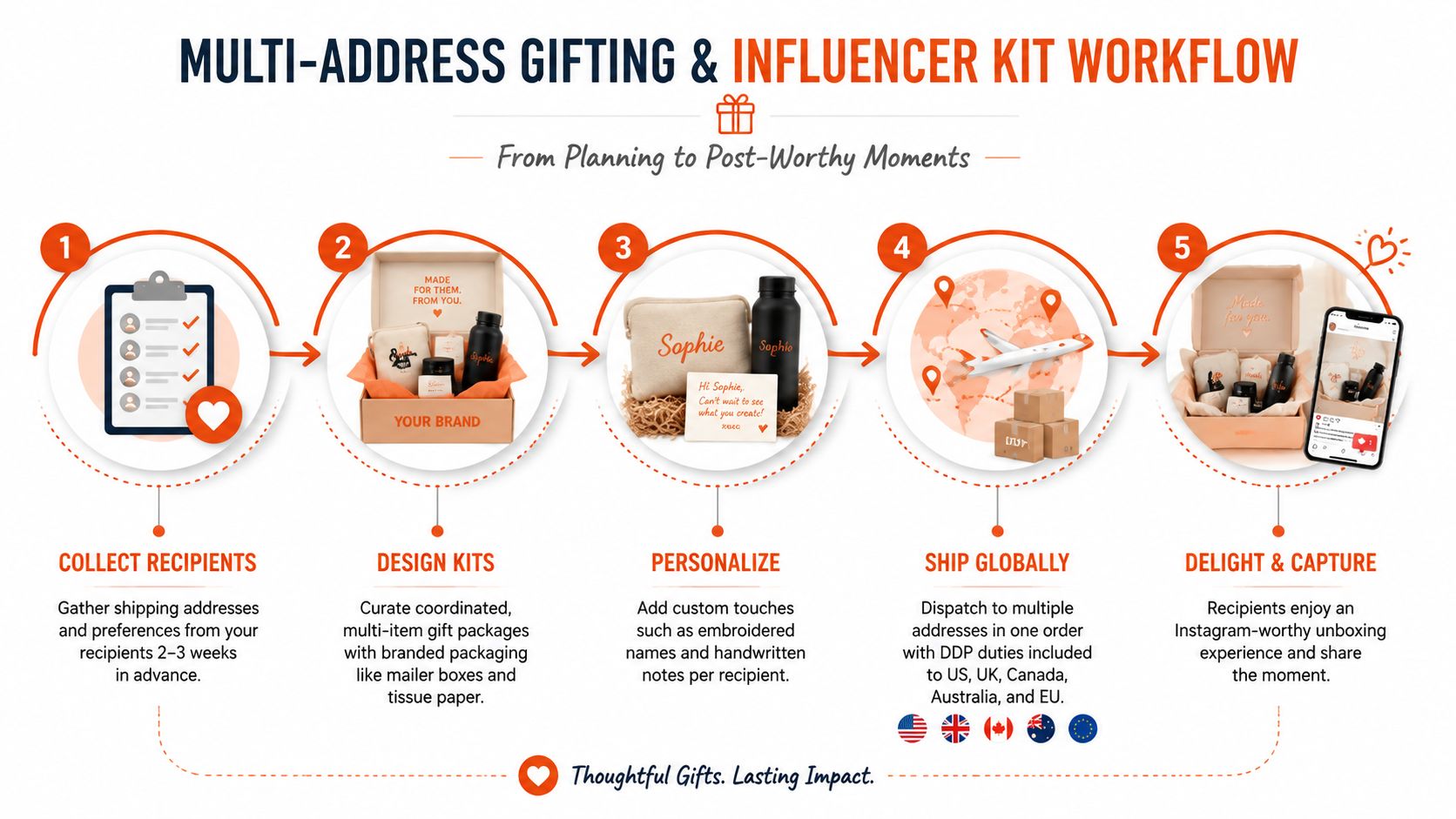
The product is only half the experience when gifts go to customers, influencers, contributors, or distributed teams. The other half is the operation: collecting accurate addresses, applying personalization, packing consistently, and delivering each kit at the right time.
A startup founder might send onboarding kits to new team members. A conference organizer could ship pre-arrival packages to attendees. A DTC brand may create appreciation boxes for its top customers, while a crypto protocol could reward contributors with a custom apparel and accessory kit.
Treat fulfillment as part of the gift
Collect recipient information two to three weeks before the desired ship date so your team has room to validate addresses, confirm sizes, resolve missing details, and prepare customs documentation. This timing is an execution recommendation, not a universal service guarantee. Build in more time for international programs or gifts tied to a fixed event.
Personalization can be simple. Add names to apparel, include handwritten notes, vary the color by recipient group, or create a short insert explaining why the person is receiving the package. The variation should feel intentional, not like a warehouse mistake.
Shipping rule: A gift that arrives late, damaged, or at the wrong address becomes an operations story instead of a gratitude story.
International gifting also requires local review. Customs, address validation, duties, packaging restrictions, and delivery timing can vary by destination. The industry outlook for 2026 projects that 65% of North American programs and about half of European programs expect more participants receiving non-cash incentives, with merchandise continuing to be widely used in both regions. The 2026 industry outlook for merchandise and event gifting makes the logistics gap clear. Distributed gifting needs a system, not a spreadsheet handed to a courier at the last minute.
9. Limited Edition Collaborative Drops
A collaborative drop gives appreciation a built-in story. Pair a brand with a creator, complementary company, artist, newsletter, or community, then produce a collection that celebrates the overlap between both audiences.
An AI startup might collaborate with a respected technology newsletter on a small apparel release. A fitness app could partner with a trainer on a custom collection. A Web3 protocol might work with an artist on merch connected to a digital collectible. A SaaS platform could co-drop with a complementary tool provider for shared customers.
Make the partnership visible in the design
Avoid placing two logos side by side and calling it collaboration. Build a visual system that gives both partners a real role. That might mean a shared graphic language, an artist-led illustration, a custom label, or a garment treatment that neither brand would have released alone.
Choose partners whose audiences overlap with the intended recipients. Audience size matters less than cultural fit and credibility. A smaller creator with a strong community can produce a more coherent gift moment than a larger name with little connection to the product.
Announce the release date ahead of time and use pre-orders when demand is uncertain. The plan notes for this format recommend limiting quantities to 100 to 300 units, but that range should be treated as an editorial design option, not a benchmark. The right volume depends on the partner audience, recipient list, and production method.
Capture content during sampling, packing, and unboxing. Give both partners assets they can publish, but don't force every recipient into public sharing. A customer appreciation gift should still feel personal when it stays private.
The trade-off is complexity. Approvals take longer, brand systems need alignment, and inventory must be split across partners or audience tiers. The payoff is a more memorable object with a clear reason to exist.
10. Sustainability-Focused Merch Programs
Sustainability-focused merch only works when the product itself is durable and the claims are specific. A recycled-polyester tote with poor construction isn't a responsible gift because the material sounds better. A short-lived hoodie creates the same waste problem as any other disposable item.
Climate tech startups can send GOTS-certified cotton hoodies with a clearly documented impact partner. A sustainable fashion brand might connect a merch program with an environmental charity. A Web3 project could choose recycled-material tees alongside a tree-planting commitment. A B Corp SaaS company might build sustainability into the entire customer appreciation kit rather than adding one recycled item at the end.
Start with the material and supply chain
Choose materials before decoration. Review certifications such as GOTS or Fair Trade where relevant, and communicate the production details in plain language. If the program includes carbon offsets, trees planted, or water saved, explain the basis for those claims and avoid vague environmental language.
Durability belongs in the sustainability brief. A garment that gets worn for years can create more value than several supposedly responsible items that recipients discard quickly. Consider repair guidance, care instructions, and a take-back option when the product category allows it.
A take-back program can close the lifecycle loop, but it needs an actual collection and processing plan. Don't promise recovery without deciding who receives returned goods, how the items are sorted, and what happens next.
For practical material and product directions, review these environmentally friendly promotional items. The strongest program connects product quality, transparent production, useful design, and credible follow-through. Sustainability should be visible in the evidence, not just in the copy on the insert card.
Customer Appreciation Gift Ideas: 10-Item Comparison
| Item | Implementation Complexity 🔄 | Resource Requirements ⚡ | Expected Outcomes 📊 | Ideal Use Cases 💡 | Key Advantages ⭐ |
|---|---|---|---|---|---|
| Custom Team Apparel Drops | Medium, design + sourcing coordination | Higher per-unit cost; premium blanks; low MOQs | Strong brand visibility; cultural cohesion | Onboarding, community drops, conferences | Wearable brand asset; fully customizable |
| Premium Tech Accessories with Custom Branding | Medium–High, material & finishing sourcing | High cost; specialist finishing; longer lead times | High perceived value; daily use & longevity | Client gifts, executive gifting, retention | Premium feel; subtle, daily utility |
| Capsule Seasonal Collections | Medium, recurring creative cadence | Moderate; multiple SKUs; inventory planning | Recurring engagement; collector mentality | Seasonal campaigns, community engagement | Creates urgency; repeat purchases & buzz |
| Branded Drinkware and Daily Essentials | Low–Medium, simple customization processes | Moderate cost; bulky/heavy shipping | Very high daily visibility; long retention | Conference swag, high-volume corporate gifting | Daily utility; high value-to-cost ratio |
| Custom Tote Bags and Carry Essentials | Low–Medium, emphasis on construction quality | Moderate cost; heavier shipping | Regular public visibility; practical longevity | Loyalty programs, eco-conscious audiences, events | Practical, durable, natural conversation starter |
| Customized Notebooks and Writing Essentials | Low, print, binding, subtle finishing | Low–Moderate; premium paper is key | Keepsake item; encourages offline engagement | Client appreciation, creative professionals, onboarding | High perceived value; long-term reference |
| Headwear Collections (Caps, Beanies, Bucket Hats) | Medium, fit testing & quality embroidery | Moderate per-unit cost; quality blanks required | High outdoor visibility; style signal | Events, lifestyle branding, community recognition | Visible branding; season-spanning wearability |
| Multi-Address Gifting and Influencer Kits | High, logistics, personalization, fulfillment | Higher operational effort; custom packaging | Memorable unboxing; scalable personalization | Distributed teams, influencer campaigns, VIP programs | Simplified logistics; scalable personal touches |
| Limited Edition Collaborative Drops | High, partner alignment & coordinated marketing | Low–Moderate (small runs); marketing investment | FOMO-driven demand; extended reach & PR | Audience expansion, cultural moments, co-marketing | Partner credibility; collectible scarcity |
| Sustainability-Focused Merch Programs | Medium, certified sourcing & transparent supply chain | Higher material costs; certification overhead | Loyalty from values-driven audiences; authentic PR | ESG programs, conscious communities, B2B ESG outreach | Differentiation via ethics; long-term perceived value |
Turn a Thank-You Into a Brand Asset
The strongest customer appreciation gift ideas start with the recipient, not the catalog. A broad customer segment may suit a useful bottle, notebook, tote, or premium tee. A high-value account or major milestone may justify a personalized tech accessory, jacket, or curated kit. A creator community may respond better to a seasonal capsule or collaborative drop than to a conventional corporate gift.
Budget should shape the product and the recipient tier, but it shouldn't replace judgment. In the United States, the IRS explains that business gifts are generally deductible only up to $25 per recipient per tax year, whether the gift is given directly or indirectly. A business can spend more than that, but the first $25 is generally the deductible amount. Because the rule applies per person per year rather than per occasion, teams should review the full recipient relationship before splitting gifts across multiple moments.
European programs need the same discipline, with local rules checked market by market. In France, the 2026 low-value-gift threshold for VAT recovery is €73 including VAT per item, per beneficiary, per year, according to French guidance on customer gifts and tax treatment. That threshold concerns VAT recovery and doesn't automatically determine corporate-tax deductibility, so finance should review the full treatment before procurement.
Personalization deserves attention because customers already experience it in loyalty programs. A 2025 Fiserv article citing its Q2 Gift Card Gauge reports that nearly 70% of consumers received a personalized loyalty reward in the previous 12 months. Fiserv's discussion of personalized rewards and customer loyalty supports a practical recommendation: use names, relevant messages, product choices, or recipient-specific packaging instead of sending one identical box to everyone.
Before production, make six decisions:
- Define the audience: Separate general customers, strategic accounts, contributors, creators, ambassadors, and event recipients.
- Choose real utility: Select the item that fits the recipient's routine, whether that's a laptop sleeve, hoodie, bottle, notebook, tote, or cap.
- Make customization intentional: Use embroidery, embossing, laser engraving, woven labels, or restrained printing according to the material.
- Confirm packaging early: Approve mailers, tissue paper, inserts, stickers, and the unboxing sequence before the final production run.
- Validate addresses and sizes: Collect recipient information early, check international details, and resolve exceptions before shipping.
- Approve the e-proof: Review the actual product preview, placement, color, finish, packaging, and personalization before the factory starts.
Timing changes the right answer. A seasonal gift must arrive while the season still matters. An event kit needs to reach the recipient before the event, not after the conversation you wanted it to support. A milestone gift should connect to the milestone clearly enough that the recipient understands why it arrived.
Fulfillment can make or break the experience, particularly for international customers and distributed teams. Check customs requirements, address formats, duties, delivery windows, damage protection, and tracking. A single-address shipment is straightforward. A multi-address program needs inventory coordination, recipient data controls, and a clear owner on your team.
Banger can support these decisions through product selection, premium customization, French atelier production, branded packaging, and worldwide delivery to one or multiple addresses. Its catalog includes apparel, caps, bags, drinkware, notebooks, leather goods, and tech accessories, with options for cut-and-sew collections when an off-the-shelf blank isn't enough.
The goal isn't to send more branded objects. It's to send one well-made object that earns a place in the customer's day, arrives without friction, and reminds them that the relationship has been noticed. Choose the product, audience, message, and delivery plan together. That's how a thank-you becomes a brand asset instead of another forgotten giveaway.
Banger creates premium custom apparel, accessories, branded gift boxes, influencer kits, and customer appreciation merch for internet-native teams, with French atelier production, premium customization, branded packaging, and worldwide fulfillment. Visit Banger to explore products, request a quote, and build a customer gift your audience will keep.