Best Hoodie Blanks: The Ultimate 2026 Buyer's Guide
You're probably here because you need hoodies for a team, a launch, a conference, or a merch drop, and you already know the obvious trap. The cheap option looks fine in a mockup, fine in a spreadsheet, and fine right up until the box arrives. Then you touch it. The fabric feels flat. The fit is weird. The print looks louder than the garment can support. A week later, nobody's wearing it.
That's why most “best hoodie blanks” roundups don't help much. They usually sort by price, softness, or decoration compatibility. Useful, but incomplete. The fundamental question is simpler and harsher: which hoodie blank still feels premium after customization, packing, shipping, and repeat wear.
If you're buying for branded apparel, that's the standard that matters. A hoodie isn't just a surface for a logo. It's a piece people either keep reaching for, or demote to gym backup, house hoodie, or donation pile.
Table of Contents
Why Most Company Merch Misses the Mark
Most company merch fails before the logo ever gets stitched or printed.
The failure starts with the blank. Teams choose a hoodie the way procurement teams often choose anything. Lowest friction, acceptable price, broad availability, done. That logic works for office chairs and shipping tape. It does not work for apparel that's supposed to carry brand perception.
A lot of hoodie content still centers on printability and price, but misses the more operational question of what actually holds up for premium branded merch after decoration, shipping, and repeat wear, as noted in this analysis of merch buying blind spots. That's the gap. Buyers compare the upfront unit cost. Wearers judge the final object.
The blank does most of the brand work
A good graphic can't rescue a bad hoodie.
If the fleece is limp, the cuffs go loose, or the body twists after washing, the brand takes the hit. People won't say, “Interesting embroidery execution, but unfortunate base garment selection.” They'll just decide the merch feels cheap.
That's why the blank is the core product decision. Decoration is the layer on top.
Practical rule: If the blank wouldn't be worth wearing without branding, it probably won't become good merch with branding.
There's also a perception problem that a lot of teams ignore. Premium brands, fashion labels, and culture-driven companies don't win by looking efficient. They win by looking considered. A hoodie that feels substantial communicates care before someone even notices the logo.
Cheap upfront usually gets expensive later
Low price can still be the right call for some event giveaways. But for onboarding kits, founder gifts, creator merch, and branded apparel meant to live past one moment, cheap blanks usually create hidden costs.
Those costs show up as:
Lower wear frequency: People don't keep reaching for a hoodie that fits badly or feels thin.
Weaker brand perception: The garment tells people whether your team has taste.
More revision cycles: A bad base creates endless mockup tweaks because the problem isn't the artwork.
Reorder regret: You end up replacing a “good enough” hoodie with the one you should've used in the first place.
If your team needs help figuring out artwork before production, it's worth reviewing how custom merch design decisions affect the final result. But even strong design direction won't fix weak fundamentals.
The brands that get this right don't treat hoodies like printable inventory. They treat them like products.
The Anatomy of a Great Hoodie Blank
The best hoodie blanks aren't defined by one thing. They're defined by the way several decisions stack together. Fabric. Weight. Fit. Construction. Finish. Miss one, and the whole piece starts to feel off.
Start with this visual breakdown.

The specs that actually matter
The biggest quality signal in modern hoodie blanks is fabric weight. Industry buying guides consistently frame heavyweight hoodies in the 400 to 500 GSM range as premium, durable options with better structure, a more stable print surface, and a more refined drape, according to this hoodie blank weight guide. That's not just a technical detail anymore. It's a market position.
For practical buying, weight usually maps to use like this:
| Blank profile | Typical feel | Best for | Watch out for |
|---|---|---|---|
| Lightweight fleece | Softer, easier all-season wear | Casual internal merch, layering | Can feel promo if the fabric face is weak |
| Midweight fleece | Balanced comfort and structure | Most team apparel, events, broad fit appeal | Can land in the forgettable middle if construction is basic |
| Heavyweight fleece | Dense, structured, premium handfeel | Streetwear-style merch, retail, founder kits | Costs more to ship and requires more deliberate fit choices |
A practical benchmark from product sourcing guidance puts heavyweight fleece around 350 to 400 GSM for stronger drape, thermal retention, and a more structured silhouette, while lighter fleece around 220 to 265 GSM is used for softer handfeel and easier all-season wear.
That doesn't mean heavyweight is always better. It means weight has to match the intention.
Here's the second thing buyers should watch. Construction details.
Ribbing: Cheap rib cuffs lose shape fast. Good ribbing keeps the garment looking intentional.
Seams: Side seams, shoulder joins, and armholes tell you a lot about consistency.
Face feel: A clean exterior matters more than people think because it affects both decoration and perceived quality.
Hardware: On zip hoodies, the zipper can ultimately make or break the whole piece.
For teams building something more custom than stock blanks allow, cut and sew manufacturing options open up a different level of control over fit, trim, labeling, and silhouette.
What premium feels like in practice
Premium isn't just softness. That's where buyers get tricked.
A hoodie can feel soft out of the polybag and still age badly. What you want is a combination of handfeel and shape retention. The hoodie should feel good when someone first puts it on, and still hold its identity after wear.
A premium blank should have enough body to make even minimal branding look intentional.
Fit matters just as much. Standard fit, boxy fit, oversized fit, drop shoulder. These aren't aesthetic side notes. They change who wants to wear the garment and how current it feels. A startup team trying to look sharp and contemporary usually won't get there with a generic athletic cut that reads like old conference swag.
The best hoodie blanks don't hide behind specs. They communicate quality on contact. You pick one up and it already feels like product, not merch.
How Blanks Perform with Customization
Once the blank is right, customization gets easier. Not easy. Easier.
That distinction matters, because decoration can either enhance a hoodie or expose every weakness in it. Heavy embroidery on unstable fleece puckers. Oversized prints on limp fabric look noisy. Dense graphics on a low-quality surface can feel like you laminated a sweatshirt.
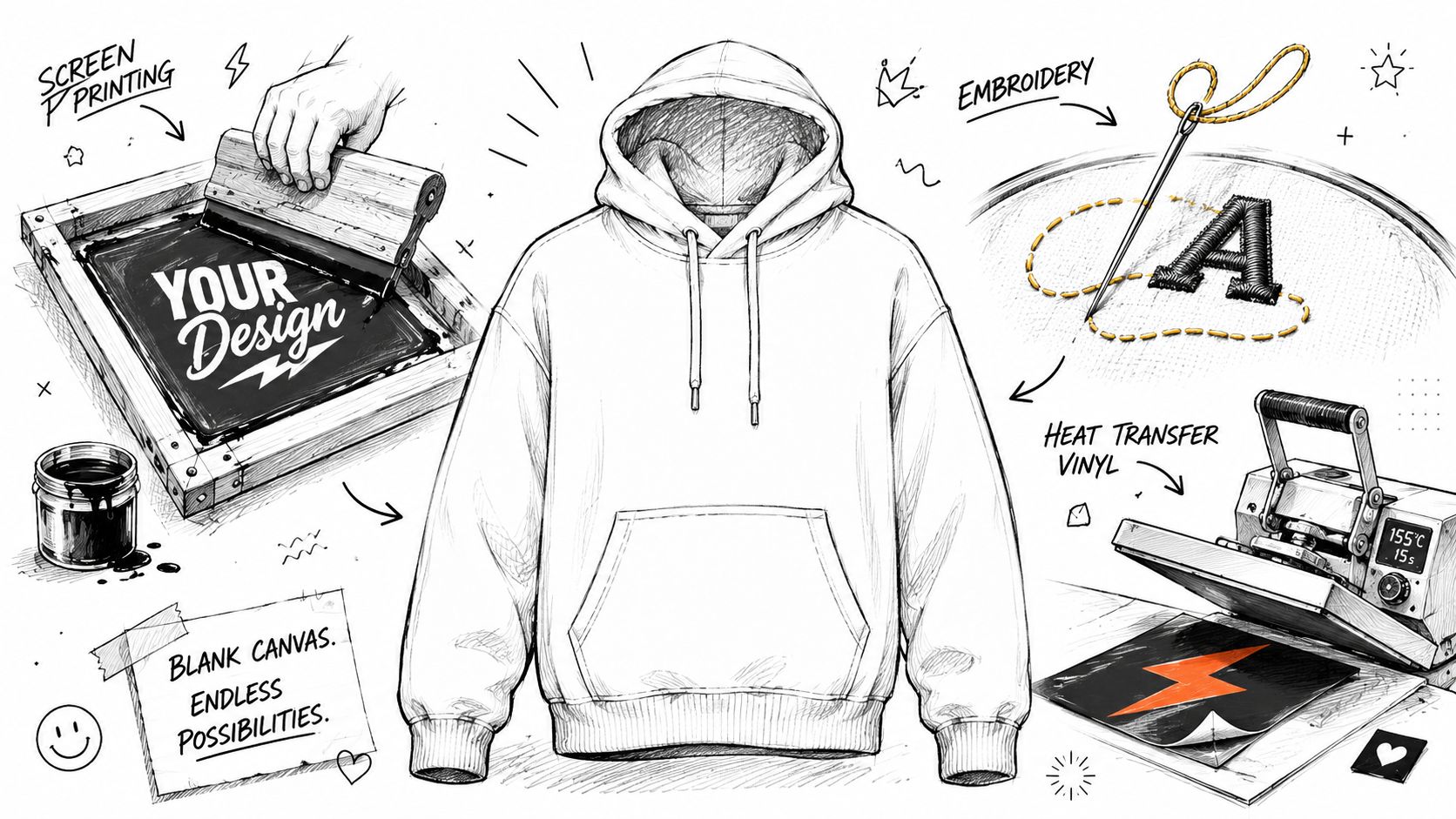
Here's the working visual often required in this stage of the process.
Screen print, embroidery, and DTF behave differently
Screen printing likes stability. A smoother, denser face gives you a cleaner result and a better chance of keeping the graphic integrated with the garment instead of floating awkwardly on top of it. That's one reason structured blanks tend to feel more expensive once decorated. The print has somewhere solid to sit.
Embroidery is different. It rewards garments with enough body to support the stitch count. If the fabric is too light or too loose, the area around the embroidery can distort, especially on chest placements. On a strong heavyweight blank, embroidery looks crisp and architectural. On a weak one, it looks stressed.
DTF is more forgiving on blends. Print guidance notes that polyester and cotton-poly blends are broadly suitable for DTF, and points to an 80/20 cotton-poly fleece at about 265 GSM.
That's useful because not every premium hoodie needs to be ultra-heavy or all-cotton. Some branded programs do better with a versatile midweight blend, especially if the design system relies on DTF, if broad size distribution matters, or if the hoodie needs to work across different climates.
If your team is weighing methods, this breakdown of merch printing techniques helps match decoration to garment type and design intent.
Where teams usually get it wrong
The common mistakes aren't subtle.
| Customization choice | What works | What usually fails |
|---|---|---|
| Large front print | Pullover with a clean, stable face | Busy placement over poor drape |
| Left chest embroidery | Structured fleece with enough density | Thin fleece that puckers around stitches |
| Full-zip branding | Smaller placements and cleaner restraint | Forcing a center graphic across the zipper |
| Premium minimal branding | Heavyweight blank with strong silhouette | Cheap blank where the logo has to do all the work |
A lot of buyers over-focus on whether a hoodie can be decorated and under-focus on whether it should be decorated that way.
If the decoration is doing all the talking, the blank probably isn't carrying enough weight.
The cleanest merch usually comes from restraint. One strong placement. One blank that already has presence. One method that suits the fabric instead of fighting it. That's how you get apparel people wear because it looks good, not just because it has your logo on it.
Matching the Blank to Your Use Case
There isn't one universal winner in best hoodie blanks. There's the right blank for the job. Different programs need different trade-offs, and pretending otherwise is how teams end up buying the same safe midweight hoodie for everything.
That's fine if your goal is to offend nobody. It's not fine if your goal is to make merch people actually want.
Internal team merch
For onboarding, offsites, team gifts, and internal culture drops, the move is usually wearability first.
You want a hoodie people will throw on during travel days, remote work, casual office time, and weekends. That means avoiding extremes. Too light and it feels disposable. Too trend-driven and half the team won't connect with it. A clean midweight or substantial fleece with a forgiving fit usually lands best.
Good profile for this use case:
Fabric: Cotton-rich fleece or balanced blend
Weight: Midweight to substantial
Fit: Relaxed, not overly fashion-coded
Branding: Smaller embroidery or restrained print
Consistency beats novelty. Teams don't need a runway silhouette. They need a hoodie that feels broadly wearable without feeling generic.
Retail-facing merch
Selling publicly changes everything.
The garment now has to compete with what people already buy for themselves. That means silhouette matters more, fabric matters more, and the blank has to carry value before the customer even knows your brand story. At this point, heavier fleece and sharper construction start making sense.
A retail-minded blank usually benefits from:
More structure: The hoodie should hold shape on-body and in product photography.
Cleaner finish: Ribbing, hood shape, and exterior face all matter.
A stronger silhouette: Boxier cuts and more deliberate drape tend to feel more current.
If your merch is meant to sit next to streetwear, creator apparel, or premium DTC clothing, the blank can't read like fallback corporate stock.
Capsule drops and custom programs
Under these circumstances, stock logic starts to break.
Limited collections, founder drops, community capsules, or collabs often need something beyond standard blank buying. Maybe it's heavier fabric. Maybe it's custom labels, trim development, garment dye, or a silhouette that isn't available off the shelf. At that point, “best hoodie blanks” becomes less about comparison shopping and more about building the right base.
The more your merch acts like product, the less useful generic blank rankings become.
Here's a quick decision table:
| Use case | Best blank direction | Why it works |
|---|---|---|
| Team swag | Versatile midweight or structured everyday fleece | Broad fit acceptance and repeat wear |
| Public merch | Heavyweight, shape-rich blank | Higher perceived value and stronger drape |
| Capsule drop | Premium blank or custom-built base | More control over identity and finish |
The best choice depends on where the hoodie lives. Internal culture piece, retail product, or branded collectible. Same category, different job.
Beyond the Blank Sourcing and Logistics
A great hoodie blank on paper can still turn into a messy program.
This is the part most guides skip because it's less fun than GSM, fit photos, or print close-ups. But production reality decides whether your hoodie works at scale. If the sizing is inconsistent, the lead times are foggy, or the supplier can't support distributed delivery, the blank stops being a product choice and becomes an operations problem.
Fit risk is a real budget problem
A recurring blind spot in hoodie buying is sizing and fit risk across regions and demographics. Most content stops at “oversized,” “unisex,” or “true to size,” but doesn't address how fit consistency affects large distributed orders. Guidance on blank hoodies points out that the essential question for global merch programs is which blank minimizes sizing mistakes across various global markets, since size uncertainty is a major friction point in apparel. That matters more than many organizations expect.
If you're shipping hoodies to remote employees, speakers, investors, creators, or community members in multiple countries, fit isn't a styling issue. It's a reputation issue. People remember when the hoodie feels great. They also remember when they get a supposedly premium piece that fits strangely and immediately feels risky to wear.
A better sourcing process includes:
Clear size mapping: Don't rely on vague labels alone.
Fit testing: Especially if your order spans different regions.
Silhouette discipline: Some oversized cuts are intentional. Others are just inconsistent grading.
Production reality changes the decision
The other trap is choosing a blank with no plan for execution. MOQ friction, unreliable restocks, long lead times, and fragmented fulfillment all create drag. That drag often pushes buyers back toward safer, lower-grade options because they feel easier to order.
They're easier upfront. They're rarely easier overall.
The wrong supplier can make the right hoodie impossible to use well.
A strong merch program needs the full chain to hold together. Sourcing, customization, proofing, packing, and delivery. That's especially true for remote-first teams and global communities shipping to multiple recipients. If that's your setup, this guide to worldwide custom merch shipping is worth reviewing before you lock the garment.
The blank still matters. But by the time you're shipping branded apparel at scale, logistics matters almost as much.
Premium European Blanks With Banger
Once you've looked at weight, construction, customization behavior, fit risk, and sourcing reality, the usual merch market starts to feel pretty thin. A lot of vendors offer printable hoodies. Fewer offer blanks that already feel like product. Fewer still can pair that with low-friction production and global delivery.
That's the lane Banger is built for.
Why the sourcing model matters
Banger works with premium European blank suppliers and builds custom apparel for teams that care how merch feels, not just how fast it can be ordered. That changes the baseline: better materials, cleaner silhouettes, and endless customization options handled through some of France's best manufacturers and production ateliers - with direct factory pricing.
A few of the best blank suppliers we work with: Stanley/Stella, WATC Studio, Maison Empty, René Bassett, Los Angeles Apparel, As Colour, Behind The Scenes Apparel, and Humane Blanks. Plus many more, including niche suppliers we bring in for specific projects.
The point isn't "premium" as a buzzword. The point is control.
Control over:
Blank quality you can feel: heavyweight fleece, fashion-grade essentials, organic cotton - none of that print-on-demand thinness.
Customization that goes deep: embroidery, screen print, DTG, DTF, custom labels, hang tags, branded packaging - down to every finishing detail.
Low MOQ flexibility: order from 1 unit. Built for startups, creator drops, capsule launches, and test runs.
Factory-direct pricing: no middlemen, no markup layers, no swag-agency margins.
Worldwide fulfillment that actually works: ship to one address or on-demand to your whole team and community worldwide, with DDP to the US, UK, and more.
For brands that have outgrown generic swag, this stack matters. You're not just buying a hoodie - you're buying confidence that what you approve is exactly what your team unboxes, wears, and keeps.
Who this works best for
Banger makes the most sense for internet-native teams, startups, fintech companies, crypto projects, creators, communities, and modern brands that need merch to operate like brand product. Not a souvenir. Not throwaway conference fleece. Product.
That can mean heavyweight hoodies for a team drop, European-sourced basics for onboarding kits, or fully custom cut and sew programs for a capsule collection. It can also mean branded packaging, custom neck labels, and fulfillment that make the whole thing feel finished, not improvised.
If you want to compare options directly, start with the Banger catalog of premium custom merch. The difference shows up fast.
If your team wants merch people actually want to keep, Banger is built for that. Browse the catalog, request a free quote, and get product previews in 24 hours. Premium branded apparel that stands out.