Leadership Skills Team Building: A Practical Playbook
Managers account for at least 70% of the variance in employee engagement (leadership research summary). That number should reframe leadership skills team building immediately. If the person running the room shapes engagement that much, then team building is not a nice offsite perk, it's a performance lever with real business consequences.
Many teams don't fail because they never did a workshop. They fail because leaders confuse activity with behavior change, then act surprised when the energy disappears by Tuesday. The fix is a loop, not an event, diagnose the actual blockers, build the right skills, make the changes visible, then measure what shifts in the work itself.
Table of Contents
- Days 1 to 30, set the baseline
- Days 31 to 60, introduce coaching and feedback
- Days 61 to 90, lock in shared norms
Why Team Building Is a Leadership Problem, Not an HR One
The cleanest argument for treating team building as a leadership job is simple, managers account for a large share of the difference in employee engagement (leadership research summary). The person leading the team shapes the daily habits that matter most, the way people speak up, how decisions get made, and whether follow-through happens. Better engagement is also tied to stronger business results and a greater sense of belonging, which shows up in how people perform and stay involved in the work.
That is why the usual handoff to HR falls flat. HR can build the container, but leaders set the tone, the tempo, and the quality of the conversation. If the manager does not change how the team communicates, decides, and follows through, the workshop becomes a memory with a whiteboard photo.
Practical rule: if a team-building effort cannot change how the next meeting runs, it probably will not change performance either.
The leadership-development gap makes that even more obvious. A leadership-development review found that many managers still receive no formal training before they are expected to lead, and companies continue to rank coaching skills, communication, and strategic planning near the top of their priorities (leadership development statistics). The problem is not that leaders do not know what matters. It is that too many of them are handed responsibility without the tools to change team behavior.
That is the core reason team-building efforts disappear after the event ends. Leaders buy the vibe, not the operating change.
For a useful outside perspective on what high-performing teams need from leaders, the Silicon Valley Speakers leadership insights piece is a solid reference point. If you are also trying to reinforce culture through physical touchpoints, the thinking behind corporate gifting programs matters too, because team rituals work best when they reinforce shared identity, not just attendance.
The Core Leadership Skills That Make Teams Click
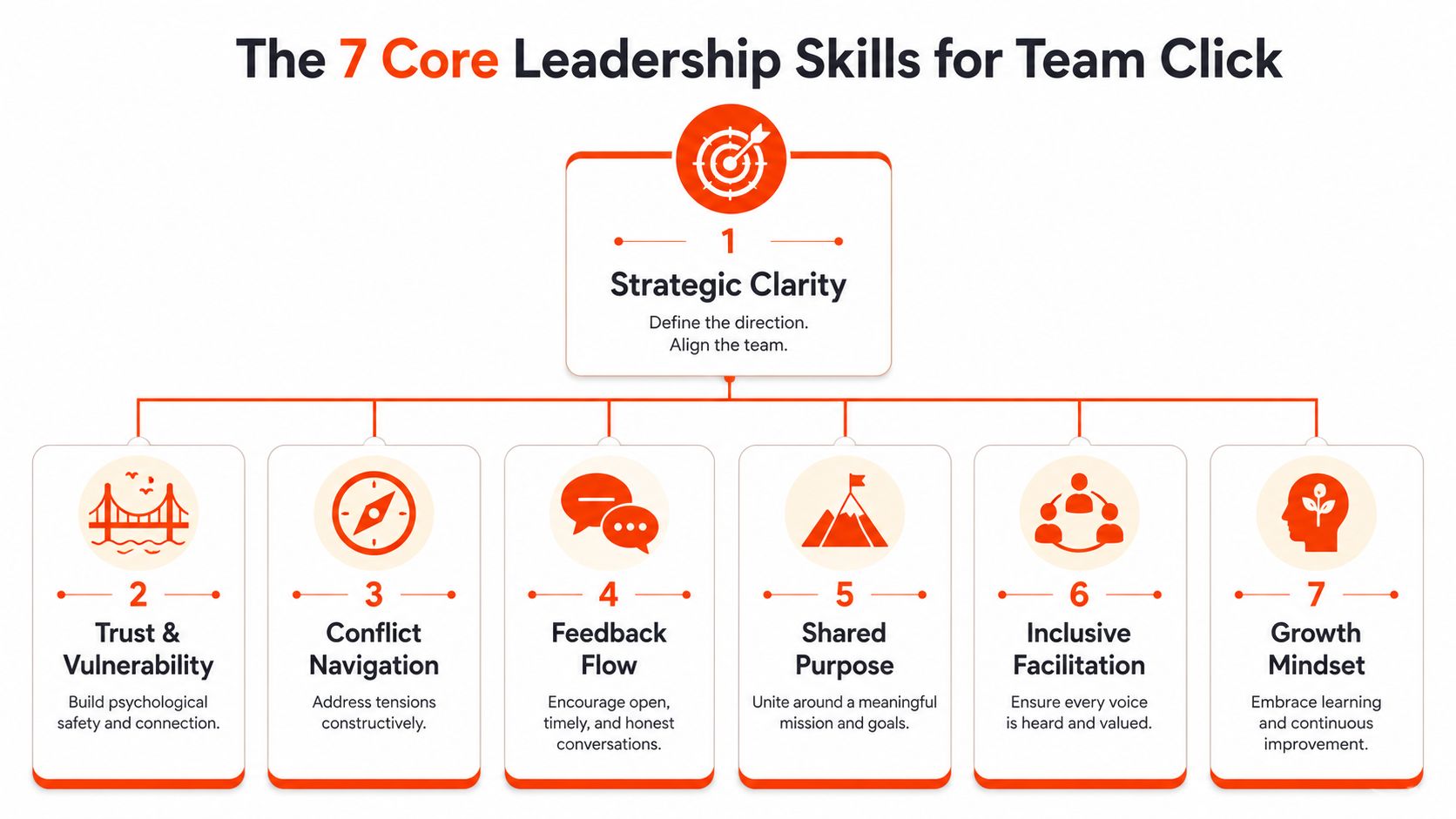
The teams that feel smooth usually aren't lucky. They're led by someone who can coach without micromanaging, communicate without fog, and handle tension before it goes underground. That lines up with the skill mix companies already say they want, and it matches the practical mechanics in FranklinCovey's 6 Critical Practices for Leading a Team, which include Align Purpose & Performance, Communicate as a Coach, Delegate to Develop, Use Feedback as Fuel, Gain, Don't Drain, Energy, and Win with 1-on-1s (FranklinCovey).
What the core skills actually do
Coaching turns one-way instruction into growth. FranklinCovey's model is explicit about asking, listening, and guiding, not just telling (FranklinCovey). In practice, this helps junior people level up without waiting for a formal review cycle.
Communication keeps the team from improvising around unclear priorities. SHRM's list of high-performing team techniques includes being genuine, asking good questions, talking about hard issues, following through, letting others speak first, and listening well (SHRM). That's not fluffy. That's how teams stop wasting time decoding intent.
Decision-making under ambiguity matters because unclear situations are normal, not edge cases. If a leader can't choose a path when the inputs are incomplete, the team stalls and starts building side opinions instead of shipping work.
Feedback delivery keeps small problems small. The point isn't praise or critique as a ritual, it's making the next action obvious.
Conflict surfacing is where most leaders get lazy. Berkeley's team-building guidance warns against false consensus and unspoken tension, which is exactly where a lot of good teams drift into fake harmony (Berkeley team-building steps).
Psychological safety makes disagreement usable. The goal isn't comfort. It's making it safe enough for people to say the uncomfortable thing early.
Follow-through is the credibility test. SHRM's list explicitly includes keeping commitments and being dependable (SHRM). People remember whether the manager did what they said.
A team doesn't trust a leader's intent. It trusts repeated evidence.
For frontline settings, leading frontline teams with Pebb is a useful lens because the pressure is different when the work is fast, visible, and coordination-heavy. And if you're trying to connect these behaviors to brand culture moments, team apparel supplier thinking is relevant only insofar as the symbols match the actual leadership habits.
Running a Real Team Diagnostic Before You Touch Anything
Most diagnostics are theatre. People fill out a form, nod through a readout, and nothing changes because nobody named the friction. A real audit is shorter and more honest. Give the team 30 minutes, ask questions that expose behavior instead of opinions, and write down what keeps showing up.
The questions that surface the real blockers
Start with a simple async prompt or live meeting and ask:
- Where do decisions slow down, and who usually has to push them across the line?
- What do people avoid saying out loud because it feels awkward or political?
- Which meetings feel productive, and which ones end with fake agreement?
- Where do handoffs break, and what gets lost in translation?
- What are we pretending is fine, but isn't?
The best answers usually come in fragments. Don't trust the loudest voice in the room to define the read, because loud people often overstate alignment. Berkeley's guidance is useful here, especially the warnings about false consensus, unspoken feelings, and the need to clarify directives when agreement shows up too fast (Berkeley team-building steps).
What to do with the answers
Write a one-paragraph team brief with three pieces of language: the pattern, the cost, and the next behavior you want to see. Keep it plain. For example, “Decisions are getting re-litigated after meetings, which is slowing launches. The team needs clearer ownership and faster closure on tradeoffs.”
That brief becomes the input for the development plan, not a conclusion. If the meeting was dominated by politeness, say so. If junior people stayed quiet, say that too. A clean read beats a flattering one.
If the room feels calm but nobody disagrees, you probably don't have alignment. You have caution.
Teams often need a reset in ritual, not a motivational talk. If you're curating practical team moments alongside the work itself, welcome gifts for new employees and best swag ideas only matter when they support the behaviors you want, not when they're used as a substitute for clarity.
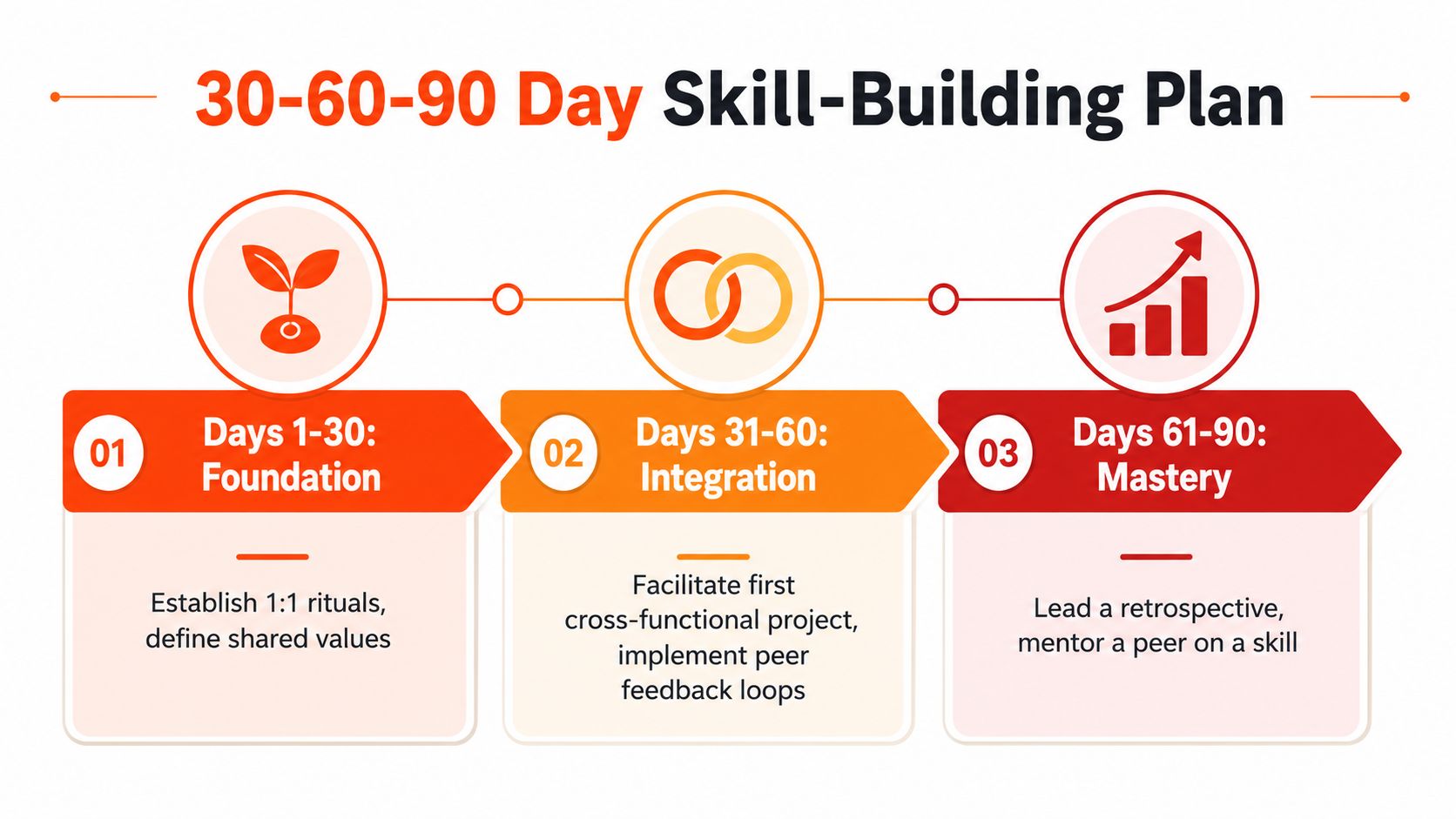
A 30-60-90 Day Plan to Build the Skills
A good plan doesn't start with a workshop. It starts with habits the team can feel inside a normal week. The point is to make leadership visible in the way people meet, decide, and recover from disagreement.
Days 1 to 30, set the baseline
Use this phase for observation, consistency, and quick wins. Hold 1-on-1s on a fixed cadence, write decision logs, and name the current pain points in plain language. FranklinCovey's emphasis on 1-on-1s to Win and Align Purpose & Performance fits here because the first job is clarity, not reinvention (FranklinCovey).
The biggest move in this phase is to stop relying on memory. If a decision matters, log who owns it and what “done” looks like. If a concern comes up twice, treat it as real, not anecdotal.
Days 31 to 60, introduce coaching and feedback
This is when leaders start using coaching language in normal work. Ask better questions, reflect back tradeoffs, and make room for disagreement before the meeting ends. SHRM's list is useful here because “let others speak first” and “talk about hard issues” are not personality traits, they're facilitation choices (SHRM).
Working rule: if feedback only shows up in reviews, it's too late to shape the team.
A short peer-feedback loop works better than a big reset speech. Keep it specific, tied to recent work, and focused on one behavior at a time. That keeps the signal clean.
Days 61 to 90, lock in shared norms
By this point, the team should have enough evidence to write a small charter. Keep it to the norms that matter most, how decisions get made, how disagreements get surfaced, and how follow-through gets tracked. Then reinforce those norms through retros and one visible example of mentoring a peer on a skill.
That final phase is where the team starts to feel less dependent on the manager's mood. The goal is not a perfect culture doc. It's a pattern the team can repeat when pressure spikes. If you want a useful parallel from a different kind of team roll-out, merch fulfillment services are a reminder that systems work when the handoff is clean, not when the launch deck looks polished.
Building Psychological Safety When the Team Is Hybrid and Diverse
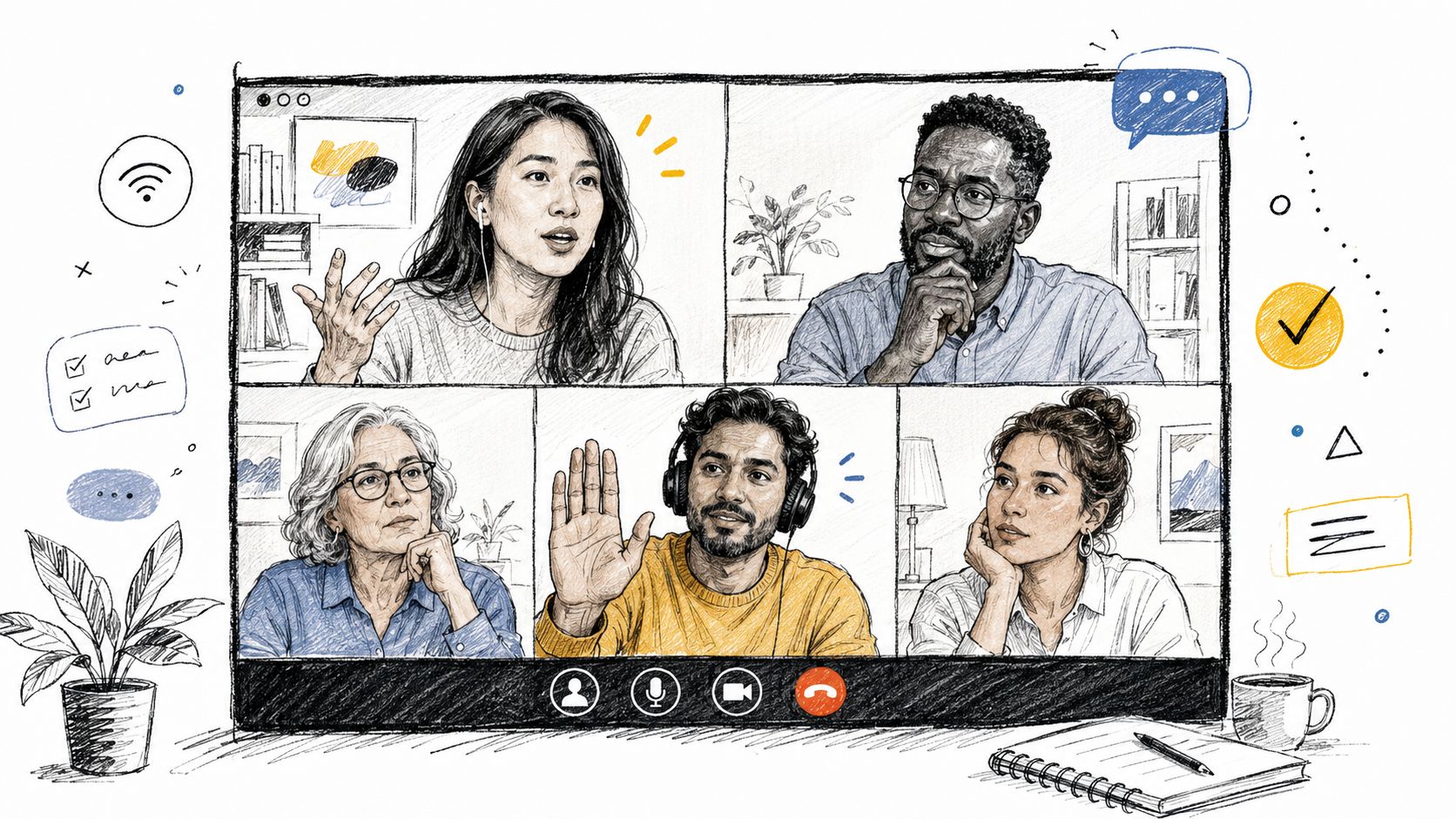
A distributed product team can look aligned and still be completely unsafe to disagree in. I've seen it happen when a senior PM dominates every meeting, junior engineers in three time zones stay quiet, and the team calls that “smooth collaboration.” It isn't smooth. It's a room where the risk signals never make it out early enough to matter.
What changes the room
Berkeley's team-building guidance is sharp on this point, leaders need to watch for unspoken feelings, probe for false consensus, and clarify directives when agreement arrives too fast (Berkeley team-building steps). That matters even more in hybrid settings, where quieter people, junior staff, or culturally different teammates can lose airtime before they've even named the issue.
The first fix is meeting design. If the most senior person speaks first every time, everyone else starts editing themselves. I've gotten better results by asking the PM to wait, using async prompts before live discussion, and pulling one written concern into the room before any decisions get made.
How to talk about the hard stuff
Don't make the room guess what safety means. Say, “I want the uncomfortable version first, not the polished one.” That single sentence does more than a generic trust exercise because it gives people permission to challenge the obvious path.
The second fix is to address microaggressions and different communication styles directly, especially when the team is cross-cultural. The Centre for Mental Health in the Workplace highlights the importance of microaggressions, intersectionality, emotional triggers, and communication styles in stronger teams (Centre for Mental Health in the Workplace guidance). That's the part a lot of generic team-building content skips because it's not neat, but it's usually where trust breaks.
If a meeting goes quiet, don't rush to fill the silence. Ask, “What's the version of this that we're not saying yet?” Then wait. That pause is uncomfortable for a reason, and it often surfaces the exact concern that would've saved the team a week later.
The product teams that get this right stop treating harmony as the goal. They treat usable disagreement as the metric. For a different angle on practical team culture, Firacard's team building ideas are a decent starting point, but the core work is still in the meeting pattern, not the activity list.
Three Workshops Worth Running and What They Actually Train
A lot of team-building sessions look busy and train almost nothing. People leave with a shared experience, but their behavior at work does not change. The better move is to choose workshops that map directly to leadership skills, then check whether those skills show up in the day-to-day work afterward.
Structured retro, show-your-work, and cross-functional simulation
A structured retro trains decision review and conflict surfacing. Keep it tight, use a simple prompt set, and ask the team to name one decision that helped, one that hurt, and one thing they would do differently next time. The failure mode is predictable. The retro turns into a blame audit or a praise circle, and neither one teaches better leadership.
A show-your-work session trains coaching and feedback delivery. Give one person a recent project, ask them to explain the choices they made, then have the group respond with questions before advice. It works because it slows down judgment and gives leaders a chance to model curiosity instead of correction. If the room jumps straight to fixes, the session stops teaching and starts posturing.
A cross-functional simulation trains coordination under ambiguity. Put people into a scenario with incomplete information, shifting priorities, and competing constraints. The team has to negotiate tradeoffs out loud, which is exactly where leadership shows up in real work. These are the moments where roles blur, and the people who can name the tradeoff clearly usually move the group forward.
What these formats beat
They beat trust falls, personality quizzes, and generic offsites because the behavior change is visible. You can hear it in the room. You can also see when a leader over-facilitates and solves the problem for everyone, which kills the point.
Montana State's leadership resource ties team-building to conflict management, strategic planning, group facilitation, and structured problem solving, which is the right lens for this kind of workshop design (Montana State leadership and teams). That is the gap between a fun event and a useful one.
If you are setting up the logistics around team rituals, merch fulfillment services only matter when they support a stronger team signal. A hoodie does not fix weak leadership, but a useful artifact can reinforce a team that already has a real operating rhythm.
A workshop is useful when you can name the behavior it trains before you book the calendar invite.
Measuring Whether Any of This Is Working
If you can't measure it, team building becomes a mood board. The cleanest stack is simple, weekly leading indicators and quarterly lagging indicators. Start with a baseline before the 30-60-90 plan begins, then track whether the actual work changes.
| Indicator | Type | Cadence | Source |
|---|---|---|---|
| Decision time | Leading | Weekly | Team logs, meeting notes |
| Conflict surfaced vs avoided | Leading | Weekly | Retro notes, manager observation |
| One-on-one follow-through | Leading | Weekly | 1-on-1 action tracker |
| Engagement score | Lagging | Quarterly | Employee survey |
| Retention | Lagging | Quarterly | People ops data |
| Delivery predictability | Lagging | Quarterly | Project planning and shipment cadence |
The important part is not the dashboard. It's the behavior behind it. Berkeley's emphasis on clear goals, standards for success, time frames, consensus methods, and evaluating team performance is the right operating frame here (Berkeley team-building steps). If the team knows what's being measured and why, the metrics build trust instead of suspicion.
A lot of leaders get trapped measuring activity, not behavior. They count workshops, attendance, or Slack enthusiasm. That tells you almost nothing. The better question is whether people are deciding faster, surfacing friction earlier, and following through more reliably.
For a practical catalog of low-lift ways to keep teams engaged, Firacard's team building ideas can spark formats, but the proof is in the weekly readout. If the numbers improve and the room gets less performative, you're on the right track.
At the end of 90 days, keep the loop tight. Re-baseline, rewrite the one-paragraph brief, and ask the team what should stay, what should change, and what's still being avoided.
If you're building a team that has to look sharp, feel cohesive, and work under pressure, Banger helps you turn that culture into something people wear with pride. Explore Banger for premium custom merch, team drops, and branded gear that fits modern internet-native teams, not throwaway swag.