Choosing a Top Team Apparel Supplier for Your Startup
You're probably here because your team needs merch, and you already know the usual outcome. The hoodie is thin. The fit is weird. The print cracks after a few washes. People wear it once for the launch photo, then it disappears into gym-bag purgatory.
That's not a small branding issue. It's a culture issue. For distributed teams, branded apparel does real work. It shows up in onboarding boxes, event photos, founder keynotes, offsites, and Zoom screens. It tells people whether your brand has taste or just a budget.
The bigger point is simple. Team merch isn't some side quest anymore. The global sports apparel market, which includes team apparel, was valued at USD 283.66 billion in 2026 and is projected to grow to USD 400.83 billion by 2031 according to Mordor Intelligence's sports apparel market outlook. That's a huge category, and buyers are paying more attention to quality, identity, and wearability. If you're still treating merch like disposable conference loot, you're behind.
If you need a reset on what good merch strategy looks like, this practical guide on how to create merchandise people actually want is a smart place to start.
Table of Contents
- Vague answers are the first warning
- Unauthorized subcontracting can wreck the whole order
- If they avoid samples, leave
Most Company Merch Is a Wasted Opportunity
Most company merch fails because the buyer starts with price instead of product.
That sounds efficient. It isn't. Cheap merch costs more in the only currency people remember, which is taste. If your team drop looks and feels generic, your brand does too. Nobody separates the garment from the company that approved it.
The problem isn't merch. It's low standards.
Bad branded apparel usually comes from the same broken logic. Someone needs shirts for an event. They ask three vendors for quotes. They choose the fastest one with the lowest number. A logo gets slapped onto a random blank, and everyone acts surprised when the result feels like a tax write-off.
For internet-native teams, that approach is upside down. What people wear in public becomes part of the brand system. A heavyweight hoodie, a clean cap, or a properly fitted tee can carry the same identity load as your site, deck, or launch film.
Good merch behaves like product. Bad merch behaves like leftover budget.
There's also a morale angle people ignore. You can't keep saying culture matters, then hand your team an awkward tee with sandpaper print and a stiff neckline. That doesn't create belonging. It creates polite silence.
Wearability is the real KPI
A lot of teams obsess over impressions. I care more about repeat wear. If someone reaches for the piece on a random Tuesday, you made something useful. If they only wear it at the company retreat, you made a costume.
A simple gut-check helps:
- Would your design team wear it off the clock
- Would your founder wear it on stage
- Would your community post it without being asked
- Would someone keep it even if the logo were smaller
If the answer is no, your team apparel supplier isn't solving the right problem.
Define Your Drop Before You Search
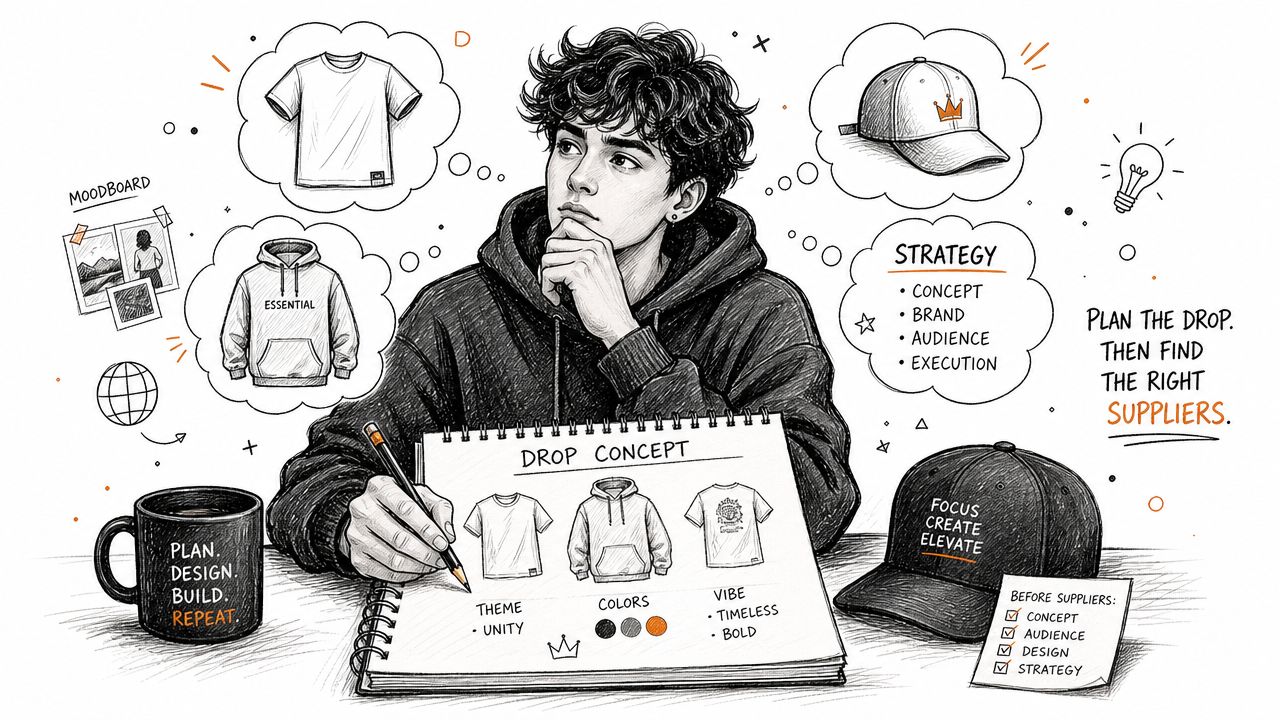
Before you start comparing suppliers, define the drop. Most bad sourcing decisions happen way earlier than people think. The brief is fuzzy, the timeline is fake, and nobody has aligned on what the apparel is supposed to do.
The category is moving toward better materials and more functional product. The performance apparel market is projected to grow from USD 47.7 billion in 2026 to USD 79.9 billion by 2036 according to Fact.MR's performance apparel market analysis. That demand exists because teams want branded gear that looks good and holds up in real life, not just on a mockup.
If you're still defining the role merch plays in your brand, this piece on company branding through clothing is worth reading.
Start with the use case
An onboarding kit is not an event giveaway. A founder gift is not a community drop. A sales kickoff uniform is not a capsule collection.
Write the use case in one sentence. Not a paragraph. One sentence.
Examples:
- Onboarding kit: make a new hire feel like they joined something with taste
- Conference merch: create instant recognition without looking like booth filler
- Internal team drop: give current employees something they'd wear outside work
- Creator or community release: build scarcity and identity, not just visibility
That sentence will shape everything after it. Product choice. Decoration method. packaging. Fulfillment. Budget. Timeline.
Know who will actually wear it
A surprising number of merch projects ignore the audience inside the company. Engineers, field teams, sales reps, community managers, and executives don't all want the same fit, fabric, or graphic treatment.
Use a short working matrix:
| Group | What they usually care about | What to avoid |
|---|---|---|
| Product and engineering | Clean design, comfort, subtle branding | Loud front graphics |
| Sales and partnerships | Polish, easy event wear, layers | Cheap blanks that wrinkle fast |
| Creator communities | Distinct look, collectible feel | Generic templates |
| Leadership teams | Premium materials, sharp finishing | Overbuilt novelty pieces |
You don't need endless personas. You need honest taste mapping.
Practical rule: if the intended wearer wouldn't buy something close to it with their own money, the concept is off.
Lock the aesthetic before supplier outreach
At this stage, a lot of teams get lazy. They say they want something “premium” or “minimal.” That means nothing unless you turn it into concrete direction.
Define a few things before the first supplier call:
Silhouette
Boxy tee, standard tee, oversized hoodie, quarter zip, cap, or jacket.Brand expression
Tiny chest mark, tonal embroidery, back graphic, sleeve hit, woven patch, or full custom cut and sew.Material feel
Soft and light, structured and heavyweight, athletic and technical, brushed and cozy.Social context
Is this meant for office wear, travel, events, content shoots, or everyday rotation?
Without that clarity, suppliers end up designing the project for you. That's how teams drift into safe, forgettable choices.
A good brief doesn't need to be long. It needs to be sharp. Product list, rough quantities, desired finish, target feel, and delivery date. That's enough to separate serious suppliers from logo printers.
Core Criteria for Vetting Suppliers
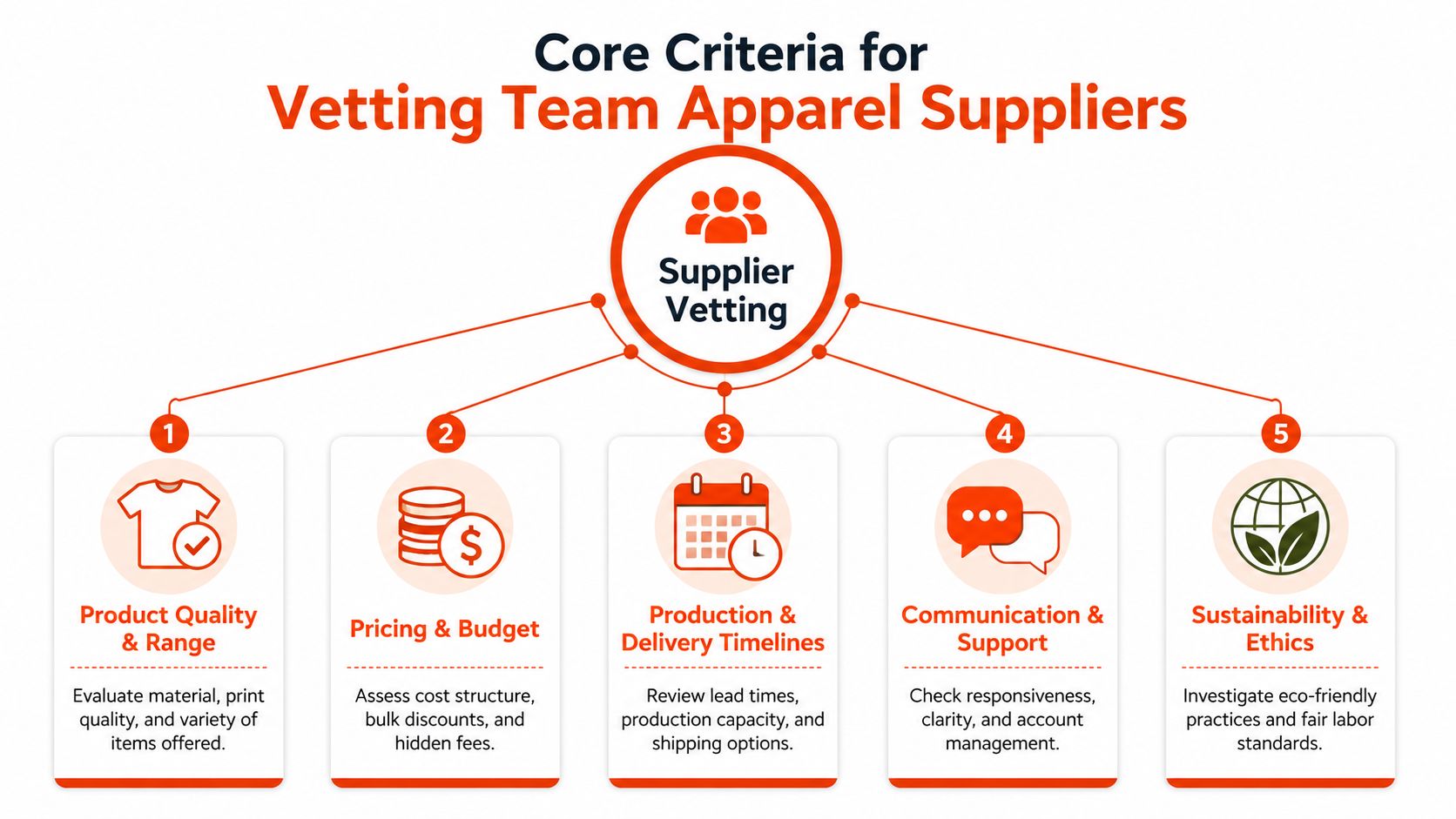
A supplier shortlist should answer one question fast: will this partner produce apparel your team wants to wear, or are they just packaging average blanks with polished sales language?
For distributed teams, this matters more than price per unit. Team apparel lives in Zoom frames, airport lounges, offsites, coworking spaces, and weekend photos. It signals taste. It shapes internal culture. A cheap garment with a decent logo still reads cheap.
A structured scorecard helps keep the review honest. A supplier selection case study in apparel manufacturing recommends evaluating suppliers across quality, delivery, and cost, and notes that suppliers with direct factory relationships can improve pricing and control. Use that framework, but weight quality and consistency harder than procurement teams usually do.
Here's a simple visual for the shortlist phase.
Pillar one is the blank
The blank is the product.
If the base garment feels flimsy, twists after one wash, or fits like leftover conference merch, the project is dead before decoration starts. Start by asking what the supplier is putting in your hands: fiber content, fabric weight, knit type, garment origin, wash treatment, and fit block. For heavyweight programs, use the common streetwear benchmark of roughly 350 GSM and up, as outlined in this guide to fabric weights for blanks and apparel.
Then ask for proof, not adjectives.
What to inspect first:
- Fabric hand feel
Dense, soft, brushed, dry, structured. They should describe the fabric like a product team, not a reseller. - Fit block
Boxy, relaxed, standard, cropped, dropped shoulder. Ask for measured spec sheets, not “unisex” as a catch-all answer. - Wash performance
Ask what happens after laundering. Shrinkage, torque, fading, and collar recovery matter. - Color quality
Black should look rich. Natural should look intentional. Heather tones should not read muddy. - Construction details
Neck rib, cuff tension, side seams, stitching consistency, inside finishing.
If you want a benchmark for decoration possibilities, this overview of custom embroidery services for branded apparel helps clarify what's possible across flat, raised, and specialty treatments.
Good suppliers can talk about blanks with precision. Great ones will also tell you when your selected garment is wrong for your target use case.
Pillar two is customization craft
Decoration is where good garments get improved or ruined.
A supplier's sample set should show restraint, technical judgment, and clean execution. Embroidery should sit flat and intentional. Screen prints should have the right hand feel for the fabric. Labels and patches should look like part of the garment, not an afterthought attached in a rush.
Use this quick comparison when reviewing samples:
| Method | Works best for | Watch out for |
|---|---|---|
| Embroidery | Caps, hoodies, polos, subtle premium branding | Stiff backing, puckering, oversized fills |
| Screen printing | Bold graphics, larger runs, durable visual impact | Heavy hand feel if over-inked |
| DTG | Detailed art on small to mid runs | Washed-out color on poor blanks |
| DTF | Flexible application across varied items | Plastic feel if overused |
| Patches and labels | Adds premium brand details | Cheap edge finishing |
Ask what they would reject. That answer tells you more than the sample deck.
If a supplier says yes to every placement, every fabric, and every technique, they are managing the sale, not the result. You want a partner who will stop you from putting dense embroidery on unstable fleece, oversized prints on low-grade cotton, or heat transfers on garments meant to feel refined.
Later, ask for physical samples. Digital mockups only confirm artwork position. They do not show thread tension, print texture, edge finishing, backing quality, or how the piece feels on-body.
This video gives a useful frame for thinking about supplier evaluation beyond surface-level sales talk.
Pillar three is the operating model
A supplier's structure affects quality as much as the sample does.
Many merch vendors are brokers. They sell the relationship, then pass production to factories you never see, sometimes through multiple layers. That setup creates risk fast. Unauthorized subcontracting, inconsistent finishing, and unclear accountability show up once the order scales, not during the first sales call.
Ask direct questions:
- Who owns production?
- Which steps are subcontracted?
- Will the same factory that made the sample make the bulk run?
- What certifications or audit records can they share?
- How do they handle quality control before shipment?
If your team ships into Canada, import handling matters too. This guide to importing textiles into Canada is a useful reference for understanding labeling, classification, and border requirements that can delay a program if your supplier is sloppy.
One example is Banger's custom merch model, which combines European-sourced premium blanks, French ateliers, low minimums, product previews within 24 hours, and a stated 10 to 15 business day end-to-end production and worldwide delivery window as listed in the Banger catalog. That model fits teams that care about product feel, fast iteration, and tighter control over the final result.
Pick the supplier whose operating model protects the brand, not just the budget.
Logistics for Distributed and Global Teams
Your new hire in Berlin gets a premium hoodie two weeks late. Your event crew in Toronto gets hit with customs confusion. Your SF office gets the bulk shipment first, so everyone else watches the drop happen in Slack before their package even exists. That is not a logistics problem. It is a culture problem.
Distributed teams experience merch one shipment at a time. If delivery is sloppy, the brand feels sloppy. A supplier needs to handle routing, customs, packaging, and reorders with the same care they put into the sample.

MOQ shapes the program
MOQ is not a back-office detail. It decides whether your merch system can support real team culture or just one big, forgettable bulk order.
Low minimums give you room to build in layers. You can run a small onboarding batch, test a heavyweight tee before committing to a full run, or create a limited drop for a regional offsite without sitting on dead inventory. High minimums push teams toward the safest option every time. That usually means generic styles, weak sizing coverage, and leftover stock nobody wants to wear.
Lead time matters just as much. A supplier that needs long production windows for every reorder will force your team into overbuying. Ask for their standard timing on samples, bulk production, and replenishment by SKU. Then ask what changes if you split shipments across countries.
Global fulfillment exposes weak operations fast
A nice sample can hide a bad fulfillment setup. Multi-country delivery cannot.
Ask operational questions that reveal whether they can run a distributed program without chaos:
- Can they ship one order to multiple individual recipients
- Can they separate office stock, event inventory, and employee sends
- Do they support delivered-duty options where needed
- Can they add branded inserts during fulfillment
- Who prepares customs paperwork and commercial invoices
- What happens when a package is lost, refused, or held at the border
If part of your rollout includes Canadian shipments, keep this guide to importing textiles into Canada close. It helps you catch labeling and border issues before they turn into delays.
Good operators also protect consistency after the first drop. That means stable blanks, repeatable decoration, and clean reorder workflows so a remote hire in month six gets the same product quality as the founding team got in month one.
If you are comparing vendors on fulfillment depth, this breakdown of merch fulfillment services for global teams is a useful screening tool.
Red Flags That Signal a Bad Supplier
Some suppliers don't fail loudly. They fail politely, one vague email at a time.
You'll see it in the slow replies, the unclear sample process, the weirdly perfect factory photos, and the refusal to answer simple production questions directly. None of that is random. It usually means they're hiding a weak operation.
Vague answers are the first warning
If you ask where production happens and they answer with brand language instead of specifics, that's a problem.
If you ask for timelines and get soft phrases like “usually fast” or “depends on complexity” without a real production window, that's also a problem. Same if they can't explain the difference between their sample stage and bulk stage in plain English.
A serious supplier should be able to tell you:
- what they make in-house
- what they outsource
- how approvals work
- what happens if a sample misses spec
- who owns communication once production starts
The fastest way to spot a weak supplier is to ask operational questions and watch how hard they work to avoid operational answers.
Unauthorized subcontracting can wreck the whole order
This is the risk most buyers ignore until it burns them. A supplier wins the order, then covertly passes production to an unvetted factory. Your garment quality shifts. Your finishing changes. Your compliance assumptions disappear.
That's not a fringe issue. Buyers can predict unauthorized subcontracting with over 80 percent accuracy by asking for specific factory validation, as covered in the UCLA Anderson Review piece on brand ignorance and subcontracting risk.
Ask for evidence that ties the supplier to the actual production site:
- Raw warehouse or factory floor photos taken for your order context
- Factory certifications linked to the producing site
- Previous work samples that match the technique you need
- A clear statement on whether any part of the order will be subcontracted
If they dodge those requests, move on.
If they avoid samples, leave
Digital mockups are not proof of quality. They're proof that someone knows Photoshop.
The biggest tell is when a supplier pushes hard toward bulk production before a physical sample is approved. That usually means they don't want scrutiny on fabric, stitching, color, placement, or finishing. The sample is where you catch the awkward neckline, the too-shiny thread, the tiny left-chest logo sitting way too high.
Run from suppliers who do any of this:
- Refuse physical samples when the order is high-visibility
- Send only polished renderings instead of atelier or production photos
- Rush approval pressure without letting you review details
- Treat revisions like a nuisance instead of part of quality control
A team apparel supplier should make quality visible before they make it expensive.
Your Ready-to-Use Supplier Decision Checklist
A supplier decision should take ten minutes in a meeting, not three follow-up calls and a messy postmortem. Good team apparel acts like a culture asset. Bad team apparel turns into dead stock, support headaches, and something your team wears once out of obligation.
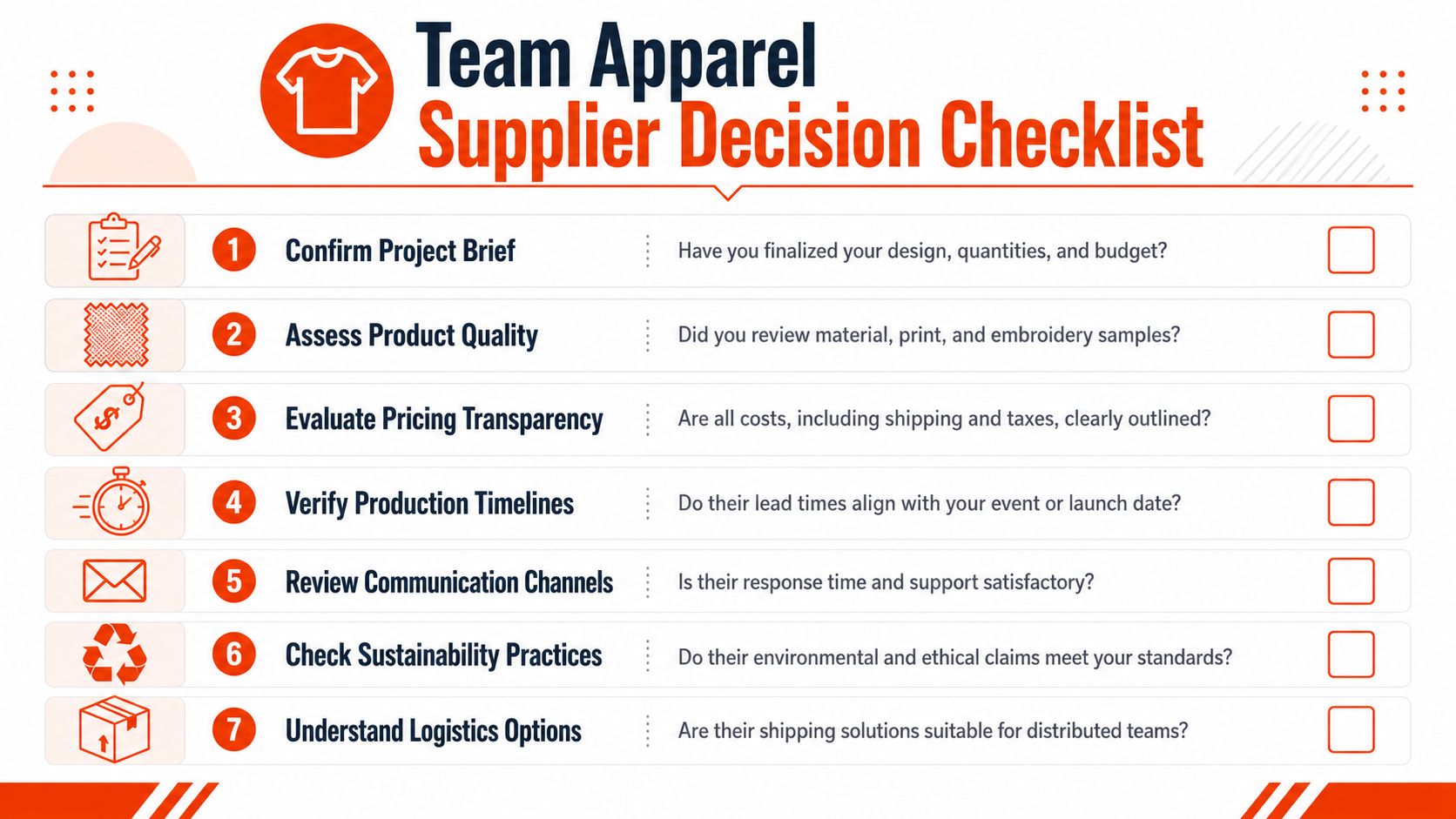
Use these questions before you approve anything
Is the brief finished
Product list, quantities, decoration method, budget range, and in-hands date should be locked before you compare vendors.Have you touched a real sample
If the order represents your brand, approve from a physical sample, not a rendering.Do you know who is making the product
Confirm the actual production site, not just the company taking your order.Can the supplier explain their pricing clearly
You should see where the money goes: blanks, decoration, freight, kitting, packaging, and any finishing details.Do their timelines match your launch reality
Ask for production and shipping timing based on normal conditions, with enough margin for revisions and transit.Can they handle distributed fulfillment cleanly
Global teams need accurate multi-address shipping, customs support, and consistent presentation from one box to the next.Would someone on your team wear this by choice
Comfort, fabric weight, fit, and finish matter more than squeezing a few dollars out of unit cost.
Use the checklist hard. If a supplier gets vague, slow, or defensive on multiple points, cut them from the shortlist.
If you want merch that feels closer to product than promo, take a look at Banger. It's built for distributed teams that care about premium blanks, low minimums, and worldwide fulfillment without the usual throwaway swag energy. Explore the catalog, request a quote, and review the response against the checklist above.