Mastering Custom Logo Embroidery in 2026
Most advice about custom logo embroidery gets one thing wrong. It treats embroidery like an automatic upgrade.
It isn't.
A stitched logo can make a garment feel more considered, more intentional, more worth keeping. It can also make it look like generic corporate merch pulled from a conference tote. The difference has less to do with the logo itself than with how the design, fabric, stitch style, scale, and placement come together.
The category itself keeps growing. The global embroidery market was valued at USD 3.3 billion in 2025 and is projected to reach USD 8.0 billion by 2034, driven by demand for personalized, high-quality items, according to Dimension Market Research's embroidery market report. So yes, embroidery is having a moment. That doesn't mean every brand should use it the same way.
For modern teams, the bar is higher. If you're building merch for hiring kits, creator drops, community apparel, or internal uniforms, the goal isn't just to "put the logo on the garment." It's to make something people actually want to wear next to the rest of their closet - including welcome gifts for new employees that don't feel like forced brand collateral.
Table of Contents
Embroidery Is More Than a Stitched Logo
Embroidery works best when you treat it like a material, not a file conversion. Thread has weight. It catches light differently than ink. It creates shadow, edge, and texture. That's why a small chest mark on a heavyweight hoodie can feel considered, while the same logo blown up on a soft knit can feel stiff and out of place.
A lot of bad merch comes from trying to force visual identity systems built for screens into stitches. Fine lines, small type, subtle gradients, dense icon systems. On a slide deck, they look clean. On a cap or polo, they collapse fast. The result isn't "premium embroidery." It's a logo fighting the medium.
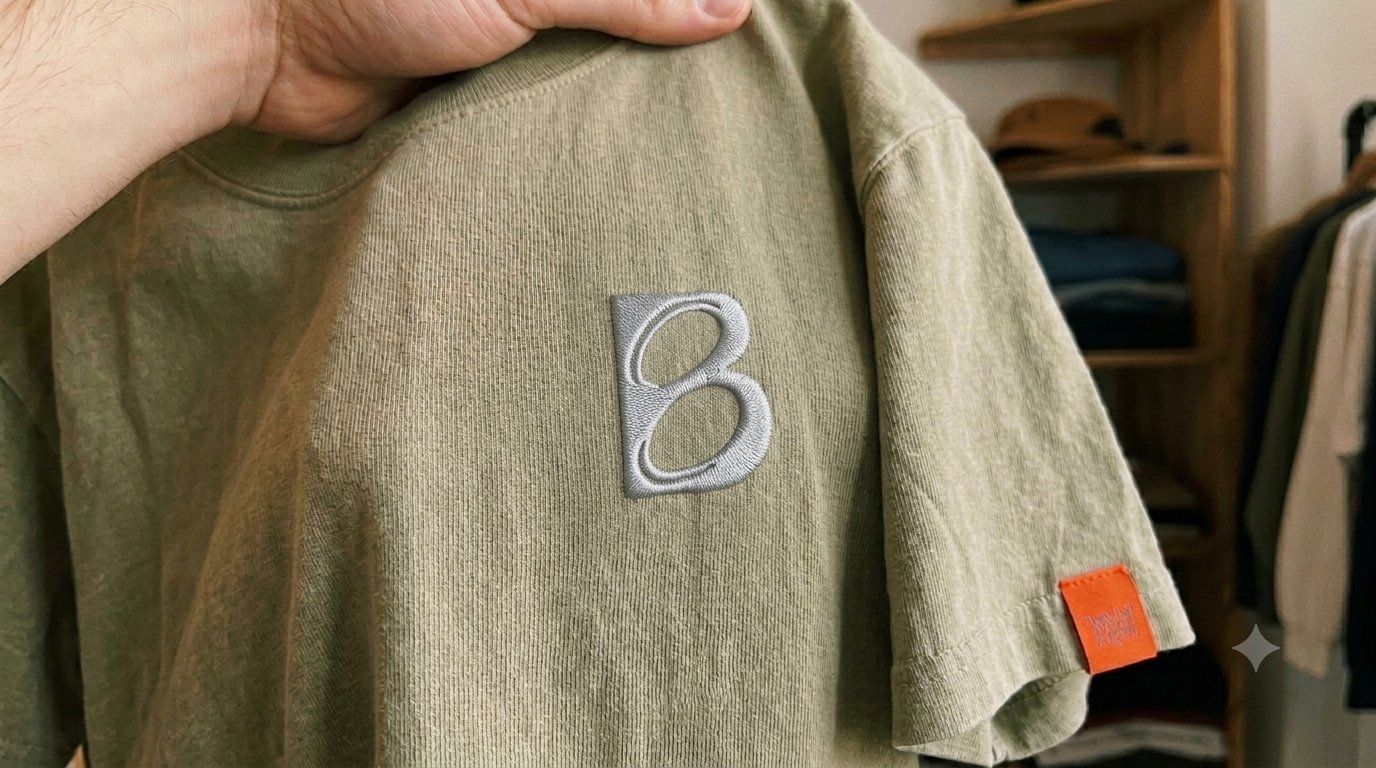
Here's an example from one of our own pieces. The B logo above is a flat embroidery on a garment-dyed sage green t-shirt - heavyweight cotton, washed for that lived-in texture, with the embroidery sitting just slightly raised against the fabric. The mark is sized to feel like part of the garment, not stamped onto it. Tonal but visible. That's the kind of detail you only get when the design is built for thread, not converted from a screen file at the last minute.
The premium look is usually restraint
The best custom logo embroidery often feels edited. Fewer details. Smarter thread choices. Better scale. More respect for negative space. That's true whether you're making staff uniforms, founder gifts, or a limited team drop.
Practical rule: Embroidery should add character to the garment. If it only adds branding, it's probably not enough.
There's also an aesthetic point that generic merch vendors tend to miss. Embroidery reads differently depending on the category. On caps, workwear jackets, and structured outerwear, stitched logos usually make sense because the garment already has shape and presence. On lightweight fashion basics, embroidery can start to look bulky or old-fashioned unless the mark is very considered.
Good embroidery looks designed, not default
The strongest embroidered pieces don't feel like someone clicked “premium decoration” in a checkout flow. They feel like the logo was adapted for thread on purpose. That usually means changing size, simplifying detail, and sometimes choosing embroidery for one product while using print for another.
That's the real mindset shift. Custom logo embroidery isn't a status upgrade. It's a design choice.
The Main Embroidery Styles Decoded
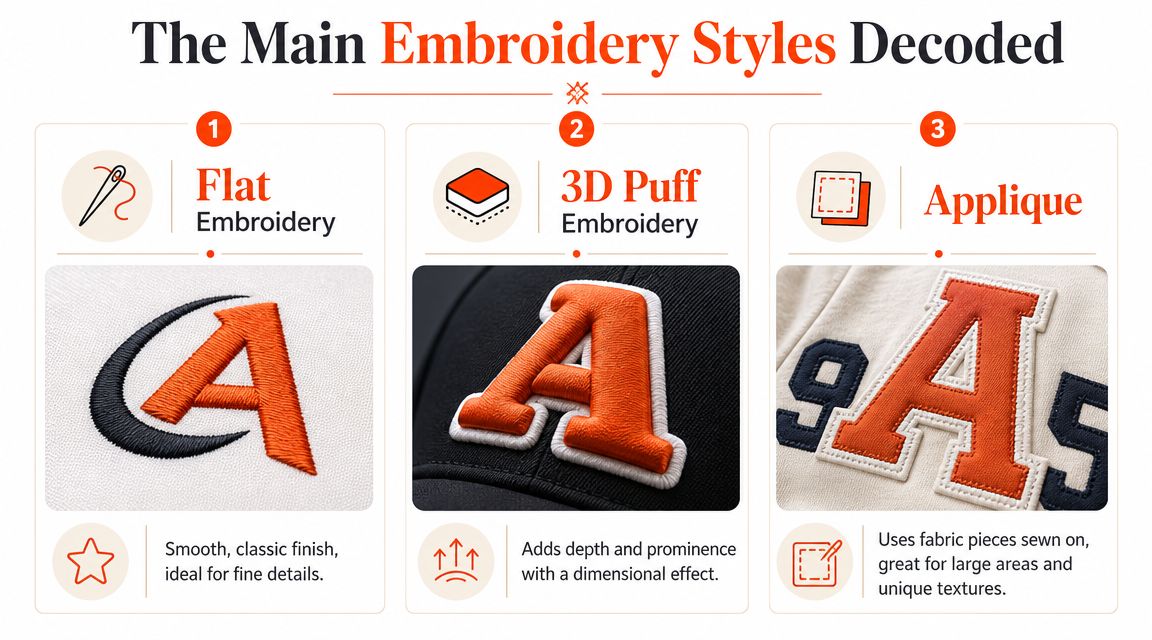
Different embroidery styles don't just change production. They change the vibe of the product.
If you're choosing decoration for branded apparel, it helps to think like a designer instead of a buyer. Ask what kind of visual language fits the garment. Crisp and understated. Bold and raised. Retro and tactile. Modular and patch-like. The stitch style should match that answer.
For a broader overview of decoration methods across merch, this guide to merch printing techniques is useful context before you commit to embroidery.
Flat embroidery
Flat embroidery is the baseline. No foam, no raised effect, no patch edge. Just thread stitched directly into the garment.
This is usually the cleanest option for left chest logos, sleeve hits, cap side marks, and understated brand applications. It works well when the logo already has a strong silhouette and doesn't need extra drama. Done right, flat embroidery feels classic, not boring.
Use it when:
Your logo is simple: Clean wordmarks, symbols, and monograms usually translate best.
You want a subtle finish: Especially on polos, overshirts, quarter-zips, and premium hoodies.
The garment already has texture: Heavy fleece, brushed cotton, and twill don't need a raised logo to feel substantial.
A flat embroidered logo is often the safest move for brands that care about longevity. It ages well.
A quick visual reference helps here:
3D puff embroidery
3D puff uses foam under the stitches to lift parts of the design off the surface. It's louder, more graphic, and usually better on structured products.
Think snapbacks, trucker caps, and certain heavyweight hoodies. Puff can look great when the logo is bold and blocky. It usually looks bad when the artwork is intricate, narrow, or dependent on fine internal spacing.
Raised embroidery needs room. Tight counters, thin strokes, and delicate serifs usually lose that battle.
The effect works because it exaggerates form. So give it form to work with.
Chenille and patches
Chenille has that fuzzy, varsity-style texture people associate with letterman jackets and vintage sportswear. It's less about precision and more about attitude. If your brand language leans collegiate, nostalgic, or streetwear-adjacent, chenille can hit hard.
Patches sit in a different lane. They're useful when you want a badge-like application, a bordered shape, or a modular look that feels separate from the garment itself. They can also solve design problems that direct embroidery can't solve cleanly.
A simple comparison makes the choice easier:
| Style | Best for | Watch out for |
|---|---|---|
| Flat embroidery | Minimal logos, chest marks, sleeves | Tiny text and over-detailed artwork |
| 3D puff | Bold cap logos, graphic initials | Fine detail, thin lines |
| Chenille | Varsity-inspired designs, statement branding | Precision logos that need sharp edges |
| Patches | Badge graphics, outerwear, tactical or workwear feel | Looking too separate from the garment if overused |
The right style doesn't just decorate the garment. It sets the tone.
Matching Your Design to the Garment
A logo can be perfectly digitized and still fail on the wrong garment. Fabric changes how thread sits, how the surface pulls, and how clean the edges look after stitching. That's why custom logo embroidery should always be judged on the actual product, not in isolation.
If you're developing embroidered hoodies specifically, this breakdown of the best hoodie blanks helps frame why fabric weight and surface matter so much.
Fabric changes everything
A heavyweight hoodie can carry a denser embroidered logo because the body fabric has enough structure to support it. A lightweight knit tee can distort under the same stitch load. A pique polo can make clean edges look slightly more broken because the surface already has texture. Nylon shell fabrics can show needle marks and tension issues more visibly than brushed fleece.
The stitch file might be the same. The outcome won't be.
One practical industry note is worth keeping in mind here. Stitch density, direction, and underlay need to be tuned to the fabric to reduce puckering, thread breaks, and misregistration, as noted in the earlier embroidery guidance. That's why a logo approved on one garment shouldn't be blindly reused across caps, polos, hoodies, and woven accessories without testing.
A few common realities:
Structured caps love bold embroidery: The crown supports shape well, especially for clean marks and raised applications.
Polos reward restraint: Small chest logos usually look better than large decorative placements.
Heavy fleece can carry more texture: Good for left chest embroidery, sleeve accents, or patch applications.
Textured fabrics punish tiny detail: Small type fills in fast.
Placement is part of the design
Placement isn't just where the logo fits. It changes how the garment reads when worn.
A left chest logo feels institutional, in a good or bad way depending on execution. A sleeve hit feels more contemporary. A center-front embroidered mark can feel streetwear-informed if the scale is right. A large back embroidery needs serious caution because too much stitch coverage creates a stiff panel that can wear poorly and look heavy.
Approve a real sample on the final garment and final placement. Embroidery behaves differently on a cap front, a polo chest, and a hoodie pocket area.
That last point matters more than people think. The best-looking embroidered merch usually comes from brands that choose placement with the garment's silhouette in mind, not from brands that just repeat one logo position across every SKU.
Embroidery vs Printing When to Choose Each
Embroidery isn't the premium option. It's one premium option.
That distinction saves a lot of merch from going in the wrong direction. If your team wants apparel that feels considered, the question isn't “How do we embroider this?” The core question is “What decoration method gives this garment the best final look?”
Choose embroidery when texture helps
Embroidery makes sense when the physicality of thread adds value to the piece. Caps are the obvious example. So are polos, workwear jackets, overshirts, and many heavyweight hoodies. These garments usually have enough structure to support stitching, and the tactile finish can make a logo feel embedded instead of applied.
It also works well when the artwork is simple. Monograms, icon marks, clean type, and compact symbols usually benefit from thread because they gain dimension without losing identity.
Choose print when detail matters more
Some logos should not be embroidered. That isn't a downgrade. It's good design judgment.
A useful point from 92 Threads' custom embroidery page is that embroidery is often treated as the default for polos and caps, but it can struggle with small text on textured fabrics and can look bulky on modern, fashion-grade garments where a refined print may be the better choice. That tracks with what good merch teams already know. Lightweight tees, soft jerseys, detailed illustrations, gradients, and large front graphics usually look cleaner in screen print, DTG, or DTF.
A side-by-side view makes the decision easier:
| Use case | Better choice | Why |
|---|---|---|
| Small chest logo on polo | Embroidery | Texture and durability suit the garment |
| Bold logo on structured cap | Embroidery | Shape and stitch depth work together |
| Large back graphic on tee | Better drape and graphic detail | |
| Gradient-heavy artwork | Thread can't reproduce that effect cleanly | |
| Tiny type on textured fabric | Better legibility | |
| Minimal icon on heavyweight hoodie | Either | Depends on the look you want |
Good brand merch often mixes methods. The cap gets embroidery. The tee gets screen print. The heavyweight hoodie might get a subtle stitched chest mark and a printed back graphic. That's not inconsistency. That's using the medium properly.
The Vendor Checklist What to Ask Your Supplier
A supplier can show nice mockups and still deliver weak embroidery. The only way to avoid that is to ask better questions.
Questions that reveal quality fast
Start with proof of execution, not promises.
Can you show real stitch-outs, not just digital mockups? Mockups say almost nothing about thread tension, edge definition, density, or backing quality.
Do you adapt artwork for embroidery, or do you just convert it? A strong supplier will talk about simplification, stitch type, and garment-specific adjustments.
Will I approve a real production proof or photo sample before the full run? That step catches the issues that screens miss.
How do you handle different garments for the same logo? If the answer suggests one stitch file for every product, that's a red flag.
What are your minimums and reorder process? This matters if you're producing for team onboarding, events, or staggered campaign drops.
Then ask operational questions that affect the experience:
What's the turnaround like from proof approval to delivery?
Can you ship to multiple addresses if the team is distributed?
Do you offer other decoration methods if embroidery isn't the right call?
Can you help choose blanks that suit the decoration?
Who reviews the artwork before production starts?
The best merch partners don't push embroidery onto every product. They tell you when not to use it.
If you're comparing options, this guide on choosing a premium custom merch supplier is a solid benchmark for what a serious partner should be able to handle.
Your Custom Embroidery Questions Answered
How is embroidery pricing usually calculated
Embroidery cost usually follows stitch count, because stitch count affects machine time and complexity. According to RushOrderTees' embroidery logo design guide, each standard letter can add around 100 stitches, and most setups are optimized for around 1 to 6 thread colors per placement. That's why simple logos often produce cleaner results and easier pricing than dense, multi-element artwork.
A practical way to control cost without hurting the design is to simplify the embroidered version of the logo. Remove micro text, reduce unnecessary color changes, and avoid tiny decorative details.
How should embroidered garments be cared for
Treat embroidered apparel like a finished garment, not a piece of hardwearing equipment. Wash it inside out, use a gentle cycle when possible, and skip aggressive heat. High heat can stress both the fabric and the backing over time.
For premium pieces, it's also smart to avoid overpacking the washer or dryer. Embroidery holds up well when the garment itself is cared for well.
Can complex logos or gradients be embroidered
Usually, not cleanly.
Embroidery is strong at shape, edge, and texture. It's weak at gradients, photographic detail, and very fine complexity. If the logo depends on tonal transitions or intricate micro-elements, print is usually the smarter route. Another good option is building an embroidery-friendly version of the logo for specific garments instead of forcing the full master brand mark into thread.
The best custom logo embroidery projects don't ask thread to behave like ink. They use thread for what it does best.
If you want custom merch that gets the details right - from the blank to the final stitch, Banger is built for that. Embroidered hoodies, caps, polos, jackets, and more - made in France's best production ateliers, with low minimums, worldwide fulfillment, and direct factory pricing. Get a free, no-commitment quote with product previews in 24 hours.