Recycled Tissue Paper: A Buyer's Guide for Modern Brands
Most advice on recycled tissue paper starts in the wrong place. It treats the sheet like an ESG checkbox, when the real decision is tighter than that, it's a packaging spec that has to survive photography, shipping, and supplier scrutiny without turning your unboxing into a compromise. If the tissue looks cheap, prints badly, or falls apart in production, nobody gives you points for the sustainability paragraph.
That's why the useful question isn't “Is recycled tissue good?” It's “What grade, what print method, what compliance level, and what end-of-life story can your team stand behind?” For brands that care about how the box lands in the hand and on camera, the answer lives in the details, not the slogan.
Table of Contents
Why Recycled Tissue Paper Is a Spec Decision, Not a Green One
A lot of teams buy tissue paper like they're buying a moral victory. That's sloppy. The people who get judged on the result, Heads of Marketing, Events Leads, merch managers, know the issue is whether the sheet supports the box, the brand, and the production line at the same time.
What gets judged in the real world
The box gets photographed, opened, stacked, shipped, and sometimes dissected by customers on social. A recycled tissue paper choice that looks flat, tears too early, or prints muddy is not a “nice sustainability choice,” it's a production miss. For a merch stack, that matters as much as the logo placement.
Practical rule: if the tissue can't survive the warehouse, the content calendar, and the unboxing video, it's the wrong spec.
The strongest case for recycled tissue is operational, not sentimental. The material is already mainstream in U.S. tissue manufacturing, with more than 90% of U.S. tissue manufacturers using recycled paper and tissue producers using about 3.9 million tons of recycled paper in 2023 according to the American Forest and Paper Association's tissue industry data. That means you're not spec'ing a novelty. You're using a material that sits inside an established supply chain.
Why this matters for brand teams
If you're building branded packaging, think in layers. The sheet has to hold color, maintain drape, and fit the box design. If you want a simple reference point for how recycled paper gets used across packaging formats, packaging materials on paper is a useful starting read.
For teams that also want a coordinated folder or insert system, the same logic applies to the rest of the packaging stack. A piece like this recycled paper folder works only when the material, finish, and logistics line up.
The bottom line is simple. Recycled tissue is a packaging decision with an ESG upside, not an ESG decision with packaging hopes attached.
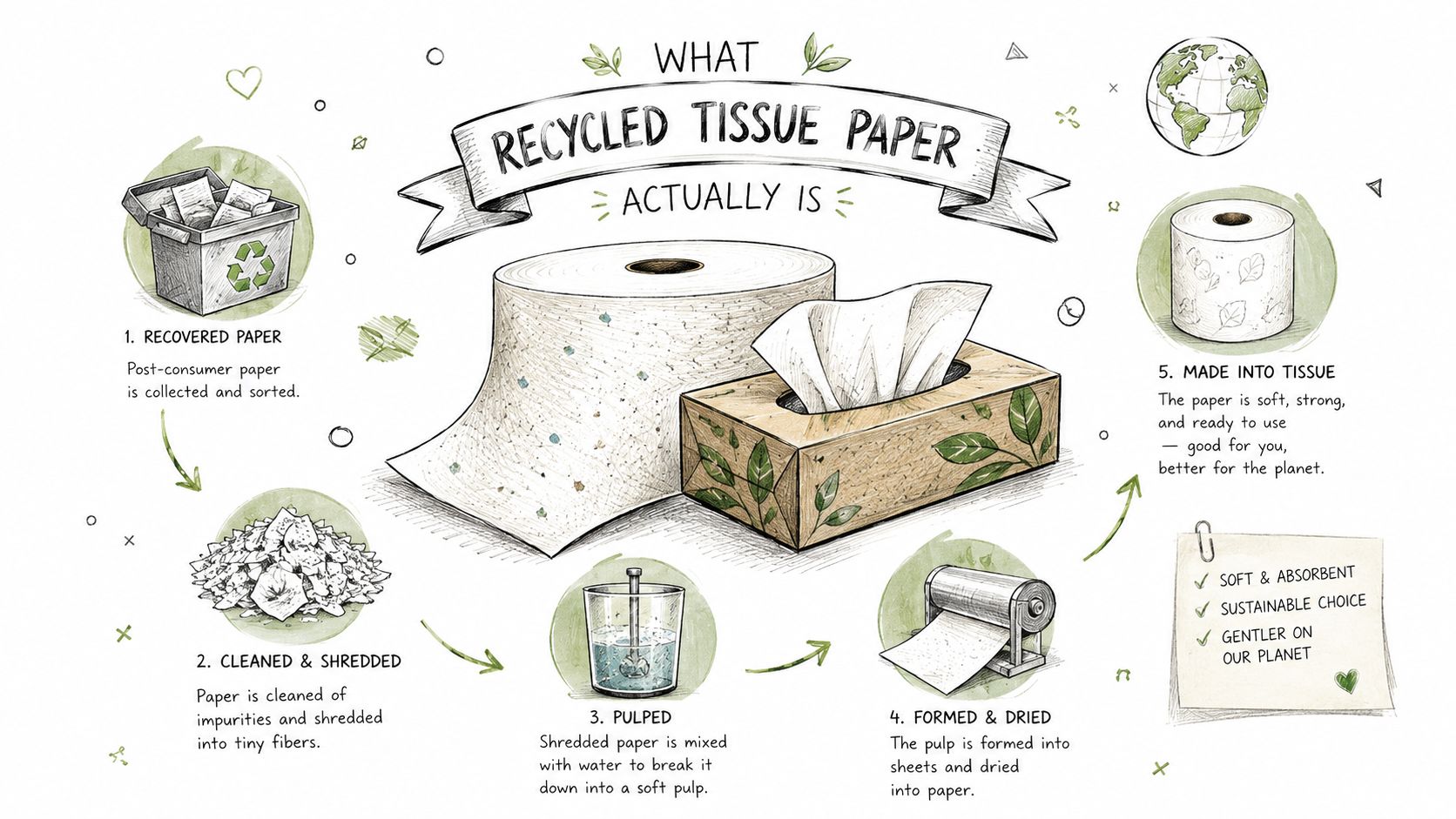
What Recycled Tissue Paper Actually Is
“Recycled” gets used loosely in packaging decks, and that's where teams get burned. In practice, recycled tissue paper can come from post-consumer fibre, which is paper that has already lived a previous life, or pre-consumer fibre, which is mill offcuts and trims that never became a finished consumer product. Those aren't the same thing, and suppliers should be clear about which one they're using.
Reading a spec sheet without guessing
If a vendor says “eco-friendly tissue,” ask them what the fibre source is, whether the sheet is certified, and what the print or dye system looks like. If they can't answer in plain language, they're probably selling a story, not a spec. A good quote should spell out fibre source, basis weight, finish, and compliance notes without making you decode half the carton industry.
Good sourcing language is boring. If the sheet needs a poetry reading to explain it, the supplier probably skipped the parts that matter.
FSC Recycled style claims matter operationally. They aren't just nice logos, they help separate recycled fibre claims from vague “made with recycled content” talk that can mean almost anything. The same goes for end-of-life wording. Recycled content and recyclable are different claims, and mixing them up is how brand teams end up overpromising.
What to ask before you approve a run
Ask three things before you sign off:
- Fibre origin. Is it post-consumer, pre-consumer, or a blend?
- Finish behavior. Will the tissue accept print cleanly, or will the stock absorb too aggressively?
- Use case. Is the sheet meant to wrap, fill, or decorate?
If you're comparing it to other paper formats in a merch system, the logic is similar to choosing a stock for a folder, but tissue is more sensitive because it's thin and visually exposed. That's why a generic “100% recycled” badge isn't enough. You need to know whether the sheet will perform in the box.
The Real Environmental Math Behind Recycled Tissue
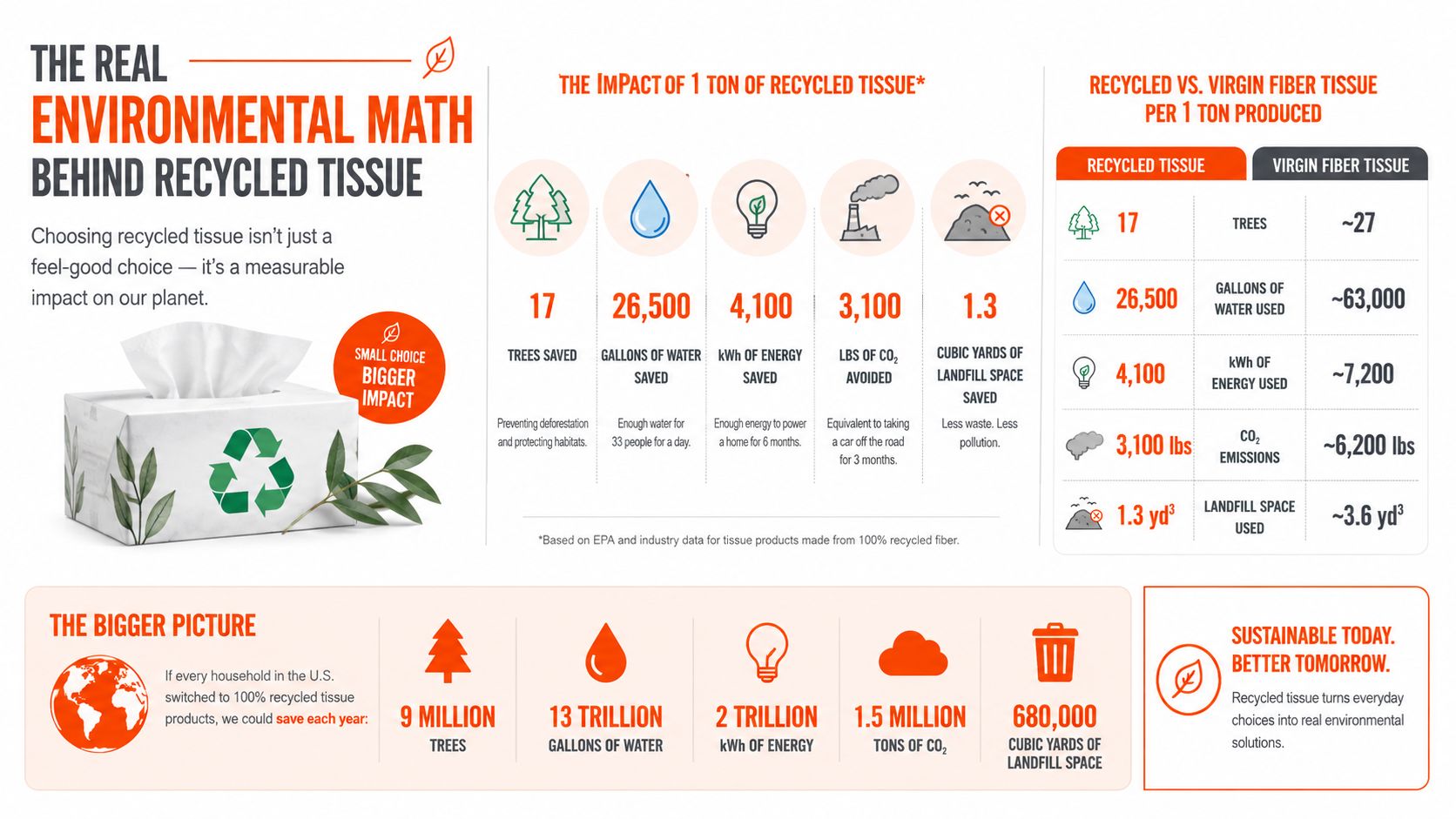
The cleanest sustainability claims are the ones that survive arithmetic. For recycled tissue paper, the numbers are strong enough that you don't need to oversell them. A San Diego sustainability fact sheet says every ton of 100% recycled paper saves an estimated 4,100 kilowatt-hours of energy, 7,000 gallons of water, and 60 pounds of air pollutants. It also says that if recycled materials weren't used to manufacture bathroom tissue, 3.5 tons of virgin wood would be needed to make one ton of bathroom tissue, according to the City of San Diego's tissue and towel fact sheet.
What that means for a packaging drop
You don't need to turn a merch deck into an engineering memo, but you do need to be able to defend the material choice. If your unboxing program uses tissue as a recurring packaging layer, those savings scale across every replenishment cycle. The claim is credible because the source is tied to the material itself, not to a vague brand promise.
A useful way to frame it in a deck is this, a recycled tissue spec reduces dependence on virgin fibre and delivers measurable resource savings every time the material replaces a virgin-pulp equivalent. That's the kind of sentence finance, marketing, and sustainability can all live with.
Why tissue matters inside the broader paper system
The EPA's paper-and-paperboard data show why the category deserves attention. In 2018, the United States generated 67.4 million tons of paper and paperboard in municipal solid waste, 46 million tons were recycled, and the recycling rate was 68.2%, the highest of all material categories tracked that year. Within that system, nondurable paper goods excluding newspapers had a much lower recycling rate of 43.1%, which is exactly why tissue, towels, and similar short-life paper products matter for procurement and waste diversion. That data is from the EPA's materials summary for paper and paperboard as quoted in the AF&PA tissue industry context.
For packaging teams, the takeaway is blunt. Recycled tissue isn't symbolic. It's one of the few paper decisions where the resource story is easy to explain and hard to dismiss.
GSM, Weight, and How the Sheet Actually Behaves
GSM is where good intentions meet reality. Recycled tissue paper is typically engineered in the 10 to 35 GSM range, and commercial packaging grades often land around 18 to 20 GSM with a bulk of about 1.1 cc/gm, according to the tissue paper specification range at G World Papers. That's the range buyers should be working in, not some abstract “lightweight” idea.
Pick the weight for the job, not for the brag
Lower GSM cuts material use and cost, but it also pushes harder on runnability and tear resistance. If the sheet is too light, it looks delicate in the wrong way and can fail during packing. If it's too heavy, you lose that airy unboxing feel and you pay for paper you don't need.
Short version: choose the lightest sheet that still survives the way your team packs, ships, and presents the product.
The right answer depends on the role the tissue plays. A single-sheet wrap for apparel doesn't need the same structure as layered filler or a decorative outer wrap. If you're trying to benchmark this against other paper specs, a resource like paper weight for business cards helps calibrate how stock weight changes the feel and behavior of printed paper without pretending all paper types perform the same way.
GSM ranges and what they're actually good for
| GSM Range | Typical Use | Trade-Off |
|---|---|---|
| 10 to 14 GSM | Very light wrapping, soft interior layers | Lower material use, but weaker tear resistance |
| 15 to 20 GSM | Most branded tissue wraps and packaging sheets | Balanced feel, better runnability |
| 21 to 35 GSM | More decorative or protective applications | Better structure, but less delicate and more material-heavy |
If you're spec'ing for a modern merch program, 18 to 20 GSM is usually the safe center of gravity. It gives you enough body to handle, enough softness to photograph well, and enough stability to pack without the sheet collapsing on itself.
For teams comparing paper properties across other branded materials, this GSM reference on fabric weight is a handy mental model. The core idea is the same, the number only matters when it matches the way the material is used.
Print Methods That Actually Work on Recycled Fibre
Customization is where tissue projects fail. The mockup looks clean, the sample looks premium, and then the production run turns into a muddy, over-absorbed mess because the stock and the print method never belonged together. Recycled fibre changes the way ink sits, so you need to choose the print process with the material in mind.
What survives recycled stock
Flexo works when the design is simple and the supplier knows how to control ink laydown. Digital can be useful for smaller runs or variable graphics, but recycled tissue can expose dot gain quickly if the stock drinks the ink too fast. Screen printing gives stronger coverage for bolder marks, while hot-foil or spot effects should be used carefully and only when the sheet and finish can support them.
The compliance side matters too. EU tissue-paper eco-criteria require recycled-fibre products to stay below formaldehyde 1 mg/dm2, glyoxal 1.5 mg/dm2, and PCP 2 mg/kg, and they also require no bleeding from dyes and optical brighteners, according to the EU tissue paper eco-criteria draft. That's not just paperwork. Recycled feedstock can carry more process chemistry, so supplier testing and finishing choices affect whether the sheet is safe for premium packaging use.
The supplier questions that save you
Ask these before you approve a custom run:
- Ink behavior. Will the color stay crisp on recycled fibre, or will it spread?
- Surface treatment. Has the stock been prepared for the print method?
- Chemistry limits. Can they document the residue limits and bleed performance?
- Finish compatibility. Are foil, labels, or overprints going to hold without cracking?
If you're building a broader branded packaging system, one option is to keep the tissue simple and move your decoration to labels or inserts. That's often the cleaner move when the material is already doing the job of visual softening inside the box.
For teams exploring finishing decisions more thoroughly, foil hot stamping is a useful reference point for what premium finishing can do, and where it can start to fight the substrate instead of improving it. A smart merch lead doesn't chase effects, they match effect to material.
Why “Recycled” Does Not Mean “Recyclable”
This is the part most guides skip, and it's the part customers get wrong. Recycled tissue paper is not automatically recyclable at the end of its life. In practice, most municipal programs reject tissue paper, plain or decorative, and tell people to check local rules first. The reason is simple, the fibres are short, the sheets are lightweight, and coatings or dyes can complicate sorting. That reality is echoed in the consumer guidance from Papermart's tissue paper recyclability guide.
What to tell customers without overpromising
Don't call it curbside recyclable unless the local program explicitly accepts it. Don't imply that recycled content automatically makes disposal easy. That language sounds green in a deck and sloppy in the world.
Say this instead: the tissue contains recycled fibre, and disposal depends on local rules. Reuse first, compost where accepted, and avoid curbside recycling unless the municipality allows it.
That's the honest version, and it's better for trust. If the tissue is uncoated and undyed, composting may be a better path than curbside recycling, but you still need to match that claim to the actual decoration and your buyer's local infrastructure.
The brand-safe messaging stack
Use a simple hierarchy in customer-facing copy:
- Reuse it. Wrap, store, or pack with it again.
- Compost it if the sheet is plain and local rules allow.
- Dispose normally if neither of those options works.
That keeps the brand out of the fake-eco trap. It also gives operations and support teams a clean answer when customers ask what to do with the tissue after unboxing.
The Lifecycle Case That Actually Holds Up
If you want the strongest argument for recycled tissue paper, use lifecycle data, not adjectives. A 2022 updated life-cycle assessment found recycled tissue paper had 70% lower total environmental impact and 97% lower renewable impact than non-integrated virgin tissue papers, with at least 30% to 60% lower impacts in acidification and terrestrial eutrophication, according to the updated lifecycle assessment spotlight report.
Where the case gets strongest
That kind of gap is big enough to matter in a brand decision. It means recycled tissue can carry a clearly defensible lower-impact profile than virgin-fibre alternatives, especially when the comparison is about the full life cycle rather than a single factory stage. For a marketing team, that's the kind of evidence that can support a real sustainability slide instead of a vague green claim.
A comparative life-cycle study also found tissue made from virgin pulp produced about 30% more greenhouse-gas emissions than tissue made from recycled waste paper, equal to 568 kg CO2-eq more per kilogram of tissue paper, according to the Springer life-cycle comparison. That's a clean contrast. Virgin tissue carries a heavier emissions burden, even if recycled processing has its own costs.
The caveat brands should not ignore
Recycling isn't lossless. A thesis on tissue production from paper-for-recycling notes that while tissue can be made entirely from recovered fibre, the deinking process loses 10% to 40% of fibre because the fibres are damaged during processing, based on the Takala thesis on tissue production from paper-for-recycling. That matters because recycled content comes with a performance and yield trade-off, especially when brands push for very high recycled percentages.
So the honest position is this. Recycled tissue has a real lifecycle advantage, but it's still a material that needs to be spec'd carefully. The win is strong, not magical.
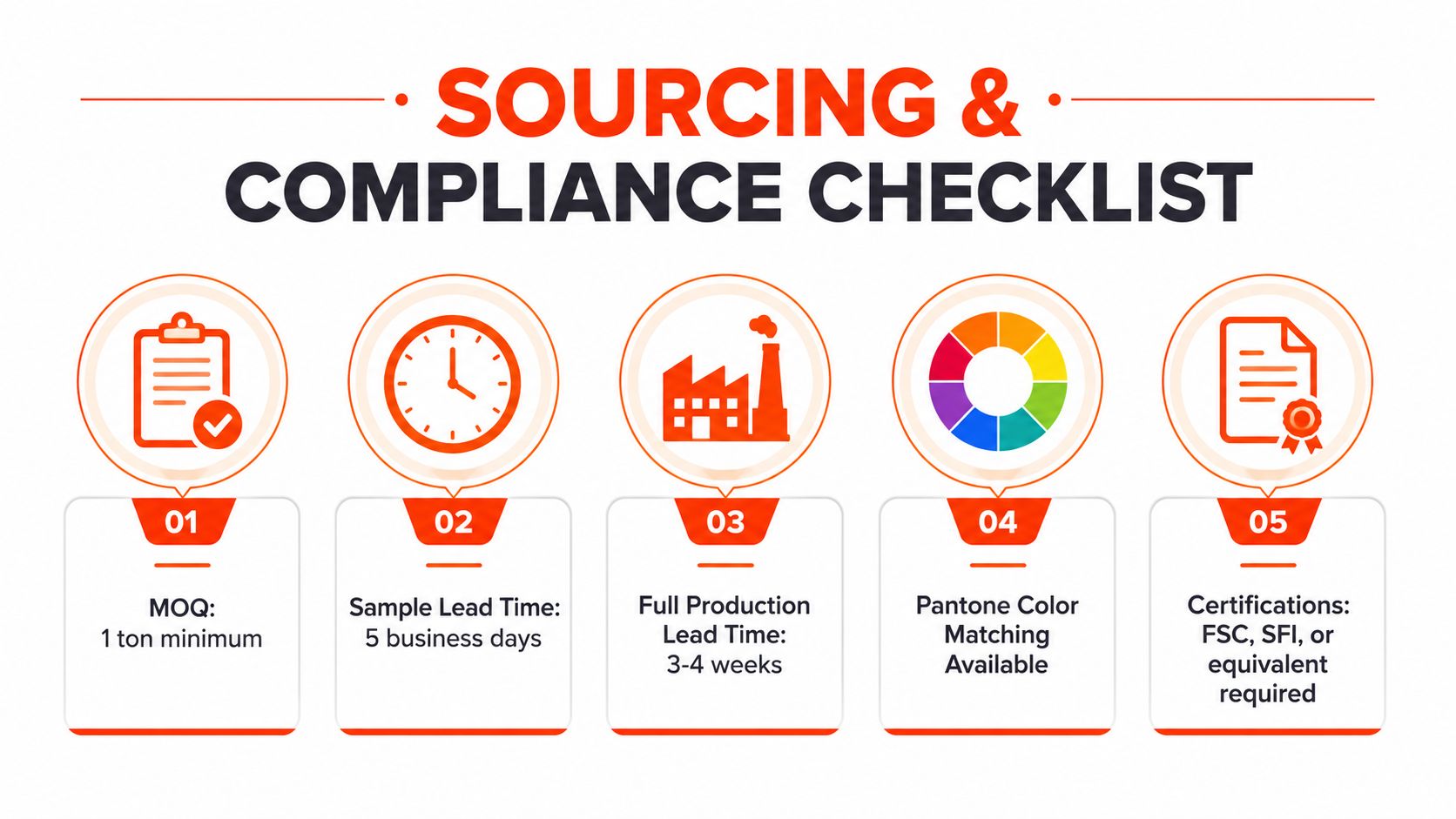
Sourcing, MOQ, Lead Time, and a Clean Compliance Checklist
This is the section an ops lead saves. Recycled tissue paper looks simple until you're trying to source it at speed, in the right shade, with the right print, and with compliance docs that won't get your procurement team stuck in email purgatory. Start by asking for the basics, then move to the details that protect you from surprises.
The checklist that should be on every supplier call
- Minimum order quantity. Ask what the MOQ is before you approve artwork.
- Sample timing. Confirm when a physical or digital proof lands.
- Production lead time. Get the turnaround, not the optimistic one.
- Color matching. Ask whether Pantone matching is available on the chosen stock.
- Compliance documents. Request FSC Recycled, EU eco-label, or equivalent paperwork where relevant.
- Chemistry testing. Verify residue and bleed limits for printed stock.
- End-of-life language. Make sure the disposal claim matches the material and the market.
Do not ship a tissue spec without the disposal sentence. If the packaging story ends at the box, customers will fill in the missing part themselves.
If you're building packaging around apparel, inserts, or event kits, custom apparel packaging is a good reference for how the broader unboxing system should hang together. Tissue doesn't live alone. It sits inside a box architecture, and that architecture has to make sense end to end.
Where a real merch workflow helps
A useful production partner should be able to show you sample previews quickly, quote across low minimums, and manage different address destinations without drama. Banger's workflow fits that logic, with a free no-commitment quote, product preview in 24 hours, and production plus worldwide delivery in 10 to 15 business days, alongside options for multi-address shipping and standard or stablecoin payment. That's not special because it sounds nice, it's useful because packaging decisions often sit inside a broader merch launch, not in isolation.
When you source tissue, think like a producer, not a sustainability brochure writer. The right sheet is the one that meets the spec, prints cleanly, ships on time, and doesn't force your team to bluff on compliance.
If you're spec'ing recycled tissue paper for a launch, ask for the material proof, the print sample, and the disposal language before you approve the run. Banger can help you build the full unboxing stack around that spec, from tissue and inserts to branded packaging that ships clean. Visit Banger to request a quote and get a product preview for your next drop.