Biodegradable Mailers: A No-Greenwash Guide
Most advice on biodegradable mailers starts in the wrong place. It assumes the bag itself is the win, when the key variable is what happens after the customer opens it. If your mailer can only break down in a controlled facility, but your buyers are in cities where that facility doesn't exist or won't take the packaging, you haven't solved much.
That's why the packaging conversation gets messy fast. Biodegradable sounds clean, but without disposal context it's just a material description, not an outcome. In practice, the better question is simple, where does this mailer go after shipping, and who can process it?
Table of Contents
Why Biodegradable Mailers Are Not the Easy Win Everyone Thinks
The packaging world likes tidy labels, and biodegradable is one of the most misleading when it appears without disposal context. A mailer that can break down in a controlled composting system is not the same thing as a mailer that disappears in a landfill, or in a curbside waste stream where no composting path exists. The material claim may be real, but the operational outcome is often underwhelming.
The problem is the end-of-life system, not the slogan
A useful place to start is the market signal. Analysts at market estimate project the broader home-compostable mailer category to reach $0.4 billion in 2025 and $1.0 billion by 2034, with a 12.8% CAGR over the forecast period. The same source puts bioplastics at 45.2% of material-type share and Asia Pacific at 42.8% of revenue in 2025. That points to a real category with real production scale, not a fringe experiment.
The same numbers also make the trade-off clear. A certified home-compostable mailer may biodegrade within 180 days in active home-composting systems at 20–30°C, but that timing depends on the actual system and conditions, not the label on the bag. If the customer has no compost pile, no accepted collection route, or a local program that rejects the format, the claim does little after fulfillment. That is why disposal infrastructure matters more than the wording on the spec sheet.
Practical rule: if the disposal path is not clear to the customer, the sustainability claim is doing more branding than work.

The bigger mistake is comparing biodegradable mailers only against old plastic mailers. The more useful comparison is infrastructure against infrastructure. The U.S. recycling rate for LDPE/LLDPE mailers is reported at just 2%, with 88% landfilled and 10% combusted, while the broader U.S. plastic packaging recycling rate sits at 13.3% and has not moved since 2018 (recovery data). That is the reality many brand teams never see until they review what happens after the parcel leaves the warehouse.
For a practical breakdown of material options and disposal assumptions, the PSC TRADING packaging guide is a useful neutral reference. If you are looking at how sustainable materials show up in branded shipping and merch programs, the same conversation comes up in discussions of environmentally friendly promotional items.
Biodegradable vs Compostable vs Recyclable vs Oxo-Degradable
These four labels get used interchangeably in supplier decks, but they should not be. Each one points to a different disposal path, a different level of proof, and a different risk once the parcel leaves your warehouse. Procurement teams that blur them usually end up with packaging that looks responsible and behaves like a liability.
The cleanest way to separate the claims
Biodegradable means a material can break down over time under specific conditions. That definition is broad, and that is the problem. Compostable is tighter, because it means breakdown into non-toxic organic matter under defined conditions and certified pathways. Recyclable means a material can be reprocessed through existing collection systems, though that does not mean it will be. Oxo-degradable is conventional plastic with additives that fragment, which is why it is restricted or banned in many markets and can create microplastic problems rather than solving them.
The commercial reality is harsh for recyclable thin-film mailers. In the U.S., LDPE/LLDPE mailers are reported at just 2% recovery, with most ending up in landfill or combustion, which is why many brands start looking at compostable alternatives in the first place. But compostable is not automatically better if the end-of-life route does not exist locally.
| Mailer Type | Breakdown Mechanism | Required Conditions | Certification Standards | End-of-Life Reality |
|---|---|---|---|---|
| Biodegradable | Breaks down over time | Varies widely, often environment-dependent | Claims should be backed by a defined pathway | Often vague without disposal controls |
| Compostable | Converts to compost under certified conditions | Industrial or home composting, depending on claim | ASTM D6400, EN13432, TÜV/OK Compost | Strong claim only if the right facility exists |
| Recyclable | Reprocessed into new material | Collection and sorting infrastructure | Typically tied to material specs and local acceptance | Works only when recovery systems accept it |
| Oxo-Degradable | Fragments into smaller pieces | Exposure and time, not true recovery | Often restricted or non-preferred | Can leave microplastic residue |
Compostable is a stricter promise than biodegradable, because it is tied to conditions, standards, and a real end state.
The biggest mistake is assuming all alternatives are equally circular. They are not. If a mailer is technically recyclable but your customer's local program will not take thin film, that label will not help much. If a mailer is compostable but only in a controlled facility, you still have to solve collection and acceptance.
Many brands also overlook the distinction between packaging claims and product claims. A merch program might sell organic cotton fabric with clear fiber sourcing, but that doesn't make the shipping mailer easier to dispose of. The package still has to match the local system the customer can use.
Key Materials and Certifications
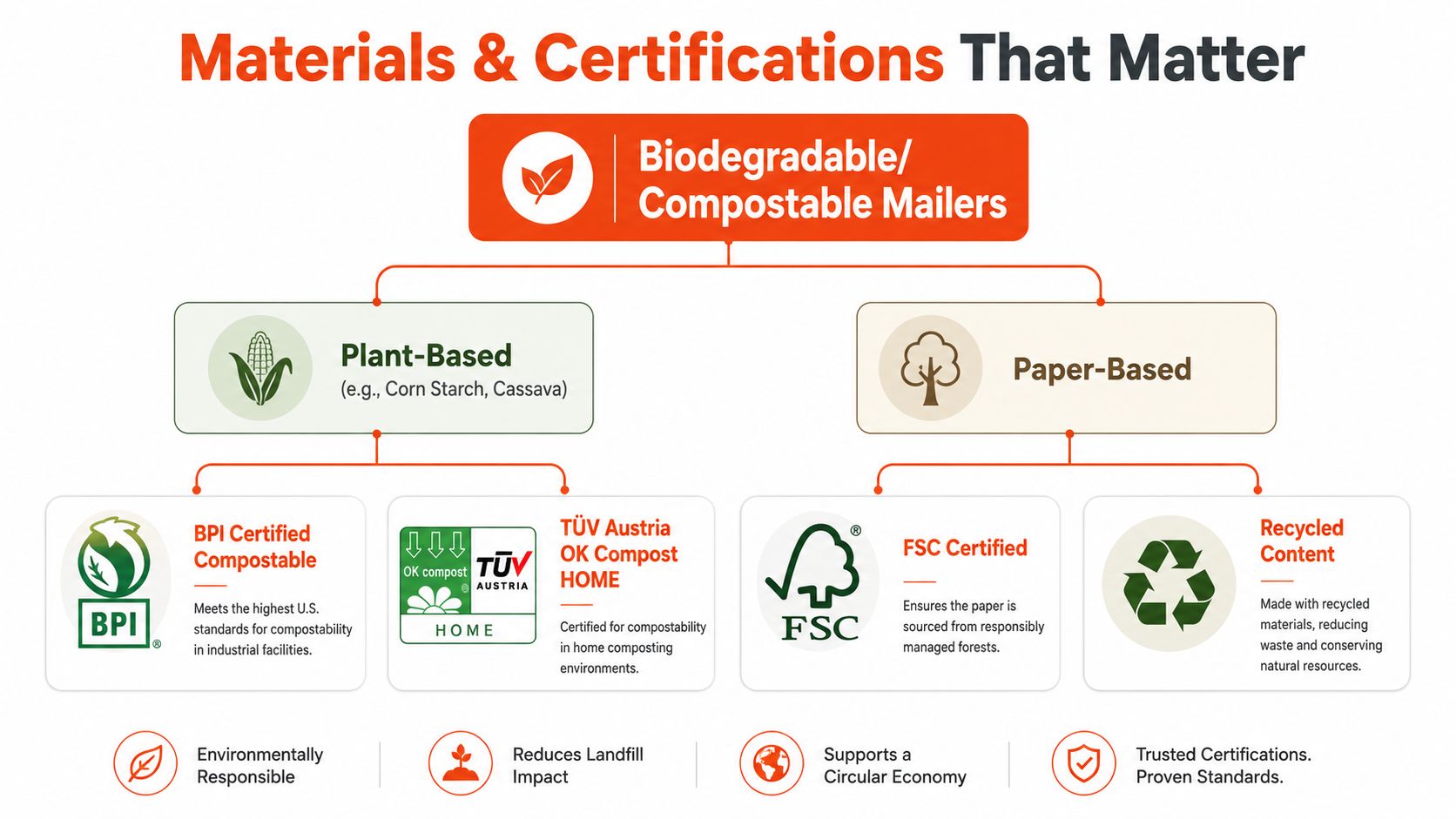
A credible biodegradable or compostable mailer is rarely a single-material product. Commercial options often combine PLA, PBAT, and starch-based feedstocks because each one handles a different part of the job. PLA adds stiffness and heat resistance, PBAT adds stretch and puncture tolerance, and starch reduces fossil content while helping the blend fit compostability targets (material guidance).
What the blend is doing
That mix matters because packaging does not live in a lab. A mailer still has to survive handling, scuffing, sealing, label application, and warehouse movement before anyone thinks about disposal. If you build in more performance through thicker film or a tougher blend, you need to verify that the composting behavior still matches the claim, especially for home-compost language.
Procurement move: ask for the spec sheet first, the certification second, and the disposal instructions third. If a supplier cannot keep those aligned, keep shopping.
The certification framework is where due diligence sits. In the U.S. and Canada, compostability is commonly tied to ASTM D6400 for plastics and bioplastics, or ASTM D6868 for coated substrates such as paper-based mailers with compostable coatings (certification guidance). In Europe, EN13432 is the benchmark many teams look for, and TÜV/OK Compost labels matter when you are checking home-compostable claims. These labels are not decoration. They tell you whether the package has a defined end-of-life pathway or just a broad sustainability promise.
Thickness is the other lever buyers usually underprice. Benchmark data from packaging suppliers shows 50–60 micron compostable mailers are generally strong enough for most apparel and soft goods, while broader industrial offerings range from 20–120 microns depending on the load and use case; some products at around 2 mil are rated to hold up to 5 lb, while heavier-duty courier bags can carry 250 g to 15 kg (thickness guidance). More thickness improves puncture and tear resistance, but it can also slow degradation, so spec decisions and certification claims have to stay tied together.
For teams comparing packaging formats, an internal reference on organic cotton fabric helps when aligning mailer choices with product materials and broader sustainability positioning. The same rule applies across packaging and apparel, proof beats vibe.
The Disposal Reality Across Major Markets
This is the part most guides skip, and it's the part that matters most after the sale. A biodegradable or compostable mailer only behaves as promised if the customer has access to the right infrastructure, and that infrastructure varies wildly across the US, UK, EU, Canada, and Australia. The bag doesn't decide its own ending, the waste system does.
Industrial composting is real, but access isn't universal
A full-scale composting study from 2024 found compostable plastics achieved a 98 wt% mass loss after 4 months in industrial composting, which confirms the material can perform well when the system is built for it (composting study reference). That's the key phrase, when the system is built for it. Industrial composting conditions are controlled, and the same isn't true for landfill, curbside contamination, or random home bins.
The market-specific challenge is basic. Customers don't all live near industrial composting, municipal acceptance differs, and many households don't have a clear local path for compostable shipping film. That's why disposal instructions need to be printed, visible, and plain. If your packaging doesn't tell people what to do next, the package is likely to end up in general waste, where biodegradation slows dramatically or creates the wrong emissions profile.
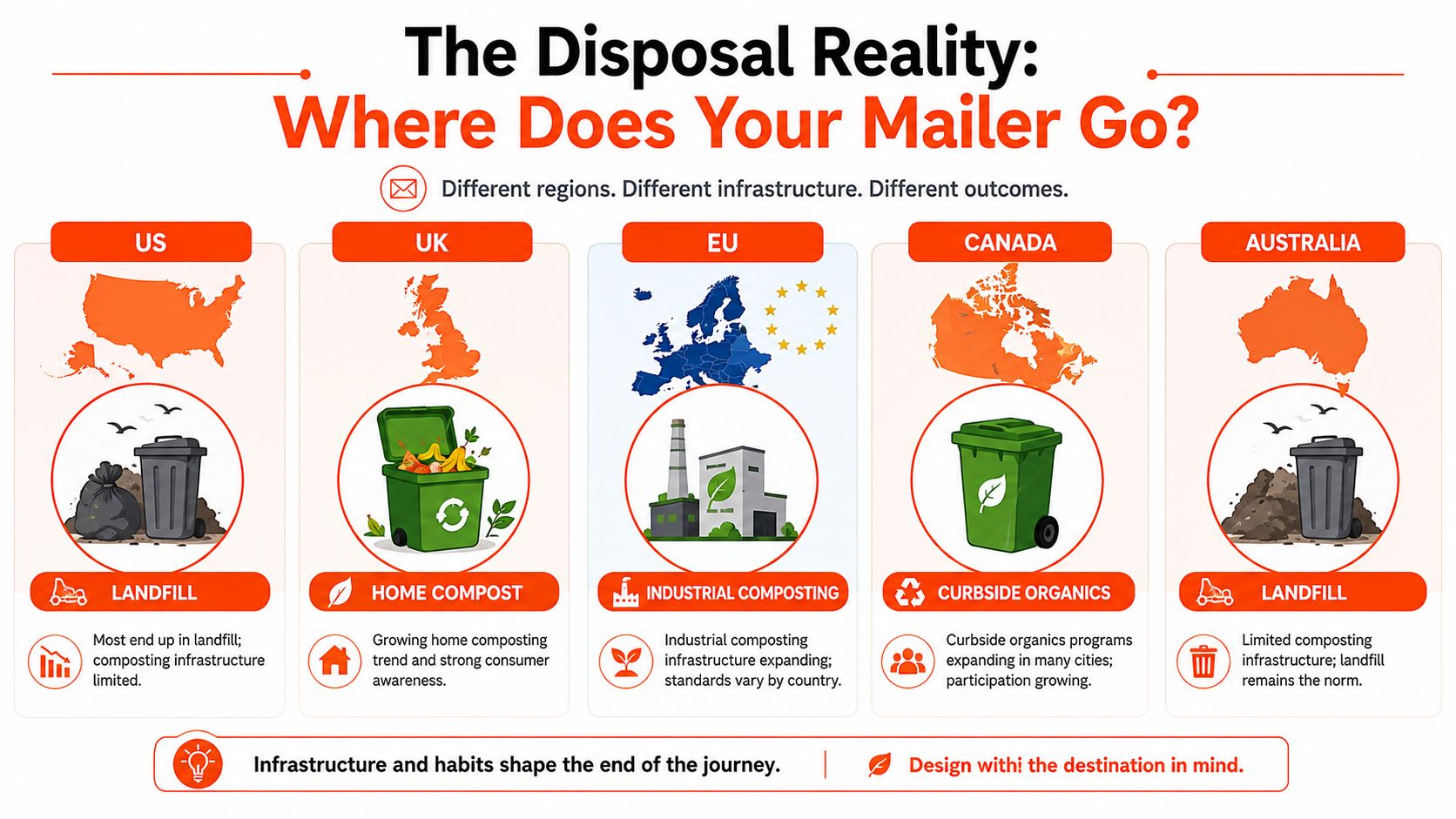
The landfill problem is not theoretical. A fisheries-industry article notes that ASTM 6954 degradability doesn't mean a poly will biodegrade in a landfill or ocean, and says full biodegradation requires long-term exposure to high temperatures above 122°F, which isn't realistic in those environments; it also says biodegradable bags in landfills can produce methane gas and add to the greenhouse effect (landfill caution). That's why vague “eco” claims can backfire so hard.
If your customers can't identify the disposal route in ten seconds, they'll treat the mailer like regular trash.
The practical move is to design for the market you sell into, not the market you wish existed. In some regions, that means industrial compostable packaging with explicit collection guidance. In others, it means sticking with a recovery pathway customers already understand, or using a different mailer format entirely.
Cost and Supply Considerations for Switching
Switching to biodegradable or compostable mailers usually starts on the budget line, then quickly turns into an operations question. The category is growing, but growth does not remove sourcing friction, since teams still have to deal with minimum order quantities, lead times, thickness choices, storage, and how the material behaves on the pack line. Market coverage of home-compostable mailers points to continued expansion in the category, but the practical realities of buying and using these mailers still decide whether a switch works in the warehouse.
What to check before you place the order
Start with the parcel itself. Apparel and other soft goods are usually the easiest fit, while heavier or more abrasive items need more testing before you commit. Ask for sample runs, because microns, seal quality, and tear behavior matter more than the word “compostable” on a quote sheet.
A sourcing checklist that helps looks like this:
- Confirm the disposal claim. Ask whether the bag is industrial compostable, home compostable, or biodegradable.
- Match thickness to use case. Heavier film can improve damage resistance, but it can also slow end-of-life performance.
- Check storage conditions. Compostable films can be sensitive to heat and humidity before use.
- Test with fulfillment equipment. Verify label adhesion, pack-out speed, and whether the material feeds cleanly in your workflow.
- Pilot before scaling. Run a small batch through real orders before you commit to a full inventory buy.
The economics improve when the mailer fits the workflow cleanly. If the bag slows pack stations, jams labels, or needs special storage that your warehouse cannot support, the hidden cost shows up fast. That is why the strongest sourcing decisions are usually the boring ones.
For teams building a sourcing plan around branded packaging and multi-supplier workflows, the custom product sourcing FAQ is a useful operational reference. If you are comparing mailers to other shipping formats, the eco friendly shipping box guide offers a different view of format choice and waste trade-offs.
Branding and Custom Printing on Biodegradable Mailers
A sustainable mailer doesn't need to look blank. In fact, when teams treat the bag like part of the brand system, the packaging feels more intentional and less like a compromise. That's especially true for internet-native brands, where the shipping experience has to carry identity, not just product.
Printing choices should support the material, not fight it
Water-based inks and soy-based printing are common routes when teams want to keep the packaging story aligned with the material story. Custom sizing helps too, because a tight fit usually looks better than an oversized bag with too much empty space. The best executions use the mailer as a clean surface for a logo, a disposal note, or a small design element that ties the shipment to the rest of the drop.
The unboxing angle matters more than people admit. Mailer boxes, branded shippers, tissue paper, stickers, inserts, and full unboxing experiences all shape how a customer remembers the order. Banger handles that broader packaging stack as part of merch fulfillment, which is useful when a biodegradable mailer is only one piece of a larger branded shipment system. For a deeper packaging example set, see the internal note on custom apparel packaging.
Good packaging doesn't shout sustainability. It makes the disposal path obvious and the brand feel considered.
What brands get wrong is overprinting. Heavy design coverage can make the mailer look more premium, but it can also distract from disposal instructions and muddy the sustainability signal. A cleaner layout usually performs better, especially if the packaging needs to carry certification labels or customer-facing instructions. If you want the mailer to feel intentional, let the material do some of the talking.
How to Make the Switch Without Disrupting Fulfillment
Start with a decision, not a purchase order. If your customers have access to the right composting path and your supplier can prove the claim, biodegradable or compostable mailers can make sense. If your buyers mostly dispose through general waste, a different mailer choice may be more honest and more effective.
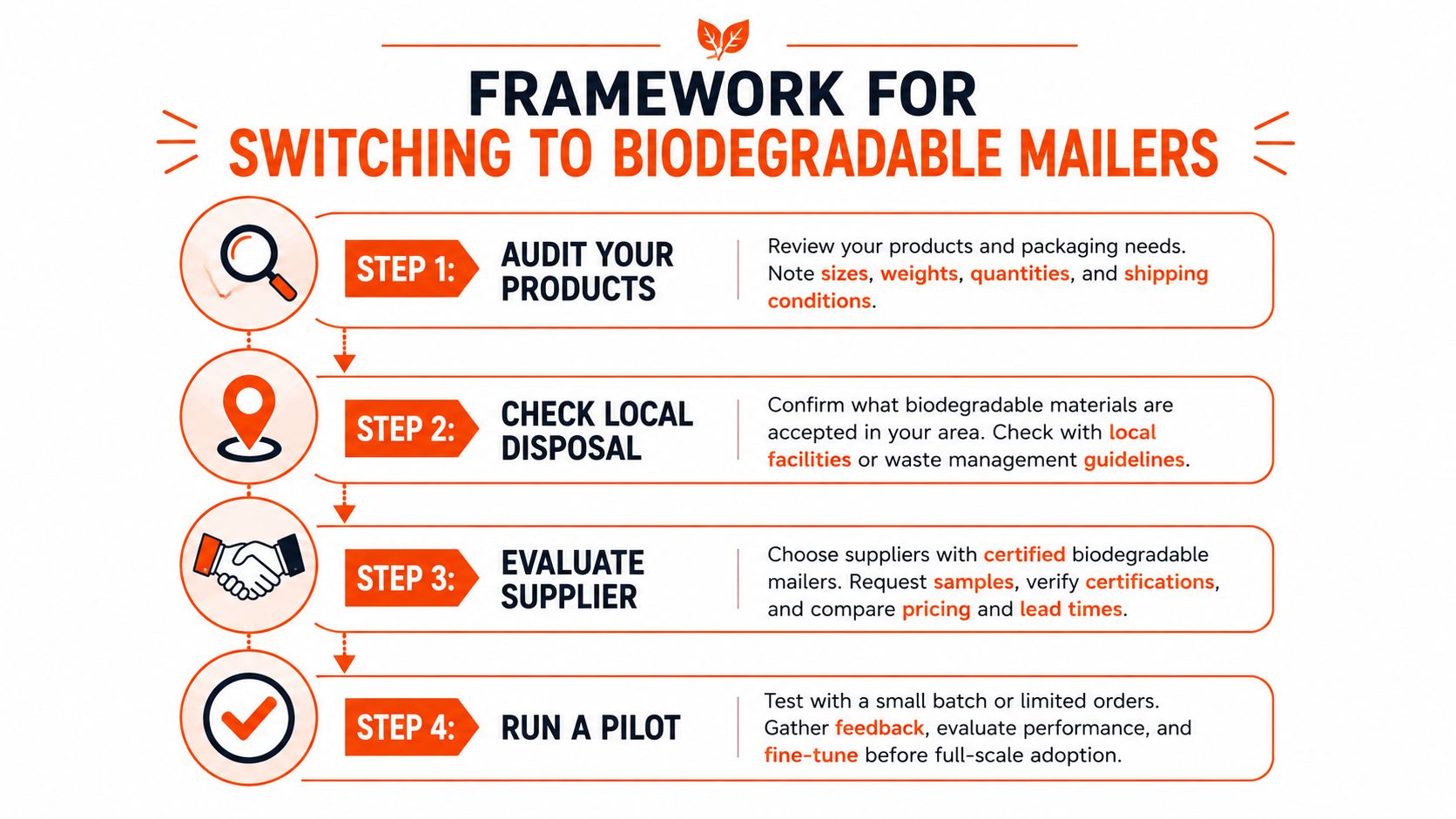
A clean rollout beats a dramatic switch
The safest way to move is in four steps. Step 1, audit your products for weight, sharp edges, and return behavior. Step 2, check local disposal in the markets you ship to. Step 3, evaluate the supplier on certification, thickness, and storage requirements. Step 4, run a pilot before you scale.
A few mistakes show up again and again. Teams buy too much inventory before they've tested real pack-outs. They forget to update disposal copy on the bag or the insert. They also assume one mailer spec works across conference drops, distributed teams, and community gifting, when those programs can require different handling.
The cleanest operators connect packaging to fulfillment, not just procurement. If you need help coordinating custom branded packaging with global delivery, merch fulfillment services can be part of that plan, especially when the shipment needs to go to multiple addresses or move across regions with different disposal rules. For teams comparing workflows, Banger also supports custom branded packaging and worldwide fulfillment, including DDP shipping to the US, UK, Canada, Australia, Switzerland, and Norway.
If you're ready to test biodegradable mailers without turning fulfillment into a science project, start with a small pilot, tighten the disposal instructions, and compare the result against your current mailer on damage, pack speed, and customer clarity. Then explore Banger for custom branded packaging that fits merch drops, conference kits, and distributed shipping without forcing your team to stitch everything together by hand.