Employee of the Year Awards: A Modern Playbook for Teams
Most advice about employee of the year awards starts with the ceremony. Pick a winner, order a plaque, write a speech, take a photo. That sequence is backwards.
A strong award program is a recognition system with a trophy at the end, not a trophy ceremony with a recognition system attached. In a hybrid company, the main challenge is deciding whose work gets seen, how judges separate impact from charisma, and whether the prize feels personal enough to matter after the applause fades.
That matters because recognition remains underused. Gallup-linked reporting says only 36% of employees report that their organization has some kind of recognition system, while about 65% say they received no recognition during the past year (Workhuman's employee recognition statistics). Another 2026 industry summary reports that only 31% of organizations rate their rewards and recognition program effectiveness as high or very high (the same Workhuman summary). The opportunity isn't to make one annual event louder. It's to make the process credible.
Table of Contents
Why Most Employee of the Year Programs Fall Flat
The popular advice says employee of the year awards boost morale by celebrating excellence. Sometimes they do. More often, they expose whether a company understands excellence beyond the people who speak most in meetings, sit closest to leadership, or work in highly visible roles.
A generic “outstanding contribution” award creates a predictable result. Judges remember the launch presentation, the big customer call, and the person who narrates their work well. They miss the engineer who prevents recurring incidents, the operations lead who catches defects before they reach customers, and the support specialist who documents the process everyone else relies on.
Hybrid work magnifies that visibility gap. Remote employees don't benefit from hallway conversations, spontaneous praise, or leadership walk-bys. Distributed teams also create uneven nomination opportunities. A manager may know a direct report's output well, while cross-functional partners see only fragments of the contribution.
Practical rule: If a judge can't explain what behavior the award reinforces, the program is probably rewarding familiarity rather than impact.
Recognition has a long history, but the modern corporate version evolved from narrow service traditions. Historical summaries trace service recognition back more than 2,600 years, including accounts of Cyrus the Great using personal acknowledgment and tangible tokens such as a coin bearing his likeness (history of employee service recognition). In the United States, formal awards became institutionalized through the Government Employees Incentive Awards Act, passed by the 83rd Congress, creating a government-wide incentive awards program. Early programs often focused on long tenure, with 25-year service or retirement awards described as typical in historical accounts.
The useful lesson isn't nostalgia. Recognition moved from honoring loyalty at the end of a career to reinforcing contribution during active employment. Your employee of the year award should follow that newer logic.
Turn a ceremony into a culture lever
Start with the behaviors your company wants more of:
- Cross-functional execution, such as an employee who removes friction between product, sales, and support.
- Mentorship and knowledge sharing, including documentation that makes other teams faster.
- Innovation under constraints, where someone improves a process without waiting for a large budget.
- Operational reliability, especially work that prevents problems rather than creating visible wins.
- Customer or community impact, when the contribution strengthens trust beyond an individual team.
A UC Riverside-led study shows why symbolism alone can fail. A non-financial award program reduced total plant productivity by 1.4% per day because internally motivated workers reacted negatively to fairness and equity concerns (the NHS rewards and recognition evidence review). The problem wasn't recognition itself. It was a program that made the reward feel inequitable.
If your last award cycle felt hollow, don't add more production value first. Audit who was nominated, whose work was easy to describe, which teams had no finalists, and whether the winner matched the behaviors your values page claims to celebrate. If you're planning recognition beyond annual awards, the same principle applies to gifts for employees who are leaving. The object matters less than the meaning and process behind it.
Setting Eligibility Rules and Nomination Workflows
Eligibility rules aren't administrative fine print. They define who gets a legitimate path into consideration.
A practical policy answers difficult questions before nominations open:
- Employment status: Decide whether full-time, part-time, temporary, and contractor roles qualify. If contractors are excluded, explain why rather than letting the omission feel accidental.
- Start date: Avoid automatically disqualifying a recent hire who delivered unusually high impact. If you use a tenure threshold, create a separate contribution category for newer employees.
- Management level: State whether executives, managers, and senior leaders can qualify. Different awards may be appropriate for individual contributors and people managers.
- Prior winners: Decide whether past recipients can return to the pool. A repeat winner may reflect sustained excellence, but recurring recognition can crowd out emerging contributors.
- Nomination ownership: Allow peers, managers, or both to submit nominations. Self-nominations should be an explicit policy choice, not an accidental omission.
Public institutions show how specific these rules can become. UC San Diego's Exemplary Staff Employee of the Year Award Program limits eligibility to current regular or career Professional and Support Staff who have completed a probationary period. It excludes Senior Management Group, Managers and Senior Professionals, and academics, while past recipients and self-nominations are also ineligible (UC San Diego's award requirements).
The University of Central Arkansas requires full-time staff to have two or more years of continuous service before January 1 of the award year. Its guidelines exclude faculty-rank employees and staff reporting directly to the university president, and they prohibit self-nominations (UCA's Employee of the Year guidelines). Those policies may not fit a startup, but they demonstrate the value of publishing boundaries.
Use a workflow people can actually complete
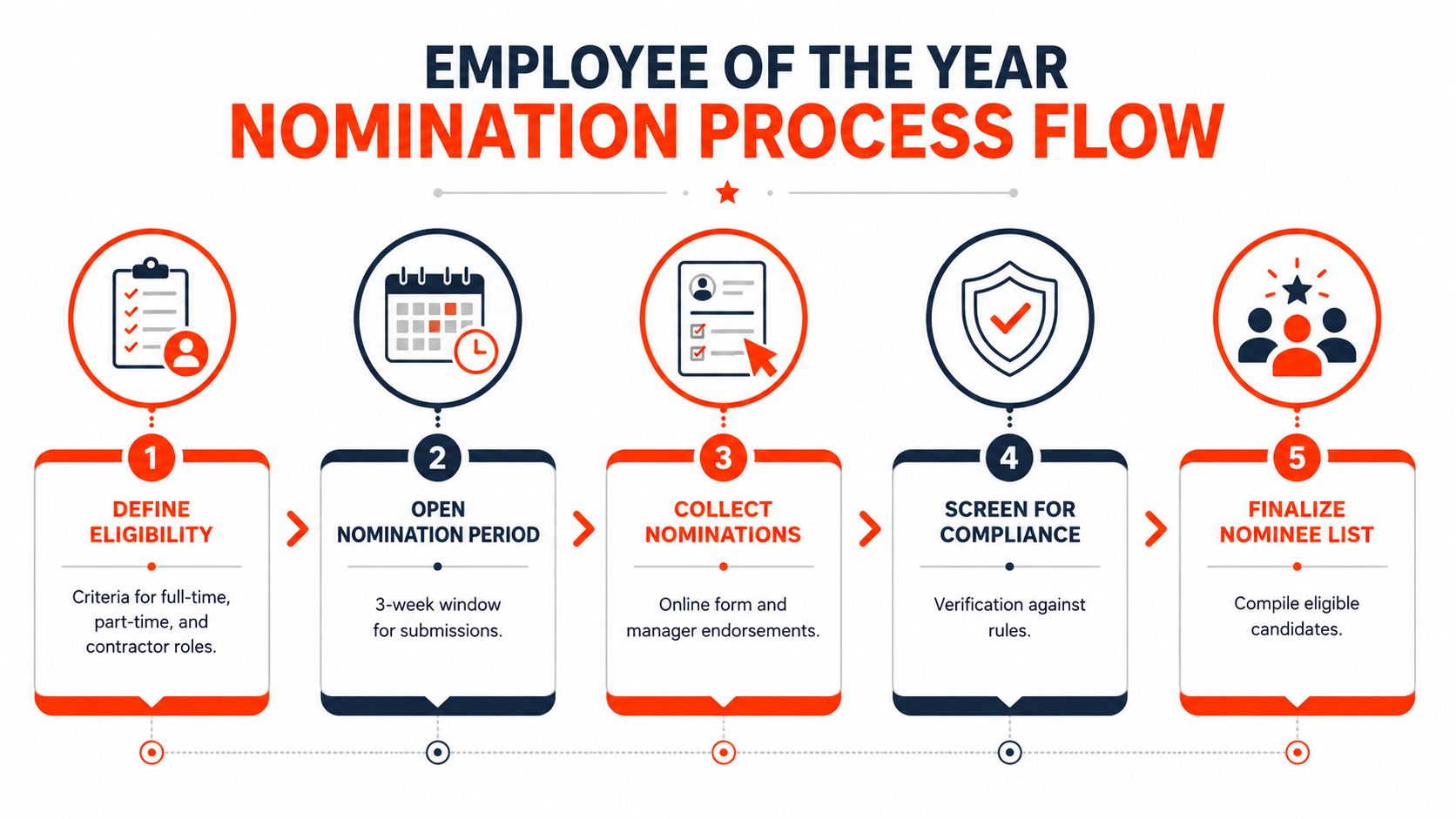
A clean nomination process might look like this:
- Define eligibility: Publish the rules, exclusions, award categories, and evidence requirements.
- Open nominations: Keep the window long enough for every time zone and shift pattern to participate. The visual workflow uses a 3-week window, while a shorter internal cycle can work when reminders and manager outreach are strong.
- Collect submissions: Use a form with concise prompts, plus a manager endorsement path. Ask for observable behavior, context, and impact, not a polished essay.
- Screen for compliance: HR or a neutral program owner checks eligibility, removes duplicate submissions, and flags conflicts.
- Finalize nominees: Compile the eligible list, anonymize evidence where practical, and share the evaluation timeline.
Manager-only nominations usually produce cleaner submissions, but they hide work outside reporting lines. Peer-only nominations widen access, but peers may lack context about business impact. The most balanced model gives both groups a route in, then asks managers to validate scope rather than control access.
For a distributed company, add two safeguards. First, invite nominations from cross-functional partners, not just a person's own department. Second, strip names, job titles, and recognizable personal details from the first judging pass when the evidence can stand alone. Operational details such as merch fulfillment services also belong in the planning checklist if prizes must reach employees across multiple locations. Fulfillment shouldn't determine whether a remote winner gets the same experience as someone in headquarters.
Building a Scoring Rubric That Captures Real Impact
A vague rubric turns an award into a charisma contest. “Went above and beyond” sounds positive, but it gives judges no shared standard for comparing a staff engineer, an account manager, and a finance operator.
Build the rubric around evidence, then define what different levels look like. One comparative study found that financial rewards and skill-development rewards had the largest effects on motivation, with regression coefficients of 0.65 and 0.45, respectively, both statistically significant at p<0.05. The same study found that 75% of respondents said achievement-based rewards directly increased motivation, while only 40% reported a significant impact from non-material rewards such as verbal recognition or symbolic awards (the comparative rewards study). That doesn't mean every employee of the year award needs a large financial component. It does mean a symbolic prize shouldn't carry the entire motivational burden.
Define categories before reading names
Use three broad categories, then adapt the evidence prompts to your company.
Business impact captures results that improve revenue, efficiency, quality, customer outcomes, risk management, or cost control. A strong submission might show how an employee reduced repeated manual work, protected a critical account, or improved reliability. Don't require every role to produce a neat financial figure. Evidence can include avoided risk, faster handoffs, fewer escalations, or a process adopted by other teams.
Cultural contribution covers mentorship, inclusion, documentation, onboarding, and the behaviors that help colleagues perform. A person who creates a reliable knowledge base may have more lasting influence than someone who gives the most visible presentation.
Innovation and problem-solving rewards useful change, not novelty for its own sake. Look for experiments that solve a real constraint, cross-functional work that unblocks delivery, or a practical improvement that survives beyond its creator.
| Category | Weight | Score 1, Below Expectations | Score 3, Meets Expectations | Score 5, Exceptional Impact |
|---|---|---|---|---|
| Business impact | 40% | Contribution is asserted without clear evidence | Work improves a team or customer outcome | Work creates substantial, durable value across teams |
| Cultural contribution | 30% | Participation is occasional or difficult to verify | Consistently supports peers and shares useful knowledge | Builds systems or habits that materially improve how others work |
| Innovation and problem-solving | 30% | Idea is incomplete or disconnected from a real need | Solves a defined problem within the role or team | Solves a complex constraint and creates a repeatable improvement |
The weights above are a design example, not a universal formula. Publish them before nominations open. If judges change the weighting after reading submissions, employees will correctly assume the criteria were built around a preferred candidate.
Make judging less personal
Use a panel with senior leaders, peer representatives, and HR or People Operations. Senior leaders understand organizational priorities. Peers see behind-the-scenes behavior. HR can identify conflicts and challenge inconsistent scoring. No single group has enough perspective on its own.
Hold a calibration session before final scoring. Give judges a fictional or anonymized sample, ask them to score independently, then discuss why they interpreted the evidence differently. The point isn't to force identical scores. It's to expose hidden standards, such as rewarding polished writing or penalizing people whose work is confidential.
Anonymize submissions during the first pass when possible. Replace names with candidate IDs, remove departments from narrative fields, and ask nominators to describe actions and outcomes rather than personality traits. Then restore context for the final discussion, especially where role scope affects the interpretation of impact.
A fair award doesn't pretend every role produces the same kind of evidence. It gives different kinds of work an equally legible route to recognition.
Treat the rubric as a living operating document. After each cycle, record which criteria generated confusion, which teams struggled to submit evidence, and where judges disagreed. A thoughtful corporate gifting program uses the same discipline, because the recipient experience only works when the rules are clear before the gift is chosen.
Choosing Prizes People Actually Want to Keep
The prize communicates what the award means. A generic gift card says, “We processed a reward.” A considered object says, “This contribution earned something with identity.”
That doesn't make cash or gift cards bad choices. They solve different problems. Cash offers flexibility and may be more useful for employees with different financial priorities. Gift cards are easy to distribute and let recipients choose. Premium custom merch creates a physical marker of belonging, but only if the design and quality feel intentional.
| Prize Type | Memorability | Social Shareability | Culture Reinforcement | Typical Budget |
|---|---|---|---|---|
| Generic gift card | Low to moderate | Low | Low | Flexible, based on denomination |
| Cash bonus | Moderate at the moment, less visible over time | Low unless the recipient chooses to share | Low to moderate | Flexible, based on compensation policy |
| Premium custom merch drop | High when the item feels exclusive and useful | High | High | Flexible, based on garment, quantity, and finishing |
“Typical budget” should remain a planning variable rather than a fake benchmark. Set the tier based on compensation policy, tax treatment, production complexity, and whether the prize is individual or part of a broader winner capsule.
Choose the object for the person
The strongest prize is usually something the winner wouldn't buy for themselves but would use constantly. That could be a heavyweight embroidered jacket, a refined travel bag, a custom-engraved tech accessory, or a desk object made with enough taste to avoid looking like conference swag.
A limited run helps the item feel earned. A subtle logo, strong fabric, careful embroidery, and useful colorway will usually outperform a giant wordmark. Add a detail that belongs only to the award cycle, such as the year, a small inside label, or an edition mark. The object should signal status without forcing the recipient to become a walking billboard.
For desk gifts, provenance can add a better story than branding alone. If you're considering a bar or hospitality item, the history of whiskey chilling stones offers useful context on how a practical object can carry cultural meaning. The lesson applies broadly: a prize becomes memorable when people can explain why it exists.
Avoid designing one prize for a global team and assuming everyone will want the same thing. Offer a choice between apparel sizes and cuts, or pair the hero item with a non-wearable alternative. Confirm shipping addresses privately. For remote winners, ship the package early enough that it arrives before the ceremony, then invite them to open it live. The unboxing becomes part of the recognition rather than an afterthought delivered weeks later.
A thoughtful collection of swag ideas can help generate options, but use the award criteria as the filter. The prize should reinforce the achievement, not distract from it.
Running the Ceremony Across Virtual and In-Person Formats
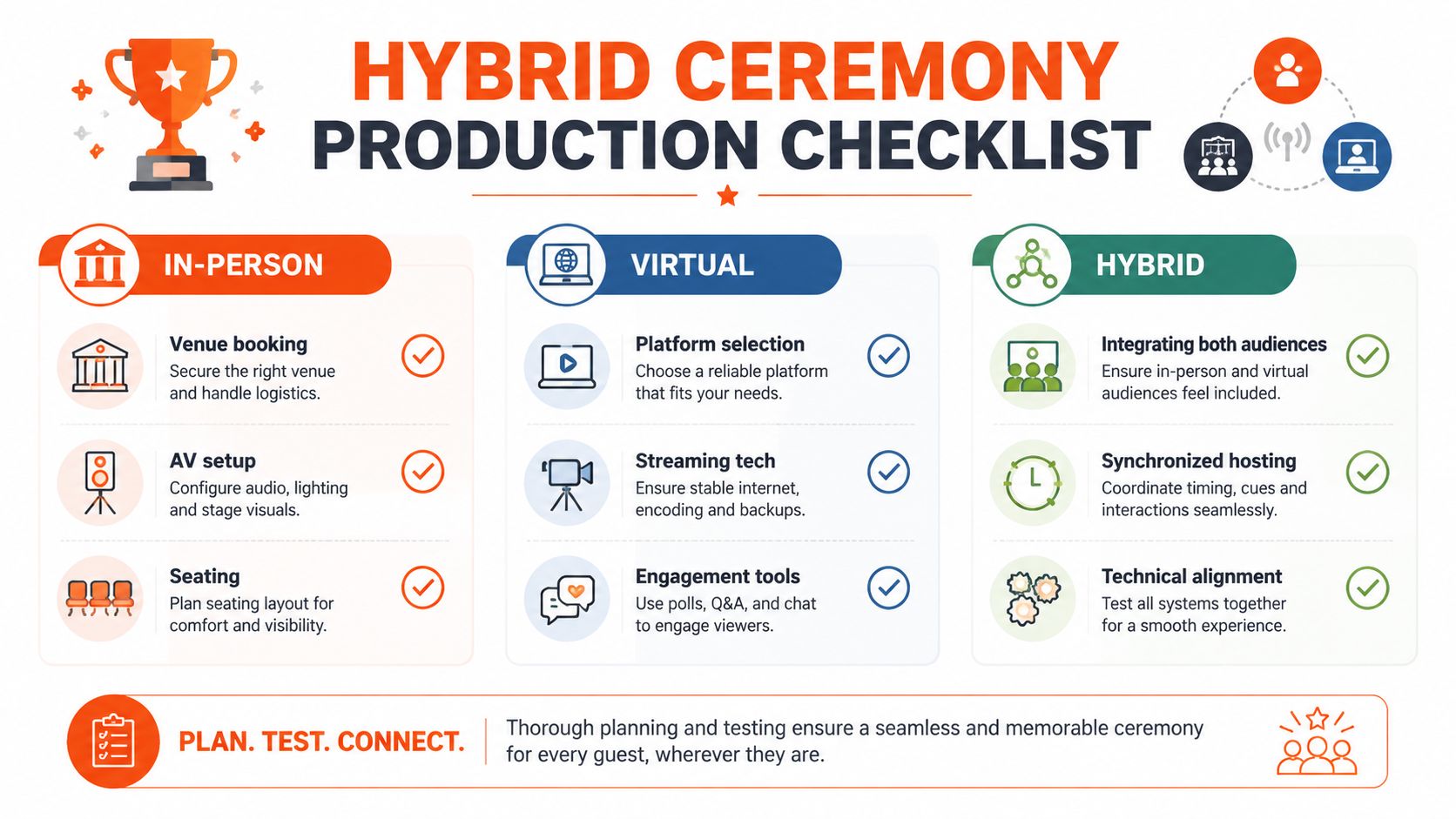
A hybrid ceremony fails when the room gets the event and remote employees get a livestream. Both audiences need a designed experience, not equal access to a camera feed.
Choose the format based on where nominees and judges can participate comfortably. An in-person event benefits from physical energy, informal conversation, and a visible reveal. A virtual ceremony can include distributed contributors without travel friction. A hybrid format works only when someone owns the remote experience as a production role, not as an extra task for the host.
Give each format its own run of show
For an in-person ceremony, reserve enough venue time for sound checks, seating, and a private reset before the reveal. Put the winner's contribution into the announcement. Don't read a generic plaque inscription aloud. Tell the story of the problem, the action, and the people who benefited.
For a fully virtual event, use a stable streaming platform, a visible chat moderator, and pre-recorded nominee spotlights. Ask colleagues to submit short tribute videos in advance, then keep the live host focused on connection rather than improvising every transition. Send prizes before the event so the winner can react to a real object on camera.
For hybrid events, run two coordinated tracks:
- Room track: Stage, microphones, lighting, audience reaction, and in-person presenter cues.
- Remote track: Dedicated host, chat prompts, captioning, remote nominee camera checks, and a clear view of the physical reveal.
- Shared track: Nominee videos, award language, winner reaction, and audience participation that both groups can access at the same moment.
Respect time zones when scheduling. If a global team can't attend live, record the full ceremony and publish a short winner cut with captions. Avoid asking remote participants to unmute into silence. Give them a specific mechanic, such as a chat prompt, reaction moment, or pre-submitted video.
For meeting structure and audience participation ideas, the United We Transform meeting benchmark provides a useful reference point. It can help you build an award segment that feels integrated into a broader all-hands rather than bolted onto the end.
Production note: Test the winner reveal with every camera, microphone, and screen involved. Emotional moments don't survive a frozen slide or a muted recipient.
Have one person own nominee logistics, one own the room, and one monitor the remote channel. If the team is small, assign the jobs explicitly anyway. You can also add personal touches such as custom embroidered name tags to distinguish nominees, presenters, or a limited award capsule without making the stage feel overproduced.
Rolling Out the Full Program Timeline and Follow-Up
An employee of the year award needs a visible cadence. In hybrid and distributed teams, visibility is part of fairness. Without deliberate reminders and evidence standards, judges tend to notice people who speak often, work near leaders, or appear in live meetings. A clear timeline gives quieter contributors, remote colleagues, and behind-the-scenes work a fairer chance to be recognized.
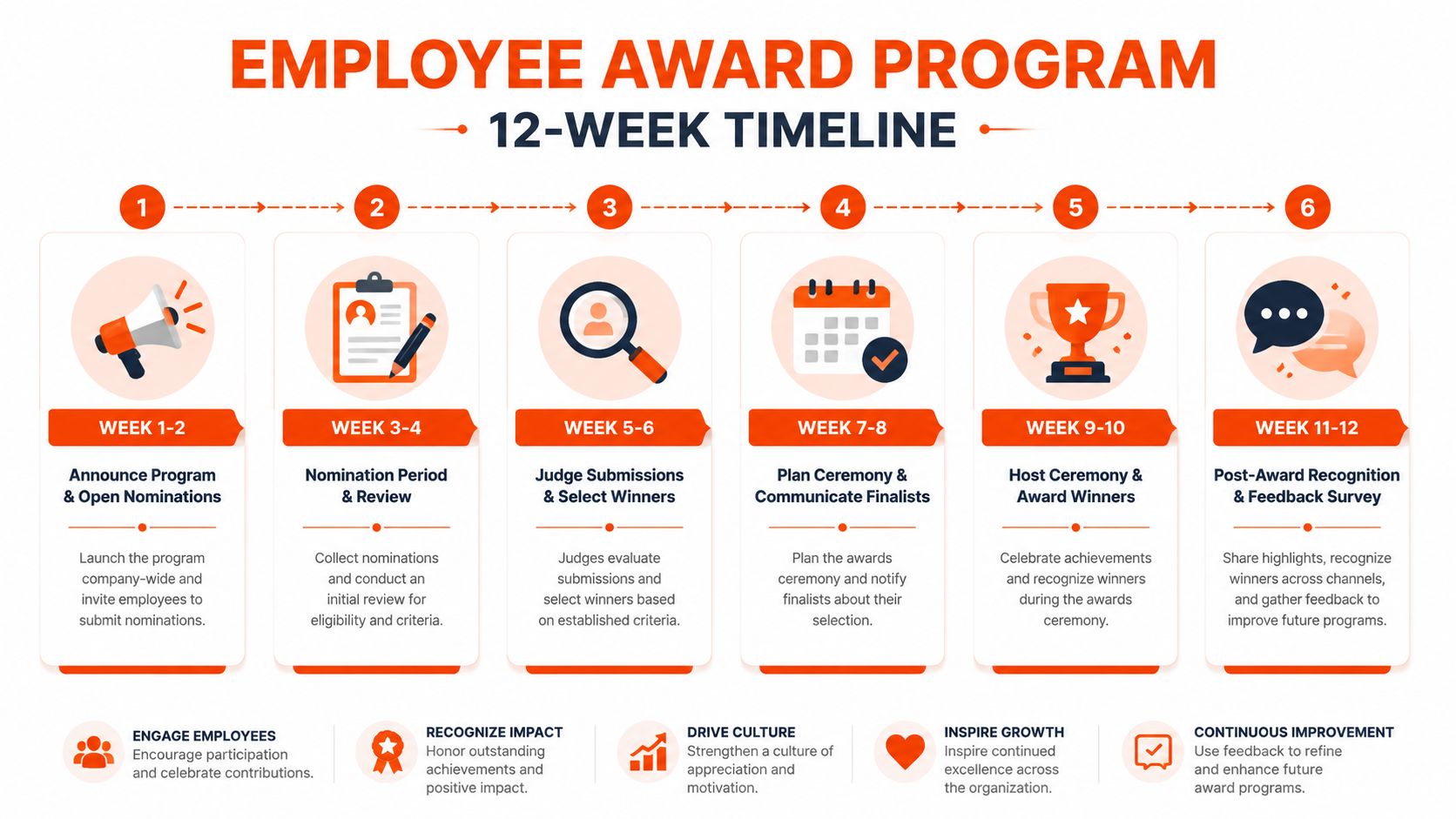
A 12-week rollout leaves room for communication, judging, production, and follow-up without making the program feel endless. Use the supplied 12-week timeline infographic outlining the step-by-step process for conducting an employee award program. as the planning backbone.
Weeks 1 through 4
Weeks 1 and 2, announce and open nominations. Publish eligibility rules, scoring categories, judging safeguards, and the prize description in one place. State how remote work will be evaluated, so visibility in the office does not become an accidental scoring advantage. The kickoff email should answer four questions: who can nominate, who qualifies, what evidence helps, and when submissions close.
Kickoff email: “Nominations are open. Tell us what the person did, who benefited, and which award criteria their work demonstrates. Short, specific examples are more useful than polished praise.”
Describe premium merch clearly if it is part of the prize tier. People respond better to a well-made item they would choose to wear or keep than to generic branded stock. Confirm sizes, shipping details, and whether remote recipients receive the same package.
Weeks 3 and 4, collect and review. Send a reminder naming contributions people often overlook, including documentation, incident prevention, mentoring, customer support, and cross-functional work. Ask nominators to include evidence from async projects and distributed collaboration, not only meeting visibility. HR validates eligibility, removes duplicates, and prepares anonymized submissions for judges.
Nomination reminder: “You don't need a long essay. Share one concrete action, its effect, and the people or customers it helped.”
Weeks 5 through 8
Weeks 5 and 6, judge and select. Judges score independently before calibration. Give them access to the same evidence, including written updates and project outcomes, rather than relying on personal familiarity. The program owner records conflicts, confirms the final decision, and keeps an audit trail showing how the winner met the published criteria.
Weeks 7 and 8, plan and communicate. Confirm the venue or streaming setup, record nominee spotlights, order prizes, check sizes and addresses, and announce finalists. Keep the announcement focused on contribution, not popularity. A premium custom item can reinforce the recognition when its design connects to the recipient, team, or achievement without making the award feel like advertising.
“Today we're recognizing the finalists whose work strengthened the company in different ways. We'll share their stories during the ceremony, and we'll publish every nominee's contribution after the event.”
Weeks 9 through 12
Weeks 9 and 10, host and award. Deliver prizes to remote recipients before the ceremony, rehearse the reveal, brief presenters, and prepare captions or transcripts. Check that the physical prize appears clearly on camera and that every recipient receives the same quality of package. Publish a recap with the winner's specific contribution and acknowledge the full nominee group.
Weeks 11 and 12, follow up and improve. Survey nominees, judges, and attendees separately. Ask whether the criteria were clear, whether different teams and work locations had a fair chance to be seen, and whether the prize felt meaningful. Track participation, sentiment, representation across teams, and retention correlation as internal indicators. Do not treat an annual award alone as proof of causation.
Keep the winner visible in useful ways. Invite them to mentor a new hire, lead a short internal session, or share the practice behind their contribution. Recognition should encourage repeatable behavior, not create only a brief spike in attention.
Widely cited recognition reporting estimates the global cost of low motivation at about $7 trillion per year (Workhuman's recognition research summary). That figure does not prove an award program will solve disengagement. It does show why recognition deserves operational care after the ceremony.
Collect feedback while the event is fresh, document what judges missed, and revise the rubric before nominations reopen. Credibility grows when each cycle improves fairness, visibility, and the prize experience.
Banger creates premium custom merch for internet-native teams, including embroidered apparel, accessories, limited-run award drops, and branded packaging with worldwide fulfillment. Visit Banger to build a prize people will keep, wear, and associate with the contribution that earned it.