10 Holiday Office Party Ideas for a Next-Level Celebration
Why should a holiday office party feel like a recycled lunch when it can function like a brand moment, a morale reset, and a merch launch all at once? Too many companies still default to generic catering, awkward speeches, and a few disposable decorations. That is weak planning, and employees notice it immediately.
Plan the event people want to attend, talk about, and keep wearing afterward. Holiday party spending already reflects that mindset. The most useful version of the event earns the attention it gets, instead of wasting it. Keep the budget pointed at the experience, the merch, and the details people remember.
These holiday office party ideas pair culture, budget, timelines, and custom merch so the night feels designed, not assembled. They work for hybrid teams, distributed teams, and internet-native brands that want the party to create a real memory instead of a forgettable calendar block. If you want extra swag inspiration, start with these merch ideas for teams and events. For a useful external planning reference, see the 2026 Cape Town party planning guide.
Table of Contents
1. Branded Team Merch Drop Party
The cleanest way to make a holiday office party feel current is to turn the reveal into a drop. Not a pile of giveaway hoodies at the door, a real unveiling with limited-edition tees, heavyweight hoodies, or a jacket your team helped shape. When people open something they want to wear, the party starts with anticipation instead of small talk.
Build the reveal around the unboxing
Send the merch ahead of time if the team is distributed, then ask everyone to show up in the piece. That gives you an instant visual and a stronger sense of unity, whether the event is in person or on a video call. Teams that care about identity, like product teams, crypto communities, or fintech startups, can use colorways, embroidery placements, and fit choices to make the drop feel intentional.
A strong merch reveal also needs timing discipline. Order 10 to 15 business days before the party, use low MOQs so you can test ideas before scaling, and ask for free product previews within 24 hours so the design doesn't get locked too early. That keeps the launch tight and removes guesswork.
Practical rule: If the merch wouldn't feel worth posting or wearing in January, it's not party-worthy in December.
- Design for repeat wear: Choose colorways and silhouettes people can wear after the event, not just on the event night.
- Ship before the party: If the team is remote, use multi-address shipping so everyone joins the reveal in the same piece.
- Keep the run small: Limited runs make the drop feel special and keep the budget focused.
For more merch framing, the best swag ideas roundup is a useful internal reference.
2. Virtual Holiday Party with Custom Gift Boxes
Remote teams don't need a weaker party. They need better packaging. A shipped gift box turns a video call into a shared moment, especially when each box includes branded merch, a local treat, and one small surprise that feels personal to the recipient. The unboxing becomes the entertainment, which is exactly why it works.
Make the box feel local, not generic
Include items that connect to the company's real footprint. If you have offices in different cities, add local chocolates, a notebook, or a drinkware piece tied to each location. Custom packaging matters here because the reveal starts before the call even does. When boxes arrive 3 to 5 days before the event, employees have time to get excited without spoiling the moment.
For international teams, build the logistics around DDP shipping for the US, UK, Canada, and Australia so nobody gets stuck dealing with duties. Plan 3 to 4 weeks ahead for overseas fulfillment, and include a card that explains what's in the box and why it was chosen. That's a small detail, but it makes the whole thing feel considered.
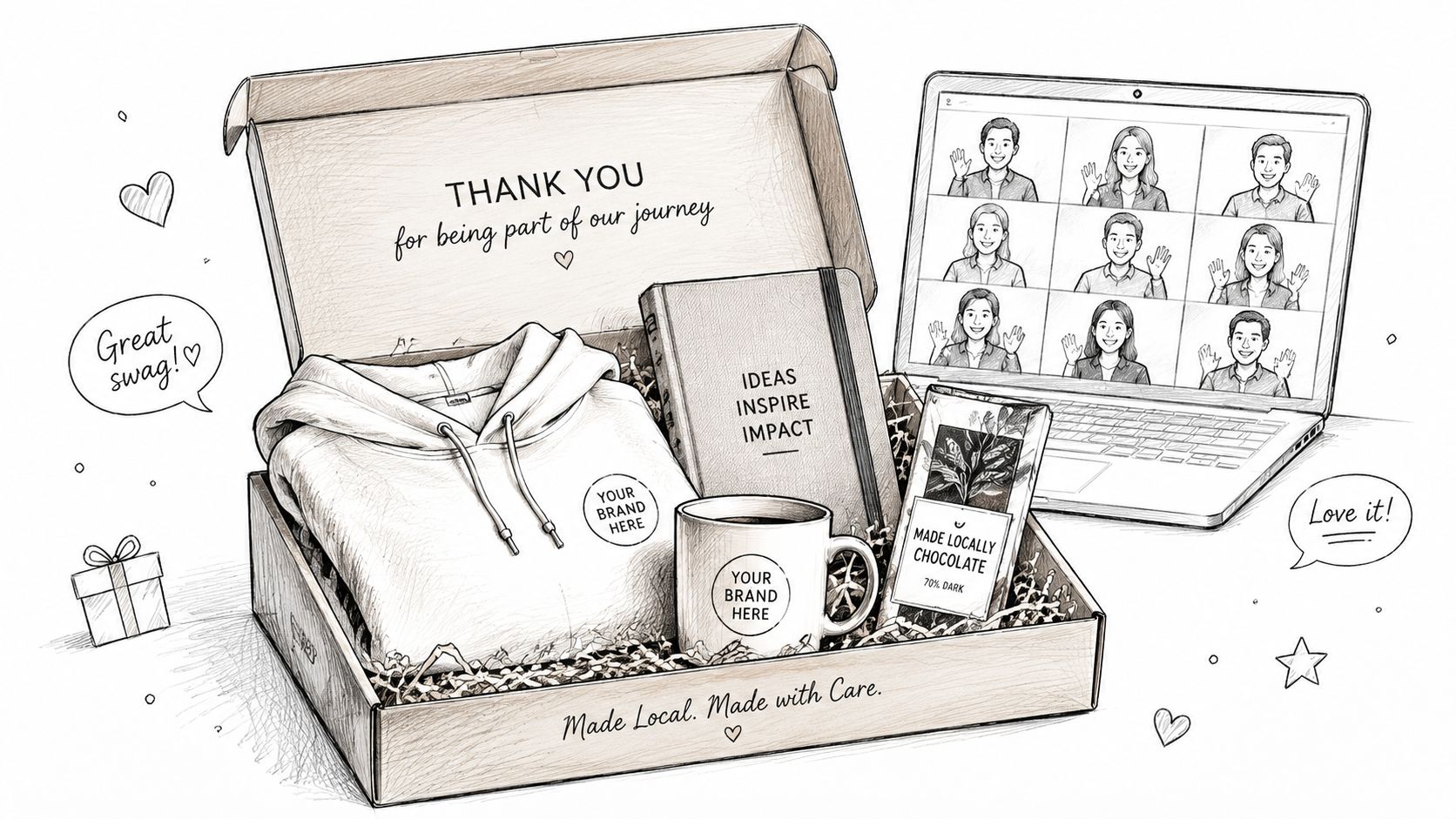
If the team is scattered across time zones, the best party prop is still the same, a box people actually want to open on camera.
- Stage the arrival: Tell people when to expect the package so delivery doesn't feel random.
- Create a Slack moment: Ask for unboxing clips and reactions before the call starts.
- Mix utility and taste: Pair branded notebooks or mugs with one edible item to balance usefulness and delight.
For a related internal reference, the corporate gifting programs page helps shape the packaging logic. For a broader gift-angle inspiration piece, see best business holiday gifts.
3. Custom Apparel Fashion Show & Voting Party
Most company parties ask people to consume. This one asks them to choose. Put 4 to 6 strong hoodie, tee, or jacket concepts on stage, let teams model them, and have the room vote on what gets produced. The result is a party that feels participatory, and the merch that wins is more likely to get worn because the team had a hand in picking it.
Keep the voting tight and visual
Don't overload the room with options. Four to six designs is enough to create energy without decision fatigue. Send out BATs, real production photos, about 48 hours before the event so people can think before they vote. Then make the vote simple, Slack polls, Mentimeter, or a live hand raise all work.
This format is perfect for teams that like debate, especially design-led startups and creator-heavy companies. A fintech team might vote on jacket colors, while a creator network could run a tee competition and fast-track the winner into production. Use the party to explain why a design won, not just which one won. That turns the merch into part of the story.
Design note: Don't pitch merch as a consolation prize. Treat it like a product launch, with a clear winner and a fast path to production.
- Show the fit, not just the graphic: Have people model the pieces instead of only displaying mockups.
- Make the rationale public: Tell the room why a specific colorway or cut was chosen.
- Move fast on production: If the winning design is good, lock it and ship it before enthusiasm cools.
The custom shirt printing guide is a solid internal anchor for production-minded teams.
4. Customizable Merch Bar Station
Want a holiday party idea that gets people involved? A customizable merch bar does the job. Set up a station where employees personalize a tote, hoodie, or notebook with embroidery, DTG printing, or laser engraving, and the whole room shifts from passive receiving to hands-on making. It feels more like a studio than a giveaway table.
Let people make something they'll keep
Start with a tight set of strong templates, then leave room for people to add their own twist. Too many options slow everything down, and too few make the station feel flat. Keep the bar moving by offering a clear starting point, then a few high-impact ways to customize the piece without making the line drag.
For an in-person event, book a local embroidery or screen printing partner so the work happens live and feels real. For a remote team, ship the blanks ahead of time and run the session with a short video guide plus a live support channel during the party. That keeps the experience active instead of turning it into a mailroom moment.
Size anxiety disappears when the merch feels worth wearing. Build the station around multiple sizes and premium blanks, so apparel feels like part of the experience instead of an afterthought. Cheap basics drag the whole setup down fast, especially when you want the merch to feel like something people would keep in rotation.
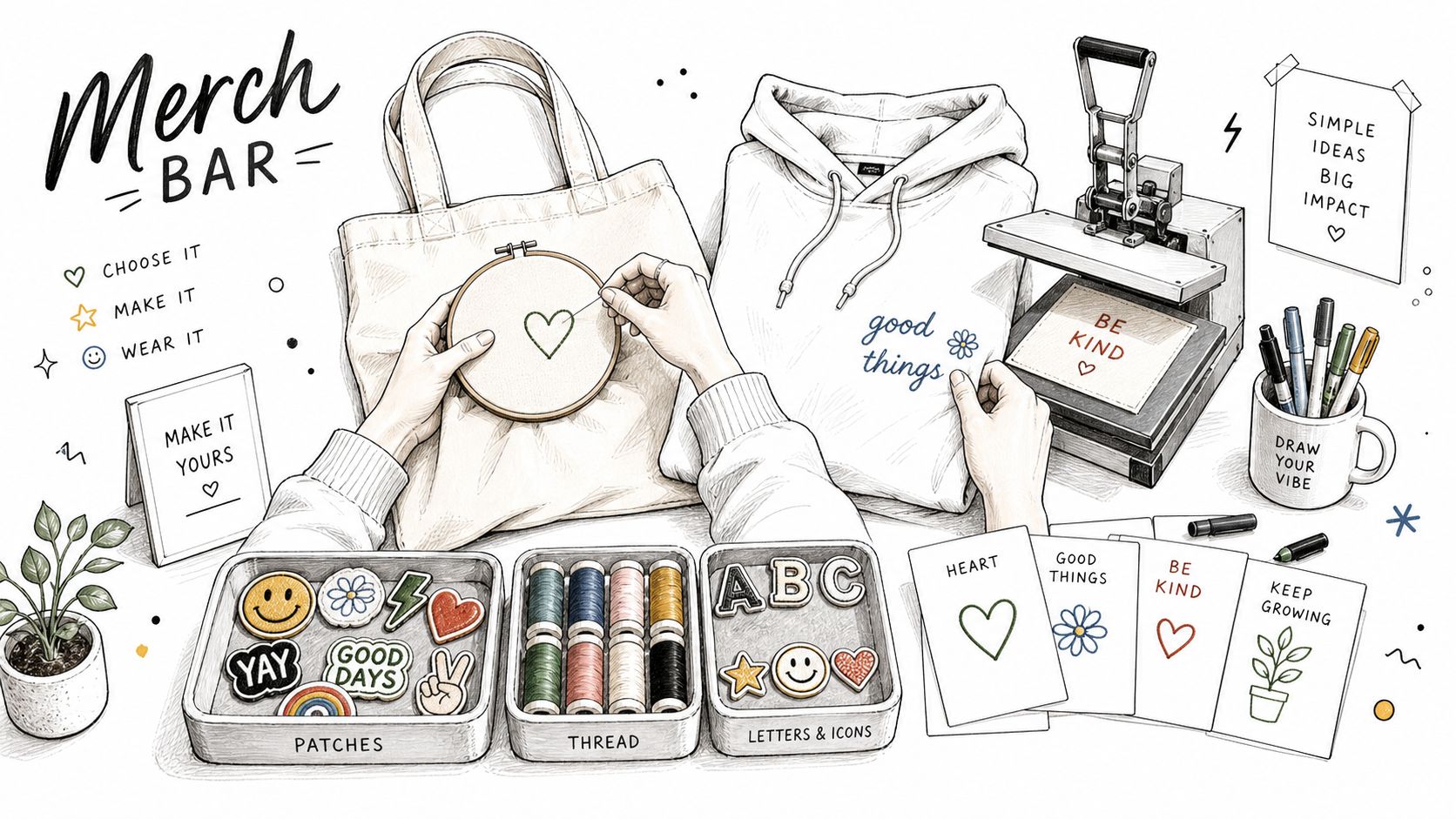
- Pre-build templates: Offer 5 to 10 strong options so people can decide quickly.
- Choose premium blanks: The shirt or hoodie has to feel good before the customization starts.
- Support remote customization: Ship materials early and run the session live.
Budgeting matters here too. A merch bar can stay controlled if you cap the number of decoration methods, keep templates pre-approved, and choose blanks that hold up well under customization. That gives marketing and events leads a cleaner production plan, better line flow, and a more polished result without turning the party into a production headache. For sourcing, the best hoodie blanks guide is a useful reference.
A setup like this makes the merch the activity, not a side item. In one room, the live station becomes a natural conversation starter. For a distributed team, the shared making moment still works because everyone finishes with something personal.
Once people start designing, the tone changes from novelty to ownership. That is the point. They did not just show up for the party, they helped build it.
5. Sustainability-Focused Merch Swap & Donation Drive
A swap party gives old merch a second life without turning the event into a lecture. Employees bring gently used company pieces from earlier years, trade for something new, and anything unclaimed goes to a local nonprofit. The vibe stays social, but the event signals that your company cares about what happens after the party ends.
Make the values visible
This works best when the new merch is sourced responsibly and clearly framed as part of the refresh. Organic cotton, recycled polyester, and durable construction matter more here than flashy graphics. The point is to show that old gear can circulate and new gear can be better from the start. That's a more honest sustainability story than a token eco tagline.
The operational part is simple if you plan ahead. Confirm which nonprofits can accept the donated items, set standards so only gently worn merch qualifies, and document the handoff for internal comms or social. That creates a story the team can point to without making the event feel performative.
The strongest sustainability move is practical, not symbolic. People should leave with less clutter, better gear, and a cleaner follow-through.
- Set the swap rules early: Only clean, wearable pieces should enter the exchange.
- Line up recipients first: Donation is easier when the destination is already confirmed.
- Use the party to refresh the wardrobe: Pair the swap with one new premium item.
For sourcing that supports the message, the environmentally friendly promotional items guide fits this format well.
6. Team Hoodie Reveal & Launch Party
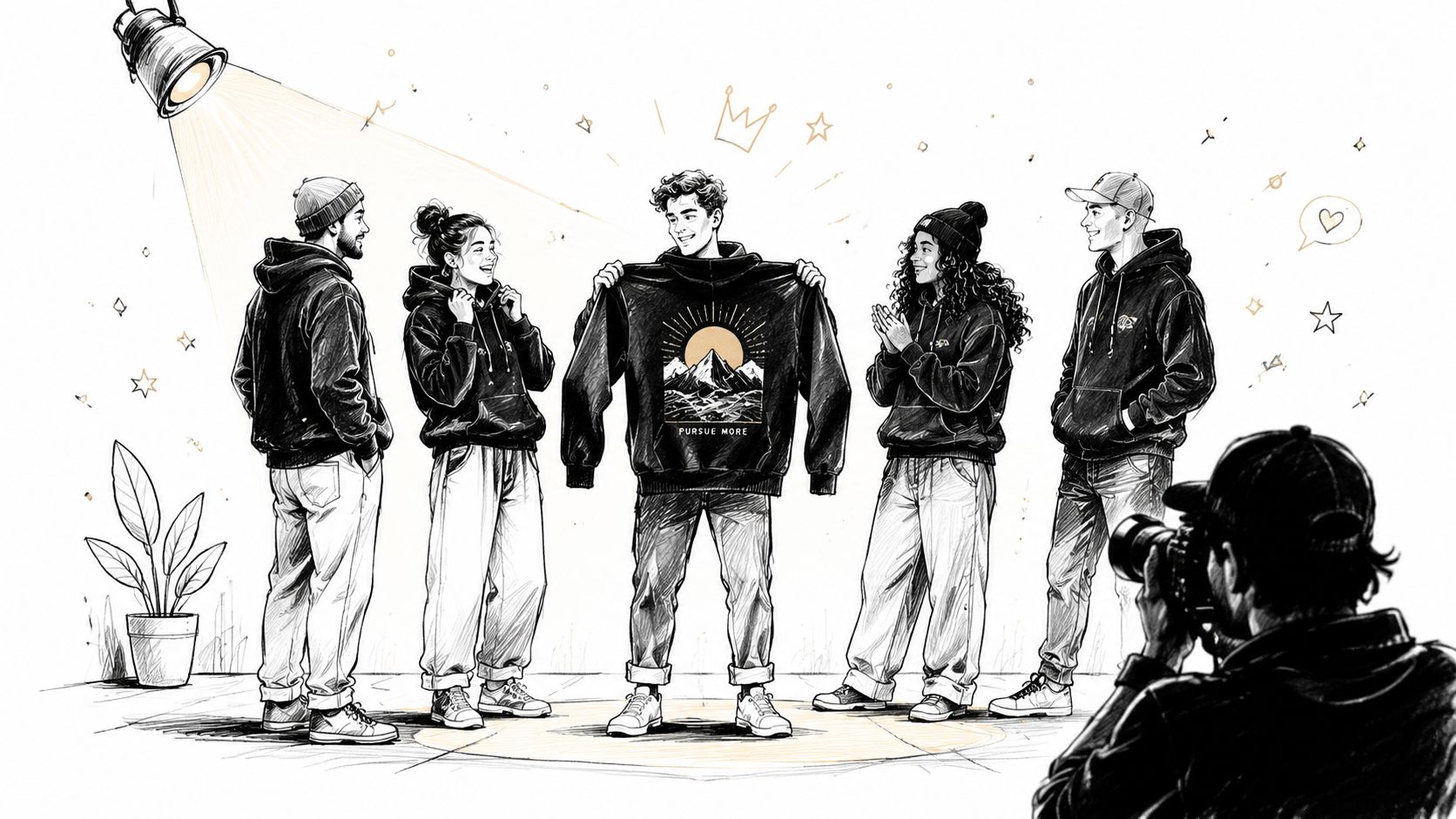
A hoodie reveal should feel like a launch, not a handout. Use the party to unveil a heavyweight piece with real structure, explain the design choices, and put the entire team in the new look before the night is over. That's how you turn apparel into a cultural artifact instead of a leftover budget line.
Treat the hoodie like a product drop
Heavyweight custom hoodies, especially in the 400 to 500 GSM range, carry better and look more premium on the body. The right sourcing and finish details matter here, especially if you're aiming for French atelier quality or a cleaner European blank. This is the kind of item that justifies a reveal because it reads as a real garment, not standard event merch.
Tell the design story as part of the party. Explain the color choice, the logo placement, and why the fit was selected. Then get photos immediately, because the best content happens when the reveal is still fresh. If the team is wearing the pieces in the room, the event itself becomes a content engine.
- Order early: Heavyweight production needs more lead time than basic tees.
- Use product previews: Validate the build before anything ships.
- Capture the moment: A photographer or designated teammate should document the reveal.
Launch rule: If the hoodie looks good enough for a team photo, it's good enough to become the centerpiece of the party.
The best hoodie blanks internal link is the right place to anchor sourcing for this kind of launch.
7. Cross-Team Branded Accessory Exchange
A cross-team exchange gives each department a chance to show its personality without breaking the brand. One team makes notebooks, another handles tech pouches, another puts together drinkware or beanies, then everyone swaps at the party. It's Secret Santa energy, but with actual design intent.
Keep the structure simple
The mistake is letting every team freestyle without coordination. Assign one owner, set one deadline, and require approval before anything gets produced. That keeps the pieces aligned and avoids the scramble that happens when every department thinks it's running its own mini drop. Low MOQs help here because smaller teams can participate without overcommitting.
This format works especially well in companies where teams already have distinct identities. The exchange creates a visible reminder that everyone is part of the same umbrella, even if each group has its own style. Document which team designed what so the gift lands with a little more meaning.
- Set a firm production cutoff: Four weeks before the party is the right time to stop design drift.
- Assign one coordinator: Someone has to own the schedule and approvals.
- Label the drops clearly: Recipients should know who made what and why.
This kind of exchange builds internal recognition without requiring a stage, a speech, or a huge spend. It's low friction, but it still feels thoughtful.
8. Branded Party Essentials Kit
If you want the room to feel branded without leaning on loud décor, turn the party infrastructure into merch. Custom notebooks can serve as place cards, branded drinkware handles the beverages, tote bags become takeaway carriers, and beanies or caps can sit at each seat as part of the table design. The event becomes cohesive because the useful pieces are doing the decorating.
Make utility do the branding
This works best when the items people touch most are the highest quality. Drinkware is the obvious one. Mugs, tumblers, or bottles should feel durable, not promo-tier. Laser engraving and embroidery make the overall kit read more premium, especially when paired with custom napkins, coasters, or a few subtle wooden serving pieces.
A branded essentials kit makes sense for teams that care about presentation. Startups, fintech companies, and creator brands can use it to make a dinner feel designed instead of catered. The key is to make every item earn its place at the table.
If it's going to sit in front of someone for two hours, it should feel like it belongs there.
- Choose post-party utility: Pick pieces people can take home and use next week.
- Mix categories: Combine apparel, drinkware, and accessories for variety.
- Plan for scale: Guest count affects everything from packaging to budget.
The best branded-party setups feel naturally integrated because the products are useful first. That's the difference between decoration and infrastructure.
9. Year-End Recognition Awards with Custom Merch
Traditional trophies collect dust. Custom merch gets worn. That's why year-end recognition lands harder when the award itself is a personalized jacket, portfolio, hoodie, or leather item with names, patches, or engraving tied to a specific accomplishment. It's a keepsake, not a shelf object.
Make the award feel earned
This format works best when the categories are set well before the party. Plan in November, produce in time for December, and make sure each recipient gets something that reflects their actual contribution. The more specific the personalization, the less generic the recognition feels. A jacket with a name or a portfolio with a role-related engraving carries more weight than a standard plaque.
The primary value is emotional clarity. People know why they're receiving the item, and they keep using it because it reminds them of the moment. That's especially effective for early employees, top performers, or contributors who had a visible impact during the year.
- Personalize every piece: Names, patches, and engraving make the award feel made for one person.
- Choose premium construction: The garment should feel worthy of the recognition.
- Document the handoff: Photos and internal posts make the moment last.
Recognition should feel like an upgrade, not admin. A custom item gets there faster than a generic trophy ever will.
10. Limited-Edition Holiday Collab Drop with External Partners
Partner drops are the most internet-native move on this list. Bring in a designer, creator, or complementary brand, produce a small holiday collection, and announce it at the party as a limited-edition collab. That creates buzz before the event and gives the team something collectible to take home.
Make the collaboration feel real
The right partner matters more than the size of the name. Choose someone whose taste and audience match yours, then build something that goes beyond a logo swap. Cut-and-sew details, special trims, and unique construction make the release feel like a proper capsule, not a branded afterthought. Keep the run limited so the piece feels worth owning.
This format is especially strong for web3 communities, fintech teams, and creator brands because partnership is already part of the culture. Use the party to reveal the collab, then let both sides co-market the drop. If the event is done right, the merch extends the celebration long after the room empties.
Collab rule: The best partner piece should still make sense if the logo disappears.
- Pick the partner early: The anticipation starts before the party does.
- Keep the edition small: Limited availability makes the drop feel collectible.
- Share the marketing load: Both sides should promote the release.
When the party and the collab launch happen together, you get both social proof and product value. That's a strong finish for year-end.
Top 10 Holiday Office Party Ideas Comparison
| Item | 🔄 Implementation Complexity | ⚡ Resource Requirements | ⭐ Expected Outcomes | 📊 Ideal Use Cases | 💡 Key Advantages & Tips |
|---|---|---|---|---|---|
| Branded Team Merch Drop Party | Medium, design coordination + production/shipping (2–3 wk lead) | Moderate, design, production, distributed shipping | ⭐⭐⭐⭐, wearable, shareable culture moment | Startups, distributed tech teams, web3 communities | 💡 Order 10–15 business days ahead; provide multiple colorways; ship pre-event for unified unboxing |
| Virtual Holiday Party with Custom Gift Boxes | High, international shipping logistics & personalization | High, curated items + international fulfillment (budget scales with headcount) | ⭐⭐⭐⭐, highly engaging remote experience | Remote-first companies, global organizations | 💡 Use DDP, order 3–4 weeks out, time delivery 3–5 days pre-event |
| Custom Apparel Fashion Show & Voting Party | Medium, needs product previews (BATs) and voting setup | Moderate, sample production, live event tech | ⭐⭐⭐⭐, strong engagement and design buy-in | Design-forward teams, collaborative companies | 💡 Limit options to 4–6; get BATs 48 hours prior; use simple voting (Slack/Mentimeter) |
| Customizable Merch Bar Station | Medium, on-site partner or pre-shipped DIY kits; time-intensive per person | Moderate, equipment/partner fees or custom kits for remote | ⭐⭐⭐⭐, highly personal, memorable keepsakes (limited scale) | Creative teams, small groups (<50), offsites | 💡 Partner with local shop; pre-design templates; ship blanks + tutorials for remote |
| Sustainability-Focused Merch Swap & Donation Drive | Medium, coordinate swaps and charity partnerships | Low–Moderate, minimal new production if swapping; charity logistics | ⭐⭐⭐, aligns with values, reduces waste, goodwill impact | Climate-conscious brands, purpose-driven startups | 💡 Partner with 1–2 nonprofits; set quality standards; document donations for comms |
| Team Hoodie Reveal & Launch Party | Medium, premium sourcing, photography, sizing collection (3–4 wk lead) | Moderate–High, premium blanks, packaging, photographer | ⭐⭐⭐⭐, high perceived value; cohesive photo moments | Tech companies, brands seeking a signature moment | 💡 Order 3–4 weeks ahead; get BATs; include design story and capture professional photos |
| Cross-Team Branded Accessory Exchange | High, multi-team coordination and quality control | Moderate, multiple small runs across teams | ⭐⭐⭐, variety-driven engagement and inter-team bonding | Large orgs, matrixed companies, multi-department events | 💡 Appoint a coordinator; set firm deadlines; require design approval; use low MOQs |
| Branded Party Essentials Kit | Medium, planning many usable touchpoints (drinkware, totes, place cards) | Moderate–High, multiple item types, custom finishes | ⭐⭐⭐⭐, cohesive, functional party experience that doubles as gifting | Client-facing events, formal celebrations, brands wanting cohesion | 💡 Prioritize high-use items (mugs, bottles); use engraving/embroidery; plan 4–6 weeks out |
| Year-End Recognition Awards with Custom Merch | Medium, personalization data + premium production | High, bespoke items (leather, embroidery, engraving) | ⭐⭐⭐⭐, meaningful, lasting recognition with strong emotional impact | Performance-driven cultures, companies celebrating wins publicly | 💡 Plan categories in November; use premium blanks; personalize via embroidery/engraving |
| Limited-Edition Holiday Collab Drop with External Partners | High, partner alignment, co-marketing, timing complexity | Moderate, low MOQs but partner management required | ⭐⭐⭐⭐, high buzz, collectible value, extended reach | Brands with communities, creator-adjacent companies, web3/fintech | 💡 Pick aligned partners; announce early; emphasize limited runs and exclusive design elements |
Make Your Next Holiday Bash Unforgettable
Pick the format that matches your culture, then work backward from the party date so production, shipping, and RSVP timing stay tight. The strongest holiday office party ideas do more than fill one evening. They leave people with a memory, a photo worth sharing, and a branded piece they keep wearing.
The latest planning data makes the opportunity obvious. Employees are already willing to show up, and companies are spending more to make the event feel worth it CFO report on holiday-party budgets and attendance. That raises the standard. The question is no longer whether the party is decent enough for December. It is whether the event earns the calendar block, justifies the budget, and creates content people want to share afterward.
Teams also want formats that feel easy to join. A 2024 Harris Poll cited in Axios found that many workplaces are moving toward annual in-person holiday gatherings, while Gen Z workers showed a stronger preference for no alcohol or limited alcohol and for themed parties with interactive activities like games and escape rooms Axios on company holiday-party preferences. Another recent data point shows that 82% of workers are willing to RSVP yes, but 45% still feel stressed about attending, which is why food-first, casual, lower-pressure formats keep performing well Stacker on holiday-party RSVP and stress data. Keep the friction low, and participation goes up.
Use merch as the connective tissue. A hoodie reveal, a team drop, a gift box, or a collab capsule gives the night a second life after the event ends. Pair that with a clear theme, a realistic budget, and a production timeline that accounts for proofs, shipping, and last-minute RSVP changes. If alcohol is part of the plan, handle office events with a clear policy and a low-drama setup, and keep the focus on the experience, not the drinks.
If you want the next party to feel sharper, start now. Lock the format, choose one branded piece that anchors the whole event, and set the production window before the calendar gets crowded. Request a quote, preview designs in 24 hours, and turn your end-of-year event into something your team wants to wear.
A CTA for Banger.