Private Label Apparel: Create Custom Merch That Sells
You're probably here because your team needs apparel, but you don't want another dead-on-arrival hoodie. You've seen the usual outcome. Thin tee, awkward fit, generic blank, logo slapped on the chest, one wash later it looks tired. Nobody chooses to wear it. It becomes conference debris or drawer filler.
That's the fundamental divide in branded apparel. Not merch versus fashion. It's forgettable product versus brand-owned product. The teams getting this right treat apparel like a cultural object. Something that carries taste, signals standards, and holds up outside the office, offsite, or event booth.
That's why private label apparel keeps getting more attention. It isn't just a supplier term. It's the move from “put our logo on something” to “build something that feels like us.” The category itself reflects that shift. The global private label apparel market is valued at $65.2 billion in 2024 and is forecast to reach $122.5 billion by 2033, growing at a 7.2% CAGR, according to Market Intelo's private label apparel market report.
Table of Contents
Beyond Bad Merch
Most bad merch fails long before production. It fails in the brief.
A founder asks for “premium hoodies.” A marketing lead wants “something refined.” The supplier replies with a standard blank, one decoration option, and a fast quote. Everyone feels efficient for about a week. Then the samples land. The body is wrong, the cuff rib is weak, the print sits too high, and the whole thing feels like a giveaway instead of a garment.
That's the trap. Generic merch is built for convenience, not identity.
Private label apparel changes the question. Instead of starting with whatever blank happens to be easiest to source, you start with the look, hand feel, silhouette, and finish you want people to associate with your brand. You're buying readymade garments from a manufacturer and selling them under your own brand name and label, with freedom to customize design, logos, and packaging, as outlined in Zega Apparel's explanation of private label clothing.
A logo isn't a product
There's a reason so much company merch gets ignored. It treats branding like decoration instead of direction.
A useful filter is simple:
- If the garment only works because your logo is on it, it's weak.
- If the garment would still feel good with minimal branding, you're onto something.
- If someone would wear it twice in one week, that's the standard.
For teams selling direct, this matters even more. The apparel has to hold attention after the first click. If you're building a merch store instead of handing out pieces internally, the growth side matters too. Tools like Shopify apps to boost clothing sales are useful once the product is worth buying in the first place.
Good branded apparel doesn't scream. It reads like a well-made product that happens to belong to your brand.
The design side usually breaks first when teams skip product thinking. They overbuild the graphic and underbuild the garment. A better route is to lock the base, trims, print method, and fit before debating the front chest artwork. If you need help getting that right, it helps to think in terms of custom design services for branded apparel, not just print placement.
The Four Paths to Branded Apparel
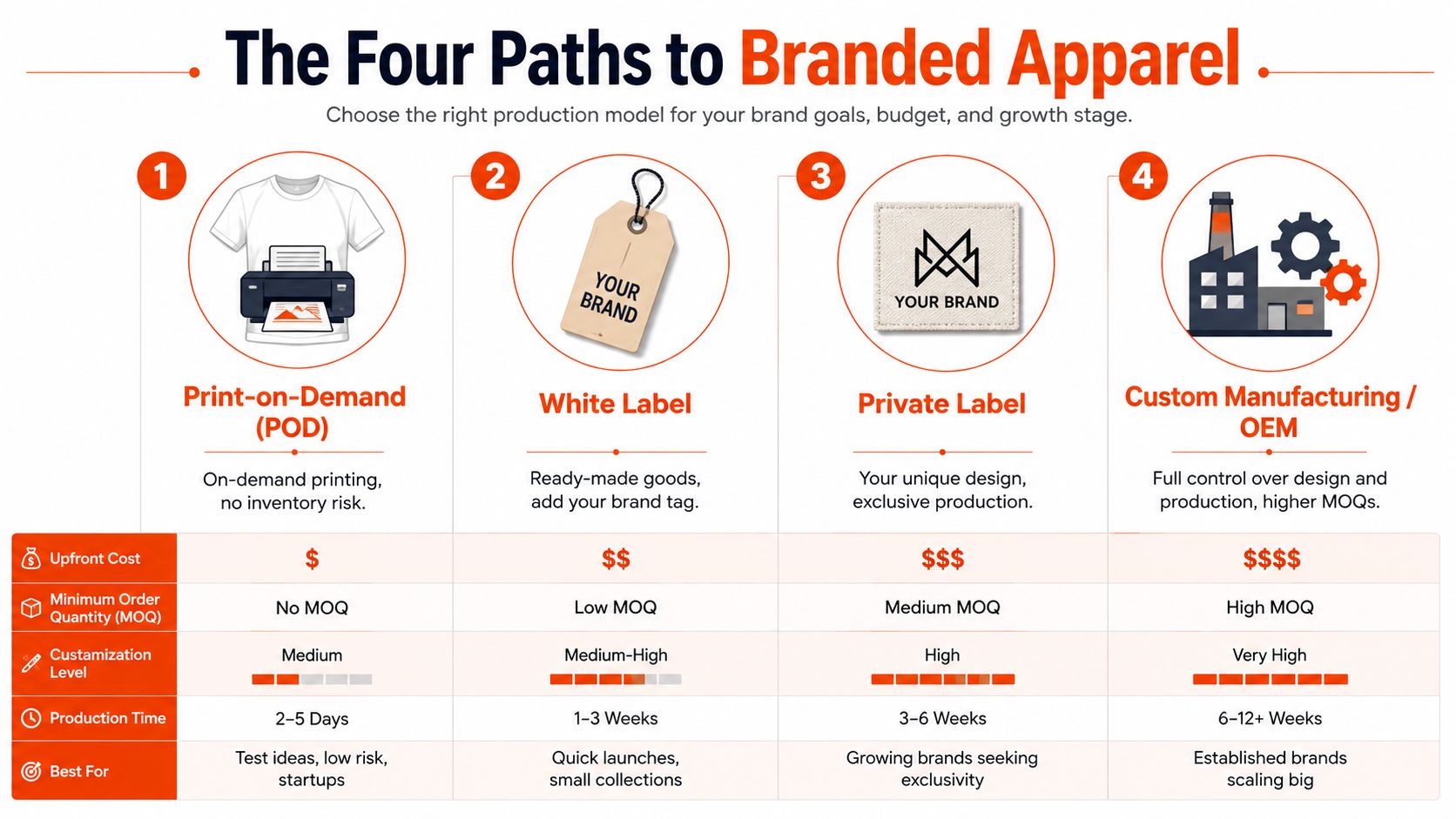
There isn't one way to make branded apparel. There are four. Most confusion comes from teams mixing them up, then expecting one model to behave like another.
Why most teams choose the wrong model
They optimize for the wrong risk.
A creator launching a community drop doesn't have the same constraints as a retailer building a full seasonal line. A fintech team ordering onboarding kits doesn't need the same setup as a DTC brand building signature silhouettes. Yet most guides still assume one thing. Higher volume is the default. That's the gap.
The quality versus volume fallacy sits right in the middle of it. The industry benchmark for private label MOQs is often 200 to 500 units, while modern internet-native teams often need 10 to 50 high-quality pieces for onboarding or community drops, as noted in The Urban Charm's guide to starting a private label fashion brand.
A cleaner way to compare the four
It's similar to building a computer.
| Model | What it feels like | Best for | Limits |
|---|---|---|---|
| Print-on-Demand | Prebuilt laptop | Testing ideas fast | Weak control over garment quality, fit, finishing |
| White Label | Prebuilt with your sticker on it | Simple branded basics | Shared product, limited distinctiveness |
| Private Label | Choosing premium components from a strong platform | Team drops, creator merch, startup apparel, capsule runs | Some constraints from the base silhouette |
| Custom Manufacturing / OEM | Engineering the motherboard | Full fashion product development | More complexity, higher MOQs, longer development |
Print-on-Demand is speed first. Upload artwork, pick a blank, go live. Great for demand testing. Bad if your brand depends on fabric feel, fit, or premium details.
White label is one step better. You start with an existing product and add your neck label, hangtag, or packaging. It can work for simple basics, but the underlying garment still belongs to the manufacturer's system.
Private label apparel is the sweet spot for a lot of modern teams. You're not reinventing every pattern piece from scratch, but you still get real control over branding, customization, and the final feel. That's usually where quality and speed stop fighting each other.
Custom manufacturing or cut and sew is for teams that need complete authorship. Every panel, trim, pattern, and proportion is intentional. It's the highest-control route, and usually the least forgiving one.
Practical rule: If you care most about silhouette, materials, and finishing, skip POD. If you care most about speed and low risk, start there and move up only when the product earns it.
Teams running DTC stores often need both a product lens and a growth lens. If that's your world, Ecommerce Boost's DTC guide is a useful companion to the apparel decision itself.
And if your use case is small-batch merch rather than full retail inventory, custom apparel with no minimum is the right frame to compare against private label, not mass wholesale assumptions.
Decoding Costs and MOQs
If one hoodie quote comes in low and another lands much higher, the difference usually isn't arbitrary. It's sitting inside the fabric, the construction, the trim package, and the quantity logic.
What you're actually paying for
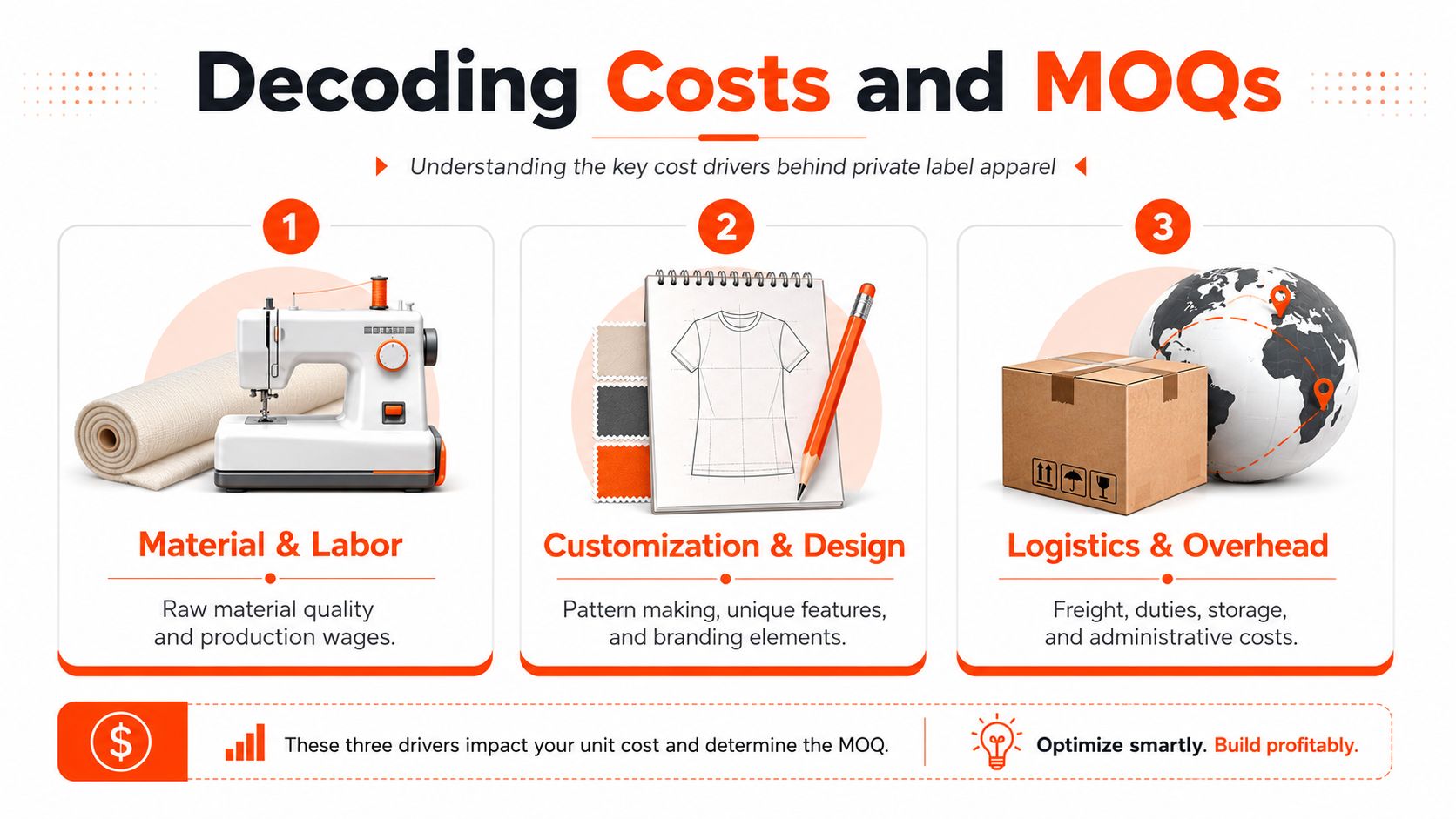
A quote is usually carrying three layers at once.
The garment itself. Fabric quality changes everything. Heavyweight cotton, better yarn, cleaner knitting, better rib, stronger sewing, and a more considered fit all raise cost before branding even enters the room.
Customization. A woven neck label, oversized screen print, embroidery, custom drawcords, branded zipper pulls, hangtags, and retail-ready packaging all add work. Not just materials. Handling too.
Operational friction. Small orders are harder to produce efficiently. Factories still deal with setup, trimming, approvals, and labeling whether you order a handful of pieces or a full run.
How low MOQ projects stay viable
The old model doesn't like small-batch work. For standard private label T-shirts and underwear, typical industry MOQs range from 1,000 to 5,000 units per style, while agile manufacturers define low MOQ as 50 to 100 pieces, according to Sino Sine Tex's breakdown of private label manufacturing MOQs.
That's why founders get whiplash. One supplier talks like a small test run is normal. Another treats it like a nuisance.
The mechanics matter:
- Stock fabric reduces friction. If a factory already holds the fabric color, you avoid custom dye minimums.
- Shared fabric across styles helps. Using the same base fabric across a tee, short, and hoodie can make a small project workable.
- Labels have their own minimums. Custom woven labels often require a separate run, so some units get held for later reorders.
Those aren't glamorous details, but they're where low-volume private label either works or collapses.
Cheap quotes often hide expensive compromises. Weak fabric, generic fit, limited branding, or no room for revisions.
A better way to read a quote is to ask what's fixed and what's variable. Is the body already stocked? Are labels included? Is packaging separate? Does the supplier expect one design placement or several? If you're comparing small-run options, low MOQ custom apparel FAQs can help frame the right questions before you approve anything.
The Anatomy of a Premium Garment
“Premium” is one of the most abused words in apparel. Usually it means nothing. Real quality is visible, but it starts in places people don't always name well.
Fabric first
If the base cloth feels wrong, nothing on top of it can save the product.
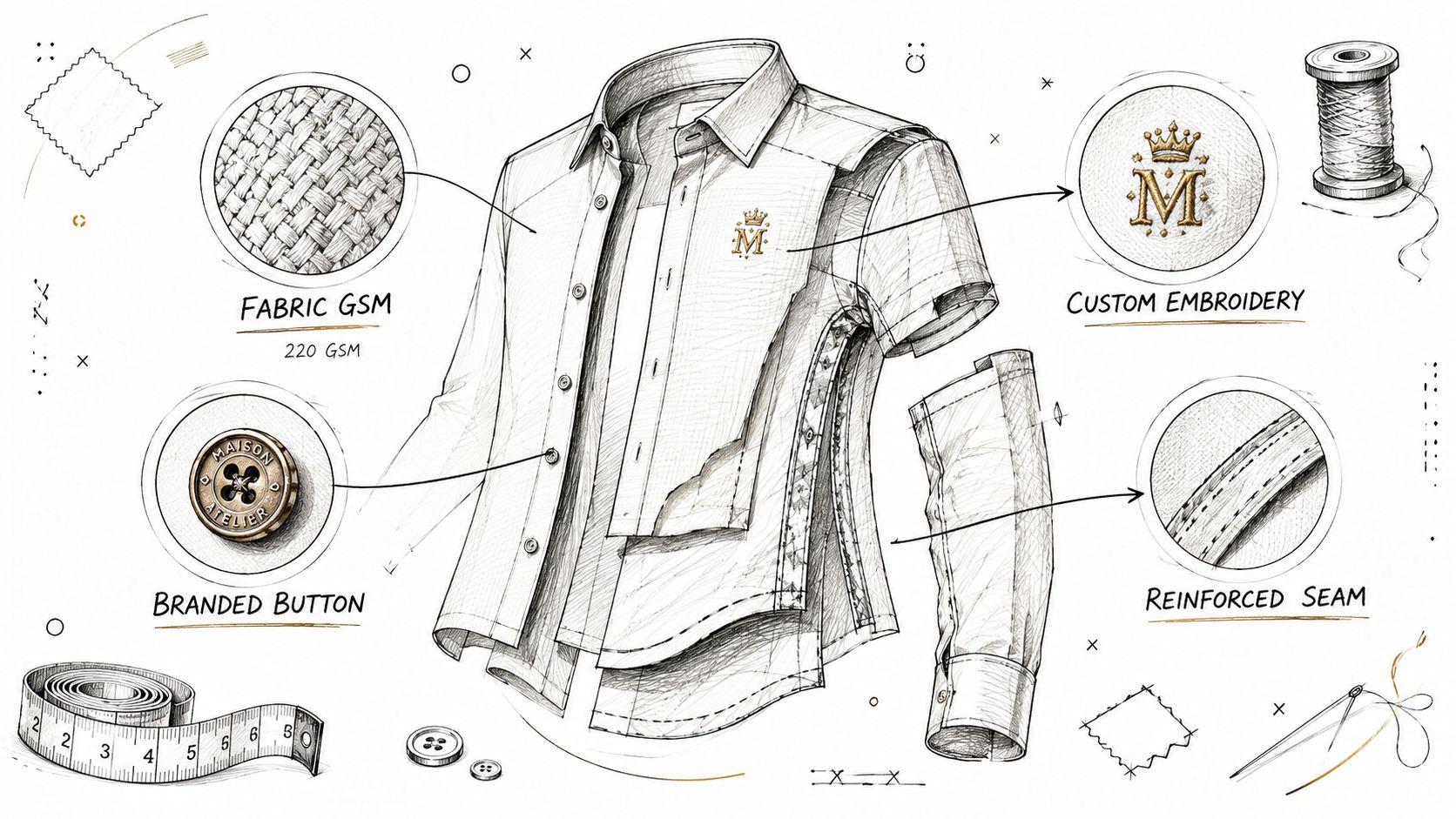
Start with GSM, which is fabric weight. Heavier doesn't automatically mean better, but it does affect drape, warmth, opacity, and how substantial a garment feels in hand. A heavyweight hoodie reads differently from a lightweight promo fleece before anyone even sees the branding.
Then look at fiber and finish. Cotton quality matters. So does whether the surface feels dry, brushed, compact, soft, or crisp. European-sourced premium blanks tend to matter for the same reason good paper stock matters in print. The hand feel changes the perception of the whole brand.
A useful benchmark is to avoid designing from moodboard language alone. “Luxury streetwear” is vague. “Heavy cotton tee with compact hand, clean collar rib, slightly dropped shoulder, and subtle chest embroidery” is actionable.
For teams comparing blanks, this guide to premium blank T-shirts is closer to how product people should think than a generic merch catalog.
Details that make it feel real
Premium garments earn trust through small decisions:
- Neck labels set the tone fast. Printed labels feel minimal. Woven labels feel more permanent.
- Embroidery adds texture. Flat embroidery is clean and classic. 3D embroidery pushes louder, which works better on caps and some outerwear than on refined basics.
- Seams and finishing matter more than most graphics. Reinforced seams, neat inside finishing, and stable rib signal quality the second someone handles the piece.
- Hardware and trims can make a hoodie feel like product instead of merch. Zippers, pullers, toggles, and even drawcord tips all count.
Visual references help more than adjectives. Use this clip to calibrate the kind of product detail worth discussing with a supplier before sampling.
The fastest way to cheapen a garment is mixing premium intent with generic finishing.
That usually shows up as a nice silhouette paired with a bad neck label, bulky print hand feel, or packaging that looks like an afterthought. Product quality is cumulative. So is product cheapness.
The Production Timeline From Brief to Unboxing
Teams get stressed about apparel production when they can't see the sequence. The work feels mysterious until you break it into decisions.
What happens before production
The process starts with a brief. Not a vague moodboard dump. A real brief. Product type, intended fit, target use, branding placements, references, colors, quantities, shipping plan.
Then comes the first visual pass. That might be a digital mockup, a spec sheet, or a tech pack. The important part isn't how pretty it looks. It's whether it removes ambiguity. If the embroidery size, label position, fabric direction, and packaging requirements aren't clear here, they'll come back as production mistakes later.
A strong pre-production stage usually includes:
- Product selection with the right base garment and customization path
- Artwork and specification alignment so no one is guessing
- Sample or e-proof review before anything scales
- Approval discipline from one decision-maker, not five conflicting opinions
For packaging, don't leave the outer layer until the end. Mailers affect the unboxing just as much as hangtags affect the first impression. If you're shipping direct, this overview of printed mailing bags is worth skimming before you finalize branded packaging choices.
What happens after approval
Once the sample or BAT is approved, production becomes a control exercise.
The supplier runs the garments, applies trims and branding, performs quality checks, and prepares shipment routing. For distributed teams, fulfillment planning matters almost as much as sewing quality. A single bulk shipment to HQ is one workflow. Multi-address shipping for a remote team or creator drop is another.
The cleanest timeline usually looks like this in practice:
| Stage | What matters most |
|---|---|
| Brief and quote | Clear references, realistic scope |
| Mockup and sample | Catch fit, print, trim, and label issues early |
| Production | Keep approvals closed and specs locked |
| Packing and fulfillment | Match destination plan to the project, not the other way around |
If a supplier can't explain the handoff from design approval to fulfillment, the process probably has gaps.
That's where projects slip. Not because the idea was bad, but because nobody owned the middle.
How to Vet a Supplier Without Getting on a Plane
The old advice says you need a factory visit to verify quality. For most modern teams, that's not realistic. It's also not the best first filter.
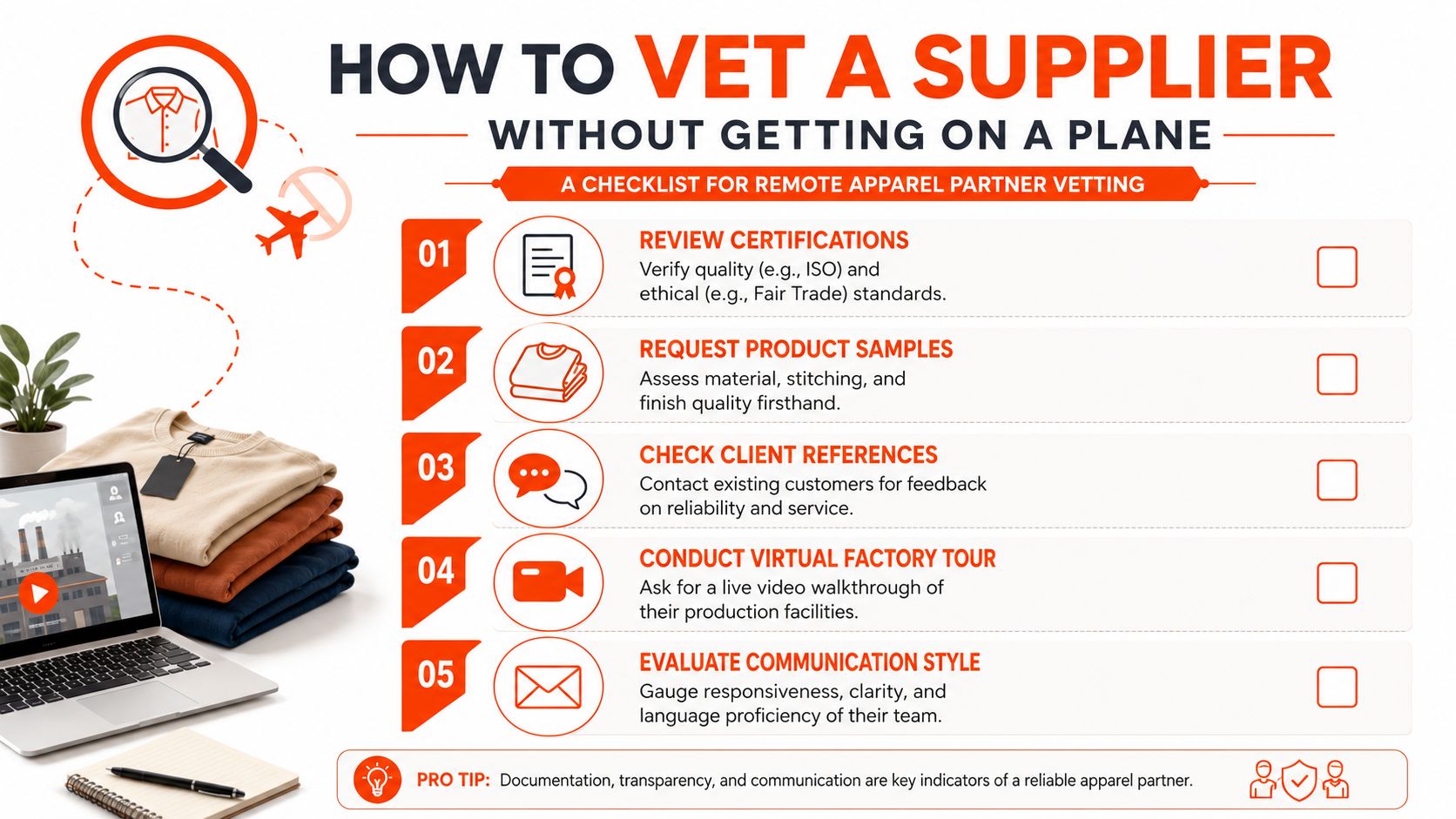
A common question is how to verify private label quality without a physical factory visit. Most guides still push factory audits, but the modern approach relies on high-fidelity digital proofing, e-proof/BAT, and sample validation to confirm details like stitch density and colorfastness without travel, as outlined in Ninghow Apparel's private label manufacturing guide.
Remote proof beats vague promises
Good suppliers can show their work clearly.
Ask for detailed photos of seams, cuffs, collar construction, embroidery edges, print texture, labels, and packaging. Ask for video in natural light. Ask for a live call if needed. The point isn't theatrics. It's evidence.
A remote review is strong when it includes:
- Close-up construction shots so you can inspect stitching and finish
- Flat measurements on the sample, not just “true to size” language
- Material details tied to the garment, not broad claims like “premium cotton”
- Branding previews with actual scale, not rough placeholders
If the supplier keeps speaking in moods instead of specs, slow down.
Questions that expose weak suppliers fast
You learn more from a few precise questions than from a glossy deck.
Ask where the garment is sourced and where customization happens. Ask what parts are stocked and what parts are made to order. Ask whether the labels are woven or printed, who handles them, and how reorders work. Ask how BAT approval is documented.
Then ask for one thing that weak suppliers hate. Specificity.
| Ask this | Good answer sounds like | Bad answer sounds like |
|---|---|---|
| What sample will I approve before production? | Clear description of sample type and approval flow | “Don't worry, production will match” |
| What can I verify remotely? | Photos, videos, measurements, e-proof, trim details | “We've done this for many clients” |
| What's your limitation on low-volume orders? | Honest trade-offs on fabrics, trims, or lead times | “Anything is possible” |
| How do reorders work? | Stored labels, locked specs, repeatability | Vague promises |
If you're comparing deeper manufacturing routes too, this overview of cut and sew clothing manufacturers helps separate supplier types before you start outreach.
A trustworthy supplier answers narrow questions with narrow answers.
That's usually the signal. Precision, not performance.
Global Standards Sustainability and Compliance
A premium garment can still fail if the compliance is sloppy. Nice embroidery doesn't help if the label is wrong for the market you're selling into.
Compliance is part of product quality
For the EU market, Regulation (EU) 1007/2011 is mandatory. Every textile product must have a permanent label indicating its exact fibre composition, and failure to comply can lead to market exclusion, according to the CBI guidance on apparel buyer requirements.
That matters for any team shipping branded apparel into Europe. Temporary swing tags aren't enough where permanent labeling is required. And if you're selling across multiple EU member states, language handling also matters. Compliance isn't paperwork someone figures out later. It has to be built into the production spec.
There's also a sizing layer that serious brands shouldn't ignore. The updated EN ISO 8559-2:2025/ISO 8559-2:2025 standard establishes a body-measurement-based sizing system for apparel, and EU member countries must adopt it by March 2026, with conflicting national standards withdrawn by that deadline, as described in iTeh's overview of clothing standards.
Sustainability that actually matters
A lot of sustainability language in apparel is still too loose. “Eco.” “Conscious.” “Responsibly made.” None of that means much on its own.
The useful questions are simpler:
- What's the fabric made from?
- Where is it sourced?
- Are the trims and packaging aligned with the same standard?
- Can the supplier explain the claim in concrete product terms?
For culture-driven brands, sustainability is part of brand taste. So is compliance. The best products don't treat either one as an add-on.
Frequently Asked Questions
| Question | Answer |
|---|---|
| What's the difference between private label and white label apparel? | White label usually means a ready-made generic product with light branding. Private label gives you more control over labels, trims, packaging, and how the product shows up under your brand. |
| Can you make fashion-grade apparel at low volumes? | Yes, but only if the supplier's workflow supports it. Small-batch production usually depends on stocked fabrics, efficient decoration methods, and realistic trim choices. |
| Do I need a full tech pack? | Not always. For simpler projects, a clear brief with references, placement notes, sizing direction, and packaging details can be enough. More complex garments benefit from a fuller spec package. |
| Should I start with samples or go straight to production? | Start with samples or an e-proof/BAT. It's the fastest way to catch issues with fit, stitching, branding scale, and material feel before they turn into a bulk problem. |
| Is private label apparel only for brands selling to consumers? | No. It also works for onboarding kits, event giveaways, community drops, internal uniforms, and creator merch. The key is whether the apparel needs to reflect brand taste, not whether it's sold at retail. |
| What usually slows projects down? | Unclear briefs, too many decision-makers, last-minute art changes, and packaging decisions made after production has already started. |
| How do I know if a supplier is actually premium? | Look for precision. Good samples, clear spec language, strong finishing, honest limits, and consistent communication beat vague “premium” claims every time. |
If you want to build merch your team wants to wear, Banger is built for that exact brief. From premium European blanks and French ateliers to low minimums, product previews within 24h, and worldwide fulfillment, it's a clean path for startups, creators, and culture-driven teams that want real private label apparel instead of generic swag. Request a quote or explore the catalog and launch your next team drop.