What Is Laser Engraving: The Complete Guide 2026
Laser engraving is a high-precision process that permanently removes material from a surface with focused light, creating visible depth rather than laying ink on top. In practical terms, true laser engraving can reach 100μm and beyond, while standard laser marking is usually shallower and often only changes the surface color.
If you're looking at custom bottles, keychains, metal cards, tools, or desk accessories right now, this distinction matters more than most suppliers admit. A lot of branded product looks good in the mockup, lands on your desk looking decent, then starts failing the second it meets real use. Logos scratch off. Surface marks fade. The product feels cheap, even if the brand on it isn't.
That gap is why people keep asking what laser engraving is. They're not really asking for the textbook definition. They want to know whether it lasts, whether it feels premium, and whether it's the right move for merch people will keep.
For quality-first teams, laser engraving is less about decoration and more about permanence. Done well, it gives hard goods the same thing good construction gives apparel. Integrity, restraint, and a finish that feels intentional.
Table of Contents
- CO2 for wood acrylic leather and other non-metals
- Fiber for metal and actual permanence
- UV for sensitive surfaces
The Difference Between Merch and Trash
Most bad merch fails in a very specific way. It doesn't fall apart dramatically. It just gets worse every time someone touches it.
A branded bottle goes through a few washes and the logo starts looking tired. A keychain rubs against keys in a pocket and the mark turns into a blur. At that point, the object stops acting like a brand asset and starts acting like clutter.
Laser engraving matters because it changes the relationship between the logo and the product. Instead of printing or coating the identity onto the surface, the laser physically removes microscopic layers of material. According to Laserax's explanation of how laser engraving works, the process creates permanent, deep marks by vaporizing material into fumes, with the beam acting like a chisel and achieving 100μm and beyond. That's a different category from shallow marking that only discolors the surface.
Premium feel comes from permanence
The reason engraved merch feels better isn't only durability. It's restraint.
A strong engraving usually looks quieter than a print. It can be tonal, tactile, and integrated into the object instead of shouting over it. On the right blank, that restraint reads as confidence. It feels closer to product design than promo decoration.
Practical rule: If the logo feels like a layer sitting on top, the product will usually feel temporary too.
That's why laser engraving works so well on hard goods that are supposed to age well. Think insulated drinkware, metal tools, leather accessories, or acrylic desk pieces. When the process is right, the branding becomes part of the item itself.
Quality is visible before anyone reads the logo
People can spot cheap customization fast, even if they can't explain why. Uneven fill, fuzzy edges, shallow contrast, or a surface treatment that looks sprayed on all send the same message. Corners were cut.
The better approach is simple:
- Choose products worth keeping: A bad blank won't become premium because it has a logo on it.
- Use engraving where permanence matters: Especially on hard goods that get handled every day.
- Match the process to the material: The wrong setup can make an expensive item look disposable.
That's the true split between merch and trash. Not whether something is branded, but whether the branding holds up.
How Laser Engraving Actually Works
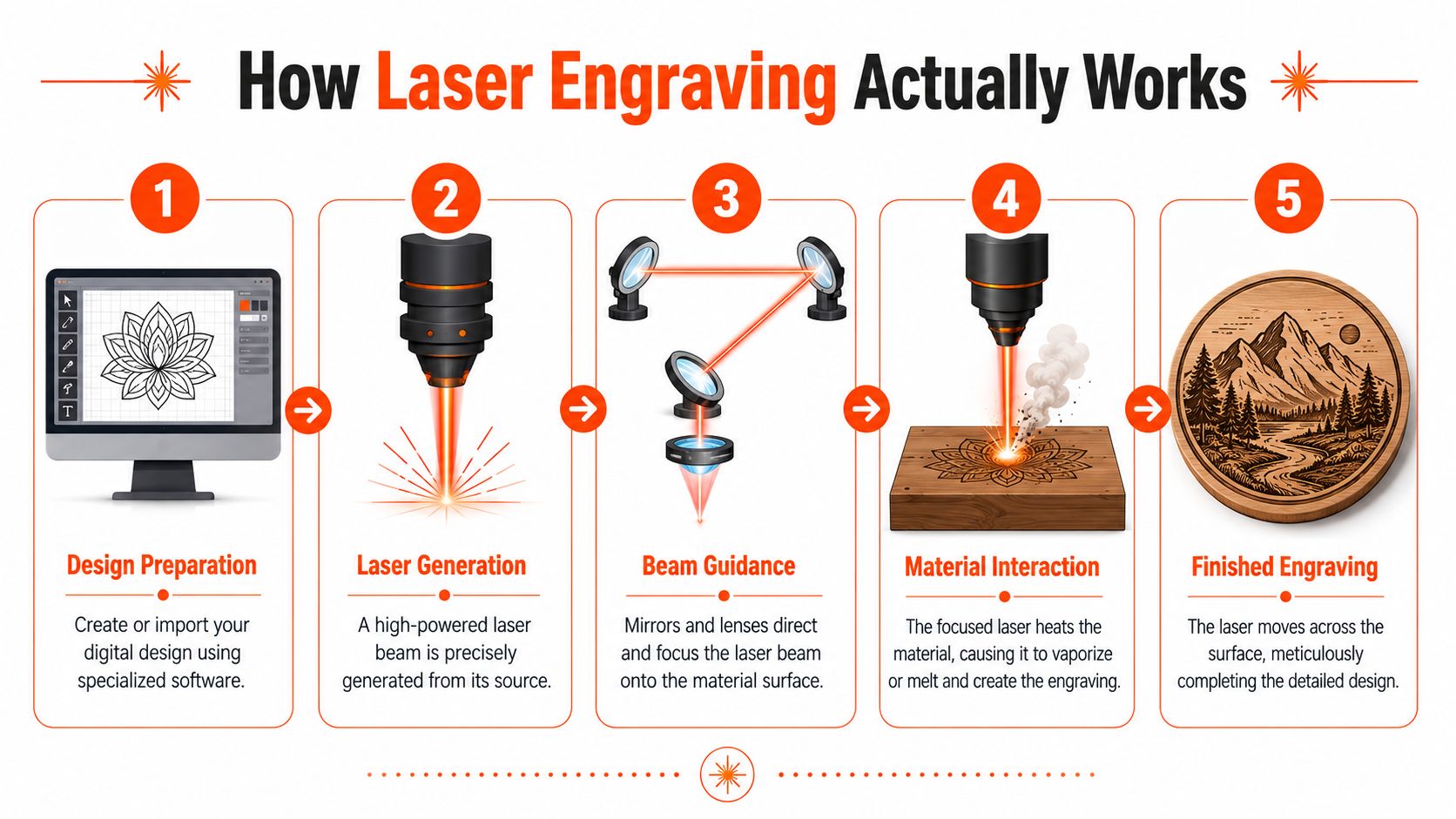
Laser engraving sounds technical, but the core idea is straightforward. A focused beam of light is directed onto a surface with enough energy to remove material in a controlled way.
This visual gives the process a clean overview.
It removes material instead of adding anything
The easiest way to think about it is a digital chisel. The machine follows a digital file and removes surface material with heat and precision. Depending on the material, that removal can happen through melting and vaporizing, direct sublimation, or ablation, where the beam dislodges microscopic particles from the substrate, as explained in Xometry's guide to laser engraving.
Two production modes show up constantly:
- Raster engraving: The laser moves line by line, which is useful for filled graphics, textures, and image-based artwork.
- Vector engraving: The laser traces paths like a pen plotter, which is better for logos, outlines, and typography.
For merch, vector is usually the cleaner choice when the goal is crisp branding. Raster has its place, but large filled areas can become slower and more sensitive to setup.
A short demo helps if you want to see the motion in real time.
The settings decide whether the result feels premium
Machines matter. Operators matter more.
According to Laserax's deep laser engraving overview, engraving depth and geometry depend on laser power, scanning speed, lens focal point, and line width, and reducing speed or increasing power directly increases material removal. That cause-and-effect is the difference between a faint surface touch and a mark with real presence.
Small setting changes can turn a sharp logo into a muddy one. That's why production judgment matters as much as the file.
In practice, teams usually feel this in four places:
Depth
More removal usually means better tactile feel and stronger permanence, but it also affects run time and finish.Contrast
Some materials naturally create beautiful contrast. Others need more careful tuning to avoid looking washed out.Edge quality
The best engraving looks crisp, not burnt, fuzzy, or overcooked.Consistency across units
One good sample means nothing if the rest of the batch drifts.
If you've seen engraved acrylic projects before, the acrylic keychain maker guide is a useful reference for how material choice and edge quality affect the final result.
CO2 vs Fiber vs UV The Right Laser for The Job
A laser logo on metal can look great on day one and cheap six months later. The difference usually starts with the machine choice.
Premium merch lives or dies on that decision. If the goal is a mark that stays sharp after daily handling, pocket wear, dishwasher cycles, or office abuse, "laser engraved" is not specific enough. CO2, fiber, and UV do different jobs, and they produce very different results.
CO2 for wood acrylic leather and other non-metals
CO2 lasers are the standard pick for organic and non-metal materials like wood, acrylic, leather, glass, and many plastics. They are good at producing clean surface removal, readable contrast, and a finish that feels intentional rather than stamped on.
That makes CO2 a strong fit for pieces where the material already has personality:
- Wood coasters and boxes: warm contrast and a crafted look
- Acrylic pieces: signage, tags, display components
- Leather patches and accessories: tonal branding with a restrained finish
CO2 is usually about visual character more than depth. On the right blank, that is exactly what you want.
Fiber for metal and actual permanence
Fiber laser is the serious option for metal. It is the method that gets you from a cosmetic mark to a mark with presence.
There is a real quality split here. Some metal branding is just surface marking. It can look dark and crisp in a sample, but it sits close to the top layer and wears down faster with friction, cleaners, and repeated use. True engraving with a fiber laser removes material. You can feel it with a fingernail. On stainless, aluminum, and other metal goods, that deeper cut is what gives premium merch its staying power.
That matters on products people keep in rotation:
- tumblers
- bottle openers
- metal keychains
- multi-tools
- desk accessories
- hardware-style branded objects
For fashion brands, creator teams, and startups trying to avoid throwaway merch, this is usually the line that matters most. A shallow mark can be enough for short-life promo. A deeper fiber engraving is the better call when the object is supposed to age well.
UV for sensitive surfaces
UV lasers are more specialized. They are useful on heat-sensitive plastics and coated parts where tight control matters more than aggressive material removal.
The upside is cleaner marking on fussy surfaces. The trade-off is obvious. UV is not the tool to choose when you want deep, tactile metal engraving with long-term wear resistance.
| Laser Type | Best For Materials | Common Merch Use Case | Key Characteristic |
|---|---|---|---|
| CO2 | Wood, acrylic, leather, glass, many plastics | Coasters, leather patches, acrylic tags, packaging details | Strong on non-metals |
| Fiber | Stainless steel, aluminum, titanium, other metals | Drinkware, keychains, tools, metal cards | Best choice for durable metal engraving |
| UV | Heat-sensitive plastics and delicate surfaces | Precision branding on select tech or accessory components | Lower thermal impact |
For branded gadgets, chargers, and metal desk pieces, it helps to review a custom tech merch catalog with the production method in mind, not just the render.
That same material-first thinking also applies outside tech. Teams building tableware or hospitality gifts can create personalized dinnerware with a much better result when the decoration method matches the surface and the expected wear.
Beyond Metal A Look at Engravable Materials
Metal gets most of the attention because it's where permanence becomes obvious fast. But engraving has a much wider design range than people expect.
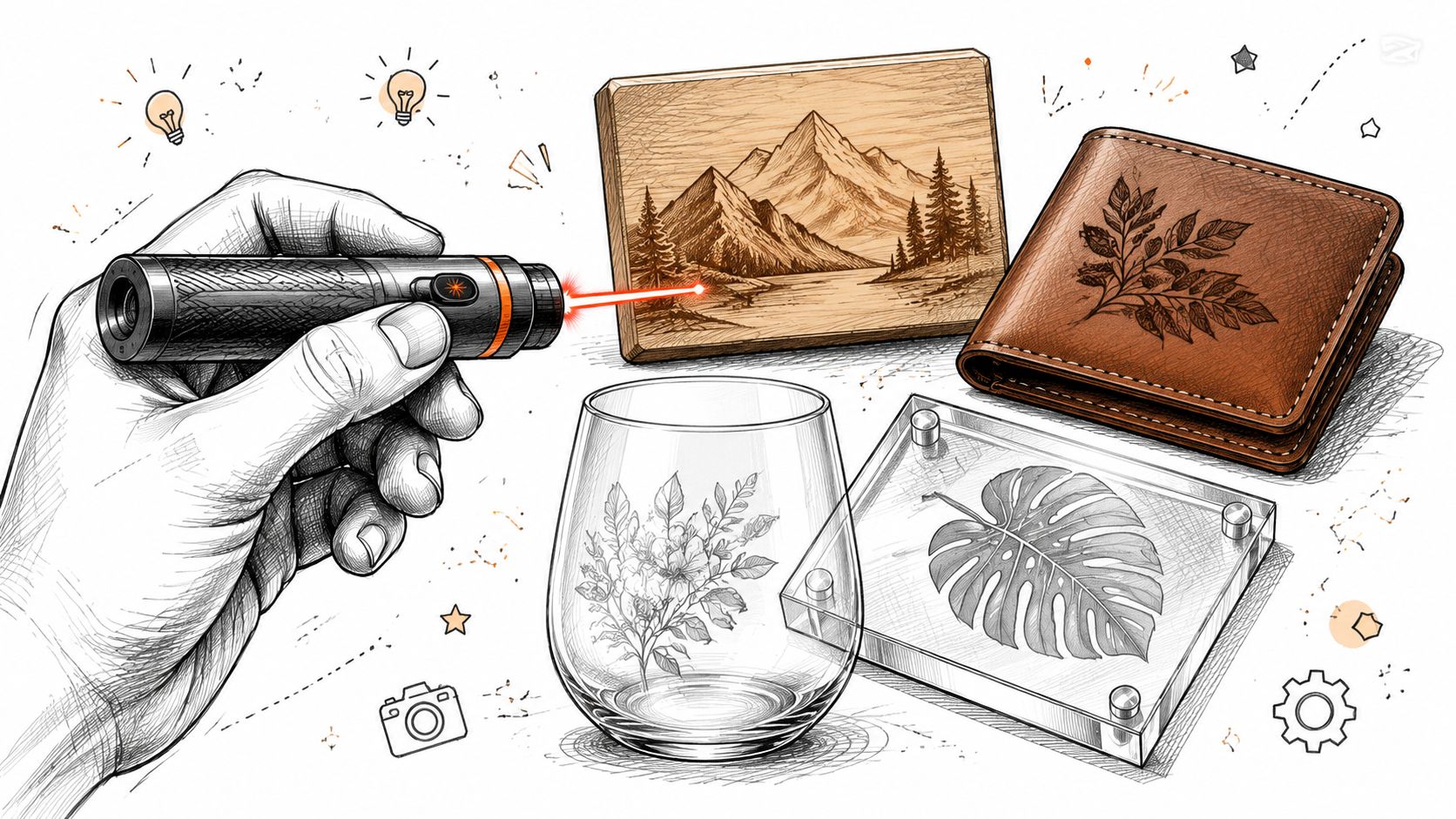
Materials change the whole mood
The same logo can feel completely different depending on the blank.
On glass, engraving often reads frosted and crisp. It feels clean, minimal, and hospitality-adjacent. That's why engraved glassware works well for premium gifting, team milestone kits, or office objects that need a quieter brand presence.
On wood, the result feels warmer and more tactile. Grain variation gives every piece slight character, which is useful if you want branded objects to feel less mass-produced.
On leather, laser engraving can look subtle and expensive when the hide is good. It reads more like a maker's mark than a promo hit. On acrylic, it goes in a different direction. Sharp, modern, slightly futuristic, especially on clear or smoked material.
The material does half the branding. Engraving just reveals whether you picked the right one.
For teams exploring tableware, hospitality sets, or premium event gifting, this guide on how to create personalized dinnerware is a useful example of how customization changes the feel of the object, not just the look.
Good merch starts with the blank
Many projects go sideways because people obsess over the logo and ignore the object.
A weak blank gives you weak results no matter how refined the engraving is. Premium customization needs premium base materials, especially when the method is permanent enough to expose every shortcut.
A few combinations consistently work:
- Stainless steel drinkware: understated, durable, easy to use daily
- Vegetable-tanned leather accessories: subtle branding, rich aging
- Acrylic desk pieces: sharp and modern, especially for startup environments
- Wood gift items: warmer and more artisanal
If you're considering bottles, tumblers, or barware, browsing custom drinkware options helps clarify which materials naturally suit engraving and which are better for print.
Engraving vs Printing and Embroidery
A brand spends real money on stainless drinkware for a launch, the samples look clean, and six months later the logo is scuffed, faded, or partly gone. That usually comes down to one mistake. The method did not match the object.
Printing, embroidery, and engraving do different jobs. Good production teams choose based on surface, wear, and the kind of brand signal the product needs to carry.
Printing is still the right call for color, artwork, and graphic presence. If the piece depends on ink saturation, gradients, or a large front hit, use print. Embroidery earns its place when fabric, texture, and stitch depth are part of the appeal. It gives caps, fleece, and uniforms a familiar branded finish.
Engraving sits in a different lane. It works best when the object itself should feel permanent, tactile, and restrained.
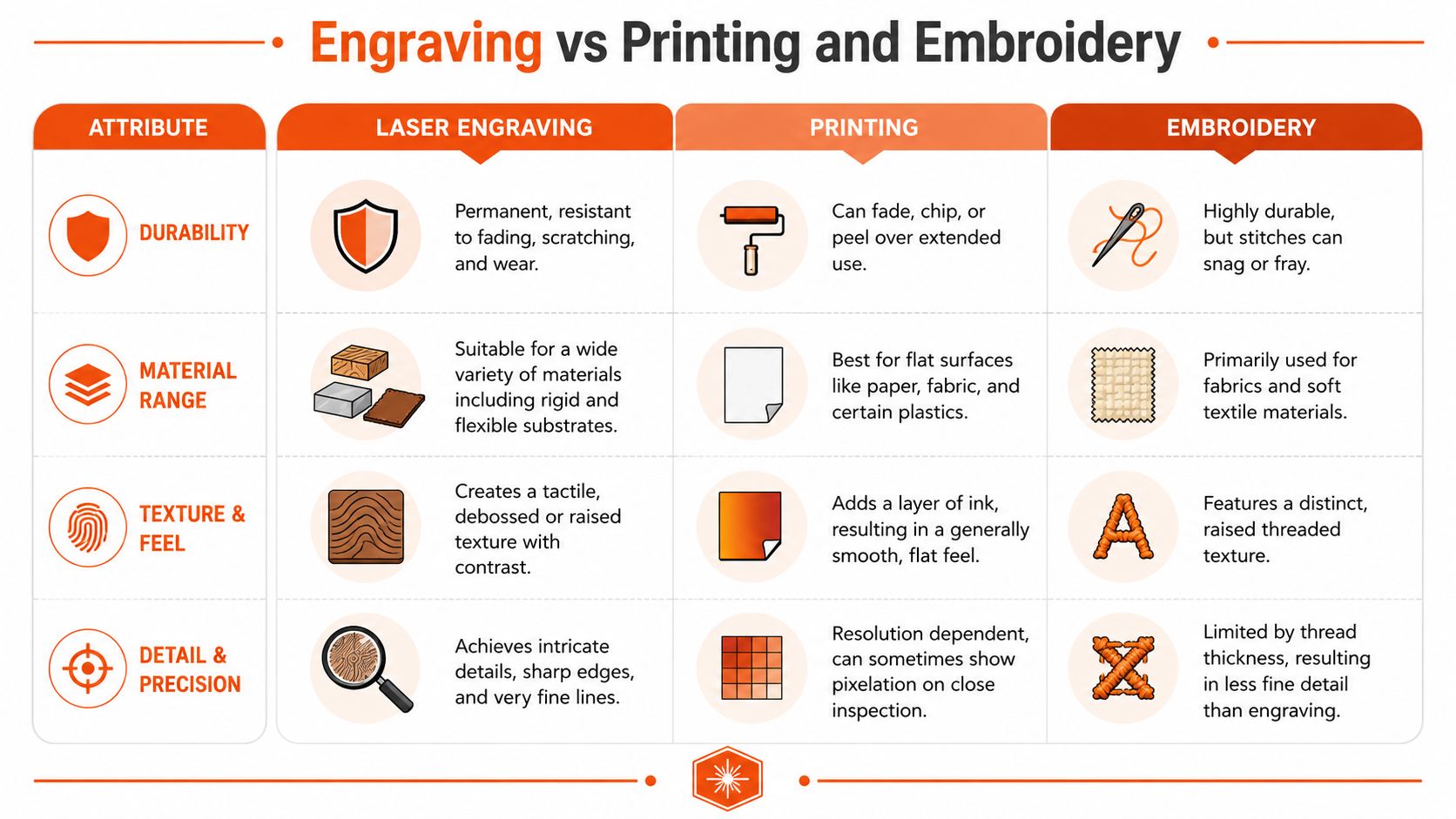
The practical breakdown is simple:
- Choose printing for color, illustration, and visual volume.
- Choose embroidery for stitched texture on garments and soft goods.
- Choose engraving for hard goods and accessories that need to look sharp after repeated use.
If you want a broader production view, this breakdown of merch printing techniques helps map methods to product types.
On premium metal merch, the comparison is not engraving versus print. It is deep engraving versus surface marking.
A lot of suppliers blur that line because both can look good on day one. They send over a tumbler or keychain with a dark logo and call it engraved. But a surface mark is still a surface effect. On hard-use items, that difference shows up fast. Scratches, cleaning, daily handling, and bag friction expose whether the logo was cut into the metal or just marked on top.
That is why fiber laser work matters for premium brands. True engraving on metal removes material and creates depth you can feel. It holds up better, reads cleaner in person, and ages like part of the object instead of decoration sitting on it. Surface marking has its place for short-term promo or budget work, but it is the wrong move when the product is supposed to communicate durability.
I always tell buyers to ask one direct question: is this a real engraved result on metal, or a surface mark being sold as engraving?
That question saves a lot of bad reorders.
For categories where permanence and finish matter most, especially jewelry, hardware, and small metal accessories, partners focused on custom engraved jewelry manufacturing show why process choice matters as much as artwork. Premium merch either keeps its character or loses it. On metal, shallow marking and true engraving do not perform the same.
Designing for Laser Best Practices for Your Merch Drop
A strong product can still get ruined by a bad file. Laser engraving is precise enough to expose sloppy prep immediately.
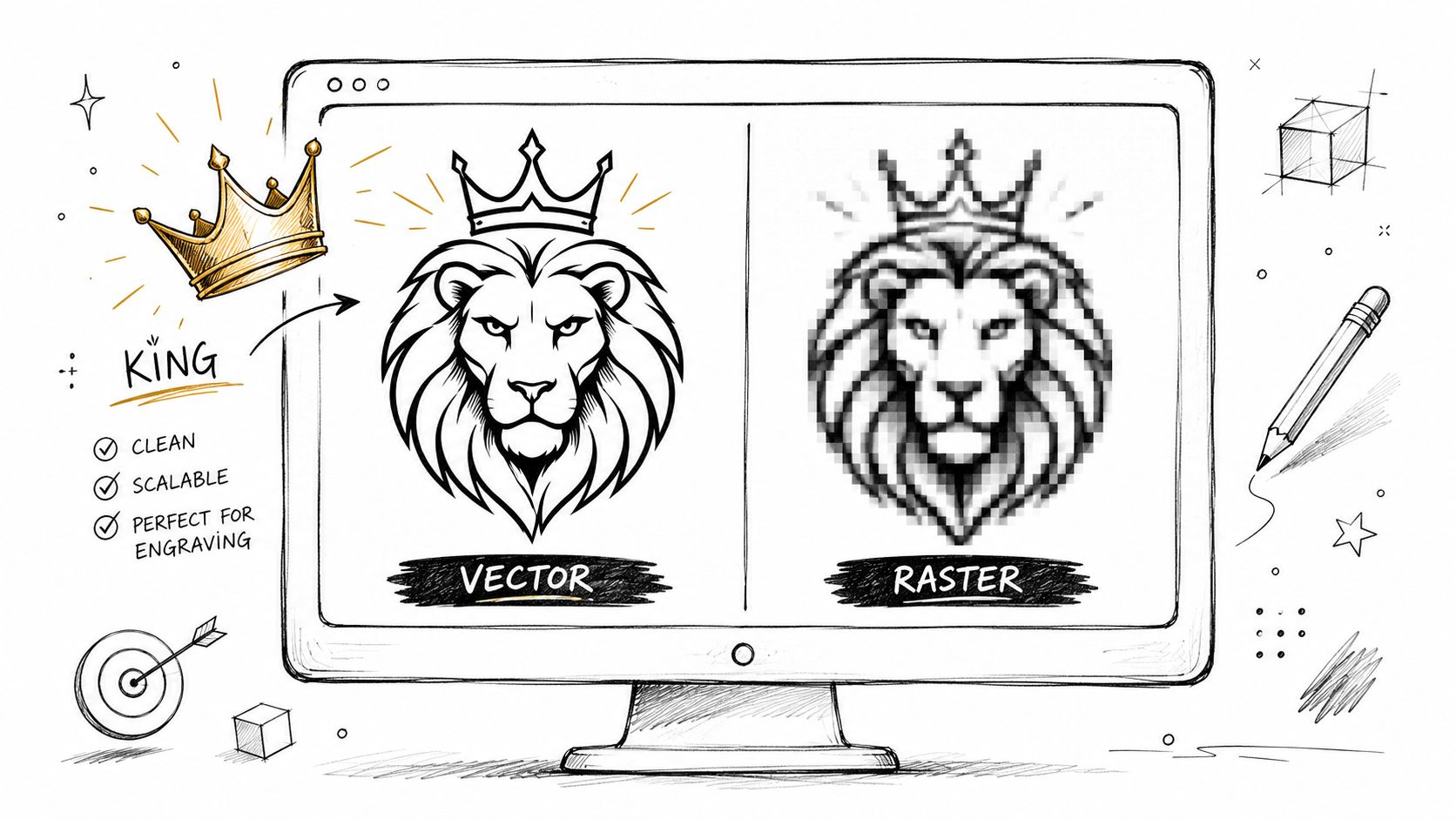
Vector files win
If you care about clean results, send AI, EPS, or SVG files whenever possible. Vector paths scale cleanly and give the machine exact edges to follow.
Raster files like JPG or PNG can work for some image-driven applications, but they introduce risk. Soft edges, compression, and unclear line definition often translate into engraving that looks less sharp than expected.
That matters because laser engraving is used for detailed work across metal, wood, plastic, glass, and leather, and it's valued for accuracy and longevity, as summarized in Wikipedia's overview of laser engraving.
Design choices that translate better
A few file decisions improve the final piece immediately:
- Outline your fonts: Don't leave live text in the file. Convert it to shapes so nothing shifts.
- Protect small details: Fine lines and tiny gaps can disappear if the artwork is too delicate for the material.
- Avoid huge filled zones: Large solid areas can create uneven visual weight on some surfaces.
- Use contrast intentionally: Tonal engraving works best when the artwork is clean and not overloaded.
For jewelry-scale work, where tiny details matter even more, examples from custom engraved jewelry manufacturing are helpful because they show how simplified linework usually reads better than crowded art.
A good rule is to design for the material, not just for the screen. A logo that looks great in Figma at full resolution might need simplification before it belongs on brushed steel or leather.
Clean artwork nearly always beats clever artwork once it hits the machine.
Quality Cost and Ordering Your Engraved Merch
Laser engraving cost is rarely about the machine alone. Primary factors are setup time, material, design complexity, and how long each piece takes to run.
What actually affects price and lead time
A simple logo on a small wood keychain is one kind of job. A deeper engraving across a batch of metal tumblers is another. More runtime, more handling, and more testing usually mean a different quote structure.
The practical variables are usually:
- Material choice: Metal, wood, leather, acrylic, and glass all behave differently
- Artwork complexity: Fine detail, filled areas, and larger engraving zones take more care
- Depth requirement: Deeper work usually asks for more passes and tighter control
- Order shape: Fewer units with lots of variation is a different production problem than one repeated design
Why expert production saves money
Cheap production often looks affordable only at the start. The eventual cost shows up later in rejected samples, underwhelming event merch, or products that don't survive actual use.
That's why it helps to work with a partner who can evaluate the blank, the file, and the method together before production starts. If you're pricing a project now, getting a quick quote for engraved merch is the fastest way to understand what the right process looks like for your specific product.
Good engraved merch isn't about making a logo permanent for the sake of it. It's about making the object worth keeping.
If you want custom merch that feels considered instead of disposable, Banger helps internet-native teams build products people use. From premium blanks and French atelier production to low minimums, factory-direct pricing, and worldwide fulfillment, the focus is simple: build merch your team wants to keep. Explore the catalog or request a quote to launch your next drop.