A Founder's Guide to Cut and Sew Clothing Manufacturers
You're probably in one of two places right now. Either you've outgrown generic merch and want to build a real garment, or you keep seeing “custom apparel” vendors that all sound the same and you can't tell who's making clothes from scratch.
That confusion is normal. Most branded apparel lives in the gap between a printed blank and a true private label piece. If you care about fit, fabric, silhouette, trims, and the small construction details people notice when they put something on, the decision gets more serious fast. The manufacturer you choose will shape the result as much as the design itself.
That's why founders need a sharper filter when evaluating cut and sew clothing manufacturers. The global Cut and Sew Apparel Manufacturing industry is a $26 billion market, and that size exists for a reason. Brands want original product, not interchangeable merch. They want apparel that feels intentional.
Table of Contents
From Merch to Apparel
Most merch fails because it was never designed to matter. It was ordered for an event, a launch week, an offsite, or a box someone wanted to ship fast. The result is usually the same: standard blank, average print, no point of view, no reason to keep wearing it.
A real apparel project starts when you stop asking, “Where can I place the logo?” and start asking, “What should this garment feel like on body?” That's the shift. You're no longer decorating a product someone else designed. You're deciding the shape, fabric, weight, construction, and finish from the ground up.
What changes when the garment actually matters
With true cut and sew, the garment becomes the brand language. A hoodie can have a cropped body and dropped shoulder. A tee can use a dense jersey with a tighter collar. A work jacket can carry custom pocket geometry, interior labels, and hardware that doesn't feel borrowed from a promo catalog.
That's very different from upgrading a blank, even when the blank is good. If you're still in the stage of comparing silhouettes, fleece weights, and which base garment gives you the strongest starting point, it's smarter to study premium hoodie blanks before jumping straight into full custom.
Practical rule: If the identity of the piece depends on the garment itself, not just the artwork on top of it, you're in cut and sew territory.
Why this decision sits above aesthetics
Founders often frame this as a design choice. It's a brand systems choice. Once you go full custom, you're committing to development, approvals, and production discipline. In return, you get something blanks can't deliver: a product with its own architecture.
That's the difference between merch people accept and apparel people choose.
When to Go Full Custom
A lot of founders use the word “custom” too loosely. That's where projects go sideways. A custom print on a premium blank, a print-on-demand garment, and a true cut and sew piece are not the same product category.
If you need branded apparel for a retreat, hiring campaign, or fast team drop, blanks with embroidery or print are usually the cleaner move. They're faster, simpler, and less exposed to sampling mistakes. But if you're building a capsule, a hero product, or a private label line that needs its own fit and construction language, blanks won't get you there.
The easiest way to tell the difference
Here's the fast filter:
| Model | What you're actually changing | Best fit |
|---|---|---|
| Print-on-demand | Surface graphic on a pre-existing product and pattern | Testing artwork, one-off drops, simple merch |
| Premium blanks plus embellishment | Decoration, labels, finishing details on an existing garment | Team apparel, event giveaways, clean branded merch |
| True cut and sew | Pattern, fabric, fit, trims, labels, construction, final silhouette | Private label, fashion-led capsules, signature products |
One of the biggest mistakes I see is treating POD like it's equivalent to manufacturing. It isn't. Some platforms talk about “cut and sew,” but they're still working from pre-existing patterns and a print-first workflow rather than building the garment the way a true manufacturer does. If you need actual pattern development and garment engineering, that distinction matters.
The minimums tell the story
The economics make the differences obvious. The industry standard MOQ for true cut and sew is around 50 units per item, compared with 10-unit minimums for customizing premium blanks. That's the primary entry point for custom fabric construction.
If you're still pressure-testing appetite, keeping risk low with low MOQ custom apparel makes more sense than forcing a cut and sew project too early.
The wrong move isn't choosing blanks. The wrong move is expecting blanks to deliver what only full custom can do.
When full custom is worth it
Go full custom when the piece needs one or more of these:
- A distinct fit that can't be sourced off the shelf
- Specific fabric behavior, like a structured tee, dense fleece, technical shell, or custom knit
- Construction details such as paneling, seam placement, rib dimensions, or pocket architecture
- Private label legitimacy, where the garment itself needs to feel native to your brand
If none of that applies, stay disciplined. High-end customization can look excellent. Full custom only pays off when the garment design is the product.
The Blueprint Your Tech Pack
Bad samples usually don't start in the sewing line. They start in the file.
A tech pack is the document that turns taste into instructions. Without one, the factory fills in the blanks. That's how you end up with the wrong collar height, the wrong stitch treatment, the wrong pocket depth, or a silhouette that looked right in your head and nowhere else.
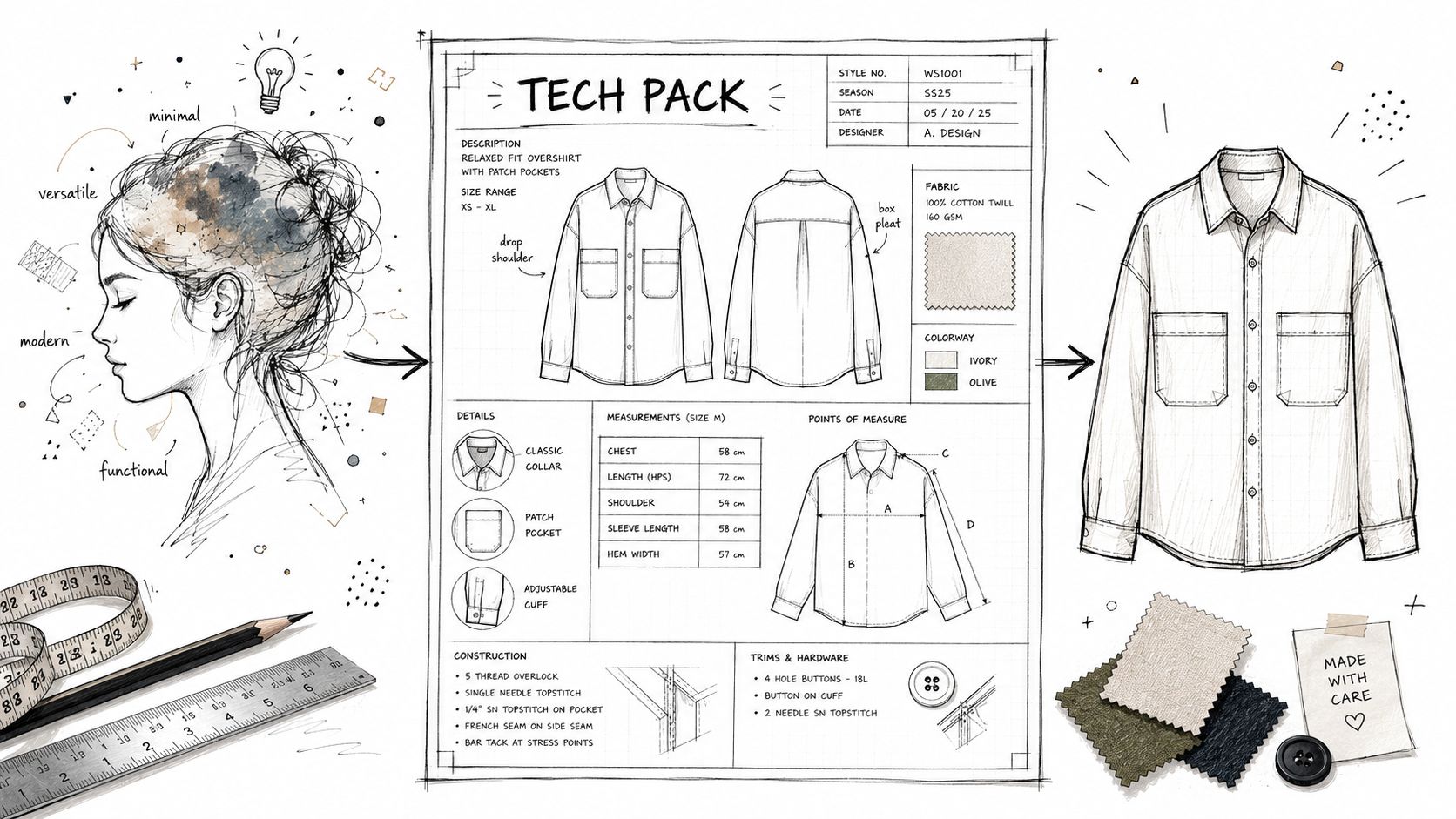
The cut and sew process follows a rigorous 8-step methodology from tech pack creation and pattern making through sampling, bulk cutting, sewing, and final quality control. That order matters. If the blueprint is weak, every downstream step gets slower and more expensive.
What belongs in the file
At minimum, your tech pack should lock these things down:
- Sketches and views. Front, back, and detail callouts. If the cuff shape matters, draw it.
- Measurements. Not vague fit language. Actual points of measure across sizes.
- Fabric specs. Main fabric, rib, lining, wash, hand feel, color direction.
- Construction notes. Seam type, topstitching, bartacks, reinforcement, finishing.
- Trim details. Zippers, snaps, cords, toggles, labels, and packaging notes.
- Brand placements. Embroidery size, patch location, print dimensions, woven label position.
The best tech packs read like the garment has already been made. Nothing is left to interpretation.
What weak tech packs usually miss
Most first-time founders focus on the front view and the logo. That's not enough. Factories need precision where most brand decks stay vague.
The misses usually look like this:
- Fit language with no measurements. “Boxy” means different things to different pattern makers.
- No trim references. Hardware gets swapped for the nearest available option.
- No label plan. Neck label, care label, hem flag, and hangtag all arrive as late decisions.
- No tolerance mindset. Tiny changes can ruin the shape of a premium garment.
If you want the garment to feel finished, build your label system early. Even something as simple as custom neck labels changes whether a piece feels like merch or a proper product.
A quick visual walkthrough helps if you haven't built one before:
A strong tech pack doesn't make you look organized. It makes the factory less likely to guess.
Vetting Your Manufacturing Partner
The right partner isn't the factory with the lowest quote. It's the one that can make the exact category you're trying to build, communicate clearly, and stay consistent once development gets messy.
That last part matters more than people admit. Sampling always exposes friction. If a manufacturer gets defensive, slow, or vague during development, bulk production won't magically become smooth.
What to look at first
Start with the portfolio. Not just whether it looks cool, but whether the factory has experience in your lane. A shop that's great at simple jersey basics may not be the right partner for heavyweight fleece, washed outerwear, or technical garments with layered trims.
Then pressure-test communication.
Ask practical questions and watch the quality of the answers. Do they understand your references? Do they challenge unclear specs? Do they speak in garment terms or generic sales language? Good cut and sew clothing manufacturers don't just say yes. They identify risks before they turn into sample revisions.
A solid evaluation shortlist should include:
- Category relevance. Look for work close to your target product.
- Development clarity. Ask how they handle pattern changes, fit comments, and trim substitutions.
- Operational transparency. You want clean answers on MOQ, timelines, and approval stages.
- Finish level. Check collars, rib recovery, stitching consistency, and label execution.
If you're surveying the wider Textiles Apparel sector, use it as a market map, not a shortcut. Directories can help you discover suppliers, but they won't tell you who understands your product taste.
Why premium European ateliers change the equation
For founders building a more high-quality product, European ateliers deserve serious consideration. Not because they're automatically better, but because the working style is often closer to what premium apparel development requires: tighter communication, stronger finishing standards, and more sensitivity to details that mass factories may flatten.
That matters when you're building pieces where proportion and hand feel do the heavy lifting.
Price matters. But in apparel development, a cheap mistake costs more than an expensive sample.
If your project leans closer to culture-driven branded apparel than a full fashion label, it also helps to review what a strong team apparel supplier should already solve before you overcomplicate production. Not every product needs a factory search from zero.
The best partner is the one whose strengths match your garment, your standards, and your pace of decision-making.
From Sampling to Production
A founder approves a sample on a busy Thursday because it looks close enough in photos. Three weeks later, bulk arrives with a collar that sits flat, cuffs that feel loose, and a body length that kills the silhouette. The factory did what the sample allowed.
That is why this stage decides whether you are building real apparel or expensive merch with better labeling.
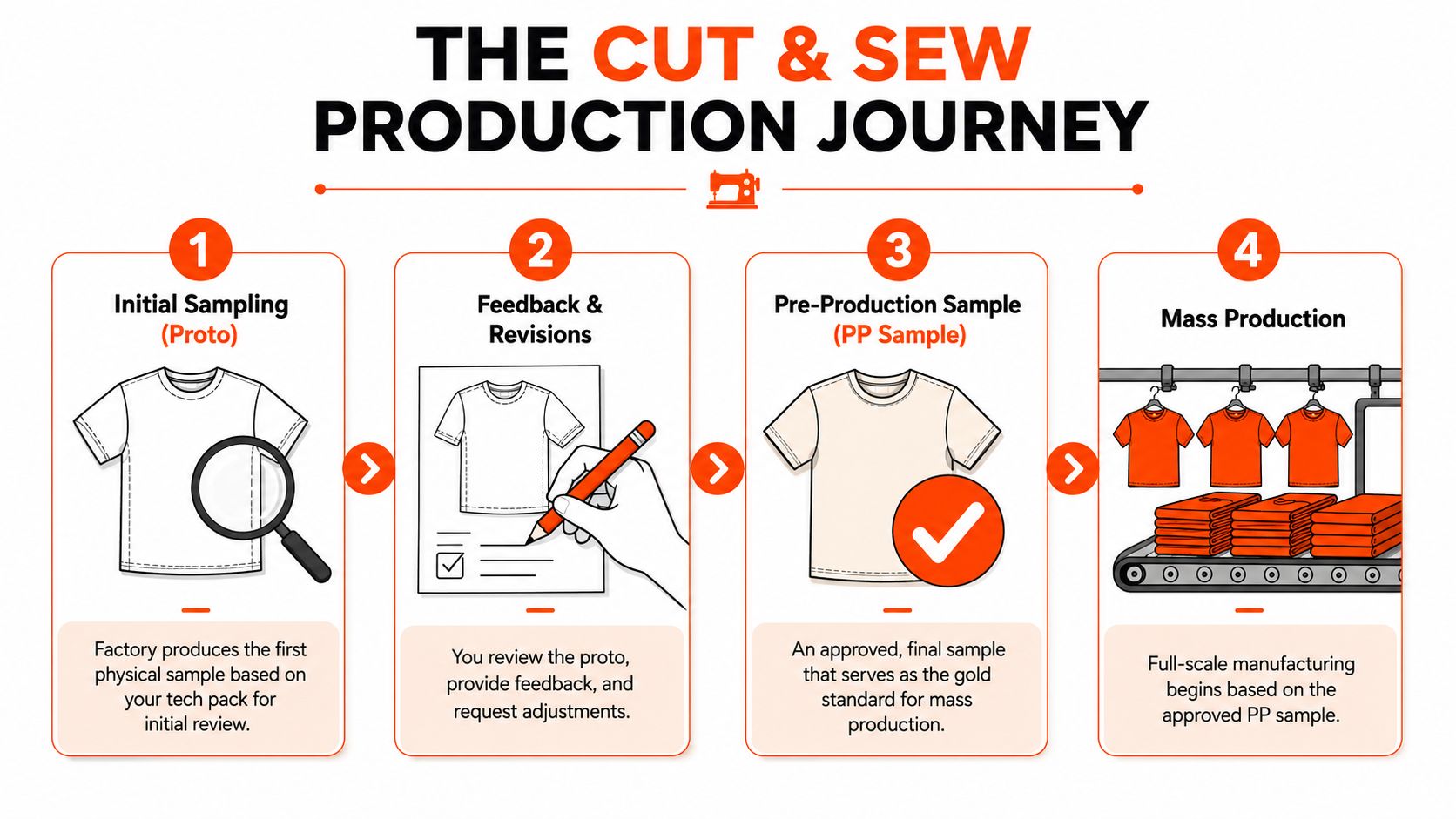
The Reality of the Sample Cycle
The first sample is rarely a win. It is a diagnostic tool.
A good proto tells you where the concept breaks under real conditions. Maybe the pattern is close but the jersey collapses after wear. Maybe the fabric has the right weight, but the armhole shape makes the piece feel generic. Maybe the garment is technically correct and still lacks presence on body. That last problem matters more than many first-time founders expect, especially in premium streetwear where proportion and hand feel carry the product.
European ateliers are often stronger here because they tend to discuss the garment as a finished object, not just a unit to manufacture. That can mean slower decisions and higher sample costs. It can also save a season if your product depends on subtle shape, cleaner finishing, or a specific fabric attitude.
Run the feedback loop with discipline:
- Fit the sample on body. Hanger shots and flats miss balance, volume, and movement.
- Comment directly on images. Put each change at the exact location. Sleeve pitch, neck drop, placket depth, and hem shape should never sit in a vague paragraph.
- Split fit, fabric, and finishing notes. A pattern problem needs a different fix than a trim or wash problem.
- Test the garment like a wearer would. Wash it, sit in it, layer it, and check recovery.
- Decide what category the product belongs to. If a blank body with upgraded trims already gets you the result, high-end customization may be the smarter path. If the identity depends on custom block, paneling, or construction, stay with true cut and sew.
Vague comments produce vague revisions.
If you are building with cotton programs, use sample stage to confirm hand feel and behavior, not just color. A fabric that sounds right on paper can still fail the garment. This is also the right moment to review how organic cotton fabric behaves in premium apparel before you lock bulk materials.
The Meaning of Approval
Approval means the sample can serve as the production standard. Nothing less.
Founders lose money when they approve a piece that is "close" and assume bulk will sharpen it up. Bulk exposes weak decisions. If the collar roll is off, if the pocket placement looks slightly dead, if the zip feels too light, production will multiply that issue across the run.
Treat the approved sample as the reference for every measurable and visual detail:
- Silhouette control. Check body length, sleeve shape, shoulder slope, and grade across sizes.
- Trim continuity. Confirm the exact rib, zipper, snap, drawcord, label, and puller.
- Construction integrity. Verify seam types, stitch density, bartacks, topstitch spacing, and reinforcement points.
- Finish standard. Pressing, wash result, label placement, and final presentation all affect perceived value.
One more hard truth. Premium factories are not mind readers, and premium pricing does not protect you from soft approvals. The brands that get strong bulk are the brands that mark up samples clearly, hold their line on the details that define the piece, and know when a garment needs another round before production starts.
Quality Control and Sustainable Sourcing
Quality control isn't a final inspection ritual. It starts with sourcing, continues through development, and gets enforced during production. If you wait until cartons are packed, you're too late.
Premium apparel fails in predictable ways. Fabric shade shifts. Rib loses recovery. Topstitching wanders. Panels twist. Labels get attached slightly off. None of this is dramatic on its own, but stacked together it turns a strong concept into a weak product.
Build quality checks into the process
The fix is simple in theory and disciplined in practice. Define what “good” means before production starts.
Use checkpoints like these:
- Material approval. Confirm the exact fabric, rib, color, and trim before cutting begins.
- In-line review. Ask for inspection during production, not only at the end.
- Measurement control. Check the key points of measure that determine the silhouette.
- Finishing review. Pressing, folding, thread cleanup, labels, and packaging all count.
A manufacturer can only protect standards you've specified.
The cleanest garments come from teams that treat QC like product design, not damage control.
Treat sustainability like sourcing discipline
Sustainability claims need the same scrutiny as quality claims. Ask what the material is, where it comes from, and what documentation exists. If a supplier says a fabric is organic or recycled, ask for the relevant certification and keep the conversation concrete.
If material selection is part of your brief, it helps to understand what organic cotton fabric actually means before approving swatches or signing off on sourcing language.
Waste reduction matters here too. According to the Canadian industry profile, minimizing waste during cutting is a critical environmental and efficiency metric, and advanced cut and sew operations use digital fabric printing and automated equipment to reduce material loss and improve consistency.
That's the kind of detail worth asking about. Not because it sounds good in a deck, but because it tells you how the operation thinks.
Your Cut and Sew Onboarding Checklist
A good factory conversation starts before the first email. If you show up with half-decided ideas, missing references, and no garment logic, the process drags immediately. If you show up prepared, quotes get sharper and development gets cleaner.
Use this before contacting cut and sew clothing manufacturers:
- Lock the product. Decide what you're making. Tee, fleece hoodie, overshirt, track pant, work jacket. Not “maybe all of the above.”
- Define the role of the piece. Team merch, capsule drop, private label hero item, community uniform. The purpose shapes every later decision.
- Build references. Pull fit references, fabric references, stitching references, and trim references. Taste needs visual evidence.
- Finish the tech pack. Not half of it. The complete document.
- List your essential requirements. Collar height, fabric hand feel, silhouette, labels, hardware, wash outcome.
- Know your order logic. Quantities by style, size split, and whether colorways are fixed.
- Plan your approvals. Decide who signs off on fit, design, and cost so feedback doesn't get scrambled.
- Budget for revisions. Sampling is part of the job, not a sign the factory failed.
The founders who get the best results aren't always the loudest or the most fashionable. They're the ones who come in prepared, know what they're building, and can tell the difference between a branded blank and a garment with its own identity.
If you want help deciding whether your project needs true cut and sew or high-end customization on premium European blanks, Banger is built for that middle ground where most internet-native teams get stuck. You can request a quote, get product previews fast, and build merch your team will want to wear.