Ideas for Trade Show Giveaways That Actually Get Kept
The most popular advice about trade show giveaways is backwards. Teams chase booth traffic, order a mountain of cheap novelty items, and call the campaign successful when the boxes are empty. That's not the outcome that matters. The actual test starts when the attendee leaves the venue, reaches the hotel, sorts the tote, and decides what earns a place in their luggage.
A useful giveaway survives that moment. It fits a daily routine, supports a real workflow, or creates a reason to interact with your brand again. These ideas for trade show giveaways are built around that after-the-show test, with a premium bias toward fewer, better items that qualified prospects will keep.
Table of Contents
Why Most Trade Show Giveaways End Up in the Hotel Trash
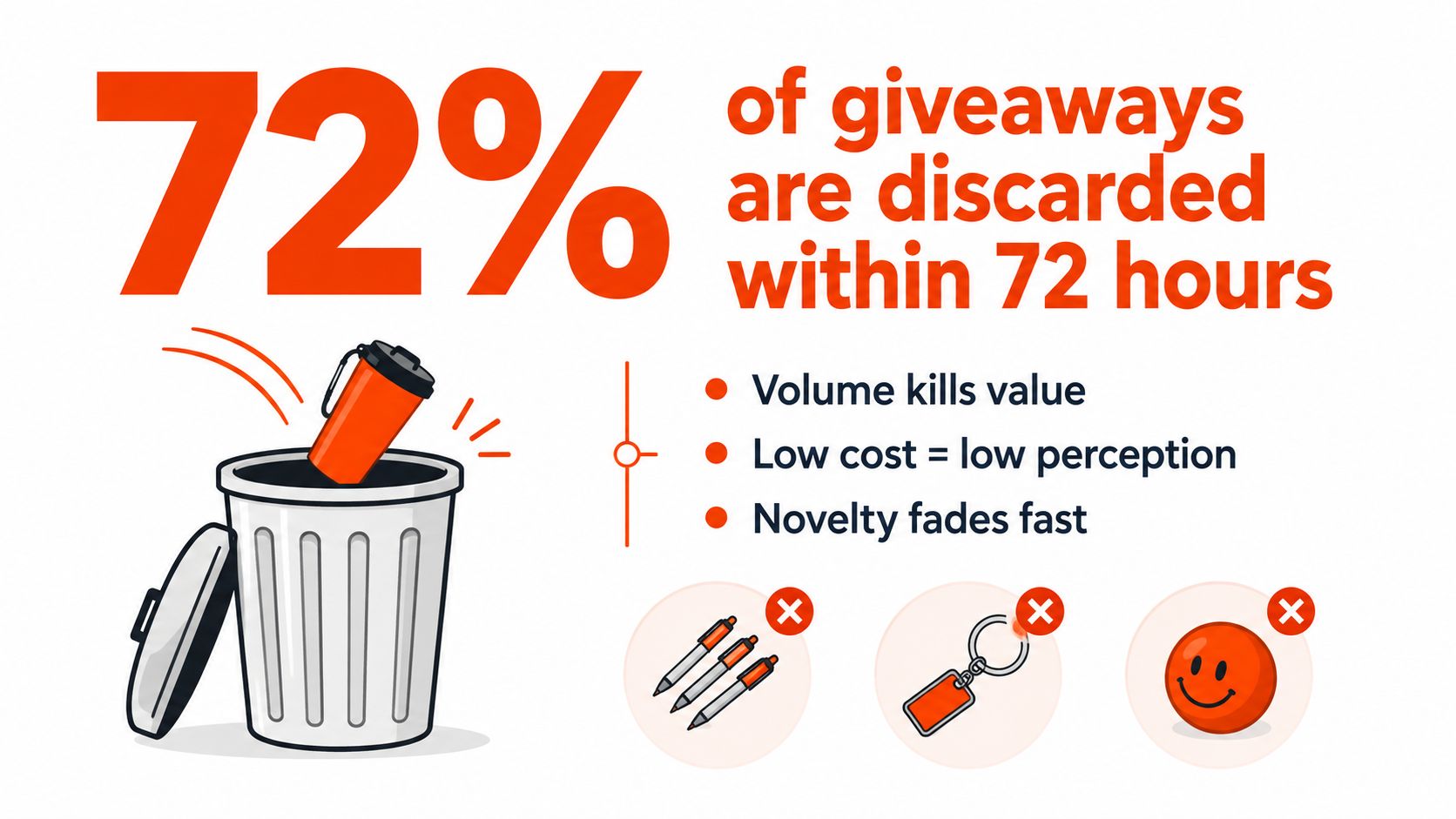
Booth-day logic rewards the wrong behavior. A cheap item is easy to distribute, easy to count, and easy to justify in a budget meeting. It also tends to become dead weight before the attendee gets home. Pens leak, stress balls gather dust, and tote bags hit the hotel floor beside the conference program.
The problem isn't that promotional products have no effect. Historical attendee research found that 62.6% of trade show attendees had received a promotional product, and among recipients, 71.6% remembered the company name while 76.3% reported a favorable attitude toward the brand. The same historical evidence connects useful, retained products with stronger memory after the event, not just a momentary handoff at the booth. Trade show promotional product statistics and context support the point that retention is the mechanism, not distribution volume.
The hotel-room test
Ask three questions before approving any item:
- Will it survive the trip? If it breaks, leaks, or takes up space without earning its place, it's a bad travel companion.
- Will it enter a routine? A bottle on a desk, a notebook in a meeting bag, or a cap worn outside the venue has a longer brand life than a novelty object.
- Will it create a second interaction? A QR code, a meeting-specific reward, or a follow-up mailer can turn a handout into a sequence rather than a single touch.
Generic logo placement makes the failure worse. A giant mark on a flimsy blank tells attendees the item was purchased for the brand, not chosen for them. Throwaway materials make the same statement. So does a product with no connection to the buyer's work, travel, or lifestyle.
The operator's rule: Don't ask whether attendees will take the item. Ask whether they'll still have it when your follow-up arrives.
A reusable bottle, premium tee, cable organizer, or well-made notebook can support the brand after the show. A random plastic trinket usually can't. If sustainability is part of your event standard, use this guide to evaluate environmentally friendly promotional items before you buy.
Defining Your Goal and Audience Before You Pick a Product
Don't open a merch catalog until the team can name the single business outcome. “More visibility” isn't specific enough to guide a product choice or judge performance later. Pick qualified leads, pipeline acceleration, partner enablement, retention, or another concrete outcome, then make the giveaway do one job.
Start with the recipient
Segment the attendee list by role and seniority. A founder, technical evaluator, procurement lead, partner, and casual passerby don't need the same object or the same handoff.
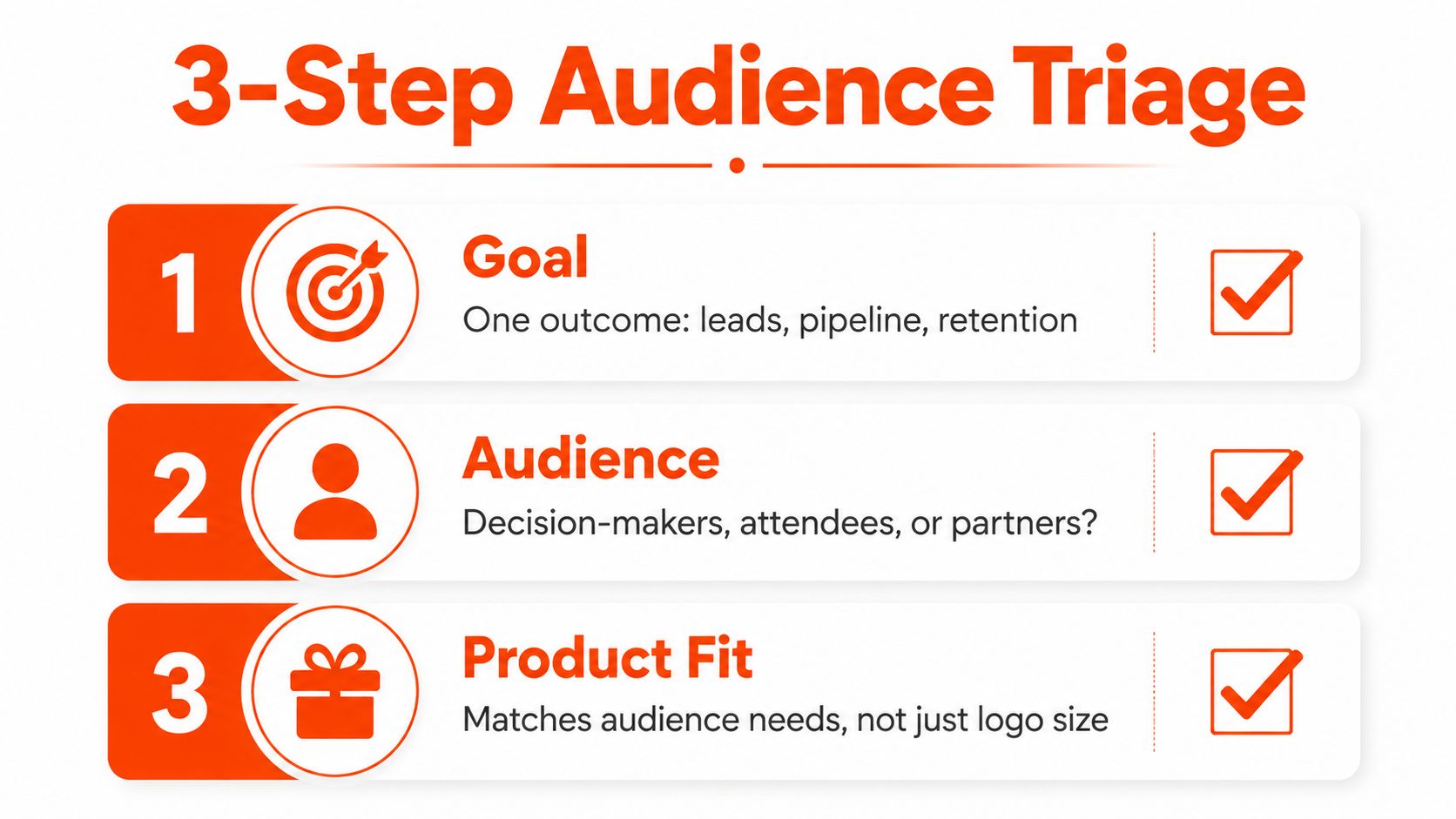
Use this triage:
- Goal: Choose one outcome, such as leads, pipeline, or retention.
- Audience: Decide whether the item is for decision-makers, general attendees, partners, or internal booth staff.
- Product fit: Match the object to a real need, not the available imprint area.
The sales team should help define the handoff. Ask which conversations deserve a premium item, which product objection the booth is trying to address, and what follow-up action should happen after the scan. A giveaway for a booked meeting can be more considered than one for a badge scan, because the interaction has a different value.
Write the brief before the mood board
Your one-sentence brief should let product, design, sales, and logistics approve the same idea:
“Create a compact, reusable item for senior fintech buyers that rewards a qualified meeting and remains useful during post-show travel.”
That sentence answers more than a product board full of references. It clarifies audience, use case, interaction, and quality level.
Set both a per-recipient ceiling and a total campaign budget. The first protects consistency across tiers. The second accounts for decoration, packaging, freight, booth storage, and distribution. Decide whether the item will be staff-worn, table-held, or handed over only after a defined action.
A premium merch partner may also help translate an approved brief into product and decoration choices. Banger's custom design services cover design development and customization when the team has a direction but not a finished production file.
Before approving an idea, check:
- Outcome: Can the team state what this item is meant to improve?
- Recipient: Is the audience specific enough to choose materials and sizing?
- Action: Does the handoff support a scan, demo, meeting, or follow-up?
- Routine: Will the item still make sense after the conference?
- Operations: Can the supplier produce, pack, and deliver it on schedule?
Giveaway Categories by What They Actually Do
A product isn't a strategy. Every giveaway should have a job, and the job should be easy to explain in one sentence. The useful categories are lead capture, brand love, utility, and retention.
Lead capture
These items earn an action. Tie a small product to a QR code, raffle entry, gated access, or demo completion. The object doesn't need to be expensive. It needs to make the next step clear and give the sales team a legitimate reason to continue the conversation.
Brand love
Premium apparel and limited-run accessories work. A heavyweight tee, embroidered cap, or distinctive tote can become part of someone's wardrobe or daily carry. Keep the logo restrained. The design should feel like something an attendee would choose even without the conference context.
Utility
Utility products enter the office routine. Think notebooks, drinkware, cable kits, desk accessories, and compact tech. These are strongest when they solve a problem the audience already has, such as low phone battery, poor note-taking, or carrying gear between sessions.
Retention
Retention items arrive after the event or mark a relationship milestone. Use post-event mailers, subscription drops, customer gifts, or a premium package for top accounts. The delayed arrival matters because it gives the brand a second moment after the booth has disappeared.
| Category | Primary Job | Typical Cost Band | Min. Order / Lead Time |
|---|---|---|---|
| Lead capture | Earn a scan, meeting, or demo | Entry to premium, based on action | Flexible, dependent on mechanic and decoration |
| Brand love | Build affinity and public visibility | Mid to premium | Apparel and accessories need sampling and production planning |
| Utility | Enter a repeated daily workflow | Entry to premium | Product and decoration method determine timing |
| Retention | Create a post-show or milestone touchpoint | Premium | Packaging, address collection, and fulfillment add planning needs |
For teams designing non-cash incentives around attention and participation, boost engagement without discounts offers useful context on structuring value beyond price cuts. The same principle applies here: the giveaway should support a meaningful action, not replace the conversation.
Browse best swag ideas for product directions, then force each option into one category. If you can't tie an item to a job in one sentence, it doesn't ship.
Customization Techniques That Make Merch Feel Premium
Premium merch isn't created by placing a logo on a better blank. Decoration, proportion, and finishing determine whether the piece feels designed or merely branded.
Embroidery is strong on caps, fleece, and structured garments, but it needs the right artwork scale. Thread count, stitch density, and panel size affect legibility and hand feel. Small text turns muddy when the stitch plan is too dense. Oversized embroidery can make a soft fleece feel stiff.
Screen printing works well for bold graphics and controlled color systems. It falls apart when teams use a complex image without adapting it for ink, fabric, and placement. Plastisol sitting heavily on top of the fabric is a cheap tell, especially on a garment that otherwise feels substantial.
Match the finish to the object
- Woven labels: Best for neck labels, side tabs, and small identity details that should feel integrated.
- Heat press: Useful for flexible artwork and smaller runs, but poor application can peel after washing.
- Debossing: Effective on leather, vegan leather, and rigid accessories where a quiet mark feels more premium.
- Foil stamping: Adds a sharp finish to packaging, notebooks, and paper goods, but needs disciplined use.
- Custom packaging: Turns the handoff into an experience, especially for VIP and retention kits.
| Technique | Best For | Min Order | Cost Tier |
|---|---|---|---|
| Embroidery | Caps, fleece, structured apparel | Depends on product and run | Mid to premium |
| Woven labels | Neck labels, tabs, garment identity | Depends on label production | Mid |
| Screen printing | Bold apparel graphics | Depends on colors and placement | Entry to mid |
| Heat press | Flexible artwork and smaller runs | Often suitable for smaller batches | Entry to mid |
| Debossing | Leather and vegan leather goods | Depends on tooling and product | Mid to premium |
| Foil stamping | Premium paper goods and packaging | Depends on tooling and surface | Mid to premium |
| Custom packaging | VIP kits and retention drops | Depends on box and insert design | Premium |
Iron-on patches that peel after two washes, generic drop-ship packaging, and mismatched hardware all expose disposable production. Tonal hardware, custom neck tape, considered hang tags, and a clean woven label work more subtly. That restraint is the point.
European sourcing and French atelier finishing can make the difference between a piece that wears in and one that wears out. Teams evaluating adjacent gift formats can also review these eco-friendly client gifts from The Candledust for packaging and sustainability cues. For paper and rigid surfaces, foil hot stamping is a useful reference when the brand wants detail without visual noise.
Budgeting, Quantities, and a Realistic Production Timeline
The product price is only one line in the budget. Build the estimate from per-unit cost, decoration setup, packaging, shipping, booth storage, and contingency. Add a 10% to 15% buffer for breakage and reorder spikes, as shown in the planning framework below.
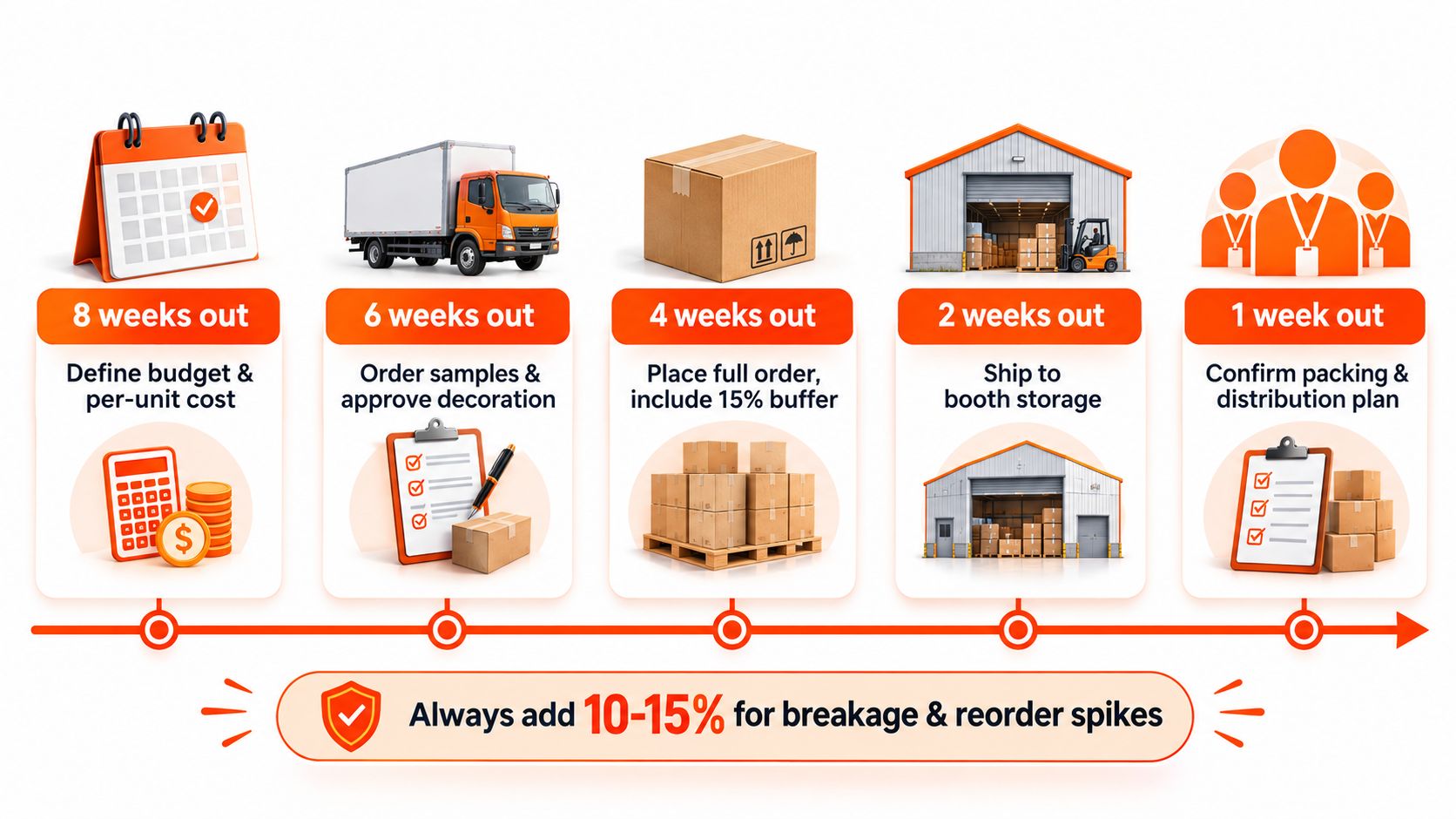
Work backward from the booth date
A realistic production plan covers 8 to 12 weeks when the campaign includes specification, sampling, approval, bulk production, quality checks, and freight. Sample rounds can take 7 to 10 business days each, so late design feedback has a direct effect on the dock date.
Use this order:
- Specification: Confirm product, material, sizing, decoration, packaging, and delivery address.
- Sampling: Approve the physical blank and decoration, not just a digital mockup.
- Production: Release the bulk order only after the sample and artwork are signed off.
- Quality control: Check decoration placement, color, stitching, packaging, and count.
- Freight: Move goods to booth storage with time for customs and carrier delays.
Late artwork approvals cause avoidable slips. Customs holds on imported blanks and freight congestion before major conference weeks create less controllable risk, which is why an operator-led calendar matters.
Use tiers instead of one giant order
For quantity planning, cap general giveaways at 60% to 70% of projected leads, reserve 20% to 30% of premiums for qualified prospects, and hold one ultra-premium piece for top accounts. These are planning rules, not guarantees. They protect the campaign from giving every valuable item to the first wave of curious passersby.
Budget rule: Count the cost of getting the product into the attendee's hand, then add the cost of making the follow-up possible.
Keep a separate line for shipping to multiple locations, branded inserts, and post-event mailers. If the campaign needs small quantities or apparel flexibility, review custom apparel with no minimum before defaulting to a mass-produced item that doesn't fit the audience.
Premium and Sustainable Giveaways Worth the Budget
Fewer, better items beat a flood of cheap ones because the attendee has to make a choice. The premium item should earn luggage space, desk space, or wardrobe space after the show.
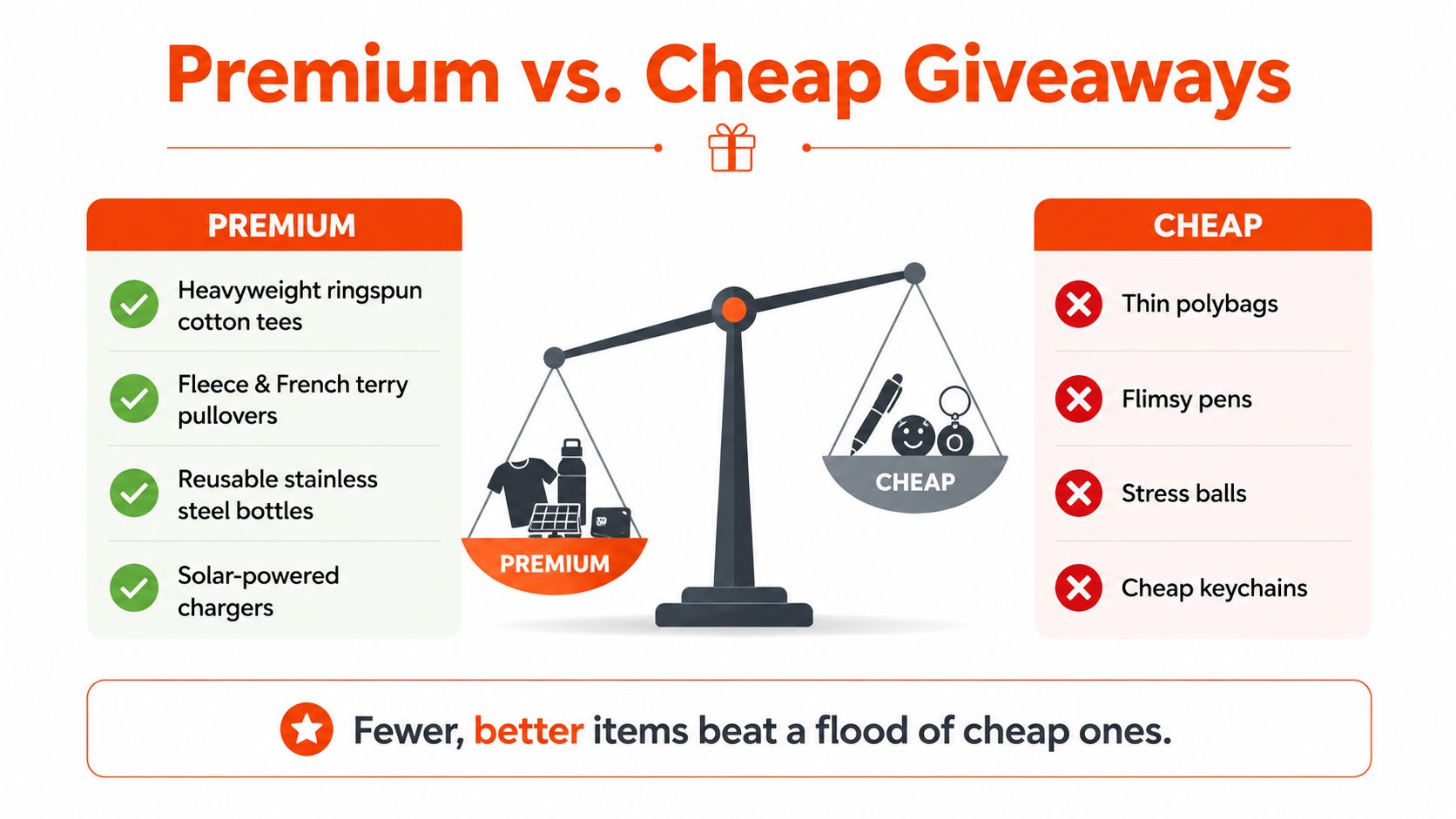
Build for the after-show moment
A heavyweight ringspun cotton tee should feel like a weekend staple, not a uniform. Fleece and French terry from European mills can work for cooler travel days and repeat wear. Recycled or organic caps offer visibility without demanding a full apparel size run.
Leather and vegan leather notebooks belong in the next meeting bag. Glassware can work for a desk or home setting when it's packed properly. Refillable metal or ceramic drinkware has a clear daily role, especially when the design is subtle enough to stay in rotation.
Sustainability needs more than a recycled mailer. Check traceable sourcing, recycled-content certifications, material composition, and whether the packaging itself can be reused. A virgin-product item inside an eco-looking wrapper is still a weak sustainability story.
Reserve the strongest pieces
Mass handouts should be useful and operationally simple. Premium pieces belong with people who can influence the relationship, such as top prospects, strategic partners, speakers, or customers. A limited collection, wearable accessory, or carefully packed capsule can make that recipient feel recognized without turning the booth into a free-for-all.
The right premium giveaway behaves like a retention asset. It gives the recipient a reason to remember the interaction, wear the brand later, and accept the next message. The wrong premium giveaway is just an expensive object with a logo.
Measuring What Worked and Next Steps
Define the measurement plan before the boxes leave the warehouse. A giveaway without attribution becomes a story about booth energy, not a usable marketing signal.
Track four KPIs:
- Scan-to-lead conversion: Measure how many booth scans become usable contacts for each giveaway variant.
- Qualified leads: Count the prospects who match the target role, account, or buying context.
- Post-event email engagement: Compare follow-up behavior among recipients who received the item.
- Social visibility: Track mentions and user-generated content that feature the product.
Give every variant a unique URL, QR code, or short code. Don't put one generic destination across every item, because you won't know whether the notebook, cap, or premium tee earned the response.
Run the follow-up for 30 days
Use a 30-day follow-up window to compare open and reply rates between giveaway recipients and non-recipients. Track LinkedIn connection acceptance, then ask top prospects which item they kept. Their answers will tell you more than the number of products handed across the counter.
A short debrief should compare cost per kept item against cost per qualified lead. Reorder the winners, retire the losers, and document the handoff mechanic while it's still fresh. For sustainability-minded teams, even the broader question of how to recycle old laptops creatively can sharpen the way you think about useful objects, reuse, and post-event responsibility.
Bring the next campaign back to the original brief. Keep the goal, audience, product fit, measurement method, and production calendar in one place. That's how an event giveaway becomes a repeatable system instead of a new panic order before every conference.
Banger helps internet-native teams build premium custom merch with European-sourced blanks, French atelier production, detailed customization, and worldwide fulfillment. Visit Banger to explore apparel, accessories, packaging, and event-ready products people will keep.