Caps Size Chart: The Definitive Guide for 2026
You're probably here because the design is done, the mockup looks clean, and someone on your team just asked the question that derails half of all cap orders: “What sizes should we buy?”
That's the moment where good merch can go sideways. Caps are less forgiving than tees, and most size charts online are way too generic to help with a real order. They'll give you a loose cm or inch range, skip head shape entirely, and pretend a fitted cap, a snapback, and a stretch-fit hat all behave the same. They don't.
A proper caps size chart should do more than convert inches to a US hat size. It should account for cap style, crown structure, and head shape, because those are the details that decide whether your drop becomes an everyday staple or event leftovers no one wants.
Table of Contents
Your Merch Drop Lives or Dies by the Fit
A cap is one of the fastest ways to make branded apparel look considered or completely off. The logo can be perfect, the embroidery can be sharp, and the color can hit exactly right. If the fit is wrong, none of that matters.
That's why generic cap sizing advice fails so often in merch. Organizations frequently order headwear the same way they order stickers or totes. They pick a silhouette, assume “one size fits most” will handle the rest, and move on. Then the caps arrive. Some sit too high. Some pinch at the sides. Some barely close. Suddenly the nicest piece in the drop becomes the least worn.
Generic charts miss the real fit problems
The problem isn't a lack of sizing charts. It's that most charts ignore the variables that change fit in real life:
- Cap construction: A structured fitted cap behaves differently from a washed dad hat.
- Closure type: Snapback, strap-back, fitted, and stretch-fit are not interchangeable.
- Head shape: Round and oval heads can wear the same measured circumference very differently.
- Use case: An event giveaway needs a different fit strategy than a core team uniform.
Practical rule: If you're ordering caps for a group, don't ask “what size hat do you wear?” until you've decided the exact cap style.
This is also where production details matter. If you're dealing with embroidery placement on curved crowns, cap frames and machine setup can affect the final result just as much as sizing. For teams digging into decoration mechanics, B-Sew Inn's guide to accessories for embroidery machines is a useful reference for how cap-specific tooling changes execution.
The chart alone isn't enough
A good caps size chart gives you a baseline. A useful one helps you avoid expensive mistakes.
That means reading sizing through the lens of style. Fitted caps need precision. Snapbacks need range awareness. Stretch-fit hats can look forgiving on paper and still feel wrong in practice. Beanies and unstructured caps introduce a different problem entirely, since fabric stretch and crown depth change the fit even when the label stays the same.
If you're ordering for a team, community, or event, the goal isn't just to find a size. It's to choose a format that gives your group the highest chance of getting a cap they'll keep wearing.
How to Measure Your Head in 30 Seconds
The whole sizing process starts with one number: head circumference. If that number is off, every chart after it becomes useless.
The good news is that measuring properly is simple. You don't need special equipment. You just need to stop guessing.
Use the right tool
Start with a soft tailor's tape. If you don't have one, use a string or charging cable, mark the length, then check it against a ruler.

Three things matter here:
- Use something flexible. A metal tape from a toolbox doesn't wrap cleanly around the head.
- Measure on bare hair if possible. Thick hairstyles can affect the result depending on how the cap will be worn.
- Write the number down immediately. People forget fast, especially when toggling between inches and centimeters.
Measure where the cap actually sits
Wrap the tape around the widest part of your head, positioning it just above the eyebrows and ears. Keep it level all the way around.
Don't angle it upward toward the crown. Don't drop it too low near the brow line. The tape should follow the path where a cap sweatband rests.
A quick visual helps if you want to sanity-check placement:
The mistake that ruins the number
Most bad measurements come from tension. People pull the tape too tight because they think snug means accurate. It doesn't. You want the tape firm, not compressing.
Measure two or three times. If the numbers vary, use the one that repeats consistently.
Once you have the circumference in inches, the formal sizing method is clear. Per the GS1 Package and Product Measurement Standard, the precise cap size is calculated by dividing the head circumference in inches by 3.14 (π) and rounding up to the nearest eighth-inch increment.
That rounding step matters. Hat sizing doesn't work like shoe sizing, where people often improvise. Fitted cap sizes move in eighths, so a small measuring error can push someone into the wrong size band.
The Universal Caps Size Conversion Chart
Ordering caps doesn't call for a lecture. It calls for a chart that's fast, clean, and useful. This is that chart.
The core logic behind it is old-school hat making. The Stormy Kromer sizing guide notes that the global cap sizing system is anchored on pi (π ≈ 3.14), and that the most common adult head circumference falls between 56cm and 58cm, corresponding to US hat sizes 7 and 7 1/8.
Universal Cap Size Conversion
| Circumference (Inches) | Circumference (CM) | US Size | General Size |
|---|---|---|---|
| 21 5/8 | 54.9 | 6 7/8 | Small |
| 22 | 56 | 7 | Medium |
| 22 3/8 | 56.8 | 7 1/8 | Medium |
| 22 3/4 | 57.7 | 7 1/4 | Large |
| 23 1/8 | 58.7 | 7 3/8 | Large |
| 23 1/2 | 60 | 7 1/2 | Large |
| 23 7/8 | 60.6 | 7 5/8 | XL |
| 24 1/2 | 62 | 7 7/8 | XL |
| 25 | 63.5 | 8 | XXL |
How to read the chart correctly
Two columns matter more than the others. Circumference tells you what someone measured. US size tells you what to order if the cap uses fitted sizing.
The general size column is useful, but it's also where confusion starts. “Medium” or “Large” can help you group people for a broad order, but those labels aren't precise enough for fitted caps and aren't always consistent across styles.
Bookmark the chart, but don't treat the letter size as the final answer unless the product itself is sold that way.
If you're choosing styles for a production run, it helps to compare the actual product formats against the chart instead of relying on a generic supplier PDF. A broad range of silhouettes can be reviewed in Banger's custom caps catalog, which is useful when you need to decide whether your order should lean fitted, adjustable, or something more forgiving.
Why Fitted Caps Require Precision
Fitted caps look clean because there's nothing to hide behind. No snap closure. No strap. No elastic forgiveness. They either fit right or they don't.
That's why fitted styles are where bad charts get exposed fastest. A person can measure correctly and still end up with a cap that feels wrong. The issue is usually not the number. It's the shape.
Circumference is only half the story
The Marlow White cap sizing guidance points out a problem almost every consumer chart ignores: head shape variance. Structured fitted caps are preshaped, and they often fit poorly on round heads unless the wearer moves to the next size up.
That's the hidden reason fitted hats trigger so many complaints. Two people can share the same circumference and have completely different experiences in the same cap. A more oval head may sit comfortably in the measured size. A rounder head may feel pressure at the sides even when the front-to-back measurement seems correct.
What works and what fails
Here's the practical version.
What works with fitted caps
- Measure carefully: Fitted sizing leaves no room for lazy numbers.
- Check crown structure: A rigid crown is less forgiving than a softer build.
- Adjust for head shape: If someone consistently feels side pressure in structured hats, moving up one size increment is often the smarter call.
- Test the actual silhouette: Not all fitted caps feel the same even when the size label matches.
What fails with fitted caps
- Ordering by T-shirt size logic: Headwear doesn't tolerate rough estimates.
- Assuming everyone with the same measurement needs the same size: Shape changes the feel.
- Using a fitted cap for a mixed group with no try-on process: That's where returns and dead stock pile up.
- Treating all structured caps as interchangeable: Crown profile, panel shape, and fabric stiffness all matter.
If your order includes a lot of first-time wearers, fitted caps are usually the highest-risk option unless you can test samples first.
There's also a style trade-off worth saying out loud. Fitted caps often look the most premium in photos. They're also the least forgiving in real life. For a smaller leadership team, core brand uniform, or limited drop, that trade can make sense. For a broad event audience, it often doesn't.
Decoding Adjustable Snapback and Stretch Fit Sizing
Adjustable caps get chosen for group orders because they reduce friction. That logic is sound, but people still oversimplify the category. A snapback is adjustable. A stretch-fit cap is flexible. Those are not the same thing.
The fit experience changes based on the closure, the crown shape, the material, and how much size range the brand built into the pattern.

What one size fits most really means
“One size fits most” sounds universal. It isn't. It means the cap covers a range, not that it will feel good on every head in that range.
That distinction matters more than people think. A snapback can technically close around a broad set of head circumferences and still look awkward because the crown sits too tall or the opening is maxed out. Stretch-fit styles solve a different problem. They hug more naturally, but some wearers dislike the pressure or the way the elastic band lands after a long day.
Snapback vs stretch-fit vs fitted
The New Era chart on Size.ly makes the inconsistency obvious: their M/L stretch-fit and snapback both cover 22 3/4 to 23 7/8 inches, but fitted caps in the same ecosystem require precise eighth-inch sizing.
That tells you everything about style-specific conversion. Same broad range. Different fit behavior.
| Style | Best for | Strength | Limitation |
|---|---|---|---|
| Snapback | Large group orders | Easy adjustment | Can still look off at range extremes |
| Strap-back | Softer styling | More subtle closure look | Less precise than fitted |
| Stretch-fit | Teams that want a cleaner line without visible snaps | Flexible and close-fitting | Feel varies by fabric tension |
| Fitted | Premium uniform look | Cleanest silhouette | Highest sizing risk |
One reason trucker caps remain popular is that they split the difference well. You get adjustability, easier distribution, and strong front-panel branding space without the rigidity of a fitted cap. If that's the lane you're considering, Banger's custom trucker cap option is a relevant benchmark for comparing shape and closure style.
Adjustable doesn't mean foolproof. It means the consequences of a bad estimate are smaller.
For team drops, snapbacks and strap-backs usually win on operational simplicity. Stretch-fit can work well when you want a more polished feel, but only if the brand publishes real size ranges and your group is narrow enough that the fit band makes sense.
The Sizing Guide for Beanies and Unstructured Caps
Beanies and unstructured caps look easy because they're soft. In practice, they need a different kind of judgment.
With soft headwear, the label tells only part of the story. The rest comes from knit tension, fabric recovery, crown depth, and how the wearer likes the piece to sit.
Beanies depend on stretch and knit tension
A cuffed beanie gives you the most forgiveness because the fold changes both the height and the feel. It lets more people tune the fit without changing the opening itself.
A skullcap or shallow fisherman-style beanie is less flexible stylistically. Even if the fabric stretches, the wearer may reject it because the crown sits too high or too tight for the look they want.
When ordering beanies for a group, focus on these questions:
- How dense is the knit? Tighter knits usually feel firmer on first wear.
- Does the fiber recover well? Some beanies relax quickly, others hold shape.
- Is it cuffed or uncuffed? Cuffed styles adapt better across preferences.
- Is the goal warmth, style, or both? The answer changes what “good fit” means.
Dad hats and other soft crowns fit differently
Unstructured caps are easier to wear because the crown collapses to the head instead of forcing a fixed shape. That's why washed dad hats are one of the safer choices for broad merch drops.
They still aren't interchangeable with structured caps. A lower-profile unstructured crown can feel better for someone who hates tall front panels, but it can also look too shallow on larger heads. Closure style still matters too. A buckle strap, fabric strap, or tuck strap affects comfort and visual finish in different ways.
Bucket hats are another category teams often overlook when they want something softer and more fashion-forward than a standard cap. If that silhouette is in the mix, Banger's custom bucket hat format is a useful reference point for comparing relaxed headwear options against more conventional cap builds.
The broad rule is simple. Soft styles are more forgiving on circumference, but more subjective on silhouette. That makes them easier to distribute and harder to standardize if your team has a strong point of view about how headwear should sit.
How to Collect Sizes for Your Next Team Drop
Most cap orders don't fail because the product was bad. They fail because the collection process was lazy.
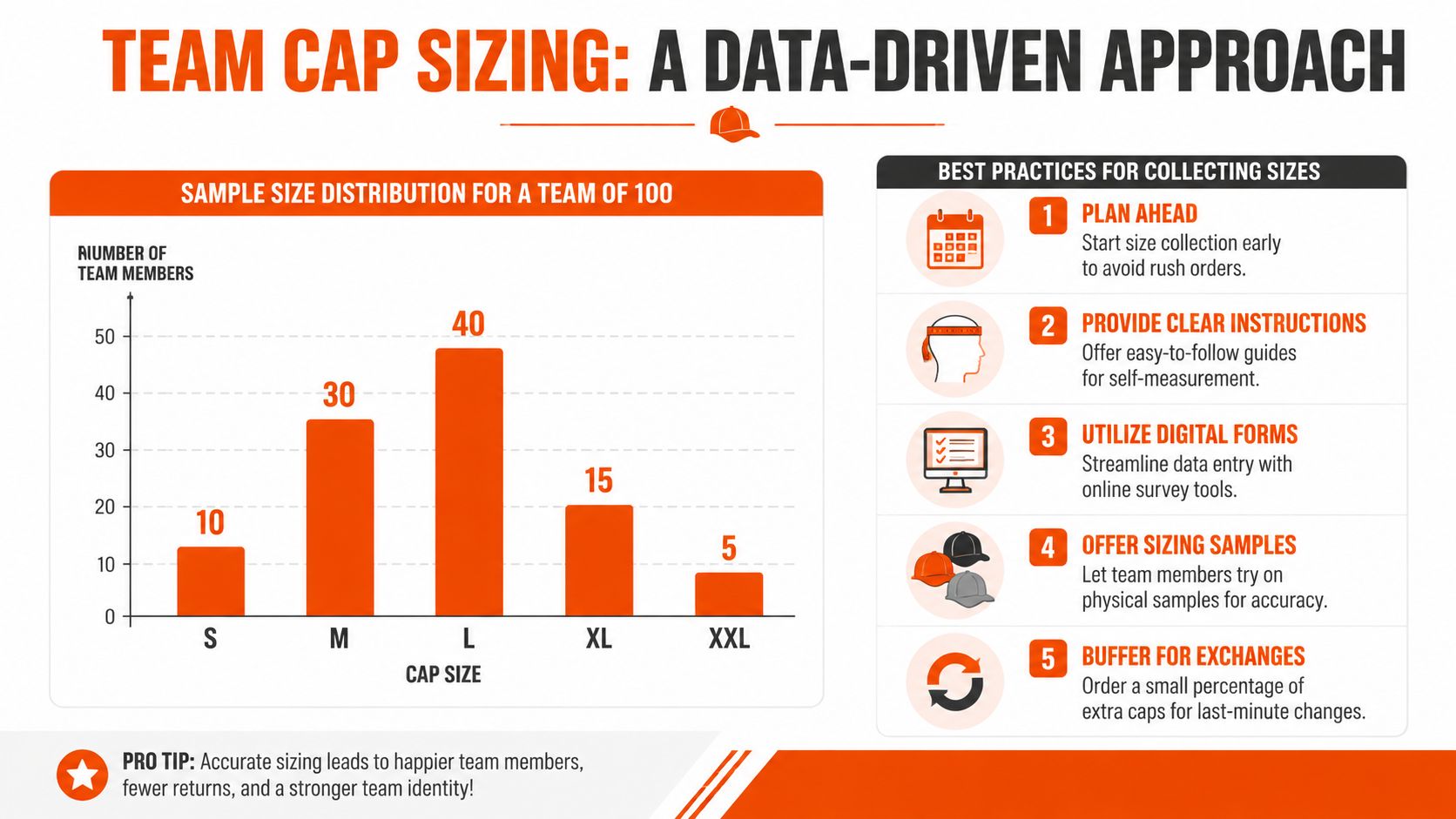
As soon as an order moves beyond a handful of people, sizing becomes an operations problem. The fix isn't complicated, but it does require structure. You need to decide the style first, gather the right data second, and validate the fit before the full run goes live.
Start with style, not size
Merch managers lose time by sending a message asking for hat sizes before they've locked the cap format. That guarantees messy replies.
Ask for different information depending on the product:
- Fitted cap: collect measured circumference and preferred fitted size if known
- Snapback or strap-back: collect only if someone knows they're usually outside standard fit ranges
- Stretch-fit: collect measured circumference, because the band range matters
- Beanie or unstructured cap: ask about fit preference as much as size preference
The stock reality matters too. The MFG Merch hat size chart notes that Medium (US 7, 22 inches) is the industry's highest stock availability point, while Large (US 7 1/2, 23.5 inches) is a critical milestone for manufacturers targeting fit consistency across diverse global teams. In plain English, orders usually cluster around the middle, but large sizes need attention because that's where fit complaints become more visible if you underbuy.
Build a form people can actually answer
Don't send a free-text Slack message and hope for clean data. Use a structured intake form with predefined options and one link to the measuring instructions.
For teams that need a simple starting point, a hosted form for t-shirt orders can be adapted into a clean cap-sizing workflow with custom fields for head circumference, preferred cap style, and delivery details.
A good form should include:
- Chosen cap style so nobody answers for the wrong silhouette
- Measurement field in inches or centimeters
- Fit notes for people who know they have trouble with hats
- Shipping details if the drop is going to multiple addresses
- Deadline that gives production time, not panic time
The best cap order form removes ambiguity before people can create it.
Always test before bulk production
If the order matters, get a size run. That means one sample in each relevant size or style and a quick try-on session with a representative group.
This matters even more for distributed teams. If your company ships merch worldwide, the sizing workflow has to connect with storage, packing, and exchange handling too. That's where a more complete setup like Banger's merch fulfillment services becomes operationally useful, because sizing mistakes don't end when production does.
What usually works best:
- For events: use adjustable caps unless the audience is tightly known
- For internal team uniforms: fitted or stretch-fit can work if you collect real measurements
- For community drops: offer one flexible style and one more custom option if budget allows
- For high-visibility launches: test embroidery, crown shape, and size spread together, not separately
The teams that get this right don't overcomplicate it. They choose a style with intent, collect data in a clean format, test samples, and leave room for a few exchanges.
Build Merch People Actually Want to Wear
Fit is brand language. People notice when a cap sits right. They also notice when a company treated headwear like an afterthought.
A well-fitted cap gets repeated wear because it becomes part of someone's normal rotation. That's the difference between branded apparel and disposable giveaway stuff. The first earns use. The second gets parked on a shelf, then disappears.
Fit is part of brand quality
This is especially true for culture-driven brands. Internet-native teams don't get extra credit for just making merch. The bar is whether the piece looks and feels like something a person would wear even if the logo weren't theirs.
That standard shows up everywhere in the process:
- Product choice: not every logo belongs on a high-crown snapback
- Decoration method: embroidery density and placement have to match the cap structure
- Size planning: one-size shortcuts can subtly wreck an otherwise strong drop
- Global delivery: sizing confidence matters more when you can't fix every issue with an office handout
There's a parallel in sports merch too. Clubs that build long-term loyalty tend to treat apparel as identity, not filler. The same idea comes through in how Vanta Sports helps clubs grow, where the gear itself plays a role in connection and repeat engagement.

The right production partner saves bad orders before they happen
The hard part of merch isn't finding a blank cap. It's making a series of good decisions before anything gets produced.
That includes asking the questions most vendors skip. Is the audience broad enough for adjustable only? Will a structured crown fight the head shapes in your team? Does the embroidery size suit the front panel height? Are you collecting sizes in a format that can feed production cleanly?
Those details are where strong drops get made.
If you need deeper support on the creative side, Banger's custom design services are built around the idea that branded apparel should feel like real product, not an afterthought with a logo attached. That matters with caps more than almost any other accessory, because headwear has zero room to hide weak fit or weak taste.
Good merch doesn't happen by accident. It comes from choosing the right silhouette, matching it to the audience, and being disciplined about sizing from the start. That's what makes the final piece feel intentional instead of promotional.
If you want a cap drop that feels considered from silhouette to sizing to finish, explore Banger. You can request a quote, get product previews within 24h, and build merch your team actually wants to wear.