Notebook with Logo: The Premium Buyer's Guide
Most advice about a notebook with logo starts in the wrong place. Buyers obsess over logo placement, imprint color, and minimum order quantity, then choose a notebook that feels disposable the moment someone opens it. A logo can't rescue weak paper, an awkward format, or a cover that looks cheap after a week on a desk.
The key decision is format strategy. Match the notebook's construction, material, and finish to the audience, occasion, and brand tier. An executive client gift shouldn't look like a conference handout, and a high-volume event giveaway shouldn't burn budget on a finish nobody will notice. Branded notebooks work when people keep them close, use them often, and associate that daily object with your brand.
Table of Contents
Why Most Branded Notebooks End Up Forgotten
A stock notebook with a logo isn't automatically good merch. It becomes useful brand collateral only when the product earns a place in someone's routine. A thin cover, awkward binding, or weak imprint turns the notebook into another object people accept politely and abandon in a conference bag.
The retention argument is stronger than the usual swag logic. One industry summary reports that 94% of recipients keep a useful notebook, while branded notebooks can generate about 3,400 lifetime impressions, more than double the 1,600 impressions reported for drinkware in the same comparison. The same summary places premium branded notebooks at about £0.89 to £4.50 per unit at quantities of 500 or more, which helps explain their appeal for major markets and event gifting programs. The industry summary on branded notebook effectiveness gives the useful distinction: usefulness drives recall, not decoration alone.
Format beats logo placement
A founder onboarding kit can justify a hardcover notebook with substantial paper, restrained debossing, and a package that feels intentional. A conference handout needs a lighter format that fits a tote, opens easily, and still feels good enough to use after the attendee gets home. Those are different jobs, so they shouldn't share the same specification.
The custom notebooks market reflects that shift toward more intentional products. Global revenue reached US$606.3 million in 2024 and is projected to reach US$895.4 million by 2030, at a projected 6.8% CAGR, according to Grand View Research's custom notebooks market data. Those figures don't prove that every branded notebook performs well. They do show that buyers are evaluating notebooks as a real product category, not merely as leftover event merchandise.
Practical rule: Decide who will use the notebook, where they'll use it, and how long you want it to stay in their orbit before choosing the logo treatment.
Two common buying scenarios
For an executive gift, perceived value comes from the entire object. Cover hand feel, page quality, binding, color restraint, and packaging matter more than adding another decorative element. For an event giveaway, utility and portability win. A notebook that slips into a laptop sleeve and starts quickly at a registration desk can outperform a more expensive object that feels too precious to use.
The same principle applies to brand systems outside stationery. If you're preparing artwork for physical applications, the guide to preparing logos for window vinyl is a useful reminder that reproduction starts with adaptable artwork, not last-minute placement. For broader merch inspiration, compare the product thinking in Banger's best swag ideas, then apply the same filter to notebooks: would someone choose this object without being asked?
Choosing the Right Format and Materials
Start with the cover and physical format, not the imprint. A hardcover notebook usually communicates more permanence and protects the pages in a backpack, while a softcover feels lighter, more flexible, and easier to distribute at scale. Neither is universally premium. A badly made hardcover can feel clunky, while a carefully finished softcover can feel considered and modern.
Material credibility matters just as much. Leather can support a high-touch executive gift, but it also carries sourcing and brand-positioning questions. Recycled kraft can communicate a practical, low-waste direction when the construction feels deliberate. Bamboo can create a distinctive natural look, while PU and cardboard offer flexible price and finish options, but quality varies sharply within each category.
A practical format comparison
| Format | Best For | Perceived Value | Cost Range |
|---|---|---|---|
| Hardcover | Client gifts, founder kits, executive onboarding | High when cover, paper, and binding feel substantial | Higher |
| Softcover | Conferences, community drops, everyday team use | Medium to high when lightweight and well finished | Lower to medium |
| Recycled kraft | Sustainability-led events and practical brand programs | Credible when texture and construction feel intentional | Low to medium |
| Bamboo or natural-material cover | Distinctive gifts and design-forward campaigns | High when the material supports the brand story | Medium to high |
| PU or cardboard | Broad event distribution and budget-sensitive orders | Variable, depends on surface and build quality | Lower to medium |
The table uses qualitative cost bands because the final price depends on quantity, material, customization, and packaging. Treat sustainability as a product decision, not a line of copy. Buyers increasingly look toward recycled kraft, bamboo, refillable journals, and other premium materials, while debossing and foil stamping remain relevant for perceived value, as discussed in this corporate notebook materials guide.
Match the object to the occasion
A fintech team sending onboarding kits to new hires can choose a durable hardcover with a clean interior layout and a subtle mark. A creator community handing notebooks to event attendees may get more reuse from a compact softcover with a bold cover graphic. A client gift should feel like a considered desk object, not a branded form someone was handed at registration.
The event environment matters too. A notebook designed to sit beside a laptop at an exhibition needs to survive constant handling and compete visually with a busy stand. When the notebook is part of a larger activation, the practical planning standards used by exhibition stand contractors are a useful reference for thinking about visibility, flow, and audience context.
For product options, review the custom office supplies catalog alongside your use case. Choose the format that supports the behavior you want, then select the material and finish that make that behavior feel natural.
Customization Techniques That Actually Work
Logo application is a technical choice, not a menu of visual effects. The right method depends on cover material, artwork complexity, contrast, and expected handling. A minimalist mark on a premium cover needs a different treatment from a detailed gradient illustration on a smooth synthetic surface.
Choose by artwork and surface
Debossing presses the mark into the cover. It works especially well for simple logos on leather, PU, and other covers that hold a clean impression. The result is quiet and tactile, which suits executive gifts and brands that don't need a loud logo.
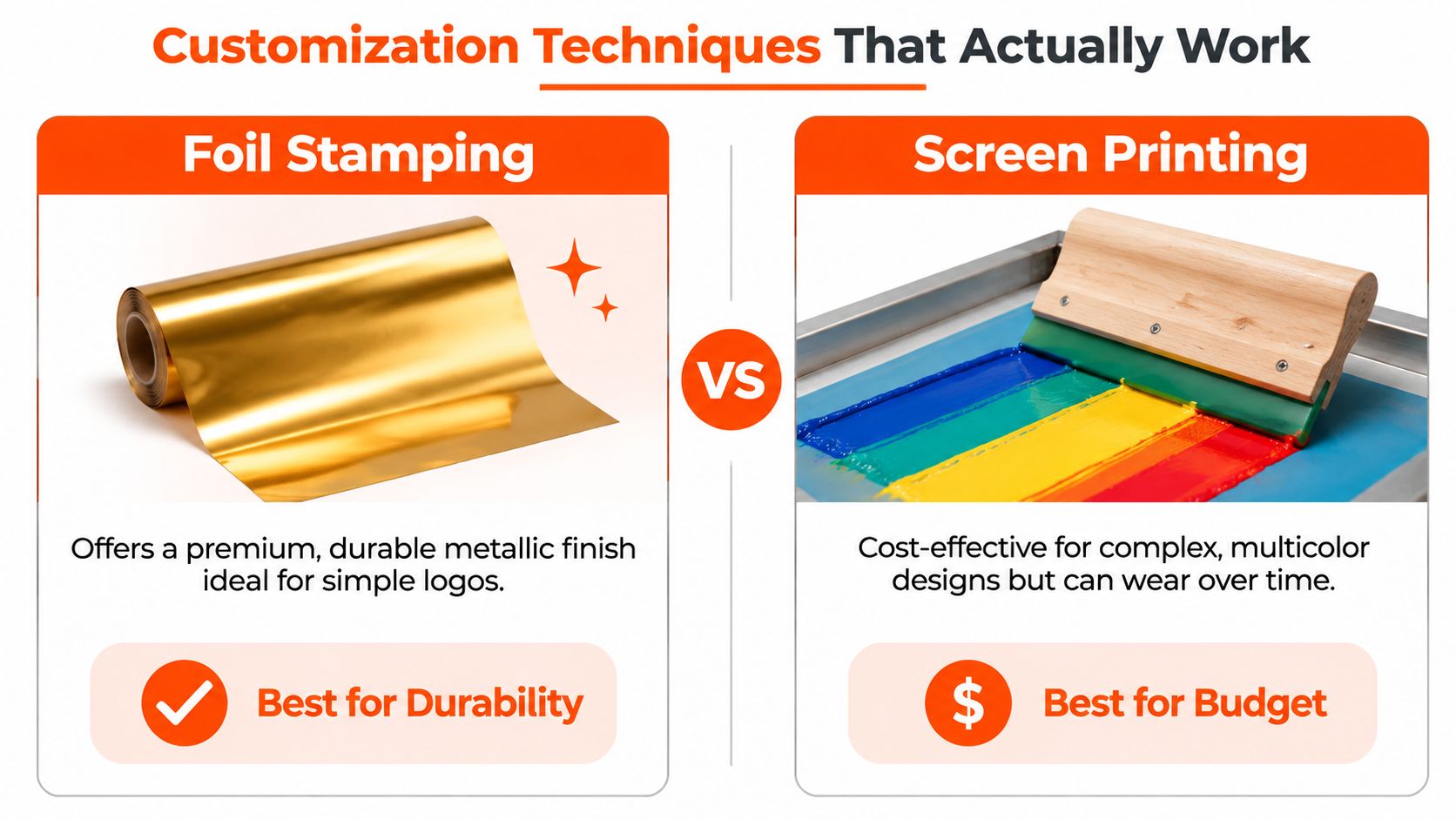
Foil stamping adds a metallic surface, often gold, silver, or a selected color foil. It makes a restrained wordmark feel intentional, but it needs enough separation from the cover to remain legible. Keep the artwork simple. Tiny details and dense marks lose their clarity quickly.
Screen printing is the reliable choice for bold, high-contrast artwork. It suits smooth covers and can handle strong graphic shapes, including multicolor work, but the surface and registration need careful control. On textured materials, fine detail may disappear, and screen-printed surfaces can wear with repeated handling.
Digital or UV printing is the better route for gradients, illustrations, and photo-style artwork. It preserves complexity that debossing, foil, and conventional screen printing can't reproduce cleanly. The trade-off is that the final result depends heavily on surface preparation and color management.
Laser engraving, spot varnish, die cutting, gluing, embossing, and pad printing expand the options further. Pundy's customization methods overview lists these techniques as part of the wider notebook production toolkit. That range is useful, but more options don't mean more decoration is better.
Avoid the predictable failures
Offset printing remains the benchmark for large runs when sharp, consistent reproduction matters. Digital printing makes more sense for small runs and variable data. Commercial print QA uses spectrophotometers and densitometers to monitor color and registration, especially when several imprint colors need to align precisely. Those controls matter because a notebook with logo can look polished in a digital mockup and visibly wrong when the mark shifts or the color density changes.
Design rule: Bold logo, smooth cover, strong contrast. Use screen print. Simple logo, premium cover, tactile finish. Use deboss or foil. Complex color artwork. Use digital or UV.
If the project includes other small-format branded items, compare the notebook approach with Banger's pad printing services. The same principle applies across merch: select the process that respects the object instead of forcing one technique onto every surface.
Artwork Setup and Proofing Process
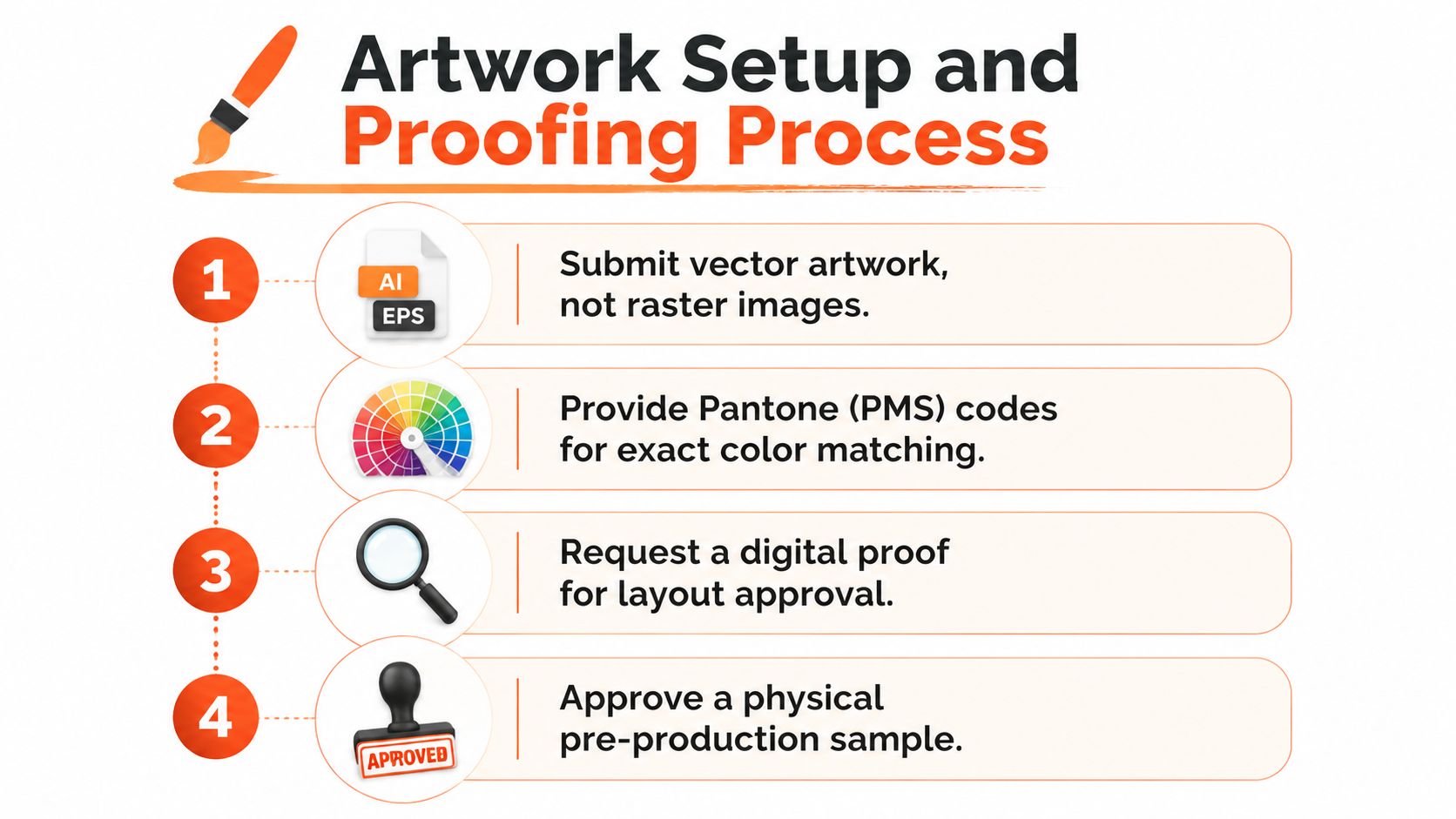
A crisp notebook logo starts before production. Send the wrong file and even a premium cover will expose the problem through soft edges, color shifts, or white slivers along a trim edge.
Prepare the file correctly
Use CMYK artwork for print production and supply the logo at 300 DPI at final size. If the artwork reaches the trim edge, include a 3 mm bleed. These requirements address the two common production problems buyers underestimate, RGB-to-CMYK color conversion and missing bleed that creates unwanted white edges. Bookblock's artwork setup guidance covers the prepress logic behind these checks.
Vector artwork is preferable for logos because it scales cleanly, but a high-resolution raster file can work when it meets the final-size requirements. Don't judge the file only by zooming out. Check sharpness at 100% and 200%, confirm pixel dimensions at the intended print size, and inspect thin lines, counters, and small type.
Approve what will actually be made
A digital proof confirms placement, scale, and general layout. It doesn't fully communicate cover texture, foil reflectivity, deboss depth, or how a color sits on a specific material. Ask for a physical test print at target dimensions when the notebook is important, the cover is textured, or the artwork uses multiple colors.
Review the proof against a short approval list:
- Scale: Verify that the logo feels balanced on the actual cover, not just on a screen.
- Contrast: Check that the mark remains legible against the chosen material.
- Color: Confirm that the CMYK conversion produces an acceptable result.
- Edges: Inspect artwork that reaches trim areas for bleed coverage.
- Finish: Ask whether the approved method matches the cover's texture and handling.
A logo that stays crisp on paper at full size is much less likely to fail in production. Soft edges, tiny files, and compressed artwork are warning signs, not problems to solve after the order is placed. For a related premium finishing reference, see Banger's foil hot stamping guide.
MOQs, Lead Times, and Cost Considerations
Custom notebook pricing isn't controlled by the logo alone. The main variables are minimum order quantity, cover material, imprint method, notebook construction, packaging, and shipping complexity. A simple mark on a stock notebook is a different production job from a bespoke size with custom paper and inside-page printing.
Understand the order threshold
Stock-branded options can have MOQs as low as 10 units, while fully customized notebooks commonly move to 100 to 150 units, depending on the supplier and feature set, according to Bookblock's custom merch pricing information. The reason is straightforward. Applying a logo to an existing product requires less setup than changing the size, paper, binding, cover construction, or interior design.
Use the lower threshold when you need a small founder kit, a pilot order, or a targeted client gift. Move toward full customization when the notebook plays a larger role in a campaign, onboarding system, or branded collection. Don't pay for bespoke interiors if the audience only needs a useful place to write.
Budget for the complete production job
Ask for an itemized quote that separates the notebook, decoration, setup, proofing, packaging, and delivery. A premium material may raise the unit cost, while a larger order can distribute setup costs more efficiently. Multi-address shipping can also affect the operational plan even when the product itself stays unchanged.
Lead time should be planned from approval, not from the first conversation. Build room for artwork corrections, e-proof review, physical samples when needed, production, packing, and delivery. If the date is fixed, tell the supplier before selecting the format. A rushed event order often fails because the buyer chooses the notebook first and checks production feasibility last.
Samples make sense when material, finish, or color is uncertain. For a simple stock option with approved artwork, a direct production order may be reasonable. Distributed teams and influencer gifting need a recipient file, packaging plan, and address validation before production begins. You can also review Banger's custom merch quote timing before setting internal approval deadlines.
Your Complete Buyer's Checklist
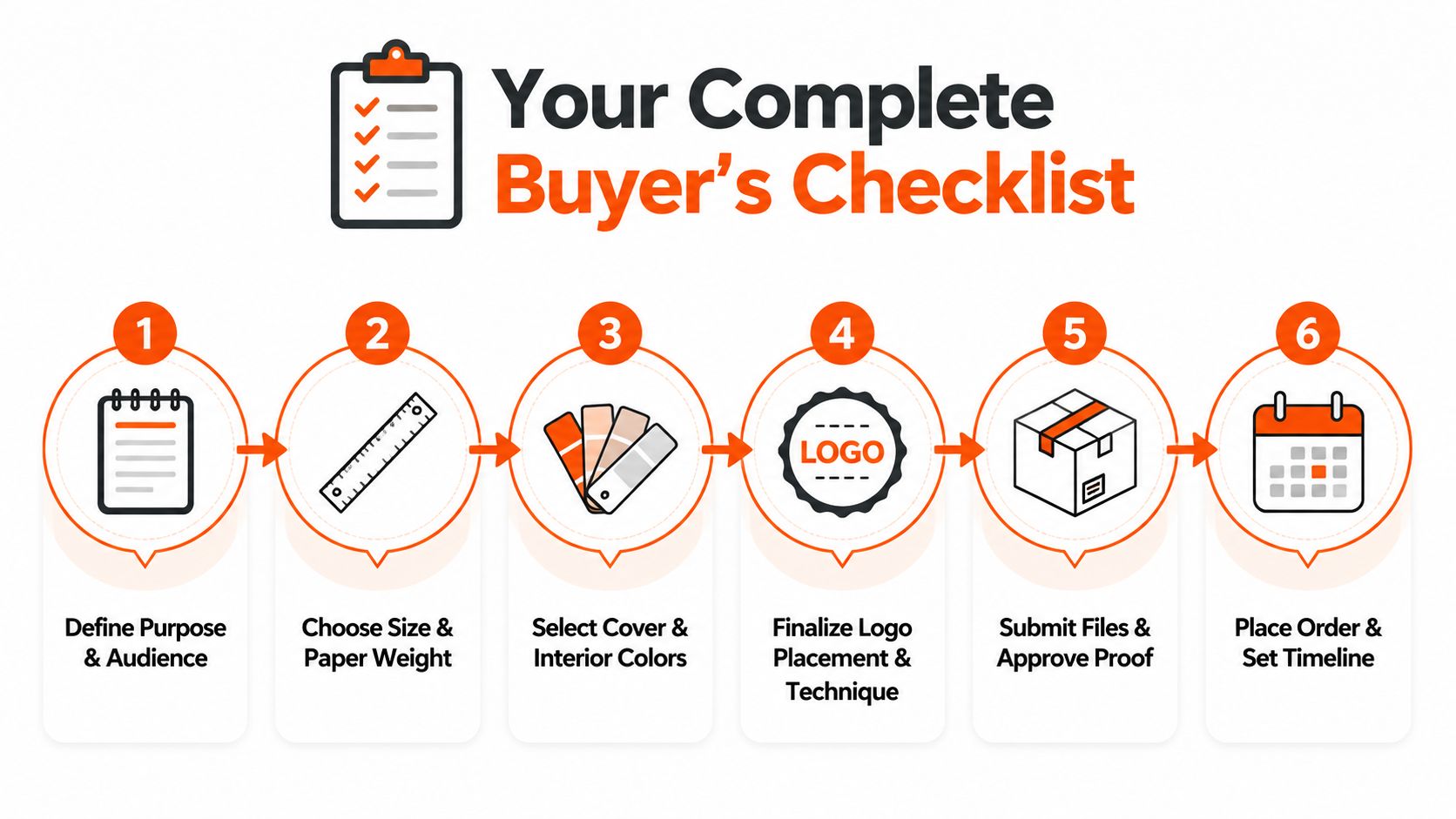
A strong notebook order starts with the use case, not the logo. Decide whether the notebook belongs in an onboarding kit, conference tote, executive gift, or client package. Then match its format, materials, decoration, artwork, and delivery plan to that setting.
Use this approval list
- Define purpose and audience: Separate executive gifts, team onboarding, event giveaways, and community drops.
- Choose size and paper weight: Use portable formats for events and comfortable paper for daily desk work.
- Select cover and interior colors: Make the material, palette, and sustainability claims support one brand story.
- Finalize logo placement and technique: Match artwork complexity to the cover texture before requesting a proof.
- Submit files and approve the proof: Check CMYK, final-size resolution, bleed, sharpness, placement, and finish.
- Place the order and set the timeline: Confirm MOQ, packaging, single or multi-address shipping, and the required arrival date.
Banger's stated process covers product selection, quantity, logo upload, a free quote with a product preview within 24 hours, e-proof approval with real atelier photos, and worldwide delivery in 10 to 15 business days. Banger offers notebooks and custom office supplies, with customization and worldwide fulfillment for teams that want a considered brand touchpoint.
Use the format to signal the occasion, then let credible materials and a disciplined imprint carry the identity. Upload the logo and request a product preview before approving the next team drop, event package, or client gift.