Striped Canvas Tote Bag: Materials, Customization & Sourcing
You don't need another tote that looks good in a mockup and dies in the first month of use. If you're ordering a striped canvas tote bag for a launch, offsite, or community drop, the real decision is whether you're buying a carryall people keep or a cheap rectangle that becomes closet noise.
That's the problem with most tote briefs. Teams obsess over stripe color first, then discover the bag sags under a laptop, the print cracks, the handle digs in, or the sizing feels weird in actual use. A tote has to do two jobs at once, it has to carry weight, and it has to signal taste.
The history matters here, too. The tote moved from utility into fashion, then into branding, which is why the best versions now live at the intersection of function and identity, not just price and decoration. That's the standard to hold this product to if you're shipping merch that's supposed to say something about your brand.
Table of Contents
- Screen print when you need scale and clarity
- Embroidery when the bag should feel premium
- DTG, DTF, and finishing details
Why Most Striped Tote Orders End Up in a Drawer
A marketing lead gets the green light for 200 totes, picks the cheaper import, approves a mockup with crisp navy stripes, and feels done. Then the boxes land, people pack laptops into them once, the handles feel sketchy, and half the batch never leaves storage. The failure wasn't the stripe pattern. It was the sourcing decision.
The three quiet ways tote orders fail
The first failure is thin canvas. A tote can look structured in a product photo and still collapse the second someone drops in a charger, notebook, and water bottle. That's why depth and reinforcement matter as much as print placement, especially when the bag is meant to act like a daily carry instead of a soft giveaway.
The second failure is decoration that doesn't age well. Crack-prone prints, sloppy registration, and decoration on the wrong panel make a bag feel disposable fast. If the tote is supposed to live in someone's rotation, the customization has to respect the fabric, not fight it.
The third failure is sizing. A fashion tote and a work tote aren't the same thing, and a grocery-style carryall is a different animal again. If you don't match the gusset and handle length to the actual use case, the bag gets judged in the first ten seconds of contact.
Practical rule: buy the tote for how it'll be carried, not how it looks flat on a white background.
Many teams waste budget. They treat a striped canvas tote bag like a giveaway, then wonder why it doesn't behave like a product. If you want a more strategic baseline for company merch thinking, the tote framing in this company tote guide is worth comparing against your brief.
The better move is simple. Decide whether the bag needs to sell a brand, support a pack, or survive daily use, then spec the fabric and construction around that job. Stripe pattern is the visible part. Performance is the part people remember.
Anatomy of a Striped Canvas Tote Bag
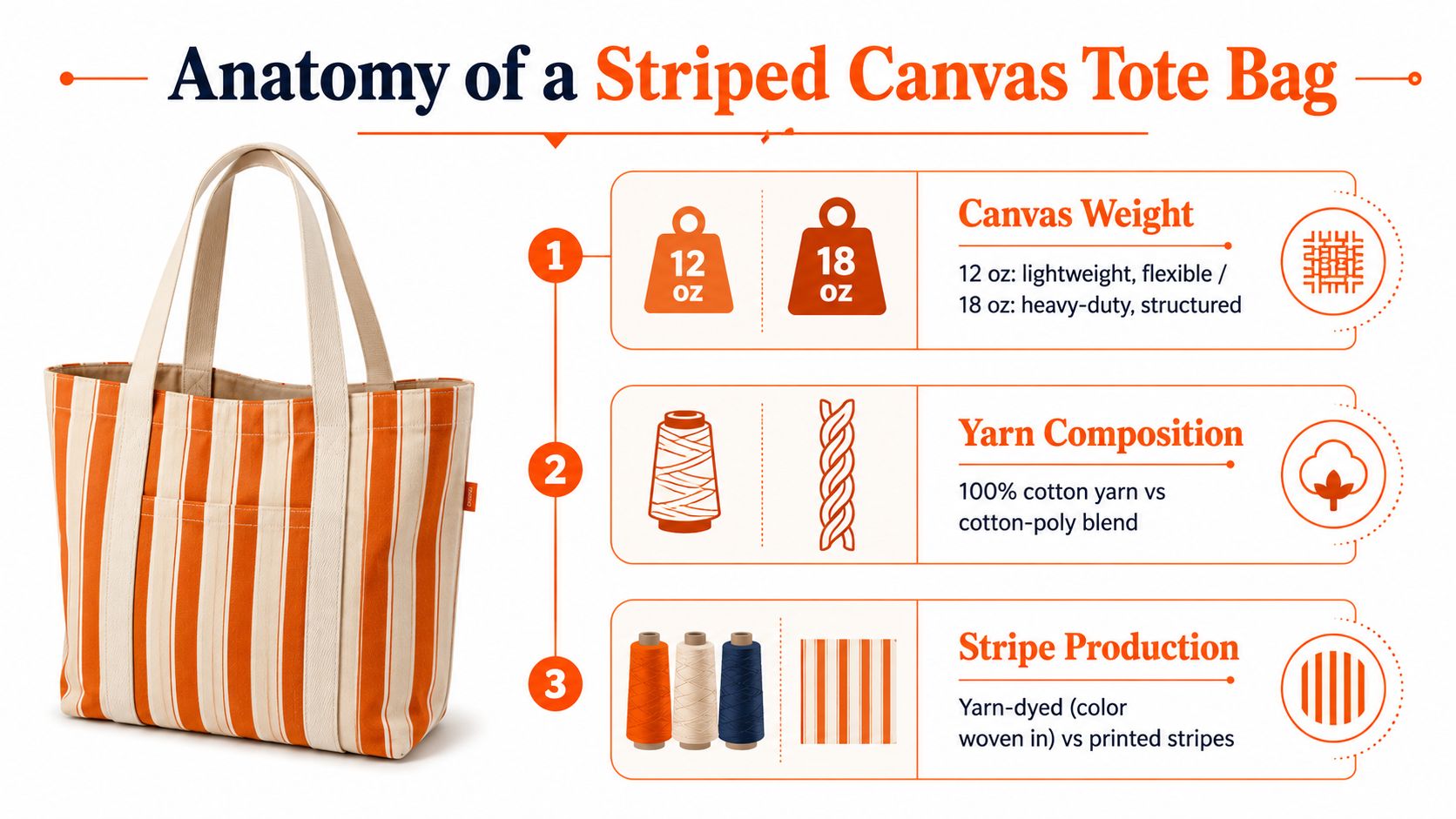
A good tote listing should tell you three things right away, the canvas weight, the stripe construction, and the bag geometry. If it doesn't, you're guessing. And guessing is how teams end up comparing fashion bags to utility bags as if they're the same product.
Start with the canvas, not the stripe
Canvas weight shapes the entire feel of the bag. 12 oz cotton canvas tends to read lighter and more flexible, while 18 oz cotton canvas feels heavier and more structured, which is the difference between a tote that drapes and a tote that stands up on its own. That matters because the market already spans both light fashion pieces and sturdier builds, and the specs on product pages aren't interchangeable. GSM fabric weight reference
Yarn composition matters just as much. Retail specs show striped canvas totes ranging from 56% jute / 44% cotton blends to 98% cotton / 2% elastane, and that spread changes both hand feel and abrasion behavior. Heavier-duty versions also show 12 oz or 18 oz cotton canvas with reinforced stitching, zippered tops, and long shoulder straps, often around 28 inches or 71 cm, which is exactly the kind of construction that helps a tote survive cyclic loading at the handles, top edge, and gusset seams. Zara striped canvas tote bag spec
Then read the stripe like a production choice
A yarn-dyed stripe is woven in, which usually feels more premium and ages better because the color lives inside the fabric structure. A printed stripe sits on top of the cloth, which gives you more color freedom and usually a lower cost path. If your brand wants a long-lived carry item, woven stripes are the cleaner move.
Read the bag like a mechanical object: weight, weave, stripe method, then finishing. In that order.
After that, look at the gusset. A tote with a 13 cm gusset behaves like an everyday carry. A bag with a deeper 19 cm gusset is closer to grocery or event-kit territory because the wider base gives you more usable volume and less load shift. If the product page gives dimensions, you can usually tell whether the bag is meant for style, utility, or both.
Customization Techniques for Striped Canvas Tote Bags
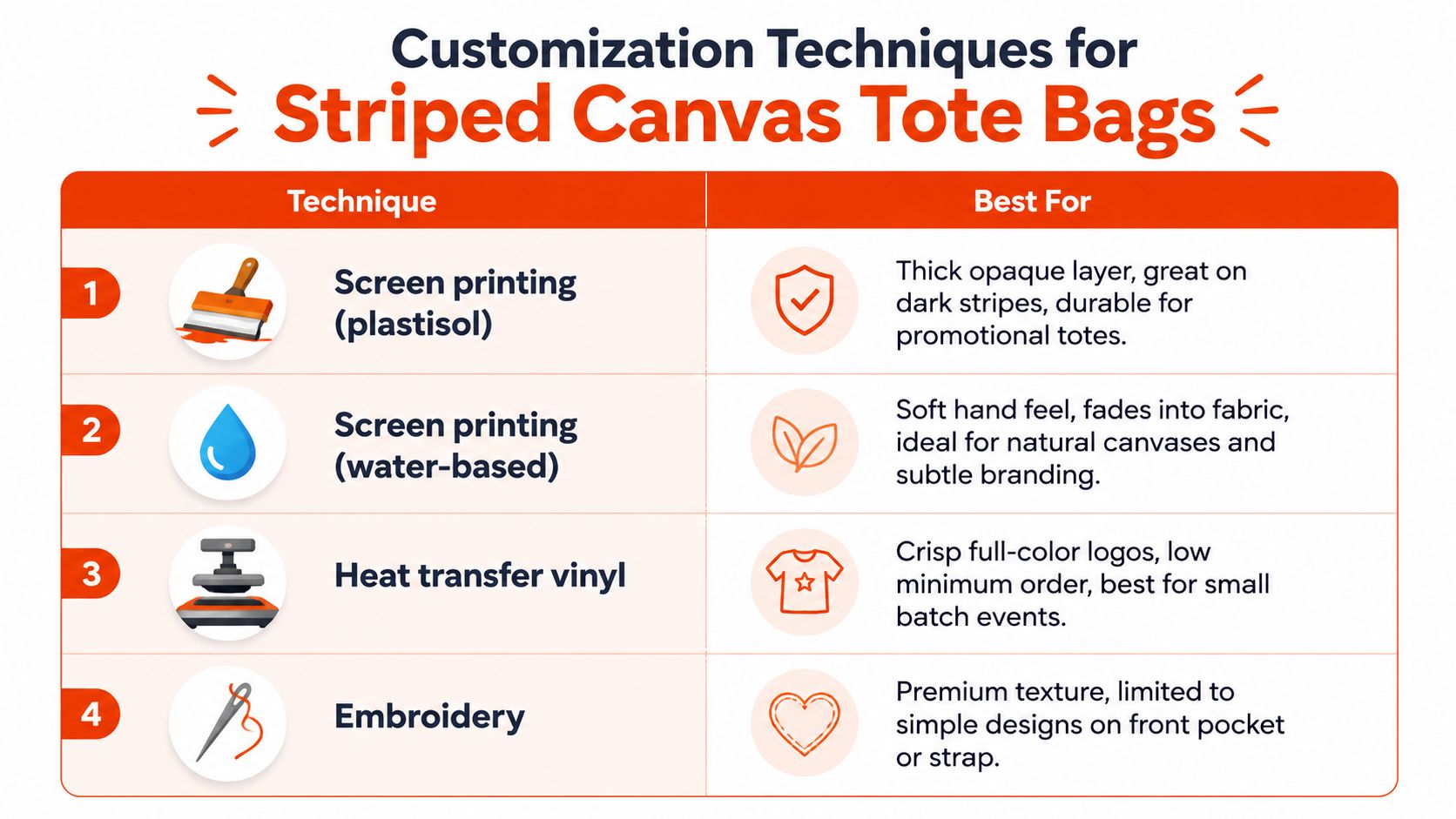
The stripe pattern changes the customization conversation. Thick woven stripes can take most decoration methods cleanly, while fine printed stripes need better alignment and more restraint. If you pick the wrong technique, the tote starts looking like a production error instead of branded merch.
Screen print when you need scale and clarity
Screen printing is still the workhorse. Plastisol gives you a thicker, more opaque mark that reads well on dark or busy stripes, while water-based ink feels softer and sinks more naturally into the fabric. For promotional totes, that's usually the right trade, especially when the logo is simple and you want repeatability across a larger order.
Embroidery when the bag should feel premium
Embroidery changes the perceived value fast. Flat embroidery, 3D embroidery, or chenille all add texture, but they work best on a solid front panel, pocket, or strap area rather than right over a loud stripe field. If the logo has tiny details or gradients, don't force embroidery just because it feels upscale.
DTG, DTF, and finishing details
DTG and DTF are useful when the logo is complex, multicolor, or gradient-heavy. They're not the first choice for every tote, but they're practical when the art direction matters more than tactile texture. For a sharper retail feel, woven labels, leather patches, and custom hang tags can do more work than overdecorating the bag itself.
Do this in the quote: specify the stripe type, the logo placement, the exact print area, and whether you want the decoration to blend in or pop.
If you're comparing methods for a merch line, this customization guide is a useful cross-check before you lock production. It'll help you separate what looks good on screen from what survives handling, packing, and shipping.
My take is blunt. If the bag is a team giveaway, screen print wins. If the bag is supposed to feel like retail merch, embroidery or a clean patch system usually gets you closer to the right signal.
Sustainability and Sourcing Decisions
A striped tote can sound “sustainable” without being a smart buy. The label only matters if the fabric, trim, dyeing, and production path make sense together. Otherwise you're just buying a nicer story.
What actually changes the sourcing outcome
Start with fabric composition. Marks & Spencer's striped canvas tote uses a 100% cotton body, but it also has a 100% polyester body lining and 100% polyurethane trimming, which is a good reminder that “cotton tote” often means a mixed-construction product once you look past the headline material. Marks & Spencer striped tote spec
That kind of build isn't automatically bad. Blends often exist because they improve shape retention, lining performance, or price control. The question is whether you want a bag that feels natural and soft, or one that holds structure and survives repeated use with less visual fatigue.
Ask about the supply chain, not the slogan
A premium sourcing conversation should cover where the fabric comes from, where decoration happens, and how far the bag travels before it reaches your customer. Shorter supply chains can simplify communication and reduce friction, while offshore production can lower unit cost if you're ordering at scale. The trade-off is straightforward, and pretending it isn't only makes the brief weaker.
If you're evaluating a partner, ask what blank options they can source, whether they can customize in a nearby atelier, and whether they can ship to multiple countries from one production run. Banger, for example, positions European-sourced blanks, French atelier customization, and worldwide fulfillment as one workflow, which is the kind of setup that matters if your audience is distributed and your drop needs to land cleanly.
Sustainability is not a sticker on the polybag. It's a sourcing decision made before the tote gets printed.
For a deeper lens on fabric origin and material choice, this organic cotton explainer is the right place to sanity-check what suppliers are claiming. The premium move is to choose the construction that matches your brand's values and the bag's job, then stop there. Don't pile on green language you can't back up.
MOQ, Lead Times, and Fulfillment Options
Ordering a striped canvas tote bag gets easy or painful depending on how rigid the supplier is. If you need a small test run, a modern merch partner should let you move without committing to warehouse-sized volume. If you need distribution at scale, fulfillment should be part of the order, not a separate headache.
The ordering math that actually matters
Traditional tote suppliers often push you toward hundreds of units before the conversation gets useful. A lower-MOQ model lets you test a design, validate the stripe direction, and avoid parking cash in inventory. For teams comparing production paths, low MOQ manufacturing is a helpful reference point for understanding how much flexibility exists outside the old bulk-order default.
Lead time matters just as much. Banger's model is built around a free quote and product preview in 24 hours, then 10 to 15 business days for production and worldwide delivery end to end, with reorder speed on previously approved designs at 5 to 7 days. Those timelines are what make a tote usable for launches, conferences, and campaign drops instead of just planned seasonal merch.
Packaging and shipping should be part of the spec
If the bag is going direct to recipients, packaging changes the perceived value a lot. Branded mailers, tissue, stickers, and inserts can turn a basic tote into a real unboxing moment. If the recipients are distributed, multi-address shipping matters more than saving a few cents on the bag itself.
For teams shipping globally, ask whether the supplier can handle DDP delivery to your target markets and whether they can ship to multiple addresses in one order. That's the difference between a smooth launch and a logistics mess.
Premium fulfillment rule: don't separate the merch decision from the delivery decision. They're the same decision.
If you're building a full kit around the tote, this fulfillment overview is worth using as a planning layer before you request samples or approve packaging.
Matching the Tote to the Use Case
A striped canvas tote bag only works when the format matches the job. A conference tote, a welcome-kit tote, a retail tote, and a community drop tote all want different construction, decoration, and fulfillment logic. Treating them as one category is how brands end up overpaying for the wrong thing.
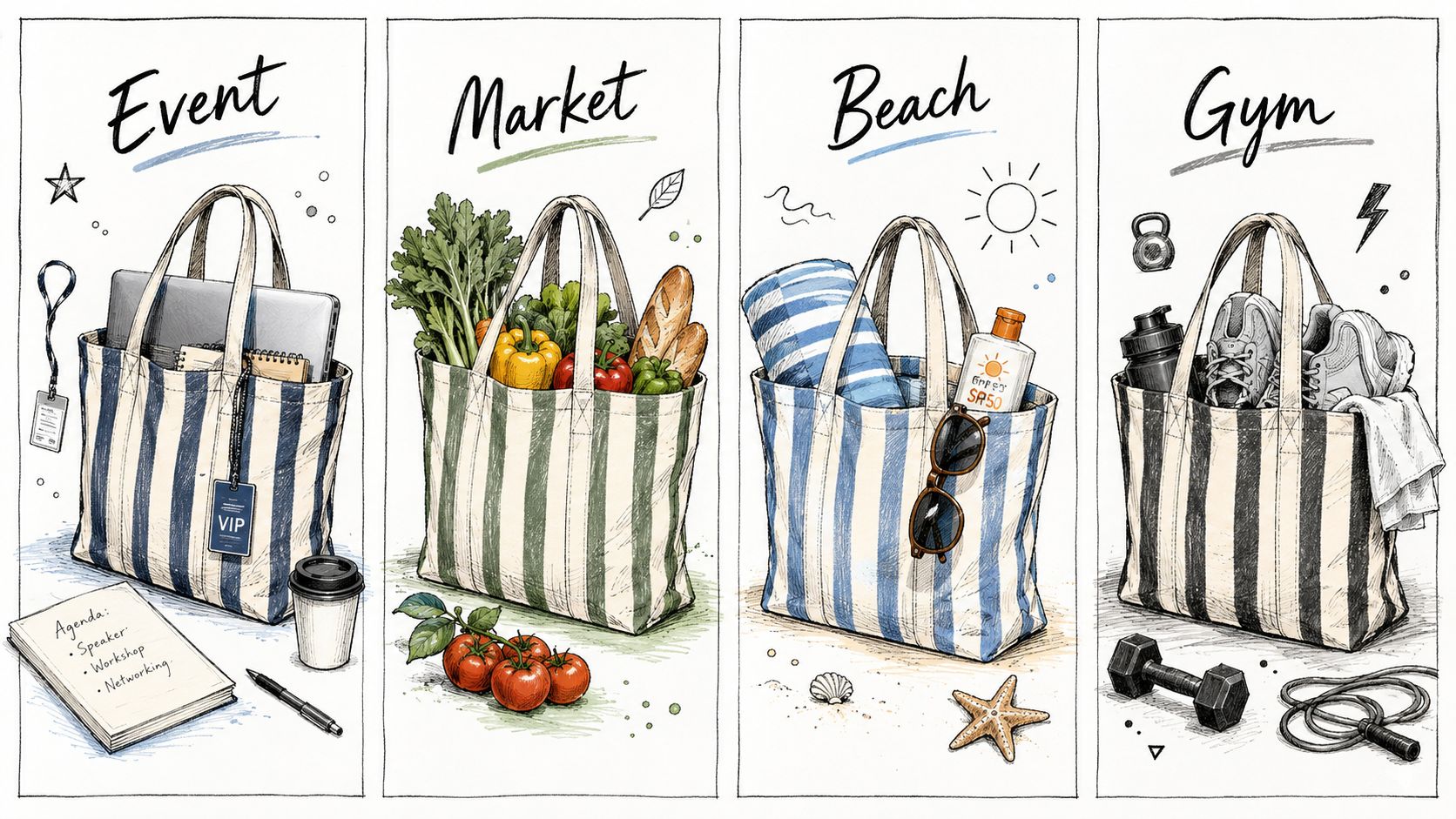
Four real use cases, four different specs
For conference and event giveaways, go light, obvious, and fast. Bold stripes, a simple screen print, and a practical carry shape are the right call because the bag needs to work in crowded spaces and survive immediate use. Don't overbuild this version. The point is visibility and convenience.
For team onboarding kits, move up a tier. Heavier canvas, cleaner finishing, and something like embroidery or a woven label gives the tote enough presence to sit beside notebooks, hoodies, and device accessories. The bag should feel like part of the internal brand system, not a one-day giveaway.
For retail and DTC merch drops, the bag has to feel collectible. Fashion-grade finishing, stronger materials, and a colorway that doesn't look interchangeable with every commodity tote online are the right priorities. The striped tote's long fashion history matters, because the right distribution can turn a simple carryall into a desirable object. The recent Trader Joe's mini canvas tote frenzy, which kept selling out in under an hour and showed up in places like London, Tokyo, and Seoul, proves how fast a striped tote can cross from utility into cultural item when the drop is constrained and the format is sticky. Trader Joe's tote demand report
For community or creator drops, the bag needs a point of view. Limited runs, a distinct stripe palette, and multi-address fulfillment make more sense than generic bulk merch. If the audience is fan-driven, the tote should feel like a collectible, not office supply.
If you're trying to shape the creative angle for a consumer-facing tote drop, these fashion UGC script ideas can help you think about how the bag will be shown, not just how it will be spec'd. That matters because tote demand is partly visual, partly social, and partly about whether the bag feels worth carrying on camera.
Care, Durability, and the Ordering Checklist
Striped canvas totes age better than you think, but only if you treat them like fabric goods, not disposable promo gear. Wash cold if you need to clean one, avoid harsh spin cycles, and spot clean embroidered areas so you don't beat up the threads. Printed stripes will usually soften over time, and that's fine if the bag was built to feel worn-in rather than pristine.
If you want the tote to hold up, don't ignore the stress points. Handles, top edges, and gusset seams are where daily use usually shows first, so reinforcing those areas matters more than obsessing over tiny decorative details. A bag that develops character is good. A bag that falls apart is just bad production.
| Decision | What to Confirm | Default for Premium |
|---|---|---|
| Canvas weight | Ask for the exact oz spec and whether the bag feels structured or soft | Heavier cotton canvas |
| Stripe type | Confirm yarn-dyed or printed stripes | Yarn-dyed when longevity matters |
| Customization technique | Match the logo to the stripe field and panel placement | Screen print or embroidery, depending on the art |
| Color references | Send exact Pantone or visual refs for stripes and logo | Locked palette before sampling |
| Finishing details | Check lining, closure, strap length, and pocketing | Reinforced handles, clean closure |
| Packaging | Confirm mailers, tissue, stickers, and inserts | Branded unboxing |
| Shipping | Specify single-address or multi-address delivery | Multi-address capable |
| Payment method | Confirm invoice, card, or approved payment rails | Whatever reduces approval friction |
| Lead time | Lock preview timing, production window, and reorder speed | Fast preview, clear reorder path |
The right brief is short, not vague. Pick the canvas weight, stripe method, decoration technique, and fulfillment path before you ask for a quote, then hold the supplier to those choices. If you're ready to ship a tote that feels like real merch instead of filler, Banger can handle the product, customization, and fulfillment side in one workflow.