Custom Packaging Design That Builds Brands
Custom packaging design isn't about a pretty box. It's the first thing your audience touches. It’s the difference between a product that’s received and a brand that’s felt.
When done right, it reinforces your identity and makes the entire experience mean something.
Table of Contents
Why Your Merch Deserves More Than a Brown Box
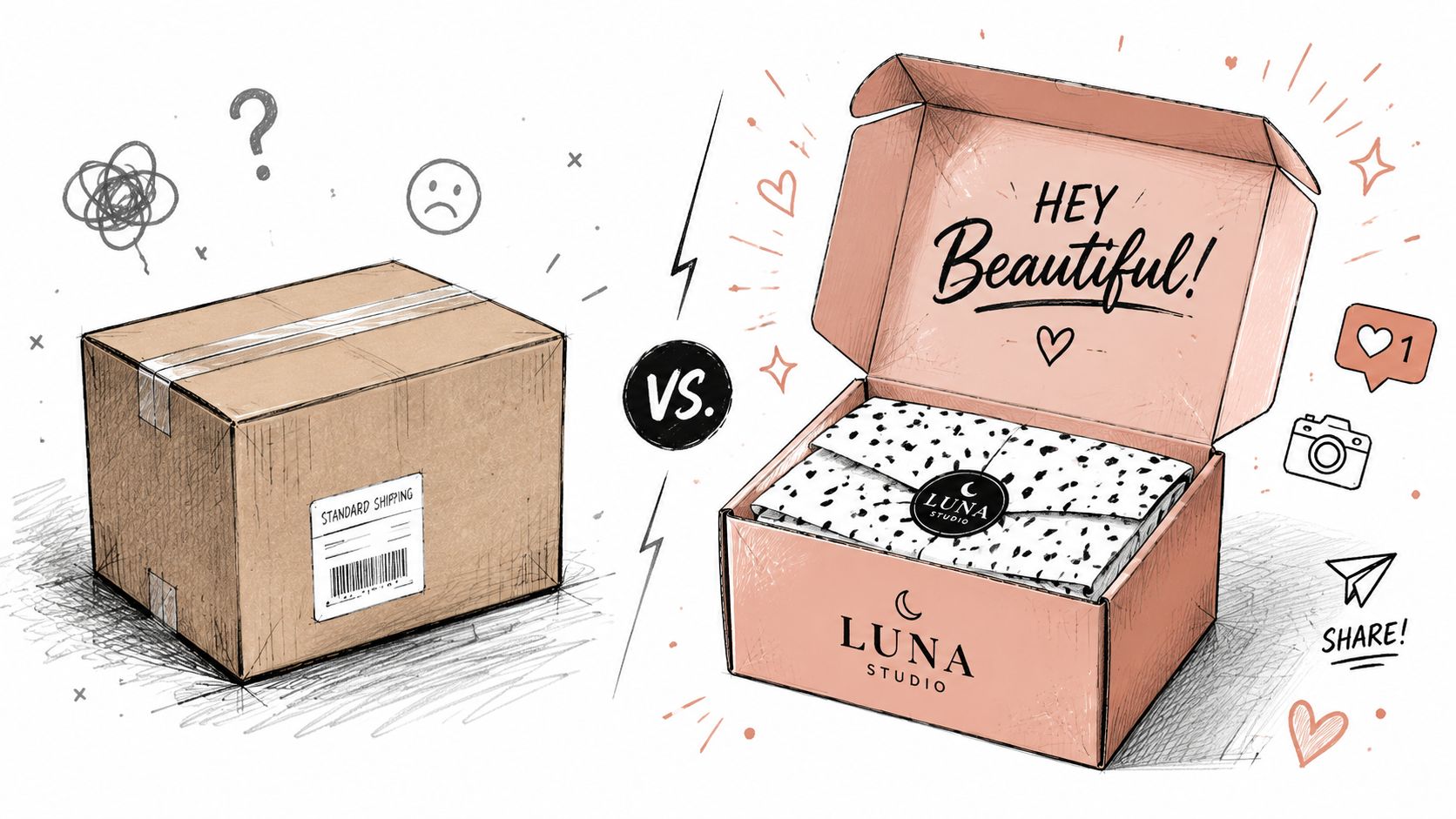
Most company merch lands in a generic, forgettable box. That's a massive missed opportunity.
Treating your packaging as a simple shipping expense kills the vibe before it even gets started. That plain cardboard is the first impression. It sets the tone, and that tone is "just another delivery."
Thoughtful custom packaging, on the other hand, turns a transaction into an experience. It’s the opening act. It communicates care, quality, and intention from the moment the package lands on a desk. This shapes how the merch inside is perceived—premium packaging signals a premium product.
The unboxing moment is part of the product itself. It’s a choreographed reveal that builds anticipation and creates a real connection, turning a one-time drop into something that gets shared online and talked about offline.
This isn't just about aesthetics. It's strategy. A well-designed package does a lot more than just protect what's inside.
Reinforces Brand Identity: It’s a physical asset that makes your brand tangible. The colors, materials, and textures all speak for you.
Elevates Perceived Value: A great box makes the items inside feel more special and valuable—much like how exceptional welcome gifts for new employees can shape a team member's first impression.
Creates Shareable Moments: People share cool things. An impressive unboxing experience is pure gold for social media, acting as organic marketing for your brand.
This thinking extends beyond merch. You see it in how sustainable food packaging designs turn a simple container into a powerful marketing tool. The principle is the same: the container is as important as the contents.
Your brand deserves to make an impact from the very first glance.
The Blueprint for Standout Packaging Design
Let’s be real: great packaging is way more than a logo slapped on a box. It's the architecture of your brand's first physical impression.
Building a standout unboxing experience starts with a solid blueprint that nails the structure, materials, and visuals. Get this right, and your packaging goes from a shipping afterthought to a core part of your brand.
This isn’t just about looking good; it’s what people expect now. The custom packaging box market is set to hit USD 9.2 billion by 2035, which tells you everything you need to know. Brands are finally treating the box as an extension of the product. You can dig into the numbers in this full market analysis.
Core Components of Your Packaging Blueprint
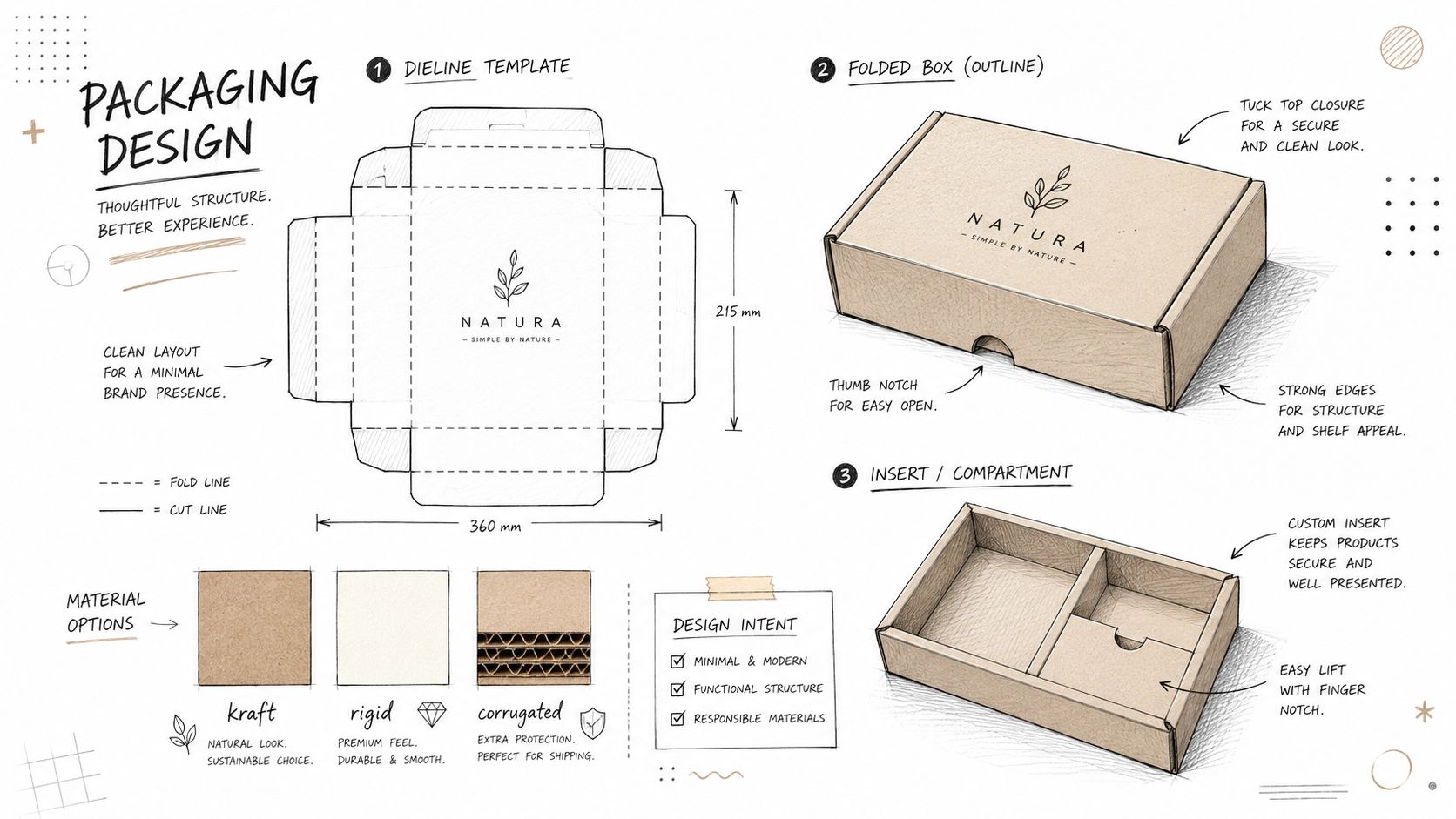
To design an experience people remember, you need to think through three key layers. Each one builds on the last to create something cohesive and impactful.
Structural Design: This is your foundation. It’s choosing the right box type—like a mailer or rigid box—and engineering custom inserts to hold your merch perfectly. A solid structure protects your gear and delivers that premium reveal.
Material Selection: The materials you pick say a lot about your brand, fast. Options range from eco-friendly kraft paper and recycled cardboard to premium, heavy-duty rigid board. The right choice telegraphs your vibe, whether it's sustainable and grounded or sleek and high-end.
Print & Finishing: This is the visual layer that makes your brand pop. Techniques like embossing, foil stamping, or spot UV add texture and depth. It’s how you turn a simple box into a tactile experience that’s impossible to ignore.
A well-executed custom packaging design considers how these three elements work together. The structure creates the stage, the materials set the mood, and the finishing delivers the performance.
For teams planning a merch drop, choosing the right starting point is everything. The table below breaks down the most common packaging types to help you match your project’s needs with the right foundation.
Choosing Your Packaging Foundation
Here’s a quick rundown of the most common packaging types we see for merch drops, events, and onboarding kits.
| Packaging Type | Best For | Vibe Check | Banger Tip |
|---|---|---|---|
| Mailer Box | Team drops, onboarding kits, e-commerce | Versatile, modern, and efficient. The go-to for DTC and tech. | Perfect canvas for bold, all-over prints inside and out. |
| Rigid Box | VIP gifting, executive kits, high-value items | Premium, sturdy, and impressive. Think Apple unboxing. | Use magnetic closures and foam inserts for an elevated reveal. |
| Product Box | Individual items, retail-ready merch | Lightweight and focused on a single product. | A great way to add branding to smaller accessories. |
| Mailer Bag | Soft goods like tees and hoodies, event giveaways | Minimalist, cost-effective, and low-waste. | Go with compostable options and a sharp one-color print. |
Picking the right format from the jump makes the entire design process smoother and ensures the final product feels right for your brand and budget.
Choosing Materials That Reflect Your Brand
The materials you choose for your custom packaging say something about your brand, whether you realize it or not. A flimsy, generic box whispers one thing. A sturdy, textured, eco-friendly mailer tells a completely different story.
This choice is everything, especially for modern, culture-driven brands. Your audience doesn't just want a great product; they want to align with the brand behind it. Sustainability isn't a niche preference anymore—it's the baseline.
Your material choice is a direct reflection of your brand's principles. Picking recycled, compostable, or responsibly sourced materials isn't just an eco-friendly choice; it's a strategic move that makes your physical product feel like your brand.
This has a real impact. Sustainability is a massive driver in custom packaging. Studies show 67% of consumers are willing to pay more for products in recyclable packaging, and the market for it is set to hit $423.56 billion by 2029. This isn't just a trend; it's a fundamental shift in what people expect. For more data, check out these packaging design best practices.
Balancing Aesthetics and Responsibility
The good news? You don't have to choose between a premium feel and doing the right thing. The two absolutely go hand-in-hand.
FSC-Certified Papers: This certification is the gold standard. It guarantees your paper comes from forests managed to protect biodiversity, providing a high-quality canvas for any design.
Recycled Cardboard: Using recycled content is a simple, effective way to shrink your footprint. Modern recycled materials are incredibly durable and offer a clean aesthetic that works perfectly for minimalist or industrial-inspired branding.
Compostable Mailers: For soft goods like tees and hoodies, these are a no-brainer. They're a fantastic alternative to plastic and send a clear signal that you’re committed to cutting waste, which resonates big time with your audience. For more ideas, check out our guide on other environmentally friendly promotional items.
Ultimately, the right materials make the unboxing experience tangible and real. The weight of the box, the feel of the paper, and the knowledge that it's all sourced responsibly—that's what turns a simple delivery into a memorable brand moment.
Using Print and Finishing to Define Your Aesthetic
The box itself sets the stage, but print and finishing are where your brand's personality really shows up. This is what separates a box people toss from a piece they keep.
It’s how you signal your vibe—whether you’re a sleek tech brand or a bold creator building a culture. Great custom packaging uses print and finishing to create a tactile experience that goes way beyond a simple logo. It’s what makes merch feel pro-level. These details aren't just for show; they signal quality and intention.
Print Methods That Set the Tone
Your choice of printing method is the foundation of your design's final look. Each one has a distinct feel and works best for different goals. For a full technical breakdown, check out our guide on the most common merch printing techniques we work with.
Offset Printing: The gold standard for high-volume orders where quality is everything. It delivers razor-sharp lines and perfect color matching, making it the top choice for ensuring your brand colors are 100% accurate, every single time.
Digital Printing: Perfect for smaller runs, prototypes, and projects that need a quick turnaround. Digital printing gives you incredible flexibility, handling gradients and photographic details with ease. It's the go-to for cost-effective customization.
Screen Printing: If you want a bold, tactile result, screen printing is the answer. It lays down a thick, durable layer of ink that you can feel, creating a vibrant look that pops on cardboard and other materials.
Finishing Details for Tactile Impact
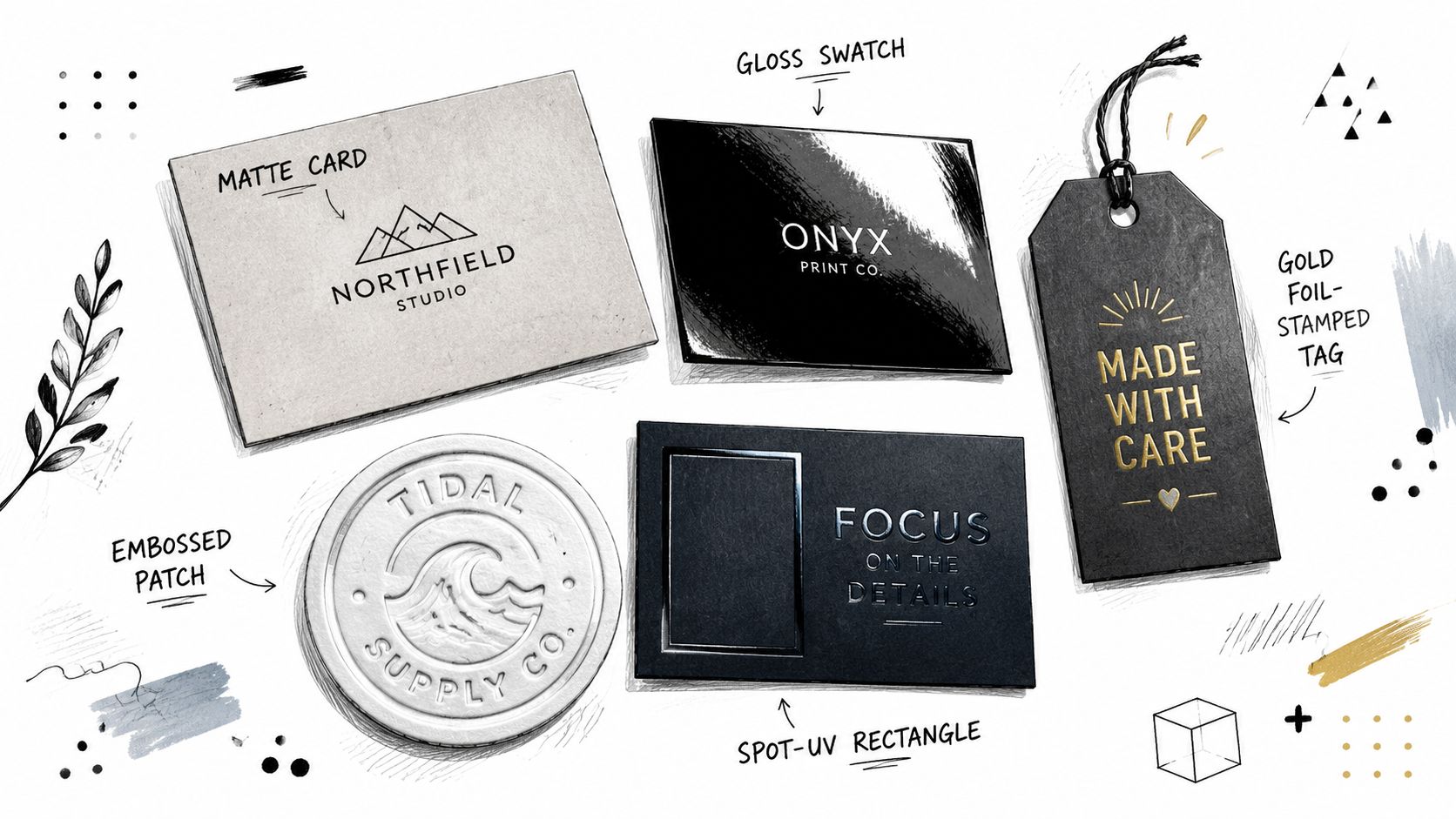
Finishing is where the magic happens. These are the details people feel—and remember—the moment they hold your package. They add texture, depth, and a premium quality that print alone can't achieve. You can also explore a full range of Marquis Book Printing specialty services to see just how far you can push your design.
A simple matte black box with a single, high-gloss spot UV logo feels intentional and confident. It’s not about being loud; it’s about controlling the experience to tell a story.
Here’s how a few common finishes can shape your brand’s entire feel:
Lamination (Matte vs. Gloss): A matte finish is smooth, modern, and sophisticated—perfect for a B2B tech or fintech brand. A gloss finish, on the other hand, is shiny and high-impact, making colors pop for a creator drop or consumer product.
Embossing & Debossing: Embossing raises a part of the design, while debossing presses it in. Both add a subtle, 3D quality that people can't resist touching, giving your logo a quiet, elegant presence.
Foil Stamping: Nothing says premium like a flash of metallic foil. From classic gold and silver to wild holographic effects, foil is a power move that instantly draws the eye and signals value.
Spot UV: This is a killer technique. A high-gloss varnish is applied to specific parts of your design—like a logo or a pattern—creating a stark, beautiful contrast against a matte background. It’s subtle, yet impossible to ignore.
Designing a Memorable Unboxing Experience
The unboxing is the main event. It’s a choreographed moment where your brand comes to life, turning a simple delivery into a tangible feeling. Great packaging design orchestrates this reveal, moving beyond the box to focus on the entire journey.
This is your brand’s opening act. It isn’t just about getting a product from A to B; it's about building a sequence of moments that creates anticipation and makes the final reveal hit that much harder. This is where you use internal elements to tell a story and control the pacing.
Think of it as a narrative. The outer box is the cover, but the real story unfolds inside. Elements like custom tissue paper, branded inserts, and perfectly designed compartments are the details that build excitement. Each layer peeled back should feel intentional and reinforce your brand’s message.
The best unboxing experiences are designed, not accidental. They consider every touchpoint, from the satisfying tear of a sticker seal to the final, perfect presentation of the product. This turns a delivery into a shareable moment.
The following infographic visualizes how these distinct stages come together to form a cohesive and memorable unboxing journey.
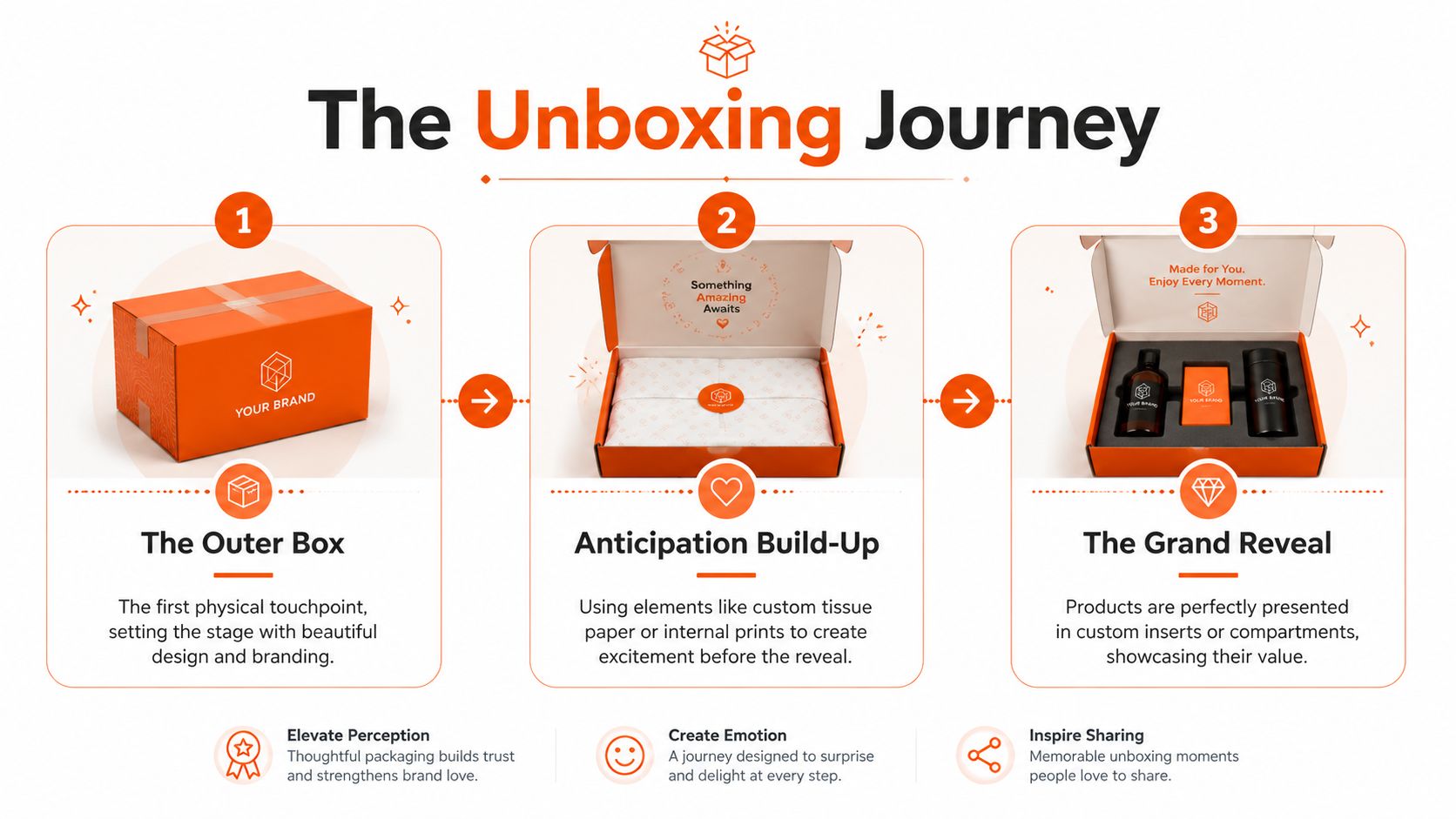
This flow proves a memorable unboxing is a multi-step process. The anticipation built by the internal elements is just as critical as the exterior design.
Building Your Unboxing Flow
So, how do you map out an unboxing experience that feels deliberate and premium? It’s about focusing on the small details that make a big impact.
The First Reveal: Use custom-printed tissue paper or a branded dust bag. It adds a layer of mystery and elegance, delaying gratification and making the main event feel more earned.
Storytelling Inserts: A welcome card, a sticker sheet, or a small print explaining the product’s origin adds a human touch. This is your chance to communicate your brand’s values directly.
Perfect Presentation: Don’t let your merch just rattle around inside a box. Custom inserts made from foam or molded pulp not only protect your items but present them with care. When the lid opens, everything should be perfectly framed. You can find more inspiration in our guide to custom branded gift boxes to see how presentation elevates the entire package.
Unboxing Experience Checklist
Ready to design your own? Here’s a quick checklist to ensure every step of your unboxing experience feels intentional.
The Outer Shell: Does the box align with your brand’s aesthetic? Does it feel sturdy and premium to the touch?
The Opening: Is the opening mechanism satisfying? Think magnetic closures, a clean tear-strip, or a friction-fit lid.
The First Layer: What’s the first thing they see inside? Custom tissue paper? An internal print?
The Reveal: How are the products held in place? Are they presented neatly in custom inserts or allowed to shift in transit?
The Extras: Did you include any storytelling elements like a thank-you note or branded stickers to deepen the connection?
The Final Impression: Does the entire sequence feel cohesive and reinforce what your brand stands for?
By choreographing these moments, your custom packaging creates an experience that gets shared—both online and off—and resonates long after the box is opened.
Turning Your Design Into a Delivered Product
A great idea on a screen is one thing. Turning it into a physical product that lands on someone's desk? That's where execution makes all the difference. This is how we get your custom packaging from a digital file to a finished piece.
The journey begins once your dielines are locked. Think of this as the flat, 2D blueprint of your box before it’s folded and glued. Once your graphics are mapped perfectly onto that template, it’s time for digital proofing. This is your last, best chance to catch any mistakes before you commit to a full production run.
The handoff from design to production is the single most critical step. A detailed digital proof confirms every color, cut, and finish, ensuring the final product matches your vision exactly. No surprises, just a perfectly executed asset.
Getting the ops side right is what separates a smooth merch drop from a logistical nightmare. Suddenly, lead times and fulfillment become just as critical as the design itself.
From Proof to Production Line
As soon as you sign off on the digital proof, your design hits the production queue. This is where your timeline really starts to take shape. A typical project moves through several stages: printing the flat sheets, applying any special finishes, die-cutting the final shape, and then final assembly.
Naturally, the total turnaround time hinges on the complexity of your custom packaging. A simple printed mailer box is always going to be faster to produce than a rigid box with magnetic closures and custom-cut foam inserts.
This is also where Minimum Order Quantities (MOQs) usually become a roadblock. Most manufacturers demand huge commitments, which can shut down custom projects for smaller teams or one-off events. But partners with factory-direct relationships change the game. At Banger, we leverage our network to offer low MOQs, opening the door for anyone to produce premium, small-batch runs without a massive investment.
The Impact of Modern Production
The custom packaging market is growing fast—it’s projected to hit a value of $32.42 billion by 2030. But this growth isn't just about volume; it's about making better, more accessible custom work. You can dig into the numbers with these packaging industry statistics to see where the market is headed.
Modern prototyping and shorter test runs are making high-quality custom packaging more attainable than ever. By working directly with our French ateliers, we get total control over quality and speed, cutting out the middlemen who inflate costs and add weeks to your timeline.
This direct access also simplifies the logistics, especially the often-tricky world of global shipping. To see how this applies to merch, check out our deep dive on merch fulfillment services.
It all boils down to this: a tight production and fulfillment process ensures your design is executed flawlessly and delivered on time, turning your creative vision into a brand asset people can actually hold.
Custom Packaging Design FAQ
Your questions on custom packaging, answered. Fast. Here’s what marketing leads, founders, and event managers ask most.
How Much Does Custom Packaging Cost?
There's no one-size-fits-all answer. The final cost for your custom packaging design depends on what you're building.
It all boils down to four things:
Complexity: A simple mailer box with a one-color print won't cost the same as a rigid box with magnetic closures, foil stamping, and custom foam inserts.
Materials: Recycled kraft paper is more budget-friendly. Premium, heavy-weight, soft-touch paper stock costs more.
Quantity: Price per unit drops the more you order. A run of 500 boxes will have a much lower per-piece cost than a run of 50.
Finishes: Every detail you add—embossing, spot UV, foil—adds to the final cost.
We'll send you a detailed quote in 24 hours. You'll see the exact cost breakdown before you commit.
Think of it like this: are you building a clean, functional landing page or a deeply interactive, animated microsite? Both get the job done, but the complexity dictates the investment. Same goes for packaging.
What Is a Realistic Turnaround Time?
For a standard custom packaging design project with Banger, you can expect product delivery in about 10 to 15 business days from the moment you approve the final proof.
More intricate projects with multiple custom finishes might take a few extra days. If you're on a tight deadline, we also offer rush options.
What Are Minimum Order Quantities (MOQs)?
MOQs are the smallest number of units a manufacturer will agree to produce. For most suppliers, that number is in the high hundreds or even thousands—a non-starter for most startups and event planners.
Banger is built for modern teams. We work directly with our French ateliers, which means we can offer some of the lowest MOQs in the industry. Premium custom packaging is now accessible for drops of any size.
If you want packaging that builds your brand, not just protects a product, Banger designs and produces premium unboxing experiences in France’s best production ateliers — premium materials, low minimums, worldwide fulfillment, and direct factory pricing. Get a free, no-commitment quote with product previews in 24 hours, and build packaging your customers will actually remember.