Merch Fulfillment Services the Guide for Modern Teams
You're probably here because merch got more complicated than it looked.
A few boxes became onboarding kits across five countries. A hoodie drop became a long list of sizes, an address spreadsheet, returns, and support tickets. Or your team tried print-on-demand and got the usual: late deliveries, inconsistent blanks, thin packaging, and pieces nobody wears twice.
Once you hit that point, merch fulfillment services stop being a back-office task and start being a brand decision. If the product is the idea, fulfillment is the execution. Get it wrong and the whole program looks unfinished, no matter how good the product was on paper.
Table of Contents
The Last Mile of Your Brand
Most failed merch programs don't fail at design. They fail at delivery.
The mockups looked good. The samples looked close enough. Then launch week hits and everything breaks at the same time. Someone in Berlin gets the wrong size. A speaker gift arrives the day after the event. Half the team unboxes plain packaging that feels off-brand. Support gets flooded with "where is my order?" messages. The problem isn't the merch anymore. It's trust.
Good merch fulfillment services prevent that spiral. They handle the operational layer your customers, employees, creators, and communities actually feel: storage, picking, packaging, labeling, shipping, tracking, and returns. None of that is glamorous - until something goes wrong, and then it's the only thing anyone remembers.
Fulfillment is the last physical touchpoint of your brand. People remember that moment longer than they remember the order form.
There's a reason this category is large and still growing. The global e-commerce fulfillment services market was estimated at USD 123.68 billion in 2024 and is projected to reach USD 272.14 billion by 2030, a 14.2% CAGR from 2025 to 2030, according to Grand View Research's e-commerce fulfillment services market analysis. That's not a niche admin function. It's core infrastructure.
For merch, the stakes are even higher because apparel and branded goods carry taste. A delayed household staple is annoying. A badly packed team hoodie feels cheap. A customs surprise on an onboarding gift makes the whole thing awkward. If you ship globally, worldwide custom merch shipping isn't a setting buried in your ops doc. It's how your brand actually shows up in each market.
What people actually judge
Teams rarely say, “our fulfillment provider underperformed.” They say:
The drop felt messy
The quality felt inconsistent
The team gift didn't land
The brand looked less polished than expected
That's the actual job. Merch fulfillment services aren't moving units from shelf to doorstep. They're carrying the final version of your brand into someone's hands - and that's the version people remember.
The Two Fulfillment Models You Need to Know
Two models to know - and one analogy that actually works.
Print on-demand is streaming. Fast to launch, no commitment, no physical inventory to protect.
Bulk pre-fulfillment and on-demand shipping is buying vinyl. More upfront work, more intention, better physical experience, harder to undo if you guess wrong.
And this is exactly what Banger does. Once production is complete, we store your inventory in our fulfillment center. When you need to ship, you send us the recipient details, and we trigger the shipment the same day - in your custom branded packaging if you have one.
The full process looks like this:
We produce all the merch upfront in our French ateliers
We store it in our fulfillment center
You send us the recipient details (one address or many, via Excel or our platform)
We trigger the shipment within ~24h, in branded packaging
On-demand works for testing, not always for feel
Print-on-demand earns its place when demand is uncertain, designs rotate fast, or you can't sit on stock.
It fits early creator stores, small community experiments, and seasonal one-offs you don't want to pre-buy. Inventory risk goes to zero. SKU variety goes wide.
The trade-off is everything that makes merch feel like merch. Blank weight, print depth, label quality, packaging, delivery speed - you give up control on each, in small ways that add up. For culture-driven brands, that gap is the difference between an item that arrives and an item people keep.
Bulk pre-fulfillment works when quality matters
Bulk pre-fulfillment means you produce inventory upfront, store it, and ship it on-demand from stock as orders come in.
This is the model for premium onboarding kits, event merch, investor gifts, internal team drops, and hero apparel - anywhere fit, fabric, finishing, and presentation need to be dialed in. You control the exact garment, customization method, labeling, packaging, and consistency from one order to the next.
It also removes a lot of shipping-day chaos. Items are ready before the order exists. Nothing is being assembled in a queue while someone refreshes their tracking page. Execution gets cleaner because the product isn't part of the variable.
The downside is inventory risk. Guess demand wrong and you're sitting on the wrong sizes, the wrong styles, or stale campaign stock. That's why low MOQ custom apparel matters. It gives teams room to be intentional without overcommitting.
Many guides treat fulfillment as simple storage and shipping, but they don't help buyers model trade-offs between print-on-demand, bulk pre-buy, and hybrid setups. The more useful view is operational: premium merch programs often accept higher unit cost in exchange for lower waste, stronger presentation, and better audience experience, as discussed in Limitless Manufacturing Group's overview of merchandise fulfillment trade-offs.
| Model | Best for | Strength | Weak spot |
|---|---|---|---|
| On-demand | Testing concepts, long-tail catalog | Low upfront commitment | Less control over feel and consistency |
| Bulk pre-fulfillment | Team kits, premium drops, event merch | Better quality control and speed | Inventory risk |
| Hybrid | Brands balancing quality and flexibility | Smarter inventory mix | More planning required |
Practical rule: If the merch is supposed to impress someone, not just exist, start from the product experience and work backward into the fulfillment model.
Deconstructing Merch Fulfillment: What's Included
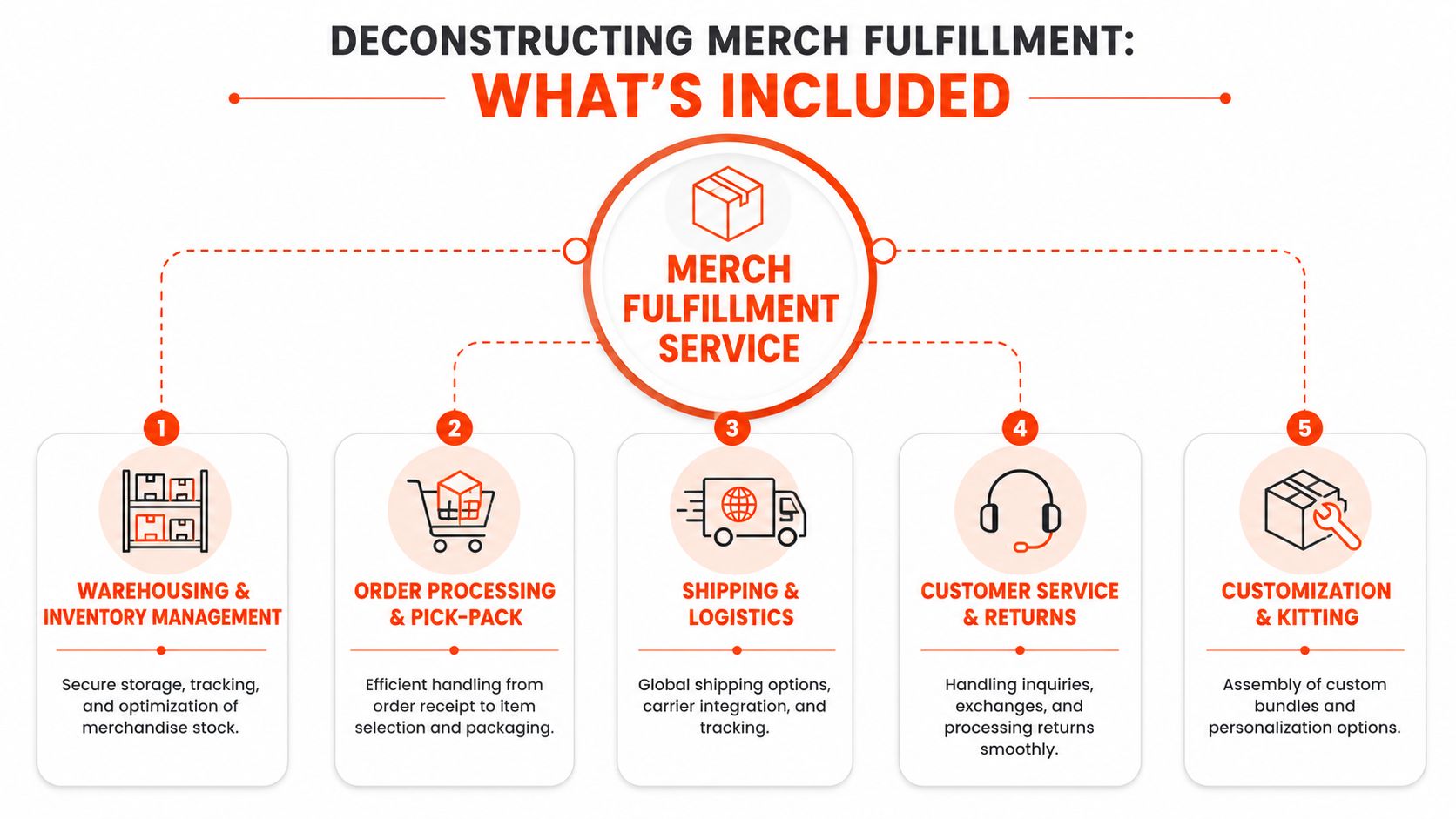
A real merch fulfillment operation does more than store boxes and print labels.
The baseline is simple enough: receive stock, store it, pick it, pack it, ship it. But branded apparel creates more moving parts than generic parcel fulfillment. Apparel orders require SKU-level handling across size, color, and decoration method, plus tighter pick-pack control to avoid damage and mis-shipments, as explained in Ops Engine's apparel fulfillment overview.
That difference changes what “good” looks like.
Inventory is part of the customer experience
If your stock data is wrong, nothing else matters.
A proper merch fulfillment service should manage inbound receiving carefully, reconcile units correctly, and keep clean visibility across live inventory. That includes knowing which SKUs are available, what's reserved, what's damaged, what's low, and what should be replenished before a launch or event.
For apparel, this gets technical fast. A black hoodie isn't one SKU. It's usually a full size run, often with variant-specific decoration notes, campaign tags, or market-specific allocation. Add bundles, and one missing component can break the whole order.
Storage matters too. Some teams need long-term inventory holding. Others need faster rotation for drops, kits, or event runs. If you're evaluating storage options, merch fulfillment storage should be discussed alongside turnover rate, SKU depth, and how often your catalog changes.
Packaging, kitting, and shipping carry the brand
At this point, many providers start sounding full-service and then gradually become generic.
A merch-focused partner should be able to handle:
Custom kitting: Bundling hoodies, notebooks, stickers, socks, cards, or welcome letters into one clean package
Branded packaging: Mailer boxes, tissue, inserts, labels, and packing standards that feel intentional
Platform integration: Clean order flow from systems like Shopify so inventory and shipment status stay usable
International execution: Duties handling, customs-aware shipping, and region-specific delivery expectations
Multi-address workflows: One order distributed to many recipients without turning into spreadsheet chaos
The packaging layer matters more than people admit. If you've spent time picking premium blanks, embroidery, labels, and trims, then ship in the cheapest possible format, the experience collapses at the doorstep.
A generic 3PL can often ship. A merch partner should know how to ship something that still feels like your brand.
Returns matter more than most teams think
Returns are where a lot of “premium” programs get exposed.
You can have beautiful products and smooth outbound operations, then lose all credibility with a slow, unclear, or fragmented return process. This matters even more when sizing is involved or when campaigns ship across borders. A clean reverse-logistics setup protects inventory, support workload, and customer trust at the same time.
Here's a practical way to evaluate scope:
| Fulfillment function | Basic provider | Merch-focused provider |
|---|---|---|
| Storage | Holds stock | Manages apparel variants and kit components |
| Pick and pack | Ships items | Checks garment-specific details and presentation |
| Packaging | Standard materials | Branded unboxing and inserts |
| Integrations | Basic order sync | Better workflow for stores, drops, and kits |
| Returns | Receives parcels | Handles sizing, restock logic, and resale condition |
If your merch includes multiple sizes, multiple recipients, or multiple countries, “store and ship” is not enough detail. You need to know exactly how the operation behaves when something goes wrong.
Cost Drivers and SLAs What Are You Paying For
Teams often ask the wrong question first.
They ask, “what's the fulfillment fee?” when they should be asking, “what exactly is included, and what breaks outside the happy path?” Cheap quotes often look great until the edge cases show up. Then every adjustment becomes an extra charge or a support problem.
The cheap quote usually leaves things out
Fulfillment pricing usually stacks from several layers rather than one clean line item.
You're commonly paying for receiving inventory, storage, pick and pack, packaging materials, inserts, kitting, shipping execution, and returns handling. The complexity of the merch changes the economics fast. A single tee in a mailer is one thing. A premium onboarding kit with size-based apparel, a custom note, branded packaging, and international routing is another.
Hidden cost usually comes from service complexity, not from the obvious base fee.
Look closely at:
Receiving rules: How inbound inventory is checked, labeled, and reconciled
Storage logic: Whether charges reflect bins, shelves, pallets, or long-term holding
Pick-pack complexity: Single-item orders versus bundles, gift sets, or variant-sensitive apparel
Packaging scope: Standard materials versus custom boxes, inserts, or branded finishing
Returns workflow: Restocking, inspection, replacement handling, and damaged-item logic
The right comparison isn't “who is cheapest.” It's “who gives me the fewest expensive surprises.”
SLA quality is the real product
The most useful benchmark for a merch fulfillment partner is service-level discipline.
One provider in this category advertises 99.99% shipment accuracy, 99.9% on-time fulfillment, and 99.9% inventory accuracy, according to RushOrder's merch fulfillment service benchmarks. You shouldn't treat those numbers as a promise every vendor can match, but they do show what mature operations aim for: near-perfect execution.
That matters because small error rates become visible very quickly in merch.
A wrong-size hoodie for a new hire means a replacement shipment, support time, and a sloppy first impression. A missed delivery window for an event speaker gift can't really be fixed after the event. Speed helps, but precision is what protects the brand. If your campaigns rely on launches, gifting windows, or rapid replenishment, fast turnaround merch only matters if the underlying operation stays accurate.
Don't judge merch fulfillment services by the rate card alone. Judge them by how calmly they can handle real-world complexity without dropping quality.
A useful vendor conversation should include order accuracy, on-time dispatch standards, inventory reconciliation, cutoff times, escalation paths, and how they correct mistakes. If they can't answer clearly, the low quote won't stay low for long.
Use Cases: How Real Teams Use Fulfillment
Merch gets interesting when it stops being one box to one person.
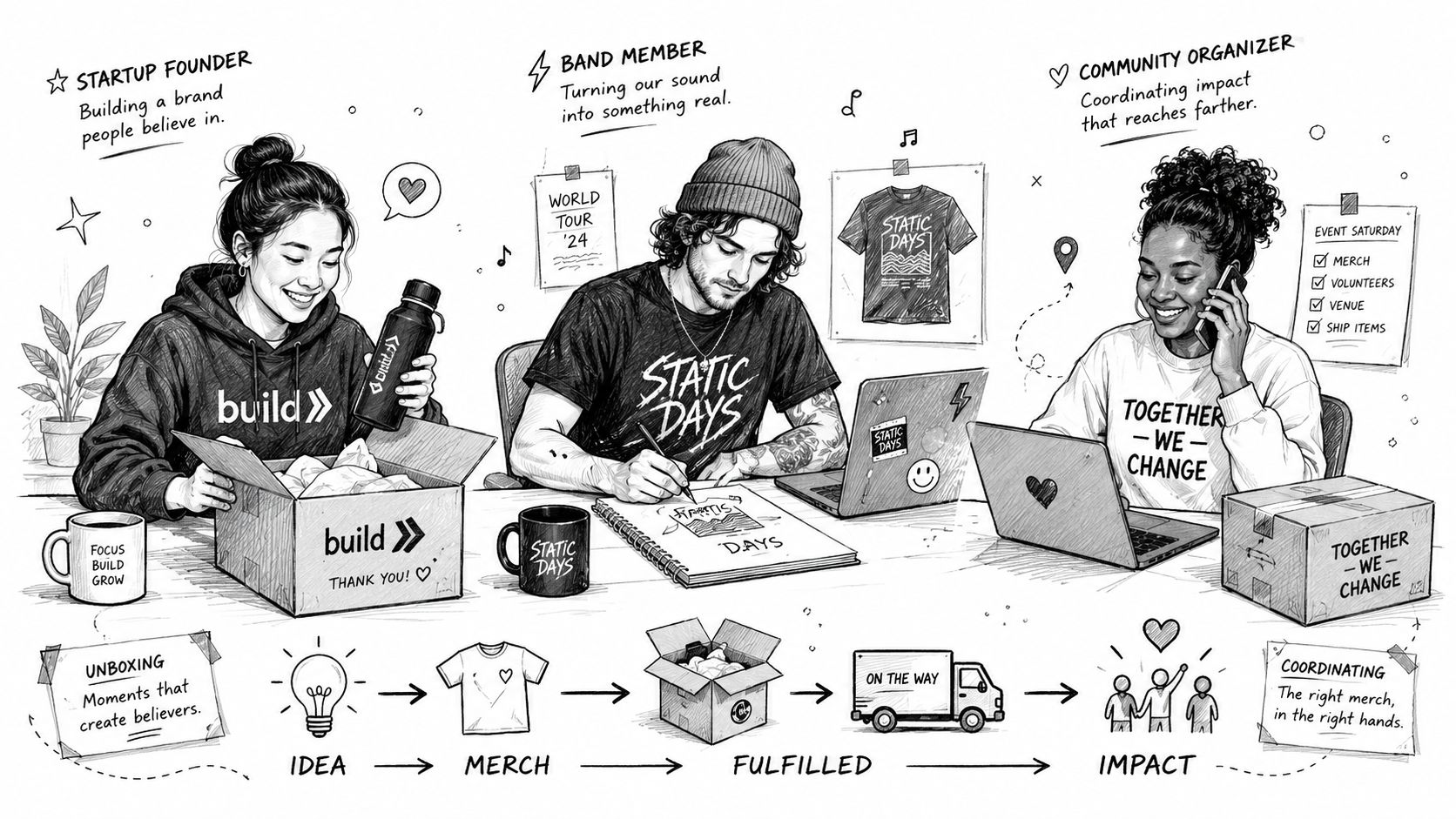
Modern teams use merch fulfillment services for distributed hiring, community drops, influencer gifting, conference kits, and post-purchase brand experiences. Many guides still talk like fulfillment is only for simple direct-to-consumer orders. That misses what teams are dealing with now: multi-address shipping, global recipients, and returns across borders. Those use cases have become mainstream for creators, influencers, and community programs, as noted in this guide to creator and multi-recipient merch fulfillment.
Distributed onboarding kits
A remote startup hires across the US, Europe, and a few other markets. They want every new hire to receive the same premium first-week experience.
That sounds simple until the details arrive. Sizes need to be collected. Start dates shift. Some employees need local delivery timing. Others can't receive surprise customs bills. The kit itself may include apparel, stationery, hardware accessories, and a welcome note from the founder.
The wrong setup turns this into manual operations. Someone on the people team becomes a part-time warehouse manager. The right setup gives the team a repeatable workflow: stock stored in one place, standardized kits, controlled packaging, and shipments triggered when each hire starts.
Event drops and multi-recipient shipping
An event lead runs a virtual conference, a field campaign, or a private founder dinner series. The guest list changes up to the last minute. Some recipients are speakers, some are VIP customers, and some are internal team members who need matching apparel.
At this stage, fulfillment quality becomes visible fast.
Good execution means one coordinated system for collecting addresses, building kits, routing shipments, and keeping the presentation consistent. Bad execution means mismatched items, late arrivals, and packaging that looks like three different vendors touched it.
This walkthrough is a useful companion if you want to see how teams think about merch operations in practice:
Creator merch that doesn't feel generic
Creators and community-led brands often start with on-demand because it's easy. That makes sense at the beginning.
The shift happens when the audience gets more committed and expectations go up. Fans don't just want a logo on a blank. They want pieces that feel specific to the brand. Better fabric. Better print or embroidery. Better packaging. Better reliability during limited drops.
That's usually the moment when fulfillment needs to evolve too.
Testing mode: Broad SKU variety, low commitment, quick launch
Growth mode: Better control on hero items and limited collections
Brand mode: Intentional packaging, managed inventory, and cleaner repeatability
The merch that builds community usually isn't the easiest merch to fulfill. It needs more control, and that's exactly why it works.
The Vendor Checklist: 10 Questions to Ask
Most vendors can sell the dream on a call. Fewer can explain the operation clearly.
Use this checklist to get past polished decks and into the stuff that affects your drop, your team, and your support load.
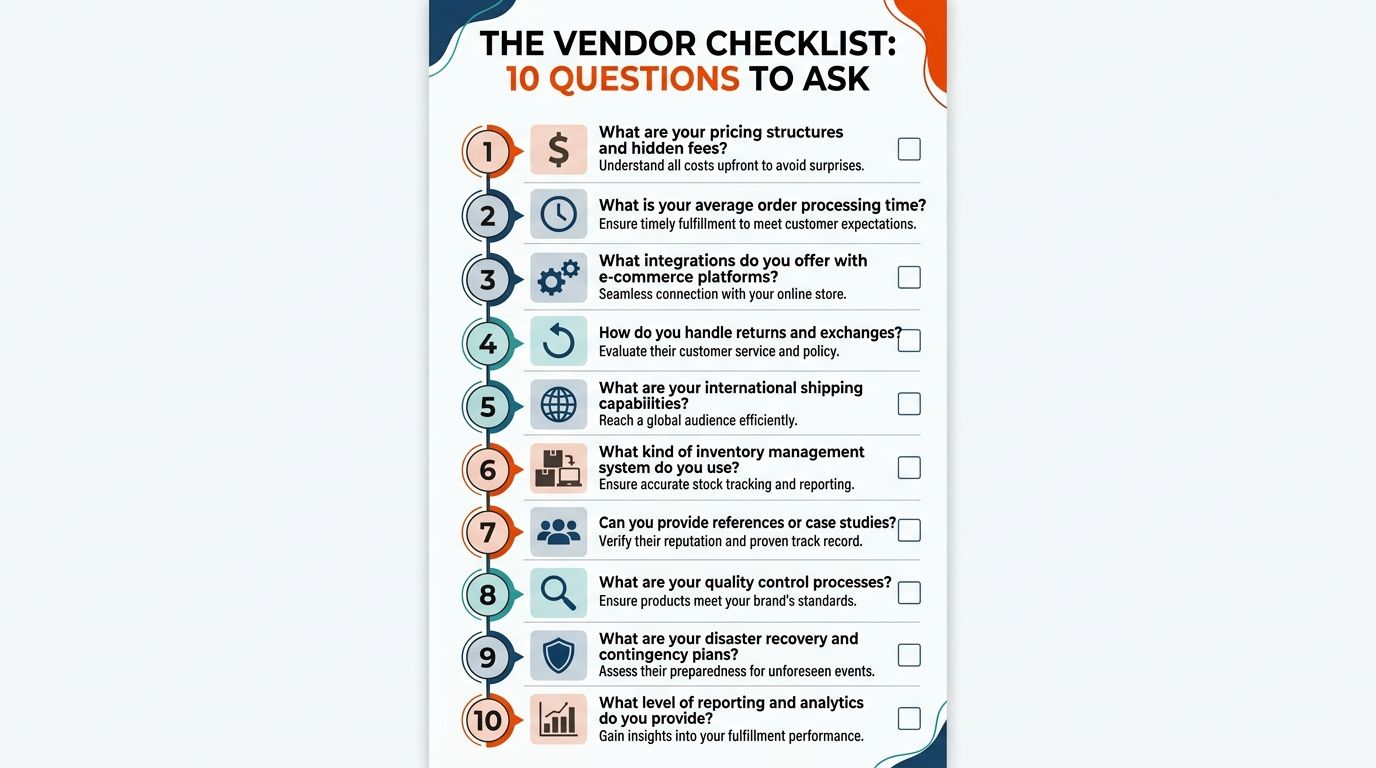
How do you price receiving, storage, pick-pack, kitting, and returns?
You want the full fee map, not the headline number.What changes the price after launch?
This reveals the hidden fees. Multi-SKU kits, split shipments, relabeling, and custom packaging often trigger them.How do you handle apparel variants?
Sizes, colors, and decoration methods create fulfillment risk. Ask how they prevent wrong-item shipments.What does your standard packaging look like, and what can be customized?
Ask for examples. A premium product shipped in generic materials loses impact instantly.How do you process multi-address orders?
This matters for onboarding kits, event mailers, investor gifts, and community rewards.What happens when an international shipment hits customs friction or a delivery exception?
You're checking whether they have a real process or just hand issues back to you.How do returns work for apparel?
Ask how they inspect, restock, replace, and communicate status.What integrations do you support for order flow and inventory visibility?
You need clarity on how orders enter the system and how stock stays updated.What are your QA steps before an order leaves the building?
Good vendors can describe this precisely. Weak vendors answer with general confidence.Who owns problem resolution when something goes wrong?
The answer tells you whether the relationship will feel like partnership or ticket ping-pong.
What strong answers sound like
A capable vendor usually answers with process, not adjectives.
They can explain how inbound inventory is checked, how bundles are assembled, how packaging standards are maintained, how exceptions are escalated, and what visibility you get after launch. If the answer is vague, the operation probably is too.
A quick screening matrix helps:
| Question area | Strong signal | Weak signal |
|---|---|---|
| Pricing clarity | Full fee breakdown | One simple rate with caveats later |
| Apparel handling | Variant-specific controls | “We ship merch all the time” |
| Global shipping | Clear customs and exception process | Generic international availability |
| QA | Defined checks before dispatch | Broad promises without steps |
| Support | Named workflow for issues | “Contact support if needed” |
Beyond Logistics Finding the Right Partner Fit
The wrong way to buy merch fulfillment services is to treat them like commodity warehouse labor.
That approach ignores what merch is for modern teams. It's culture made physical. It's how a new hire meets the brand. It's how a community remembers a drop. It's how an event gift either feels intentional or forgettable.
The category itself has moved far beyond manual box-moving. One market report says 78% of online retailers outsource logistics and order handling, 47% of fulfillment centers have adopted robotics and AI-based sorting, and 39% of providers are shifting to SaaS-based inventory and logistics tools, according to Business Research Insights' fulfillment services market report. That's a sign of where fulfillment sits now. It's a technology-driven operating function.
The decision isn't just who can ship. It's who can protect product quality, maintain presentation, handle exceptions, and support the specific kind of merch program you're running. Generic providers can move inventory. The right partner understands apparel, packaging, timing, and the difference between a parcel arriving and a brand landing well.
That's what Banger is built for. We produce premium custom merch in our French ateliers, store the inventory in our fulfillment center, and ship it on demand to one address or to your whole team and community worldwide to multiple locations - in your custom branded packaging, within 24 hours of your order. Same standard from the first thread to the last delivery.
If your team cares about premium blanks, customization depth, and product quality from the start, that standard has to carry through fulfillment too. Same goes for custom product sourcing - better products need better execution around them.
If you want a partner that treats merch like a brand asset, not a logistics afterthought, Banger is built for that. Browse the catalog, get a free, no-commitment quote with product previews in 24 hours, and start sending your merch on-demand anywhere in the world.