Carbon Neutral Shipping: A Practical Guide for Modern Brands
Buying carbon offsets is the most popular advice in carbon neutral shipping. It's also the advice most likely to create a credibility problem.
An offset can balance an emissions estimate on paper. It doesn't automatically mean a carrier used cleaner fuel, a package traveled the shortest practical route, or a brand accounted for packaging, warehousing, returns, and last-mile delivery. For a merch program, the question isn't whether someone can add a climate fee to an order. It's whether the full shipment can be measured, reduced where the brand has control, and balanced with verified action where emissions remain.
That distinction matters for teams shipping premium apparel, onboarding kits, event giveaways, and global community drops. A sustainability claim that sounds clean at checkout can become difficult to defend when procurement asks for the methodology, the carrier data, or proof that credits were retired. Carbon neutral shipping is best treated as an operating policy, not a checkbox in a marketing campaign.
Table of Contents
- Start with the parts you can change
- Choose carriers with evidence, not badges
- Procure the residual responsibly
Why Most Carbon Neutral Shipping Claims Fall Short
The assumption that “we bought offsets, so shipping is carbon neutral” skips the hardest part: defining what was emitted.
A shipment's footprint can include the freight leg from the factory, transfer between distribution centers, electricity used in fulfillment, packaging production, the final delivery route, and returns processing. If a brand calculates only the parcel's final-mile estimate, it may be balancing one slice of the journey while presenting the result as a complete climate claim. That's not necessarily fraud. It is often incomplete accounting dressed up in marketing language.
Practical rule: Never approve a carbon neutral shipping claim until you know which transport legs, facilities, packaging materials, and returns are inside the calculation.
The same issue appears in broader merch decisions. A practical guide to environmentally friendly promotional items can help teams think beyond the logo and assess materials, usefulness, durability, and waste. Shipping needs that same level of scrutiny. A reusable tote or premium hoodie may be a better long-term product choice, but it still creates logistics emissions before it reaches the recipient.
The offset question most teams skip
Offsets only carry real weight when the underlying project produces an emissions reduction or removal that wouldn't have happened without the finance. That principle is known as additionality. If a project would have gone ahead regardless, buying its credit may fund an activity without creating the claimed extra climate benefit.
Procurement should ask:
- What exactly is being funded?
- Which emissions are being balanced?
- Is the project independently verified?
- Were the credits retired for this program?
- Could another buyer claim the same reduction?
A carrier's “carbon neutral” badge doesn't answer those questions. Neither does a low per-order climate fee. The credible position is more modest and more useful: measure the shipment boundary, reduce avoidable emissions, document the residual estimate, and use traceable credits only for that residual.
Understanding the Scale of Shipping Emissions
Shipping carries more than 80% of world merchandise trade by volume and produces about 2.8% to 3% of global greenhouse gas emissions annually, according to the World Bank's analysis of carbon revenues from international shipping. That scale creates a procurement problem for merch teams. Shipping supports modern commerce, yet reducing its footprint requires more than adding a “carbon neutral” option at checkout.
The IMO's materials cite the Third IMO GHG Study, which estimated that international shipping represented about 2.2% of anthropogenic CO2 emissions in 2012. More recent assessments place shipping at roughly 2% of global CO2e today. The World Economic Forum's tracker records direct shipping emissions at 0.86 Gt CO2e in 2023, compared with 0.84 Gt in 2022 and 0.80 Gt in 2020. Emissions rose about 2% from 2022 to 2023, even as shipping's emissions intensity fell 4.6% from 2019 to 2023. These figures appear in the IMO's 2023 GHG Strategy materials and the World Economic Forum Net-Zero Industry Tracker.
Efficiency can reduce emissions per tonne-kilometre while total emissions remain high. Trade volumes, routes, and delivery expectations still influence the result. A global merch drop may involve a factory, port, ocean vessel, regional carrier, fulfillment center, and local delivery network. An air leg may be added to protect a launch date.
Mode affects the footprint, but generic labels are not enough
Air freight generally has higher emissions intensity than ocean or ground transport. The actual result depends on distance, load factor, equipment, fuel, routing, and the accounting method. Procurement teams should therefore request shipment-level assumptions instead of accepting a mode label as the complete footprint model.
| Transport Mode | Avg CO2 per Tonne-km (g) | Typical Use Case in Merch |
|---|---|---|
| Air freight | Varies materially by aircraft, route, and load | Rush samples, launch-critical stock, urgent event replenishment |
| Ground freight | Varies by vehicle, fuel, load, and route | Regional replenishment, parcel delivery, domestic distribution |
| Rail freight | Varies by network, electricity source, and load | Inland bulk movement where rail infrastructure is available |
| Ocean freight | Varies by vessel, route, cargo, and fuel | Factory-to-region movement for planned inventory |
Start with service decisions. Ask whether the hoodie, cap, or kit needs to fly, whether orders can move in a consolidated batch, and whether regional inventory can prevent avoidable cross-border legs. Delivery coverage and routing rules also need to be explicit. The worldwide custom merch shipping FAQ provides a useful operational reference when reviewing destination coverage and delivery options.
How Emissions Are Measured Across the Supply Chain
Carbon accounting gets easier when you picture a carbon receipt. Instead of one vague number attached to an order, the receipt itemizes the emissions connected to each stage, from factory gate to customer doorstep.
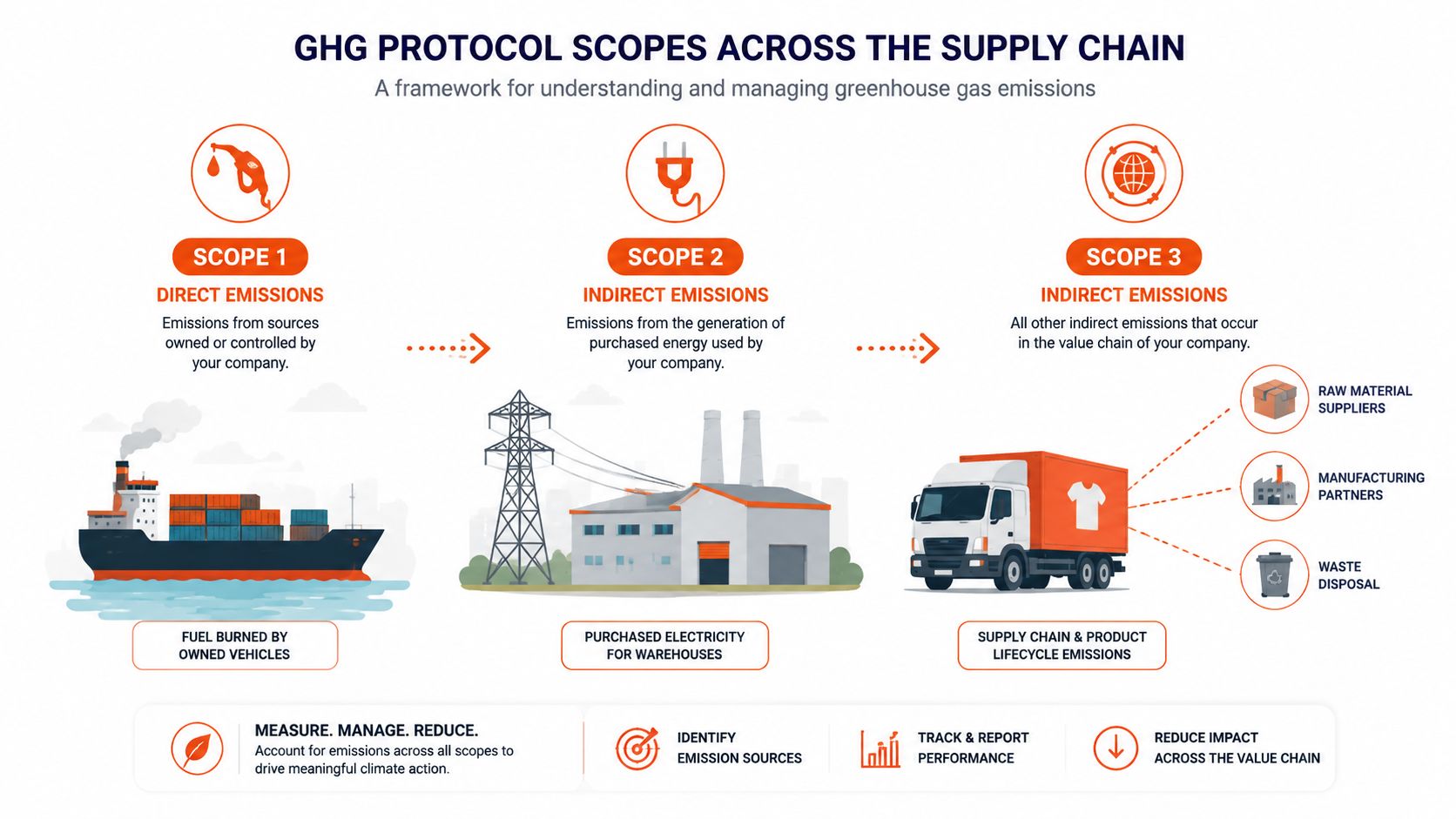
The GHG Protocol's scopes translate neatly into merch operations:
Scope 1
Scope 1 covers direct emissions from assets a company owns or controls, such as fuel burned in company-owned delivery vehicles. Most merch brands don't operate cargo ships, aircraft, or large delivery fleets, so this category is often limited. It still matters if a brand owns a warehouse vehicle fleet or runs facilities with direct fuel combustion.
Scope 2
Scope 2 covers purchased electricity used by owned or controlled facilities. For a merch program, that could include electricity in a company-operated warehouse, studio, or fulfillment site. The brand needs to know whether the facility is owned, leased, or operated by a third party, because that changes how the emissions are classified and who should provide the data.
Scope 3
Scope 3 is where most logistics complexity sits. It can include purchased goods, outsourced manufacturing, third-party freight, packaging inputs, fulfillment operations, downstream delivery, customer returns, and disposal. If a carrier or 3PL performs the transport, the emissions don't disappear from the brand's value chain. They become indirect emissions that require supplier data or a defensible estimation method.
Build the receipt in lifecycle order
Start at the product and packaging source. Then record factory-to-port movement, ocean or air freight, customs and regional transport, fulfillment-center handling, parcel delivery, and returns. Packaging deserves its own line because a lightweight mailer and a rigid branded box create different material and dimensional requirements.
The useful distinction is well-to-wheel versus tank-to-wheel accounting. Tank-to-wheel counts emissions produced while the vehicle or vessel operates. Well-to-wheel also considers upstream fuel production, processing, transport, and distribution. The latter gives a more complete view, particularly when a fuel is marketed as low carbon but its production pathway remains emissions intensive.
For fuel comparisons, the IMO's framework increasingly uses well-to-wake greenhouse gas fuel intensity, which includes the lifecycle pathway through onboard use. The approved benchmark uses threshold values around 19.0 gCO2eq/MJ for 2028 to 2034, tightening to 14.0 gCO2eq/MJ from 2035, compared with a 2008 reference value of 93.3 gCO2eq/MJ, as described in the IMO's net-zero regulations briefing. The implication is practical: a fuel only helps if its production, bunkering, and combustion work together.
When an RFP asks for emissions data, request the boundaries, activity data, emission factors, assumptions, reporting period, and treatment of returns. If the partner can't produce a carbon receipt, the neutrality claim is probably too broad. For material choices that affect the upstream footprint, teams can also use this explainer on what organic cotton fabric means as part of a wider product lifecycle review.
Reducing Emissions Versus Buying Offsets
Reduction and offsetting solve different problems.
Direct reduction changes the logistics system itself. Carbon offsets fund a project intended to compensate for emissions that remain after measurement and reduction. The strongest programs use both, in that order. The weakest programs lead with a cheap credit and leave the shipping process untouched.
For merch teams, the controllable reductions are usually unglamorous but effective: right-size packaging, remove unnecessary void fill, consolidate orders, avoid split shipments, plan inventory by region, and use slower transport when the launch calendar allows it. Carrier fleet composition and fuel mix are harder to control, so the procurement contract needs to expose those limits instead of pretending the brand can solve them alone.
| Factor | Direct Reduction | Carbon Offsets |
|---|---|---|
| Primary function | Lowers emissions produced by the operation | Balances estimated residual emissions |
| Brand control | Strong for packaging, order timing, and consolidation | Depends on project selection and retirement records |
| Speed | Often requires process, supplier, or network changes | Can be purchased after an emissions estimate |
| Cost profile | May require operational investment or slower delivery | Adds a recurring procurement cost |
| Main risk | Savings may be limited by carrier infrastructure | Weak projects, double counting, or poor additionality |
| Claim strength | Demonstrates physical change in the system | Supports residual balancing when independently verified |
Teams that need the basics before evaluating a credit can review what is a carbon credit from Blocsys Technologies. The important distinction is that a credit represents a quantified climate claim, while “carbon neutral” describes a broader accounting and communication position. One doesn't automatically prove the other.
Use a control-first decision rule
A practical sequence looks like this:
- Reduce packaging volume and weight. Choose packaging that protects the product without forcing the carrier to price empty space.
- Consolidate shipments. Batch team drops and event inventory when the recipient experience permits.
- Choose the least intensive practical mode. Don't default to air because a launch plan was finalized late.
- Measure the residual. Use shipment-level activity data where available, not a generic annual estimate.
- Buy and retire credible credits. Match the purchase to the documented residual and retain the evidence.
Offsets aren't useless. They become unreliable when they're treated as permission to avoid operational work. A branded box can be part of the unboxing experience without being oversized, and the custom apparel packaging guide offers useful prompts for separating presentation from unnecessary material.
Verification and Certification That Actually Matter
A carrier's self-reported neutrality claim is marketing copy until the underlying accounting and credits can be inspected.
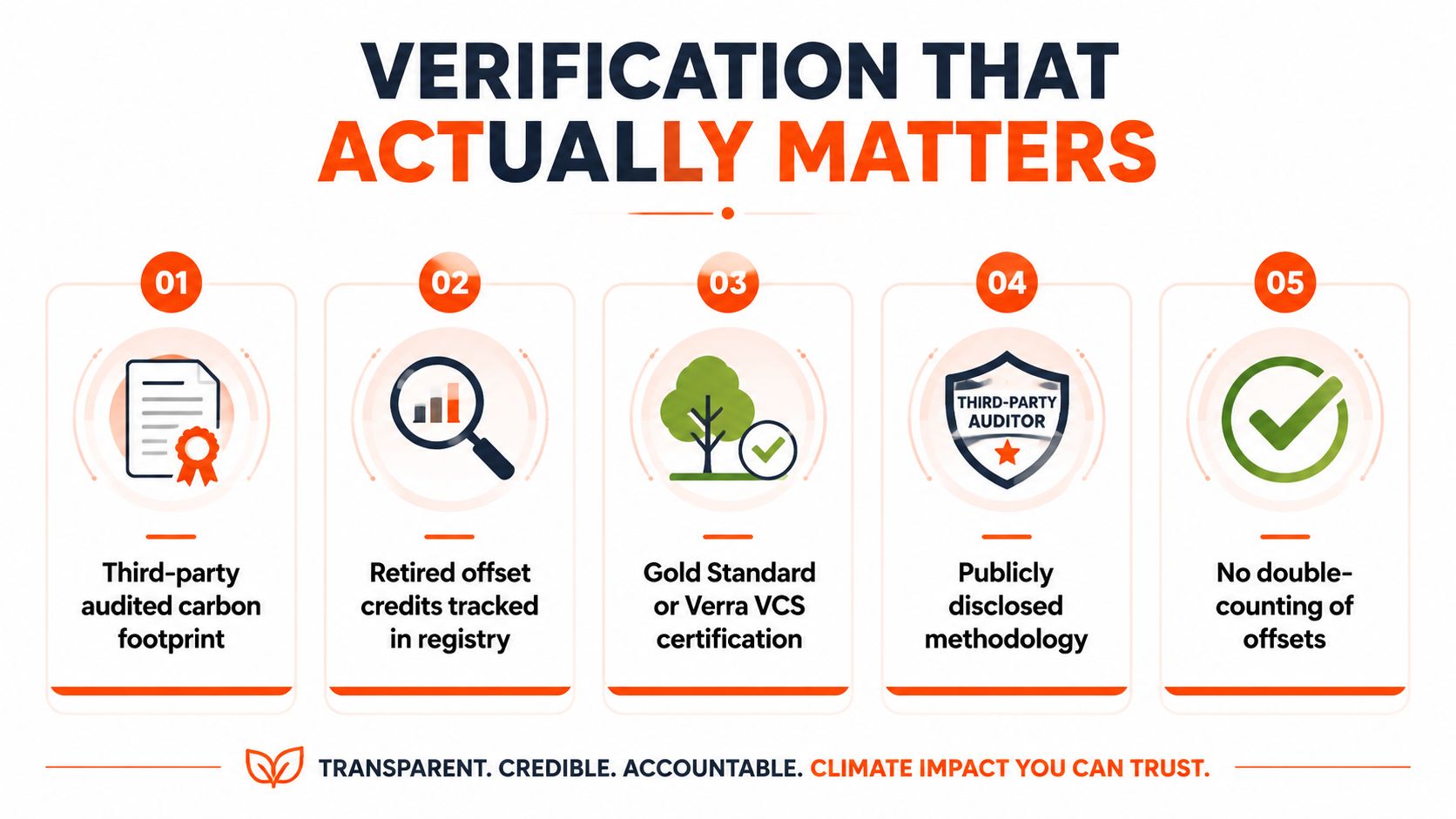
Verification should cover two separate things. First, an auditor or qualified reviewer should assess the emissions inventory and methodology. Second, the offset transaction should be traceable from issuance to retirement, so the same environmental attribute can't be sold or claimed twice.
What to request during procurement
Ask logistics partners for:
- A defined footprint boundary, including transport legs, facilities, packaging, and returns.
- The calculation method, activity data, emission factors, and treatment of estimated shipments.
- Third-party review, with the assurance scope and reporting period clearly stated.
- Registry records, including project identification and retirement evidence.
- Additionality information, explaining why the project creates reductions beyond business as usual.
- A communication policy, showing exactly what the brand may say at checkout, in campaigns, and in sustainability reporting.
Standards such as ISO 14064 and the GHG Protocol corporate and product standards can help structure the accounting. Offset registries and certification systems, including Verra's VCS, Gold Standard, and the American Carbon Registry, can provide a traceability layer. None of these names should be used as a shortcut. Procurement still needs to verify the specific project, methodology, vintage, ownership, and retirement status.
Red flag: A partner that can't explain its emissions boundary, project registry, retirement process, and double-counting controls shouldn't receive unqualified carbon neutral claim language.
Marketing teams should avoid saying “zero-emission delivery” if the program relies on balancing credits. “Shipping emissions are measured and compensated through retired credits” is narrower and easier to substantiate, provided the documentation supports it. Legal review matters here, but legal review can't rescue missing operational evidence.
A short explainer can help teams understand the broader issue of carbon offset verification and why project quality matters. Treat every certificate as a starting point for questions, not as proof that the entire shipment has no climate impact.
Building a Carbon Neutral Shipping Program for Your Merch
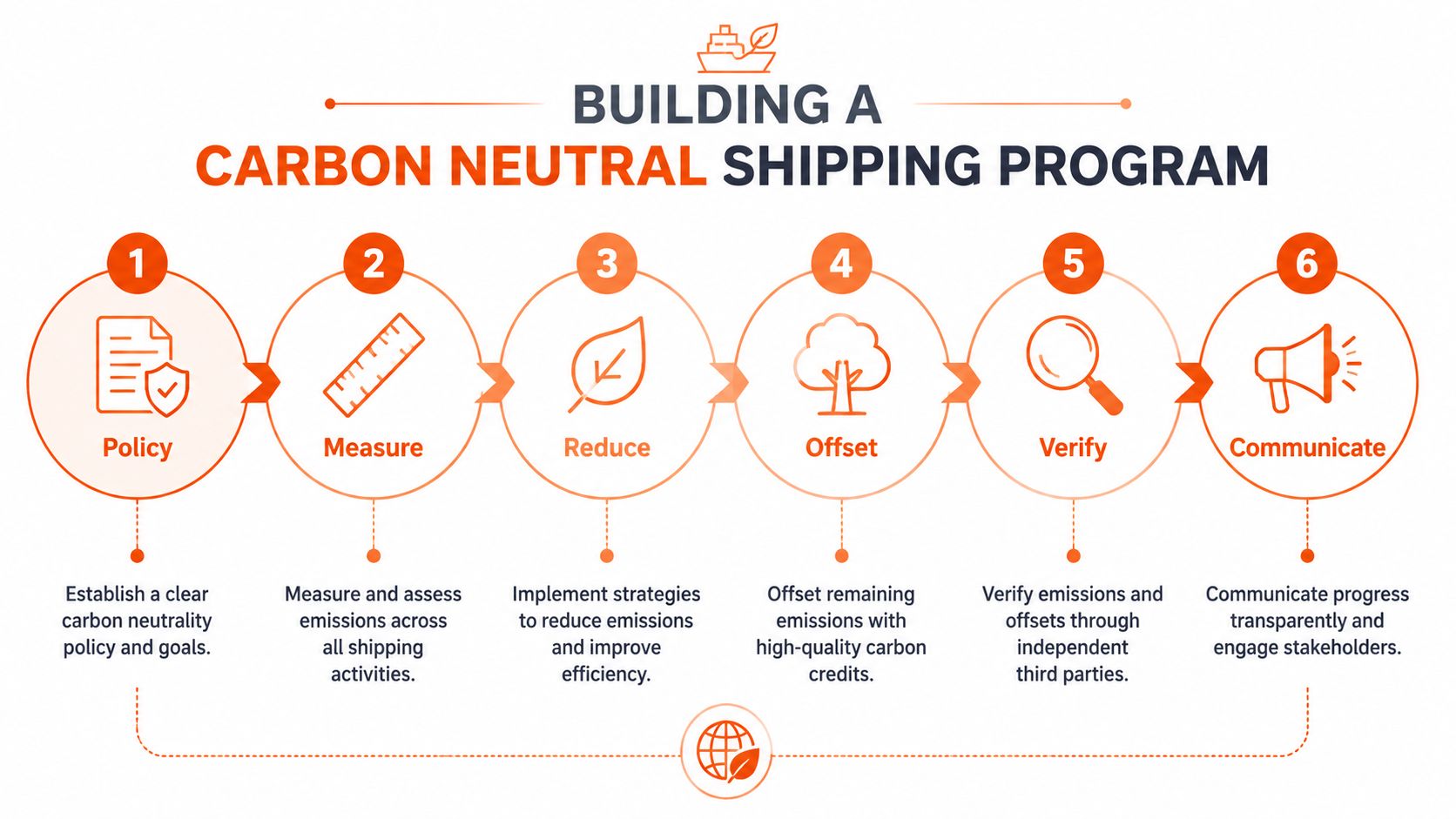
A credible program starts with a written boundary. Decide whether the policy covers only company-controlled operations or extends into downstream logistics, fulfillment, packaging, delivery, and returns. Put the owner beside the policy, usually operations with sustainability or finance support, and document what the customer-facing claim will and won't say.
Start with the parts you can change
Measure first. Operations should collect shipment weights, dimensions, origins, destinations, modes, carrier services, and return activity. A clean baseline is more valuable than a polished claim built on assumptions.
Right-size the package. Packaging and procurement teams can test mailers, folding methods, carton dimensions, recycled content, and void-fill alternatives. Don't swap material blindly. A mailer that fails in transit can create replacement shipments and erase the intended benefit.
Design the network around real demand. A fulfillment lead can place inventory near recurring recipient regions, batch conference shipments, and prevent one order from splitting into several parcels. Customer experience owns the trade-off. Slower consolidated delivery can reduce emissions, but it needs clear expectations.
Choose carriers with evidence, not badges
During the RFP, ask carriers and 3PLs for fuel mix transparency, emissions methodology, reporting cadence, subcontractor coverage, and details of programs such as UPS carbon neutral or DHL GoGreen. Carrier commitments are useful signals, but they don't replace shipment-level accounting.
Build the cost model before launch. The brand can absorb the climate cost as an operating expense, include it in product pricing, or disclose it as part of a checkout option. The choice depends on margin, positioning, and the claim being made. Finance should approve the treatment, while marketing should receive approved language and supporting evidence.
Procure the residual responsibly
After reductions, select a registry and project portfolio. Forestry, renewable energy, and direct air capture represent different risk, durability, cost, and verification considerations. Don't choose by project aesthetic alone. Ask how the project handles permanence, leakage, additionality, monitoring, and retirement.
A fulfillment partner can make execution easier, especially when it supports inventory storage, multi-address orders, branded packaging, and shipment reporting. The key is to keep ownership clear. The merch fulfillment services overview can help teams map operational responsibilities before they write a carrier or 3PL brief.
How Modern Brands Are Implementing This Today
The most useful examples aren't grand sustainability campaigns. They're small operating decisions that survive contact with real launch calendars.
A distributed team running a seasonal apparel drop might first consolidate regional inventory instead of sending every order from one overseas factory. The team then shifts routine replenishment away from air, measures the remaining parcel emissions, and retires credits from a documented portfolio. The friction usually appears in the data, not the packaging. The carrier may report shipment counts but omit returns or subcontracted legs, forcing operations to narrow the claim or improve the data request.
A B2B gifting program can take a different route. It may replace oversized branded cartons with right-sized recycled mailers, set a weekly consolidation cutoff, and negotiate carbon-inclusive rates with a 3PL that reports logistics emissions to the brand on a regular schedule. If the 3PL can't separate transportation emissions from facility activity, the program should label the estimate clearly rather than presenting a precise-looking number with an uncertain boundary.
A streetwear label may embed the residual climate cost into product pricing so carbon neutral shipping is the default rather than an optional checkout add-on. That approach keeps the customer experience clean, but it creates a margin and messaging decision. The label still needs to show that it reduced avoidable transport and packaging emissions before making the claim.
The pattern that works: teams solve one operational leak at a time, then use verified credits for what they can't yet remove.
What doesn't work is launching a “green shipping” badge before the carrier can provide a methodology, or buying the cheapest available credits without checking retirement and additionality. The program becomes defensible when operations, finance, procurement, and marketing use the same inventory and the same claim language.
What Comes Next for Carbon Neutral Logistics
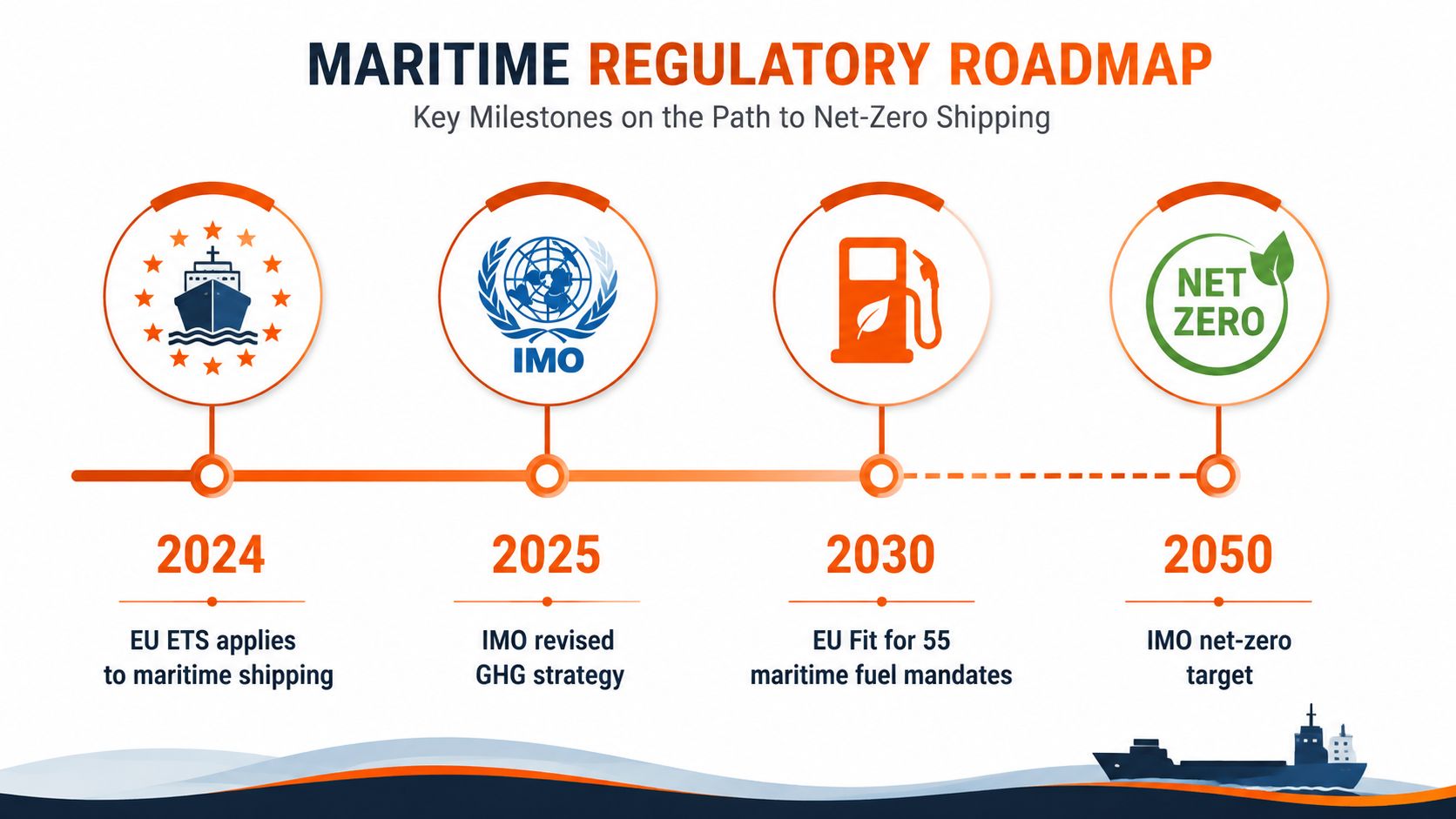
The international policy direction is clear. The IMO's 2023 GHG Strategy, adopted in July 2023 at MEPC 80, sets a net-zero target for international shipping by or around 2050. It also establishes checkpoints to cut total annual international shipping GHG emissions by at least 20% by 2030, striving for 30%, and at least 70% by 2040, striving for 80%, versus 2008 levels. The strategy calls for at least 5% of shipping energy to come from zero- or near-zero GHG fuels by 2030, with a stretch goal of 10%.
A separate maritime pricing mechanism is expected to apply to a share of international shipping emissions from 2028, with an initial price of USD 100 per tonne of CO2, according to the European Commission's landmark shipping agreement update. The policy pressure won't stay inside shipping companies. Brands will increasingly need carrier data that supports procurement reviews, climate disclosures, and defensible customer claims.
The latest EU maritime reporting also shows why intensity and totals must be tracked separately. Monitored voyages emitted 144.9 million tonnes of CO2 in the 2024 reporting year, the highest level since the EU MRV system began, while a 2025 analysis placed total EU-linked shipping GHG at about 156 million tonnes CO2e after additional ship types entered scope, as reported in the European Commission document173_0/090166e52cd79d40). Efficiency can improve while absolute emissions rise.
The practical next moves
- Audit carrier data now. Identify missing legs, estimated activity, returns, subcontractors, and packaging inputs.
- Pilot one reduction initiative per quarter. Start with consolidation, dimensional sizing, or a modal shift that operations can measure.
- Write an offset procurement policy. Require registry records, retirement evidence, additionality documentation, and approved claim language.
- Brief leadership on disclosure exposure. Ask legal, finance, and marketing to align on reporting boundaries before a campaign goes live.
The brands that build measurement and reduction into merch procurement now will have fewer expensive fixes later. They'll also earn more credibility with buyers who can tell the difference between a verified operational program and a climate badge added at checkout.
If your next team drop, event kit, or global merch program needs premium products with thoughtful packaging and worldwide fulfillment, visit Banger. Build branded apparel and accessories people want to keep, while giving your operations team a clearer starting point for measuring and reducing the emissions tied to delivery.