Custom Embroidered Name Tags: A Guide for Modern Teams
You're probably here because the rest of the project is already dialed. The venue looks right. The uniforms are clean. The jackets, totes, or overshirts feel worth wearing. Then someone suggests a plastic badge holder, a peel-off sticker, or a flimsy printed tag, and the whole thing drops a level.
That's the mistake. A name tag looks minor until it's the first thing people read at chest height. On staff uniforms, event apparel, and hospitality gear, it isn't an afterthought. It's a piece of branded apparel doing a job.
Custom embroidered name tags work when you treat them like product design, not office supplies. The good ones feel intentional, hold up through real use, and fit the garment instead of fighting it. The bad ones look like procurement won.
Table of Contents
- Flat embroidery is usually the right answer
- Thread finish changes the tone
- Density is where quality gets decided
- Pick the backing based on replacement logic
- Borders decide whether it looks classic or current
- Size should follow distance and garment scale
- What to lock before production starts
- Production quality includes fulfillment
- Packaging changes the read
- Use a tag when the name needs flexibility
- Choose direct embroidery when the garment should feel seamless
- The real trade-off is aesthetic, not just functional
Beyond the Plastic Holder
A great launch event can still look cheap in photos if everyone's wearing glossy plastic rectangles on lanyards. The same thing happens with retail staff, conference crews, and hospitality teams. You spend on fit, color, signage, and lighting, then put the weakest object in the whole system right in the center of the frame.

Custom embroidered name tags solve a different problem than disposable badges. They don't just identify a person. They stabilize the visual language of a uniform. They make the person wearing the garment look like they belong there, and they make the garment look finished.
Why the material says more than the text
A stitched tag has texture, edge definition, and a sense of permanence. Even when it's removable, it reads as part of the garment system. That matters if your team cares about brand perception, because people notice when one detail feels improvised.
One of the simplest ways to think about it is this:
Cheap tags say “temporary staffing.” Well-made embroidered tags say “this team is supposed to be here.”
That's why they work especially well on utility shirts, chore jackets, aprons, overshirts, bags, and event uniforms that need some structure. The tag becomes part of the merch language, not a workaround taped onto it.
A small object with repeat value
This category is also bigger and more durable than people assume. The broader embroidered badges and patches market, which includes name tags, was valued at US$1.38 billion in 2026 and is projected to reach US$2.04 billion by 2035, a 4.44% CAGR according to Business Research Insights' embroidered badges and patches market report. That matters because embroidered identification lives inside a recurring apparel category, not a novelty trend.
If you want a useful baseline for how names translate into thread, Dirt Cheap Headwear's embroidery guide is worth skimming because it shows how quickly clean lettering can look messy when the design doesn't respect the medium.
For modern teams, this is the same mindset that separates forgettable onboarding swag from things people keep. The same logic applies to welcome gifts for new employees. The object has to feel like it belongs to the brand, not just the budget.
Nailing the Design and File Prep
Most failures happen before the machine starts. Not at the border. Not at sewing. At the file.
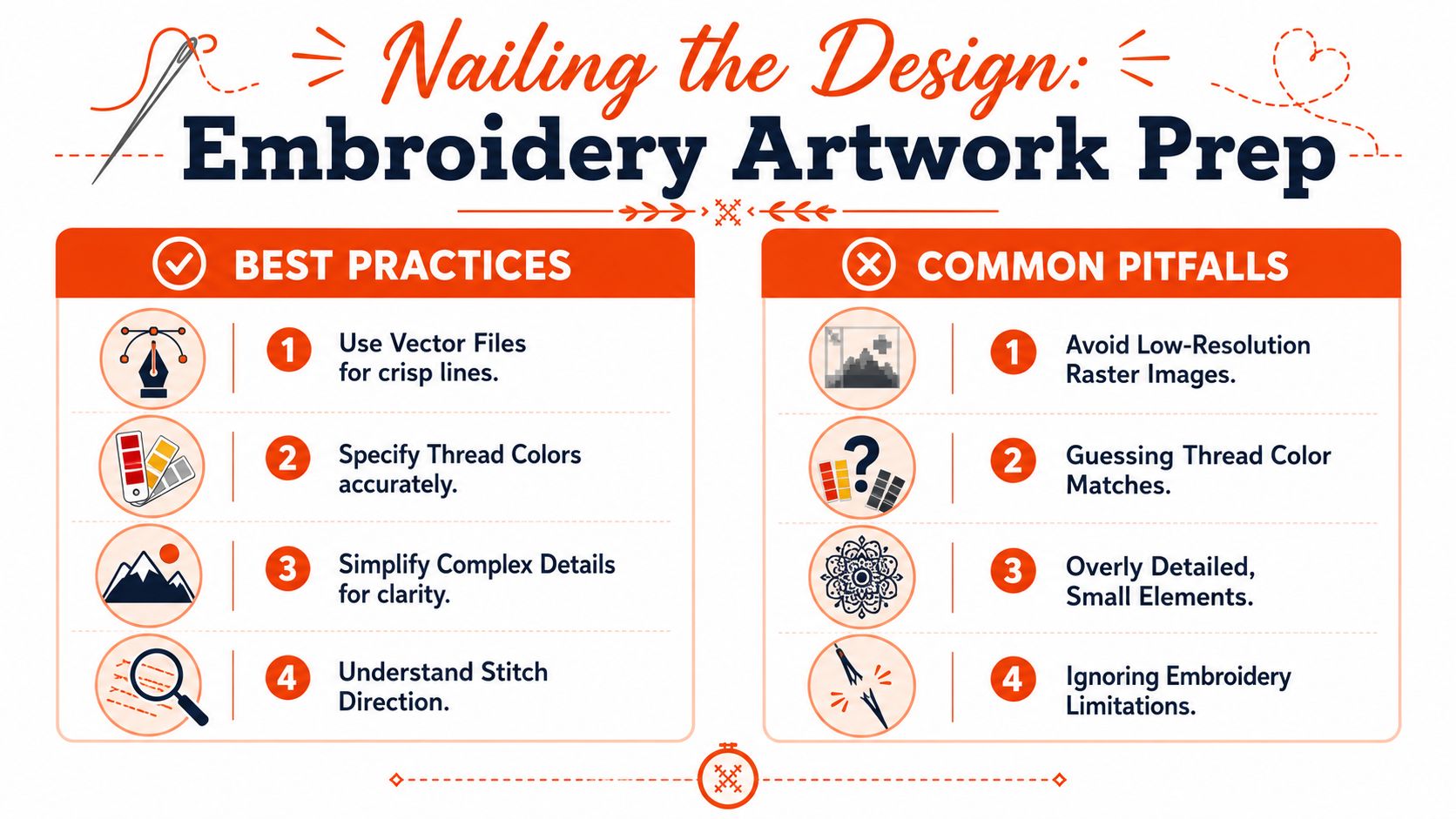
The technical gatekeeper is digitizing. Artwork has to be converted into a stitch-ready file, and that translation is where bad decisions get exposed. According to New York Custom Labels on embroidered name patches, the critical first step is digitizing, and experienced providers stress simple, bold fonts, short text, and high contrast because over-complex typography or gradients often render poorly in thread and can force a redesign before production begins.
Design for thread, not for screen
A custom embroidered name tag isn't a tiny poster. It's a stitched object with limits, and those limits are useful if you respect them.
What works:
- Short names or roles: One or two words hold shape better and stay readable.
- Block-style lettering: Sans serifs and simple capitals usually survive stitching cleanly.
- High contrast: Dark thread on a light ground, or the reverse, reads faster at distance.
- Simplified logos: Remove micro-details, thin outlines, and visual noise.
What usually fails:
- Delicate scripts: They collapse once stitch width tightens.
- Gradients: Thread doesn't blend like a screen.
- Overloaded lockups: A name, title, logo, icon, and slogan on one small patch almost never looks premium.
- Tiny negative spaces: They disappear first.
File prep that saves the job
You should still send proper source files when possible. Vector artwork makes life easier because edges are defined and elements can be separated cleanly before digitizing. But even with a good vector, the design has to be edited for embroidery logic. A beautiful brand asset can still be a bad patch.
Practical rule: If the design only works at zoom level on a laptop, it's not ready for embroidery.
A good production partner will tell you where the art needs to change, but it helps to arrive with the right instincts. If your team needs guidance on artwork formatting, Banger's custom merch design FAQ covers the kind of file expectations that prevent cleanup loops later.
If you want a deeper look at how artwork becomes stitches, B-Sew Inn's guide to digitizing is a useful reference. It's especially helpful for understanding why the same logo can produce a sharp result in one version and a muddy one in another.
The aesthetic test
Before approving anything, ask a blunt question. Does this still look good if the thread has more presence than the artwork?
That's the right test for custom embroidered name tags. Thread adds texture, weight, and slight irregularity. A strong design gets better with that treatment. A weak design gets exposed.
Stitch Types and Thread Selection
The fastest way to cheapen a name tag is to treat all embroidery as the same. It isn't. Stitch type changes readability, surface texture, and how formal or casual the piece feels on the garment.
For text-first tags, restraint wins. You want crisp letterforms, controlled density, and a thread choice that matches the mood of the uniform or merch item. If the name is the hero, texture should support legibility, not compete with it.
Flat embroidery is usually the right answer
For names, roles, and straightforward identifiers, flat embroidery is the standard because it stays clean. Raised effects can be fun on logos, but they tend to fight the functional purpose of a name tag if used on the lettering itself.
A useful shorthand:
| Approach | Best use | Risk |
|---|---|---|
| Flat satin lettering | Names and short titles | Can look stiff if density is too aggressive |
| Fill stitch backgrounds | Base shapes and solid fields | Can make small tags feel heavy |
| Selective raised detail | Small logo accent only | Looks gimmicky if overused |
The point isn't to show off stitch variety. The point is to create hierarchy. The wearer's name should read first. Everything else supports that.
Thread finish changes the tone
Thread choice is one of those details buyers underestimate until samples arrive. A high-sheen finish can feel polished on hospitality uniforms or eventwear. On rugged workwear, that same sheen can look slightly off, especially if the garment fabric is matte, brushed, or washed.
That's why thread should follow fabric character:
- Polyester-style durability: Better suited to uniforms, repeated wear, and harder use.
- Higher-sheen thread appearance: Better when you want a cleaner, slightly dressier finish.
- Matte-feeling visual balance: Usually more convincing on heavyweight overshirts, chore coats, and utility pieces.
If the garment already has a lot going on, washed canvas, brushed twill, garment dye, visible topstitching, keep the name tag controlled. Don't introduce glossy thread and decorative stitch effects unless they belong to the rest of the product.
Text should feel embedded in the object, not laid on top of it like a sticker made of thread.
Density is where quality gets decided
Dense stitching can make text look sharp, but too much density creates a board-like patch that feels stiff and overworked. Too little density and the tag looks thin, cheap, or fuzzy at the edges. The sweet spot depends on the fabric, the lettering width, and the border construction.
This is also why embroidered tags deserve the same attention as larger logo placements. The discipline is similar to custom logo embroidery. The machine can technically stitch many things. That doesn't mean every stitch choice improves the product.
The best custom embroidered name tags don't feel loud. They feel resolved.
Backing Borders and Sizing
Many buyers make the wrong call. They focus on color and text, then treat backing and border as production trivia. In reality, those are the decisions that determine whether the tag feels premium after a month of use or tired after a week.
Commercial suppliers consistently show embroidered name tags as small-format patches with standard sizes like 2 in × 4 in or a 4-inch-wide format. One supplier also notes that standardized cloth nametags often ship with Velcro® hook backing already attached and that 4 inches by 2 inches is the standard size, which tells you this is an operational format, not a one-off craft object, as described by Nametags4u's tag information page.
Pick the backing based on replacement logic
A name tag should match how the garment is used, laundered, and reassigned.
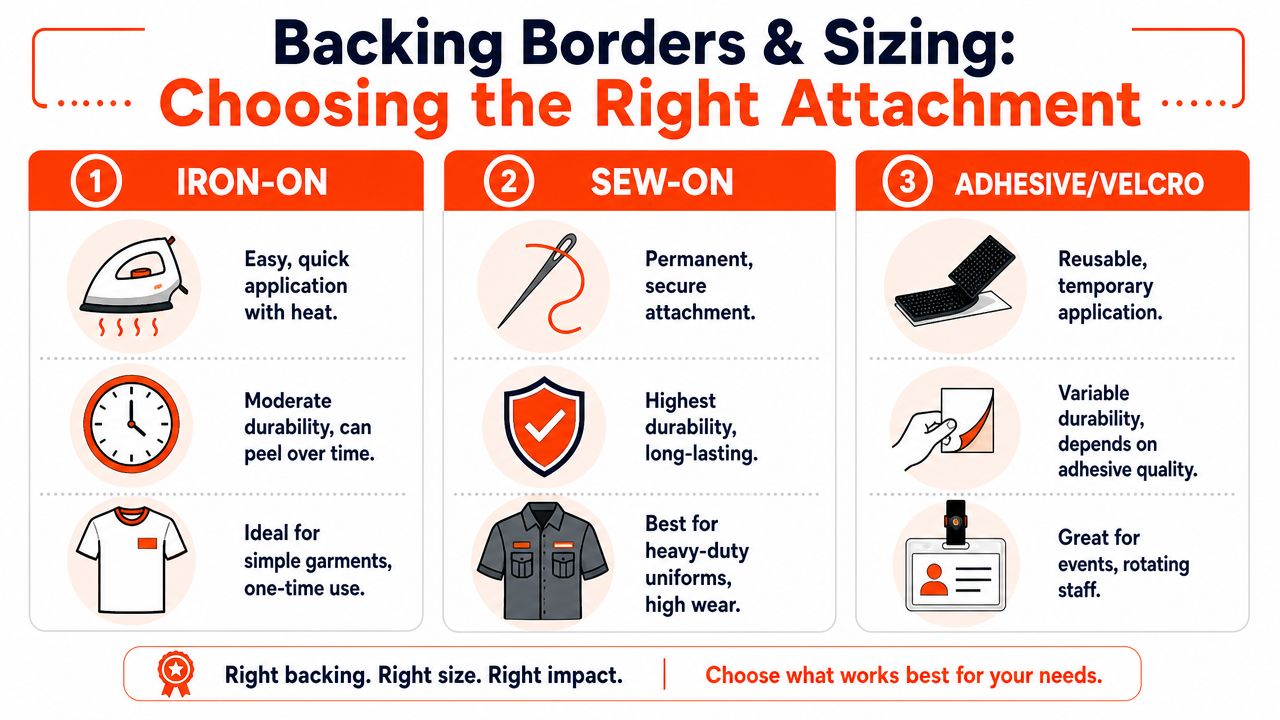
- Sew-on: Best when the tag is intended to stay put for the full life of the garment. This is the strongest choice for hard-use uniforms, outerwear, and pieces that will be washed often.
- Iron-on: Fine when speed matters and the garment won't live a brutal life. It can look clean at first, but it isn't my first choice for heavy rotation.
- Hook-and-loop or adhesive systems: Useful when names change, staff rotates, or garments are shared. Operationally smart, visually dependent on execution.
If you're comparing configurations for staff apparel or identity products, Banger's FAQ on custom labels and name tags is the kind of reference that helps you map the method to the use case instead of defaulting to the easiest option.
Borders decide whether it looks classic or current
The border changes the silhouette more than people expect.
A merrowed border feels traditional. It has body, visual weight, and a more overt patch language. It works on heritage uniforms, mechanic-style shirts, and pieces where a classic workwear cue is welcome.
A hot-cut or tightly stitched border feels cleaner and more modern. If the brand leans minimal, this is usually the better answer. It sits flatter and lets the typography do more of the work.
Here's the practical issue. Finishing has to be done carefully. Commercial workshop guidance notes that embroidered name tags are typically built in standardized dimensions like 2 in × 4 in, and a critical finishing step is trimming close to the border and applying fray prevention. It also warns that clipping too aggressively or skipping edge stabilization can expose stitches and shorten service life, especially on uniforms, as shown in this YouTube workshop example on patch finishing.
A quick visual reference helps if you're deciding between attachment methods:
Size should follow distance and garment scale
Standard sizing exists for a reason. It reads clearly and fits most uniform placements without dominating the chest. But custom shapes only make sense if they improve the object, not if they just make it novel.
Use standard rectangles when the tag is doing real identification work. Consider custom shape only when the brand language is strong enough to justify the complexity, and the added contour won't hurt readability.
The Production Playbook
A name tag usually fails before anyone notices the stitching. The wrong file goes to production. The name list changes after proofing. Tags arrive loose, unpaired, or sorted badly, and a polished uniform program suddenly looks improvised.
Good production feels controlled. That matters because the tag is a small object carrying an outsized brand signal. If it looks generic, ships inconsistently, or needs last-minute fixes, the garment feels less considered, even if the embroidery itself is technically fine.
What to lock before production starts
Production runs cleanly when five decisions are fixed early, not negotiated in email threads after sampling.
Artwork and name list
Final spelling, capitalization, title format, and any department markers need approval before digitizing is finalized. Late edits are expensive because they create revision loops across proofs, files, and packing lists.Attachment method
Attachment changes more than the final step. It affects how the tag is built, how stiff it feels, how clean the edge reads, and how easily the piece can be replaced later.Versioning across garments
A single tag rarely works across every uniform color and fabric weight. Build separate versions if the program includes black fleece, pale shirting, and heavy outerwear. That decision protects legibility and keeps the brand system looking intentional.Proof approval
Approve the proof at production scale, not as a branding sketch. Check stroke weight, small-letter clarity, border finish, and the actual amount of negative space around the name.Sorting and packing logic
Decide whether tags ship by individual wearer, by team, by location, or as bulk stock. This sounds operational. It directly affects error rate.
If the sample looks slightly unresolved, the final run will not fix it. It will multiply it.
Production quality includes fulfillment
Name tags often sit inside a larger apparel system. Onboarding kits, event uniforms, retail staff programs, and multi-office drops all create the same pressure point. The object has to be produced correctly, then matched to the right garment, person, and destination.
That is why operations should be scoped at the same time as embroidery. Teams managing distributed apparel programs usually need merch fulfillment services for distributed teams, not just a factory that can sew a patch. A full-service partner can help when the tag is one component inside a branded kit, especially if names, sizes, and shipping addresses vary by recipient.
This is also where the strategic choice becomes visible. If the program depends on frequent staff changes, replacement stock, or multi-address distribution, a tag system often ages better than direct embroidery. If every garment is assigned once and expected to stay fixed for its full life, direct embroidery may be the cleaner production path. The method changes the logistics, not just the look.
Packaging changes the read
Presentation matters because people judge finish before they judge craftsmanship. A beautifully made tag tossed into a bulk polybag reads cheap. A correctly paired tag, packed flat, labeled clearly, and ready to apply or wear reads premium immediately.
Small details decide whether custom embroidered name tags feel like an afterthought or part of a disciplined brand program. Production should protect the garment, the identity system, and the replacement cycle in equal measure.
When to Use Tags Over Direct Embroidery
This is the decision most guides skip, and it's the only one that really matters. Not every garment should get a patch-style name tag. Sometimes direct embroidery is the stronger move.
The missing comparison is practical, not theoretical. As Nexus Patches notes in its custom name patch page, buyers often aren't given a clear answer on when to choose embroidered name tags over direct embroidery, especially when durability, wash resistance, comfort, and garment type all matter. That gap is real.
Use a tag when the name needs flexibility
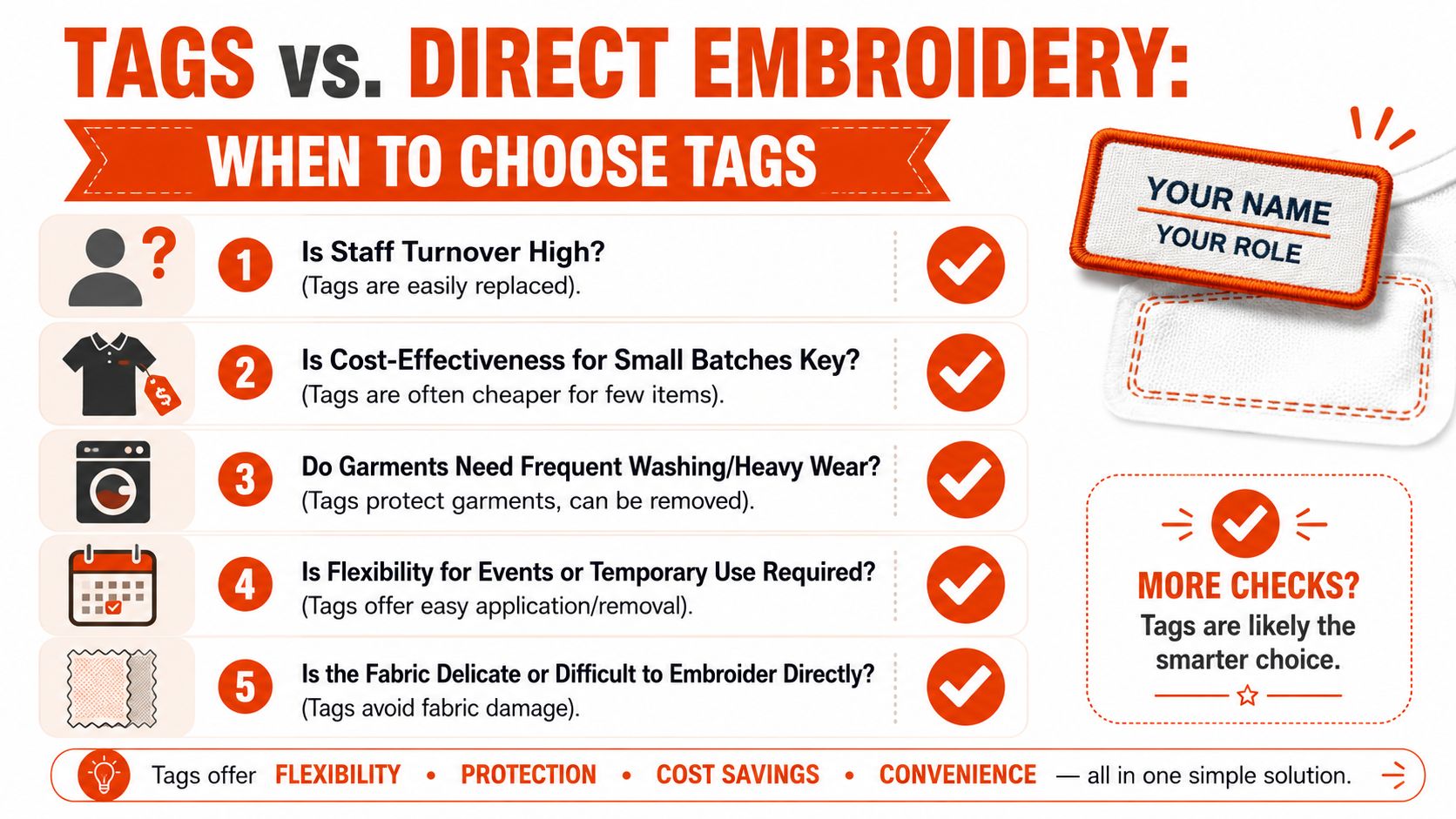
Custom embroidered name tags are the better choice when identity changes more often than the garment.
That includes:
- Rotating staff uniforms: You don't want to retire a good overshirt because one employee left.
- Events and pop-ups: Temporary names, roles, or access levels make removable systems useful.
- Bags, aprons, and outerwear: These pieces can carry a patch naturally without compromising comfort.
- Shared inventory: A tag lets one garment serve multiple people over time.
A patch also gives you more control when the fabric itself isn't ideal for direct stitching. Some materials look better with a contained embroidered object rather than a stitched name punched straight through the shell.
Choose direct embroidery when the garment should feel seamless
Direct embroidery wins when the garment is supposed to feel integrated, lighter, and more fashion-grade. Tees, hoodies, fleece, and many caps usually benefit from that cleaner relationship between garment and mark.
Use direct embroidery when:
| Garment type | Better option | Why |
|---|---|---|
| Heavy overshirt or uniform shirt | Tag or patch | Feels native to the product language |
| Apron or utility bag | Tag or patch | Easy replacement and strong visual framing |
| Hoodie or sweatshirt | Direct embroidery | Better hand-feel and less added bulk |
| Soft tee or lightweight layer | Direct embroidery | Patch can feel unnecessary or intrusive |
A removable patch offers versatility. Direct stitching offers permanence and integration. Brand perception changes with that choice.
The real trade-off is aesthetic, not just functional
A tag creates an object on top of a garment. That can be exactly right on structured products. It can also look clumsy on soft ones. Direct embroidery has less modularity, but it usually looks more refined when the apparel is meant to feel like retail, not uniform.
For premium merch programs, that distinction matters. “Customizable” isn't automatically better. Sometimes the right move is a beautifully integrated stitched name. Sometimes it's a removable embroidered identifier built to survive reassignment, washing, and operational reality.
The smart choice is the one that fits the garment's role.
If you're building a uniform system, event kit, or team drop and want the naming detail to feel as considered as the garment itself, Banger can help you spec the right route, from patch-style tags to direct embroidery, plus the product previews and production setup needed to get it right before anything goes into a full run.