Branded Travel Accessories: A Guide for Modern Teams
Most advice about branded travel accessories is stuck in giveaway logic. Pick something cheap, add the logo, hit the order minimum, move on. That's exactly how teams end up with tote bags nobody carries, mugs nobody likes, and backpacks that make the brand look less serious than it is.
The better question isn't “what can we hand out?” It's “what will people keep using when the event is over?” That shift matters because the difference between disposable swag and a real brand asset isn't just taste. It changes how people read your company. Good gear suggests standards. Bad gear suggests you wanted visibility without earning it.
For marketing leaders, this gets even trickier because the measurement gap is real. Strategic Market Research notes that tech teams lack data proving that fashion-grade branded travel gear, including 400–500 GSM hoodies and leather goods, drives higher brand recall and employee retention than generic alternatives. That gap is exactly why so many merch decisions still get treated like event spend instead of long-term brand building.
Table of Contents
Beyond the Throwaway Tote Bag
Most company merch fails for one simple reason. It's bought like a procurement item and judged like a fashion object.
That mismatch kills it. A team chooses the lowest-friction option, usually a thin tote, a basic bottle, or a generic pouch, then expects the recipient to treat it like a meaningful object. They won't. People keep things that are useful, well-made, and culturally legible. They ignore things that feel like conference leftovers.

There's also a category problem. A lot of branded merch gets designed for the giveaway table, not for actual movement through real life. Travel gear changes that. If the item ends up in a coworking space, at the airport, on a train, or in a weekly commute, it has a much longer brand life than a one-day event freebie. That's why curated custom bags for team merch drops tend to outperform random accessory bundles in perceived value.
Practical rule: If the item wouldn't survive your own creative director's daily carry setup, it probably shouldn't carry your logo.
The “brand asset vs. swag” debate matters because spend isn't the only variable. Reputation is in the mix. If your team ships something flimsy, overbranded, or obviously cheap, the product starts communicating on your behalf. Not in a good way.
A better standard is simple. Would someone still use this if your logo were smaller? If the answer is no, you don't have branded travel accessories. You have ad inventory disguised as a gift.
The Modern Team's Travel Kit
The strongest branded travel accessories earn their place through utility first. Then branding plays its part. That order matters.
A modern team travel kit doesn't need twenty items. It needs a few pieces that get packed repeatedly, survive movement, and look good enough that nobody feels like they're carrying corporate leftovers. The market is moving in that direction too. Coherent Market Insights reports that the premium segment holds 50.3% of the travel accessories market, while travel bags account for 20.3% of the total market. That tells you buyers are already choosing quality and design over bargain-bin utility.

What gets used in real life
A backpack is still the highest-signal piece in the category. It's visible, functional, and part of daily movement, not just occasional travel. In practice, it works as a brand object because it lives in offices, airports, and coffee shops. A clean, structured traveller backpack format usually does more for perceived brand quality than a loud tee ever will.
Then there's the dopp kit. It doesn't sound glamorous, but people keep them for years if the shape is right and the material feels substantial. It's one of the best examples of low-drama usefulness. You don't need to convince anyone to use it.
Tech organizers are underrated because they solve a specific pain point. Loose cables, chargers, adapters, earbuds, SD cards. A well-laid-out organizer feels competent. That feeling transfers to the brand attached to it.
What to prioritize first
If you're building a tighter kit, start with items that combine repeat use and decent design surface:
- Backpacks or duffels: Best for visibility, especially for commuting teams and event crews.
- Toiletry pouches: Easy to gift, easy to keep, and more durable than novelty desk swag.
- Travel mugs: Good when the form factor is sleek and the finish feels deliberate.
- Luggage tags: Small, but effective when they avoid the tourist-shop look.
- Cable or tech pouches: Useful for remote teams, founders, sales staff, and frequent travelers.
The best item isn't the one with the biggest imprint area. It's the one people reach for without thinking.
A common mistake is stuffing everything into a “kit” just because bundling feels generous. It usually dilutes the impact. One excellent backpack plus one clean organizer often lands better than six average objects.
Another mistake is choosing products based only on event relevance. A neck pillow may fit the travel theme. That doesn't mean it belongs in your merch strategy. Utility has to outlast the campaign concept.
Designing Merch People Actually Keep
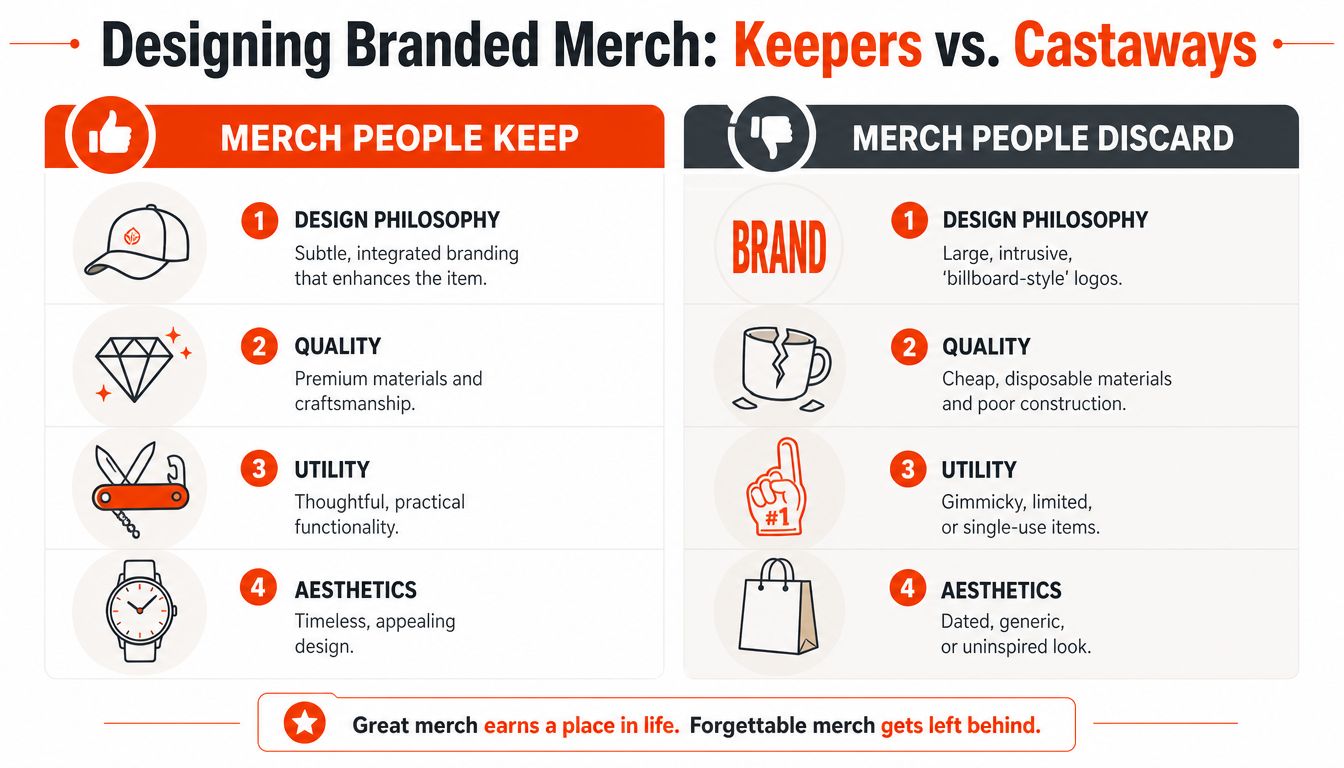
Design is where most branded travel accessories go wrong. The product itself can be solid, but the branding turns it into a walking apology.
Big chest logos and giant front-panel marks come from old-school sponsor thinking. They assume exposure matters more than object quality. In reality, oversized branding often lowers the perceived value of the piece. It stops feeling like gear and starts feeling like promotion.
Why loud branding usually loses
The best travel gear behaves like a product brand would design it. Branding is integrated, not sprayed on. That means tonal embroidery, blind embossing, woven tabs, debossed leather patches, zipper-pull detailing, or laser engraving on hard surfaces.
What works:
- Tonal decoration: Same-color embroidery or print keeps the item wearable and sharp.
- Placement with restraint: Side seam labels, small front hits, inner messages, and subtle hardware marks age better than center-front billboards.
- Material-aware branding: Leather wants embossing. Metal wants engraving. Heavy canvas can handle a patch. Good customization follows the product.
What usually fails:
- Huge contrast logos: They dominate the item and date it fast.
- Default print placements: Standard front-center application looks like no one cared.
- Random slogans: If the phrase only makes sense at the event where it was handed out, it won't survive beyond that event.
A fast way to pressure-test a concept is visualizing it in context before production. That's where tools like MerchLoom's e-commerce image solutions can help a team compare logo scale, color balance, and product presentation before approving final art.
A good reference point for production craft sits behind the scenes, not just on the moodboard. UCT Asia's travel accessories guide notes that premium custom branded travel accessories should follow AQL 1.0 for critical failures, AQL 2.5 for major defects, and AQL 4.0 for minor cosmetic issues, checked through in-production and pre-shipment inspections. That matters because a beautiful mockup means nothing if zipper alignment, edge paint, stitch consistency, or hardware finish falls apart in bulk.
Here's a closer look at how product storytelling changes once you stop treating merch like a print job:
The production details people notice
People may not know the factory term for a bad seam allowance, but they feel the difference immediately. The handfeel is off. The zipper catches. The strap twists. The patch peels. Cheap merch announces itself through friction.
That's why the design process should include real product decisions, not just artwork decisions. Think through:
| Detail | Weak choice | Better choice |
|---|---|---|
| Logo treatment | Large print on front panel | Tonal embroidery or emboss |
| Hardware | Generic shiny pulls | Matte branded pulls or minimal trims |
| Interior | Plain lining | Contrast lining or useful internal organization |
| Finish | No packaging thought | Clean presentation that matches the item |
If your team needs deeper product development than logo placement, a partner with custom merch design services should be able to build around silhouette, trims, labels, and finishing details. That's the line between ordering merch and creating a piece.
Choosing Sustainable and Premium Materials
Materials do more branding work than most logos.
You can feel the difference between stiff, noisy synthetic fabric and a dense recycled nylon with proper structure. You can see the difference between generic cotton canvas and a cleaner weave with a better finish. Recipients may never ask what mill produced it, but they'll decide whether the item feels worth keeping in the first ten seconds.
Material choices signal taste
For soft travel accessories, canvas and heavyweight cotton blends can feel grounded and familiar, especially for tote bags, pouches, and weekenders. Recycled synthetics usually make more sense when weather resistance, wipeability, and lighter carry weight matter more. Harder-wearing travel pieces often need those performance advantages.
Leather is another category where teams get into trouble. Done well, it adds longevity and restraint. Done badly, it looks like faux prestige. If you're using leather or leather-like trims, keep the application minimal and let it support the object instead of trying to make the object look expensive by force.
A few material cues tend to travel well across teams:
- Recycled nylon or recycled polyester: Useful for technical bags and organizers.
- Organic cotton canvas: Better for softer silhouettes and understated branding.
- Metal hardware with a muted finish: Usually feels more premium than bright plated components.
- Structured lining: Makes a bag feel considered instead of floppy.
If your team is comparing natural fibers, this breakdown of organic cotton fabric and how brands use it is a useful starting point.
Better materials don't just last longer. They make the brand look like it understands product, not just promotion.
Compliance is becoming part of the product
Material choice is also moving from preference into compliance. Carbonfact's overview of textile regulation explains that the EU's Digital Product Passport for textiles will require QR-accessible data on material composition, traceability, and environmental impact by 2027, with a minimum 18-month implementation window for brands.
That doesn't only matter to fashion companies. It matters to any brand ordering textile-based merchandise for European markets. A supplier that can't document material inputs or traceability is becoming a bigger risk.
There's also a reputational side to this. Sustainability claims on merch are easy to print and much harder to back up. The more serious move is choosing materials and partners that can withstand scrutiny when someone asks where the product came from and what it's made of.
The Logistics Behind a Premium Merch Drop
Good branded travel accessories don't happen because someone picked a nice bag from a catalog. They happen because the team handled product selection, approvals, quality checks, packaging, and shipping without losing the original standard halfway through.
That matters more now because this category isn't slowing down. Future Market Insights projects the global travel accessories market at USD 61.6 billion in 2026, reaching USD 123.5 billion by 2036, with a 7.2% CAGR over that period. More demand usually means more options, but it also means more mediocre suppliers hiding behind polished websites.
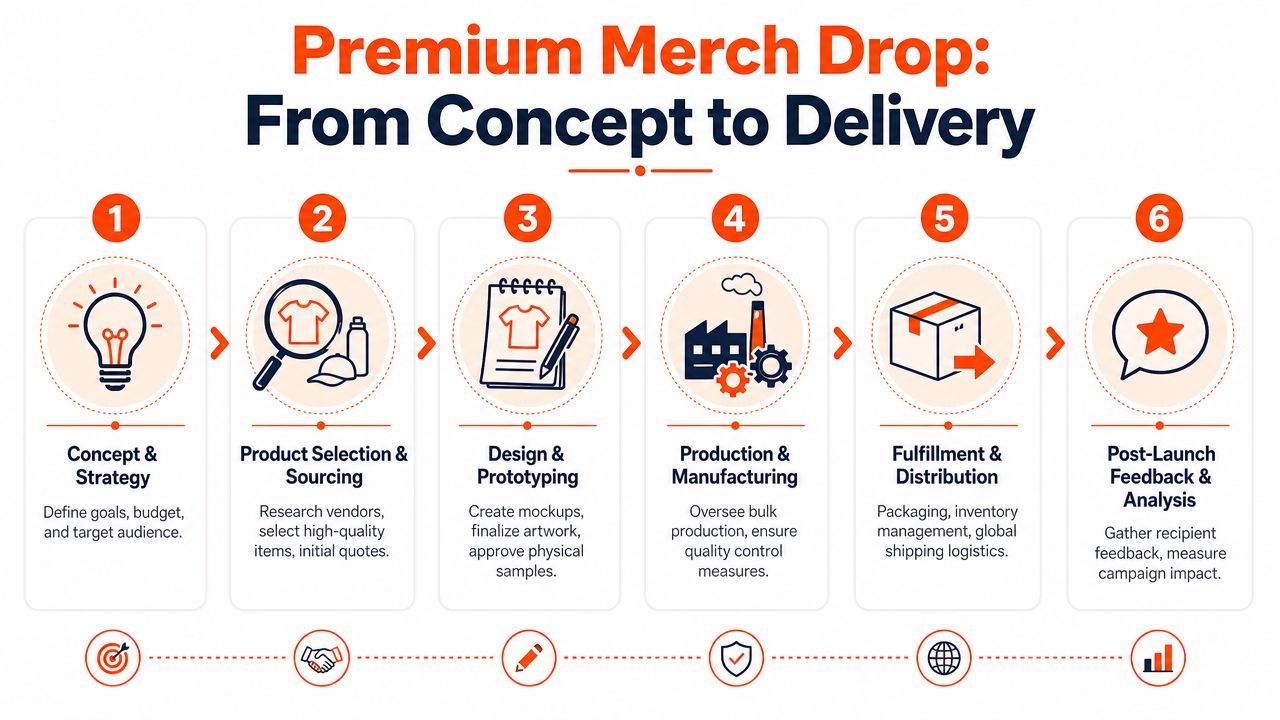
How the process actually works
A premium merch drop usually follows a predictable path:
Define the role of the item
Is this onboarding gear, speaker gifting, client seeding, or a community reward? The answer changes the product choice.Choose the base product carefully
Don't start with branding. Start with silhouette, storage, carry comfort, and finish.Approve visuals and samples
Digital proofs help, but for premium travel items, physical sampling matters when timelines allow.Lock production details
This includes trims, placement, packaging, and any custom inserts or labels.Run fulfillment with intention
Single-address event delivery is one model. Multi-address distribution for remote teams is another.
The teams that get burned usually rush step two and skip step three. They assume all backpacks are interchangeable, or that a mockup proves the final object. It doesn't.
Questions worth asking before you order
Ask your supplier things that reveal operational maturity, not just friendliness on a sales call.
- How are defects checked? You want a real quality process, not “we inspect everything carefully.”
- Can they ship to multiple recipients? Remote-first teams need this constantly.
- What's customizable beyond the logo? If the answer is just print color and placement, your ceiling is low.
- What does packaging look like? Premium gear in cheap packaging loses force.
- Can they support reorders cleanly? Consistency matters if the drop works and you scale it.
For teams handling distributed rollout, merch fulfillment services for multi-address shipping can remove a lot of operational drag. That's especially useful when the same drop needs to land with employees, speakers, creators, and partners across different markets.
One more practical note. Low minimums are useful, but only if the supplier can hold quality at small volume. Fast turnaround is valuable, but not if it means defaulting to the easiest decoration method on the wrong product.
How to Deploy Your Branded Gear
A premium travel item works best when it lands at a moment that already matters. Context raises perceived value.
That's why the strongest merch programs feel less like procurement and more like drops. The object is still useful, but the release has intent. People understand why they got it, why this item, and why now.
Onboarding drops
The first week at a company is one of the rare moments when branded gear can effectively shape identity. A clean backpack, a cable organizer, and a durable travel mug can make a new hire feel like they joined a team with taste, not just a company with a budget.
What doesn't work is overstuffing the box. A giant welcome kit full of filler often cheapens the one or two things that could've felt special.
New hires don't remember how many items were in the box. They remember the one piece that instantly entered their routine.
Event and community drops
Conference speaker gifts, offsite kits, and community reward drops benefit from tighter curation. If the audience travels often, practical items land harder than decorative ones.
A few strong setups:
- Speaker pack: Structured backpack, slim pouch, understated luggage tag.
- Offsite carry kit: Weekender, insulated bottle, and an organizer for chargers.
- Community reward: Limited-run accessory in a colorway that feels collectible, not generic.
For Web3 and internet-native teams, scarcity and design language matter. People want something that feels like it belongs to the culture of the community, not a leftover corporate conference pack.
Field team and partner gifting
Sales teams, founders, and partner-facing operators need gear that travels without looking like event collateral. That usually means fewer logos, better materials, and pieces that can sit beside someone's own belongings without clashing.
A thoughtful gift here does two jobs. It gives the recipient something useful, and it signals your brand knows how to make choices. That sounds subtle, but people notice when a company's gifts feel well-edited.
The wrong deployment pattern is “same merch for every use case.” Onboarding, VIP gifting, and event seeding shouldn't all pull from the same box. The product can stay within one visual world, but the mix should change based on who receives it and how they'll use it.
Build Merch That Builds Your Brand
The problem with most company gear isn't that it's branded. It's that it was never designed to deserve attention in the first place.
Branded travel accessories fix that when the team treats them like products, not imprint surfaces. The useful item lasts. The better material gets carried. The subtle branding gets seen in the right contexts. Over time, that creates a different kind of brand memory than throwaway swag ever could.
This is also why the best merch strategy looks a lot like product strategy. You choose fewer things. You make better decisions on design and materials. You care about fulfillment, packaging, and consistency. You stop chasing cheap impressions and start building objects people actually want nearby.
If you're looking for inspiration outside the usual promo ecosystem, it can help to compare how more gift-led brands approach curation. A collection like explore our distinctive corporate gifts is useful because it highlights an important point. The item has to stand on its own before branding makes it stronger.
A good merch drop won't fix a weak brand. But it will absolutely reinforce a strong one.
If your team wants to build merch people keep, Banger is worth a look. They help internet-native teams create premium custom merch with strong product taste, deep customization, low minimums, and worldwide fulfillment. You can explore the catalog, request a quote, or get product previews within 24h for your next team drop.