Cut and Sew Apparel: The Ultimate Guide for Modern Brands
You're probably here because your team has already done the usual merch cycle. You ordered the safe hoodie, added the logo, sent it out, and watched it land exactly where forgettable merch always lands. In a drawer, at the bottom of a tote, or on someone's dog-walking rotation.
That's the gap between branded apparel and actual product. A standard blank with decoration can work. Sometimes it's the right move. But when a startup, creator brand, or culture-first team wants the garment itself to carry the brand, not just the logo on top of it, cut and sew apparel is the lane.
The difference is obvious the second you unbox it. The fabric feels intentional. The silhouette makes sense. The labels, trims, stitching, and finishing don't feel borrowed from somebody else's template. It feels like your brand made clothes, not merch.
Table of Contents
- Three different production models
- Apparel Customization Methods Compared
- What actually changes the outcome
When Your Merch Needs to Be More Than a Logo
The easiest way to spot weak merch is simple. Remove the logo in your head. If the piece has nothing left, it was never strong to begin with.
That's why so many company hoodies miss. The fabric is generic. The fit belongs to no one in particular. The garment exists only as a surface for branding. Once the novelty wears off, there's no reason to keep wearing it.
The problem with logo-first merch
A founder sends out welcome kits. A team wears the hoodies on launch week. A few photos go up. Then the pieces disappear. Not because people hate the brand, but because the product didn't earn repeat wear.
Good cut and sew apparel flips that equation. The garment comes first. The logo becomes part of a complete object with its own shape, hand feel, trim language, and point of view.
Most bad merch asks the logo to do all the work. Good apparel makes the logo the final detail, not the whole idea.
That matters more for internet-native brands than for old-school corporate merch programs. If your brand lives in group chats, on X, in Discord, at founder dinners, at offsites, and at events where everyone notices fabric and fit, the bar is higher. People know the difference between a blank with decoration and a piece that was developed.
What strong merch feels like
The best team drops don't read like giveaways. They read like uniform, signal, and artifact all at once.
A sharp onboarding hoodie can say more about a brand than a recruiting deck. A well-cut tee can make an event team look coordinated without looking promotional. A capsule drop for your community can create more attachment than another round of stickers and mugs.
If you're still shaping the direction, this guide on how to create merchandise that people actually keep is a useful place to pressure-test the concept before you get into production.
Cut and Sew vs Decorated Blanks vs Print on Demand
Not every project needs full custom construction. Sometimes speed wins. Sometimes simplicity wins. The mistake is treating every apparel need like the same problem.
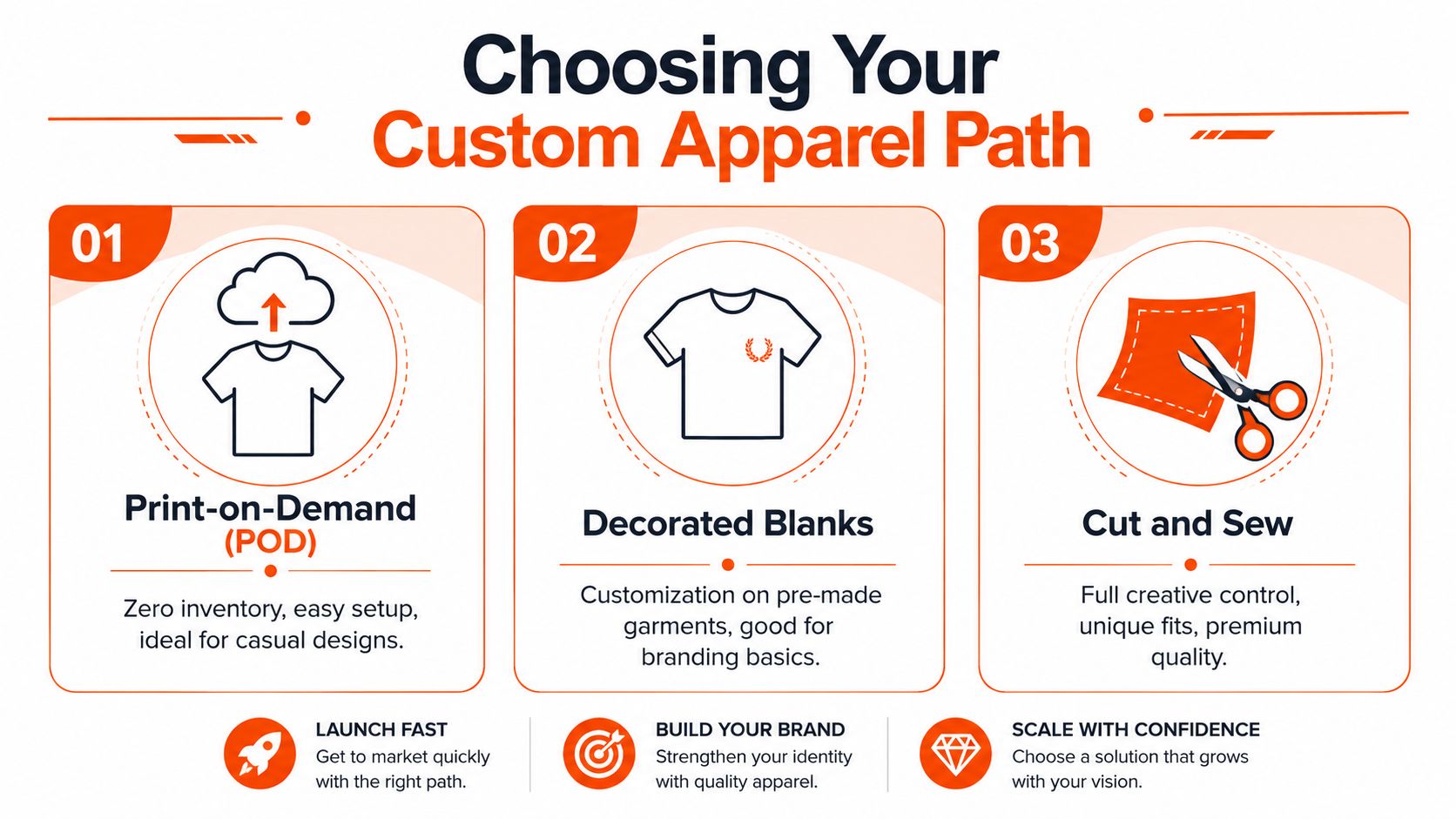
Three different production models
Print-on-demand is the lightest operational setup. You upload art, connect a storefront, and produce one item at a time. It works for testing graphics, running low-risk experiments, or serving broad catalog demand without holding inventory. If you're evaluating that model, these strategies for print-on-demand sellers are useful for understanding how operators approach assortment and sell-through.
Decorated blanks sit in the middle. You choose an existing garment, then add screen print, embroidery, or another decoration method. This is the standard route for team tees, event giveaways, and straightforward branded apparel where the blank is already doing enough.
Cut and sew is different. You're not selecting from an existing body. You're building the body itself from raw fabric, pattern pieces, construction specs, trims, and finishing decisions. That means more work upfront, but it also means you control the parts that shape perception.
Apparel Customization Methods Compared
| Attribute | Cut & Sew | Decorated Blanks | Print-on-Demand (POD) |
|---|---|---|---|
| Garment construction | Built from scratch | Pre-made garment | Pre-made garment |
| Fit control | Full control over silhouette and sizing approach | Limited to available blank | Limited to available blank |
| Fabric choice | Custom-selected for the project | Limited to chosen blank options | Limited to platform catalog |
| Brand details | Full trim, label, panel, and finishing control | Mainly decoration and some finishing | Mostly graphic placement |
| Best use case | Capsule drops, premium uniforms, private label apparel | Team basics, event merch, reliable staples | Fast testing, one-off orders, low-risk launches |
| Speed to launch | Slower upfront | Faster | Fastest |
| Upfront development | Highest | Moderate | Lowest |
| Brand impact | Highest when executed well | Solid but constrained | Usually surface-level |
What actually changes the outcome
The biggest difference isn't just customization. It's performance. Cut and sew yields garments with a 40% higher durability rating and a 25% lower return rate compared to decorated mass-produced alternatives, because custom construction removes many of the fit inconsistencies built into standard blanks.
That's the part people skip when they talk about ROI. Better apparel doesn't only look better in the launch post. It tends to hold up better in actual wear and create fewer problems after delivery.
Practical rule: Use POD when you need speed and zero inventory risk. Use decorated blanks when the garment already exists and just needs branding. Use cut and sew when the product itself is part of the brand strategy.
If you're deciding whether a heavyweight blank is enough or whether the shape itself needs to change, reviewing a range of premium hoodie blanks and fit directions helps clarify the line.
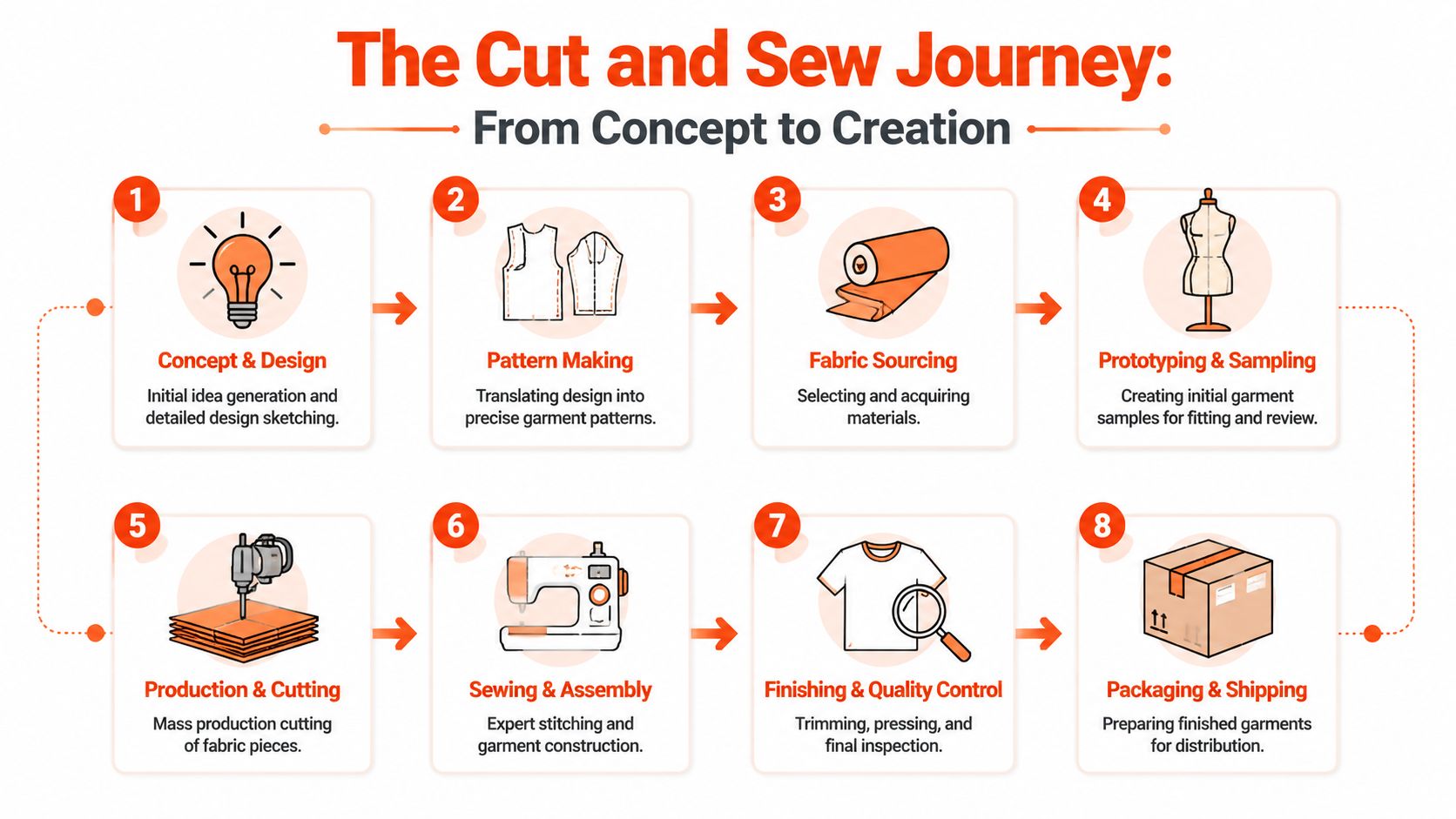
The End-to-End Cut and Sew Manufacturing Process
A lot of people hear “cut and sew” and imagine chaos. It's not chaos. It's a disciplined sequence. The brands that get strong outcomes respect the process instead of trying to skip around it.
A visual overview helps before getting into the details.
It starts with the tech pack
The tech pack is the blueprint. It tells the factory what the garment is, how it should be built, what materials it uses, how it should measure, and where every detail belongs.
A strong tech pack covers things like:
- Construction details such as seam type, stitch choice, placket build, pocket placement, rib dimensions, and finishing notes.
- Bill of materials including shell fabric, rib, drawcords, labels, zippers, snaps, and packaging components.
- Points of measure for every size, so the factory isn't guessing where width, body length, sleeve length, or opening dimensions should land.
- Artwork and branding placements for prints, embroideries, woven labels, neck labels, hem flags, and hang tags.
Precision is key. A detailed tech pack, specifying stitch codes like 301 lockstitch and requiring a 24-hour fabric rest period, is proven to reduce defect rates in bulk production by 15-20% and prevent size inconsistencies in high-GSM garments.
That fabric rest note matters more than people think. When fabric is unrolled and allowed to relax before cutting, you avoid tension-based distortion that can throw off sizing and seam behavior later.
Sampling is where taste meets reality
The sample tells you whether the idea works on an actual body.
A sketch can look clean and still fail in real life. Maybe the shoulder drops too far. Maybe the hood sits flat. Maybe the pocket opening feels cheap. Maybe the fabric weight is right, but the drape is wrong. Sampling catches all of that before bulk production locks it in.
Don't approve a sample because it's “close enough.” If the sample feels slightly off in fit or balance, bulk production will magnify that problem.
This is also where pattern grading matters. A garment can look perfect in one size and collapse in the full size run if the grading logic is weak. Teams that want a smoother path usually work with partners who already specialize in custom hoodie manufacturing and apparel development, because they've seen where fit issues tend to hide.
A factory-floor look at the process makes the sequence more concrete:
Production rewards precision
Once the sample is approved, production moves into sourcing, cutting, sewing, finishing, inspection, and packing. This stage looks straightforward from the outside, but it's where small sloppiness gets expensive.
The checkpoints that matter most are usually these:
- Fabric readiness. Fabric has to be inspected, matched, and prepared correctly before cutting.
- Cut accuracy. If panels drift early, every downstream operation inherits the problem.
- Sewing consistency. Good operators keep construction clean across the full run, not just the top sample.
- Finishing discipline. Threads trimmed, garments pressed properly, labels straight, packaging aligned with the product level.
The strongest projects treat neck labels, woven tabs, hang tags, and packaging as part of the garment system, not decoration added at the end. That's how a piece stops feeling like merch and starts feeling like apparel.
Breaking Down Costs MOQs and Timelines
Cut and sew costs more upfront because you're paying for development, not just production. That's the honest answer.
If you're buying decorated blanks, the garment body already exists. If you're using POD, the platform has already standardized the product and workflow. With cut and sew, your project carries the cost of making new decisions. Pattern work, sampling, sourcing, grading, trim development, and production planning all happen before the first finished unit lands in a box.
Why the first units cost more
The cost stack usually includes a few categories that don't exist in simpler merch models:
- Product development. Tech pack creation, pattern making, and revisions.
- Sampling. You pay to test the idea before bulk.
- Material work. Fabric and trim sourcing can require approvals and substitutions.
- Labor intensity. Manual cutting and sewing represent approximately 35% to 40% of total manufacturing costs and create a real bottleneck for fast-turnaround brands.
That last point changes the planning math. You're not just buying cloth and stitches. You're buying skilled labor, production capacity, and quality control in a category that still depends heavily on human execution.
For context on the category itself, the global cut and sew apparel manufacturing industry is valued at approximately $26 billion and is growing at a 3.2% CAGR according to Grata's market overview of NAICS 3152 cut and sew apparel manufacturing. That continued growth makes sense. More brands want private label product instead of generic blanks.
How to think about break-even on small drops
The hardest projects are usually the smallest ones. Limited drops under 50 units force a sharper decision because the development cost is spread across fewer garments.
For limited drops under 50 units, the key is calculating the break-even point where the premium brand perception and lower return rates from cut-and-sew's superior fit and finish outweigh the higher non-recoverable development costs compared to print-on-demand.
A practical way to evaluate it:
- Use POD if the goal is testing artwork demand with minimal commitment.
- Use decorated blanks if you need polished basics and don't need a proprietary silhouette.
- Use cut and sew when the garment itself is the asset. That usually means core team uniform, premium community drop, or private label product with repeat value.
You also need to be honest about MOQ friction. If your concept only works when everything is custom, but your order quantity can't support development, the smart move is often to simplify the first drop and build toward full cut and sew later. If MOQ is the blocker, this breakdown of low minimum custom apparel options helps frame what's realistic.
When to Use Cut and Sew Real-World Use Cases
The strongest use cases all share one trait. The brand wants the clothing to carry cultural weight, not just visual branding.
Use it when the garment is the message
A startup onboarding kit is a good example. If the team is design-literate and product-obsessed, a generic fleece with a chest logo sends the wrong signal. A custom hoodie with the right weight, silhouette, label set, and finish feels like an extension of the company's taste.
The same applies at conferences. A custom-paneled jacket, a cropped boxy tee, or a heavyweight quarter zip changes how the team shows up in person. People notice shape before they notice the logo.
A strong event uniform doesn't make your team look sponsored. It makes them look coherent.
Private label is another clear fit. The global cut and sew apparel manufacturing industry is valued at approximately $26 billion and is growing at a 3.2% CAGR, driven by demand for private label collections and unique brand expressions that generic blanks can't satisfy, according to Grata's cut and sew apparel manufacturing research. That's exactly why more culture-driven brands are moving past stock garments.
Use it when community matters more than volume
Cut and sew works especially well for limited capsules, contributor gifts, artist merch, and founder-led brands with a strong visual language. You don't need a massive catalog. You need one or two pieces that people want to keep wearing.
Some of the best drops are narrow and specific:
- Community reward pieces for early members, moderators, holders, or contributors.
- Creator merch that feels closer to fashion product than fan souvenir.
- Client gifting where the item has enough quality to survive beyond the first unboxing.
- DTC test lines that need private label credibility from day one.
Fit and end use matter here. Even in adjacent apparel categories, buyers care about performance details and real-world wear, which is why guides like finding the perfect thermal tights tend to resonate. People don't just want branding. They want product choices that make sense on the body.
The common mistake is using cut and sew for projects that don't need it. If the piece is disposable by design, keep it simple. If the item is meant to carry identity, build it properly.
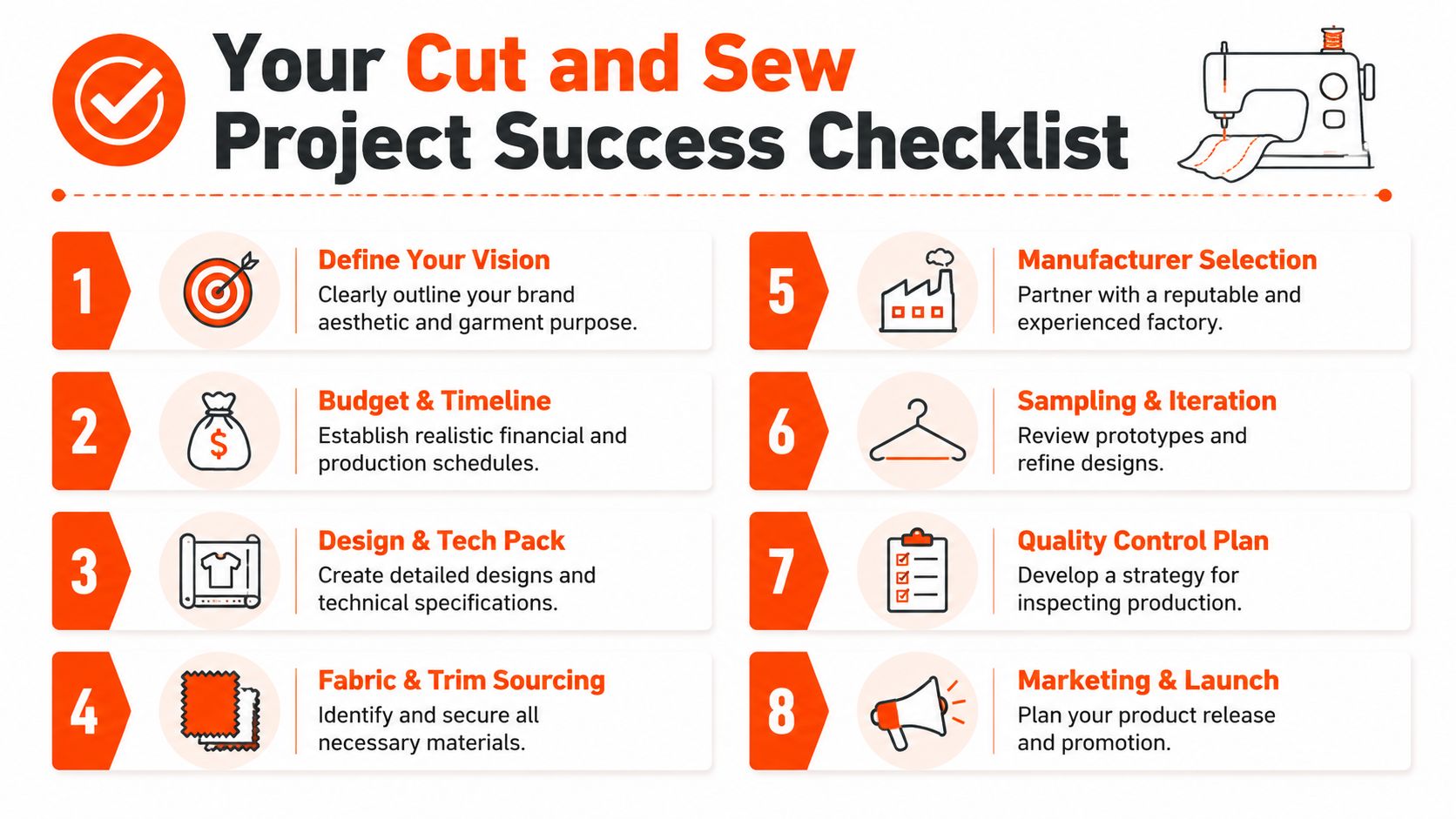
Your Checklist for a Successful Project
A good cut and sew project usually looks calm from the outside because the messy decisions got handled early. Most failures start before production. The brief is vague, the approvals are loose, and no one has decided what matters.
What to have ready before you start
Bring clarity, not just enthusiasm.
- A real product vision. Decide what you're making and why. Oversized heavyweight hoodie, washed tee, cropped crew, nylon coach jacket. Vague references waste time.
- Your brand cues. Logo files aren't enough. Share color direction, references, trim preferences, and the level of subtlety or loudness you want.
- Use-case discipline. Is this for onboarding, resale, community gifting, or an event uniform? The answer changes fabric, fit, and finishing.
- Budget logic. Know whether you're optimizing for margin, perception, retention, or cultural impact.
- Timeline honesty. If your launch date can't move, say that early.
Approving fast only works when the inputs are good. Rushing unclear decisions is how teams end up paying for a second sample.
If you need help turning references into a workable product brief, professional custom design support for merch and apparel can tighten the process before development starts.
What to ask your manufacturing partner
This part matters more than the moodboard.
Ask direct questions:
- What are the minimums for this type of garment?
- How does sampling work, and how many revision rounds are realistic?
- Who handles the tech pack and pattern development?
- Can they source trims, labels, and packaging, or are you coordinating multiple vendors?
- What quality checks happen before bulk is approved?
- Can they also manage fulfillment if the project ships to multiple recipients?
You want a partner who can speak clearly about fit, fabrication, finishing, and production limits. If the conversation stays vague, the output usually will too.
A strong first project is rarely the most complicated one. It's the one with the cleanest brief, the most honest scope, and the fewest unnecessary moving parts. Start with one hero piece. Get the silhouette right. Build confidence from there.
If your team wants merch that feels closer to product than promo, Banger is built for that. They help internet-native brands develop premium custom apparel, from early design direction to production and worldwide fulfillment. You can request a quote, get product previews within 24h, and build a drop people will want to wear.