Foil Hot Stamping: Your 2026 Guide to Premium Merch
You're probably here because you've seen shiny merch go wrong.
A logo looked metallic in the mockup, then arrived looking plasticky, loud, and weirdly stiff. After a few wears, the edges started lifting. After a wash, the shine turned patchy. That's usually the moment teams decide foil isn't worth it.
The problem isn't the finish. It's the execution.
On premium apparel and accessories, foil hot stamping can look surgical. Not flashy in a cheap way. Sharp. Controlled. Built into the garment instead of sitting on top of it like an afterthought. In a good French atelier, the difference shows up fast: cleaner edges, better foil-substrate pairing, and enough restraint to make the metallic hit feel intentional.
Table of Contents
- Design less, design smarter
- Substrate changes everything
- Placement matters more than most mockups admit
- Can foiled apparel be washed?
- What materials work best?
- Can foil hot stamping work on organic or recycled materials?
- Can you combine foil with embossing?
- Where can I compare other merch printing techniques?
That Shine Isn't Always Gold
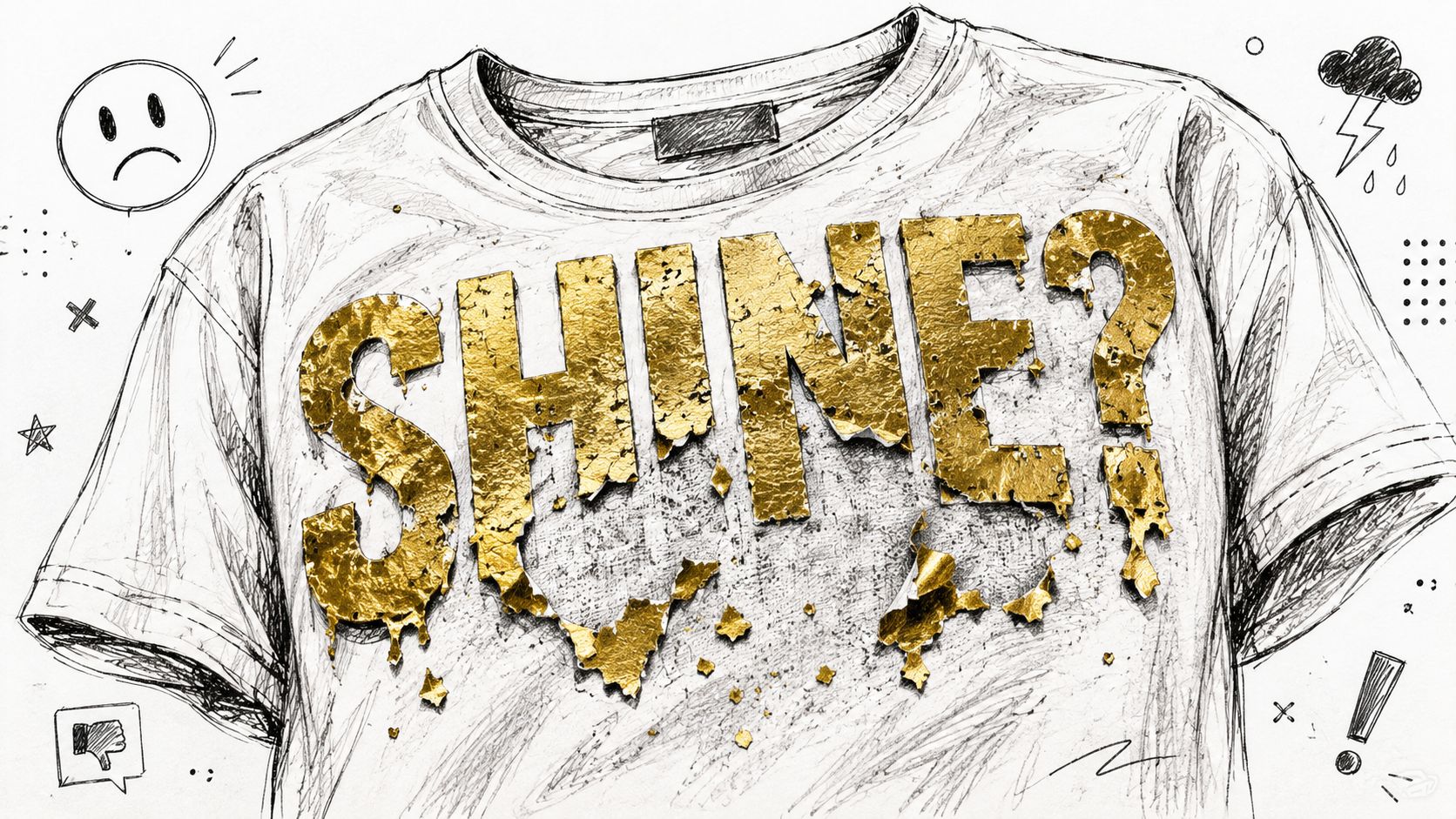
Most bad foil merch follows the same script. A team wants a premium effect, picks gold or silver, approves a fast mockup, and ends up with something that looks closer to a novelty souvenir than branded apparel. The shine is too harsh. The application is uneven. The logo cracks the first time the fabric flexes.
That's why foil hot stamping gets judged unfairly.
On apparel, the line between premium and cheap is thin. A small metallic wordmark on a heavyweight tee can feel fashion-led. The same artwork blown up across the chest, on the wrong blank, with the wrong heat profile, turns into costume. That's not a foil problem. That's a production problem.
The cheap version is always obvious
You can spot failed foil from across the room.
- Edges look fuzzy: the die pressure was off, or the artwork asked too much from the material.
- Coverage looks patchy: heat drifted during production, or the foil chemistry didn't match the substrate.
- The hand feel is wrong: the design is too large, too dense, or sitting on a fabric that needed a different approach.
The premium version feels quieter
The best foil hot stamping on apparel doesn't scream. It catches light when the wearer moves. It gives a logo or graphic a controlled flash. On caps, leather goods, heavyweight hoodies, and structured totes, it can look closer to finishing detail than decoration.
Foil works best when it feels deliberate. A metallic accent beats a metallic billboard.
That is the appeal for culture-driven brands. Not “add shine.” Add contrast, depth, and precision. If the goal is merch people keep wearing, foil has to behave like part of the garment system, not just a visual trick.
What Is Foil Hot Stamping Anyway
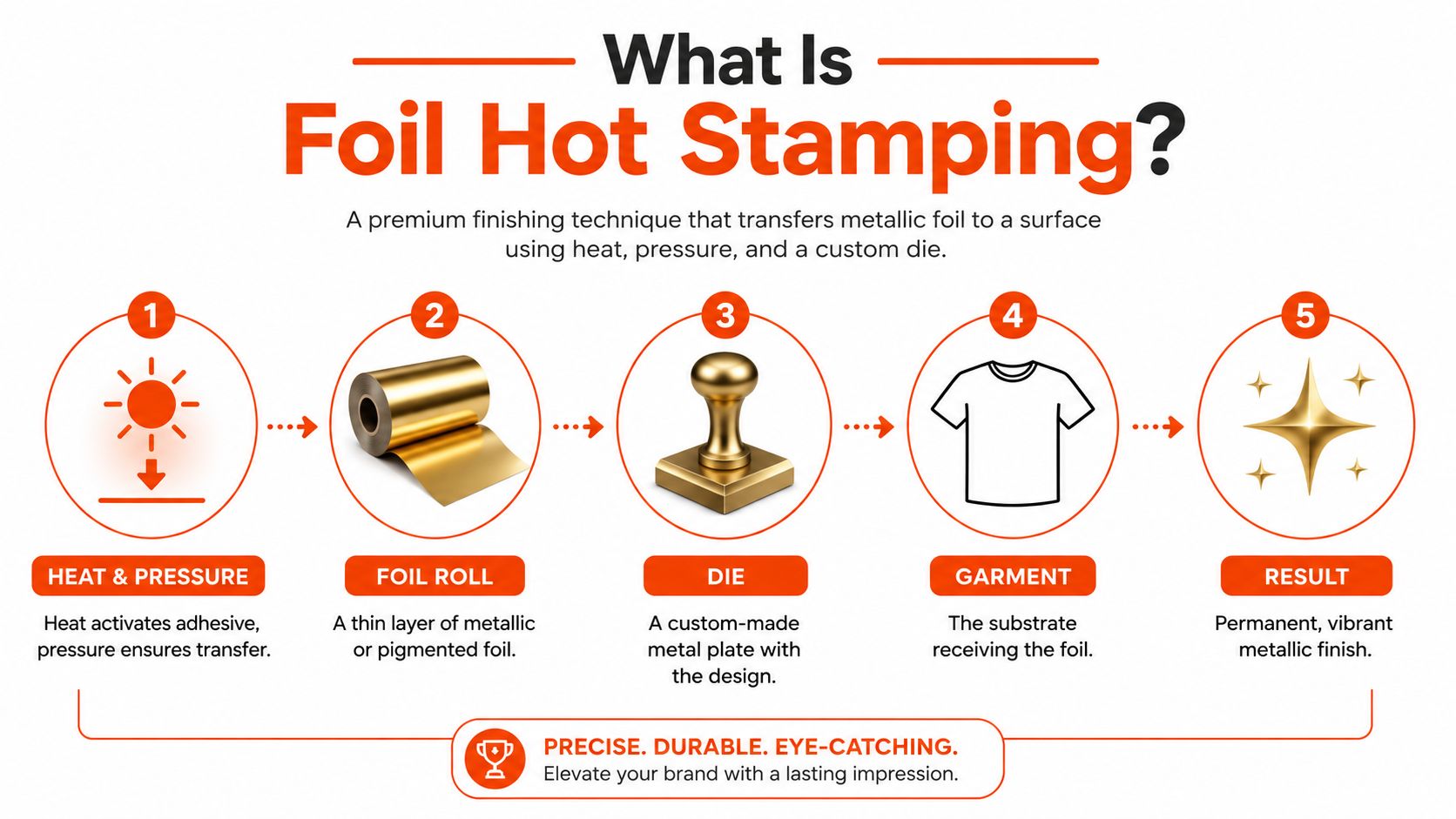
Foil hot stamping is a transfer process. A heated metal die presses foil onto a garment or accessory surface so the decorative layer releases only where the die makes contact. Think of it as a highly controlled heated stamp, not a print pass.
A heated transfer, not a print
There are four parts doing the primary work.
The die
A custom metal plate carries the artwork in relief. If the die is weak, the finish will be weak too.The foil
This isn't just a shiny sheet. It's a layered construction engineered to release under heat and pressure.The substrate
The garment, cap, tote, leather panel, or label receiving the foil.The press setup
Heat, pressure, and dwell time need to match both the foil and the material.
A generic explanation usually stops there. That's where a lot of teams get misled. On apparel, the process is less forgiving than on rigid paper goods because the surface moves, stretches, and reacts differently to heat.
What the foil is actually made of
The foil itself is a precision stack, not a single decorative film. As outlined in this technical guide to metalized hot stamping foil structure, the build includes a release coat, a color or metal layer, often just 0.02–0.05 microns of vacuum-metallized aluminum, and an adhesive sizing, all on a polyester carrier. That precision is why foil creates a reflective finish ink can't really fake.
A separate detail from the same technical framework matters on press. The polyester carrier acts as a thermal barrier, and the heated die activates release only at contact points. That's why clean edges are possible when setup is right, and why poor pressure uniformity creates lift-off or partial transfer.
Practical rule: If the design depends on broad, forgiving coverage, foil is the wrong tool. If the design depends on crisp metallic placement, foil starts to make sense.
Foil hot stamping also sits in a wider manufacturing context. The hot stamping foil market is projected in one estimate to grow from USD 1.22 billion in 2024 to USD 2.14 billion by 2033 at a 6.46% CAGR, driven largely by demand for premium packaging, according to Business Research Insights. That data comes from packaging-heavy demand, but the logic carries over to apparel: brands still want finishes that feel premium at first glance.
The Look and Feel Pros and Cons
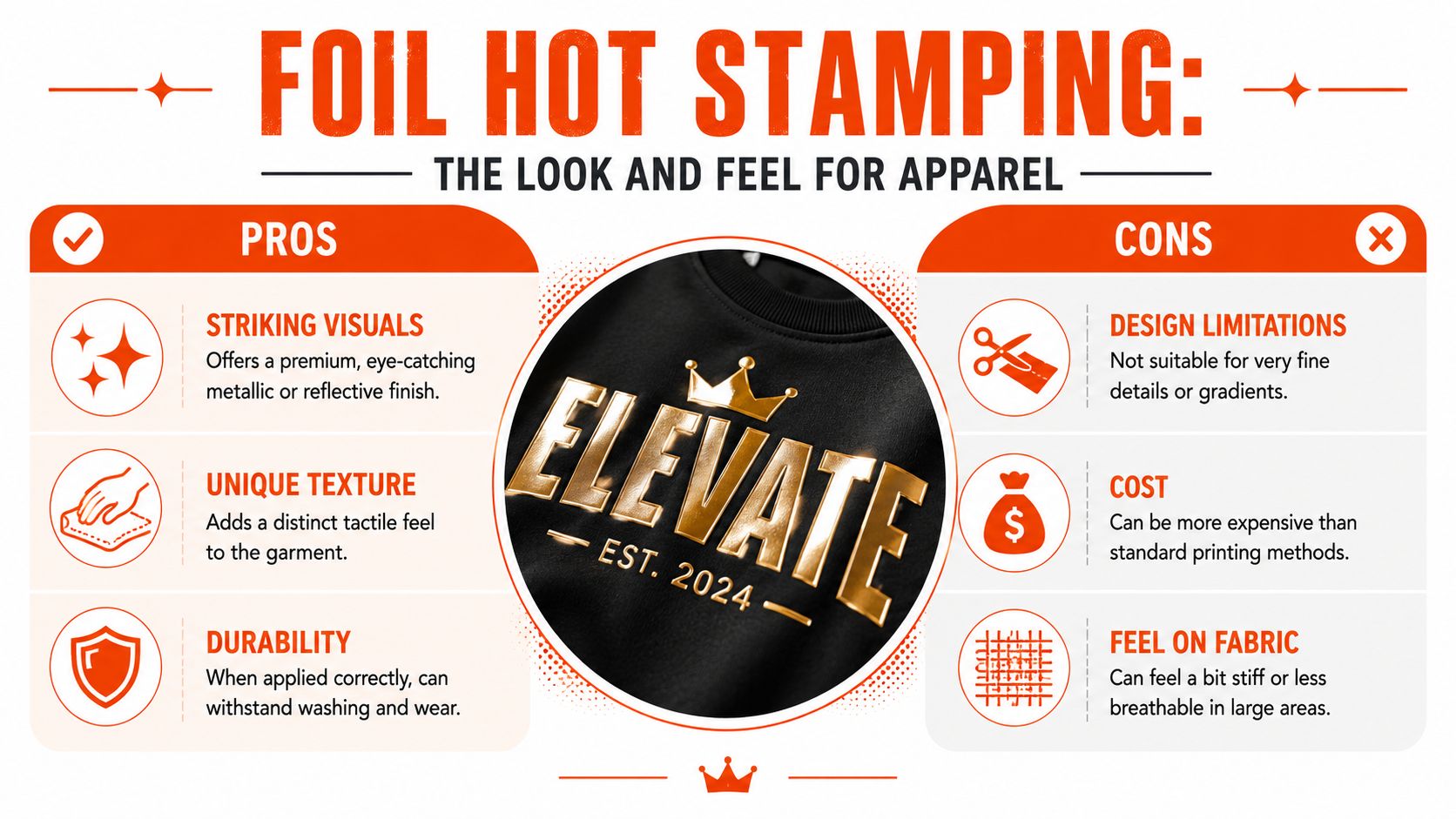
Foil hot stamping earns its place on apparel because it does something standard ink doesn't. It reflects light with edge definition and a tactile finish that reads intentional. But it's not universal. Good merch decisions come from knowing where foil shines and where it starts fighting the fabric.
Where foil wins
Foil is strongest when the design language is clean.
- Metallic impact: logos, wordmarks, monograms, and simple line graphics pick up light in a way standard print can't.
- Sharper luxury cues: on heavyweight cotton, structured twill, leather accessories, and dense fleece, foil can feel more like finishing than decoration.
- Tactile contrast: a matte garment with a reflective hit creates tension. That's usually where the premium feeling comes from.
There's also a reason foil remains a staple in adjacent print categories. If you want a useful reference point for how detail, stock choice, and metallic restraint shape perceived quality, the breakdown on wedding invitation printing essentials is worth a look. Different product category, same truth: metallic finishes only look expensive when the whole composition is controlled.
Where teams get into trouble
Foil isn't forgiving.
Large solid shapes can feel heavy on fabric. Very fine details can break, bleed, or transfer inconsistently. Gradients and photographic effects aren't what this technique was built for. If you need color complexity or full-surface artwork, something like sublimation printing for apparel solves a different problem.
A few trade-offs matter in real production:
| Consideration | What happens in practice |
|---|---|
| Large coverage | The finish can feel stiff and less breathable |
| Tiny details | Edges may lose definition under heat and pressure |
| Stretchy fabric | Movement increases the risk of visual distortion |
| Care habits | Harsh washing and drying can shorten the life of the finish |
Good foil design respects the fabric. Bad foil design tries to overpower it.
When the artwork, substrate, and press settings agree with each other, foil wears well and looks expensive. When one of those variables is wrong, the flaws are visible fast.
Hot Stamping vs Other Customizations
Decisions on foil hot stamping are rarely made in isolation. This choice is typically compared against embroidery, screen print, embossing, or foil effects achieved through an alternative print method. Such a comparative evaluation is appropriate, as each technique resolves a distinct aesthetic requirement.
What changes across techniques
Foil hot stamping is best when the brief is precision plus reflective finish. Think chest marks on premium tees, small graphics on hoodies, cap details, leather patches, branded notebook covers, or tote accents.
Foil screen printing can mimic metallic impact, but the result usually reads flatter. It's useful when you want a foil-like feel across broader artwork, though it won't have the same sharply transferred metallic edge.
Traditional screen printing wins on versatility. It's easier for larger graphics, layered color, and everyday wearability. If the brand system leans bold and graphic rather than reflective, it's often the cleaner move.
Embroidery gives dimension and permanence, but it creates a very different vibe. Thread has texture and depth, not mirror-like reflection. Great for logos, bad for sleek metallic cues.
Embossing is all about form without shine unless you combine it with foil. It works especially well on accessories, leather goods, and packaging details where the tactile impression matters as much as the visual mark.
Here's the fast comparison.
| Technique | Best For | Texture | Durability | Cost |
|---|---|---|---|---|
| Foil hot stamping | Metallic logos, sharp accents, premium accessories | Smooth with slight raised feel depending on substrate | Strong when properly applied and cared for | Higher than standard print |
| Foil screen printing | Foil-like graphic effects over broader areas | Ink-like, flatter than stamped foil | Good for print use cases | Mid to high |
| Screen printing | Bold graphics, larger art, everyday tees | Soft to moderate depending on ink | Strong for general apparel use | Usually more accessible |
| Embroidery | Logos, badges, caps, fleece, workwear feel | Textured and dimensional | Very strong | Mid to high |
| Embossing | Blind detail on leather and structured accessories | Pressed, tactile | Strong on suitable materials | Mid to high |
A lot of buyers also confuse foil hot stamping with “premium” by default. It isn't. It's premium only when it matches the concept. A crypto conference tee with a tiny reflective neck hit can work beautifully. A massive metallic slogan across lightweight cotton usually doesn't.
If you're comparing broader apparel customization routes, custom shirt printing methods gives a useful overview of where each process fits.
A final practical note. Hot stamping as a manufacturing method has deep industrial roots well beyond merch. According to ScienceDirect's hot stamping process overview, the technique originated in Sweden in the 1970s, with an initial patent registered in 1977 by Plja AB. In automotive applications, production reached approximately 124 million hot-stamped parts in 2010 and approximately 360 million in 2015, with the share of hot-stamped parts in the Body in White market projected by Berger to rise from 8% in 2015 to 17% by 2025. Different industry, same takeaway: hot stamping is trusted when precision matters.
Designing for Foil Best Practices for Apparel
The best foil work usually starts with restraint. Not because the technique is limited, but because apparel moves. It folds, stretches, absorbs pressure differently across seams, and reacts to heat based on fiber blend, thickness, and finish. Designs that look clean on a screen can fall apart on fabric.
Design less, design smarter
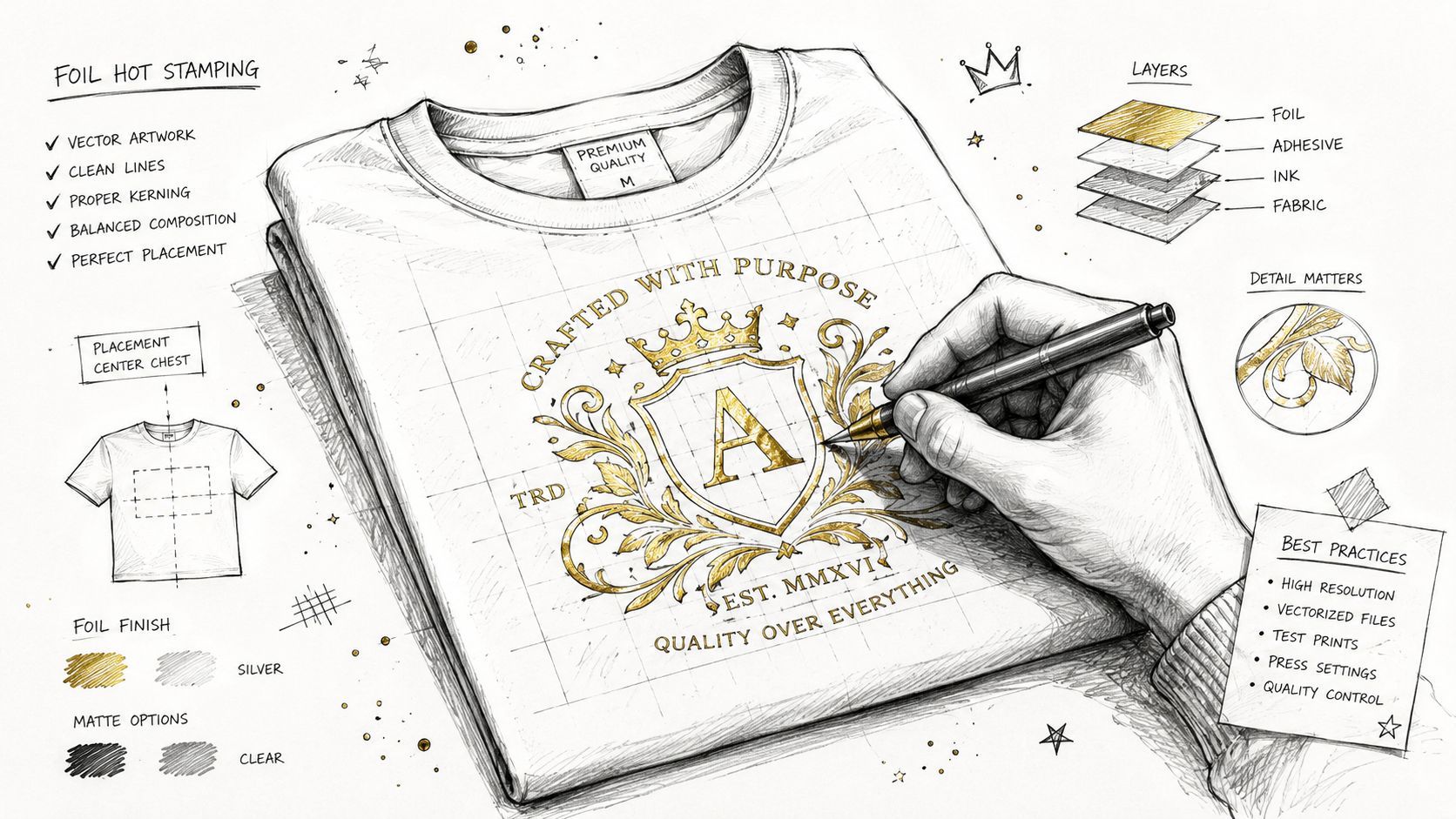
Vector artwork beats messy raster art almost every time. Strong outlines, deliberate spacing, and shapes with confidence tend to transfer better than complex textures or distressed effects.
What usually works well:
- Wordmarks with breathing room: clean sans serif logos, compact serif marks, or short statements.
- Line art: symbols, monograms, crests, and icon systems with enough thickness to hold their edge.
- Small placements: left chest, sleeve hits, cap fronts, pocket area details, tote corners, and leather tag applications.
What usually doesn't:
- Huge solid panels: too much foil can make the garment feel rigid.
- Tiny intricate details: pressure and heat expose weak geometry fast.
- Fake “metallic” gradients: foil wants decisive shapes, not soft tonal transitions.
For inspiration on how personalized graphics translate across everyday garments, galleries of unique personalized tees can be useful. Not because every example should be foiled, but because they show how placement and scale affect whether custom apparel feels considered or cluttered.
Substrate changes everything
Most generic advice proves insufficient in this area. Surface cleanliness matters, but foil-substrate compatibility matters more. Heat-sensitive leather, coated fabrics, recycled paper trims, organic cotton blends, and synthetic mixes don't all respond the same way.
According to Dragon Foils' breakdown of common transfer problems, that compatibility gap causes 30% to 40% of failures on non-traditional materials, and some heat-sensitive substrates need low-temperature foils with settings around 150°C and a 1-second press to avoid scorching or bleed. That's the kind of detail generic “just use more heat” advice misses.
Foil failure often gets blamed on dirt or operator error. A lot of the time, the material simply needed a different foil and a different thermal profile.
That matters even more on hoodies and fleece because texture, loft, and surface movement change how pressure lands. If you're selecting heavyweight garments before designing the artwork, a guide to the best hoodie blanks helps frame which base fabrics give decorative techniques enough structure to behave.
Placement matters more than most mockups admit
A mockup is flat. A garment isn't.
Center chest can work, but only if the artwork respects drape. Ribbed areas, seam crossings, pocket edges, and unstable surfaces are where crisp foil goes to die. On accessories, foil often performs best where the substrate is stable: leather patches, smooth canvas zones, structured caps, notebook covers, and boxed packaging paired with apparel drops.
There's a useful production demo below that shows how much setup discipline matters even before the press closes.
If the goal is a premium result, design around what foil does well. Don't force it into jobs that screen print, embroidery, or woven applications handle better.
The Process Cost Lead Times and What to Expect
Foil hot stamping sits in the premium tier for a reason. You're not just paying for a visual effect. You're paying for setup accuracy, a custom die, material testing, and production discipline.
What affects price
The first cost driver is the die. Every foil job needs a metal die built for the artwork. Larger graphics, more complex layouts, and multiple placements increase setup complexity.
The next variables are the garment or accessory itself, the foil type, and the run size. A foil hit on a stable leather patch is one job. A foil hit directly onto a soft fleece hoodie is another. The more sensitive the substrate, the more test work the atelier usually needs before approving production.
A separate cost factor is process tolerance. As covered by Dragon Foils' guidance on temperature and pressure control, most hot stamping foils perform best within a strict adhesion window of 250°F to 350°F (121°C to 177°C). Go below that and reflection suffers. Go above it and the foil can scorch or the garment can degrade. Precision like that slows down careless production, which is exactly why expert production matters.
Why lead time isn't just scheduling
Lead time includes more than machine time.
- Pre-production review: artwork gets checked for realistic transfer behavior.
- Die making: the physical tool has to be produced.
- Material testing: especially important for apparel blends and textured surfaces.
- Press calibration: heat, pressure, and dwell need to be dialed in before the main run.
- Finishing and packing: premium merch still has to leave the workshop looking clean.
If you're comparing foil against lower-complexity methods for accessories or hard goods, pad printing services are useful context because they show how different customization methods shift setup demands.
The short version is simple. Foil hot stamping isn't the fastest route to decoration, and it shouldn't be. It's the route you pick when surface finish is part of the product story.
Your Foil Hot Stamping Questions Answered
Can foiled apparel be washed?
Yes, but it needs sensible care. Gentle washing, lower heat, and avoiding harsh abrasion help preserve the finish. Foil is decorative surface work, so care habits matter more than they would with a dyed fabric.
What materials work best?
Stable, smoother surfaces usually give the cleanest result. Heavyweight cotton, structured fleece zones, canvas, certain leathers, and accessory materials with less stretch are generally easier to foil well than thin, unstable, highly elastic garments.
Can foil hot stamping work on organic or recycled materials?
Yes, but material choice changes the setup. Heat-sensitive and non-traditional substrates often need different foil chemistry and lower-temperature application, not the same settings used on standard blanks.
Can you combine foil with embossing?
Yes, the finish takes on a special quality. According to Yana Smakula's hot foil stamping guidance, the correct sequence is foil first at around 150°C, then emboss with a separate die at a higher temperature. Get the order wrong and you risk ghosting or scorching.
Foil and embossing can look incredible together, but only when the sequence is treated like process engineering, not craft-room improvisation.
Where can I compare other merch printing techniques?
If you're still deciding whether foil is the right route, this overview of merch printing techniques helps place it against embroidery, screen printing, DTG, and other methods.
Foil hot stamping is worth it when the brief is precise: premium apparel, controlled shine, and a finish that feels designed instead of added later.
If you want foil hot stamping done at fashion-grade quality, Banger builds custom merch for internet-native teams with French atelier production, premium blanks, low minimums, factory-direct pricing, and worldwide fulfillment. You can request a quote, get product previews within 24h, and build merch your team will want to wear.