Sweatshirt Quality: What Actually Makes a Premium Crew
Most advice about sweatshirt quality starts and ends with GSM. That's too easy. A heavier sweatshirt isn't automatically a better sweatshirt, and a soft sample on a showroom table proves almost nothing about how the garment will look after repeated laundering.
A premium crew is a system. Knit construction, yarn quality, finishing tolerances, shrinkage control, pilling resistance, and bulk-run consistency all matter. GSM gives you a useful starting point, but the post-wash result is where disposable merch gets exposed.
Table of Contents
- Knit construction changes the personality
- Yarn quality controls the surface
- Finishing is where the sample becomes a product
Why the GSM Number Does Not Tell the Whole Story
GSM, or grams per square meter, measures fabric mass. It helps predict hand-feel, structure, warmth, and drape, which is why it belongs on every serious sweatshirt tech pack. Independent apparel guidance places high-quality sweatshirts around 300–400 g/m², with 300–320 g/m² often used for standard French terry or sweatshirt weight, while a normal hoodie or sweatshirt commonly falls around 280–350 g/m². You can review the broader context in this guide to GSM and fabric weight.
But weight is not engineering.
A heavy fleece can still have loose knitting, weak yarn twist, unstable finishing, and poor recovery. It may feel impressive in the first fitting, then pill, twist, or lose its proportions after washing. Extra fabric mass can create a denser garment, but it can't rescue short fibers, inconsistent stitch density, or careless shrinkage control.
Production rule: Treat GSM as a gate, not a verdict.
The useful question isn't, “Is this sweatshirt heavy?” Ask instead, “What happens to this sweatshirt after laundering?” A lighter garment with stable dimensions, clean seams, good rib recovery, and controlled surface fuzz can outperform a heavier garment that was built without production discipline.
Quality is a stack of specifications
The strongest sweatshirt programs evaluate four connected areas:
- Knit construction: The loop structure, stitch density, and fleece formation determine how the fabric behaves.
- Yarn quality: Fiber length, yarn strength, spinning method, and twist influence softness and surface stability.
- Finishing tolerances: Brushing, singeing, heat-setting, dyeing, and pre-shrink treatment shape the final result.
- Post-wash behavior: Shrinkage, pilling, colorfastness, and shape recovery reveal what the sample is really worth.
A sweatshirt around 300–400 g/m² is generally positioned as fashion-grade rather than disposable promotional apparel, according to independent apparel guidance on fabric weight and sweatshirt construction. That's a defensible baseline for premium merch, not permission to stop testing.
The GSM obsession survives because it's easy to print on a product page. Quality failures are harder to photograph. They show up at the collar after washing, along the side seam after drying, and across the brushed back when the surface starts collecting pills. Serious buyers judge the whole garment, not the headline number.
The Core Specs That Define Sweatshirt Quality
Start with GSM, then move quickly to the details that make the number useful. Typical sweatshirt guidance places fabrics around 280–420 GSM, with premium or heavy fleece often beginning around 330 GSM and extending beyond 400 GSM when the yarn and finishing support the weight. The range should match the use case, not a trend.
| GSM Range | Weight Class | Typical Use | Expected Feel |
|---|---|---|---|
| 280–320 g/m² | Midweight | All-season team wear, layering, everyday merch | Comfortable, flexible, breathable |
| 330–400 g/m² | Premium midweight to heavyweight | Retail-style crews, colder climates, elevated team drops | Dense, structured, warmer |
| 400+ g/m² | Heavyweight | Statement blanks, cold-weather capsules, fashion-led merch | Substantial, firm, pronounced drape |
These bands are practical positioning ranges, not quality grades. A 320 GSM sweatshirt made from short-staple cotton can perform very differently from one made with long-staple, ring-spun cotton. That distinction matters more than adding another label that says “heavyweight.”
Knit construction changes the personality
A three-end fleece typically offers a denser, more structured body than a lighter two-end construction. Brushed-back fleece creates a soft, warm interior by raising fibers on the reverse side. French terry or loopback construction leaves visible loops inside, giving the garment a cleaner, more breathable feel and a sharper transition between casual and fashion styling.
Loopwheel production can create a distinctive hand-feel and drape, but the machine name isn't a substitute for testing. Inspect the actual fabric, its recovery, and its consistency across the size set.
Yarn quality controls the surface
Ring-spun yarns generally create a smoother hand than open-end yarns because the fibers are twisted into a more compact strand. Combed cotton removes shorter fibers and can reduce surface fuzz, while compact yarns help create a cleaner, tighter fabric face.
That doesn't mean every ring-spun garment wins automatically. Fiber length, yarn strength, twist, and finishing work together. Open-end yarn can produce a functional sweatshirt, but buyers should expect more variation in softness and surface behavior unless the mill has controlled the process carefully.
For design-led references, a resource such as this vintage Halloween sweatshirts guide can help clarify how wash character, graphics, and fabric feel combine into a specific visual direction. Vintage styling only works when the base garment supports it.
Finishing is where the sample becomes a product
Specify GSM tolerance, stitch density, pre-shrink stabilization, brushing intensity, and heat-setting requirements. Independent textile guidance recommends pairing fabric weight with construction and using a GSM tolerance commonly around ±5%, because a material delivered materially lighter than the approved reference can change hand-feel and silhouette. The same principle applies to choosing hoodie blanks.
A strong production run holds these variables together. A weak one hits the advertised weight while missing the garment's actual character.
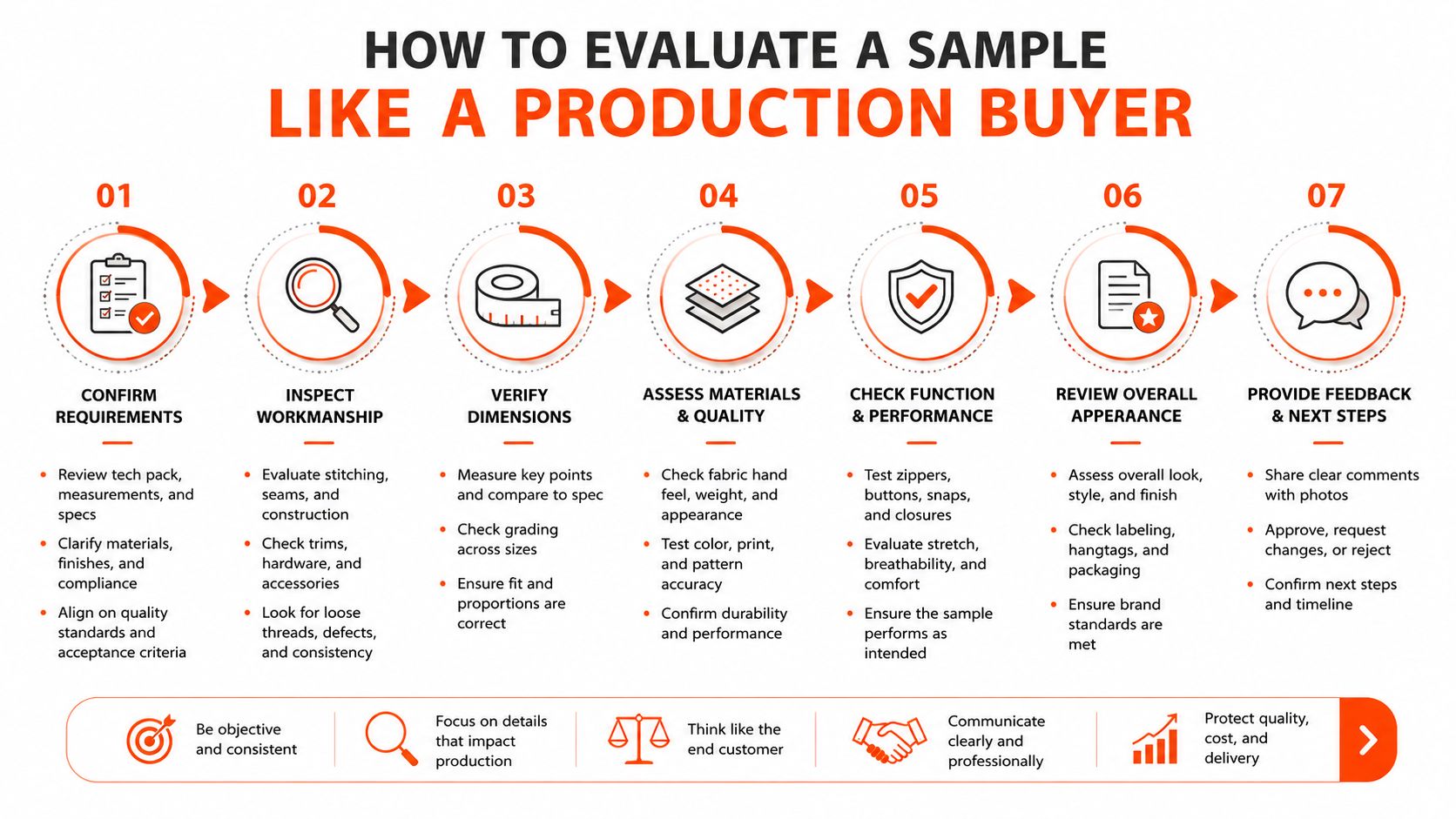
How to Evaluate a Sample Like a Production Buyer
Put the sample flat on a clean table. Don't start with the logo, color, or packaging. Start with the physical evidence.
Use your hands before your eyes
Run your palm across the body, then turn the garment inside out. A brushed back should feel even, not patchy or aggressively fuzzy. French terry should show consistent loops without thin zones, snags, or irregular gaps.
Stretch the body fabric gently across the chest and release it. Then test the neck rib, cuffs, and waistband separately. Good recovery means the material returns without a visible wave or slack edge. A rib that looks fine before wear but stays stretched after handling will make the sweatshirt look tired quickly.
Check the collar tape and shoulder seam next. The tape should sit flat, the seam should be straight, and the shoulder should not show puckering. Inspect the cuffs for balanced stitching and clean joins, then turn the garment inside out to look for loose threads, skipped stitches, and uneven seam allowances.
Verify the sample against the tech pack
Weigh the sample or test a fabric cutting against the approved GSM specification. Compare the measurements with the tech pack, including chest, body length, sleeve length, rib height, and neck opening. A sample that feels premium but misses the approved silhouette is still a failed sample.
Look at print placement and embroidery tension only after checking the base garment. A good decoration cannot hide a spiraled side seam or unstable rib.
Run a simple recovery check:
- Stretch the body and rib using consistent, moderate force.
- Record how the fabric looks immediately after release.
- Leave the sample flat for 24 hours.
- Recheck the same areas for waviness, distortion, or permanent extension.
For a more formal sample workflow, review the requirements and process described in this guide to custom apparel samples. The point isn't to turn every buyer into a textile laboratory. It's to stop approving garments based on first touch alone.
A sample is a promise. The wash test tells you whether the factory can keep it.
Pre-Wash vs Post-Wash and the Tests That Matter
The cleanest sweatshirt in the showroom can become the worst garment in the order. Brushing creates immediate softness, garment dyeing can create an appealing worn surface, and finishing treatments can make a blank feel expensive before it has experienced real use.
That first impression is useful for styling. It isn't proof of durability.
Independent textile references identify dimensional stability and pilling resistance as core sweatshirt quality indicators. Shrinkage is commonly assessed with AATCC 135 or ISO 5077, while domestic washing and drying procedures can follow ISO 6330. Well-finished cotton-based apparel often targets roughly 3–5% shrinkage, while untreated cotton can shrink around 5–10% and polyester typically remains under 1%, as summarized in this fleece testing research.
Build a production-equivalent wash protocol
Use the approved bulk fabric, not only a development sample. Wash and dry it under the conditions your customer will realistically use, then measure the same points before and after laundering. Dimensional change often appears during the early washes, while pilling may emerge later around collars, cuffs, and underarms.
For pilling, use a named method. ASTM D3512/D3512M covers random tumble pilling, and ASTM D3511/D3511M covers brush pilling. ISO 12945-2 uses a modified Martindale method, and one technical knitwear guide summarizes typical acceptance targets around grade 3–4 on a 1–5 scale. Testing standards should appear in the supplier's documentation, not remain an informal promise.
| Test | Method | Acceptable Threshold | Premium Target |
|---|---|---|---|
| Dimensional change | ISO 6330 washing and drying, ISO 5077 assessment | Defined shrinkage limit stated by the buyer | Stable measurements within the approved tolerance |
| Pilling resistance | ISO 12945-2, ASTM D3512/D3512M, or ASTM D3511/D3511M | Grade 3–4 on the selected scale | Consistent surface with no early visible pill build-up |
| Fabric weight | ASTM D3776 or equivalent controlled method | Approved GSM tolerance | Consistent weight across the bulk run |
| Surface finish | Production inspection and wash comparison | No uneven fuzzing or harsh zones | Even hand-feel before and after laundering |
Put the claim in writing: “Supplier must meet the approved GSM tolerance, dimensional-change limit, and pilling grade on production-equivalent fabric tested under the agreed wash method. Any deviation requires written approval before bulk shipment.”
Singeing and heat-setting can reduce pilling in polyester-cotton three-thread fleece, but finishing quality matters more than a blend label alone. The product is not the pre-wash hand-feel. The product is the garment after the customer has lived in it.
A Practical Inspection Checklist for Bulk Orders
Bulk inspection starts before the factory packs a carton. If the tech pack is vague, the inspection becomes subjective, and subjective inspections usually favor the supplier.
Lock the measurement system first
Send a full size set with measurement points, tolerances, and a diagram. Common apparel tolerances may be set at ±1 cm for chest and length and ±0.5 cm for sleeve, while fabric weight may use ±5%, based on the approved specification. These are not universal legal limits. They're practical control points that must be agreed before production.
Check the approved sample against the pre-production sample, then compare the pre-production sample with bulk. A factory can reproduce the wrong reference perfectly, so every stage needs a signed baseline.
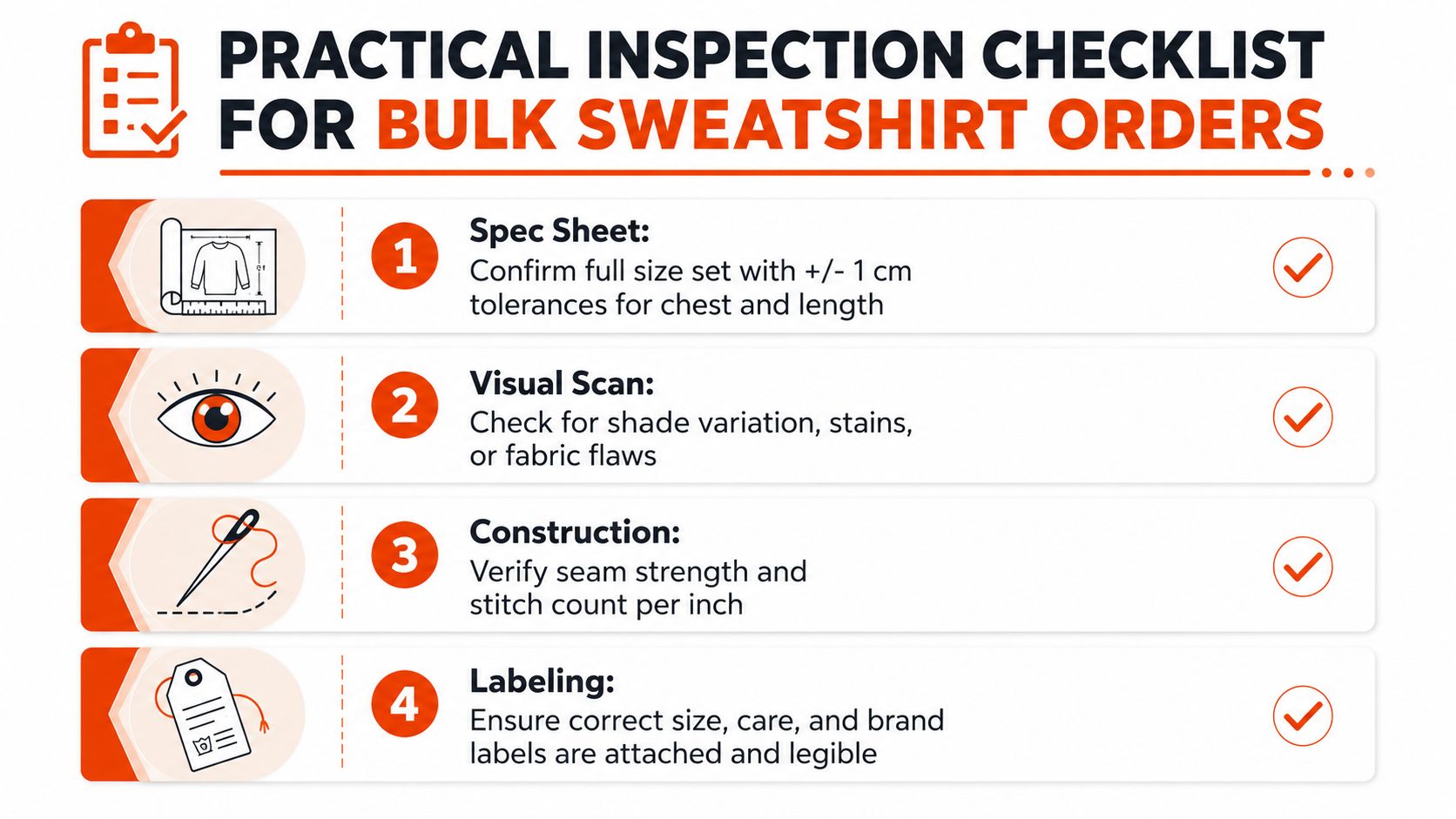
Inspect the garment in four passes
- Visual scan: Check shade variation, stains, fabric flaws, dropped stitches, spiraled side seams, and misaligned graphics.
- Trim check: Inspect neck tape, rib recovery, drawstring aglets, grommet placement, label legibility, and exposed elastic.
- Construction review: Open the garment where possible. Look at seam strength, stitch consistency, skipped stitches, loose threads, and coverstitch density.
- Label compliance: Confirm the correct size, care, fiber, brand, and country information is attached and legible.
AQL sampling can help structure the inspection, but it doesn't make a defective garment acceptable. Apparel programs commonly reference 2.5 general AQL and 4.0 critical AQL levels. The actual acceptance decision depends on the lot size, sample plan, defect classification, and the agreement in the purchase order.
Don't forget the shipment
Before loading, reconcile the poly bag count against the purchase order. Record master carton weights, check humidity indicators where relevant, and request time-stamped production-floor photos showing packed goods, labels, carton marks, and loading conditions.
Shipment control: If the factory can't show what left the floor, your receiving team will have to reconstruct the story from the cartons.
Reject defects that alter fit, appearance, safety, or brand presentation. A missed stitch may be minor on one unit and evidence of a broader process failure across the run. The buyer's job is to identify the pattern before the customer does.
Sustainability Signals and What They Actually Mean
Sustainability language only helps buyers when it connects to traceable production. A hangtag claiming “eco” tells you less than a certificate number, certifying body, and defined scope.
Certifications such as GOTS, GRS, OCS, Fair Trade, and BCI address different parts of fiber, processing, labor, or supply-chain control. Treat them as evidence to verify, not decoration. A useful primer on what sustainable design means makes the same broader point: responsible design has to influence the product and its lifecycle, not just the story around it.
Connect materials to performance
Fiber traceability can reveal whether a mill controls the inputs that affect aging. Long-staple organic cotton can reduce surface fuzzing, ring-spun yarns generally offer a smoother hand than open-end yarns, and recycled polyester can contribute to dimensional stability and pilling performance when the fabric is properly engineered. None of these outcomes is automatic. The finishing process still decides a great deal.
Ask for residual chemical screening under OEKO-TEX Standard 100 or evidence of ZDHC MRSL alignment where relevant. Then connect the paperwork to physical testing. A certified material that shrinks badly or pills early still creates waste through premature replacement.
For teams sourcing branded basics, the organic cotton fabric guide can help distinguish fiber terminology from actual sourcing requirements. Your manufacturer should identify the mill, not just repeat the fiber name.
Use one simple verification rule:
- Request the certificate number.
- Name the certifying body.
- Confirm the certificate scope.
- Check the certifier's public database before approving the sample.
A credible sustainability story is usually a byproduct of controlled production. It can't replace shrinkage testing, pilling testing, or bulk inspection.
Specs and Questions to Send Your Manufacturer
The point where buyers become serious is the point where they stop saying “premium” and start specifying what premium means. Send a manufacturer a document that leaves little room for interpretation.
| Category | Specification or Question to Include |
|---|---|
| Composition | State fiber content, blend percentages where applicable, and required certification scope |
| Fabric weight | Target GSM, measurement method, and agreed tolerance |
| Knit type | Specify French terry, brushed fleece, two-end, three-end, or another construction |
| Yarn | Ask for yarn count, spinning method, fiber length, and supplier identity |
| Dyeing | State dye method, shade standard, lab-dip approval, and lot consistency requirement |
| Shrinkage | Define pre-wash and post-wash measurement points, wash method, and maximum dimensional change |
| Pilling | Name the test method, cycle, rating scale, and minimum acceptable grade |
| Seams | Specify coverstitch, chain stitch, taped neck, seam allowance, and stitch-density expectations |
| Rib | Define rib composition, height, recovery requirement, and color matching |
| Trims | List drawcords, aglets, grommets, labels, hangtags, and packaging requirements |
| Compliance | Request care, fiber, size, brand, and country labels with approval before bulk |
| Packing | Specify folding method, polybag details, carton marks, carton quantity, and shipping documentation |
| Production control | Ask for pre-production approval, bulk inspection process, AQL standard, and photo log |
Ask who supplies the yarn and where knitting takes place. Cutting and sewing may happen at a different facility, so record each production location. Then ask whether the factory can match a reference garment during pre-production, including weight, hand-feel, measurements, rib recovery, and wash performance.
Questions that expose weak sourcing
A capable supplier answers with documents, named processes, and measurable limits. A weak supplier answers with adjectives.
Ask:
- What is the approved GSM tolerance, and how will you measure it?
- Which wash method will you use for shrinkage testing?
- Which pilling standard and rating scale will appear on the report?
- Is testing performed on bulk fabric or only on a development sample?
- What happens if the bulk fabric falls outside the approved tolerance?
- What AQL standard is written into the purchase order?
- Can you provide a full size set and a measurement-point diagram?
- Who approves shade variation between dye lots?
- Which facility applies the decoration and final labels?
- Can you produce private-label woven labels and hangtags, including the requirements described in this guide to custom neck labels?
For branded merch, add the details that turn a blank into a product: woven labels, hangtags, polybag specifications, fold and pack method, branded mailers, and multi-address shipping instructions. Banger is one sourcing option for teams that need premium European blanks, custom decoration, French atelier production, low minimums, and worldwide fulfillment. The important part isn't the vendor name. It's whether the supplier will put the garment's performance into writing.
Build your next team drop around specs that survive the wash, not a GSM headline that looks good in a catalog. Visit Banger to explore premium blanks, custom finishing, French production, and worldwide fulfillment for branded apparel your team will actually keep wearing.