Modal vs Cotton Underwear: Which Fabric Actually Wins
Most modal vs cotton underwear advice gets one thing backward. It treats softness like the whole story, when comfort is only one job a fabric has to do. If the underwear is for daily office wear, sweaty travel days, gym sessions, hot weather, or a branded merch drop, the right answer changes fast.
| Criterion | Modal | Cotton |
|---|---|---|
| Next-to-skin feel | Smoother, finer, more uniform | Natural, familiar, more variable |
| Breathability | Solid, but not the strongest airflow story | Stronger airflow and ventilation |
| Moisture handling | Moves moisture faster and dries faster | Absorbs well, can feel heavier when damp |
| Shape over time | Keeps fit and cut better | More prone to shrinkage unless engineered well |
The simple question is which fabric helps the underwear do its job without annoying the person wearing it. That means looking at hand feel, breathability, moisture management, durability, care, and, for brands, how the fabric behaves once you turn it into a product people will keep wearing.
Table of Contents
- Why This Comparison Matters More Than You Think
- Modal is engineered cellulose, cotton is a natural seed fiber
- The yarn and knit matter almost as much as the fiber
- Softness is modal's cleanest win
- Breathability is still cotton's strongest case
- Moisture handling is where the decision gets practical
- What the table really says
- Wash life changes the answer fast
- Pilling and shape retention separate premium from cheap
- Which fabric ages better depends on the buyer's tolerance
- Everyday wear and office days
- Travel, long days, and sweaty commutes
- Gym sessions, active use, and hot climates
- Sensitive skin and buyers who care about touch
- Branding changes the production conversation
- Sustainability signals matter to modern buyers
- What to ask a production partner
Why This Comparison Matters More Than You Think
The lazy take is that softer means better. That sounds neat, but it's a terrible way to buy underwear because softness alone doesn't tell you how the garment will behave after a full day, a hot commute, or ten washes. A fabric can feel great in-hand and still lose the fit, hang onto sweat, or age badly in the drawer rotation.
What matters is the job. Modal usually earns its keep when the wearer wants a smoother feel, faster moisture movement, and better shape retention through repeated laundering. Cotton still makes sense when airflow, a more natural hand, and straightforward everyday comfort matter more than quick-dry performance. For a plain everyday brief or boxer brief, both can work. For active wear, travel, humid climates, or a branded drop that needs to stay presentable, the trade-off gets sharper.
Practical rule: don't ask which fabric is “better,” ask which failure is more annoying, dampness, shrinkage, or a rough next-to-skin feel.
That's the lens I'd use in production too. Buyers often over-focus on fabric labels and under-focus on wear conditions, which is how they end up with a product that looked right on a sample sheet but feels wrong after real use. If you're building a wardrobe staple, not a throwaway, you need to think like a buyer, not a mood board.
For a quick primer on how raw material categories differ, identify natural and synthetic fabrics is a useful starting point because it forces the basic taxonomy before the marketing language kicks in. And if you're comparing cotton options specifically, the differences between standard and organic builds are worth checking in this organic cotton fabric overview.
What Modal and Cotton Actually Are
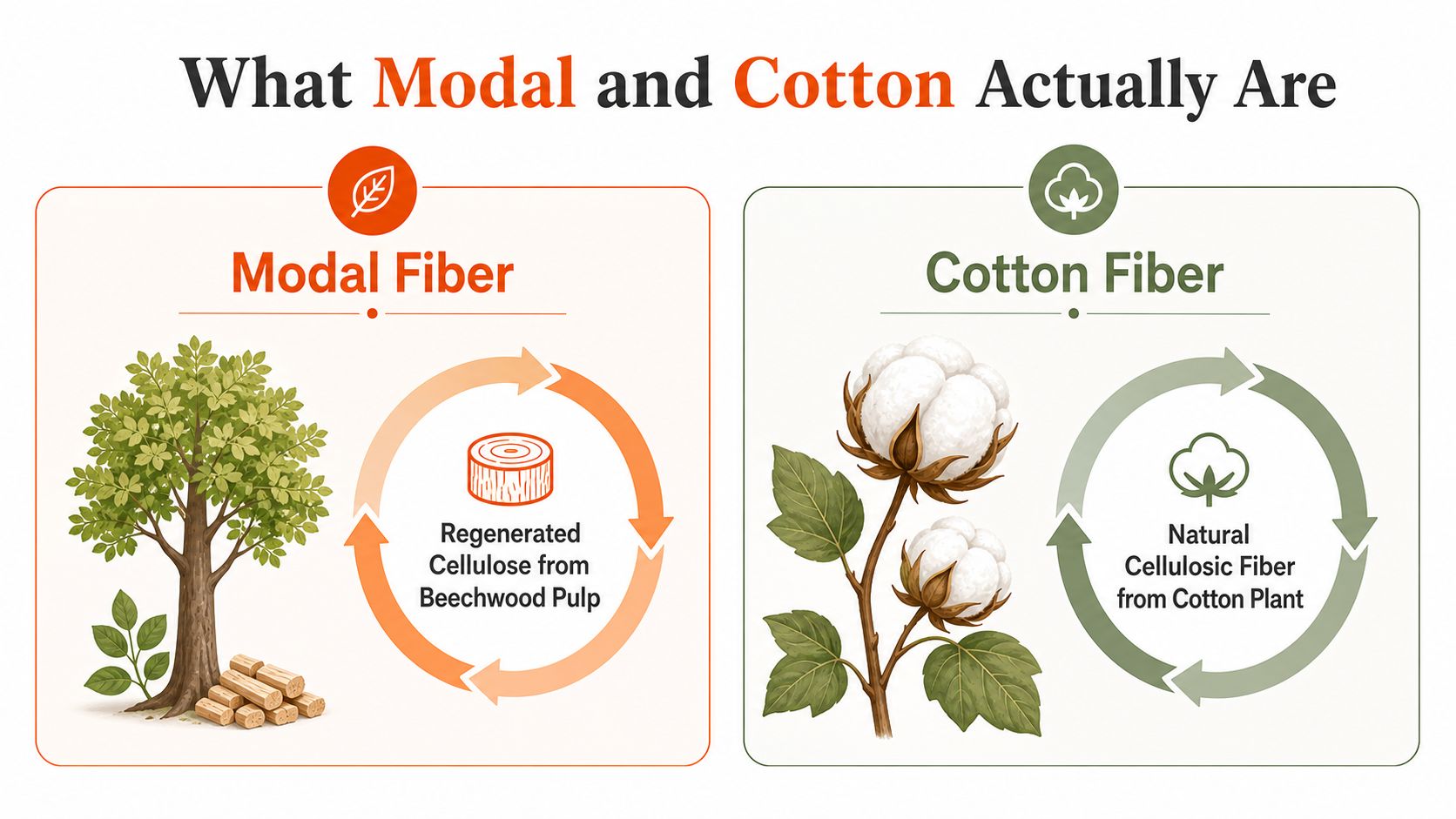
Modal is engineered cellulose, cotton is a natural seed fiber
Modal is a regenerated cellulose fiber made from beechwood pulp, and that matters because the fiber can be spun to feel more uniform and controlled than many cotton builds. You'll often see it referenced through names like TENCEL Modal or Lenzing Modal, which signals a more traceable supply chain and a higher-end spec. Cotton, by contrast, is a natural seed-hair fiber that comes off the plant with more variation baked in from the start.
That structural difference shows up in the hand. Fiber-level measurements from a technical underwear analysis put micromodal at about 10 μm, while upland cotton runs about 12 to 22 μm. Finer fiber usually means a smoother next-to-skin feel, and that's a big part of why modal reads as more polished on body.
The yarn and knit matter almost as much as the fiber
A lot of people talk about “modal” or “cotton” like the label decides everything. It doesn't. The way the fiber is spun, the yarn count, the knit structure, and the finishing all shape the final result. Modal yarns are often more uniform, which helps the fabric feel sleek and less gritty. Cotton can be beautiful too, but the texture changes more depending on staple length and processing.
If you're sizing up how fabrics are built for apparel, this GSM fabric weight guide is a smart companion read because construction details matter just as much as fiber content. GSM doesn't tell the full story here, but it does tell you how much fabric you're dealing with, which is useful when you're evaluating underwear, tees, or any close-to-body layer.
Modal is the more controlled material. Cotton is the more familiar one. That difference explains most of the comfort debate before you even get to performance.
Side by Side on Softness, Breathability, and Moisture
Softness is modal's cleanest win
Modal's best card is simple. It feels smoother against skin because the fiber is finer, and that clean hand shows up immediately in underwear. One technical comparison reports equilibrium moisture regain of 11 to 13% for micromodal versus 7 to 8.5% for cotton, which helps explain why modal can feel softer and more supple in wear while still managing sweat well. Cotton, on the other hand, usually reads as familiar and natural rather than slick.
Breathability is still cotton's strongest case
Cotton remains the airflow fabric. An underwear comparison cited cotton as more breathable and better at air movement, while modal was described as stronger on moisture movement and quicker drying. That's why cotton still feels right for people who prioritize ventilation over fast recovery after sweat. It lets the body breathe in a way many buyers still prefer, especially in low-activity settings.
Moisture handling is where the decision gets practical
Modal has the cleaner sweat story. Another comparison described modal as having about 50% higher moisture-wicking capacity than cotton and drying faster, which is exactly what you want in heat, travel, or long wear days. Cotton can absorb up to 27% of its weight in moisture before it feels wet, but once it gets damp, it tends to stay heavier than modal. That's the difference you feel on a commute or after a long stretch sitting still.
Bottom line: modal moves moisture faster and stays lighter, cotton breathes more and absorbs more. Pick the trade-off you actually want.
What the table really says
If you want a fast decision, read the contrast like this. Modal wins on softness, smoother drape, and moisture management. Cotton wins on airflow, familiar comfort, and the natural-fiber feel some people want on skin. That's why “modal vs cotton underwear” is not a beauty contest. It's a use-case question.
Durability, Pilling, and How Each Fabric Ages
Wash life changes the answer fast
The first few wears can hide a lot. After repeated washing, the differences get obvious. Alibaba's product-insights page says cotton underwear shrank by an average of 5 to 7% after 10 washes unless it was pre-shrunk, while modal shrank by less than 2% and held its fit and cut more effectively. That's not a tiny detail. Fit stability affects how underwear feels, how long it stays in rotation, and how often buyers decide it's time to replace it. Alibaba's comparison of cotton vs modal underwear puts that shrinkage problem right where it belongs, in the durability conversation.
The same source says well-made cotton underwear typically lasts 6 to 12 months of regular use. That makes shrinkage a real product issue, not a side note. If the waistband twists, the leg opening tightens, or the rise changes, the wearer doesn't care about fiber romance. They just stop reaching for it.
Pilling and shape retention separate premium from cheap
Pilling shows up faster on lower-quality cotton knits, especially when the yarn is short, loose, or poorly finished. Modal's smoother fiber structure and longer filament profile help it resist that fuzzy, worn-out look longer. Cotton can absolutely be engineered to perform better, especially if it's pre-shrunk and built with better yarns, but the baseline risk is still higher.
For anyone comparing underwear to other apparel categories, the same logic shows up in tees. This premium blank t-shirts guide makes the same point in a different product family, the best blank is the one that keeps its shape and surface after real wear, not the one that only looks good on day one.
Which fabric ages better depends on the buyer's tolerance
If the wearer wants a garment that stays looking clean longer, modal has the edge. If they're okay with a fabric that relaxes and softens over time, cotton can still work, but it needs better engineering to avoid early fit drift. Pre-shrunk cotton closes the gap, but it doesn't erase the underlying tendency. In underwear, that matters more than in a tee because the fit sits closer to the body and gets judged every time it's worn.
Which Fabric Wins by Use Case
Everyday wear and office days
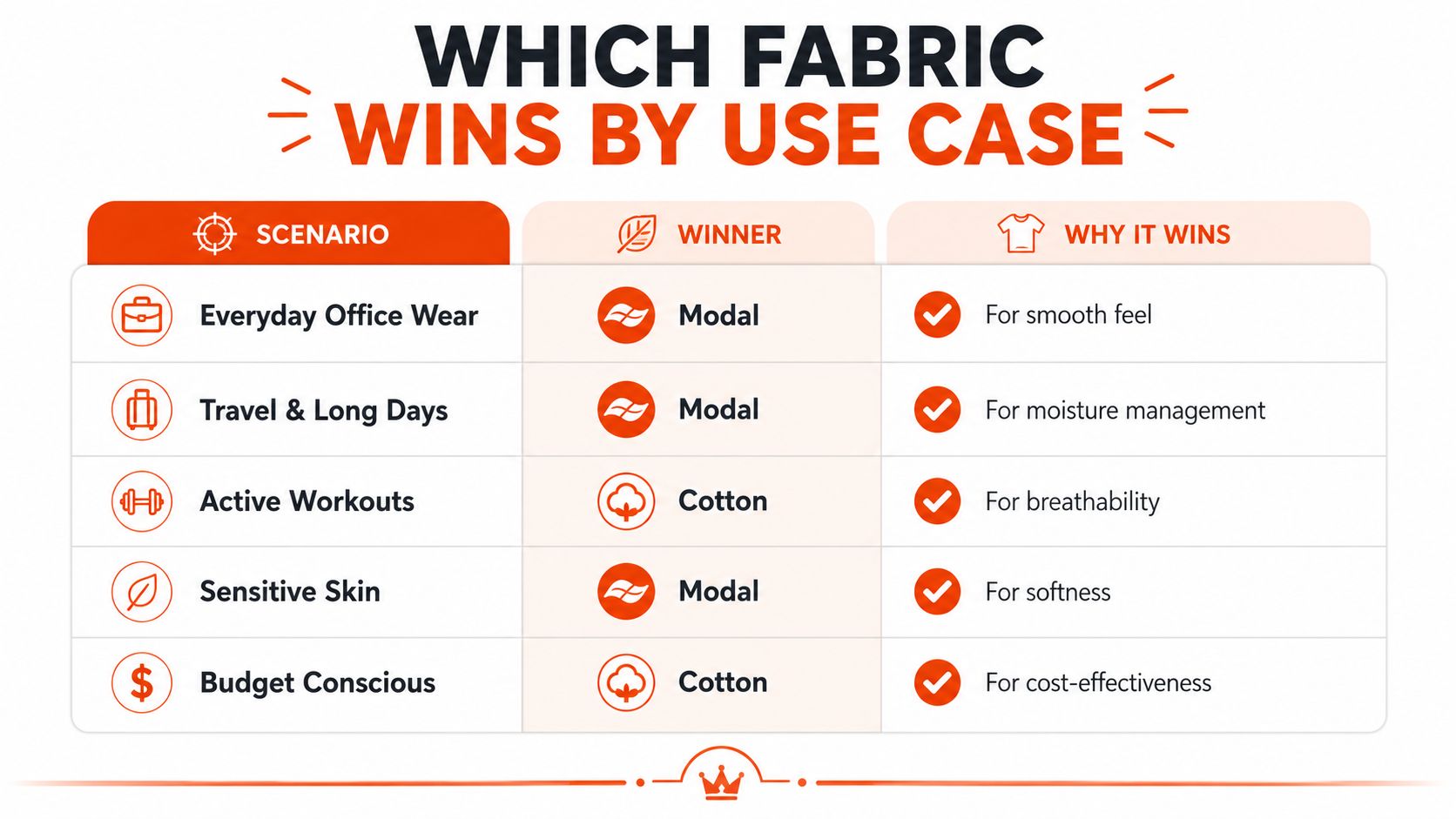
For daily office wear, I'd lean modal. It sits smoother under trousers, feels cleaner for longer, and doesn't get as annoying if your day runs long. If the wearer spends most of the day seated, modal's comfort and stability matter more than pure airflow.
Travel, long days, and sweaty commutes
For travel, modal is the better call. The moisture-management advantage matters when you're stuck in transit, moving between climates, or wearing the same pair from morning to night. Cotton can work, but it's the fabric more likely to feel heavier once it's picked up moisture.
Gym sessions, active use, and hot climates
Here's the split that matters. For active movement and humid conditions, modal usually wins because it handles sweat better and dries faster. For hot, dry weather or long rest periods, cotton can be the better call because it breathes well and feels more natural when ventilation is the main priority. One source put that context nicely, modal suits active lifestyles and moderate climates, while cotton can be the better choice in hot, dry weather or long rest periods. Shinesty's modal vs cotton underwear comparison makes that use-case split explicit.
Use-case rule: if sweat management is the problem, pick modal. If airflow is the problem, pick cotton.
Sensitive skin and buyers who care about touch
For sensitive skin, modal usually gets the nod because the fiber is finer and the surface feels smoother. Cotton still has loyal fans because it feels honest and familiar next to skin, but if someone is sensitive to texture or wants a softer first touch, modal is the safer recommendation.
The attached comparison video is useful if you want a visual rundown of the trade-offs in a wearable context.
Customization, Printing, and Sourcing for Branded Merch
Branding changes the production conversation
Underwear is a weirdly strategic merch piece because it sits in the same category as premium basics, not disposable giveaway junk. That means branding has to be subtle, comfortable, and durable. Cotton knits usually take screen printing and label finishing without drama, while modal can produce a cleaner, more polished result when the branding is minimal and the hand feel needs to stay premium.
For teams deciding how visual the product should be, apparel photo printing methods is a helpful reference because it lays out how print techniques affect the final look on fabric. The same thinking applies here. The more delicate the fabric hand, the more careful you need to be with decoration, waistband treatments, and tag choices.
Sustainability signals matter to modern buyers
Cotton still carries strong trust, especially when it's organic or certified through a transparent supply chain. Modal can also play well here, especially when buyers look at Lenzing Modal and traceable sourcing rather than generic viscose-style blur. That matters for teams that care about what the fabric says as much as how it feels.
If you're building branded basics, the smartest question is not “which fabric is more premium.” It's “which fabric matches the identity of the product and the audience wearing it?” A creator drop, an onboarding kit, and a conference gift all want different answers.
What to ask a production partner
- Decoration method: Will the waistband, care label, or packaging stay comfortable after printing or finishing?
- Fabric behavior: Does the knit keep its shape after washing, or does it relax quickly?
- Order size: Can the supplier handle low MOQ work without turning the product into a generic stock blank?
- Brand story: Does the fabric support the sustainability message you want to send?
For a broader view of decoration workflows, this custom shirt printing guide shows how print choices affect the final garment. The same production mindset carries over cleanly to underwear.
Picking the Right Fabric and Making It a Brand Asset
Ask four questions before you choose
Who's wearing it. Where will they wear it. How often will it get washed. What do you want the fabric to signal. If the answer leans toward comfort under movement, travel, heat, or long wear, pick modal. If the answer leans toward airflow, natural hand, and a familiar everyday feel, pick cotton.
For giveaways, the same logic applies. Advice for useful company giveaways is a decent reminder that people keep the items that solve a real problem, not the ones that just carry a logo. Underwear is even harsher than a bottle. If the fabric misses the use case, the logo doesn't save it.
My blunt recommendation
Choose modal for premium everyday basics, active wear, humid climates, and any branded piece where fit stability matters. Choose cotton for buyers who want the most breathable, most familiar natural option and don't mind a little more aging. If you're building a product to be worn often, modal is the safer bet. If you're building a product to feel airy and simple, cotton still earns its place.
For broader cut-and-sew thinking, this apparel development guide is worth a look because the fabric choice is only one part of whether the final piece feels intentional or cheap.
If you want help turning fabric choice into an actual product decision, Banger can source premium European blanks in modal or cotton, build the right finishing details, and turn a basic underwear concept into something people keep in rotation. Visit Banger to request a quote, review product previews, and see how the right fabric can make branded underwear feel like a real wardrobe staple.