Elevate Your Corporate Gifting Programs for 2026
Most advice about corporate gifting is stuck in an office park from ten years ago. It assumes a centralized team, a holiday budget, and recipients who are somehow excited to get the same mug, basket, or logo tee everyone else got.
That playbook breaks fast with distributed, internet-native teams. Remote employees care about fit, taste, timing, and whether the thing feels like your brand or just procurement doing procurement things. Clients and partners notice the same stuff. A generic gift doesn't feel neutral anymore. It feels lazy.
The upside is bigger than many realize. Corporate gifting isn't some minor line item anymore. One market estimate puts the category at about $1.11 trillion by 2028 as a projection, via Postal's corporate gifting market roundup. At that scale, the question isn't whether companies are gifting. It's whether they're building programs that create actual cultural and commercial value.
Table of Contents
- The old gifting model is built for compliance, not connection
- What modern teams actually need from gifting
- Start with identity, not inventory
- Build tiers without turning the program into a points system
- Packaging is part of the product
- Should corporate gifting programs focus on employees, clients, or both
- How personalized should a gifting program be
- What gifts work best for distributed internet-native teams
- How long does a corporate gifting program take to launch
- What's the biggest mistake teams make after launch
Phase 0 Why Most Corporate Gifting Fails
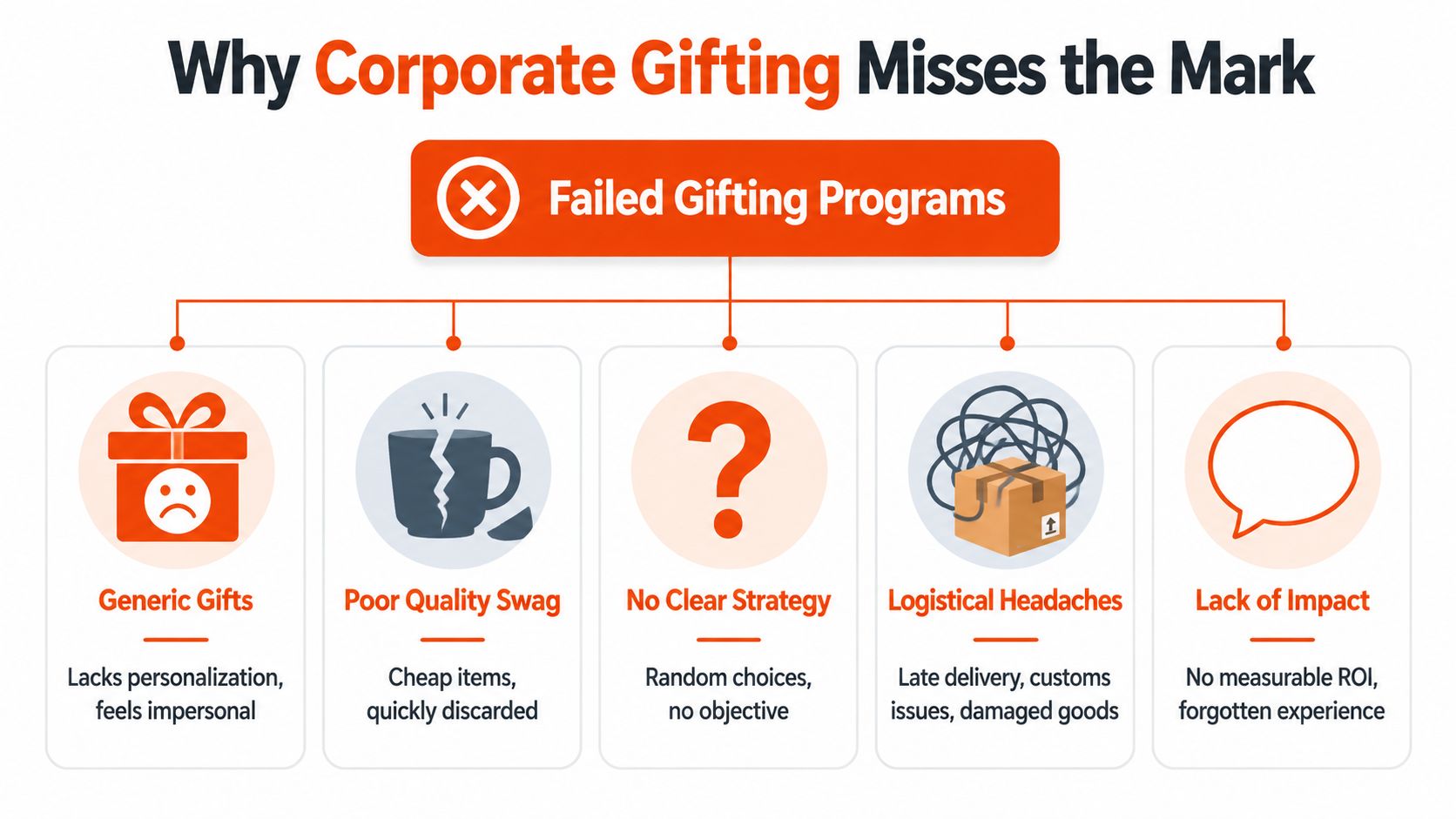
Most failed corporate gifting programs don't fail because the team forgot to order something. They fail because nobody decided what the gift was supposed to do.
A lot of companies still treat gifting like a seasonal errand. Buy items in bulk, add the logo, send them out, hope people smile. That approach creates volume, not meaning. For modern teams, especially remote ones, the gap is obvious. If the object feels generic, low quality, or disconnected from the moment, the recipient reads that instantly.
The old gifting model is built for compliance, not connection
Traditional gifting logic is simple. Stay safe, pick something broadly acceptable, keep procurement happy. That's how you end up with desk clutter and forgettable branded goods.
That logic isn't harmless. A weak gift can diminish brand perception because it tells people your company doesn't notice detail. Internet-native teams are especially sensitive to this. They live in a visual culture. They know the difference between intentional design and filler.
Three patterns show up again and again:
- Generic selection: The item could've come from any company, in any industry, in any year.
- Bad product-market fit: You send heavy office swag to a mobile team, or formal gift baskets to people who'd rather get wearable gear.
- No emotional timing: The gift isn't tied to onboarding, a milestone, a launch, a thank-you, or a recovery moment. It just appears.
If you do want a more traditional format for certain moments, curated options like Canadian corporate gift baskets can make sense for specific local recipients or hospitality use cases. The key is context. A basket works when it fits the audience and occasion, not when it's a default because nobody had a stronger idea.
Corporate gifting works best when it behaves like a brand experience, not a shipping task.
What modern teams actually need from gifting
Remote culture is built through small signals. A well-timed hoodie with thoughtful finishing. An onboarding pack that feels like joining something with taste. A launch gift that people post because it looks good enough to wear outside the house.
That's why gifting now belongs closer to brand, people, and community teams than to office admin alone. The strongest programs create moments people remember. They reinforce identity. They make the company feel coherent.
A useful test is this: would the recipient keep it if your logo were smaller?
If the answer is no, the issue usually isn't customization. It's product choice. Teams looking for better inspiration than the usual tote-and-pen loop can borrow ideas from strong event swag ideas for modern teams, then adapt those concepts for gifting moments with more personalization and better timing.
Phase 1 Designing a Drop People Actually Want
Bad corporate gifts usually fail before sourcing starts. The problem is concept, not shipping. If the idea is generic, no premium blank, recycled fabric, or nicer insert card will save it.
For distributed teams, gifting has a harder job than it does in a traditional office. It has to travel across countries, work across climates, and still feel native to your brand. The best programs treat each send like a product drop with a clear point of view. Fewer pieces. Better judgment. Higher standards on design, materials, and relevance.

Start with identity, not inventory
A supplier catalog is a bad place to begin. Start with the moment you are designing for and the signal you want the gift to send.
Onboarding gifts should reduce distance fast. A new hire in Berlin, Lagos, or Toronto should open the box and understand the team's taste level immediately. Client gifts should reflect the quality of the relationship. Launch gifts should feel connected to the campaign world, not like leftover ops budget spent on branded objects.
That framing sharpens the brief. The right question is simple: what would this person keep, wear, use, or post without feeling like they are doing your brand a favor?
A useful brief usually covers:
- Recipient context: role, geography, climate, customs constraints, and whether the person is more likely to want apparel, desk objects, food, or travel gear
- Brand expression: subtle mark, insider cue, or louder campaign treatment
- Use case: daily wear, home office, event follow-up, milestone gift, or welcome kit
- Taste threshold: whether the item clears the bar for real life, not just company life
Sustainability belongs here too, because recipients read material choices as a proxy for brand judgment. According to Prize Possessions' summary of corporate gifting ideas, employees show a clear preference for eco-friendly gifts. For people and brand teams, that matters. Premium, lower-waste choices tend to feel more intentional, and intentional gifts get kept longer.
Build tiers without turning the program into a points system
Different audiences need different levels of gifting. Internet-native teams usually get better results by building gift families instead of formal tiers. Keep the visual language consistent, then vary the depth.
A new hire might get a strong core kit. A long-term client might get the premium version with better packaging and a personal note. A product launch contributor might get a limited piece tied to the release. Same world. Different expression.
That approach protects brand coherence and budget discipline at the same time. It also avoids a common mistake: sending the exact same branded kit to everyone because standardization feels operationally easier. Easy for ops is not the same as memorable for the recipient.
Personalization needs restraint. Names on everything usually make gifts feel forced and harder to reuse. The better places to personalize are size, color preference, timing, packaging, and the note. Those choices make people feel seen without turning the item into a souvenir from HR.
If you want a sharper framework for translating brand into physical product, this guide on how to create merchandise people want is worth reading.
Packaging is part of the product
Packaging sets the quality expectation before the gift is touched. A strong item in a flimsy box loses status fast.
Good packaging protects the contents, carries your brand language, and photographs well enough that recipients want to share it. That matters more for remote teams because the unboxing moment often stands in for the in-person handoff. If the outside feels careless, the whole program feels careless.
Structure matters. So does restraint. One clean shipper, one well-sized box, one insert with a real message. No filler material pretending to be luxury. Teams exploring formats and finishes can learn about custom boxes from Packaging Panda to get a better read on inserts, print treatment, and sizing decisions that change the experience.
The standard is simple. If the gift looks good on a desk, in a closet, and in an Instagram story, you are close. If it only looks good on a procurement spreadsheet, start over.
Phase 2 The Modern Sourcing & Production Model
A gifting program does not fall apart at the concept stage. It falls apart in sourcing, sampling, and production, where internet-native teams often inherit old enterprise workflows that were built for bulk swag, not brand-led drops sent across a distributed company.
The weak point is distance from the factory. The more intermediaries between your team and production, the more likely your spec gets diluted. Fabric weight gets substituted. Trim details disappear. Packaging changes without context. The pre-production sample looks polished, then the final run arrives with softer construction and cheaper finishing because nobody caught the shift early enough.
That problem gets worse for remote teams. You are not ordering a few boxes for one office manager to hand out. You are building a repeatable system that has to hold up across countries, climates, and recipient expectations. Premium, sustainable merch only earns its keep if the quality survives scale.
Why middle layers create expensive drift
Traditional swag agencies were built to make procurement easier. That convenience has a cost.
If your brief includes garment weight, embroidery density, recycled fabric content, custom labels, box engineering, or color matching, someone has to translate those details into production language with precision. If that translation is loose, you get merch that is close to the mockup and far from the standard. Recipients notice. So does your budget, because revisions, remakes, and rush fixes are rarely cheap.
The planning work matters too. Strong gifting programs start with analysis, clear use cases, and recipient logic, as noted earlier. Last-minute item picking usually produces generic kits that feel disconnected from both the brand and the person receiving them.
What a modern production partner should handle
For distributed teams, a production partner should do more than source products from a catalog. They should be able to explain how an item will be made, where the pressure points are, and what trade-offs come with each decision.
Use this filter:
- Material specificity: Ask for exact fabric blends, GSM, coating types, paper stock, vessel materials, or packaging substrates. “Premium” is not a spec.
- Decoration realism: Confirm what method fits the item. Embroidery, screen print, DTG, debossing, foil, engraving, and woven labels all behave differently in production and at different volumes.
- Sampling rigor: Review proofs that reflect the final item as closely as possible. A digital mockup is useful for alignment. It is not production approval.
- MOQ flexibility: Smaller test runs help teams validate taste, usage, and demand before committing budget to a large global order.
- Sustainability trade-offs: Recycled or lower-impact materials can strengthen the program, but they may limit color options, increase lead times, or change unit economics.
- Operational fluency: The partner should understand sizing matrices, SKU complexity, address collection, and understanding customs classification before fulfillment starts.
One more tell. If a vendor answers every question with catalog language, they are selling inventory, not helping you build a gifting system.
For teams shaping product direction before locking production, custom design support for branded merch helps align design decisions with manufacturing reality early, which is usually where the best programs separate themselves from forgettable swag.
Phase 3 Nailing Global Fulfillment for Distributed Teams
A great gift that arrives late, damaged, or with a surprise customs invoice is not a great gift. It's an apology waiting to happen.
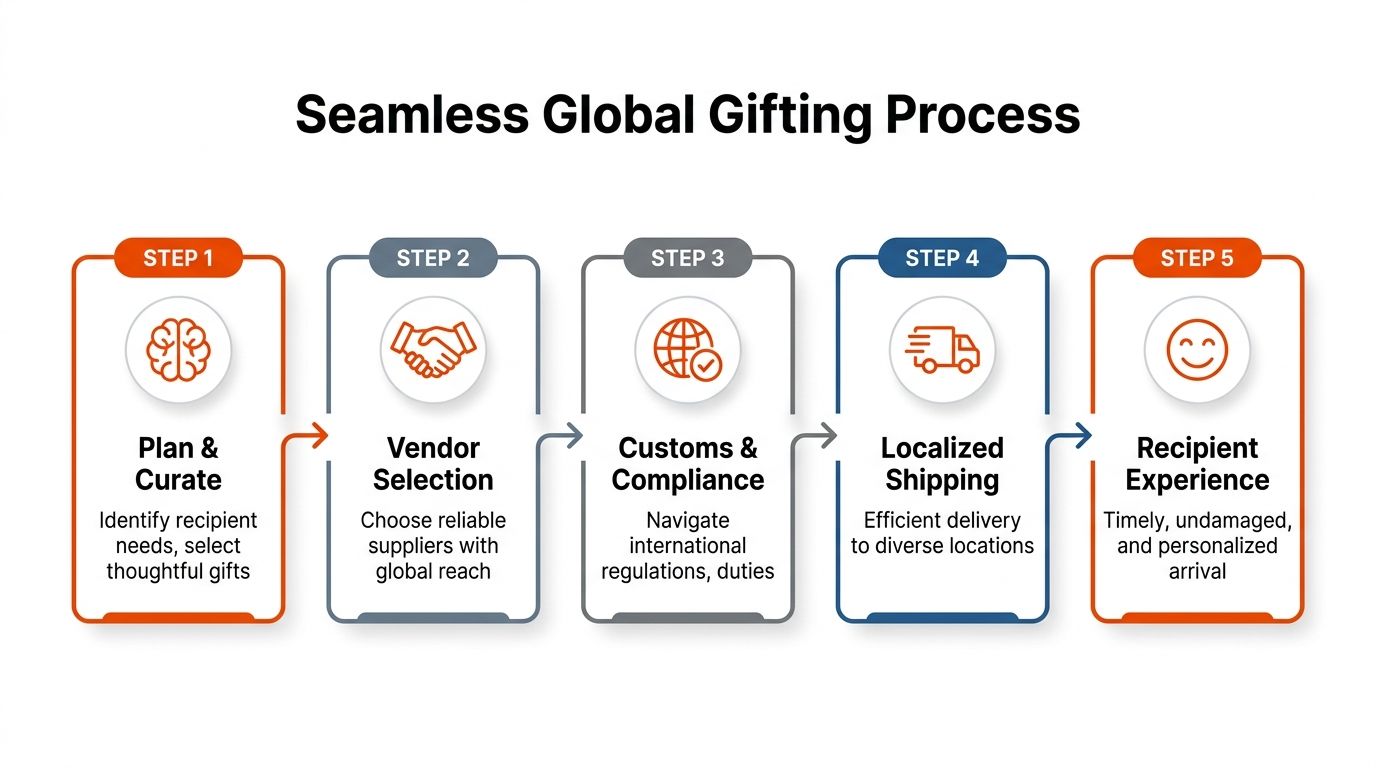
This is the part a lot of traditional corporate gifting guides barely touch. They assume one office, one receiving desk, maybe a few domestic addresses. Distributed teams don't have that luxury. They ship to apartments, coworking spaces, temporary residences, and multiple countries at once. Logistics isn't the boring back half of the program. It's the experience.
DDP is the standard, not a nice-to-have
If you're sending internationally, recipients should not become unpaid customs coordinators.
That's why DDP (Delivered Duty Paid) matters. With DDP, duties and taxes are handled before delivery. The recipient gets the package, not a payment request or a customs puzzle. The alternative, DDU, creates friction right at the finish line.
The operational downside is real. Northstar Meetings Group's article on corporate gifts with a charity element cites a 2024 Deloitte study saying 68% of companies struggle with customs delays, and notes that multi-address shipments crossing 3+ borders without DDP have a 40% higher failure rate in on-time delivery. For remote teams, that's the difference between “nice touch” and “why did this become my problem?”
How to keep multi-address shipping from becoming chaos
The fix isn't one magic tool. It's operational discipline.
Start by collecting addresses in a standardized format. Use one intake method, validate fields early, and separate recipients by country before the production run is finished. If you wait until goods are packed to sort the shipping logic, you're already behind.
Then pressure-test the fulfillment flow:
- Data hygiene first: Wrong apartment numbers and inconsistent phone fields create a shocking amount of downstream pain.
- Country grouping: Batch by destination and customs profile, not just by campaign.
- Recipient communication: Tell people what's coming and what they may need to do, ideally nothing.
- Buffer for exceptions: Some packages will require manual handling. Build for that.
A lot of customs confusion starts with product classification. If your team needs a straightforward primer on tariff coding, understanding customs classification through HS codes is a helpful reference before you ship across multiple regions.
The cleanest gifting experiences are usually invisible. No customs emails. No missed-delivery loop. No awkward follow-up asking whether the package ever showed up.
If your program includes warehousing, kitting, or recurring sends to global recipients, look at how merch fulfillment services for multi-address delivery are structured. The right setup reduces errors before they happen instead of treating every shipment like a fresh improvisation.
Phase 4 Measuring What Matters KPIs and True ROI
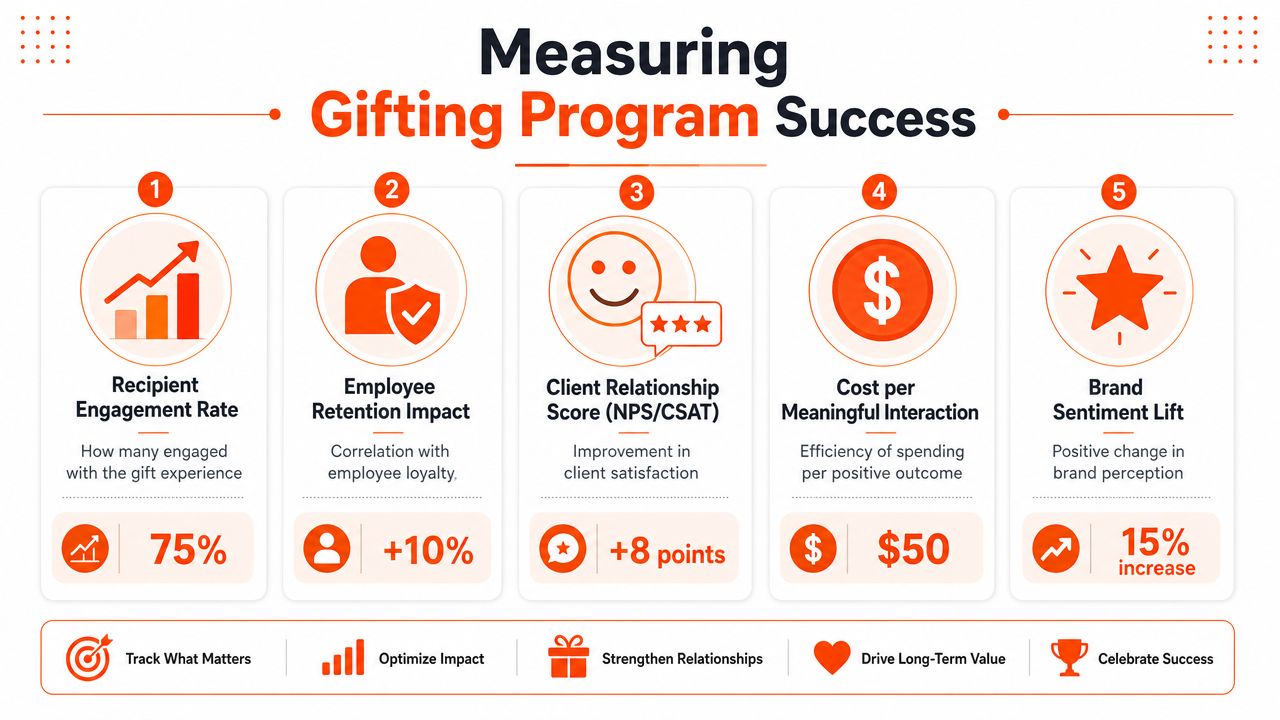
If your reporting stops at units sent and total spend, you don't have a measurement framework. You have an expense summary.
That's the trap with a lot of corporate gifting programs. Teams can tell you how many boxes went out, but not whether they arrived, were claimed, changed sentiment, improved retention, or influenced any downstream outcome. Without that layer, gifting always looks softer than it is, and finance teams start treating it like decorative spending.
A visual summary helps anchor the conversation.
Track three layers or you're not really measuring
A defensible framework measures gifting across operational efficiency, recipient engagement, and business impact, according to Huggg's guide to measuring corporate gifting ROI. That same source recommends tracking metrics like monthly participation rate, redemption rate, delivery success rate, and admin time at the operational layer, then quarterly pulse scores, eNPS, recognition frequency, and turnover, followed by annual comparisons between gifted and non-gifted cohorts on turnover, cost per hire, revenue per employee, and full ROI.
That structure matters because each layer answers a different question:
| Layer | What it tells you | Examples to track |
|---|---|---|
| Operational | Did the program run cleanly? | Delivery success, redemption, admin time |
| Engagement | Did recipients respond positively? | Pulse feedback, eNPS, recognition frequency |
| Business | Did it affect outcomes that matter? | Retention, cohort comparison, revenue per employee |
Here's the common failure mode. A team sees high send volume and assumes the campaign worked. But if redemption is weak or deliveries fail, there may have been very little actual impact. The source above also warns that teams managing physical inventory should track waste as a percentage of total spend, because unsent stock and failed deliveries can become pure cost.
A short video can help if you're building your internal reporting case:
A simple ROI workflow teams can actually maintain
Keep it boring enough to survive quarter after quarter.
Set a baseline before the program starts. If possible, maintain a control cohort. Use the same attribution window across cohorts so one group isn't being compared against a different seasonal context. That recommendation comes directly from the methodology outlined in the Huggg article above.
A practical internal dashboard can be lightweight:
- Monthly view: deliveries, claims, issues, admin load.
- Quarterly view: recipient sentiment, internal feedback, repeat recognition behavior.
- Annual view: compare gifted and non-gifted groups on retention or other business outcomes.
If you're also investing in the physical presentation layer, custom packaging design for branded merch can support stronger consistency between what you measure and what recipients experience. Packaging won't save a weak strategy, but it can improve delivery quality, perception, and claim behavior when the core program is sound.
Your Corporate Gifting Program FAQs
A good program looks smooth from the outside. Under the hood, there are always edge cases.
Should corporate gifting programs focus on employees, clients, or both
Both can work, but not with one shared logic.
Employee gifting supports culture, belonging, and recognition. Client gifting supports relationship depth, memory, and trust. Those goals overlap a little, but the gift language should change. Employees can get more insider-coded items. Clients usually need a cleaner, more universally readable experience.
If budget is tight, start with the audience where the gifting moment is clearest and easiest to operationalize well. A smaller, sharper program beats a broad, sloppy one.
How personalized should a gifting program be
Personalization should feel intentional, not creepy and not overproduced.
Generally, the sweet spot is light-to-medium personalization. Recipient name on a note. Region-aware product selection. Sizing and color choices. Maybe a milestone reference. Full hyper-personalization sounds impressive until the ops load becomes ridiculous and the result still feels forced.
Use personalization where it improves relevance. Skip it where it only adds complexity.
What gifts work best for distributed internet-native teams
The best gifts usually fit one of three lanes:
- Wearable pieces: Clean hoodies, tees, caps, or outerwear people would readily wear off-camera and outside work.
- Useful gear: Travel accessories, desk tools, notebooks, drinkware, or objects with daily utility.
- Moment-based kits: Launch packs, onboarding kits, event follow-ups, or milestone bundles built around a specific story.
What usually underperforms is random assortment logic. One snack, one sticker sheet, one pen, one notebook, one trinket. That kind of bundle often feels like leftovers assembled into a box.
How long does a corporate gifting program take to launch
It depends on complexity, customization depth, and shipping footprint. A basic domestic send moves much faster than a global apparel program with custom packaging and multi-address fulfillment.
Here's a practical planning view:
Corporate Gifting Program Timeline
| Phase | Tasks | Timeline |
|---|---|---|
| Discovery | Audience segmentation, objective setting, recipient list planning | Early planning stage |
| Creative | Product selection, branding direction, packaging concept, approvals | After discovery |
| Production | Sampling, customization, manufacturing, kitting | After creative approval |
| Fulfillment setup | Address collection, country grouping, customs prep, shipment rules | Parallel with late production |
| Launch and review | Delivery monitoring, issue handling, feedback, KPI review | After shipping begins |
What's the biggest mistake teams make after launch
They assume the job is done once the gift ships.
The critical phase starts after send-out. You need delivery monitoring, issue handling, feedback capture, and a clear read on what people engaged with. Strong teams treat gifting like a repeatable system. Weak teams treat it like a one-off campaign and learn the same lesson every quarter.
If you want to build corporate gifting programs with better product taste, stronger customization, and global delivery that doesn't turn into a mess, Banger is built for that. They help internet-native teams create premium custom merch, packaging, and worldwide fulfillment flows that feel like real brand assets, not forgettable swag. Explore the catalog, request a quote, or launch your next team drop.