What Is Cut and Sew and Why Modern Brands Care
Most brands don't think about cut and sew until after the first merch drop. The box arrives, the shirts look fine on the table, and then half of it ends up in a drawer because it feels like the same thing everyone already gives away. That's usually the moment founders and marketing leads realize the core issue isn't the logo, it's the production route.
Cut and sew is what you reach for when merch needs to feel like a brand asset, not a template with decoration on top. It gives you control over silhouette, paneling, construction, and finish, but it also asks for more planning, more coordination, and usually more patience. If you're deciding between a fully custom build and a premium blank, the difference matters a lot more than the phrase makes it sound.
Table of Contents
The Merch Problem Most Brands Hit First
A founder orders hoodies for a launch, the team wears them once, and then the stack sits in the office closet. The problem usually isn't the idea, it's that the garment never felt distinct enough to compete with what people already own. A clean logo on a standard blank can be good merch, but it doesn't always become the piece someone reaches for on a Saturday.
That's the point where people start asking whether they need something more custom. They don't necessarily need more decoration, they need more product thinking, fit, structure, and construction choices that make the garment feel intentional. If the item looks and behaves like every other giveaway tee, the brand is relying on printing alone to do the heavy lifting.
Practical rule: if the garment would still make sense with no logo at all, you're closer to product design than decoration.
This is also where confusion starts. People hear “cut and sew” and assume it means luxury fashion, but that's too narrow. It's really a production method for brands that want the garment itself to carry the identity, not just the surface graphics.
For teams deciding how to build merch people keep, the answer often starts with the commercial goal, not the technique. If the job is a fast event tee, a premium blank can be enough. If the job is a distinct piece that needs its own fit, paneling, or fabric story, cut and sew becomes the right conversation.
If you're still mapping out what good merch looks like, Banger's overview of how to create merchandise is a useful companion read before you choose a production path.
What Cut and Sew Actually Means
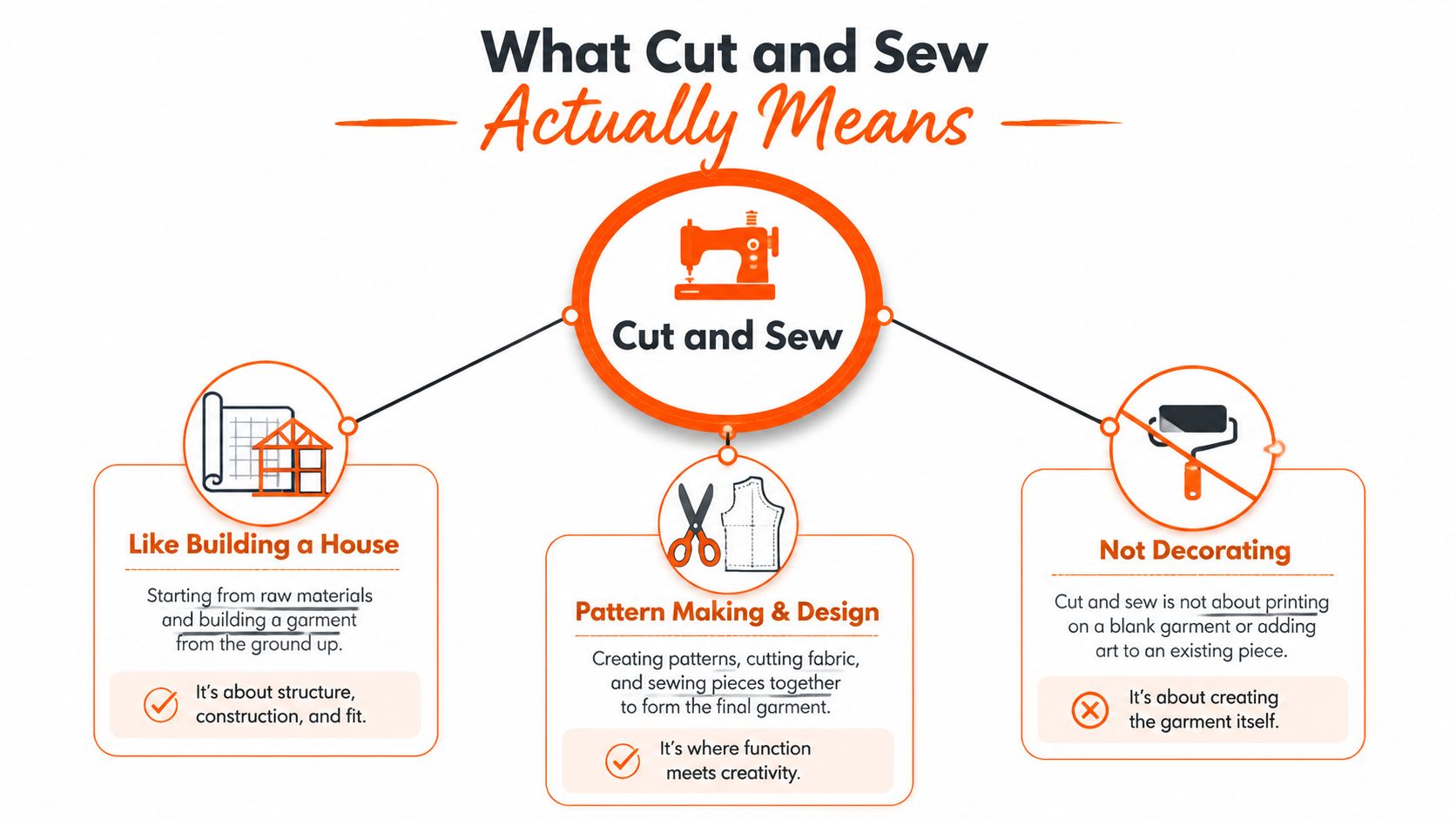
A cut and sew garment starts with fabric, not a finished blank. The factory cuts pattern pieces, stitches them together, and finishes the item into a new garment. In industry terms, cut and sew clothing manufacturing covers establishments that make garments from fabric produced elsewhere, which is why it sits apart from textile mills and fabric production. In Canada's 2023 profile for NAICS 3152, the sector's manufacturing intensity ratio was 56.9%, down from 62.3% in 2022 and above 52.5% in 2020 after a volatile 2021 to 2023 stretch (Canada NAICS 3152 profile).
That distinction matters because cut and sew is a conversion business. You are not making fiber or weaving cloth, you are turning purchased textile inputs into finished apparel through patterning, cutting, stitching, and finishing. Canada's 2023 profile also reports materials and supplies costs of $856.9 million, up from $820.4 million in 2022, which shows how input-heavy the model is before labor and overhead enter the picture.
What the market scale tells you
The U.S. side is mature, not flashy. The Bureau of Labor Statistics' 2023 occupational estimates for NAICS 315200 report 70,320 total employees, with all occupations at a mean annual wage of $50,350 and a mean hourly wage of $24.21 (BLS NAICS 315200). That points to a real labor market with skilled operators, not a niche craft hobby.
The revenue picture is steady but pressured. Banger's guide to cut and sew clothing manufacturers frames this as a serious production model that sits at the center of apparel manufacturing, while still facing the usual cost and demand pressure in mature markets. In practice, that means the format can support a brand that needs its own fit, paneling, or fabric story, but it also carries the cost, MOQ, and timeline trade-offs that come with building a garment from the ground up.
How the Cut and Sew Process Works End to End
The cleanest way to understand cut and sew is to treat it as a sequence of decisions, not a factory line. Each step narrows what the garment can become, and each one depends on the one before it. If the brief is loose early on, the factory can still make something, but it may not be the product you thought you were ordering.
The workflow starts before the first cut
A standard cut and sew workflow includes pattern making, marker making, cutting, sewing, finishing, and quality control (Cut and sew overview). Pattern making turns the design into actual garment shapes. Marker making lays those pieces out efficiently on the fabric so the factory wastes less material.
Then comes cutting, which is where precision matters. Industry examples show CNC or laser cutting tolerances around 0.5 to 1 mm for pattern pieces, and specialist operations may advertise precision cutting to ±1/16 inch with material handling up to 82-inch width and 1/2-inch thickness (cut and sew process details). If the cut is off, the rest of the build inherits that error.
That is why the cutting table matters so much. A clean cut gives the factory a repeatable starting point, while a poor cut creates fit problems that show up later in sewing and finishing.
Sewing, finishing, and quality control close the loop
Sewing is where the construction choices show up. Common seam and finish decisions like 301 lockstitch for seams, 504 overlock for edge finishing, and stitch density in the 8 to 12 stitches per inch range in high-stress zones affect durability, stretch recovery, and seam failure risk. The linked process reference explains how those choices shape the final garment construction (cut and sew process details). Finishing adds the final polish, then quality control checks whether the garment matches the spec.
Cut and sew also appears outside apparel. It is used for fabric-based products like tents, upholstery components, dust covers, guitar cases, and foam cushions (IQS Directory). Some references also use the term for changes to existing garments, like changing sleeve design or adding pockets, not just making a brand-new piece from scratch (AM Custom Clothing).
For a manufacturer-facing version of the workflow, the cut and sew clothing manufacturers guide is a useful follow-up if you are comparing production partners.
The Tech Pack as Production Blueprint
A strong cut and sew project lives or dies on the tech pack. If the garment is the build, the tech pack is the spec sheet. Without it, the factory is guessing at details that need to be repeatable across sizes, and guessing is where production drift starts.
What has to be in the file
A useful tech pack typically includes flat sketches, a bill of materials, size specs and tolerances, stitch types, seam instructions, hardware, label and packaging details, and grading rules (apparel cut and sew process). That's the minimum language the factory needs to turn design intent into production reality.
The reason this matters is simple. One garment can be mocked up by eye, but a run of garments has to stay consistent. Grading rules tell the manufacturer how the pattern changes by size, while tolerances define how much variation is acceptable before the piece is off spec.
What to watch before the first sample
If the factory doesn't know the intended seam behavior, closure placement, or finishing details, it can't build a repeatable product. That's why the tech pack is less about “pretty documentation” and more about protecting the outcome. It also gives both sides a shared reference when the first sample comes back and something feels off.
Practical rule: if two people can read the tech pack differently, the factory will find the least expensive interpretation.
For teams that don't speak apparel fluently, this is the document to slow down and over-clarify. The same goes for construction choices. A secure build can use different stitch types for different stress points, and the cutting spec has to support the shape you want, not just the shape you can afford.
If you're translating a concept into a production-ready spec, custom design services is a good internal reference point for how design inputs typically become manufacturable outputs.
Cut and Sew vs Decorated Blanks vs Private Label
Most modern brands choose between three paths. They either build from scratch with cut and sew, customize a premium blank, or work through a private label program that sits somewhere in between. The right choice depends on how much control you need, how much complexity you can carry, and how much of the garment needs to be uniquely yours.
| Dimension | Cut and Sew | Decorated Blanks | Private Label |
|---|---|---|---|
| Control over fabric and fit | Full control | Limited to the blank chosen | Moderate, usually within an existing base style |
| MOQ | Usually higher because development is custom | Often lower | Varies by supplier and program |
| Cost structure | More development and sourcing overhead | Simpler and usually leaner | Middle ground |
| Lead time | Longer because the garment is built from scratch | Faster | Usually faster than full cut and sew |
| Best fit | Original collections, capsule drops, unique silhouettes | Event merch, team apparel, brand-safe staples | Brands that want a branded product line without full custom development |
Cut and sew gives you the most room to design the silhouette itself. Decorated blanks are better when the base garment already works and you just want premium printing, embroidery, or finishing on top. Private label can make sense if you want more brand control than blanks offer, but don't need a fully engineered garment.
For a practical example of how a product-led apparel category is often built, the ECORN swimwear brand guide is a useful reference because swimwear brands have to think about construction, fit, and positioning early, even when the visuals are simple. That's the same decision pressure many apparel founders feel, just in a different category.
If your team is still in the “what blank even makes sense?” phase, the premium blank t-shirts guide can help separate blank quality from custom build complexity before you commit.
When Cut and Sew Is Not the Right Answer
Cut and sew gets romanticized because it sounds more serious. Sometimes it is. Sometimes it's just overkill.
When the blank is the smarter move
If your design doesn't need a unique silhouette, paneling, or construction, cut and sew may just add sourcing overhead and development time. A premium blank can deliver a better result when the goal is clean branding, fast fulfillment, and a garment that already fits the audience's expectations.
That's especially true for teams that want a simple drop, not a new apparel program. If the audience cares more about the message than the pattern line, the extra work won't show up in wear rate. You'll still pay for coordination, but you may not get much more perceived value back.
The real filter to use
Ask three questions before you commit. First, does the brand have a design reason to build from scratch. Second, does the timeline support sampling and revisions. Third, will the audience notice the construction difference without being told.
If the answer is no on all three, decorated blanks usually make more sense. If the answer is yes on at least one of them, cut and sew starts to earn its place. The goal isn't to use the most complicated path, it's to use the one that solves the actual commercial problem.
Practical rule: cut and sew is premium only when the garment itself needs to be part of the brand story.
That's the part most explainers skip. They define the term, but they don't help you decide whether it's worth it. For many internet-native brands, the smartest move is still a premium blank with excellent decoration, not a fully custom build.
A Practical Checklist for Briefing a Cut and Sew Partner
A good brief makes the quote faster and the sample less messy. You don't need to know every factory detail, but you do need to hand over enough specificity that the partner can price the job and flag problems early. This is similar to briefing a design agency, if the agency also has to source the raw materials and build the final object.
What to confirm before production
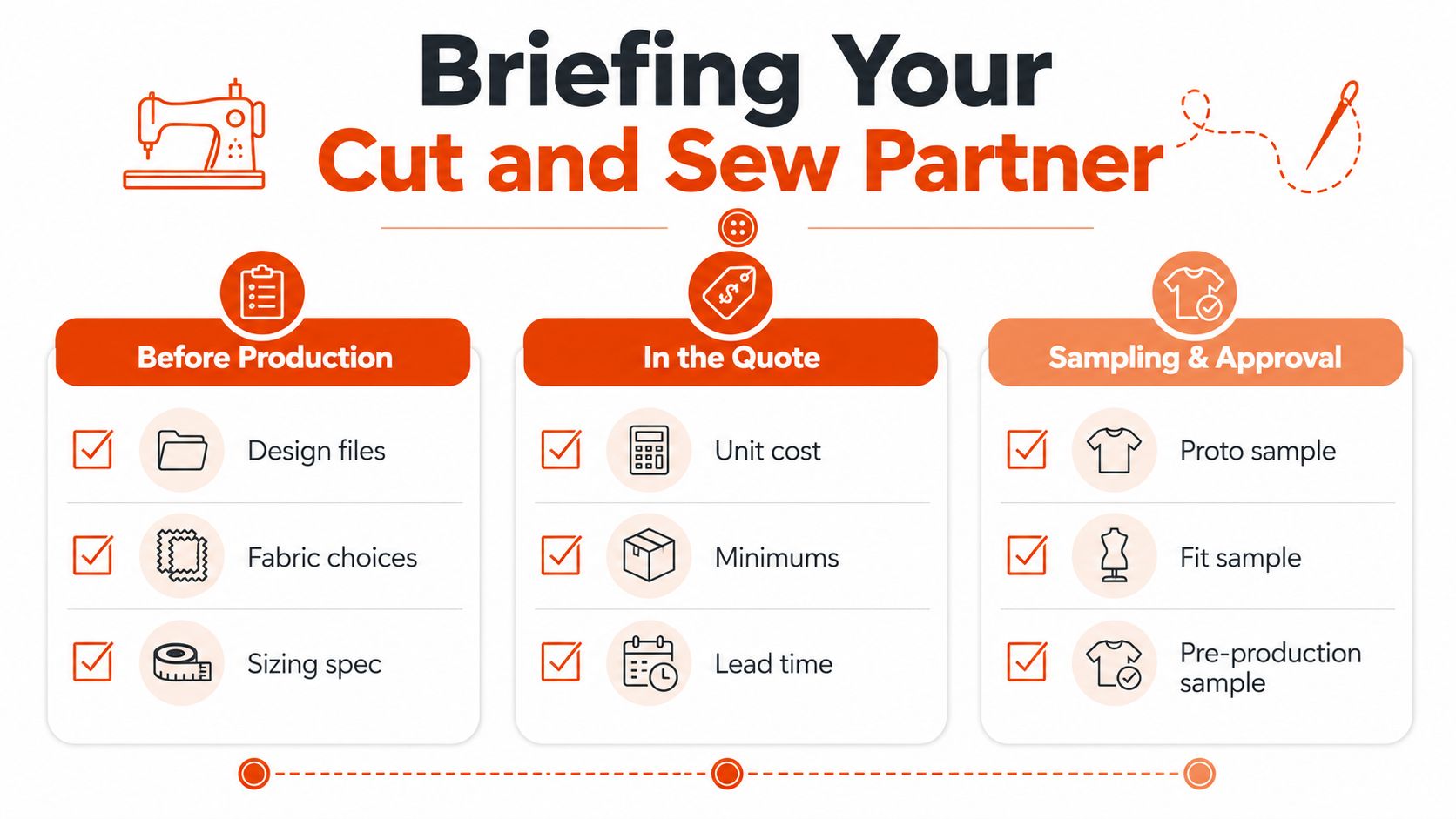
- Design files: send flat sketches, references, and any callouts that clarify shape or construction.
- Fabric choices: be clear about hand feel, weight, stretch, and finish.
- Sizing spec: define the target fit, not just the size range.
- Trim and label expectations: confirm neck labels, hang tags, and packaging if they matter to the unboxing.
- Sampling rounds: ask how many proto, fit, and pre-production samples are expected.
- Lead time: get the development timeline and production timeline separately.
- MOQ expectations: ask for the minimum per style and whether color or size splits change the count.
- Quality checkpoints: define what gets approved before bulk begins.
Banger's cut and sew work typically starts around 50 units per style for low-minimum projects, which gives smaller runs room to move without pretending the process is as light as blank customization. That number only matters if the rest of the brief is equally tight.
What a clean quote should answer
The quote should tell you the unit cost, what's included, what's excluded, and what happens if the sample changes. If it doesn't, you're not comparing real options yet. A quote without clarity on sampling or approval is just a guess with a logo on top.
For teams used to writing a crisp product brief, the 925 studios guide to UX briefs is a surprisingly good mental model. A strong brief in any field does the same thing, it reduces interpretation gaps before money starts moving.
Working with Banger on a Cut and Sew Project
A cut and sew project gets easier when product, design, and production live in the same conversation. Banger works with French ateliers, handles factory-direct production, and supports projects from brief to sample to global fulfillment, which means a founder or marketing lead isn't stitching together five vendors just to launch one collection. For teams that want a single partner for custom apparel, that setup is the whole point.
The workflow is straightforward. You submit the idea, shape the spec with in-house design support, review product previews, approve samples, and move into production and shipping. If you're the kind of team that wants a faster starting point, Banger also offers a quick quote path that gets the conversation moving without a long procurement loop.
For founders comparing partners, it's also worth looking at how production teams handle collaboration more broadly. If you want a reference point for that kind of partnership mindset, partner with Presidio shows how some brands frame long-term vendor relationships around shared execution, not just one-off orders.
The main thing to remember is that cut and sew is a product decision, not a vibe. It makes sense when you need a garment that carries the brand through fit, shape, and construction, and it makes less sense when a premium blank already solves the job. If you want to build merch that feels like something your team would wear outside the office, start with the production path, then build the story around it.
If you're deciding between cut and sew and premium blanks, Banger can help you map the trade-offs without turning it into a huge project. Explore Banger, request a quote, and see what a real custom apparel build looks like before you commit to the wrong route.