Chenille Embroidery Patches: A Guide for Modern Brands
You're probably here because you've seen the difference already.
One hoodie feels like standard team merch. Printed logo. Flat surface. Easy to forget. Another piece has that raised varsity patch on the chest — a little fuzzy, a little nostalgic, and somehow way more expensive-looking even when the graphic is simple. That second piece has presence.
For modern brands, that difference matters. Internet-native teams don't need more disposable merch. They need apparel that feels like belonging. That's why chenille embroidery patches keep showing up on jackets, heavyweight hoodies, and limited drops built to stick around.
The real question is when chenille is the right move, when it isn't, and how to use it without turning a strong logo into a muddy patch. If you care about texture, heritage, durability, and brand clarity, this is your decision guide.
Table of Contents
That Texture You Cant Ignore
The classic reference is obvious. A letterman jacket with a big chenille letter on the chest still hits because it doesn't just carry a logo. It carries status, team identity, memory, and a little bit of mythology.
That's baked into the material itself. The term “chenille” comes from the French word for caterpillar, a nod to the fuzzy, velvety texture, and while the technique traces back to the 19th century, its modern identity was forged on American varsity jackets in the 1930s and ’40s as a premium badge of belonging, as noted in this history of chenille patches.
That heritage still translates cleanly today. A founder jacket for the core team. A heavyweight hoodie for top community contributors. A creator drop where the patch becomes the whole point of the garment. Chenille works because it feels less like branding and more like membership design.
Most merch misses this. The artwork may be fine, but the execution is forgettable. Flat print has range, and there are plenty of cases where it's absolutely the right choice, especially for graphic-heavy pieces like screen printed t-shirts. But if the goal is a piece that reads as collectible, not just wearable, texture changes the entire outcome.
Chenille isn't subtle. That's exactly why it works when the brand mark deserves to feel institutional, cultural, or earned.
Streetwear figured this out a long time ago. So did sportswear. Internet brands are catching up now because physical merch has a different job than social content. On a screen, your logo needs speed. On a garment, it needs weight.
Chenille embroidery patches give a mark that weight. Not through complexity. Through volume, contrast, and tactile presence. If your brand already has a strong icon, monogram, initial, mascot, or block-letter form, chenille can turn it into the piece people reach for first.
The Anatomy of a Chenille Patch
Chenille looks simple from the outside, but the construction is doing a lot of work.
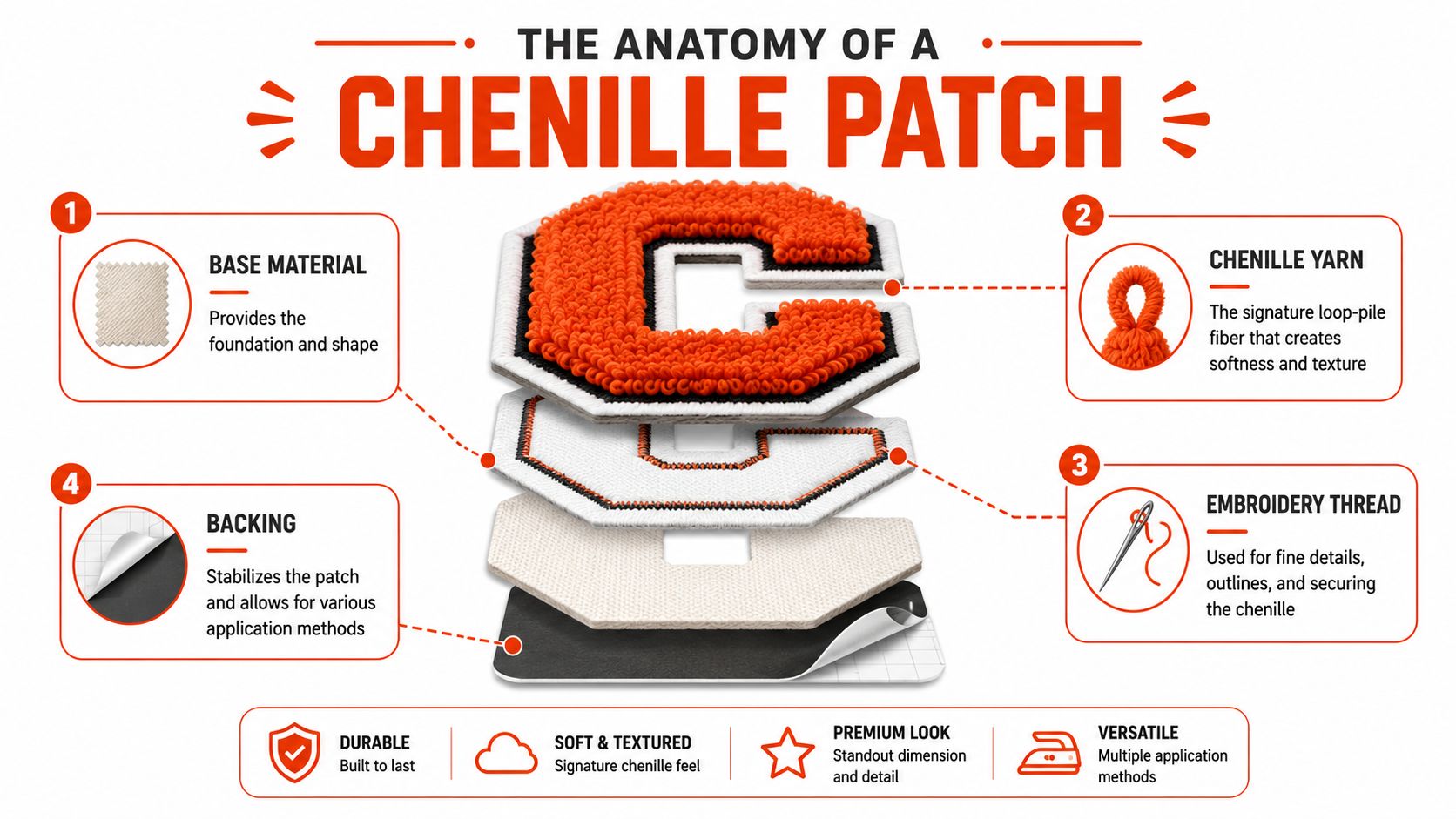
At the core, chenille patches use a loop-pile construction. Yarn is pushed through backing material and secured with a loop stitch, which creates the raised, fuzzy surface. That's why chenille feels completely different from flat embroidery. It has body. It catches light differently. It reads from across the room before anyone even sees the fine detail, as described by Ninja Patches' chenille patch overview.
What actually creates the texture
Think of chenille as a layered build, not a single stitch style.
You usually have a base material that holds the patch shape, chenille yarn that creates the pile, embroidery thread that handles outlines or smaller details, and a backing that helps with stability and application. The fuzzy area gets most of the attention, but the border and backing are often what determine whether the patch feels clean or cheap in hand.
A practical way to read it:
Base material gives the patch structure and silhouette.
Chenille yarn creates the plush, raised fill.
Embroidery thread sharpens edges, borders, and small graphic elements.
Backing determines how the patch gets attached and how stable it stays during use.
Why chenille behaves differently from embroidery
Flat embroidery sits closer to the garment surface. It's good at definition, small text, tight curves, and logos with technical detail.
Chenille does the opposite job. It amplifies big shapes. A varsity letter, a star, a mascot head, a monogram, a shield. The pile adds visual opacity and tactile volume, so the design can stay simple and still feel premium.
Practical rule: If texture is the message, chenille makes sense. If precision is the message, flat embroidery usually wins.
This matters when you're planning branded apparel. A lot of teams try to force a full digital logo system into a patch format that was never meant for tiny details. That's where bad results happen. The material isn't failing. The spec is.
The best chenille patches treat the fuzzy fill as the hero and let embroidery do cleanup work around it. Once you understand that split, the design decisions get much easier.
Designing for Chenille Patches
The fastest way to ruin chenille is to treat it like a print file.
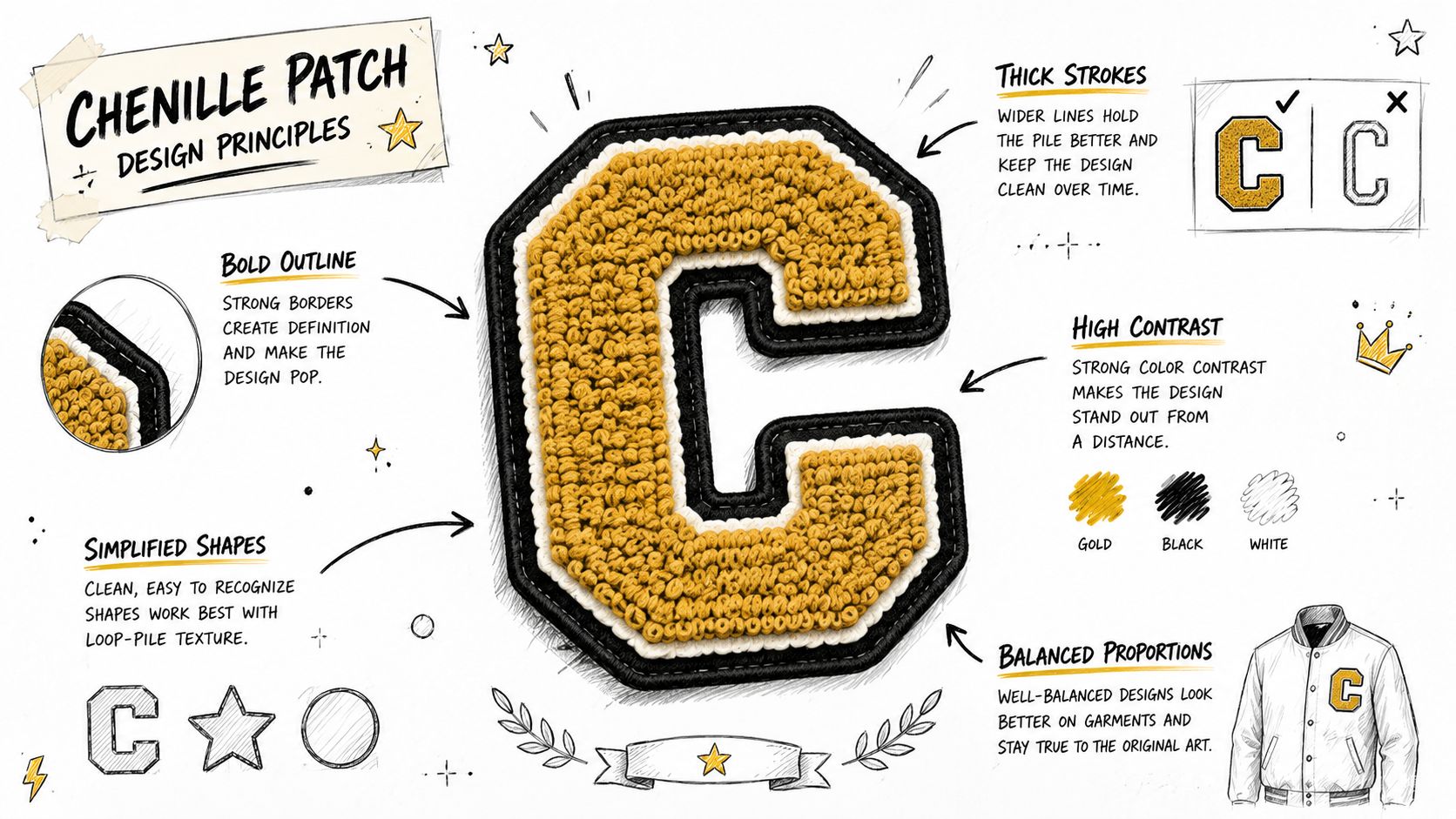
Chenille rewards simplification. Big forms. Confident shapes. Letters with enough mass to hold pile. Icons that still read when the texture becomes part of the graphic. If your mark relies on thin lines, tiny text, gradients, or intricate negative space, you need to edit before production, not after a sample disappoints you.
Start with shapes, not artwork
A good chenille patch usually starts with the boldest part of the brand system, not the most complete one.
That might be:
A single letter from the wordmark
An icon or symbol that the community already recognizes
A shortened lockup built specifically for merch
A badge shape that feels more like a crest than a logo
What doesn't usually translate well is the full homepage header version of a logo with tagline, micro text, and several visual effects packed in.
A better approach is to ask one question: what should still read if the texture becomes the dominant feature? If the answer is “not much,” chenille probably isn't the right primary technique.
When hybrid construction wins
At this juncture, a lot of modern brand work gets more interesting.
For complex logos, a hybrid approach is often the right answer. Use chenille for the large filled areas that need texture and volume, and use satin-stitch embroidery for sharp outlines, small text, and fine details. That gives you the varsity feel without losing brand fidelity, as shown in this chenille and embroidery combo tutorial.
That hybrid logic is especially useful for startup and creator brands that want the emotional feel of chenille but still need the mark to look like their mark.
A few design calls usually work well:
Use chenille for the interior fill when the logo has a bold silhouette.
Keep outlines embroidered so edges stay crisp.
Reserve small text for embroidery only instead of forcing it into pile.
Separate the badge from the full logo system if the original brand asset is too detailed.
If your logo is detail-heavy, a partner experienced with custom logo embroidery can usually help split the artwork into what should be plush and what should stay stitched.
One more trade-off matters. Public content often celebrates chenille for the look, but durability and wear behavior depend on how and where you use it. Tutorials around faux chenille construction focus on stabilizer, tack-down stitches, and careful trimming, which tells you something important. This is a style with labor sensitivity. It's better as a statement finish than a default choice for high-friction placements.
That's worth seeing in motion before approving a design:
A chest patch on a jacket or hoodie makes sense. A chenille patch on a cuff, backpack corner, or kidswear piece that takes constant abrasion usually doesn't.
If you want chenille to look expensive, give it space. Don't make it fight tiny details or rough placement.
How to Apply Your Patches
The patch design gets the attention. The application method decides how the garment holds up.
This is less about “which backing exists” and more about permanence versus flexibility. The right choice depends on whether you're making a founder jacket, a conference giveaway, a modular uniform piece, or a limited drop where people might move patches between products.
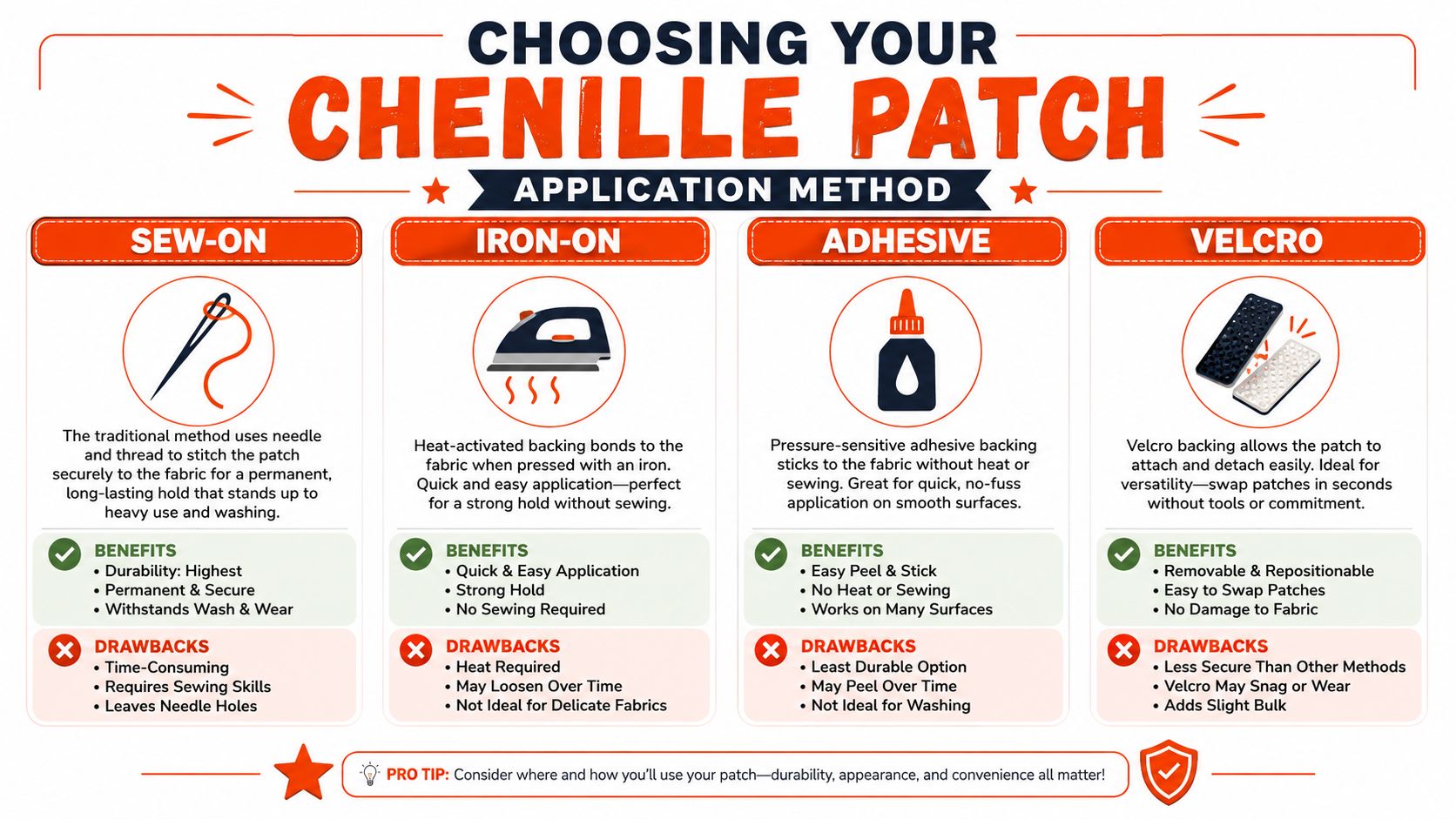
A quick comparison
| Method | Best for | Trade-off |
|---|---|---|
| Sew-on | Jackets, heavyweight hoodies, premium outerwear | Most permanent, least flexible |
| Iron-on | Simple rollout merch, easier application | Convenient, but less heritage-feeling |
| Adhesive | Temporary event use, packaging add-ons, notebooks, totes | Fast, but not built as a long-term apparel solution |
| Velcro | Modular kits, tactical styling, collectible patch sets | Flexible and swappable, but more niche visually |
Sew-on is still the cleanest answer for premium garments. It feels correct on varsity-inspired pieces because it's stable, durable in feel, and visually consistent with the heritage of patches in the first place.
Iron-on is the practical middle lane. It works when you need easier application and don't want every unit sewn individually. The trade-off is that it can feel more functional than premium, depending on the garment.
How to choose by product type
Use the garment first, then choose the patch backing.
For varsity jackets and heavyweight overshirts, sew-on usually makes the most sense.
For employee hoodies or event merch, iron-on can be a reasonable production choice.
For temporary activations, adhesive works when the patch acts more like a campaign object than a permanent apparel feature.
For collectible or modular concepts, Velcro gives you a different kind of interaction.
A lot of teams get this backwards. They pick the easiest backing before deciding how the item should age. If the piece is meant to become part of someone's regular wardrobe, lean toward permanence. If the idea is novelty, movement, or short-term use, flexibility matters more.
The application should support the story of the merch. Not fight it.
Use Cases for Modern Teams and Brands
Chenille isn't stuck in school nostalgia. It's one of the clearest ways to give a modern brand a physical symbol that feels earned.
That cultural logic has deep roots. Patches became a formal system for signaling identity at scale when the U.S. Army authorized shoulder insignia during World War I, and chenille later fit naturally into that same visual language because its raised construction makes symbols highly visible and easy to read as badges of belonging, as outlined in this history of custom patches.
Why chenille still signals belonging
Digital brands spend most of their lives on screens. Slack avatars, profile photos, launch visuals, decks, websites. That makes physical identity more valuable, not less.
A chenille patch turns a logo into a badge. It's an actual, physical emblem. It sits on the garment as an object with weight, edge, and texture. It feels closer to a team marker than a print placement.
That's useful when the audience isn't “everyone.” Chenille works best when the piece is for a defined group:
Founding team apparel
Top contributor rewards
Community milestone drops
Creator merch with a symbol-first identity
Conference pieces for hosts, speakers, or VIP tiers
Where it works for internet-native brands
A crypto protocol can use a chenille icon on a heavyweight hoodie for core contributors. A fintech startup can put a monogram patch on wool-blend jackets for the founding team. A creator can build a tight drop around one symbol instead of overloading the garment with graphics.
This kind of merch also fits influencer seeding and community gifting, especially when the piece needs to feel considered rather than mass-issued. If you're mapping that side of distribution, it's worth reviewing learn about influencer platforms with Famcut to think through how product, recipient list, and gifting flow connect.
One body option that consistently pairs well with chenille is a heavyweight hoodie, because the patch texture has enough garment weight under it to feel intentional. If you're comparing blanks for that kind of project, best hoodie blanks is a useful starting point.
The strategic point is simple. Chenille shouldn't go on everything. It should go on the pieces that represent closeness to the brand. The closer the relationship, the more sense the patch makes.
How to Order Custom Chenille Patches
Ordering chenille patches gets easier once you stop thinking in terms of “logo upload” and start thinking in terms of product direction.
The cleanest orders come from brands that already know four things: what garment the patch is going on, how large the patch should feel on-body, whether the artwork needs hybrid embroidery support, and how permanent the application should be.
What to prepare before you ask for a quote
Bring a focused set of inputs, not a folder full of every brand asset you've ever made.
Useful inputs usually include:
The exact garment or product the patch will live on
One preferred logo mark and one fallback option
Desired placement such as left chest, sleeve, or full back
An idea of finish level like pure chenille or chenille with embroidered borders
Your quantity and delivery window
That lets a production partner evaluate feasibility quickly. Banger, for example, works from uploaded logos and product selections, then sends a preview and quote flow built around custom apparel production, low minimums, and global delivery. If the project includes storage and multi-address shipping after production, merch fulfillment services becomes part of the planning too.
What affects the result most
Price and production complexity usually move with a few core variables: patch size, shape complexity, color count, border treatment, and whether the design needs a hybrid chenille plus embroidery build.
The smarter buying move is to decide what matters most before sampling starts. If the patch is the hero feature, don't overcomplicate the artwork. If the logo is sacred and highly detailed, accept that hybrid construction may be the cleaner route.
Brand strategy work helps here more than people think. If your team is still deciding which mark should represent the brand physically, Wand Websites' branding strategy insights are a useful reminder that strong brand systems usually include simplified assets for different contexts, including merch.
A good chenille order doesn't begin with manufacturing. It begins with editing.
FAQ Your Chenille Patch Questions
How durable are chenille patches really
They're more durable than a lot of people assume, but they're still a textured finish with real trade-offs.
Commercial-grade chenille patches are often engineered for repeated laundering, and one supplier states they can withstand at least 50 domestic washing cycles when properly made and cared for, which signals that the bond between pile, backing, and edge finishing is built for longevity on premium apparel, according to Stahls' chenille patch product information.
That doesn't mean chenille is the right choice for every use case. Durability depends on placement, garment type, edge finishing, and friction exposure. A chest patch on a varsity jacket is a much better fit than a patch placed where it constantly rubs against straps, desks, or rough surfaces.
Washability can be solid. Abrasion is the bigger question.
If you want a broader view of decoration trade-offs across garments, merch printing techniques is useful because it helps compare chenille with print, flat embroidery, and other finishes based on use case.
Chenille vs 3D puff embroidery
These get grouped together because both create height, but they don't look or behave the same.
Chenille uses loop-pile yarn to create a fuzzy, soft surface. 3D puff embroidery raises thread over foam for a sculpted, more structured effect. Puff feels sharper and more graphic. Chenille feels plush, nostalgic, and more textile-driven.
Use chenille when:
The goal is texture first
The design is bold and simple
You want varsity or heritage energy
Use 3D puff when:
You want a cleaner, more technical raised look
The application is on caps or tighter surfaces
The artwork needs harder edges instead of fuzzy volume
What mistakes ruin chenille patches
Most bad chenille patches come from forcing the wrong artwork into the right technique.
The common misses are predictable:
Too much detail: Tiny text and intricate interior shapes get lost.
Weak silhouettes: If the outer shape isn't strong, the texture can't save it.
Bad placement: High-friction zones flatten or wear the pile faster.
No embroidered support: Complex logos often need stitched outlines to stay legible.
Treating chenille like a default: It works best as a statement finish, not a universal solution.
The strongest chenille pieces usually feel edited. One symbol. One clear placement. Enough contrast to read instantly. Enough restraint to let the material do its job.
If that sounds closer to fashion design than office merch ordering, that's because it is.
If you're planning a chenille patch piece for your team, community, or next drop, Banger is built for that. Premium European blanks, chenille embroidery and every other customization technique in France's best production ateliers, low minimums, worldwide fulfillment, and direct factory pricing. Get a free, no-commitment quote with product previews in 24 hours, and build merch your team will actually want to wear.