Best Swag Ideas: Unique & Desirable Team Gifts
Most company swag ends up in a donation pile or the back of a closet. Generic tees, forgettable pens, and flimsy plastic accessories do nothing for your brand. They signal low standards.
The market has already moved past throwaway merch. Buyers, hires, creators, and community members keep the pieces that feel good, fit right, and serve a real purpose. That means your swag strategy has to start with use case first. Onboarding kits need daily-wear staples. Event merch needs instant appeal and easy sizing. Community rewards need scarcity and details people want to show off.
Execution decides whether merch gets worn or ignored. Fabric weight, silhouette, trim, logo placement, embroidery quality, and packaging all shape how the piece is judged. A heavyweight hoodie in the right fit can become part of a team uniform. If you are building around apparel, start with the best hoodie blanks for premium brand merch before you even touch decoration.
Cheap swag chases impressions. Good merch builds memory, status, and repeat wear.
This list focuses on the part most brands get wrong. Materials. Context. Finishing. The details that turn a branded item into something people keep, use, and associate with your brand long after the handoff.
Table of Contents
1. Premium Heavyweight Hoodies as Team Uniforms
If you're only going to make one piece, make a heavyweight hoodie. It's the closest thing internet-native teams have to a uniform. The right one works in onboarding boxes, conference wear, community photos, and founder content without looking like HR merch.

Banger's hoodie programs sit in the 400 to 500 GSM range, which is where structure starts to matter. A lighter blank can work for promo. A heavyweight blank looks intentional, holds shape, and keeps its silhouette after real wear. That's the difference between “free company hoodie” and “piece your team chooses to wear.”
How to make the hoodie feel like culture
Figma teams wearing matching hoodies at design events, Binance seasonal team drops, and Ledger community apparel all point to the same thing. A hoodie becomes social proof when the design feels native to the brand, not pasted on top of it.
Use restraint. Put the logo on the chest in embroidery, not a giant billboard print. Add a woven neck label. Offer two or three colorways so people can choose a version that fits their style while still signaling the same team.
Practical rule: Heavyweight fleece deserves heavyweight decoration. Use chest embroidery or applique instead of oversized low-grade printing.
A few specifics matter more than people think:
- Use 3D embroidery: It feels sharper on heavyweight fabric and holds up better than basic screen print.
- Add custom neck labels: Small details make the hoodie feel produced, not sourced.
- Think in drops: One annual hoodie gets stale. Rotating seasonal versions keeps the piece alive.
- Package it well: In an onboarding kit, the hoodie should arrive folded like product, not stuffed like inventory.
If you're comparing silhouettes, fabric weights, and fits, start with this breakdown of the best hoodie blanks.
2. Capsule Collections and Limited Drops
Random merch is how brands train people to ignore them. A tight capsule does the opposite. It gives your audience a clear point of view, a reason to care, and a release they remember after the giveaway table is gone.
This approach works best when the pieces belong together. One strong hoodie or heavyweight tee sets the tone. A cap, tote, or accessory supports it. Shared colors, consistent graphics, and disciplined copy make the drop feel produced instead of assembled from leftovers.
Why limited drops work
Drops create timing and selectivity. That matters for startups, creator-led brands, and community businesses that need more than logo exposure. An anniversary release, launch capsule, conference edition, or post-fundraise drop gives people a story to attach to the product. Story is what makes merch travel.
Scarcity is only effective when the product quality justifies it.
That means the execution has to carry the idea. Use better blanks. Keep the assortment tight. Choose decoration methods that match the item. If you add hard goods or packaging details to the capsule, finishes like foil marks or laser engraving for branded merchandise make the set feel deliberate.
Good capsules also match the use case. Onboarding drops should feel wearable and easy to repeat at scale. Event capsules should photograph well and signal attendance. Community drops should reward insiders with details outsiders would miss, such as custom labels, release-specific graphics, or numbering.
A strong capsule usually follows a simple structure:
- Lead with one hero piece: Start with the item people will want even without the logo, usually a heavyweight tee, hoodie, or outer layer.
- Add one supporting item: Choose a cap, tote, socks, or another piece that extends the look without bloating the set.
- Keep the design system tight: Repeat the same palette, typography, references, and trim details across every item.
- Build in finishing details: Custom tags, embroidered marks, garment washes, and packaging details make the drop feel collectible.
- Launch with a clear reason: Tie the release to a milestone, campaign, city, partnership, or community moment people care about.
Pudgy Penguins seasonal releases, creator capsules tied to live moments, and startup merch drops that mark product milestones all follow the same rule. The item matters, but the system matters more. Handle the capsule like a product line, and it starts acting like a brand asset.
3. Custom Tech Accessories and Leather Goods
Cheap tech swag dies in a desk drawer. Well-made tech accessories stay in rotation for years.
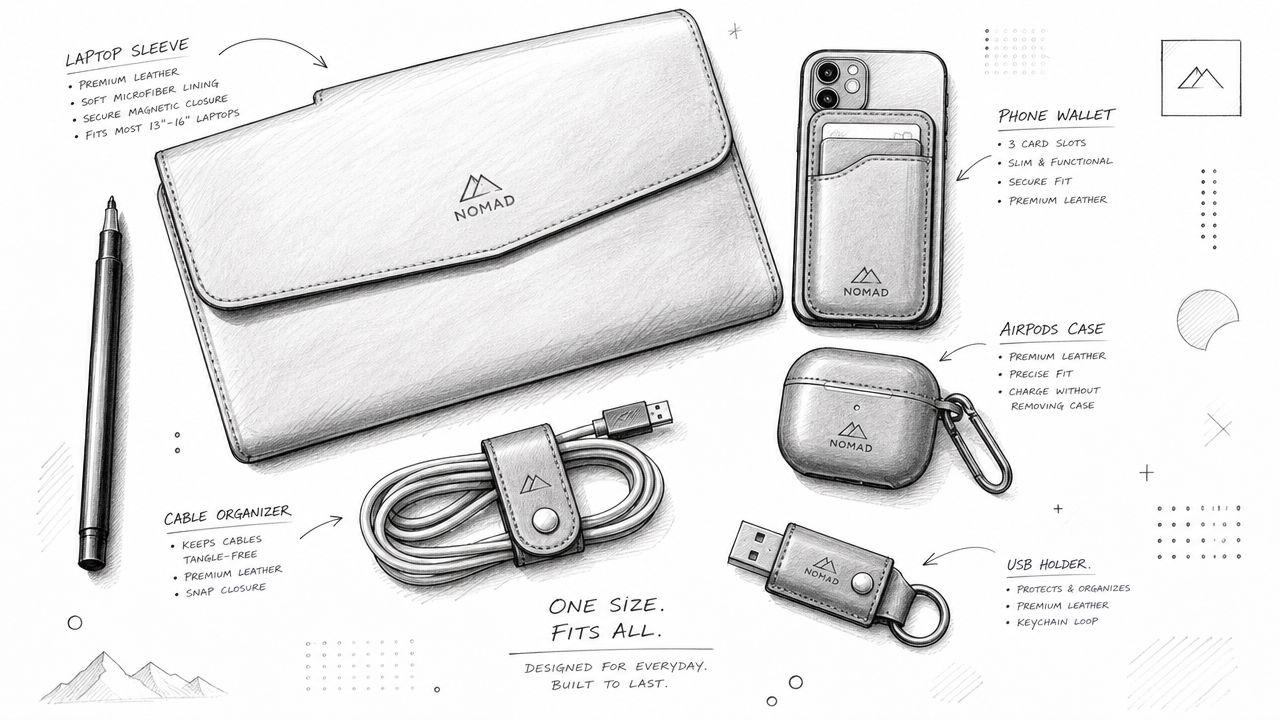
A laptop sleeve, cable organizer, phone wallet, or leather AirPods case lives inside someone's daily setup. It gets pulled out in meetings, on flights, at coffee shops, and at conference tables. That repeated use gives your brand more staying power than a throwaway giveaway ever will.
The right accessories for high-value gifting
This category works best when the use case is obvious. For onboarding, send pieces that clean up a desk setup. For investor or client gifting, choose items that travel well and feel expensive in hand. For events, keep the profile compact enough to carry home without turning into luggage.
Material choice decides whether the product feels premium or promotional. Full-grain or well-finished vegan leather beats coated giveaway material every time. Brushed metal beats glossy plastic. A dense notebook with a proper cover beats a flimsy pad with a logo stamped across it.
Decoration matters just as much. Printing on leather usually looks temporary and cheap. Debossing and embossing feel permanent. On aluminum, stainless steel, and coated accessories, engraving gives you a cleaner result. Banger has a clear primer on laser engraving for branded merchandise.
The best sets are built like products, not random add-ons. Pair a laptop sleeve with a cable organizer for onboarding kits. Use a phone wallet and charger for event gifting. Send a leather cardholder and notebook for founder, executive, or partner packs.
Packaging has to support the same standard. A premium sleeve dropped into a generic poly mailer loses half its impact before it arrives. If you want these pieces to feel considered from first touch to daily use, build the presentation around them with custom packaging for branded merch drops.
Good tech swag earns its place by being useful first, branded second. Get the material, finish, and context right, and these pieces stop acting like merch. They start acting like part of the brand.
4. Branded Packaging and Unboxing Experience
Organizations often underinvest in packaging, then wonder why the merch feels forgettable.
The product might be solid, but if it arrives in a plain mailer with no thought behind presentation, you lose the emotional hit. Packaging is part of the product. For onboarding, creator drops, and community rewards, it's often the first physical brand interaction someone has with you.
Packaging is where perceived value jumps
This matters even more for distributed teams. Someone opening a box in Berlin, New York, or Singapore should get the same impression. Clean mailer. Branded tissue. Insert card. Sticker sheet. Proper fold. That sequence tells people the brand has standards.
Banger builds this layer into the merch system with custom boxes, branded shippers, tissue, inserts, and stickers, because the unboxing moment is where a simple garment starts to feel like a drop. Figma-style onboarding kits, collectible protocol packs, and creator mailers all rely on that effect.
Studio note: If the piece is premium, the packaging has to protect that perception all the way to the doorstep.
A few packaging details do outsized work:
- Use a real insert card: Not a generic thank-you slip. Add campaign copy, an inside joke, or context for the drop.
- Design stickers for use, not filler: People keep good sticker sheets.
- Coordinate color systems: Packaging should echo the collection palette.
- Make it camera-friendly: If someone posts the unboxing, every layer should look intentional.
For a deeper look at how to structure branded shippers, inserts, and mailers, Banger breaks it down in this guide to custom packaging design.
Premium merch doesn't start at the garment. It starts when the box lands.
5. Cut and Sew Limited Editions and Private Label
Printing on blanks is fine. Building your own piece is different.
Cut and sew is where merch stops looking like merch and starts looking like brand product. If you want a custom overshirt, varsity-inspired jacket, cropped hoodie silhouette, or branded workwear piece that no one else can buy off the shelf, this is the lane.
What real custom manufacturing actually means
A lot of teams say they want “fully custom” when they really mean custom print placement. True custom apparel manufacturing starts before any fabric is cut. A manufacturer should request or build a tech pack, create a pattern based on your measurements and target fit, and complete at least one sample round before bulk production, as explained in this guide to custom apparel manufacturers.
That process matters because fit is branding. Proportions are branding. Pocket shape, rib width, wash, trim, and seam finishing are branding.
A startup launch jacket, a protocol anniversary overshirt, or a signature community hoodie carries much more weight when the silhouette belongs to you. That's where private label starts paying off. You're no longer renting someone else's garment and adding your logo. You're building your own object.
Banger handles that through cut and sew apparel production, from concept through sampling and final manufacturing.
Use this path selectively:
- Start with one hero piece: Jacket, overshirt, or hoodie.
- Invest in fit first: A custom pattern beats extra graphics.
- Finish like a real label: Neck labels, seam tape, custom trim, and packaging.
- Keep the run tight: Limited quantities make the piece more desirable.
The teams with the strongest merch programs usually don't make more items. They make fewer, better ones.
6. Community Rewards and Holder Incentives Web3 and DTC
Free merch can feel cheap. Earned merch doesn't.
That distinction matters most in Web3, DTC communities, and membership-led brands. If everyone gets the same item for doing nothing, the reward has no weight. If someone earns a piece through contribution, participation, or status, the item becomes proof of belonging.
Build scarcity around contribution, not just access
One overlooked idea in the best swag ideas conversation is the earning mechanic. Data highlighted by VistaPrint's company swag coverage says 78% of event attendees report swag fatigue when items are handed out without engagement, and research referenced there notes that earned swag can create a 3.2x higher retention rate and 45% more social sharing because recipients feel ownership over the item, as discussed in VistaPrint's company swag ideas guide.
That maps perfectly to holder communities and contributor programs. Reward voters, top referrers, long-term holders, early members, top mods, or event participants with pieces they had to earn. The object becomes narrative. “I got this because I was there.” That's stronger than “I grabbed this at a booth.”
Pudgy Penguins style holder merch, Binance community rewards, and DTC VIP tiers all work best when the item signals status through scarcity and finishing.
A smart setup usually includes:
- Tiered access: Different items for different contribution levels.
- Visible distinction: Special colorways, numbered tags, or edition labels.
- Moment-based releases: Tie the reward to a launch, milestone, or governance event.
- Global fulfillment: Community merch fails fast if shipping gets messy.
Give the piece after the action, not before. Ownership starts in the unlock.
For Web3 teams, the merch isn't secondary. It's one of the few physical expressions of digital identity.
7. Conference and Event Branded Merchandise
Conference merch should do one thing well. It should make it home.
That's where most event giveaways fail. They optimize for volume, not travel. If the item is bulky, flimsy, or pointless, attendees leave it behind. If it's useful, compact, and decent quality, it ends up in a suitcase and stays in rotation.
What actually works on a show floor
Research collected by PerkUp notes that apparel and drinkware continue to dominate brand recall and retention, and highlights high-quality water bottles, premium notebooks, and phone accessories as top swag items people use daily. The same source also notes that functionality and personalization correlate with retention rates above 70% versus generic print-on-demand items, in this roundup of swag ideas for in-person events.
That gives you a clear event stack. Keep the booth freebie small and useful. Reserve better merch for engaged visitors, speakers, or qualified leads. Make the premium item something people would have bought if it didn't have your logo on it.
Conference-specific hoodies, city-stamped caps, speaker jackets, embroidered totes, and branded notebooks all work better when they connect to the event itself. Date, city, edition, or theme creates a memory object, not just a logo object.
Use a simple event hierarchy:
- General audience: Tote, notebook, bottle, or hat.
- Qualified lead: Better apparel or a bundled kit.
- VIP or speaker: Premium hoodie, jacket, or leather accessory.
Event merch doubles as recruiting too. If someone keeps wearing your Config, Devcon, or launch-week piece later, your brand keeps traveling with them.
8. Founder and Leadership Capsules
A founder capsule works when the founder has taste.
That sounds obvious, but plenty of teams force leadership merch into existence with committee-approved graphics and safe messaging. The result usually looks like internal comms in hoodie form. A good founder piece should feel personal, slightly opinionated, and wearable outside the office.
Founder merch works when it reflects a point of view
This format is strongest for startup founders, creators, podcast hosts, and community leaders whose identity already shapes the brand. A founder's preferred silhouette, favorite color palette, reference points, and phrases can become a small apparel system that people want because it feels connected to a person, not a department.
Keep the run small. Make it feel like a drop, not a staff uniform. Maybe it's a heavyweight black hoodie with tonal embroidery and a custom inside label. Maybe it's a washed cap with a phrase your audience already associates with the founder. Maybe it's a jacket tied to year one, first fundraise, or first major product ship.
The best ones are understated. People don't want to wear your CEO's face. They'll wear a strong piece that carries the founder's taste and mythology.
For teams thinking harder about performance and brand impact, it also helps to study a broader guide to marketing ROI with giveaways. The lesson is simple. The better the object fits the audience, the more value the brand gets from it.
A founder capsule is also useful internally. Team members wearing the same piece as leadership creates alignment without forcing uniformity. It signals shared taste and shared standards, which is a better cultural cue than a giant mission statement on cotton.
9. Sustainable and Ethical Merch Organic Recycled Fair-Trade
Sustainable merch only works when the product would be desirable even without the sustainability story. Start there. If the fit is bad, the fabric feels flat, or the item has no clear use case, organic cotton and recycled polyester will not save it.
The right approach is tighter and more disciplined. Choose pieces people keep. Match them to the moment. Organic heavyweight tees for onboarding. Recycled outerwear for community rewards. Fair-trade totes or drinkware for events where repeat use matters. Sustainability earns brand equity when it shows up in lifespan, not just copy.
Material choice matters, but execution decides whether the item feels premium or performative. Soft hand feel, dense knits, stable ribbing, durable stitching, and clean dyeing standards are what make a responsible product worth wearing for a year instead of a week.
If you're comparing fibers and standards, this guide to organic cotton fabric gives useful context.
Founders usually miss three things here:
- They treat sustainability like the headline: Put the product first. Let the material story support it.
- They ignore proof: Share material origin, certifications, and factory context anywhere the recipient can find it, on a hangtag, insert card, or product page.
- They choose weak blanks: A flimsy “eco” shirt still feels cheap, and cheap merch gets discarded fast.
Documentation is getting more important, especially for brands producing or shipping apparel in Europe. Requirements around traceability, material composition, durability, and product-level transparency are tightening, as outlined in this overview of upcoming EU textile regulations. Smart teams prepare early and build cleaner sourcing records now.
Production standards matter as much as the fabric. Genpire's sustainable production solutions are a useful reference if you want to examine lower-impact manufacturing options without defaulting to generic promo products.
The best sustainable swag does not feel like a compromise. It feels like your brand got more serious about quality.
10. Embroidery and Premium Finishing Details 3D Chenille Custom Labels
Finishing is where cheap merch gets exposed.
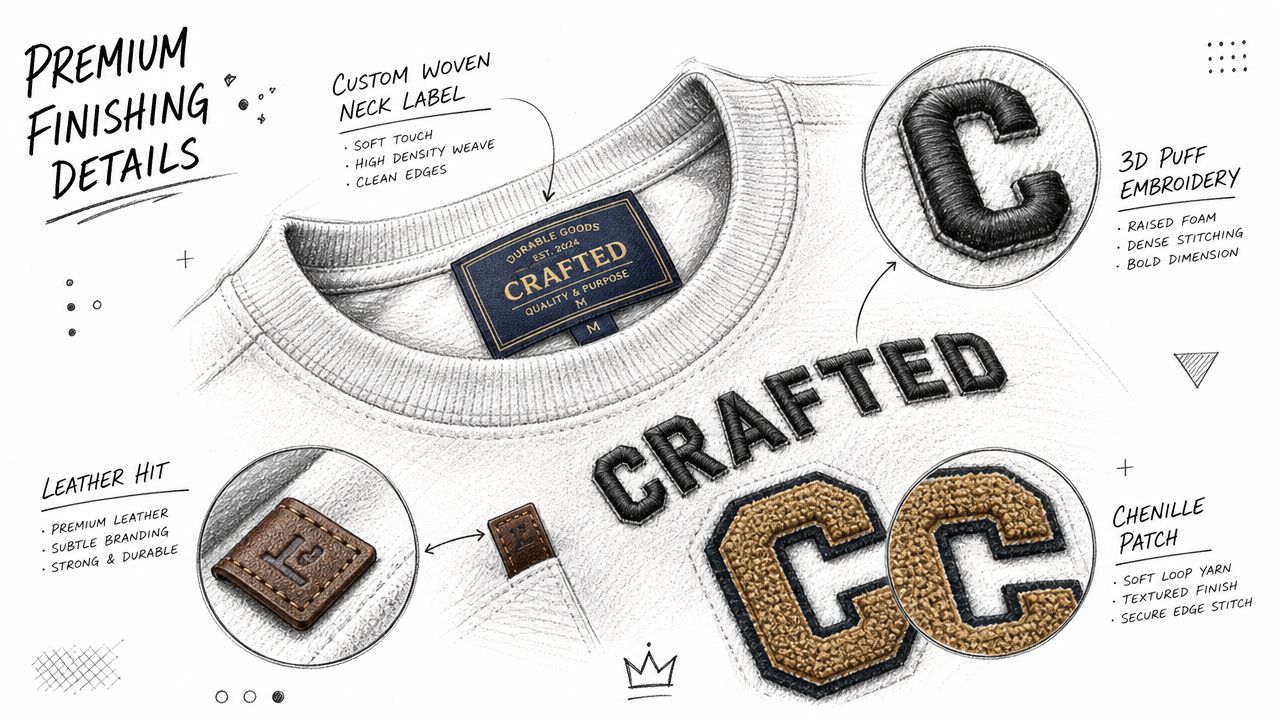
Two hoodies can use the same base blank and land in completely different categories once you look at embroidery quality, patch choice, neck label construction, and trim details. If you want merch that feels collectible, finishing does more work than adding more graphics.
The details people notice after the first wear
Premium streetwear labels distinguish themselves from generic print shops with attention to details like these. Puff embroidery on the chest. Chenille patch on the sleeve. Woven neck label with the brand and year. Matching seam tape. Debossed leather hit. These aren't gimmicks. They're signals.
There's also a practical angle. Research cited by Flyp notes that teams treating swag as a lifecycle program design reduce waste by 40%, and the same source says AI-curated employee choice stores had been adopted by 35% of tech firms in 2026. It also reports that a three-tier giveaway strategy for trade shows increased booth conversion by 25%, while interactive activations such as custom sock walls or photo-friendly booths amplified social sharing by 3x, according to Flyp's corporate swag ideas research. If the item itself is well finished, those program gains compound because people want the object.
Your logo isn't the premium part. The construction around it is.
Use finishing with intention:
- 3D embroidery: Best on heavyweight fleece and caps.
- Chenille patches: Strong for anniversaries, varsity cues, and limited editions.
- Custom woven labels: Small cost, major perceived value.
- Leather or embossed hits: Better for understated branding.
- Screen print sparingly: Best for larger graphics, not every logo.
French ateliers are especially good at this layer because they treat decoration like craft, not just fulfillment. That's the standard you want if your merch is meant to represent the brand beyond one event.
Top 10 Swag Ideas Comparison
| Item | 🔄 Implementation complexity | ⚡ Resource requirements & speed | 📊 Expected outcomes (⭐) | 💡 Ideal use cases | ⭐ Key advantages |
|---|---|---|---|---|---|
| Premium Heavyweight Hoodies as Team Uniforms | Medium, sizing planning, quality customization | Medium-high cost per unit; moderate MOQs; standard lead times | Durable, high wear frequency, strong internal identity (⭐⭐⭐⭐) | Distributed teams (10+), onboarding kits, office/events | Long-lasting wear, visible brand presence, season-flexible |
| Capsule Collections & Limited Drops | High, design narrative, coordinated launches | Higher upfront design effort; multiple SKUs; recurring timelines | Drives anticipation, collectibility, repeat engagement (⭐⭐⭐⭐) | Creator/Web3 audiences, product launches, recurring campaigns | Scarcity-driven demand, content-friendly, higher perceived value |
| Custom Tech Accessories & Leather Goods | Medium, sourcing, personalization, embossing | Higher per-unit cost but low MOQ options; moderate timelines | High perceived value, daily utility, long retention (⭐⭐⭐⭐⭐) | Client gifting, VIP rewards, conference VIPs, B2B gifting | One-size-fits-all, premium positioning, practical constant use |
| Branded Packaging & Unboxing Experience | Low–Medium, design/proofing and packaging coordination | Low relative cost; adds production time and shipping volume | Amplifies perceived value and shareability (⭐⭐⭐⭐) | Premium drops, onboarding kits, DTC retail, limited editions | High impact for small spend, improves unboxing shareability |
| Cut & Sew Limited Editions & Private Label | Very high, tech packs, sampling, pattern grading | Highest upfront cost; MOQ ~50/style; long lead times (weeks) | Unique, brand-defining pieces; prestige and collectibility (⭐⭐⭐⭐⭐) | Mature brands, signature items, high-prestige drops | Full differentiation, collectible longevity, premium craftsmanship |
| Community Rewards & Holder Incentives (Web3 & DTC) | Medium–High, token-gating integration, tiering logistics | Moderate costs; global shipping/sizing complexity; coordination needed | Tangible holder value, status signaling, retention (⭐⭐⭐⭐) | NFT communities, DAOs, loyalty/holder reward programs | Strengthens community, drives organic visibility, tiered incentives |
| Conference & Event Branded Merchandise | Medium, sizing prediction, tiered item planning | Moderate cost; quick turnaround possible (10–15 business days) | Extended event visibility, recruitment tool, memorable tokens (⭐⭐⭐⭐) | Conferences 500+, VIP gifting, recruitment/events | Drives social content, long-term attendee wear, tiered VIP options |
| Founder & Leadership Capsules | Medium, founder-curated design, very small runs | High per-unit cost; very low MOQ (5–25); short-to-medium timelines | Builds founder mythology, internal pride, collectible mystique (⭐⭐⭐⭐) | Founders, solo creators, investor signaling, early hires | Authentic personal branding, culture-building, aspirational value |
| Sustainable & Ethical Merch (Organic, Recycled, Fair-Trade) | Medium, certification and transparent sourcing | Slightly higher per-unit cost; supply-chain visibility required | Values alignment, premium narrative, attracts conscious audiences (⭐⭐⭐⭐) | Purpose-driven brands, DTC, Web3 addressing environmental concerns | Differentiator on values, justifies premium pricing, durable materials |
| Embroidery & Premium Finishing Details (3D, Chenille, Labels) | Medium, setup with skilled ateliers; sample testing required | Higher per-unit cost (2–5x printing); longer production time | Strong quality signal and durability; collectible appeal (⭐⭐⭐⭐⭐) | Premium editions, heavy garments, founder or limited pieces | Visible craftsmanship, long-lasting branding, justifies premium price |
Create Merch That Becomes Part of Your Brand's Story
The best swag ideas don't start with a catalog. They start with a question. Where will this piece live, and why would someone keep it?
That's the gap most brands miss. They think merch is about item selection. It's really about context, execution, and taste. A hoodie for onboarding should make a new hire feel like they joined something real. A community reward should feel earned. A conference piece should travel well and still look good six months later. A founder drop should reflect a point of view. And if you're doing packaging, labels, embroidery, or leather details, those choices should reinforce the brand, not distract from it.
The strongest programs also understand use-case alignment. Internal team merch doesn't need the same design logic as event giveaways. Holder incentives don't need the same product mix as client gifting. The mistake isn't choosing the wrong category. It's treating every audience like they should get the same generic thing.
That's why premium materials matter. So do fit, finishing, and packaging. People don't build emotional connection with throwaway objects. They build it with pieces that feel considered. Apparel that fits right. Drinkware they keep on their desk. Accessories that slide into their everyday carry. Boxes that feel like product, not promo.
This is also where a full-stack partner makes the difference. If your merch supplier only handles printing, you're left stitching together blanks, decoration, packaging, storage, shipping, and reorders across multiple vendors. That setup usually kills consistency. It also makes it harder to build a real system for onboarding, launches, retail-style drops, conferences, and community gifting.
Banger is built for the brands that care about this layer. Startups, fintech teams, crypto protocols, creators, and culture-driven companies that want merch people wear. Premium European blanks. French atelier craftsmanship. Custom packaging. Cut and sew capabilities. Worldwide fulfillment. Low minimums. Factory-direct pricing. That combination gives you room to think beyond “what should we print?” and focus on “what should this brand put into the world?”
If you want your merch to feel like a real extension of the company, treat it like product. Fewer pieces. Better materials. Stronger finishing. Cleaner storytelling. That's how swag stops being spend and starts becoming identity.
If you want to build merch your team wants to wear, Banger is the right place to start. You can request a quote, get product previews within 24h, and launch custom apparel, accessories, packaging, and team drops with premium blanks, French atelier production, low minimums, and worldwide fulfillment.