Top European Clothing Manufacturers for Your Brand in 2026
You're probably in one of two situations right now.
Either you've already ordered company merch before and watched it die the slow death of all bad apparel: wrong fit, thin fabric, weird print placement, then straight into a drawer. Or you're trying to avoid that outcome this time because your team cares how the brand shows up in the world.
That shift matters. Apparel isn't just a giveaway anymore. For startups, creators, fintech teams, crypto communities, and modern internet brands, it's part of the product surface. A hoodie can say “we have taste” faster than a pitch deck can. A cheap tee says the opposite.
That's why European clothing manufacturers keep coming up in serious sourcing conversations. This isn't a niche market. The European apparel market was valued at USD 375.98 billion in 2024 and is projected to reach USD 538.38 billion by 2033, growing at a CAGR of 4.07%, while accounting for 26.55% of global apparel revenue according to European apparel market data. If you're sourcing in Europe, you're not playing in some boutique side lane. You're stepping into one of the core production and branding ecosystems in fashion.
If you're still building your supplier shortlist, it also helps to sign up for buyer connections so you can meet vetted suppliers faster instead of cold-emailing your way through random directories.
And before you contact anyone, it's worth tightening the brief. A clean concept, realistic product choice, and clear use case will save you weeks. This guide on how to create merchandise that people actually keep is a good place to get the fundamentals right.
Table of Contents
- The triangle you can't escape
- Where low-volume brands usually get stuck
- A cleaner way to budget the project
- Questions serious buyers ask
- Red flags that usually mean trouble later
- What good partners usually do differently
The Merch Problem Nobody Talks About
The actual merch problem isn't that companies make apparel. It's that they make apparel like an afterthought.
You see it at conferences, offsites, hackathons, launch weeks, investor dinners. Tables full of stiff tees with giant logos. Hoodies in one awkward unisex block fit. Tote bags people accept politely, then never use again. The budget got spent, the team checked the box, and the brand lost a chance to make something people wanted.
Bad merch creates a weird kind of drag. It doesn't just waste money. It teaches your own team that brand details don't matter. For culture-driven brands, that's expensive in ways most spreadsheets won't show.
Good apparel extends the brand. Bad apparel exposes the gap between what the brand says and what it actually makes.
The fix is simple in theory and harder in practice. Treat merch like product. Start with fit, fabric, finishing, and context. Ask where it'll be worn. An onboarding tee isn't the same object as a conference giveaway. A community drop shouldn't feel like leftovers from an HR portal.
What usually goes wrong
A few patterns show up again and again:
- Wrong product choice: Teams choose a cheap blank first, then try to rescue it with design.
- No wearer in mind: The item is made for “everyone,” which usually means it works for no one.
- Weak production partner: The factory can make garments, but can't guide details that make apparel feel premium.
- Zero follow-through on finishing: Neck labels, embroidery placement, wash feel, packaging, and trim all get ignored.
The best European clothing manufacturers tend to work better when the buyer shows up with intent. Not perfection. Just clarity.
Why this matters more now
Modern brands don't get judged only on product and website anymore. People judge taste everywhere. Teamwear, creator merch, event kits, community drops, founder gifts, retail capsules. It all counts.
That's why the sourcing decision matters early. If the garment itself is wrong, the design won't save it.
Why Sourcing in Europe Is a Power Move
A lot of sourcing advice still treats Europe like the “premium but expensive” option. That's lazy framing.
A compelling case for European clothing manufacturers is speed, control, and brand alignment. Cost matters, obviously. But if you're building a modern brand, the cheaper option can turn expensive fast when quality slips, communication lags, or your delivery window collapses.
The upside isn't just quality
Yes, Europe has a quality reputation. But the sharper advantage is operational.
Factories in established hubs like Portugal and Italy are known for stricter quality control and labor and environmental regulations, which significantly reduce supply chain risk for brands compared to many alternative sourcing regions according to this sourcing overview of European manufacturers. That matters when you're not just ordering apparel once. It matters even more when your brand has investors, press, employees, and customers watching how you operate.
Risk reduction isn't sexy. It is useful.
Here's where Europe tends to win in practice:
- Fewer surprises: Better process discipline usually means cleaner sampling, clearer approvals, and fewer last-minute deviations.
- Closer collaboration: Time zones, travel access, and communication rhythm are easier for many US and EU-based teams.
- Brand signal: “Made in Portugal” or “Crafted in France” tells a different story than the generic offshore route.
- Stronger compliance baseline: If your brand cares about labor, chemicals, and documentation, you're starting in a better place.
European sourcing fits internet-native brands
Internet-native teams move oddly compared with traditional apparel buyers. They launch fast, change their mind mid-cycle, test products in public, and care a lot about aesthetics. That creates friction with factories that only want predictable mass production.
European suppliers often fit better when you need:
| Need | Why Europe often works |
|---|---|
| Small team drops | More flexibility around quality-focused low-volume runs |
| Event deadlines | Shorter communication loops and less coordination drag |
| Premium feel | Better access to refined finishing and fabrication |
| Reputation protection | Stronger regulatory culture around production standards |
Practical rule: If the garment carries your logo, it's part of brand strategy. Source it like you'd source packaging, product design, or retail experience.
What doesn't work
Europe isn't magic. A bad brief still gets you bad output. A rushed approval still causes mistakes. And not every factory that says “premium” has taste.
Some buyers also overpay because they confuse geography with fit. A factory in Europe is only a power move if its capabilities match the product. Don't ask a structured outerwear specialist to make your perfect heavyweight streetwear tee. Don't ask a high-volume basics producer to execute a tiny cut-and-sew capsule with complex trims and expect enthusiasm.
The point isn't “Europe is best.” The point is that the right European partner can give you cleaner execution, better brand signal, and fewer ways to get burned.
The Manufacturing Landscape Decoded
Most founders hear “manufacturer” and picture one thing. In reality, European clothing manufacturers work across very different models. If you don't separate those models early, you'll waste time talking to the wrong suppliers.
The easiest way to think about it is this. Some partners sell the set menu. Some cook from your recipe. Some handle the whole dinner.
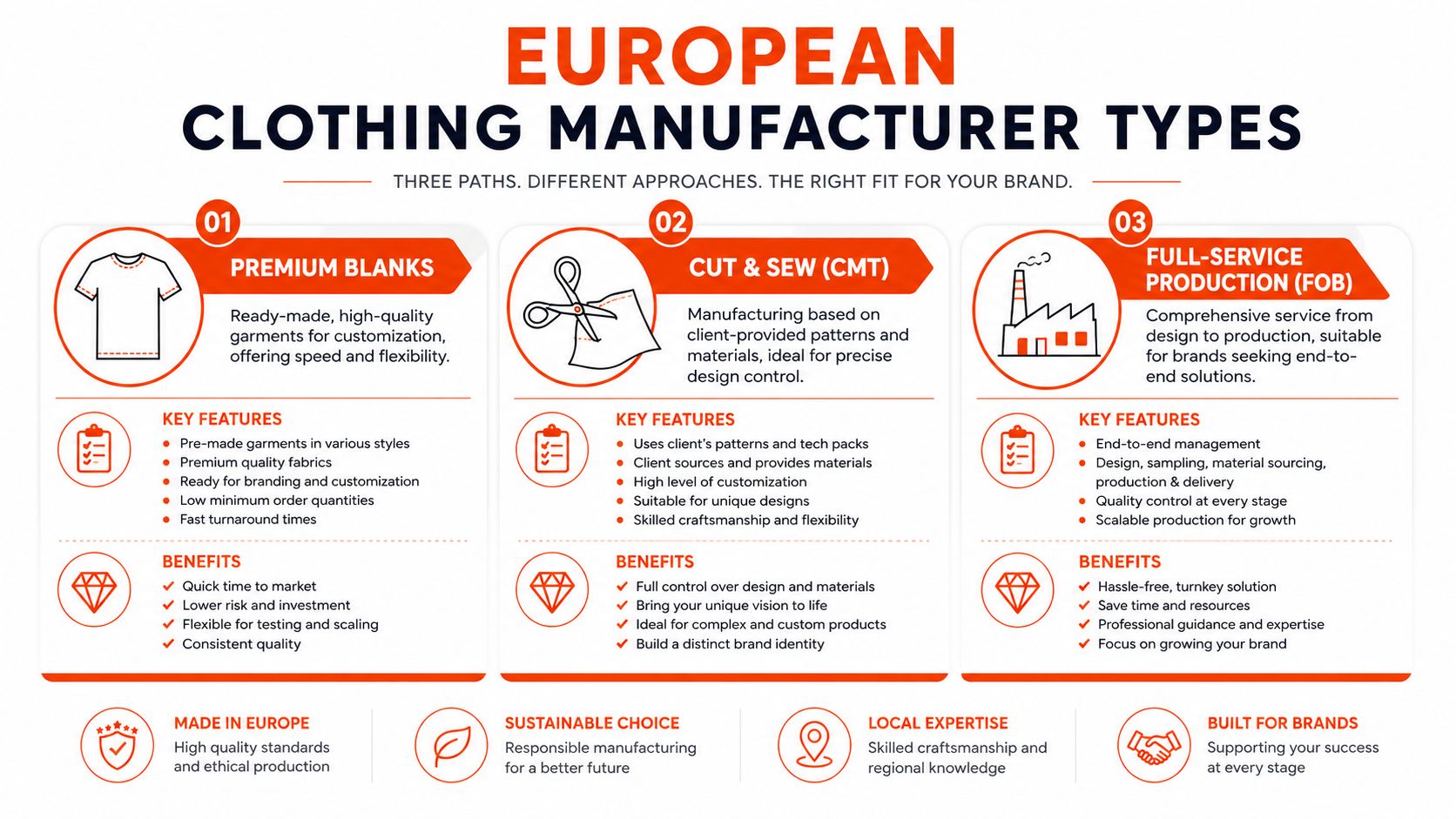
Premium blanks for speed
This is the fastest path when you need high-quality branded apparel without inventing a garment from scratch.
You choose an existing blank. Think heavyweight tees, hoodies, sweatshirts, polos, caps, or tote bags. Then you customize with embroidery, screen print, woven labels, patches, or packaging upgrades. For startups doing onboarding kits, event giveaways, or internal teamwear, this route is usually the smartest first move.
Premium blanks work when:
- You need speed: The body already exists, so development is lighter.
- You want lower complexity: Fewer moving parts means fewer ways to mess up.
- You care most about finish: Decoration, placement, and packaging become the differentiator.
This model is underrated because people assume “blank” means basic. It doesn't. A strong blank with the right fit and wash can outperform a weak custom garment every time.
Cut and sew for control
Cut and sew is where you build the garment itself. Fabric, pattern, silhouette, trims, labels, finishing. Everything gets specified.
If you're launching a capsule collection, a private-label line, or a product that needs its own shape and feel, this is the route. It's slower and more technical, but it gives you real control. If you need a clean breakdown of how this process works, this guide to cut and sew apparel production is worth reading before you start emailing factories.
Eastern Europe becomes interesting here. CMT rates there are 30 to 45 percent lower than Portugal and 50 to 70 percent lower than Italy, and the region beat Asian sourcing lead times by 5 to 7 weeks in 2024 while serving brands like Hugo Boss and Inditex based on CBI's apparel sourcing data. That makes it a serious option for brands that need custom product but can't absorb Western European pricing.
Ateliers and full-service partners
Then you have ateliers and broader full-service setups. These partners are less about simple production and more about execution depth.
Some are ideal for luxury finishing, limited runs, embroidery-heavy product, premium packaging, or specialty details. Others manage development more holistically, from sourcing and pattern support to production coordination and finishing. These are the partners that save brands when the project has nuance.
A quick comparison helps:
| Model | Best for | Trade-off |
|---|---|---|
| Premium blanks | Fast branded apparel | Less silhouette control |
| Cut and sew | Custom garments and capsules | More development work |
| Ateliers or full-service | Premium execution and detail-heavy work | Usually more selective and process-driven |
The mistake most early brands make is jumping straight to full custom because it sounds more serious. It usually isn't. It's just more complex.
Start with the model that matches the job. If you're building your first team drop, blanks may be enough. If you're building a collection with its own identity, cut and sew earns its complexity. If the details are the product, you need a partner that can execute them.
Navigating Sustainability and Certifications
A lot of sustainability talk in apparel is branding theater. Too many vague “eco” claims. Too little operational detail. When you're working with European clothing manufacturers, the useful question isn't “Are they sustainable?” It's “What can they prove, and what systems do they already have in place?”
That difference matters more now because the compliance layer is getting real.
What the labels actually mean
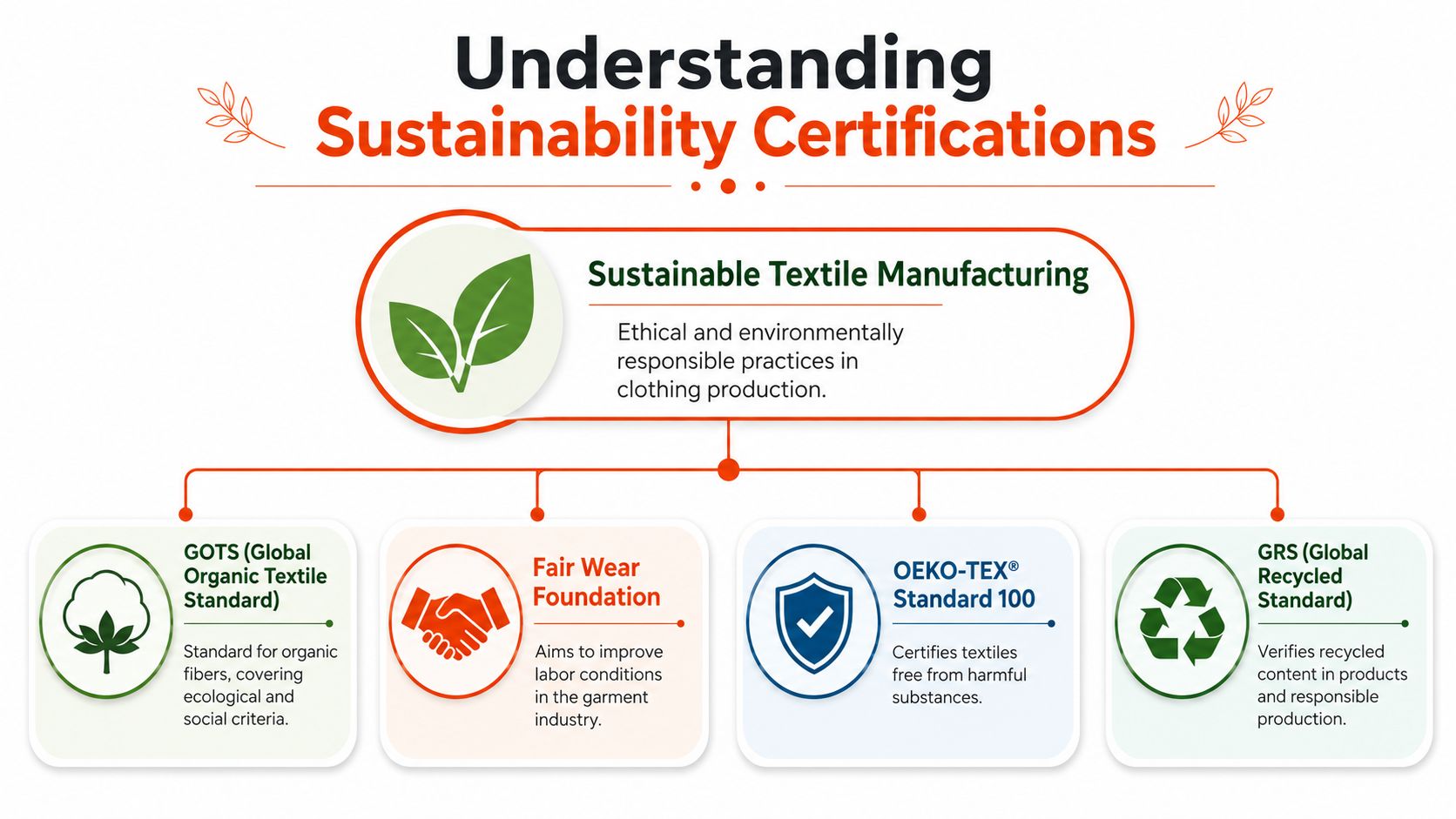
Some certifications matter because they verify a specific thing. Others get thrown around in sales decks with very little clarity.
Here's the practical version:
- GOTS: Relevant when you're using organic fibers. The standard also covers ecological and social criteria. The verified data notes that GOTS-linked organic cotton farming showed a 62% reduction in energy consumption, 91% less water usage, and a 46% decrease in global warming potential compared to conventional cotton farming in a life cycle assessment, as summarized in CBI's guide to sustainable materials.
- OEKO-TEX Standard 100: Useful for chemical safety. It's about whether the textile is free from harmful substances.
- GRS: Relevant when recycled content is part of the sourcing story.
- REACH alignment: Critical if you're selling into Europe and don't want chemical compliance to become a mess later. If you need the legal basics, this explainer on understanding REACH compliance obligations is a strong practical starting point.
You also want to hear how a supplier handles transaction certificates, fabric lot traceability, and third-party social audits. If they only answer with logo soup, keep pushing.
Certifications are useful. Traceability behind the certification is what makes them credible.
For founders comparing mills and factories, this primer on organic cotton fabric and what to ask suppliers helps separate real sourcing decisions from surface-level marketing.
Why DPP changes the sourcing conversation
This is the part many factory lists still miss.
The Ecodesign for Sustainable Products Regulation will require minimum recycled fiber content, durability requirements, and carbon footprint disclosures for all textile products on the EU market by mid-2028 according to CBI's sustainability market guidance. Alongside that shift, the Digital Product Passport changes what brands need from manufacturers.
In practical terms, DPP pushes brands to think like data managers, not just product buyers. You'll need clean records around materials, processes, chemical compliance, and product history. The factory that can only tell you “trust us, it's compliant” is not built for where the market is going.
This is why transparent traceability is a competitive advantage. Brands that can show where a garment came from, how it was processed, and what standards it met will look sharper to customers, buyers, and internal stakeholders. It also makes launches easier when your team wants to publish real product detail instead of generic sustainability copy.
What works and what doesn't
What works is boring but effective. Certified mills. Clear paperwork. Material traceability. Real answers on chemical controls. Partners who already think in systems.
What doesn't work is loose language. “Eco-friendly.” “Conscious.” “Sustainable-ish.” Those labels collapse fast when someone asks for the receipts.
If you're sourcing now for product that'll still be selling into the next few years, future-proofing isn't optional. It's just part of choosing a competent partner.
The Real Talk on Costs MOQs and Lead Times
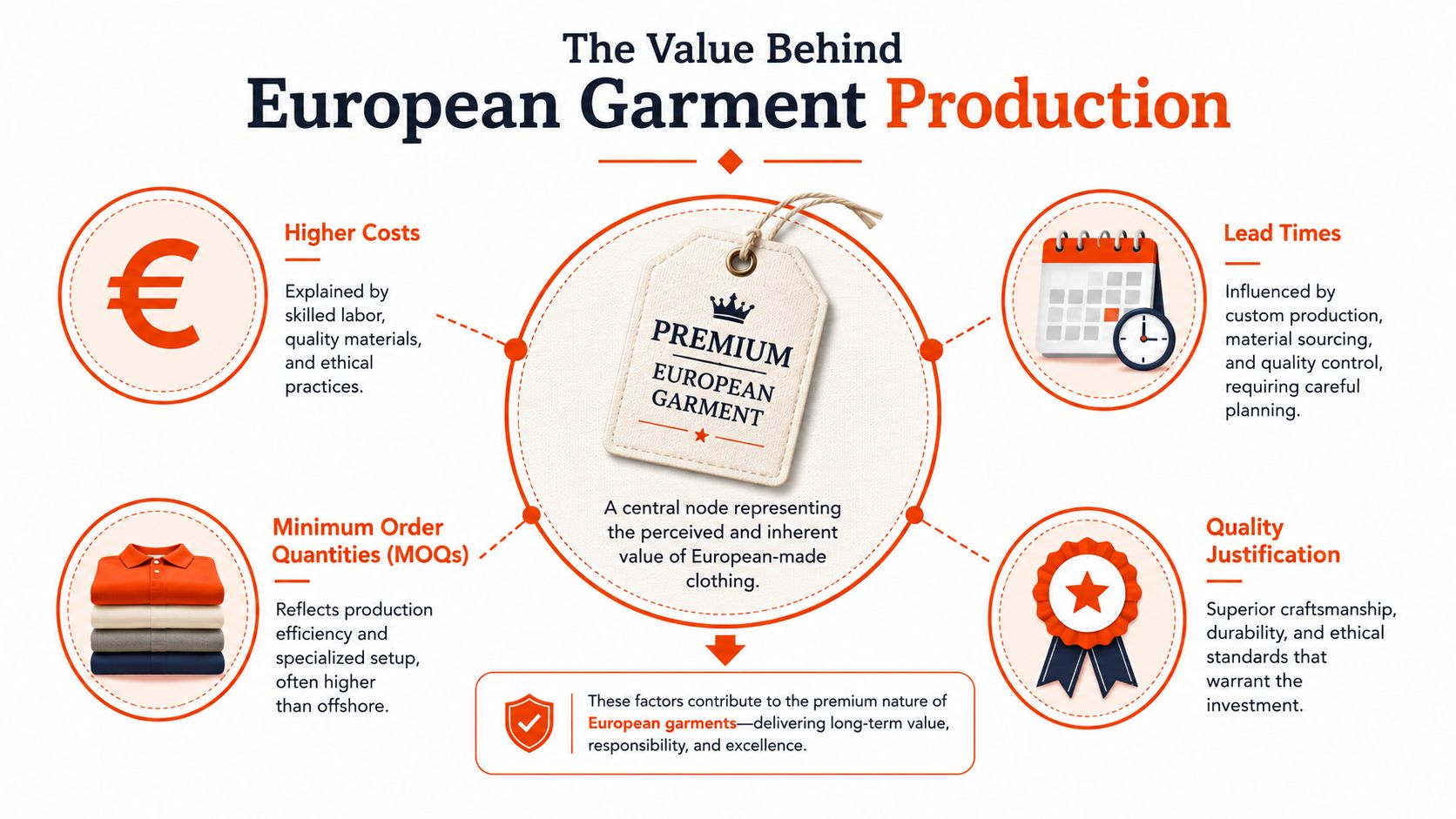
Most frustration in apparel sourcing comes from one thing. Buyers want premium quality, low minimums, fast delivery, and low pricing at the same time. Factories want none of that contradiction.
European clothing manufacturers can absolutely deliver premium output. But you have to understand the trade-off structure or you'll keep comparing quotes without understanding what you're buying.
The triangle you can't escape
Three forces keep shaping the deal: MOQ, unit cost, and lead time.
Push one hard, and the others react.
If you want a tiny run, the unit cost usually rises because the factory still has setup time, sampling overhead, labor planning, and sourcing friction. If you want a lower unit cost, the supplier will usually want more volume. If you want speed, you may need to simplify fabrics, reduce customization, or accept stock-based options.
That's normal. It's not a red flag.
Sustainable sourcing adds another layer. Certified sustainable fabrics in hubs like Portugal and Turkey typically cost 15 to 40 percent more than conventional equivalents, with mill MOQs around 200 to 800 meters, compared with 100 to 500 meters for conventional fabrics, and lead times are usually 2 to 4 weeks longer according to this sustainable fabrics guide focused on European sourcing. That changes how you plan drops, especially if you want custom dye, uncommon fibers, or traceability paperwork.
Where low-volume brands usually get stuck
A lot of guides tell early-stage brands that “low MOQ” means 50 to 100 units. That's useful, but it doesn't solve the core problem for teams launching tiny capsules, founder merch, or test drops.
The more interesting detail is this: while many guides list MOQs of 50 to 100 units, a small number of European manufacturers, particularly in Portugal, offer in-house cut-and-sew for orders under 50 units, which is a critical capability for 62% of tech and Web3 brands prioritizing limited capsule drops according to Athleisure Basics' research on low-MOQ clothing manufacturers in Europe.
That's a real wedge for internet-native teams. If you're not trying to hold deep inventory, sub-50 production can enable smarter launches.
A useful reference point is this guide to low-MOQ custom apparel options, especially if you're deciding whether to test with blanks first or go straight to custom production.
The best first drop is rarely the biggest one. It's the one that teaches you what people actually want to wear.
A cleaner way to budget the project
Instead of asking “What's the cheapest price?” ask four tighter questions:
- What's the minimum run that still gives me a wearable product?
- Which detail matters most to the wearer? Fabric, fit, print, embroidery, wash, or packaging.
- What timeline am I really on? Event date, team onboarding, or public launch.
- Which part needs to stay flexible? Quantity, color count, garment type, or sourcing standard.
That framework usually gets you to a better answer faster than quote shopping.
Cheap product with bad fit is expensive. Overbuilt custom apparel for a team that just needed premium blanks is also expensive. The sweet spot is finding the production model that matches the use case, then paying for the parts that people notice.
How to Vet a Manufacturer and Avoid Red Flags
The easiest way to waste a production cycle is choosing a manufacturer that looks credible in a PDF but falls apart in actual collaboration.
Most bad factory relationships don't fail because of one dramatic issue. They fail because small warning signs get ignored early. Slow replies. Vague sample notes. No clear ownership. Weak documentation. Defensive answers when you ask how they manage problems.
That matters even more now because traceability is moving from “nice to have” to baseline requirement. With the EU's Digital Product Passport regulation becoming effective, traceability is now a necessity, yet 78% of EU fashion startups are unaware of how to implement DPP-ready manufacturing according to this DPP-focused industry note. If a supplier can't discuss DPP workflows in a concrete way, that isn't a future problem. It's a present screening issue.
Questions serious buyers ask
Don't stop at price, MOQ, and lead time. Ask questions that reveal process maturity.
A strong shortlist call should include things like:
- How do you collect and store material traceability data? You want a real workflow, not a generic “we can provide documents.”
- What happens when a small-batch run has QC issues? Small runs often get less tolerance from buyers, not more.
- Which steps are handled in-house and which are subcontracted? Dyeing, embroidery, washing, finishing, packaging.
- How do you manage approvals? Digital mockup, physical sample, BAT photos, pre-production confirmation.
- Can you show an example of product documentation you provide after production? DPP readiness becomes evident through this documentation.
- What's your standard communication rhythm during production? Weekly updates beats silence followed by surprise.
Red flags that usually mean trouble later
Some warning signs are obvious. Others are more subtle.
Watch for these:
| Red flag | Why it matters |
|---|---|
| They avoid video calls | Harder to verify team, facility, and communication quality |
| They answer compliance questions vaguely | Usually means documentation is weak or fragmented |
| They can't explain subcontracting clearly | You may not know who is actually touching the product |
| They resist sample iteration | Suggests low patience for fit and finish refinement |
| They push only one production model | Often means your product is being forced into their convenience |
If a manufacturer gets annoyed when you ask about traceability, chemical controls, or production ownership, they're telling you how the relationship will feel later.
What good partners usually do differently
Good manufacturers don't just say yes fast. They ask better questions.
They'll ask for the intended use case. They'll challenge poor fabric choices. They'll explain why one print method fits better than another. They'll flag timeline risk before it becomes your emergency. And when they don't know something, they'll say that plainly.
That last part matters a lot. Honest uncertainty is easier to work with than polished vagueness.
For modern brands, especially those building public trust online, transparent traceability should sit near the top of the vetting checklist. Not because regulation says so, though it does. Because the manufacturer that can support traceability is usually also the one with better operational habits everywhere else.
Your Onboarding Playbook From Quote to First Drop
A strong first run with European clothing manufacturers should feel more like launching a product than placing a generic purchase order. You need a clean brief, a partner who can interpret it correctly, and a workflow that doesn't collapse under revisions.
That doesn't mean making the process complicated. It means making it tight.
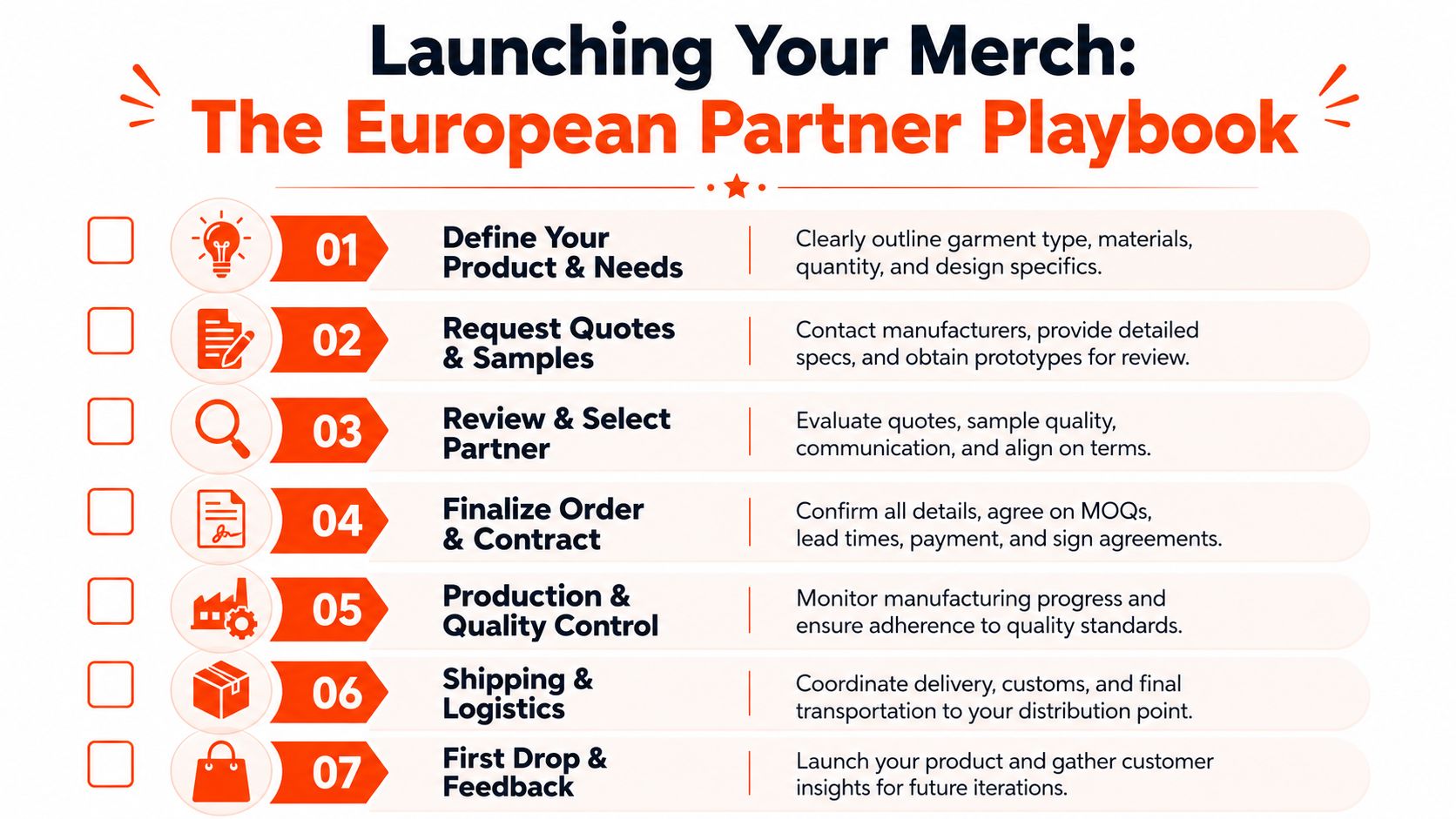
What a clean launch process looks like
The best onboarding process usually follows this shape:
Define the product clearly
Choose garment type, fit direction, material preference, customization method, quantity range, and delivery context. “We need hoodies” is not a brief. “We need oversized heavyweight hoodies for a founder retreat, black and washed navy, subtle left-chest embroidery, packed individually” is a brief.Request quotes with usable detail
Include sizes, target delivery window, decoration placement, and whether you need samples. Better input gets you better pricing and fewer revisions.Review samples like a brand owner, not just a buyer
Check fit, hand feel, print texture, embroidery tension, label placement, and how the piece looks in real light. Not just on paper.Lock approvals before bulk production
Teams save or lose time at this stage. Sign off on the exact version. Color. placement. decoration size. labeling. packaging. Don't “kind of approve” and hope it works out.Plan fulfillment before production finishes
If you're shipping to a distributed team or community, get addresses, split quantities, and packaging rules in order early. If you need help thinking through that piece, this guide to merch fulfillment services for modern teams is useful.
How to keep the first drop from drifting
The first drop usually drifts in predictable ways. The product expands. Too many stakeholders jump in late. Someone wants a second garment added. Packaging gets discussed after production already started. Then the timeline gets blamed.
A few habits keep things under control:
- Freeze the SKU count early: Fewer SKUs means fewer mistakes.
- Name one decision-maker: Group chat approvals are where merch timelines go to die.
- Separate test drop from forever product: Your first run should teach you something.
- Document every approval: Sizes, placements, colors, trims, and pack-out rules.
Small drops work best when the team treats every choice as intentional. The point isn't more merch. It's better merch.
A good European production partner will make this flow feel orderly. A great one will make it feel calm.
That's the standard worth looking for, especially if your team cares about premium blanks, low minimums, custom details, fast turnaround, and worldwide fulfillment without turning the whole project into a second full-time job.
If you want a partner that already speaks the language of premium custom merch, low-friction approvals, French ateliers, factory-direct pricing, and worldwide fulfillment, Banger is built for that. You can explore the catalog, request a quote, and get product previews within 24h to start building merch your team will want to wear.