On Demand Fulfillment for Modern Teams
You've got a hoodie budget approved, a conference date locked, and a spreadsheet full of people who don't share an office, a city, or sometimes even a continent. The order is placed in bulk because that's how merch programs have always worked. Then someone asks whether 400 hoodies can reach 280 recipients across nine time zones in five days.
That's when the warehouse-first model starts showing its seams. You're holding inventory before demand is clear, splitting shipments by hand, chasing addresses in Slack, and discovering that “delivery” means something different in every market. The merch isn't the problem. The operating model is.
On demand fulfillment moves the production decision closer to the actual order. That changes how marketing teams handle distributed onboarding, conference gifting, creator drops, Shopify-backed merch, and global community rewards. It also introduces tradeoffs that vendors often bury. Here's what the model really buys you, where it breaks, and how to evaluate it without getting burned.
Table of Contents
- The Moment You Realize Bulk Merch Doesn't Scale
- Traditional warehousing
- Generic print-on-demand
- Brand-focused on demand fulfillment
- 1. The order triggers the workflow
- 2. The design gets approved
- 3. Production and customization happen
- 4. Finishing creates the brand experience
- 5. Shipping gets routed by recipient
- Distributed onboarding kits
- Conference and event gifting
- Web3 and community rewards
- Creator and podcast drops
- Corporate gifting
- Product range and blank quality
- Customization depth
- Packaging and finishing
- Logistics and commercial fit
The Moment You Realize Bulk Merch Doesn't Scale
The event team has already left the venue when the shipping problem becomes obvious. Four hundred hoodies sit in a warehouse, while attendees are scattered across the US, Europe, and Asia. You've got five days, incomplete addresses, different customs rules, and a campaign promise that made the merch feel personal.
Bulk production looks efficient on paper. You place one large order, secure a lower per-unit cost, receive everything in one location, and ship when the goods are ready. That workflow works when a team shares an office or when a retailer can move inventory through predictable channels. It gets messy when every item needs to reach a different person.
The hidden work multiplies quickly:
- Address collection: Marketing owns the campaign, but someone still has to clean recipient data and resolve missing apartment numbers.
- Shipment splitting: A single pallet becomes dozens or hundreds of individual parcels.
- Regional complexity: Customs, duties, carrier coverage, and delivery expectations vary by destination.
- Timing risk: Production may finish on schedule while receiving, repacking, or last-mile delivery pushes the campaign past its useful date.
Practical rule: If your team needs to ship personalized merch to many addresses, judge the program by total operational effort, not just the unit price.
Traditional bulk merch also creates an inventory bet. You choose sizes, colors, and quantities before the audience has confirmed what it wants. Unsold units consume space and attention. Popular sizes disappear first, while less popular variants remain stranded.
That's why the model feels especially awkward for internet-native teams. A startup might hire across several countries, a DAO might reward contributors worldwide, and a creator might have no reliable way to predict demand for a new drop. The more distributed the audience, the less useful a single warehouse full of finished goods becomes.
The structural fix is simple: move more production and packing decisions downstream, after the recipient and order are known. The question isn't whether bulk merch is always wrong. It's whether your program needs the cost advantage of bulk or the flexibility of producing and shipping closer to demand.
What On Demand Fulfillment Actually Means
On demand fulfillment means a product is produced, customized, packed, and shipped after an order or recipient request is confirmed. Instead of making a large quantity, storing finished goods, and deciding later where they'll go, the fulfillment partner can connect the order to production and send the finished item directly to one address or many addresses.
Think of the difference between a cafeteria that pre-cooks 500 meals and one that cooks each meal after the order is placed. The pre-cooked cafeteria moves quickly when demand matches the forecast. The cook-to-order kitchen wastes less when preferences are unpredictable, but it needs a reliable process behind the counter.
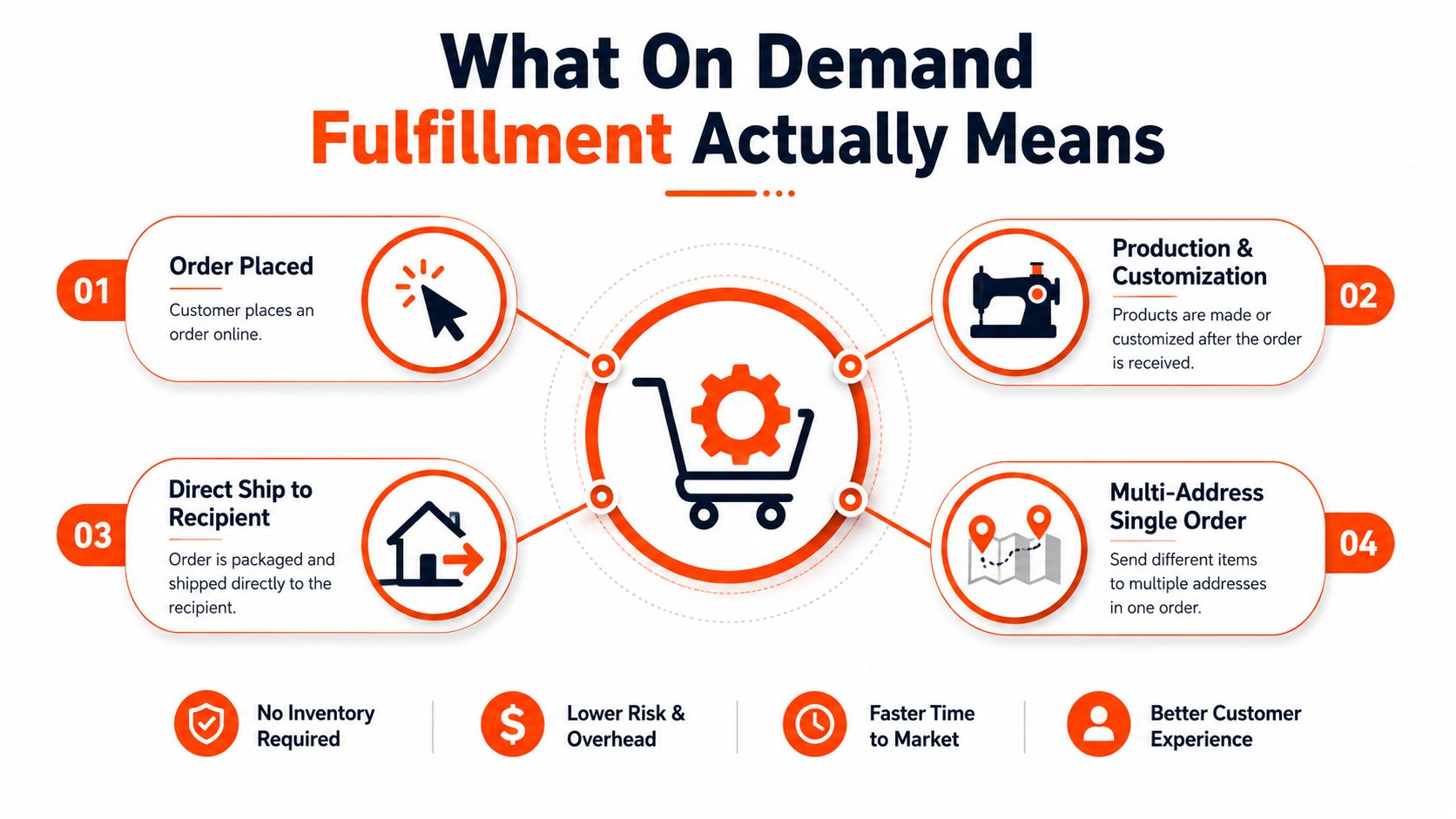
Three terms get mixed together:
Traditional warehousing
You buy or manufacture inventory in bulk, store finished goods, then pick, pack, and ship each order. This can make sense for stable products with predictable volume. It also means you carry storage responsibility and unsold inventory risk before the customer commits.
Generic print-on-demand
A customer places an order, a standard blank receives a print, and a provider ships it through a preset workflow. This eliminates upfront finished-goods inventory, but the product range, print methods, packaging, and routing can be limited.
Brand-focused on demand fulfillment
The broader model combines post-order production with deeper product and logistics control. Look for low minimums, multiple customization techniques, branded finishing, and multi-address fulfillment under one invoice. Those details matter more than the label a vendor uses.
The underlying principle is postponement. A business delays final differentiation, such as embroidery, labeling, packaging, or destination assignment, until it has better demand information. An MIT SCALE report on postponement in supply chains explains that pushing more processing downstream can shorten fulfillment lead time, while also showing that the right design depends on SKU count, work-in-process costs, finished-goods costs, and process timing.
For logistics teams documenting these handoffs, Doczen for logistics teams can be a useful reference point when mapping order, production, inventory, and delivery responsibilities. The vocabulary is straightforward: ask what happens after the order, where customization occurs, how addresses are handled, and which party owns exceptions.
On Demand Fulfillment vs Print-on-Demand vs Traditional Warehousing
The three models solve different problems. Traditional warehousing optimizes for cost and availability when demand is stable. Print-on-demand optimizes for low inventory exposure with a narrower product and packaging system. On demand fulfillment is the middle path for teams that need low minimums without giving up premium customization or coordinated shipping.
| Criterion | Traditional Warehousing | Print-on-Demand | On Demand Fulfillment |
|---|---|---|---|
| Minimum order quantity | Usually designed around bulk production | Often no upfront inventory requirement | Low minimums, depending on product and technique |
| Customization depth | Broad during the production run | Usually one print method on a standard blank | Embroidery, labels, packaging, patches, print, and other finishing options |
| Per-unit cost | Often lower at large, predictable volumes | Higher per item, with simple production | Higher than bulk, but includes flexibility and fulfillment handling |
| Lead time | Production happens before the order, shipping follows stock availability | Production begins after the order | Production, finishing, and shipping follow the confirmed order |
| Packaging control | Strong if the warehouse offers value-added services | Often basic or provider-standard | Can include branded mailers, boxes, tissue, inserts, and hang tags |
| Multi-address capability | Possible, but often requires manual warehouse coordination | Available through some providers, not universal | A core requirement to verify before signing |
| Best fit | Evergreen uniforms, stable bestsellers, large planned programs | Simple ecommerce products and unpredictable single-item demand | Distributed team drops, gifting, events, premium merch, and limited collections |
The important distinction is customization depth after the order is known. A generic POD workflow may print a logo on a blank tee. A more capable on demand partner can apply embroidery, woven labels, name tags, branded packaging, and other details once the recipient and product choice are confirmed.
The cost comparison also needs context. Bulk production can win on unit economics when volume is high and predictable, but that advantage weakens when you're storing the wrong sizes, shipping inventory twice, or paying a team to reconcile addresses. On demand fulfillment charges you for flexibility. That can be the right trade when the campaign's value comes from relevance, timing, or presentation.
For a broader look at the operational questions buyers should ask, use this guide to merch fulfillment services.
Choose traditional warehousing for stable, repeatable demand. Choose generic print-on-demand when speed to catalog and minimal product complexity matter most. Choose on demand fulfillment when the merch needs to feel designed, personal, and coordinated across many recipients.
How On Demand Fulfillment Works Step by Step
Take a 400-piece team drop with custom embroidery, branded mailers, and recipients across multiple countries. The process should feel less like a warehouse project and more like a controlled production pipeline.
1. The order triggers the workflow
The trigger might come from a Shopify order, a CSV upload, or a campaign form. The file needs clean recipient names, addresses, sizes, quantities, and any personalization fields. If the input is wrong, no fulfillment model can rescue the delivery cleanly.
2. The design gets approved
The vendor confirms the garment, placement, thread or ink treatment, and packaging details. Don't skip the proof. A small placement error becomes expensive once production starts, especially when the design includes embroidery or multiple finishing elements.
3. Production and customization happen
The blank can be pulled from available inventory, then sent through the appropriate process. Depending on the design, that could include embroidery, screen printing, DTG, DTF, sublimation, patches, or cut and sew work in a French atelier.
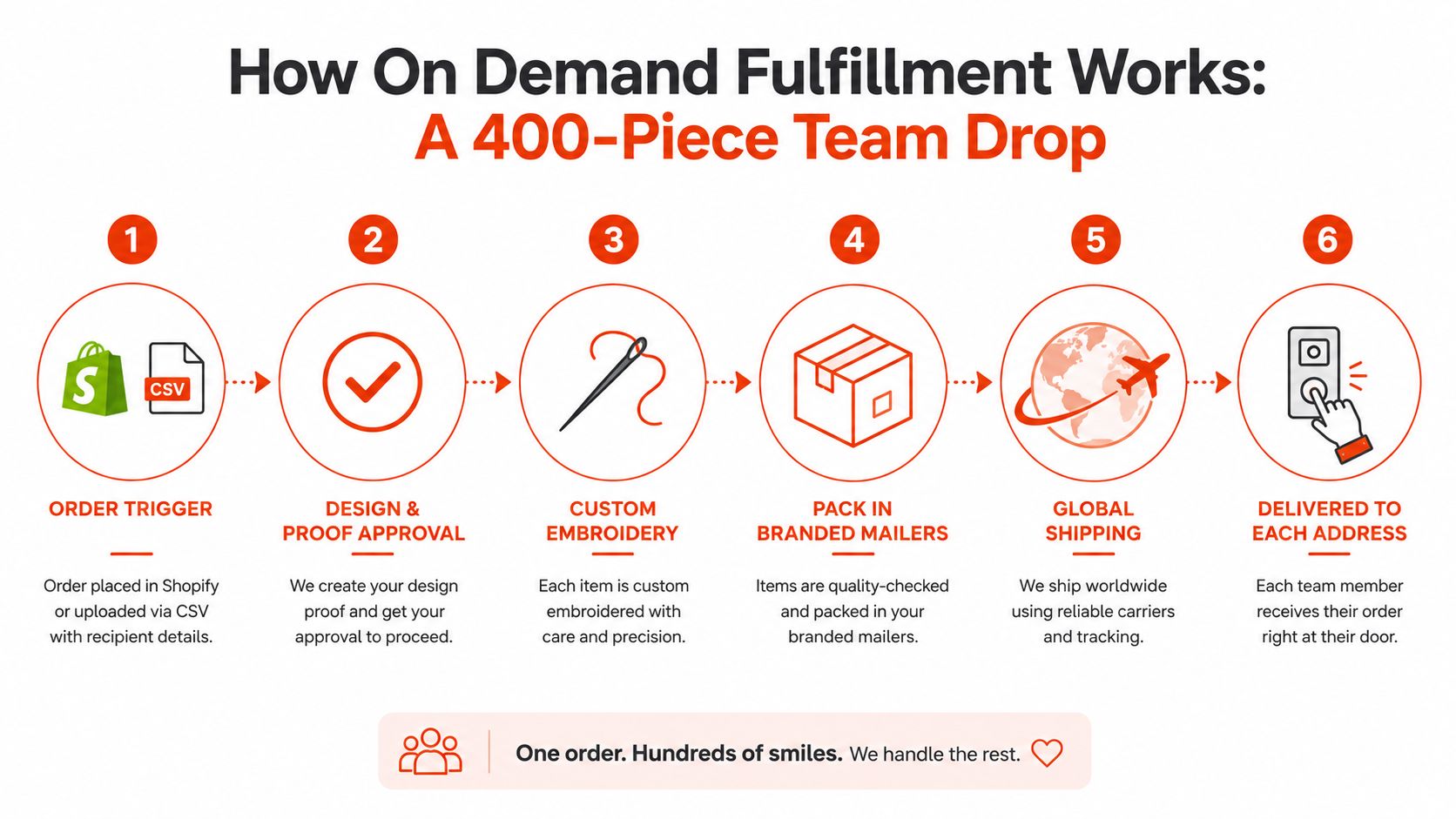
4. Finishing creates the brand experience
Custom neck labels, hang tags, embroidered name tags, tissue paper, inserts, and branded mailers turn a product shipment into a deliberate unboxing. Packaging isn't decoration when the merch is part of a launch, hiring moment, or event narrative. It's the final physical touchpoint of the campaign.
See how custom apparel packaging fits into the production plan before approving the order. Packaging decisions can affect dimensions, costs, handling, and delivery timing.
5. Shipping gets routed by recipient
The fulfillment partner prepares one shipment per address, or one consolidated shipment when that makes more sense. For major markets, ask whether duties can be handled through DDP so recipients aren't surprised by a customs payment.
The deadline is always production time plus transit time. A POD provider shipping domestically may reach a total delivery window of 2 to 3 business days when production takes about one day and transit takes about two, according to this POD shipping time comparison. International delivery adds carrier, customs, and destination variables, so an event date alone isn't enough for planning.
A separate Canadian TBYB shipping and UX guide is useful when reviewing how shipping expectations affect the customer or recipient experience. Make the delivery promise explicit before the campaign launches.
Use Cases Marketing and Events Teams Run On Demand
On demand fulfillment earns its keep when the recipient list changes, the audience is distributed, or the product needs to feel more specific than a logo slapped on a blank.
Distributed onboarding kits
A new hire in Berlin shouldn't wait for a quarterly office shipment. Each person can receive a hoodie, tee, notebook, and accessories at their own address, with a name tag or role-specific insert when the program calls for it. Operationally, the company replaces pallets and internal handoffs with a repeatable trigger tied to the hiring workflow.
Conference and event gifting
Events teams can ship merch ahead of a conference, directly to registered attendees, speakers, partners, or VIP guests. The box arrives in the recipient's name rather than becoming another item in an overcrowded booth. The shift is from transporting bulk giveaways to coordinating targeted attendance moments.
Web3 and community rewards
DAOs, protocols, and online communities often need to reward contributors or holders across many countries. On demand fulfillment lets the team collect recipient details after eligibility is confirmed, then route branded apparel or gift boxes without guessing regional demand. DDP availability should be part of the evaluation, because duties can destroy the recipient experience.
Creator and podcast drops
Creators rarely know which color, size, or product will move before a launch. Producing after orders are placed avoids turning a speculative drop into a storage problem. Premium blanks and packaging matter, because fans judge the physical product as part of the content ecosystem.
Corporate gifting
Client gifts, partner packages, and employee milestones benefit from controlled presentation and flexible recipient lists. A company can use different inserts or products for different groups without building a separate warehouse program for every campaign.
For product ideas that fit these moments, browse best swag ideas with the recipient and use case in mind. The right item isn't the one with the biggest logo. It's the one people will keep.
Choosing an On Demand Fulfillment Vendor
Treat the vendor quote like an operations document, not a mood board. Product photography can look premium while the actual workflow breaks at address import, proof approval, or returns.
Product range and blank quality
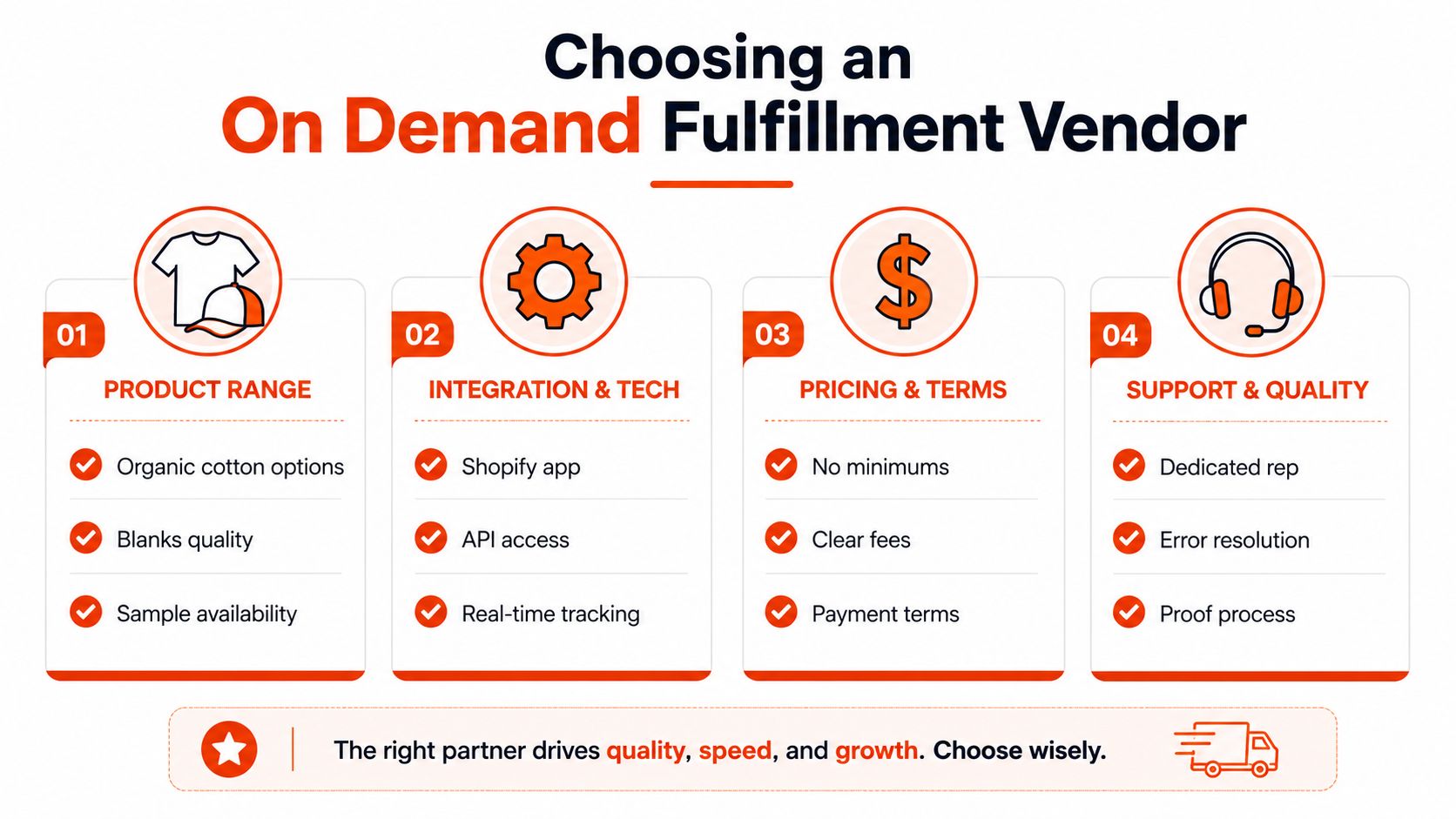
Ask what the vendor can source beyond a basic tee. Look for organic cotton, recycled materials, heavyweight hoodies in the 400 to 500 GSM range, jackets, caps, bags, drinkware, and accessories. Request physical samples before committing to a campaign. A blank that feels good on a screen can feel ordinary in hand.
Customization depth
Confirm which techniques are available and where they're performed. A serious program may need flat or 3D embroidery, chenille, screen printing, DTG, DTF, sublimation, leather work, patches, laser engraving, embossing, or cut and sew construction.
Packaging and finishing
Get the packaging specification in writing. Ask about custom labels, hang tags, tissue, inserts, mailer boxes, branded shippers, and whether the partner can assemble kits with multiple SKUs. Packaging should be priced and proofed alongside the garment, not added as a last-minute request.
Logistics and commercial fit
Build the quote around real destinations and real deadlines. Ask for:
- Minimums: Can the vendor produce one unit per item, and what is the apparel order minimum?
- Preview speed: Can you receive a product preview and quote within 24 hours?
- End-to-end timing: What is the production and worldwide delivery window?
- Reorders: Can previously approved designs ship again in 5 to 7 business days?
- Address handling: Can one order ship to single or multiple recipients worldwide?
- Duties: Is DDP available in your major markets?
- Integrations: Does the system connect to Shopify, accept CSV files, or expose an API?
- Exceptions: Who handles damaged parcels, misprints, failed deliveries, and returns?
A vendor comparison such as Skup's print on demand comparison can help you build an initial shortlist, but generic POD rankings won't answer every premium merch question.
For low-volume programs, also review custom apparel with no minimum. As a benchmark to ask about, Banger offers one unit per item on most products, a 10-unit minimum per apparel order, preview quotes within 24 hours, 10 to 15 business day end-to-end production and delivery, and reorders in 5 to 7 days, according to its published service details.
Where On Demand Fulfillment Breaks Down
On demand fulfillment reduces the risk of sitting on unsold inventory. It doesn't eliminate operational risk. It changes where that risk lives.
The first problem is concentration. If most production or shipping runs through one regional hub, a delay at that hub can stall a large share of your campaign. A model marketed as distributed may still depend on a small number of physical nodes, so ask where inventory sits, where customization happens, and how orders reroute when a location is unavailable.
The second problem is cost. You're trading storage and inventory exposure for higher per-unit production, handling, packaging, and shipping costs. If you have stable demand for an evergreen uniform or a consistently popular tee, bulk production may still be the smarter financial choice.
Returns create another blind spot. A 2025 fulfillment report from Pattern describes operations leaders dealing with rising fees, delayed receiving, frustration with Amazon FBA, and limited returns visibility. That matters even more for international merch, where a return can involve customs, cross-border postage, damaged packaging, and unclear ownership.
Customization has limits, too. Heavy 3D embroidery, leather work, complex patches, and cut and sew construction can require more production time or higher minimums than a simple print. Ask for the technique-specific lead time, not the vendor's broadest average.
The honest read: On demand fulfillment isn't free flexibility. It's paid flexibility, with vendor dependency and more moving parts after the order is placed.
Before signing, clarify the storage and shipping model in merch fulfillment and storage FAQs. If the answers on hub failure, returns, and inventory visibility are vague, the flexibility probably isn't operationally mature.
Getting Started With Your First On Demand Drop
Start with the last quarter's merch spend. Split the catalog into two buckets: bulk-stable items, such as evergreen uniforms and repeatable core tees, and on demand items, such as event gifting, onboarding kits, client packages, and unpredictable drops.
Build one SKU list for each use case. Decide whether the design needs screen printing, embroidery, DTG, patches, custom labels, or a simpler finish. Then send a vendor two or three real scenarios, including destinations, quantities, packaging requirements, and the actual date the recipient needs the package.
Ask for a quote that includes product previews, production timing, multi-address shipping, duties, packaging, and exception handling. Don't accept a unit price that excludes the work your team will eventually have to perform.
Pilot one small drop from order trigger through delivery. Track proof turnaround, production communication, address accuracy, delivery visibility, packaging quality, and reorder handling. Expand only after the workflow works with real recipients, not just a clean test order.
A short product walkthrough can help your team review how the catalog and fulfillment experience fit together.
The right setup is usually hybrid. Keep predictable, high-volume items in bulk when the economics are clear, and move distributed, personalized, or deadline-sensitive programs to on demand fulfillment.
Banger combines premium European blanks, French atelier customization, branded packaging, and worldwide fulfillment for teams that need merch to reach real people in real locations. Visit Banger to explore the catalog, request a product preview, and plan a team drop that feels like a brand asset instead of leftover swag.