Screen Printed Labels: Premium Choice for Apparel
Most merch fails in a place almost nobody talks about. Not the front print. Not the hoodie weight. The inside label.
You can hand someone a clean silhouette, a strong color, and a logo that actually belongs on clothing - then ruin the whole thing with a stiff neck tag or a cheap-looking finish inside the garment. People notice. Maybe not consciously, but they feel it. The piece either feels considered, or it feels like leftover conference swag.
That's why screen printed labels matter. For premium apparel, they're not a minor production detail. They're part of how the garment feels in someone's hands. They shape comfort, brand perception, and the difference between "company shirt" and something someone actually keeps wearing.
Table of Contents
The Last Detail Your Merch Is Missing
Most teams obsess over the visible branding and ignore the part people physically feel first. That's a mistake. A scratchy neck tag, a badly sewn label, or a generic inside print tells the wearer the garment was treated like a giveaway, not a product.
The irony is that branding products directly isn't new. The shift from manual marking to industrial printing made branded labels viable, and the first commercially printed paper labels appeared in the 1880s using lithography, as outlined in this history of custom printed labels. That long arc matters because it shows something simple: labels have always been part of how products signal identity.
Why the inside label changes the whole read
A premium garment should feel intentional from every angle, including the one nobody sees on a rack. Interior branding tells people whether the brand understands apparel or just added a logo to a blank.
That's where screen printed labels win. They remove the separate tag and replace it with a direct print, usually at the neck or inner seam area. The result is cleaner, softer, and visually quieter. For modern branded apparel, that restraint often looks better than a chunky sewn label fighting for attention.
A bad neck label doesn't just feel cheap. It makes the whole garment feel less considered.
There's also a cultural shift here. People don't wear merch the way they used to. They wear it next to actual retail pieces - sometimes instead of them. That means the small finish details carry far more weight than most teams realize.
The quality signal people remember
When a shirt feels good on first wear, the label played a part in that. No itch. No fold. No stiff edge rubbing the back of the neck all day.
If you're already thinking hard about print placement, garment weight, and silhouette, the inside label belongs in the same conversation. It's part of the custom shirt printing decisions that shape the final product, not a compliance afterthought.
Premium merch rarely misses because of one huge flaw. It misses because of a pile of small signals. The neck label is one of the loudest.
How Screen Printed Labels Actually Work
A screen printed label isn't really a tag. It's a print built into the garment.
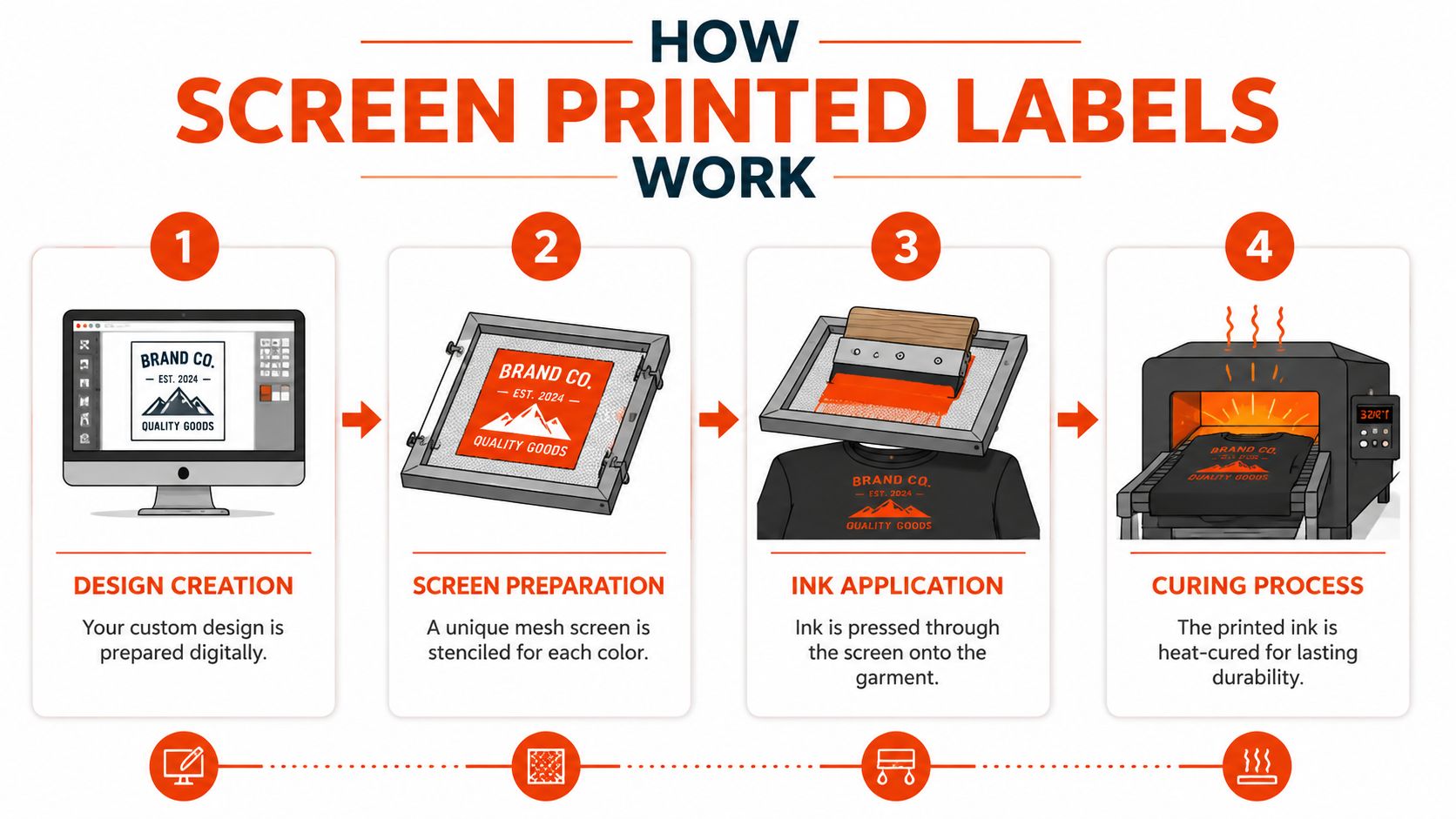
The simplest way to think about it is a controlled stencil process. A mesh screen is prepared for the artwork, ink is pushed through the open areas, and the label design lands directly onto the fabric where a tag would normally sit. Then it's cured so it stays put through wear and washing.
What happens in production
The flow is straightforward, but the quality lives in the setup.
Artwork gets prepared for print, usually as clean production-ready design.
A screen is made for each color in the label.
Ink is applied directly onto the garment in the chosen placement.
Heat curing locks it in so the print holds as part of the piece.
That last part is what separates a real production finish from something temporary. The label isn't attached after the fact. It becomes part of the garment.
Why it feels better than a tag
Because there's no folded fabric edge, no sewn seam at the neck, and no extra component sitting against the skin, screen printed labels usually create the softest interior experience. On the right blank and with the right ink system, the print can feel almost invisible during wear.
That “tagless” feel is one reason this method became so common in apparel. It also isn't an unproven shortcut. Automated screen-printing systems became common in the 1960s for custom decals and stickers, which helped establish the method as a reliable scaled process long before it became standard for apparel branding, as noted in this history of promotional stickers and automated screen printing.
Practical rule: If comfort is the first priority, printing the label into the garment usually beats attaching one to it.
There's a visual benefit too. Screen printed labels look modern because they remove clutter. No folded satin tab. No extra seam. No secondary object breaking the interior line of the garment. Just branding, size, and care info where it belongs.
Screen Printed vs Woven vs Heat Transfer Labels
Different label types say different things about a brand. Some feel understated and modern. Some feel heritage-driven. Some feel acceptable until the garment has been worn a few times.
The mistake is choosing based only on price or habit. For premium apparel, the better question is what kind of experience you want the wearer to have.
The fast read
Here's the practical comparison.
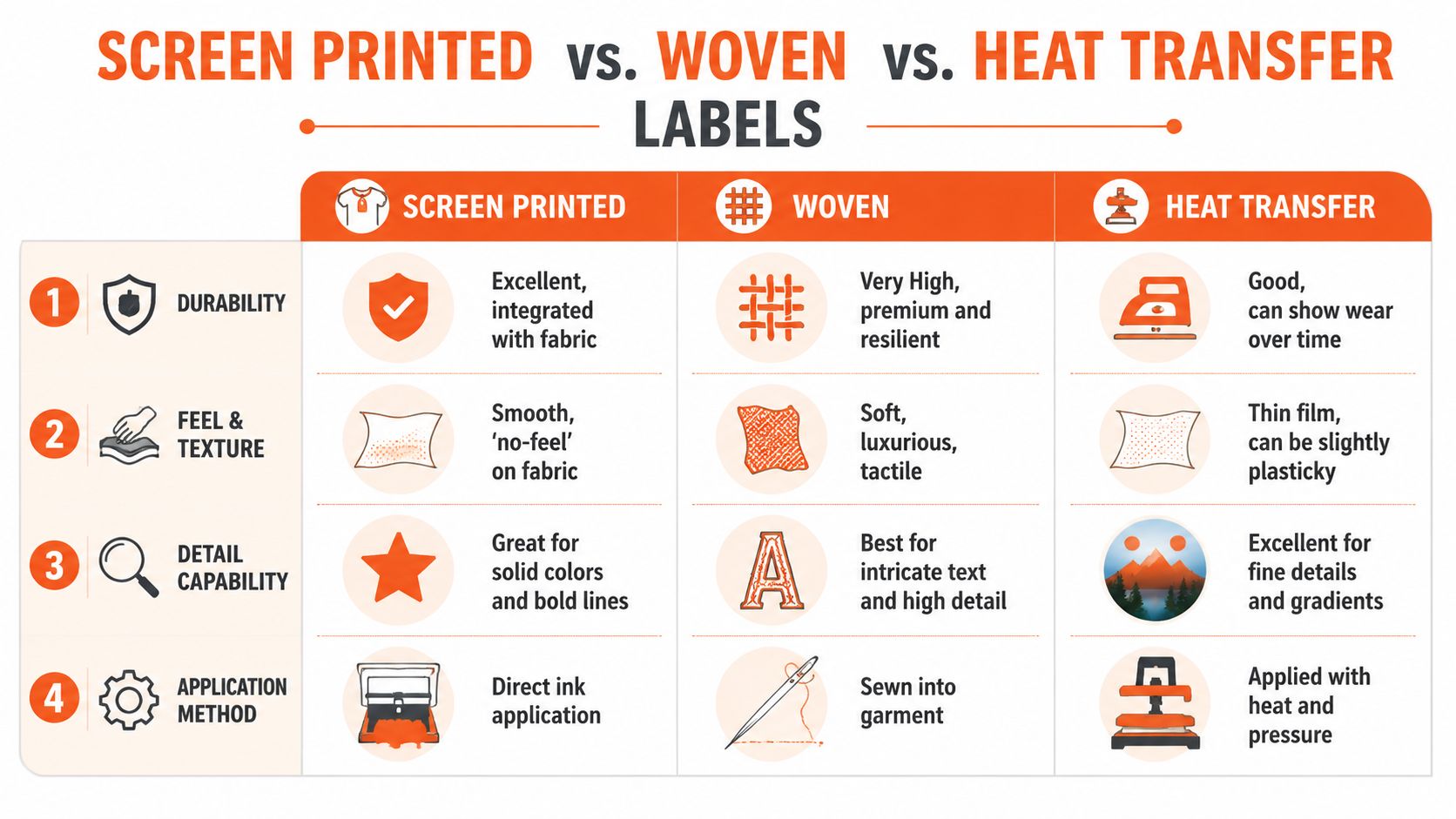
| Feature | Screen Printed | Woven | Heat Transfer |
|---|---|---|---|
| Feel | Soft, low-profile, often close to no-feel | Tactile, premium, but still a physical label | Smooth at first, can feel film-like |
| Brand perception | Clean, modern, apparel-native | Traditional, elevated, crafted | Functional, less premium in most cases |
| Durability | Strong when executed well on the right garment | Very strong because the label is its own component | Good, but finish can degrade depending on use |
| Fine detail | Better for bold graphics than tiny detail | Strong for intricate text and small elements | Better suited to high detail and changing artwork |
| Best use case | Neck labels for comfort-first premium apparel | Heritage or luxury-coded branding moments | Short-run or detail-heavy applications |
| Main drawback | Less suited to tiny typography and variable data | Can itch, add bulk, or interrupt the interior feel | Can read slightly plasticky |
Screen printed labels
Screen printed labels are usually the best choice when the goal is a clean inside finish and a softer wearing experience. They work especially well for tees, sweats, and other garments where comfort is part of the value proposition.
They also fit the visual language of contemporary brands. Minimal. Direct. Product-aware. Nothing extra.
The trade-off is fidelity at very small scale. If your label artwork depends on tiny legal text, miniature symbols, or hairline typography, screen printing starts to push back. This method likes clarity more than micro-detail.
Woven labels
Woven labels bring a different kind of premium. They feel more traditional, more tactile, and sometimes more “finished” in a classic apparel sense.
That can be exactly right for brands leaning into heritage, texture, or a more premium trim package. But woven labels are still objects sewn into the garment. Even soft woven labels create edge, thickness, and a physical presence that some wearers notice immediately.
Independent label makers frame the choice clearly. Screen printing is often picked for cost-effectiveness and soft feel on satin or cotton bases, while woven labels better serve brands that want a more traditional refined finish, as explained in this comparison of screen printed and woven labels.
Heat transfer labels
Heat transfer labels sit in the middle. They can hold more detail than screen printing and avoid some of the bulk of sewn labels. They're useful when artwork changes often or the design needs a finer level of resolution.
But they rarely deliver the same interior authenticity as a well-executed screen print. In premium apparel, heat transfer can work. It just needs a reason. If it's chosen only because it feels easy, the finish often reflects that.
If your brand lives on softness and simplicity, screen printed labels usually feel most natural. If your brand wants trim detail that reads more classic, woven may be the better move.
For teams comparing decoration methods more broadly, this guide to merch printing techniques helps frame how label choice fits into the bigger production stack.
Designing Your Custom Screen Printed Label With Banger
Good label design is mostly restraint. The best ones communicate exactly what needs to be there, fit the garment, and don't try to prove how much design work went into them.
That matters because screen printing is physical. Ink moves. Fabric texture interferes. Details that look crisp on a screen can collapse once they hit cotton.
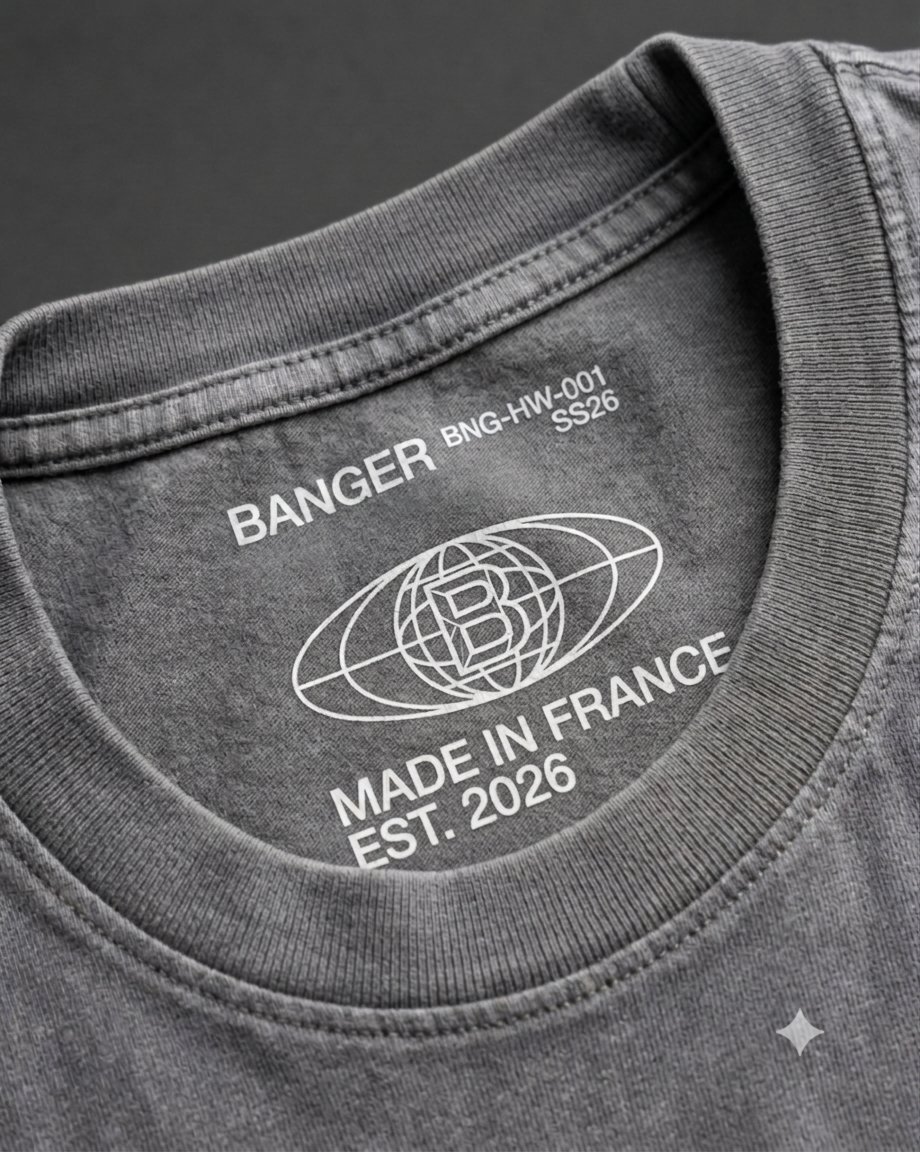
Here's how we approach it at Banger. The label above sits inside the neck of one of our own pieces - a screen-printed inside label that replaces the manufacturer's neck tag. Brand mark, product code (BNG-HW-001), season (SS26), origin (Made in France), and founding year. No more than what belongs there. Designed at a scale that holds up on cotton, with line weights that won't blur after the first wash.
Keep the artwork production-ready
Use vector files whenever possible. AI, EPS, and SVG files give production teams clean edges and scalable artwork. A random PNG pulled from Slack usually creates avoidable problems fast.
The label itself should also be edited for the method, not copied from your website brand sheet. The interior label isn't a hero lockup. It's a compact information system.
A strong custom label usually includes:
Brand name or logo that stays readable at small scale
Size marking placed clearly and intentionally
Care or composition info only if it belongs in the printed area
Country or compliance details handled cleanly, not crammed
Design for the real print, not the mockup
Screen printing has physical limitations that digital files don't. Fine typography and tiny symbols can get lost because of screen resolution, ink spread, printable area limits, and non-printable margins, as highlighted in this screen printing guidance on small-format detail constraints.
That means a few practical design rules matter more than people expect:
Go bolder than feels necessary. Thin lines often disappear first.
Simplify small logos. An alternate mark usually prints better than the full master brand lockup.
Give the design breathing room. Crowded labels look messy faster than large back prints.
Separate hierarchy clearly. Brand first, size second, utility info third.
Small label artwork should survive friction, fabric texture, and imperfect viewing distance. If it only works zoomed in on Figma, it isn't ready.
Placement is part of the brand
Most screen printed labels live at the inside neck, and that's still the cleanest choice for many tees and hoodies. But premium apparel doesn't have to stop there.
Some brands add a subtle interior hem print, a side seam detail, or a secondary mark inside the body. Used carefully, that can make the piece feel more developed without over-branding it.
If you're sorting out the difference between neck labels, sewn trims, and other interior finishing choices, this custom labels and name tags guide is useful context.
The goal isn't to fit more into the label. It's to make the piece feel authored.
Choosing the Right Materials and Inks
A screen printed label can look sharp in a proof and still feel wrong in the actual garment. That's usually a material problem, an ink problem, or both.
Fabric changes the print. Ink chemistry changes the finish. If you care about how a garment feels on body, the decision becomes critical.
Fabric changes the feel
On cotton, printed labels often feel softer and more integrated because the fabric accepts ink in a way that reads natural. On blends, the finish can shift. Sometimes the print sits a bit differently on the surface. Sometimes the texture underneath affects edge sharpness and hand-feel.
That's why the same label file won't behave identically across a lightweight tee, a dense heavyweight jersey, and a fleece hoodie. The blank is part of the print result, not just the base layer.
If you're choosing blanks for sweats or heavier apparel, this guide to the best hoodie blanks helps map material quality to final finish.
The premium move
For premium apparel, the best result usually comes from balancing three things instead of maximizing one:
Softness on skin
Legibility after wear
A finish that fits the garment's mood
A label inside a heavyweight fashion tee shouldn't feel like an afterthought. It should feel tuned to the fabric, the wash, and the overall product story.
Understanding MOQs Cost and Turnaround Times
Screen printed labels are efficient when the project is structured correctly. They're less forgiving when the order is tiny, the artwork keeps changing, or the team wants six versions of the same label for no real reason.
That's because setup is built into the method. A physical screen has to be prepared. Production has to be aligned to the garment and placement. That work is why screen printing often becomes more attractive as runs get larger and designs stay stable.
What affects cost
The main drivers are usually simple:
Number of colors in the label artwork
Number of garments being printed
Number of label versions across sizes, regions, or product types
Placement complexity and handling requirements
This is also why trying to make one label do too much can backfire. If the artwork turns into a mini document with changing details across SKUs, a different label method may make more sense.
Where screen printing fits best
Screen printed labels are strongest when the brand wants consistency, comfort, and a clean interior finish across a run that's large enough to justify setup. They're weaker when every unit needs variable information or the design changes constantly.
That trade-off matters more now because label printing itself is a large and growing industrial category. One market estimate values the global variable data printing labels market at USD 18.74 billion in 2024, up from USD 16.64 billion in 2023, with a projected 13.6% CAGR from 2025 to 2030 and a forecast of USD 40.33 billion by 2030, according to this market overview referenced in label industry history context. For apparel teams, the takeaway is practical. Custom labels are not niche. But not every customization method fits every production problem.
Use screen printed labels when repeatability matters more than personalization. Use other methods when every unit needs to change.
Turnaround depends on the supplier, the garment, and whether the artwork is ready. Clean files and decisive approvals always move faster than endless revision loops. Most delays come from indecision, not from the print itself.
Your Checklist for Ordering Screen Printed Labels
Ordering screen printed labels gets easy once the decisions are made in the right order. Most production issues happen because teams jump straight to artwork without locking the garment, placement, or information hierarchy.
Use this as the final pre-flight before you place an order.
Creative and brand checks
Your label artwork is simplified for print. Not your full brand system. The actual label version.
The file is vector-based and production ready.
The logo has a small-format version if the main mark is too detailed.
The hierarchy is clear so brand, size, and care details don't compete.
Product and production checks
The garment is already chosen because fabric changes how the print feels.
Placement is confirmed. Inside neck is the default, but not the only option.
The ink direction is decided based on softness versus stronger visual presence.
The quantity is realistic for a screen-based process.
Information and approval checks
Before approval, make sure the boring details are right. Sizes, care text, origin details, and garment color mapping create more rework than the logo ever does.
A clean order usually includes:
Final garment selection
Approved label artwork
Exact size breakdown
Placement confirmation
Proof review by someone who understands apparel, not just branding
The best screen printed labels almost disappear into the garment. That's the point. They make the piece feel complete, not overbuilt.
Once those pieces are locked, the order process gets much smoother. If you're ready to turn ideas into a real production request, get a free, no-commitment quote for custom merch with product previews in 24 hours.
If you want screen printed labels that feel like part of the garment, not an afterthought, Banger is built for that. Premium European blanks, custom inside labels and neck tags made for internet-native teams. Get a free, no-commitment quote with product previews in 24 hours, and build merch your team will actually want to wear.