Merch Custom Design Services: A Guide for Modern Brands
Most advice about custom design services starts in the wrong place. It treats "custom" like a logo placement option.
That's how you get generic tees, forgettable tote bags, and conference hoodies nobody picks up twice. A left-chest print isn't a design strategy. It's a placement decision. If you care about brand, culture, and product feel, custom design services for merch should go much deeper than that.
The difference is simple. Weak merch puts your brand on a product. Strong merch builds your brand into the product — through fabric, fit, print method, trims, packaging, and the small finishing calls most buyers never think to ask about.
Table of Contents
What Custom Design Services Really Mean
Custom design services aren't a niche side category anymore. They're part of a large professional market. In the U.S., the Web Design Services industry is estimated at $47.4 billion in 2026, with revenue growing at a 2.3% CAGR from 2020 to 2025, and the broader global graphic design market is valued at USD 59.29 billion in 2026, projected to reach USD 85.53 billion by 2031 according to IBISWorld market data. That matters because it tells you something basic. Design is no longer an optional polish layer. It's an operating function.
In physical products, that function gets misunderstood all the time.
A lot of buyers hear “custom design services” and think they're paying for artwork. Sometimes they are. But premium merch work usually lives in the decisions around the artwork. The blank. The weight. The silhouette. The ink hand feel. The embroidery height. The patch edge. The neck label. The packaging. The way the product lands in someone's hands.
Product customization versus product creation
There's a real difference between customizing stock and shaping a product with intent.
If you print a logo on a standard tee, you've customized an item. If you choose an oversized fit, washed finish, high-density chest graphic, woven hem label, and a custom inside neck print that matches your brand identity, you're building a product.
That distinction changes the outcome.
Custom design services for merch work best when the product carries the brand on its own — before anyone notices the logo.
What serious custom work looks like
For merch, good custom design services usually involve choices like:
The blank itself: weight, cut, drape, collar shape, cuff construction
Customization options: screen print, DTG, DTF, embroidery, patches, embossing, laser engraving
Finishing details: custom woven labels, hang tags, care labels, neck prints, custom trims
Packaging: mailers, inserts, tissue, stickers, full unboxing experiences
What it's for: onboarding kits, community drops, event giveaways, retail-style capsules
Most bad merch fails before production even starts. The team never decides what the product should be. They only decide what file to upload.
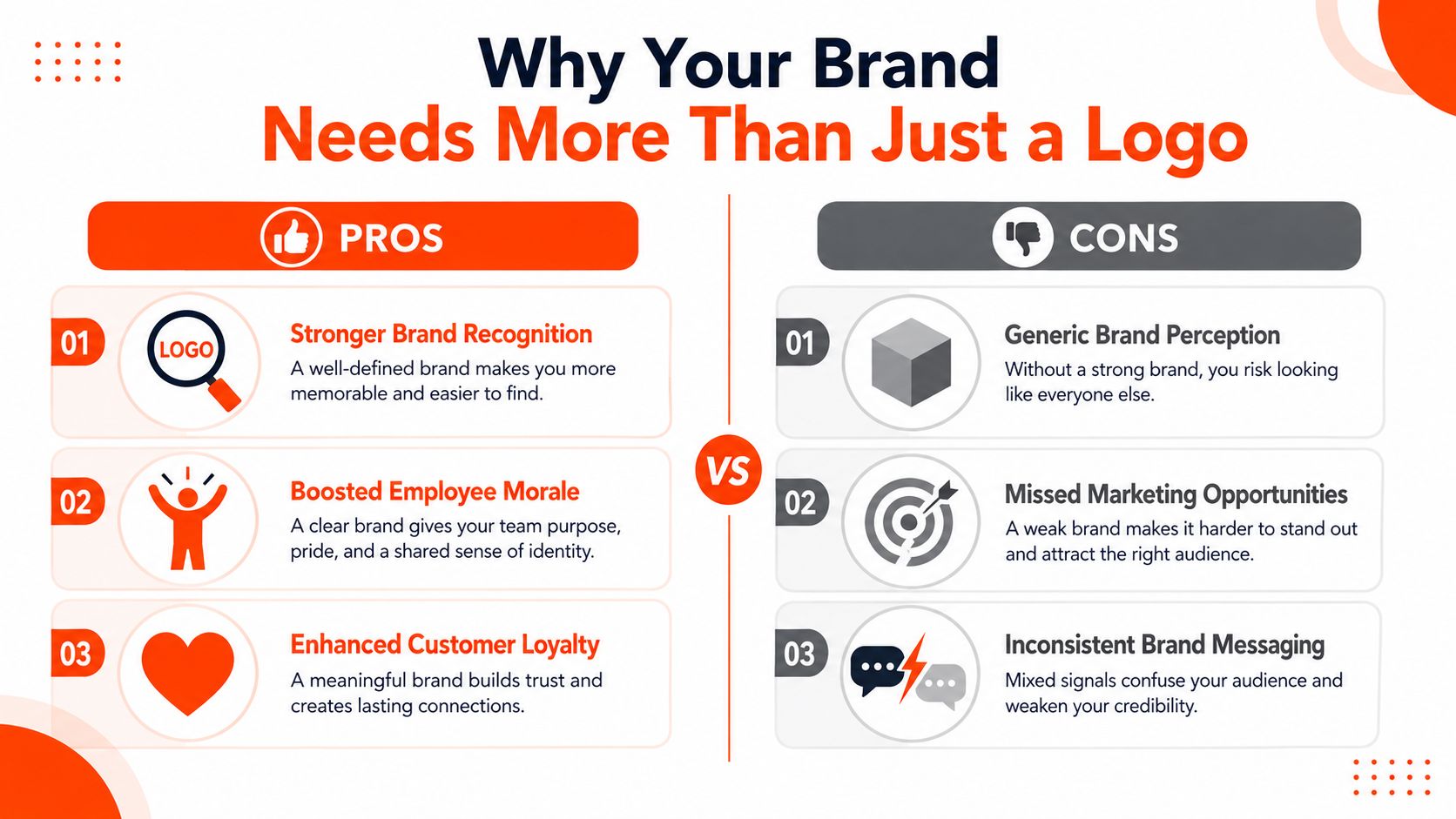
Why Your Brand Needs More Than Just a Logo
A logo-only approach saves time upfront and wastes value later. You end up with merch that looks fine in a mockup and flat in real life.
Here's what most teams miss: branded apparel doesn't compete with other branded apparel. It competes with everything already in someone's closet. If the cut feels off or the graphic feels lazy, nobody wears it just because they like your company.
Generic merch works against you
When a team hands out weak merch, the message lands whether they meant it to or not. Cheap feel reads as cheap judgment. Bland design reads as low conviction. Inconsistent pieces make the brand look scattered.
Thoughtful merch does the opposite — and does several things at once:
Signals taste: people read quality in seconds
Builds belonging: teams wear what feels like part of the culture, not part of the uniform
Extends memory: the right piece outlasts the event it came from
Closes the gap: physical touchpoints start matching the digital brand
Design matters when someone has to defend the budget
Merch conversations frequently sharpen. The buyer often isn't a designer. It's a founder, marketing lead, event lead, or people ops lead trying to justify spend internally.
That case gets easier when design is framed as performance, not decoration. McKinsey's 2024 analysis found that companies in the top quartile for design maturity outperformed industry peers in revenue growth by roughly 2x, according to this summary of McKinsey's design maturity finding. That doesn't mean every hoodie creates revenue on its own. It means teams that treat design seriously tend to make better commercial decisions around customer experience, brand clarity, and execution quality.
Practical rule: if merch only exists to display your logo, buy less of it. If it exists to strengthen culture, recognition, and recall, design it like it matters.
The forgotten drawer test
Every merch project should pass one basic filter. Would someone choose this if the logo belonged to a brand they didn't work for?
If the answer is no, the issue usually isn't budget. It's that the team stopped at branding and never got to product thinking.
Good custom design services solve that by pushing past surface-level personalization. They shape an object someone wants to keep, wear, and be seen in.
A Guide to Customization Techniques
Not every technique says the same thing. The method changes the mood of the product as much as the artwork does.
That's why strong custom design services don't start with “What's your logo?” They start with “What should this piece feel like?” Clean and minimal is different from loud and graphic. A recruiting hoodie has different needs than a conference tote or a private-label cap.
There's also a bigger expectation shift behind this. 71% of consumers expect personalized web experiences, but only 34% of brands deliver them successfully, according to Dataintelo's market overview. Physical products aren't exempt from that expectation. People notice when the merch feels generic.
Customization Technique Comparison
| Technique | Best For | Feel & Finish | Typical MOQ |
|---|---|---|---|
| Screen printing | Bold graphics, event tees, high-volume apparel | Crisp, graphic, classic print look | Varies by project |
| DTG | Detailed multicolor art on cotton garments | Softer print feel, good for complex artwork | Low-volume friendly |
| DTF | Flexible artwork application across varied runs | Smooth applied finish, strong color range | Varies by project |
| Flat embroidery | Caps, hoodies, polos, subtle logos | Premium texture, clean raised thread | Varies by project |
| 3D embroidery | Hats and statement branding | Chunkier dimensional look | Varies by project |
| Patches | Varsity, workwear, outerwear, collectible feel | Layered and tactile | Varies by project |
| Custom labels | Inside neck, hem, packaging details | Quiet branding, retail finish | Varies by project |
| Cut and sew | Full apparel development from scratch | Fully custom product build | Usually higher than print-only projects |
Screen print, DTG, and DTF
Screen printing is still the standard for a reason. It works best when you want a confident, graphic result. Large back prints, strong chest hits, and simple spot-color artwork usually look best here. It feels intentional, especially on heavyweight tees and hoodies.
DTG is useful when the artwork is detailed, tonal, or image-based. It's often the better route for illustration-heavy designs where screen setup would be overkill. The risk is choosing DTG for the wrong garment. A great file on a weak blank still looks weak.
DTF sits in a practical middle lane. It can solve versioning problems and certain artwork constraints, but it shouldn't be treated as automatically premium. It depends on the product, placement, and finish expectations.
For a deeper breakdown of print choices on tees, this guide to custom shirt printing methods is useful when you're deciding between graphic impact and fabric feel.
Embroidery, patches, and labels
Embroidery changes the tone immediately. A small tonal stitch on a heavyweight hoodie feels restrained and expensive. A big multicolor embroidered graphic can work too, but only if the garment can carry the density.
Patches are great when you want separation from the base fabric. Twill, woven, merrowed-edge, or embroidered patches add structure. They work especially well on caps, bags, and outerwear.
Custom labels do quieter work. While not mentioned first, they are nevertheless noticed. A woven hem tag, branded neck label, or interior message makes the item feel built, not bought.
The best premium merch often uses one loud detail and two quiet ones. Not five loud ones at once.
Cut and sew for brands that want full control
Cut and sew is where custom design services become actual product development. You're no longer selecting from a catalog and decorating it. You're building the piece from pattern, fabric, fit, trim, and finish.
That opens up more control, but it also raises the need for discipline. If you don't know why the garment should be boxy, cropped, washed, lined, or paneled, custom freedom just creates noise.
Good teams choose cut and sew when the product itself is the message. Not when they just want more options.
From Brief to Banger The Production Timeline
Most clients don't struggle with ideas. They struggle with translation. They know they want a clean founder hoodie, a conference kit that doesn't feel disposable, or an onboarding box that makes an impact. The hard part is turning that into files, approvals, samples, production, and delivery without losing quality halfway through.
That's why process matters.
Adobe's 2024 digital trends data shows 86% of business leaders say creative teams are under pressure to produce more content faster, as highlighted in this summary of Adobe's 2024 trend data. In merch, the pressure sounds familiar. Product launch in two weeks. Offsite in three. Conference shipping deadline locked. The question isn't just whether a partner can design something good. It's whether they can move cleanly.
The usual production flow
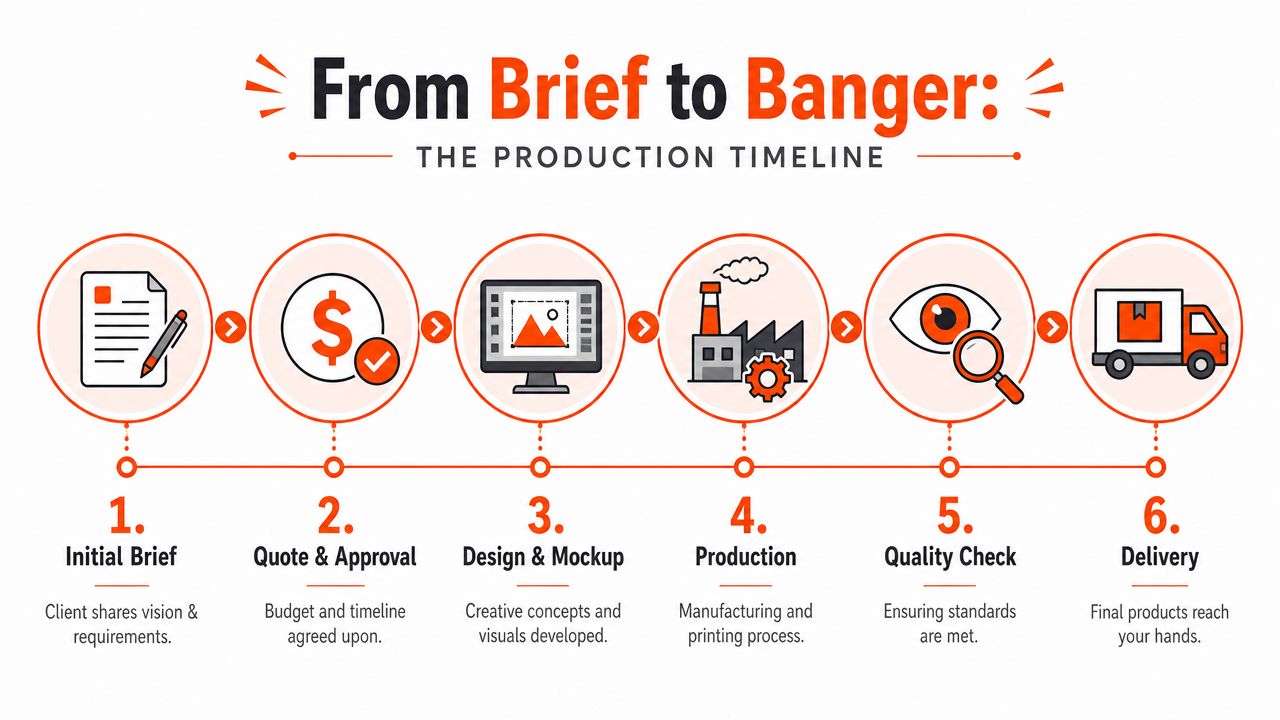
Initial brief
During this phase, strong projects separate early. The client shares product type, quantities, use case, artwork, target feel, delivery timing, and budget range. If those inputs are vague, everything downstream gets slower.Quote and approval
Pricing usually shifts based on garment choice, customization method, number of placements, finishing details, packaging, and shipping structure. A simple front print on a tee is one thing. A heavyweight hoodie with embroidery, woven labels, and kitted fulfillment is another.Design and mockup
Digital mockups help align on placement, scale, color, and overall mood. They're not the finish line. They're a decision tool.
BAT, tech pack, and the stuff buyers should know
A few terms matter here.
BAT or e-proof: this is the approval stage before bulk production. For some projects, it's a digital proof. For others, it's real photos of the customized sample before the full run moves.
Tech pack: the build sheet for more involved projects, especially cut and sew. It can include measurements, materials, placements, colors, trims, and construction notes.
Fulfillment split: when one order ships to multiple recipients, offices, or event destinations.
If your team is distributing merch across locations, it helps to understand how merch fulfillment services fit into the production timeline instead of treating shipping as an afterthought.
Where projects usually slip
Projects rarely go sideways because of one dramatic mistake. It's usually smaller friction:
Too many approvers: five people leaving separate comments on placement and color
Unclear assets: low-res logos, missing font files, inconsistent color references
Late packaging decisions: adding inserts, stickers, or mailers after production is already moving
Version chaos: regional edits and size breakdown changes made too late
Approvals should narrow options, not reopen the brief.
A clean process feels fast because the decisions are clear. That's different from rushing. Fast production with weak approvals just moves errors downstream.
How Modern Teams Use Custom Merch
The strongest merch programs aren't random. They're tied to a moment, a group, or a reason to care.
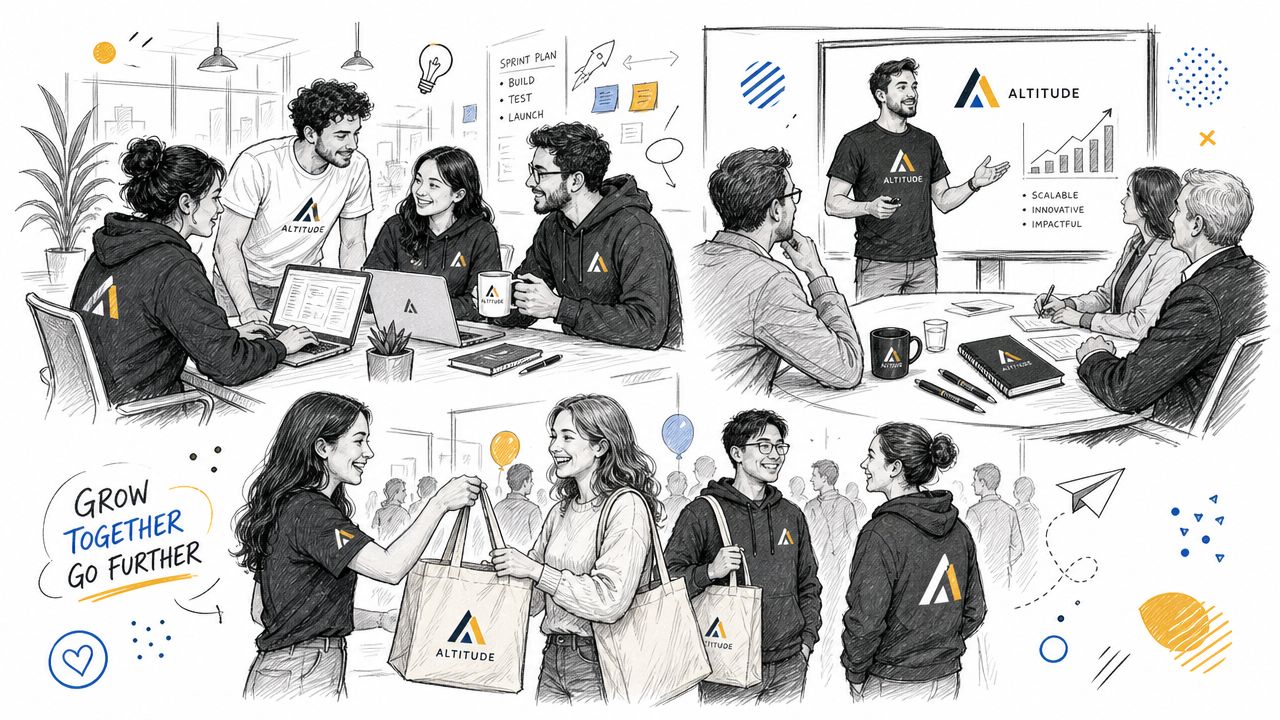
A startup onboarding kit works when it feels like joining something specific, not receiving office supplies. That usually means one hero item, often a hoodie or tee with real fit consideration, plus a few smaller pieces that carry the same visual language. Teams planning first-week experiences often get better results when they think in systems, which is why curated ideas for welcome gifts for new employees can be more useful than shopping item by item.
Four common plays that work
A fintech brand at a developer conference might skip the generic expo giveaway and produce a limited-run heavyweight hoodie with subtle embroidery. People line up for scarcity and taste, not for another stress ball.
A crypto protocol can use merch as contributor recognition. Not loud token merch. Better to make pieces that feel collectible, with insider references only the community gets.
A creator launching a first merch line usually does better with fewer SKUs and stronger execution. One great tee, one hoodie, one cap. Tight palette. Strong packaging. No filler.
A remote team planning an offsite can use merch to create instant cohesion. Same visual direction across apparel, notebook, badge holder, and tote. Not matchy. Connected.
Later in the cycle, video helps teams align on what premium execution looks like in motion:
What these teams understand
The product is doing social work. It helps people feel inside the brand, not adjacent to it.
That's why the best custom merch usually isn't trying to impress everyone. It's designed for a specific audience with a clear point of view.
Finding a Merch Partner That Gets It
A lot of merch vendors can take an order. Fewer can protect the idea once production starts.
That's the real filter. You're not choosing a print shop. You're choosing a partner who can hold quality across product selection, customization, sampling, packaging, and delivery — without letting the piece slide back into generic.
What to ask before you commit
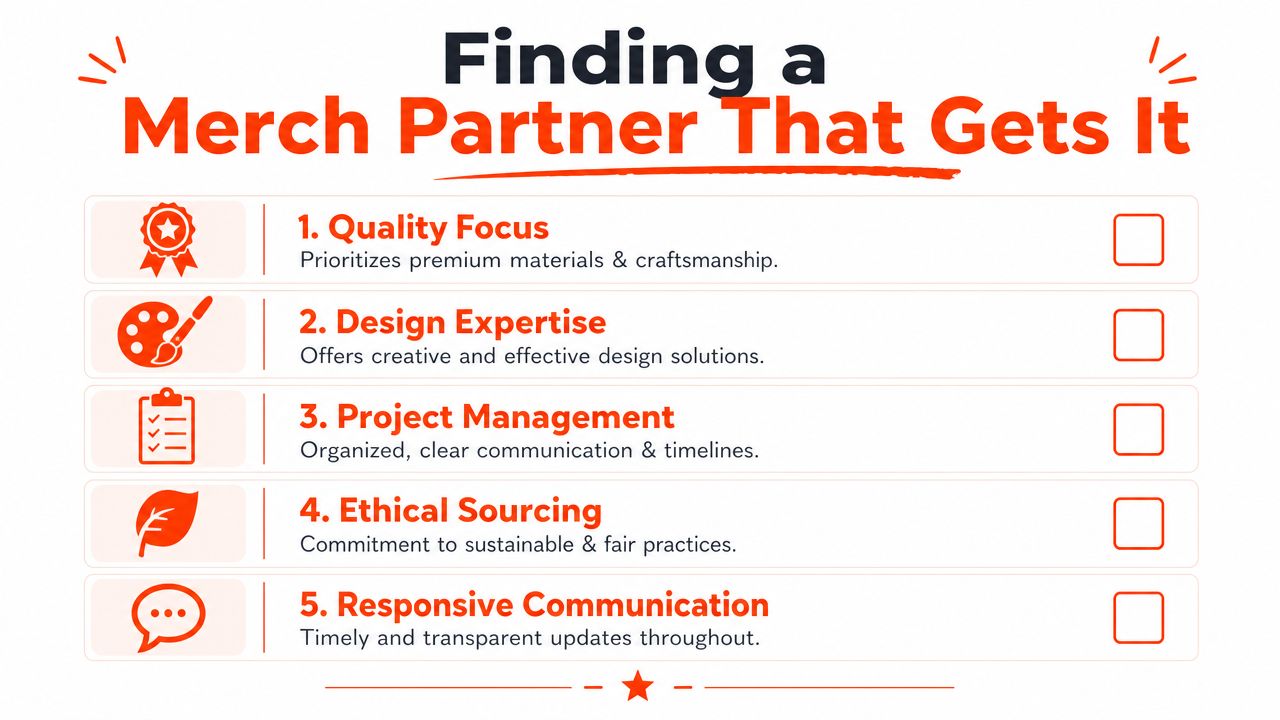
Use this as a working scorecard when you evaluate suppliers:
Product opinions: ask what blanks they recommend for different use cases. A good partner has opinions on fabric weight, fit, hand feel, and where certain garments hold up — or don't.
Customization range: if they only offer one or two techniques, they'll force every idea into those techniques. Better partners match the method to the outcome.
Real proofs, not mockups: ask how approvals happen. A digital mockup isn't enough for anything beyond basic work. You want real photos of the actual customized product before production starts.
Operational clarity: get direct answers on timelines, revisions, shipping, and who owns the project from quote to delivery.
Finishing depth: labels, tags, packaging, inserts, presentation. If you want retail-level results, ask if they handle retail-level details.
The red flags are usually obvious
Some vendors talk almost entirely about price. Others say yes to everything without challenging weak choices. Neither is great.
If a supplier can't explain why embroidery will pull on a lightweight fabric, why a certain print placement feels off, or why your artwork needs simplification for a patch, they're probably taking orders, not directing outcomes.
A sharper evaluation framework is this. Can they help you make fewer, better decisions?
For teams that want a clearer benchmark, this overview of what to expect from a premium custom merch supplier is a useful gut check.
A real merch partner doesn't just ask what you want. They tell you what won't work before it becomes expensive.
The trade-off nobody likes but everyone hits
Low minimums, fast timelines, premium blanks, custom trims, and complex finishing don't always stack perfectly on every project. Sometimes the best move is to simplify the number of techniques and spend the effort on a better garment. Sometimes it's the opposite.
Good partners make those trade-offs visible early. Bad ones leave you to discover them after approval.
Your Checklist for a Perfect Merch Drop
The best client isn't the one with the biggest brief. It's the one with the clearest one.
Industry guidance on design specifications is blunt about this. A complete specification covering measurements, materials, colors, and tolerances reduces ambiguity and rework, according to the Interaction Design Foundation's overview of design specifications. That principle applies directly to merch.
What to prepare before the project starts
Define the job of the merch: Is this for onboarding, retail sale, a conference, a community reward, or internal culture?
Send proper assets: Vector logos, organized artwork files, brand colors, and font references save time fast.
Reference the feeling, not just the logo: Share examples of fit, finish, and mood. “Premium streetwear” is too vague on its own.
Know your essential requirements: Maybe it's heavyweight cotton, subtle branding, or custom packaging. Pick the priorities early.
How to make approvals cleaner
Most project delays come from feedback sprawl. One stakeholder wants the logo larger. Another wants it smaller. A third changes the garment color after the print file is ready.
A tighter process works better:
Consolidate feedback: one decision-maker or one merged feedback round
Approve in sequence: garment first, then decoration, then packaging
Treat proofing seriously: if something feels slightly off in the e-proof, it won't magically improve in bulk
If your team is reviewing a sample or pre-production proof, this guide to merch e-proof approval is worth sending to everyone involved before comments start flying.
Don't forget the last ten percent
Unboxing, size breakdown, recipient lists, inserts, and shipping logic often show up late. They shouldn't.
Those details are where polished drops separate from rushed ones. Not because they're flashy, but because they make the whole thing feel finished.
FAQs on Custom Design Services
What's the difference between screen printing and DTG
Screen printing is usually the better choice for bold, graphic artwork and a classic printed look. DTG works well for detailed, multicolor, or illustration-heavy files on the right garment. The best choice depends on artwork style, quantity, and the finish you want.
When do I need a tech pack
You usually need a tech pack for cut and sew or any project with custom construction details. If you're building a garment from scratch, the factory needs exact guidance on measurements, materials, placements, trims, and finishing.
What file format should I send for logos and artwork
Vector files are the safest choice for logos. If the artwork includes raster elements, send the highest-quality original file you have and make sure fonts, colors, and placement notes are clear.
What is BAT
BAT is the approval step before bulk production. Depending on the project, it may be a digital proof or real sample photos showing the actual customization before the full run starts.
Can one merch order ship to multiple addresses
Yes. For distributed teams, event speakers, creators, or community drops, multi-address shipping is often the cleanest setup. It works best when recipient data is finalized early and the packaging plan is locked before fulfillment starts.
Is more customization always better
No. More options can make a product worse if the decisions don't connect. The best merch usually has a clear idea, one or two strong details, and restraint everywhere else.
If you want help turning an idea into merch people actually keep wearing, Banger is built for that. Premium European blanks, custom apparel made in France's best production ateliers, low minimums, worldwide fulfillment, and direct factory pricing. Get a free, no-commitment quote with product previews in 24 hours for your next team drop, event kit, or capsule collection.