Apparel Inventory Management: 2026 Playbook
Most apparel inventory advice starts in the wrong place. It treats stock like boxes on shelves, when the core failure point is usually the variant structure underneath. A single hoodie in five sizes and four colors isn't one item, it's twenty trackable units, and if your system can't see that cleanly, you'll get oversells, dead stock, and endless manual cleanup.
That's why apparel inventory management is really a demand-planning problem disguised as operations. The category is short-seasoned, trend-sensitive, and unforgiving when the item master is messy. In 2020, 70% of apparel retailers reported stockouts due to forecasting and inventory issues, and 41% of apparel companies said inaccurate forecasting was their number one inventory problem, while fashion retailers typically hold only 2 to 4 weeks of inventory to absorb demand swings (source). If the structure is wrong, the math gets ugly fast.
Table of Contents
Why Most Apparel Inventory Systems Fail Before They Start
They often think they need more warehouse discipline. They usually need a better item architecture. The failure starts when style-level thinking gets forced onto a variant-heavy category, where size, color, fit, collection, and channel allocation all matter at once.
A retail system can look organized and still be broken. If one product line is split across spreadsheets, a Shopify store, a wholesale reserve, and a conference stash, the team doesn't have one inventory view, it has four partial ones. That's how stockouts happen even when the back room isn't empty.
Variant complexity is the real bottleneck
Apparel doesn't behave like generic inventory because the SKU count multiplies so quickly. The same tee becomes a different sellable item once it shifts from black to white, small to medium, or retail to event allocation. One practical guide frames the job as controlling variant complexity, not just counting units, and recommends replenishment at the variant level rather than the style level (Flyp).
That framing matters because the system has to answer specific questions, not vague ones. “Do we have hoodies?” is useless. “How many medium black hoodies are left for the conference drop?” is the question that decides whether the team ships on time or scrambles in Slack.
Practical rule: if a variant can be sold, reserved, or moved separately, it needs its own inventory logic.
This is also where a lot of teams break reporting. They group too early, then lose visibility into what's driving sell-through, channel pressure, or reserve depletion. A cleaner structure keeps the item master granular enough to manage reality, while still rolling up to style-level reporting for leadership.
The discipline starts with the right mental model, then the right system. For teams building premium branded apparel or custom merch programs, that usually means connecting product design, allocation, and fulfillment from the start. A useful reference point is this team apparel supplier framework, because supplier decisions shape the downstream inventory shape more than many expect.
Building a SKU Hierarchy That Scales
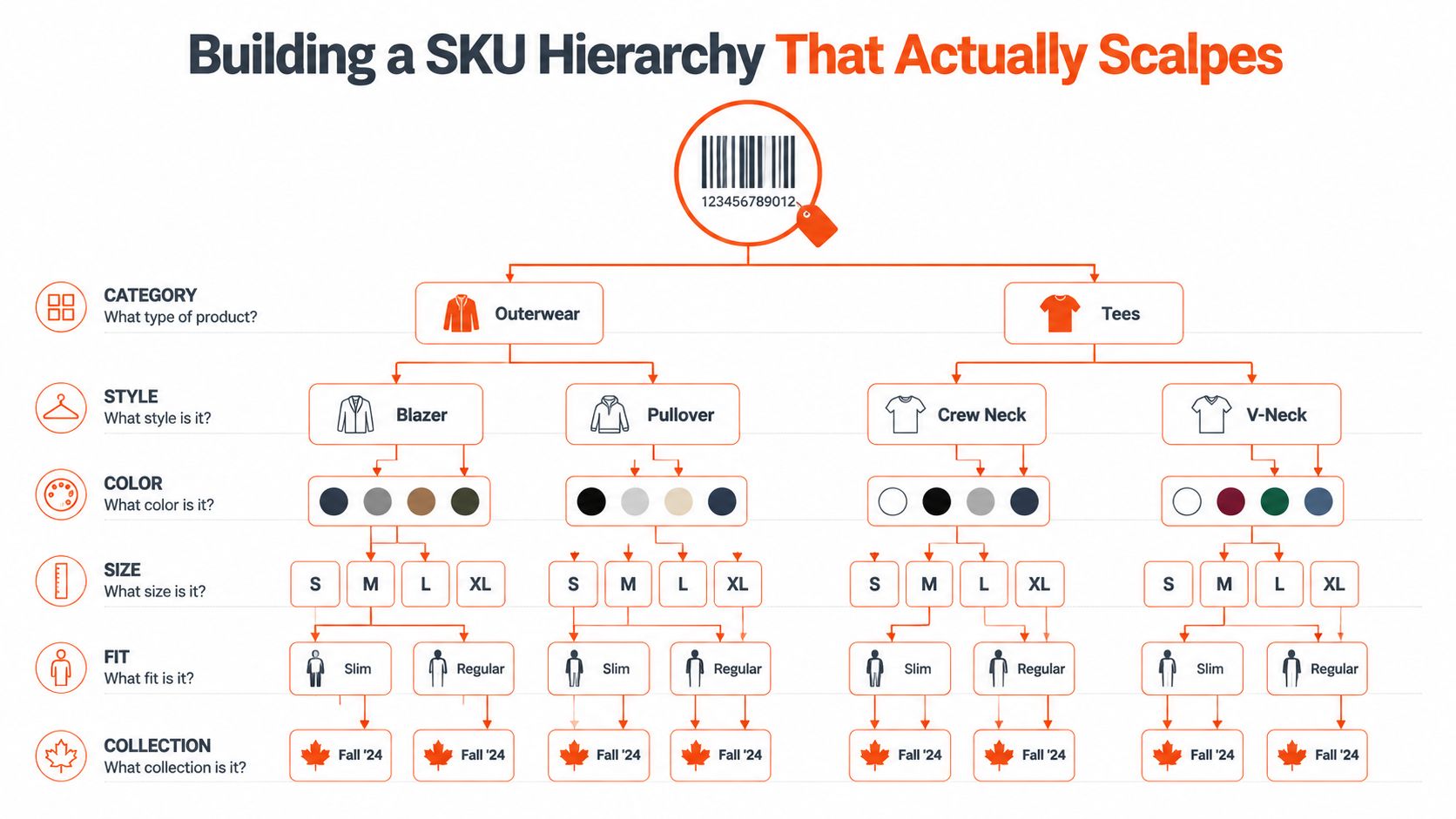
A scalable SKU hierarchy has to do two jobs at once. It needs to stay legible for humans, and it needs to be strict enough for software to track without ambiguity. Style, color, size, fit, collection, and channel allocation all need a place in the structure, or the model collapses the moment a launch gets busy.
Start with parent and child logic
Use the parent SKU for the style, then children for each sellable variant. A hoodie might sit under one parent, while black, charcoal, and bone become color children, then each color splits again by size. If the brand sells slim and regular fits, those need to sit inside the hierarchy too, not buried in notes.
That structure keeps reporting usable. You can see which styles are winning, which colors are overbought, and which sizes are disappearing first. It also gives teams a clean way to handle limited editions, regional exclusives, and wholesale reserves without inventing a new naming convention every time a drop goes live.
The physical setup matters just as much as the naming. SKU design should be paired with barcode scanning, bin location storage, and cycle counts so the warehouse record stays aligned with the system of record (AIMS360). Real-time tracking and automated software reduce manual error and cut the oversell risk that comes from stale counts, especially when multiple channels are pulling from the same pool. Teams that sell a premium blank t-shirts assortment usually feel this first, because the same base style can be sliced into many sellable variants before the stock starts to look simple on paper.
The hoodie example that exposes bad structure
Take a premium hoodie drop. One style, two fits, four colors, and six sizes already creates a dense matrix. If the brand also holds event reserve stock and a wholesale allocation, those are not just notes in a spreadsheet. They are separate controls that decide what is available to sell.
Loose item masters get exposed fast in that setup. Teams see “stock on hand” and assume they are safe, then find out the conference allocation was already promised, or the wholesale reserve was never tagged correctly. The fix is not more counting. It is cleaner data shape and channel-specific allocation.
Keep the variant as the unit of decision, then roll up for reporting. That is how you protect both speed and accuracy.
If the catalog has no minimum-order complexity, the structure still matters. Even smaller programs need the same logic, just with fewer branches. A practical reference is this custom apparel no minimum guide, because low-MOQ work still needs disciplined SKU handling if it is going to scale past one-off orders. For teams that want to tie that structure to demand planning, predictive analytics in retail supply chains is only useful after the SKU tree is clean enough to trust.
Forecasting Demand and Setting Safety Stock by Product Class
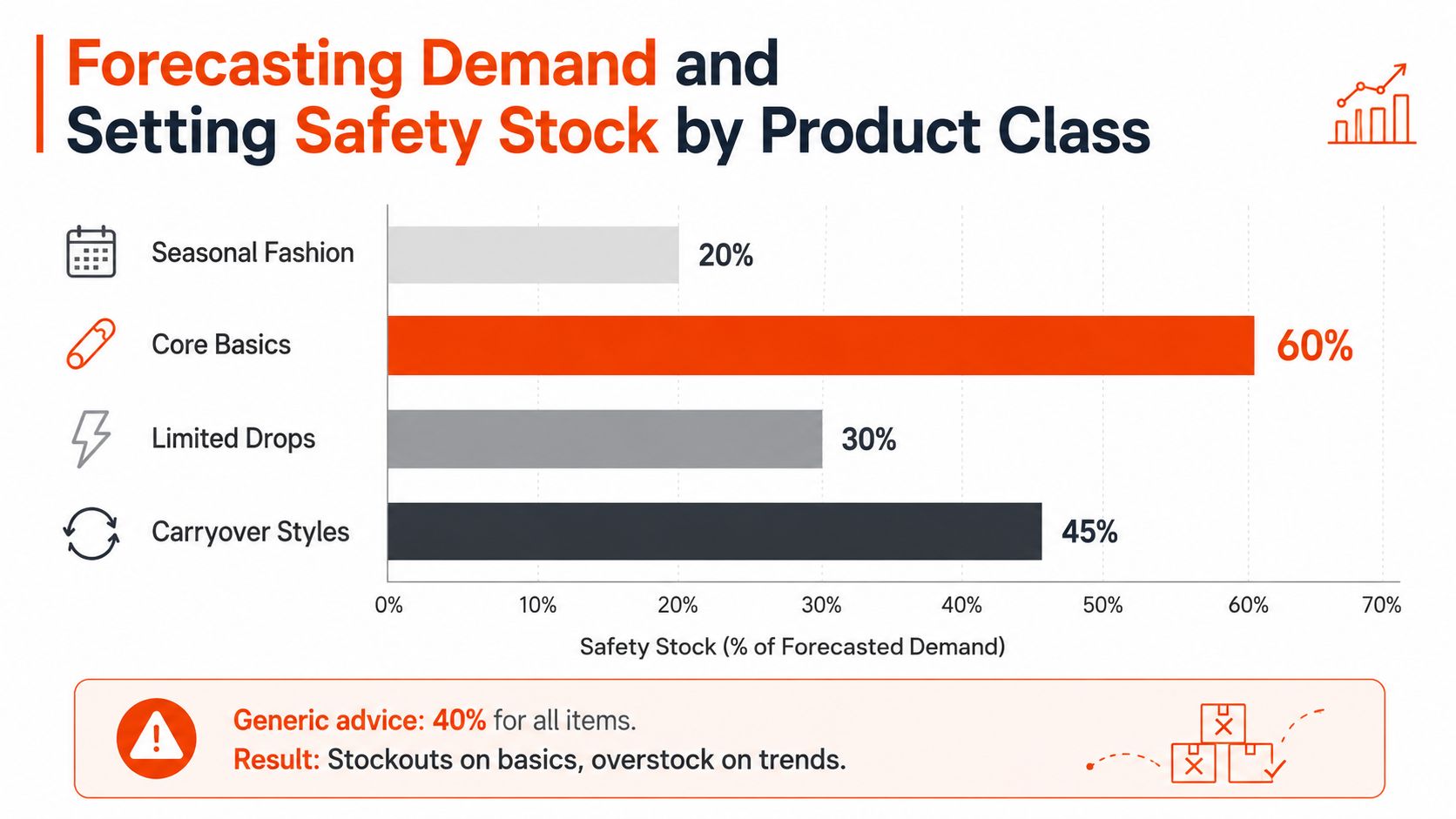
Safety stock only works when it matches the product class. Apparel gets hurt by generic buffers because basics, seasonal fashion, carryover styles, and limited drops do not move at the same pace. Treat them as if they do, and you either miss sales on fast movers or carry dead inventory that turns into markdowns.
Match buffer size to the product life cycle
A common benchmark for core products is 15 to 25% safety stock, while another guide breaks apparel into 20 to 30% for core basics, 40 to 50% early season, and around 10% late season as products move toward clearance (Cart.com). Those numbers are not magic. They are a reminder that product class and seasonality should drive the buffer, not one universal rule.
Forecast quality matters more than forecast complexity. Apparel retailers often only have 2 to 4 weeks of inventory to absorb demand swings (rawshot.ai), so a small miss can hurt service levels quickly. A system that works for evergreen basics can fail on trend-driven SKUs.
Practical rule: if a SKU's demand curve changes faster than your replenishment cycle, hold less excess stock and tighten review frequency.
The trade-off is straightforward. More buffer lowers stockout risk, but it raises carrying cost, markdown exposure, and waste. Less buffer improves cash efficiency, but it punishes weak forecasting. The right answer depends on whether the SKU is replenishable, seasonal, or one-and-done.
For teams that want a closer look at model design, predictive analytics in retail supply chains is useful because it pushes the discussion beyond gut feel and into demand sensing. That matters when the business is moving fast, the channel mix keeps changing, and the plan needs to update more than once a season.
Replenish faster, don't just buy more
The cleanest inventory teams do not carry a bloated buffer and call it control. They shorten the loop between demand signal and replenishment decision. That can mean tighter review cycles, better variant-level sell-through checks, or more conservative buys on trend-heavy pieces.
Channel mix changes the answer too. A style that sells steadily on your own site may need a different buffer than the same style pushed through wholesale, marketplaces, or event allocation. That is why variant architecture matters. Size, color, and channel should not all sit in one blunt forecast bucket. If the SKU tree is not clean enough to separate those demands, the safety stock number will look precise and still be wrong.
For smaller programs, the same logic still applies, just with fewer branches. Even a low-MOQ setup needs disciplined SKU handling if it is going to scale beyond one-off orders, which is why a custom apparel no minimum guide is still relevant for planning structure as well as sourcing choices.
A good forecast will not fix a bad assortment. It can only help you place smaller, smarter bets and spot misses sooner.
In-House Warehousing Versus 3PL Fulfillment
The warehouse decision sets the operating rhythm for everything downstream. In-house warehousing gives tighter control over presentation, QC, and the odd edge case that never fits the playbook. A 3PL gives reach, scale, and lower fixed overhead. The right choice depends on how much complexity the team can carry without creating inventory drift.
Compare control against scalability
| Factor | In-House Warehousing | 3PL Fulfillment |
|---|---|---|
| Control | Tight control over receiving, packing, and quality checks | Less direct control, more process dependence |
| Scalability | Better for small, predictable volumes | Better for growth, multi-location, and higher volume |
| Integration | Can be simpler early on if the stack is small | Needs strong sync across store, WMS, and shipping tools |
| Brand presentation | Easier to experiment with custom packaging | Depends on the provider's workflow |
| Labor | Requires hiring, training, and oversight | Outsourced labor, less internal warehouse management |
In-house usually makes sense when SKU count is still manageable, the brand wants hands-on quality control, or packaging tests are frequent. That setup gives you more room to intervene when a variant tree gets messy, especially if channel-specific allocation is changing fast. It also helps when the team needs to hold back certain sizes or colors for a launch, wholesale drop, or event shipment instead of treating every unit as interchangeable.
3PL starts to win when the business ships across regions, needs distributed fulfillment, or cannot justify running its own warehouse. It becomes more attractive once the cost of handling all those variant and channel splits internally starts to crowd out actual merchandising work. For a practical external view, this 3pl guide for logistics managers is useful because it lays out the trade-offs without pretending outsourced fulfillment removes operational complexity.
The integration layer is where many teams get burned. Shopify, WMS software, and real-time inventory updates need to agree on what is available before orders go live. If they do not, the issue is not just a fulfillment problem, it is an overselling problem that usually starts with bad variant data or a channel sync delay.
Teams comparing operating models can also use this merch fulfillment services overview as a benchmark for how fulfillment choices affect speed, presentation, and scale. The question is whether the brand can keep control of the customer experience while inventory sits offsite. For some programs, that trade-off is easy. For others, the loss of visibility around size-level stock and channel allocation is enough to keep fulfillment in-house until the system is cleaner.
Pick, Pack, Ship, and Returns Workflows That Protect Brand Quality
Apparel inventory breaks down at the variant level, then gets exposed at the box level. The size can be right on paper and still fail in the cart, the warehouse, or the unboxing moment if channel allocation, pick logic, and packaging are not aligned. That is where quality gets lost.
Receiving and packing need checkpoints, not guesswork
Receiving should start with barcode verification, then a quick quality check before stock is put away. If a shipment arrives with damage, print defects, or mislabeled variants, catching it at receiving is far cheaper than finding it after the customer opens the box. The same applies to lot tracking when a quality issue needs to be traced later.
Packing needs the same rigor. Strong apparel programs usually follow a fixed sequence, first the pick list, then SKU and size verification, then branded packaging assembly, then label generation. Custom mailers, tissue paper, stickers, and inserts slow the line if they are treated like extras, so they need to be staged as part of the workflow, not added after the fact. For teams trying to keep presentation consistent, a clear custom apparel packaging process keeps the box experience tied to the product standard instead of the picker's habits.
Returns need equal discipline. Returned items should be inspected, refolded, and restocked only after the system confirms they are sellable again. If the size exchange process is sloppy, the inventory file drifts fast and the business starts shipping phantom stock.
For a practical reference on customer-facing return flows, Helmsly's Shopify returns guide is useful because it ties return handling to operational clarity. Recover value where possible, isolate damaged goods before they contaminate the available pool, and keep the return disposition rules simple enough for the team to follow without debate.
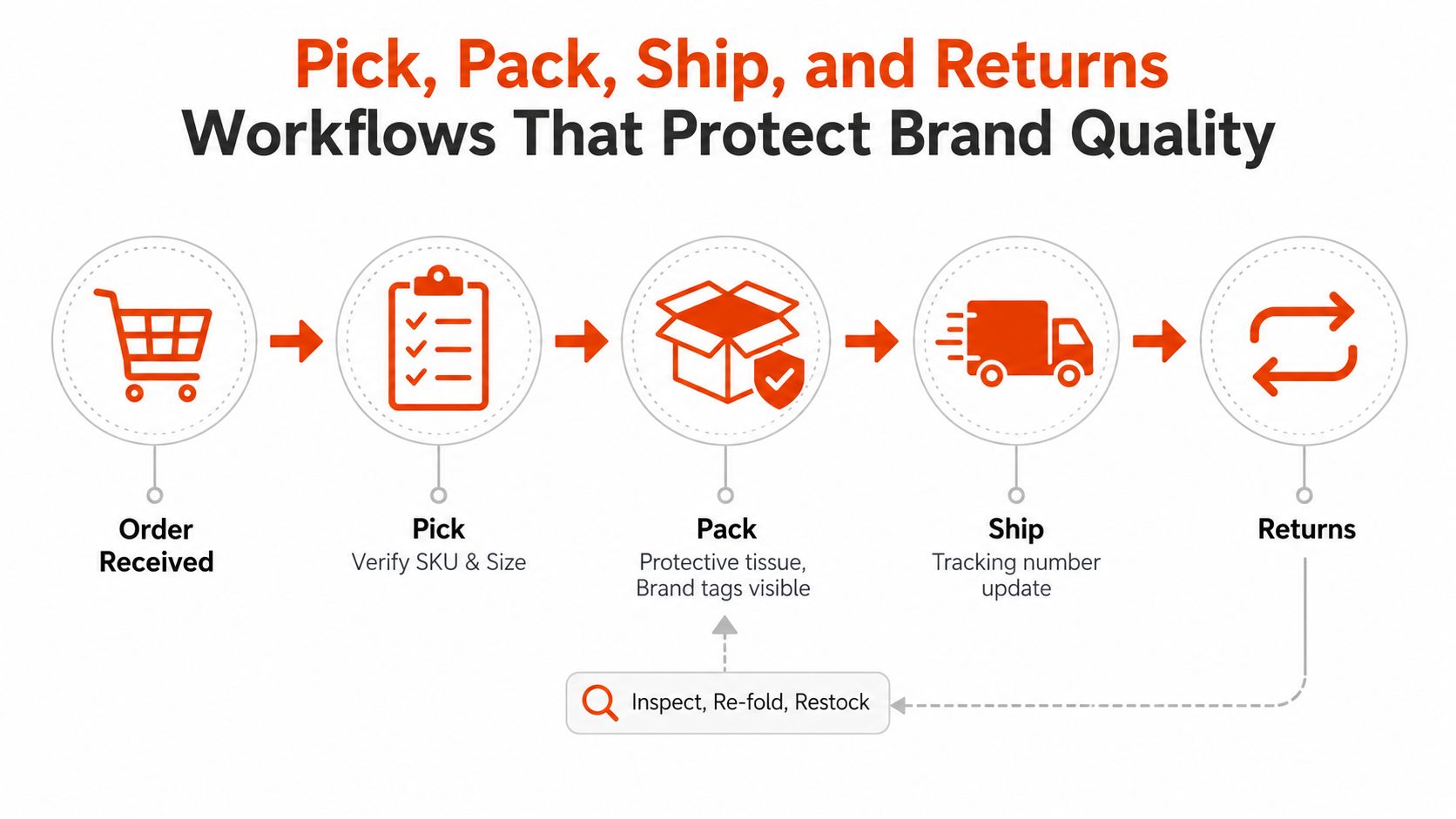
The unboxing moment is part of the product. If the workflow ruins it, the merch loses value before the customer even wears it.
Lots of teams underinvest here. They optimize for speed and assume quality will hold on its own. It does not. The line needs checkpoints that protect both velocity and presentation.
Metrics and Reporting That Predict Problems Early
Most inventory dashboards are backward-looking. They tell you what already happened, not what is about to go wrong. The better ones surface slow movers, rising shrink, and stockout pressure before the hit shows up in revenue or markdowns.
Watch the metrics that move cash, not just stock counts
Inventory carrying costs typically run 20 to 30% of inventory value per year, covering capital, storage, insurance, tax, handling, shrinkage, and obsolescence (WhiteBox). Idle stock is not neutral. It ties up margin while it sits in the building or at a 3PL.
A separate WhiteBox note says U.S. retailers lost US$112.1 billion to inventory shrink in 2023, equal to about 1.6% of sales. That is a reminder that inventory mistakes do more than leave product unsold. They show up as loss, mismatch, and bad visibility.
A useful dashboard should track turnover by product class, sell-through velocity, stockout frequency, and shrinkage by location or channel. If a style is moving too slowly, it should surface before it turns into a markdown problem. If a core item keeps running out, the issue is usually variant-level demand, not a generic shortage. That matters in apparel because one size can be overstocked while another sells out cleanly.
Build alerts around exceptions
The strongest reporting does not bury the team in data. It highlights exceptions that need action. A SKU can look healthy at style level and still be dead in a key size, so the report has to point to the exact variant that is drifting.
Useful rule: if the report can't point to the exact variant that's drifting, it's not operational enough.
Channel-level allocation needs its own view. A product can be available in the wrong place and still look fine in the total file. If ecommerce is short on medium while wholesale has excess, the problem is not stock count, it is allocation discipline. That is why the best teams watch inventory by channel, by size curve, and by reserve pool, then make the trade-off explicit instead of pretending all units are interchangeable.
More inventory tech will not fix overbuying by itself. It only helps if the team uses the data to hold less stock without creating lost sales. That matters because excess inventory and demand mismatch still sit at the center of most apparel planning problems, not warehouse noise.
Merch-Specific Scenarios That Break Standard Inventory Rules
Standard inventory rules assume a steady retail calendar. Merch doesn't live there. Launches, drops, event giveaways, influencer kits, and community rewards all push the system into weird shapes, and the old warehouse logic stops fitting.
A limited drop with preorders needs tighter reservation logic than a basic evergreen tee. Event giveaways need multi-address shipping and clear reserve allocations so the marketing team doesn't promise stock the warehouse already counted elsewhere. Influencer gifting campaigns need a separate visibility layer because those units are not open to retail demand.
Web3 and community-based programs complicate things further. The same SKU can sell through Shopify, get handed out at an event, and sit in wholesale reserve, all while the team still wants one clean inventory number. That only works if channel-specific allocation is deliberate from the start.
Sustainability goals change the decision too. Sometimes the right move is less inventory, not more. In fashion, overbuying creates carrying cost, markdown pressure, and waste, so a smarter system can be the one that holds a smaller buffer and replenishes with more discipline.
The goal is merch people keep wearing, not boxes of forgotten inventory that need to be rescued later. When the product is good, the system gets easier because sell-through happens naturally. When the product is weak, no inventory stack can hide it.
If you're building branded apparel, team drops, or event merch and want the inventory side to feel as clean as the product, Banger can help you plan, produce, and fulfill without the usual chaos. Explore Banger and launch merch that your team wants to wear, keep, and reorder.