Custom Neck Labels: Design, Specs & Legal Guide 2026
You're probably looking at a hoodie or tee mockup right now that's almost there. Front graphic is dialed. Blank is decent. Fit is sorted. Then you get to the inside neck and realize the fastest way to make the whole piece feel generic is to leave that detail unresolved.
That's why custom neck labels matter more than many realize. They're not just a branding component. They're one of the clearest signals of whether a garment feels considered, retail-ready, and worth keeping, or whether it still feels like a decorated blank.
A good neck label does two jobs at once. It handles legal compliance, and it subtly tells the wearer what kind of brand made this piece. Clean woven label? Different message than a rushed heat transfer slapped over a stock tag. Soft tagless print with sharp typography and proper spacing? Different message again. Small detail, big read.
Table of Contents
- The non-negotiables
- The origin mistake that trips brands up
- What belongs on the neck label and what can live elsewhere
- What each label type communicates
- Neck Label Type Comparison
- How to choose without cheapening the product
- Placement and size that feel intentional
- Typography and print specs that hold up
- Production files that factories can actually use
- Can you relabel an existing branded garment
- What's the point of a tearaway tag
- Is a hang tag the same as a neck label
- Should you choose woven or printed for merch
What Legally Goes on a Custom Neck Label
The non-negotiables
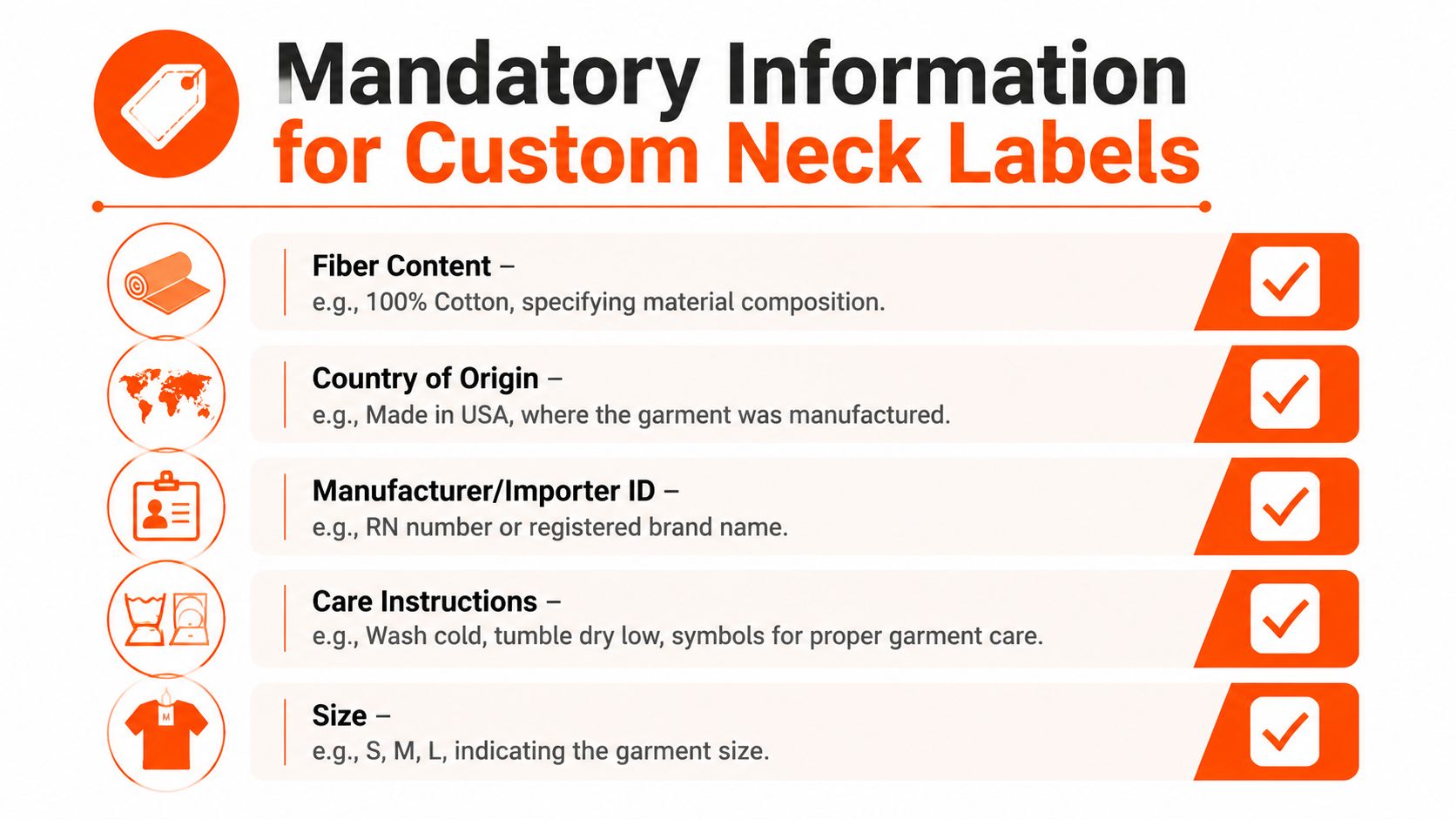
Before you think about aesthetics, get the compliance layer right. In North America, custom neck labels require three core data points: the full legal company name or an RN/CA number, the country of origin where the garment was originally manufactured, and the fabric content listed by generic fiber name and percentage in descending order by weight, as outlined in this custom neck label compliance guide.
That part isn't optional. If you replace a manufacturer's tag with your own branded label, you still need to preserve the required information tied to the original garment. A logo alone doesn't make the piece compliant.
Here's a clean visual reference for the required elements:
For teams managing product data across multiple SKUs, variants, and sales channels, it also helps to treat labeling as part of your broader catalog structure. A solid guide for eCommerce product data is useful because label content, fiber composition, origin data, and size info all need to stay consistent across product records, customs paperwork, and what's physically printed on the garment.
The origin mistake that trips brands up
The biggest compliance mistake is simple. Brands confuse where the garment was printed with where the garment was made.
Data cited in this neck label guide on origin labeling shows that 60% of new apparel brands incorrectly label their country of origin as their print shop's location, and 32% of apparel startups faced customs holds in 2025 due to mislabeled origin tags. If a blank was manufactured in Vietnam and decorated in Los Angeles, the country of origin is still Vietnam.
Practical rule: Decoration doesn't change origin. Printing, embroidery, or relabeling is not the same thing as manufacturing.
That distinction matters because customs and consumer protection rules care about the underlying garment, not where your branding was added. A lot of small brands get this wrong on their first run, especially when they're moving fast with on-demand suppliers.
What belongs on the neck label and what can live elsewhere
A neck label isn't the place to dump every brand message you have. Use it for the essentials first, then layer in branding carefully.
Keep these items prioritized:
- Legal identity: Company name or RN/CA number comes first because it anchors the label to a responsible seller.
- True origin: List the country where the garment was originally manufactured.
- Fiber breakdown: Use generic fiber names and percentages by weight, in descending order.
- Size and care info: These are often expected by customers and operationally useful, even if placement can vary by market and garment type.
If you need a practical starting point for implementation details, Banger's custom labels and name tags FAQ is a useful reference for how brands handle custom labeling across merch programs.
One more note for EU-bound apparel. To be legally allowed on the European market, apparel must comply with the EU General Product Safety Directive (GPSD: 2001/95/EC), which includes product safety, chemical use under REACH, quality, and labeling requirements, according to this EU apparel market compliance document. The exact label layout can vary, but the discipline is the same. Clear, accurate product information is part of selling like a real brand.
Woven vs Printed: Choosing Your Neck Label Type
A customer pulls a tee off the rack, checks the fabric, then flips the collar. That split second tells them whether the brand made deliberate product choices or just added a logo to a blank.
That is why neck label type matters. It shapes comfort, yes, but it also signals how seriously the garment was built.
What each label type communicates
Woven labels read as considered and product-first. They suit heavyweight jerseys, fleece, cut-and-sew programs, and pieces where structure is already part of the appeal. On the right garment, a woven label adds density and finish. On the wrong one, especially a light tee, it can feel stiff, bulky, or too formal.
Printed neck labels read cleaner and more restrained. They work well on soft cotton tees, washed blanks, active basics, and any program where tagless comfort is part of the sell. A good print disappears against the skin and keeps the interior sharp. A weak print cracks, blurs, or looks like it was added late in production.
Heat-transfer labels sit close to printed labels in terms of appearance, but the tolerance for bad execution is lower. If the adhesive, application temperature, or artwork prep is off, the label starts to look temporary. If the transfer is done well, it can feel precise and premium.
Silicone and specialty labels are a narrower tool. They make sense on technical outerwear, performance pieces, or styles with a harder visual language. On a basic jersey tee, they usually read as decoration for its own sake.
The decision is not woven versus printed in the abstract. It is whether the label supports the story the garment is already telling.
Neck Label Type Comparison
| Label Type | Best For | Feel & Comfort | Durability | Typical Cost |
|---|---|---|---|---|
| Woven | Premium streetwear, cut-and-sew pieces, heavyweight hoodies | Structured, tactile, can feel less soft on sensitive skin | Strong when sewn properly | Usually higher |
| Printed | Tees, soft basics, tagless programs, high-volume merch | Soft and low-profile | Good when ink and curing are right | Usually lower |
| Heat-transfer | Fast-moving apparel programs, detailed graphics, light garments | Smooth when well applied | Varies heavily by transfer quality | Mid-range |
| Silicone or specialty | Technical apparel, statement branding, experimental pieces | Tactile and distinct | Can be durable, depends on application | Usually higher |
How to choose without cheapening the product
Start with the garment, not the label catalog.
A dense fleece hoodie with a premium hand usually benefits from a woven neck label because the rest of the product already carries weight and structure. A soft ringspun tee usually benefits from a printed interior because comfort is part of the value. Force either one into the wrong context and the mismatch is obvious.
I usually judge it by one question: does the label feel native to the garment? If yes, the brand feels intentional. If no, the inside of the piece exposes the shortcut.
Cost still matters, but it should be read as a trade-off, not the decision-maker. Woven labels often cost more and require sewing steps that can slow production. Printed labels are usually more efficient, but they depend heavily on ink quality, curing, and fabric compatibility. For teams considering a tagless route, this guide to screen printed labels gives a useful production-level breakdown.
Brands building a full apparel line should make this choice early. Label direction affects trims, construction planning, and how polished the final product feels when a customer handles it for the first time. That broader brand-building discipline is covered well in Picjam's online brand guide.
The best neck label matches the product's intent, price point, and wearing experience. That is what makes it feel designed instead of added.
Designing a Neck Label That Lasts
A neck label can be legally correct and still feel cheap. Longevity comes from small technical choices that most mockups hide.
Placement and size that feel intentional
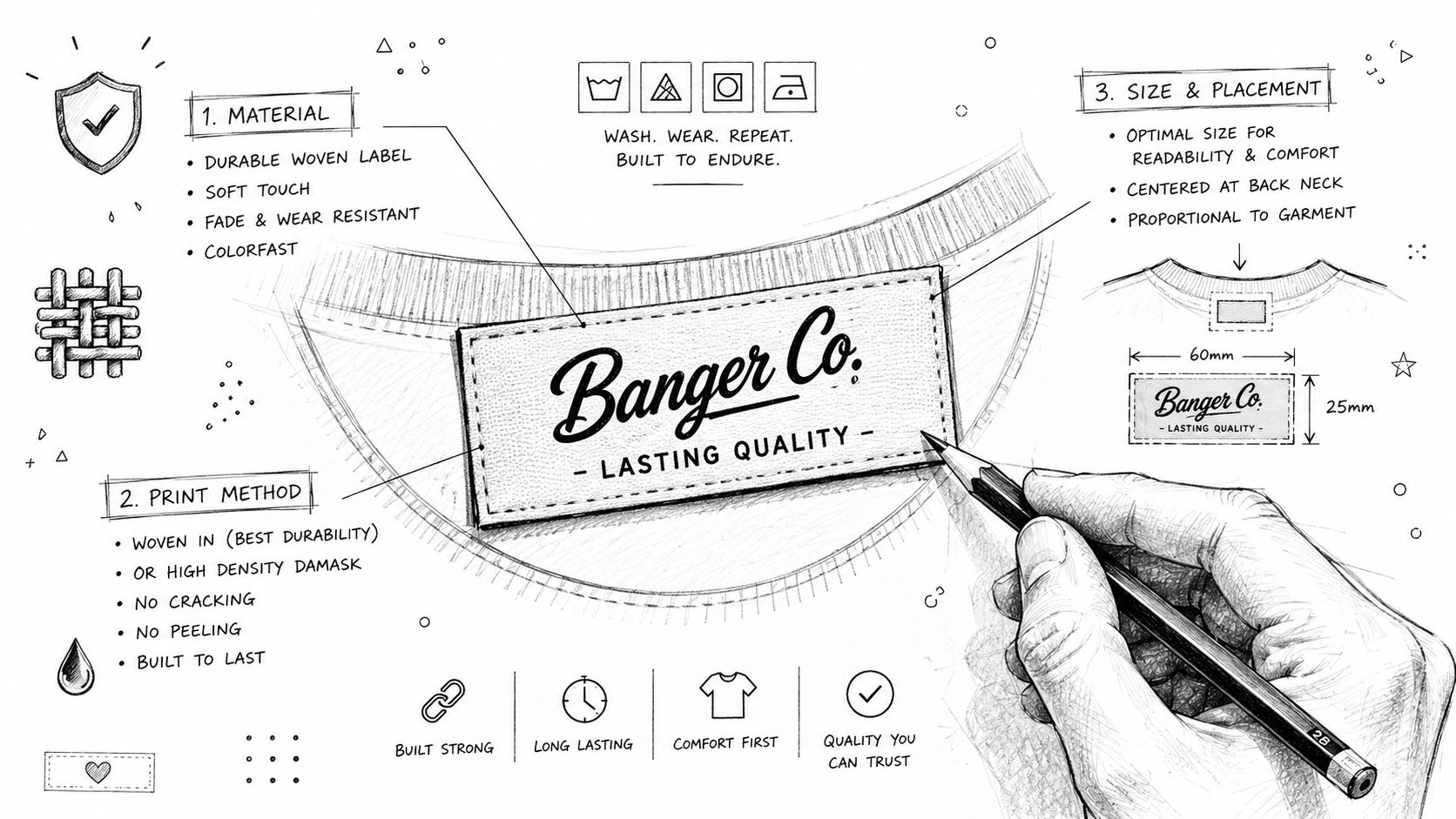
For most apparel, the standard placement is ½ inch to 1 inch below the collar seam, with label dimensions typically kept around 3 to 4 inches to maintain fit and visibility, as noted in the same custom neck label production guidance. That range gives you enough room for legal info and brand identity without making the interior look crowded.
Bad placement is easy to spot. Too high and the label fights the collar seam. Too low and it feels detached from the neckline. Off-center is worse. It makes the garment look sloppy before anyone tries it on.
When sizing the label artwork, think in layers:
- Primary line: Brand wordmark or logo
- Secondary line: Size
- Utility layer: Fiber content, origin, RN or company identity, care info if needed
If all three layers compete visually, none of them work.
Typography and print specs that hold up
Small text is where weak label design falls apart. The data cited by Cotton Incorporated shows that using 7 to 8pt sans-serif fonts for essential info improves readability by 40% and reduces label detachment by 25% after 12 washes, and that soft-hand additives with high-mesh (230+) printing reduce scratchiness by 60% while maintaining ink opacity in this neck label print quality research.
That's the difference between something that looks sharp in a proof and something that still reads clearly after real wear.
Use these rules:
- Choose a sans-serif: Neutral, compact fonts hold up better at small sizes than decorative type.
- Give the legal copy room: Don't crush fiber content and origin into a tight block under a large logo.
- Control ink feel: Soft-hand additives matter if you want tagless prints that don't feel plasticky.
- Respect the garment fabric: A label on airy jersey behaves differently than one on dense fleece. If you're still deciding blanks, fabric weight changes how the print sits, and this overview of GSM fabric weight helps frame that relationship.
A premium neck label shouldn't demand attention. It should feel clean, legible, and inevitable.
Production files that factories can actually use
Often, teams lose time. They send a PNG pulled from Figma or a flattened JPEG from a deck, and the factory has to rebuild it.
For best results, provide:
- Vector artwork in AI, EPS, or PDF.
- Outlined fonts so no type swaps happen in production.
- Clear size specs for the final printed or woven area.
- Color references with named values or approved visual targets.
- Placement notes relative to the collar seam, not vague comments like “center back.”
What doesn't work is improvising the label after the main garment is approved. Good labels are engineered details. They need the same discipline you'd give embroidery placement, fabric selection, or trim development.
Neck Label Costs, MOQs, and Production Timelines
Custom neck labels feel tiny, but they sit inside a huge manufacturing ecosystem. The global clothing labels market was valued at about $15 billion in 2024, with demand for more than 300 billion individual labels per year, according to these clothing label industry statistics. That scale is why there's such a wide spread between low-cost printed options and more premium woven programs.
Why pricing swings so much
A few variables move the cost fast.
Label type is the obvious one. Printed labels are usually easier to scale for straightforward apparel runs. Woven labels often require more setup discipline and can make less sense for very small orders.
Artwork complexity matters too. Fine woven detail, dense text, edge finishes, and unusual constructions all create friction. Even when the label itself is small, the setup burden isn't.
Then there's application method. A label produced separately and sewn in has a different labor profile than a tagless print applied during garment decoration. Neither is automatically better. They just create different production paths.
How to budget without wasting money
If you're launching a brand or building a first collection, treat the neck label as part of the product cost from day one. Don't bolt it on later after approving blanks, printing, and packaging. That usually leads to compromise.
A practical budgeting filter looks like this:
- Use printed labels when comfort, simplicity, and lower setup friction matter most.
- Choose woven labels when the garment itself is premium enough to justify the extra finish.
- Keep your first version tight: One strong label system is better than multiple variants with minor differences.
- Ask about total applied cost: The useful number isn't just what the label costs. It's what the label costs once it's finished on the garment.
For early-stage founders, this broader online brand guide is a helpful companion because it frames labeling inside the larger realities of launching apparel online.
If you need a clearer sense of how suppliers usually structure charges across decoration, sourcing, and finishing, Banger's custom merch pricing FAQ gives a practical baseline.
How Banger Develops Your Custom Neck Labels
The hard part of custom labels isn't the idea. It's getting from rough concept to approved production detail without drift.
From quote to approved proof
The process starts in a way that is quickly manageable for many. You choose the garment, upload the logo or label artwork, and request a quote. Banger then provides a product preview within 24 hours, which is useful because label placement and scale are hard to judge from words alone.
This part matters more than people think. Neck labels fail when nobody checks proportion against the actual garment. A mark that looks balanced in Illustrator can feel oversized once it's sitting inside a real collar.
Here's a look at the environment where that merch development process comes together:
Teams that need help before the proof stage can also use Banger's custom design services if the label system, artwork cleanup, or overall merch direction isn't fully locked yet.
Why the BAT matters
The strongest part of the process is the BAT, short for bon à tirer. Instead of approving a vague digital mockup and hoping the production result matches, you approve real photos from the atelier before bulk production moves forward.
That changes the conversation. You can check alignment, line weight, contrast, spacing, and whether the label feels right for the garment. Those aren't abstract design questions at that stage. They're production decisions.
Approval should happen on something tangible. Neck labels are too small and too important to leave to guesswork.
This is also where French atelier production makes a difference. Finishing details tend to get handled with more care when the team treating the label sees it as part of the garment, not just a low-priority internal print.
For larger programs, the rest of the path stays straightforward. Approve the proof, move into production, and ship worldwide. Banger states an end-to-end timeline of 10 to 15 business days, with reorders of previously approved designs shipping in 5 to 7 days through its standard process on the Banger website. That's fast enough for launches and event timelines, but still structured enough to protect quality.
What stands out is the combination: premium blanks, French ateliers, low minimums, and an approval flow built around real product previews instead of abstract promises. That's exactly the kind of setup that helps teams create merch people keep wearing.
Custom Neck Label FAQs
Can you relabel an existing branded garment
Sometimes. But you can't treat relabeling like a cover-up job. If you remove a manufacturer tag and replace it with your own, the required product information still needs to remain accurate and present on the garment. If the original blank wasn't built for relabeling, the seam area can also look messy after removal.
The safest relabel projects start with garments designed for private labeling or clean tag replacement.
What's the point of a tearaway tag
A tearaway tag gives decorators and brands a cleaner path to relabeling. It reduces labor, lowers the risk of damaging the neck seam, and makes it easier to add a custom branded solution that looks intentional.
That said, tearaway doesn't automatically mean premium. The final result still depends on your replacement method, layout, and garment quality.
Is a hang tag the same as a neck label
No. A neck label is part of the garment's permanent identity. It handles brand presence, sizing, and required information. A hang tag is temporary. It helps with retail presentation, campaign storytelling, or pricing, but the customer removes it.
If you have to choose one place to invest first, the neck label usually has more staying power because it's the detail that remains after the packaging is gone.
Should you choose woven or printed for merch
For most team apparel, printed labels win on comfort and simplicity. For more premium pieces, especially heavier garments or fashion-led drops, woven often creates a stronger premium signal.
The right answer depends on the blank, the audience, and whether you want the inside of the garment to feel invisible or intentionally built.
If you want Banger to handle the neck label details properly, from premium blanks and French atelier production to proofs that clearly show what you're approving, request a quote, get product previews within 24h, and build merch your team is eager to wear.