How to Reduce Production Costs Without Killing the Quality
Reducing production costs often seems like finding a cheaper quote. That's the fast way to buy bad blanks, messy handoffs, reprints, and a warehouse full of merch nobody wants to wear. The key is to cut waste, rework, changeovers, order changes, and middlemen, then measure the total cost of getting a piece from idea to delivered box.
That matters even more in premium custom apparel, where the cheapest unit price often hides the ugliest backend. A founder can feel great after locking a low quote on 200 hoodies, then get smoked by defects, rush shipping, split deliveries, and the cost of fixing a run that should've been right the first time. If you care about branded apparel that people keep, how to reduce production costs starts with total cost of ownership, not sticker price.
Table of Contents
Why Cutting Production Costs Usually Backfires
The worst merch programs obsess over the unit quote and ignore everything that happens after approval. That's how you end up with thin blanks, off-brand texture, cracked decoration, and a team drop that looks fine on a spreadsheet but cheap in a person's hands. If the order needs rework, repacking, or a second shipment, the “savings” were fake from the start.
The manufacturing rule of thumb is simple. Direct materials typically account for 40–60% of total cost in manufacturing, so cost programs usually start by attacking the bill of materials, waste, and supplier terms rather than just trimming labor Kaizen. That's the right instinct for merch too, because materials are where the biggest lever usually lives.
Practical rule: never compare quotes without asking what happens if the first run misses spec.
A premium merch order has hidden cost buckets that cheap factories rarely surface upfront. Bad-fit sizing creates dead stock. A decoration that looks sharp on approval but fails after a few washes creates reprints. Five separate shipments to five different events eat the margin that looked healthy on paper.
As a working example, a startup founder ordering 200 hoodies can celebrate a great per-unit number, then watch the bill balloon once defects, reruns, and rush freight show up. That doesn't mean premium production is expensive. It means sloppy production is expensive, and discount sourcing just hides the bill until later. If you want a deeper look at how construction choices affect apparel economics, the cut and sew apparel guide is worth keeping open while you price a drop.
Anatomy of a Production Cost
The stack you need to price
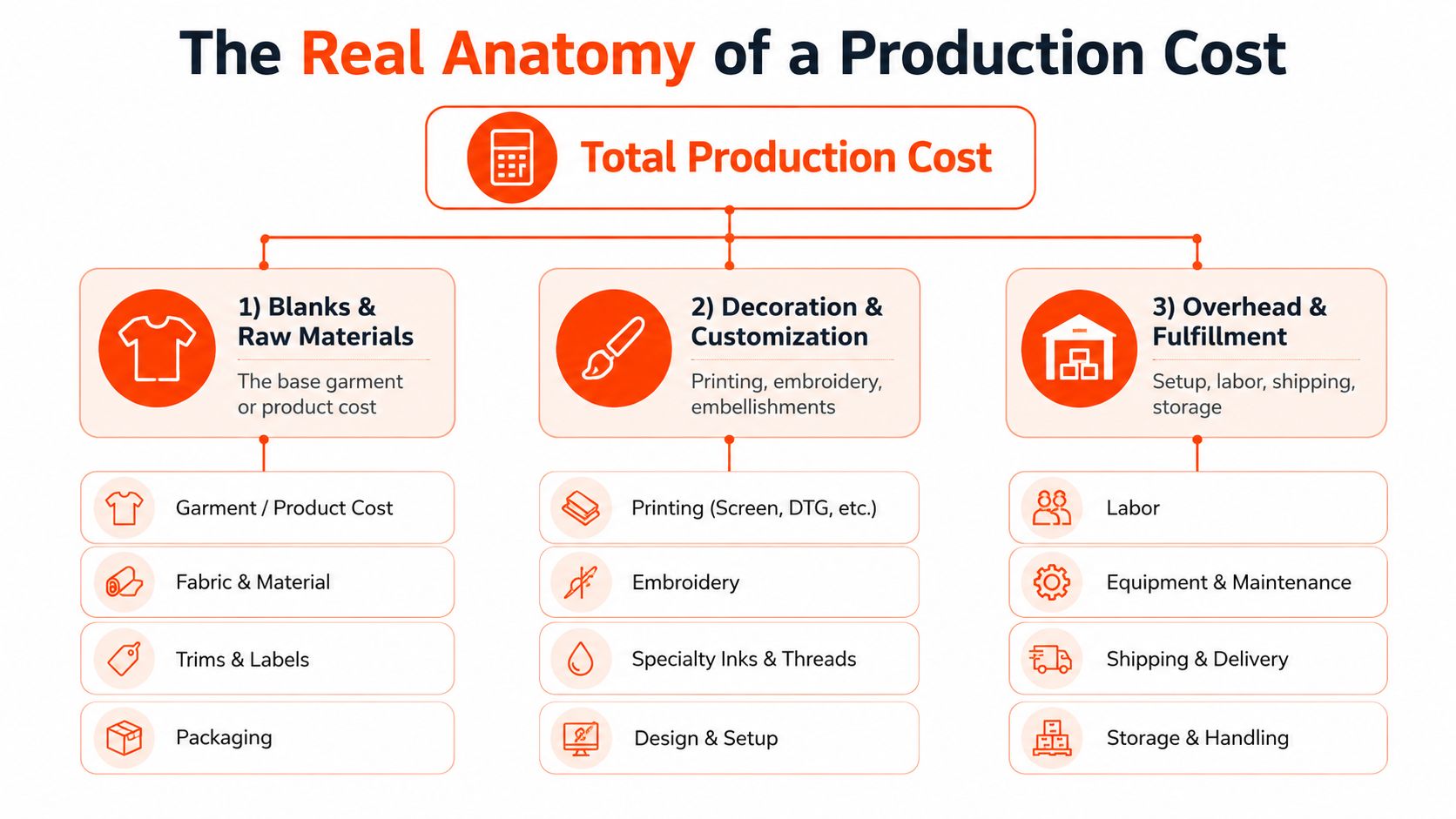
Production cost in custom apparel is not a single line item. It is a stack of blanks or raw materials, decoration, labor, packaging, freight, duties, storage, rework, and shrinkage. If you leave out the hidden pieces, your quote is fiction.
A tee can look cheap on paper and still burn margin once you add embroidery setup, polybagging, individual packing, split fulfillment, and the second pass needed to fix a misprint. That is why discount sourcing often looks smart right up until the order lands and the bill shows up. Premium direct-to-atelier production wins when you measure the full cost, not just the factory line.
Where the money leaks
A few metrics tell you more than spend alone. Scrap, first-pass yield, changeover time, WIP, and OEE show whether cost is being created or trapped in the flow. If those numbers are weak, the quote is only one symptom.
The same logic separates fixed and variable costs. A useful breakdown of that distinction helps teams decide which expenses move with order size and which ones stay in the background. Use the fixed vs variable costs guide before you argue about whether a cost is structural or just a one-off mess.
Operational truth: the most expensive part of a merch run is often the part that has to be touched twice.
For premium custom apparel, savings usually live in the messy middle. The win is not shaving a dollar off the blank. The win is preventing a size run from going wrong, avoiding a second press pass, and cutting the number of times a box gets repacked. A dependable team apparel supplier helps there, because the right partner reduces rework, not just unit price. If you reduce those hidden costs, you can keep quality high and still make the economics work.
Run a 90-Day Cost Audit Before You Change Anything
Start with the last two runs, not with a new idea. Pull the standard quote, the actual invoice, and the production notes, then reconcile every variance line by line. Validate the BOM, decoration spec, sizing curve, and fulfillment plan before you touch the next order.
The baseline needs to include the things that usually get hand-waved away. Measure throughput, scrap, rework, cycle time, changeover time, WIP, and first-pass yield before you recommend a fix Cleverence. If you skip that step, you'll end up guessing at the root cause and optimizing the wrong thing.
Pick a narrow target
Choose two or three levers, not ten. In apparel, the best candidates are usually supplier price variance, setup loss on the bottleneck decoration method, and inventory accuracy. Those are the areas where a small change shows up in the P&L.
A clean audit template looks like this:
- Run data: order size, SKUs, sizes, colors, decoration method, and delivery destination.
- Cost data: blank cost, decoration cost, packing cost, freight, duties, and rework.
- Process data: changeovers, defect count, first-pass yield, and on-time delivery by phase.
- Inventory data: received quantity, picked quantity, and any mismatch between stock and the count sheet.
Keep the pilot small
Use a baseline first, then change one thing. That's how you know whether the win came from the new vendor, the new blank, or the new fulfillment route.
A simple 90-day sprint works because it creates a clean before-and-after comparison. Week one is measurement, week four is the first pilot, and week twelve is standardization. The trap is trying to fix every variable at once, which muddies attribution and slows adoption.
If you need a supplier-facing reference while you build your audit sheet, the team apparel supplier guide is a practical benchmark for how a real sourcing conversation should be framed.
Sourcing and Blends That Move the Needle
The easiest sourcing win is vendor consolidation. The IISE notes that rebidding the highest-cost parts and materials, reducing vendors, and using vendor stocking can produce a 10% reduction in material cost and a 25% reduction in raw materials and purchased-parts inventories IISE. That's not a fantasy number, it's what happens when procurement stops behaving like a one-off shopping spree.
For premium merch, that means fewer random blanks and fewer “special” suppliers per drop. Build a core set of tees, hoodies, and jackets, then reuse them across collections instead of sourcing a new blank every time someone wants a fresh mood board. If a supplier already fits your quality bar, price structure, and decoration compatibility, keep them in rotation.
Rebid the expensive stuff
Not every SKU deserves attention. Start with the items that carry the most spend, the highest defect risk, or the most setup complexity. Those are the lines where rebidding can change the economics.
A good sourcing stack is boring on purpose:
- One core tee family that fits most campaigns.
- One hoodie family that can handle repeated drops.
- One outerwear option for colder launches or higher-ticket kits.
- One backup supplier for continuity, not experimentation.
That's also where minimum order quantities stop being a headache and start being a cost lever. A low minimum per item can still improve unit economics if it spreads setup across a more sensible run and keeps you from fragmenting the order into tiny one-off batches.
If you need a clean way to think about the accounting side of sourcing, the manufacturing accounting guide for founders is a useful read before you approve your next PO.
Good sourcing doesn't mean the cheapest fabric. It means the fewest surprises per dollar spent.
For premium custom apparel, one option is a partner like Banger, which works with European-sourced blanks, French ateliers, and direct factory pricing. I'd still judge any vendor the same way, by price, defect control, decoration fit, and how fast they can repeat the same result without drama. If you want a deeper fabric benchmark, the organic cotton fabric guide helps frame the tradeoffs before you lock in a blend.
Design Choices That Quietly Cut Cost
Design is often treated as branding, while production is seen as someone else's problem. That's backwards. Design decisions create real cost, and the expensive ones are usually the tiny details people barely notice until they're on the invoice.
Start with color discipline. If your season uses five shades of black, two off-whites, and three custom inks, the atelier pays for that mess in scheduling and setup. A tighter palette reduces friction, keeps production cleaner, and makes reorders easier to run without fresh chaos.
Make the decoration stack boring
Match the decoration method to the fabric and use case. Heavyweight hoodies can support different techniques than lightweight tees, and a design that works in one method can become a headache in another. A mix of embroidery, screen print, and DTG across the same order sounds flexible until the run gets split and the costs start multiplying.
You don't need cleverness everywhere. You need consistency where it matters.
- Standardize the neck label: one format beats a custom version for every drop.
- Avoid mid-run changes: the second someone tweaks artwork after approval, cost climbs.
- Simplify cut-and-sew panels: fewer pieces usually means less labor and fewer seams.
- Keep sizing curves stable: mixed, custom curves make inventory harder to trust.
The DTF vs. DTG decision is another place where teams lose money by chasing novelty. If your art, fabric, and order profile don't match the method, the apparent savings disappear into rework and setup. The DTF printing guide is a useful reference when you're choosing a decoration path instead of guessing.
A strong design-for-reorder system matters too. Once a blank and decoration stack are standardized, reorders stop behaving like new projects and start moving like repeatable production. That's how you protect quality without paying to reinvent the same drop every time.
Fulfillment and Packaging by Total Landed Cost
Unit price is a weak lens for fulfillment. The question is what each recipient costs after shipping, duties, storage, split addresses, and the occasional fix to a bad packout. Once you measure total landed cost, the cheapest warehouse is not always the cheapest decision.
Bulk shipping to one location works when you've got a single event or a tight internal distribution plan. Multi-address shipping wins for remote teams, creator collabs, conference kits, and community drops where sending one pallet to one place would just create another handoff later. International orders add another layer, and DDP can simplify the buyer experience when duties need to be handled up front.
Compare the options by what they do to the P and L
| Production Cost Levers Ranked by Typical Impact | ||
|---|---|---|
| Lever | Typical Impact | Watch Out For |
| Vendor consolidation | Often strongest on material cost and inventory load | Overconcentrating risk with one weak supplier |
| Rework reduction | Usually the fastest hidden-cost win | Measuring output but ignoring defect causes |
| Fulfillment model | Big effect on landed cost and customer experience | Comparing only warehouse fees |
| Design standardization | Cuts setup time and reorder friction | Making the product too generic |
| Packaging simplification | Small on cost, meaningful on perception | Going so bare that the drop feels cheap |
Storage is another silent drain. Dead stock ties up cash, and the longer it sits, the more likely the sizes and styles go stale. That's why inventory visibility and connected order flow matter, especially when you're shipping from multiple stock locations or running on-demand workflows. The merch fulfillment services guide is useful if you're deciding whether to store, kit, or ship from a single hub.
Packaging should earn its place. A mailer box, sticker, or tissue paper adds cost, but it can support higher perceived value downstream when the product itself is worth keeping. The point isn't to pad the box. It's to make the landed cost make sense for the kind of merch you're trying to put into the world.
Your 90-Day Cost Reduction Playbook
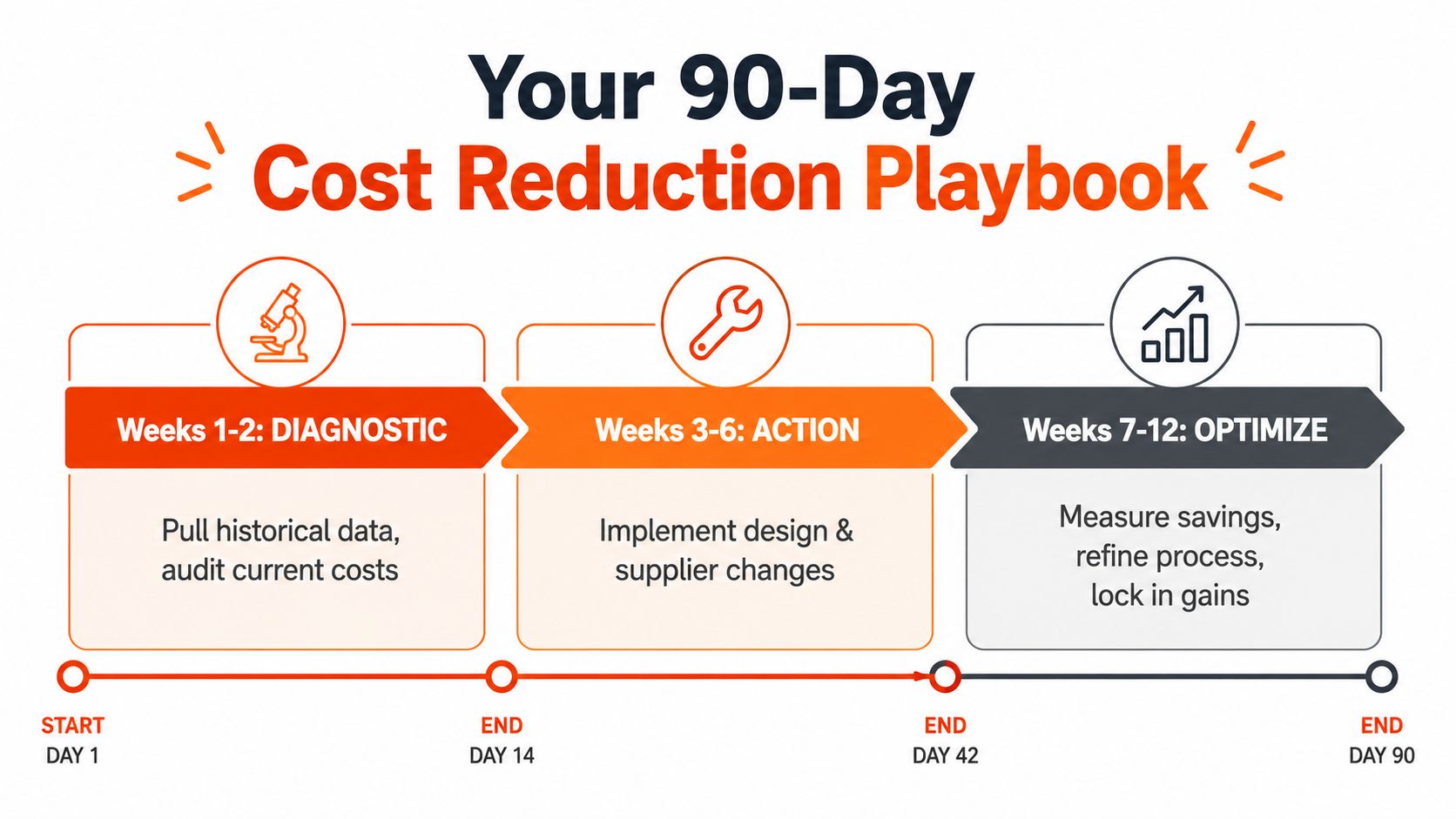
Weeks one and two are about truth, not improvement. Pull the last two quotes, normalize them into one cost stack, and decide which two or three levers deserve attention first. If you don't know whether the biggest drag is sourcing, setup, or fulfillment, don't touch the next order yet.
Weeks three through six are where you pilot the change. Ship a small run with the new vendor setup, the tighter colorway, or the simplified decoration stack, then measure rework, on-time delivery, and total landed cost. If a change doesn't improve those numbers, it's decoration, not progress.
Weeks seven through twelve are where the win gets locked in. Standardize what worked, keep the approved vendor set tight, and build a reorder kit so the next drop doesn't start from zero. That's the part teams often skip, then act surprised when the same cost problems come back in the next launch.
The cleanest outside reference on cost discipline is the Receipt Router cost reduction guide, especially if your team wants another lens on where operational waste hides. It's a useful reminder that cost control is usually a measurement problem before it's a negotiation problem.
The fastest path to lower production cost is not cheaper merch. It's fewer mistakes, fewer middlemen, fewer reworks, and fewer moving parts between the factory and the person opening the box.
If you want merch that holds up on quality and still makes sense on total landed cost, Banger can help you build the run from blank selection to fulfillment without the usual middle layers. Request a quote, get product previews fast, and launch a drop your team wants to wear.