Mastering Supply Chain Transparency for 2026 Success
A merch launch can look finished on the surface and still be fragile underneath. The mockups are approved. The landing page is live. The samples look good. Then one question lands late: where did that fabric, trim, or dye come from, and who handled it before final assembly?
That's where supply chain transparency stops being a nice brand value and turns into an operating requirement. Only 24% of global companies can trace their supply chains beyond tier-one suppliers, which leaves most brands exposed to blind spots they can't see until a shipment stalls, a claim gets challenged, or a customer asks for proof of sourcing (Sustainable Atlas).
For startups, merch teams, and culture-driven brands, the risk isn't abstract. A single unknown subcontractor can derail a drop, force rushed replacements, or turn a product story into a trust problem. Teams already thinking about material choices and product longevity will recognize the overlap with broader sourcing questions covered in this guide to environmentally friendly promotional items. You can't make responsible claims if you can't see past the first handoff.
Table of Contents
- Start with mapping, not software
- Add traceability where it matters most
- Verify the data and keep it live
- What merch teams should ask for upfront
- How marketing can use transparency without sounding performative
Introduction to Supply Chain Transparency
Supply chain transparency starts with a simple shift. Stop treating your supplier list like the whole story. It's only the front row.
A common failure point looks like this. A brand orders custom hoodies for a launch. The cut-and-sew partner is known, the invoice is clean, and the timeline seems locked. But a zipper supplier changes, a dye house isn't documented, or a fabric mill sits outside the original approval flow. Suddenly nobody on the brand side can answer basic questions about origin, labor conditions, or compliance records.
That's the actual shape of the problem. The visible supplier is often just the last organized layer before production.
Why blind spots matter
Supply chain transparency means knowing how a product moves from raw material to finished good, and being able to prove it when someone asks. In practice, that means brands need visibility across more than just the factory they placed the order with.
Practical rule: If your team can name the factory but can't name the fabric mill, trim vendor, or packaging source, you don't have transparency yet.
The stakes go beyond delivery timing. Hidden upstream gaps can expose brands to labor issues, environmental claims they can't verify, and sourcing narratives that collapse under basic scrutiny. For apparel, that matters even more because a single garment often passes through multiple hands before it reaches final assembly.
What good looks like
Teams that handle transparency well don't chase total perfection on day one. They begin by mapping the product they care most about. One hoodie. One launch kit. One event run. Then they document the chain behind it, decide which data points matter, and create a repeatable way to collect them.
That's a much better starting point than publishing broad claims and hoping nobody asks follow-up questions.
Understanding Supply Chain Transparency
Hearing “transparency” often brings to mind a public sustainability page. That's too narrow. Transparency is an operating system for product truth.
True transparency requires documentation of suppliers across all tiers and disclosure of working conditions, materials, and environmental practices so claims can be verified rather than just stated (Procurement Tactics). That definition matters because it separates real traceability from polished storytelling.
What transparency actually covers
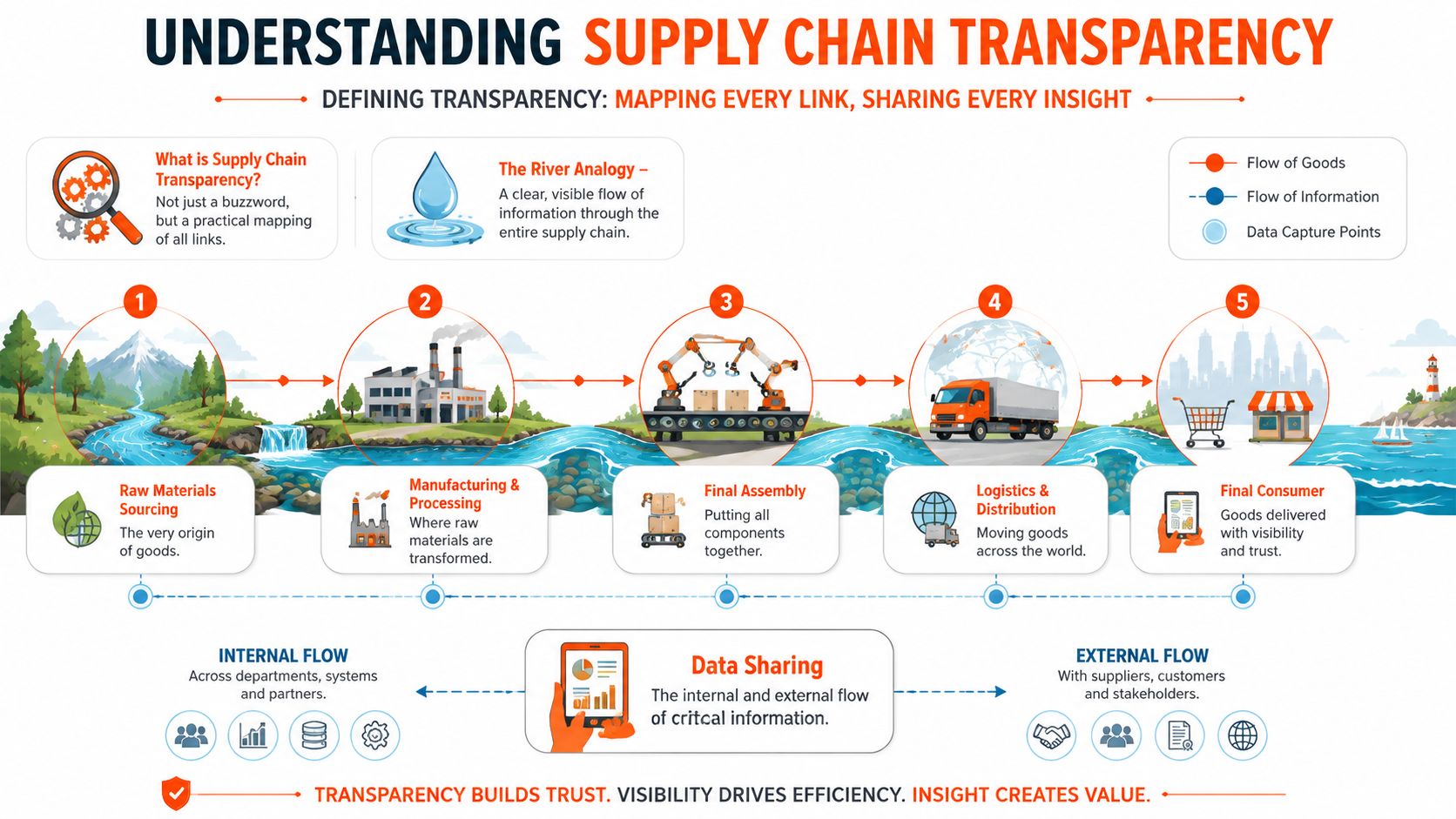
A transparent supply chain usually has four moving parts:
- Mapping every tier: You identify who supplies raw materials, who processes them, who assembles the product, and who moves it.
- Collecting usable data: You gather records on material origin, labor practices, environmental handling, certifications, and chain-of-custody handoffs.
- Running a materiality assessment: You decide what matters most based on product risk, customer expectations, regulations, and the parts of the chain most likely to fail.
- Disclosing at the right level: Some information stays internal for buying, quality, and compliance teams. Some gets shared outward so customers and partners can verify key claims.
That's why transparency isn't one spreadsheet and done. It's structured, scoped, and maintained.
The runway and river way to think about it
A good analogy is a fashion runway. Every model appears in order, under light, with a clear identity. If one person walks on without a name, designer, or look reference, the show breaks. Supply chains work the same way. Every supplier needs to be identified, vetted, and connected to a specific role.
There's also a better visual for data flow. Think of a river system. Raw materials sit at the source. Processing, assembly, and logistics are the tributaries. If one branch is muddy or hidden, the whole river becomes harder to trust.
Transparency works when information flows forward with the product, not when teams try to reconstruct the story after a problem appears.
Digital traceability proves useful. In apparel, that might mean batch records, unique IDs, supplier portals, or cloud-based chain visibility tools. In adjacent sectors, similar logic shows up in compliance work like e-waste traceability and compliance, where documentation has to survive audits and downstream scrutiny.
If your team sources apparel from Europe, this also changes how you vet production partners. A supplier directory is helpful, but a stronger starting point is understanding how European clothing manufacturers differ in sourcing depth, documentation quality, and upstream visibility.
Benefits of Transparency for Business and Brand
What happens when a customer asks where a limited-run jacket was dyed, which mill supplied the fabric, and whether the recycled trim claim can be verified? In high-customization supply chains, that question reaches your team faster than many founders expect.
Transparency helps long before anyone visits a sourcing page. It gives brands a way to check claims, compare suppliers with more context, and catch weak points before they become expensive cleanup projects.
Why trust gets stronger
Trust grows when a brand can explain the path behind a product in plain language. Who cut it. Where the fabric came from. Which steps were verified. Customers usually are not asking for a full audit file. They are asking whether the brand knows its own production story.
This matters even more in low-volume programs. A large retailer may spread compliance costs across huge order runs. A startup placing small, customized orders often relies on smaller mills, trim vendors, embroidery shops, or dye houses that carry the paperwork burden with far less margin. If your brand asks for new declarations, test reports, and chain-of-custody records without planning for that cost, the pressure lands upstream on the smallest supplier.
That is where many transparency guides fall short. They describe visibility as a brand benefit and ignore who funds the recordkeeping.
Material claims make this clear fast. Teams reviewing organic cotton fabric sourcing requirements usually learn that a fiber claim is only as credible as the documentation linking each handoff from farm, to spinner, to mill, to finished garment.
Transparency also reduces internal friction. Design, sourcing, compliance, and marketing stop working from separate versions of the product story. One verified record set gives each team the same reference point.
Why operations get sharper
Operational gains often show up before reputational gains do. A clear supplier record works like a labeled parts bin in a workshop. If every component has a name, source, and status, the team spends less time guessing and more time fixing the right problem.
The benefit is practical:
| Business area | What transparency changes | Why it matters |
|---|---|---|
| Procurement | Buyers compare suppliers using documented capabilities, lead times, and compliance records, not just quoted price | Better vendor selection and fewer production surprises |
| Quality | Teams can trace a defect back to a process step, batch, or facility | Faster root-cause checks and cleaner corrective action |
| Legal and compliance | Product and sustainability claims have supporting records | Lower exposure when customers, platforms, or regulators ask questions |
| Brand and marketing | Campaign language stays tied to verified facts | More credible storytelling and fewer claim revisions |
A small brand with custom development sees this quickly. If one capsule collection uses three specialty suppliers for fabric, printing, and finishing, one missing record can stall the whole launch. The cost is not only delay. It can mean extra sampling, relabeling, rushed approvals, or a last-minute change in marketing copy.
Field note: Transparency shortens decision time when a launch is under pressure.
There is also a resilience benefit. The OECD due diligence guidance for garment and footwear supply chains frames supply chain visibility as part of risk identification and response, not just public disclosure. That distinction matters. A spreadsheet or portal does not prevent every disruption, but it does help a team locate the affected supplier, process, or claim faster.
The bigger shift is organizational. Transparency belongs inside sourcing decisions, product development calendars, costing conversations, and brand review workflows. For smaller brands and merch teams, that also means budgeting for supplier documentation time instead of treating it as free admin work.
Implementation Roadmap for Transparency
The same early mistake is frequently observed. Many shop for software before they know what they need to trace. Start with the product, the suppliers, and the risk points. Then choose the system.
Start with mapping, not software
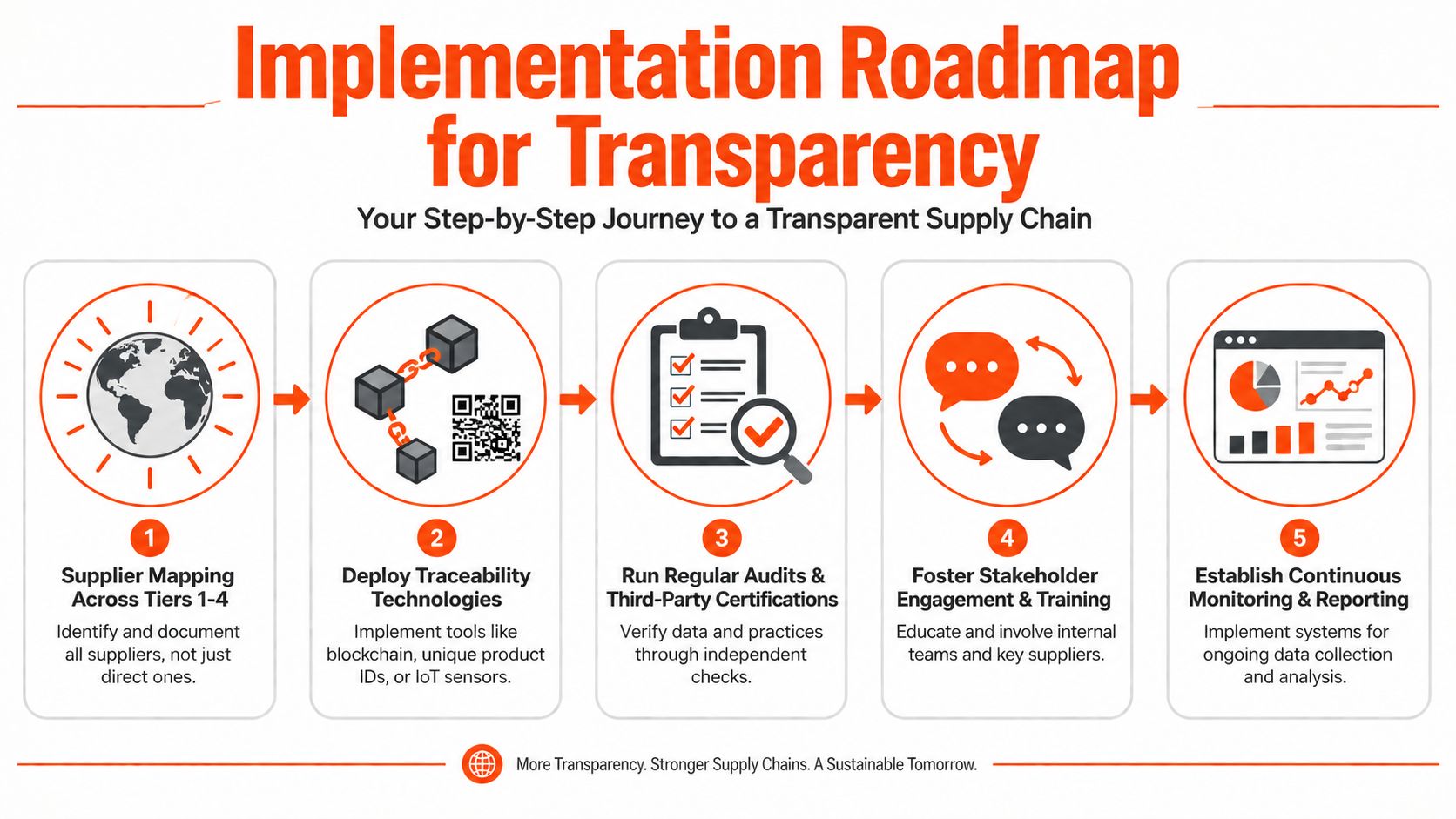
Build one product map from Tier 1 through Tier 4. For apparel, that usually means final assembly, dyeing or finishing, textile processing, and raw material origin. Write down each supplier name, location, process performed, and what documentation you already have.
If a handoff is missing, mark it clearly. Don't hide gaps inside “TBD.”
A simple first-pass map should capture:
- Supplier identity: Legal name, facility location, and parent company where relevant
- Process role: Fabric mill, embroidery partner, dye house, trim vendor, packer, warehouse
- Material links: Which inputs move from one supplier to the next
- Evidence held: Certifications, audit records, shipping docs, invoices, batch references
Some sectors use public disclosure standards to force discipline. In apparel, the Transparency Pledge standard requires companies to publicly disclose a machine-readable spreadsheet with the full name, exact address, parent company, product type, and approximate worker count for every Tier 1 factory, and to update that data at least every 12 months in line with the Open Data Standard for the Apparel Sector (Human Rights Watch).
Add traceability where it matters most
Once the map exists, identify the riskiest nodes. That's where digital traceability earns its keep.
The MIT Sloan framing is useful here. Teams need to separate visibility from disclosure, and anchor the program in a materiality assessment that reflects stakeholder interests, regulation, ethics, and risk tolerance (MIT Sloan). In plain terms, don't track everything with equal effort. Track what can hurt you most if it goes dark.
Tools vary by use case:
- Unique IDs or batch codes help track trims, fabric lots, packaging runs, and product versions.
- Supplier portals centralize records so vendors upload labor, environmental, and compliance data in one place.
- Blockchain-based platforms can support immutable records for chain-of-custody handoffs.
- IoT sensors matter most in high-value or high-risk nodes where conditions and movement need proof.
For finished goods, especially in apparel, deeper verification often requires tracking raw materials from Tier 4 origins through each handoff. Digital traceability tools such as blockchain-based platforms like TrusTrace or TextileGenesis, or cloud-based chain visibility systems, are often used to automate ESG data collection and support chain-of-custody documentation (Forbes Technology Council).
A short explainer helps if your team needs a visual overview before building the workflow.
Verify the data and keep it live
Traceability without verification turns into self-reported noise. Teams need checks.
Use audits, third-party certifications, invoice matching, shipment records, and periodic supplier reviews to confirm the chain still matches reality. Keep the cadence risk-based. A stable low-risk packaging supplier doesn't need the same level of scrutiny as a dye house with environmental exposure.
A clean operating rhythm usually includes:
- Monthly updates for active products so supplier changes get captured fast.
- Quarterly reviews of high-risk categories such as chemical processing or complex custom runs.
- Annual disclosure refreshes for public-facing data and partner reporting.
Define KPIs that people can act on. Compliance rate by supplier category. Percentage of mapped handoffs with supporting documentation. Audit findings resolved within target windows. If your team also handles distribution, transparency should continue past manufacturing into storage and shipment workflows, especially when using external merch fulfillment services.
The practical goal isn't a perfect map on day one. It's a chain you can explain, verify, and improve without rebuilding the process every launch.
Tools and Governance Options
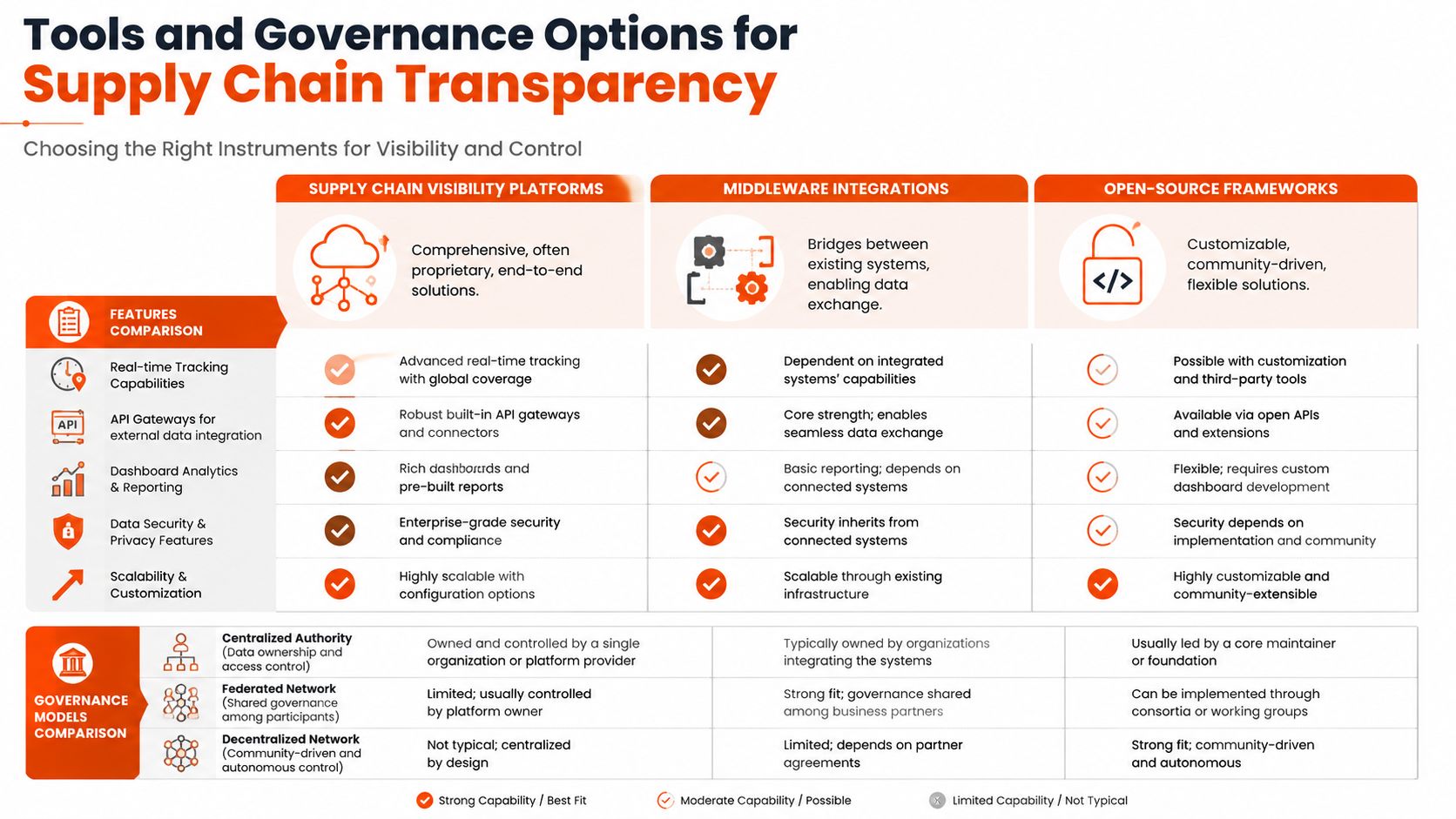
No single transparency stack fits every business. A brand with a modern ERP and disciplined suppliers can move fast with middleware and a portal. A growing team with scattered spreadsheets may need a packaged platform first, then custom layers later.
Disconnected data systems and siloed architectures block end-to-end visibility, costing companies up to 30% of annual revenue due to inefficiencies and delays (M Accelerator). That's why the tool choice matters less than the integration logic behind it.
Choosing the right tool stack
Here's the simplest way to compare the main options.
| Option | Best fit | Pros | Cons |
|---|---|---|---|
| Supply chain visibility platforms | Teams that want faster rollout | Central dashboard, supplier onboarding workflows, reporting features | Less flexible, vendor dependency |
| Middleware integrations | Companies with existing ERP and WMS systems | Connects legacy systems, phased rollout, lower disruption to current ops | Requires stronger technical ownership |
| Open-source frameworks | Teams with in-house technical depth | Customizable, flexible governance, easier to shape around niche workflows | Higher setup and maintenance burden |
| Hybrid setup | Brands with mixed legacy and modern systems | Balances control and speed | Can get messy if ownership is unclear |
Middleware deserves more attention than it usually gets. Where ERP and WMS systems don't speak cleanly to each other, an API gateway or middleware layer can standardize formats and support secure communication without forcing a full rip-and-replace. That's often the most realistic path for companies that already run live operations.
For brands managing multiple logistics partners, especially across regions, it also helps to understand the operational role of orchestration models like 4PL for your Australian business. The concept is broader than transparency alone, but it helps explain who should coordinate data when warehousing, transport, and fulfillment sit across different providers.
Choosing the right governance model
The technology won't hold if ownership is fuzzy. You need a clear model for who approves data, who chases gaps, and who decides what gets disclosed.
Three governance patterns show up most often:
- Dedicated transparency lead: Strong accountability, quicker decisions, easier escalation. Risk is over-centralization if every answer depends on one person.
- Cross-functional council: Better buy-in from sourcing, operations, compliance, and brand. Risk is slower movement if nobody owns the final call.
- Federated model: Each region or business unit manages its own supplier data under shared standards. Useful for scale, but only if data definitions are tight.
The best governance model is the one that makes supplier data someone's job before a problem shows up.
For merch-heavy teams, one practical test is this. If you ask who owns the trim supplier record, packaging origin, and fulfillment handoff, do you get one answer or four? If the answer changes by meeting, the governance model isn't settled.
That's also why supplier selection matters. A strong team apparel supplier isn't just good at product and timelines. They can document upstream decisions in a way your internal teams can use.
Common Pitfalls and How to Avoid Them
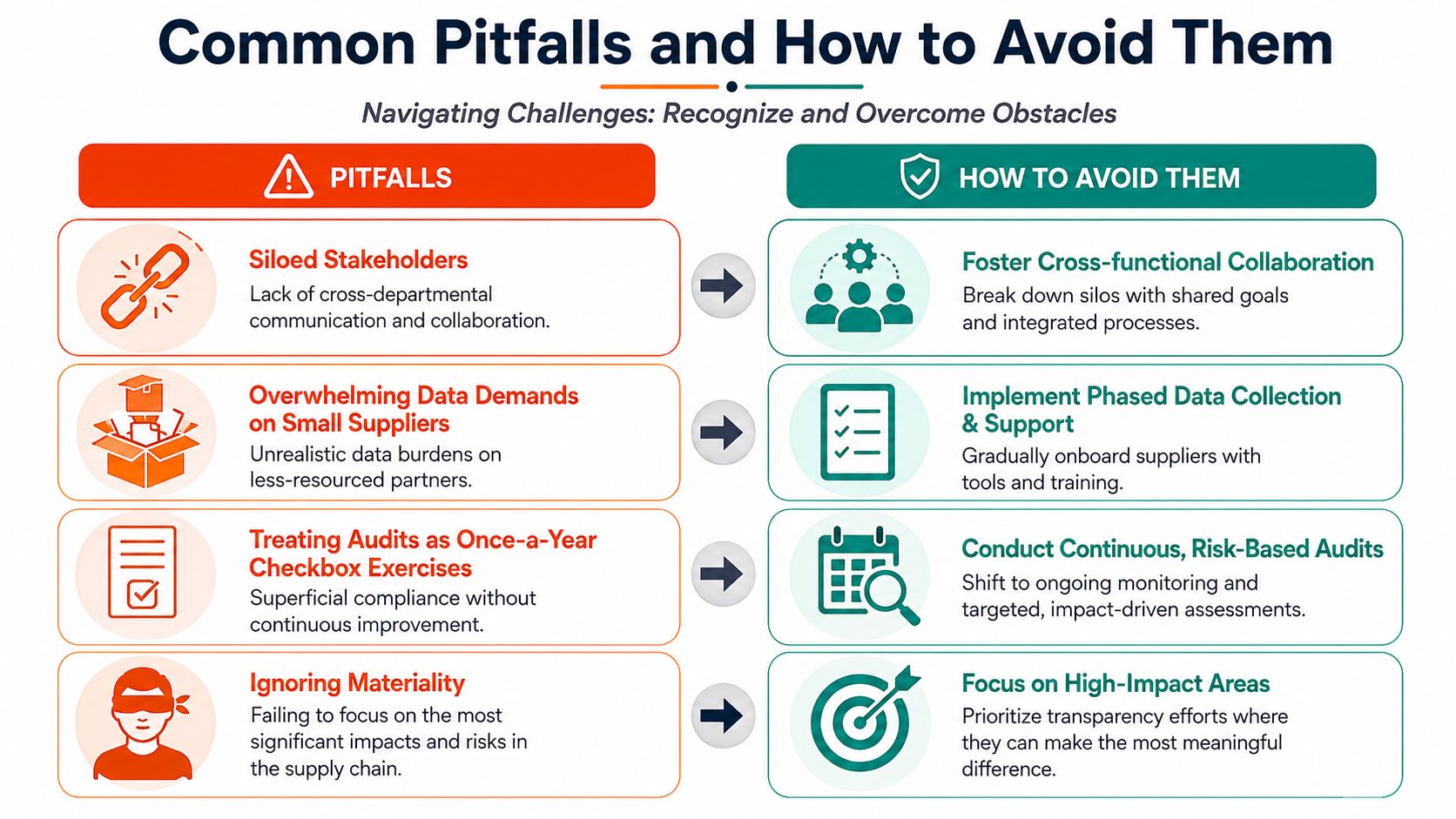
The path to transparency usually gets blocked by a few repeat mistakes. They show up in global programs, but they hit low-volume, high-customization supply chains harder because every special request creates another data handoff, another approval, and another cost that someone has to absorb.
The traps that slow teams down
Scope creep is usually first. A brand asks for mill records, facility details, packaging declarations, subcontractor names, transport documents, and certifications all at once, even though the team only needs a fraction of that data to approve the next run. Suppliers respond with partial files, mismatched formats, and long delays because the request was wider than the actual decision.
The second trap is harder to see. In custom merch and short production runs, the admin burden often gets pushed downhill to the smallest supplier. A specialist trim shop, local printer, or small cut-and-sew partner may be asked to complete the same paperwork as a large factory, even though they have no compliance staff and no software to track batch-level records. For a big brand, that looks like a simple form. For a small supplier, it can mean unpaid hours spent digging through invoices, recreating material histories, and answering repeated follow-up emails.
That cost matters. In low-volume, high-mix work, the paperwork can eat the margin faster than the production itself. A supplier making three customized runs with different trims and packaging may need to document each variation separately. If the buyer does not simplify the request or help cover the effort, the supplier either guesses, delays, or prices the admin work back into future orders.
Checkbox auditing creates a different problem. A team collects documents once a year, files them away, and treats the file as proof that the chain is understood. Then a decorator changes, a packaging vendor swaps materials, or a rush order moves to a backup facility. The record is now outdated, but the dashboard still looks complete.
The fixes that actually hold up
The better method works like building a map in layers. You sketch the main roads first, then add side streets only where they matter.
- Phase the data request: Start with supplier identity, facility location, process role, and the few documents tied to immediate risk or claim review.
- Match the request to supplier size and order type: A small specialist vendor handling one component should not get the same questionnaire as a vertically integrated manufacturer.
- Pay attention to admin load: If your transparency request creates extra work for a small supplier, reduce the fields, provide templates, or pay for the reporting effort.
- Track custom work at the right level: For changing designs, record data by order, batch, or component set rather than relying only on a static supplier profile.
- Review when something changes: Trigger checks when materials, factories, decorators, packaging, or routes change, not only on an annual calendar.
A simple rule helps here. Separate "needed to place the order" from "needed to improve the record later." That distinction keeps production moving while still raising data quality over time.
Don't measure seriousness by the size of the questionnaire. Measure it by whether the data helps you approve, question, or change a sourcing decision.
The strongest transparency programs are usually less dramatic than teams expect. They ask better questions, place fewer unnecessary demands on small suppliers, and keep records current where product variation creates real risk.
Strategies for Merch Partners and Marketing Teams
Merch teams sit in a tricky spot. They need enough transparency to make real claims, but they also work with launch deadlines, low minimums, design changes, and custom runs that don't fit generic supply chain playbooks.
What merch teams should ask for upfront
Start with the brief, not the campaign copy. Every merch order should include a supplier-facing traceability checklist that asks for facility names, material sources, processing steps, packaging origin, and the documents available for each handoff.
For low-volume custom work, it helps to build a lightweight digital twin for each product line. That can be as simple as a shared product record tying together the blank or base garment, customization method, trim set, packaging components, and fulfillment route. If one component changes, the record changes too.
This is also where fairness matters. Larger brands must share the cost and capacity burden of due diligence with Tier 2+ suppliers, who often lack the infrastructure to meet data demands without support (UK government practical guide). If a small atelier or specialist trim vendor is doing extra admin work for your reporting needs, the brand side should help with templates, tools, and realistic timelines.
How marketing can use transparency without sounding performative
The best marketing use of transparency is specific, not self-congratulatory.
Instead of broad claims, teams can publish product-level sourcing notes, explain what parts of the chain are verified, and update launch pages when a supplier changes. Event teams can also add traceability checks to production calendars, packaging sign-off, and post-event recap workflows.
A simple communications stack might include:
- Launch pages: Clear sourcing notes tied to the product being sold
- Packaging inserts: Short verification details with QR-based product records
- Internal briefs: A one-page source-of-truth document for support, social, and partnerships teams
That keeps transparency useful. Not decorative.
Conclusion and Next Steps
Supply chain transparency is hard because products move through many hands, systems, and decisions. It's worth doing anyway. Teams that can map their chain, verify key handoffs, and disclose the right information are better positioned to protect trust, reduce sourcing risk, and make product claims that hold up under pressure.
The smartest way to begin is small. Pick one product line. Map the known suppliers. Mark the unknowns. Decide which records matter most, then build a lightweight process your team can repeat. That first pass won't be perfect, but it will be real. Real is what gives you an advantage.
If you work in custom merch, don't copy a bulk-manufacturing playbook and hope it fits. Short runs, premium customization, and multi-supplier production need a version of transparency built for that reality. The brands that get this right won't be the ones with the biggest promise page. They'll be the ones that can answer specific questions quickly, clearly, and with proof.
If you're building premium custom merch and want a partner that understands sourcing depth, low minimums, French atelier production, and worldwide fulfillment, explore Banger. You can request a quote, get product previews within 24h, and build merch your team wants to wear.