Custom Apparel No Minimum: Smart Choices for 2026
The most repeated advice in custom apparel no minimum is also the most misleading: just because you can order one piece doesn't mean you should.
That logic created a mountain of disposable merch. It solved inventory risk, but it also normalized thin blanks, generic fits, weak decoration, and packaging that feels like an afterthought. If your team is building a real brand, that's not a win. It's a downgrade dressed up as convenience.
The better question isn't “Who offers no minimum custom apparel?” It's “Which production model matches the role this piece needs to play?” A one-off sample, a founder gift, an onboarding kit, a community drop, and a retail-quality capsule should not be made the same way.
Table of Contents
- Can I really order just one piece
- What if I want premium quality in a small run
- Can I mix sizes colors and products
- What if I don't have a finished design
Most No Minimum Merch Is Forgettable Here Is Why
No-minimum merch fixed one old problem and created a new one.
Yes, it removes bulk requirements. You can order exactly what you need, whether that's one piece or a much larger run, without overstocking, as noted by Yes We Print's no minimum t-shirt overview. That flexibility matters. It's useful for samples, one-off gifts, and small tests.
But the average result is still mediocre.
Organizations don't need more “easy merch.” They need fewer bad decisions. A generic tee with a center-chest logo isn't neutral. It tells people your brand didn't care enough to think about fit, fabric, print method, or how the piece lives outside the office.
Convenience made bad merch easier
The standard no-minimum workflow rewards speed, not taste. You upload a file, pick a blank, approve a mockup, and move on. That's efficient. It's also how you end up with apparel that feels like software documentation printed on cotton.
The problem isn't the model itself. The problem is using pure flexibility as the main buying criterion.
Custom apparel that nobody wants to wear is still waste. It just becomes emotional waste instead of inventory waste.
That matters more for startups, fintech brands, crypto teams, and creators than it does for legacy companies. Internet-native brands live or die on signal. Every touchpoint says something. If the shirt feels cheap, the brand feels less sharp.
The real job of merch
Good merch does at least one of these things well:
- Builds internal culture: onboarding kits, team offsites, launch moments
- Extends brand language: same level of taste as your site, product, and social presence
- Creates actual demand: pieces people wear because they like the garment, not because it was free
- Makes events more memorable: not another giveaway people forget in a hotel room
If your supplier can only promise “no minimum,” that's not much of a strategy.
A better filter
Use no minimum as a tool, not a goal.
Ask whether you're buying flexibility, quality, or brand value. You can usually maximize two. Rarely all three. Once you accept that trade-off, choosing the right custom apparel partner gets much easier.
Decoding Your Options POD vs Low MOQ vs Cut and Sew
Not all custom apparel no minimum offers are the same. Buyers lump everything together, then wonder why the results vary so wildly.
Use a simple food analogy. Print on Demand is fast food. Low MOQ is a strong small-batch kitchen. Cut and sew is a private chef. All three have a place. They just serve different jobs.
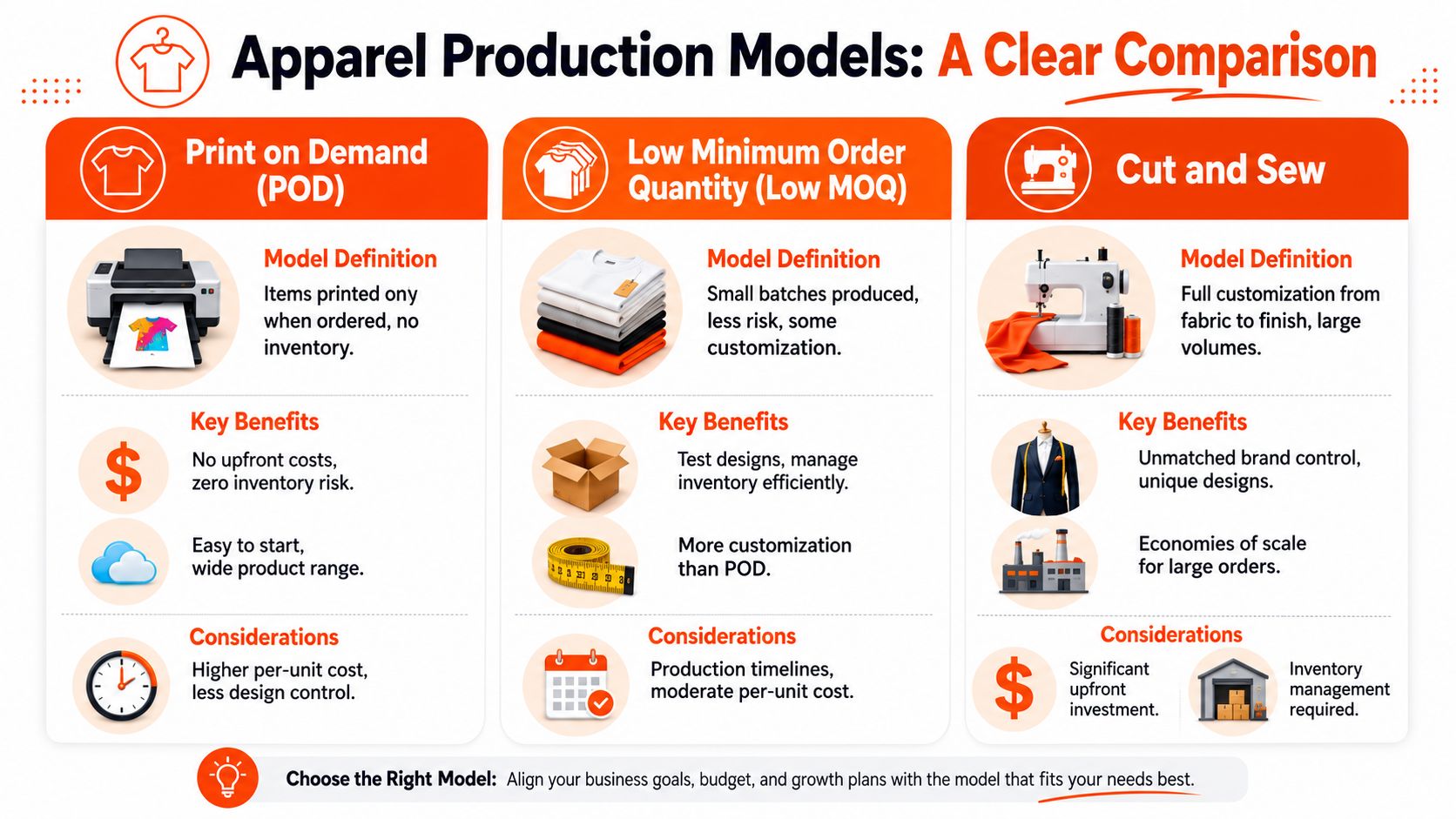
POD is speed first
Print on Demand works because DTF and DTG let decorators produce one piece at a time without the setup labor that traditional bulk methods require. By contrast, Jam 4 Apparel notes that screen printing often needs an MOQ of 50–300 units to cover fixed setup costs.
That's the key. No screens. No large setup hurdle. No need to commit to inventory before demand exists.
POD is right when you need:
- A single sample: check sizing, feel, or artwork placement
- A quick test: validate whether a design deserves a broader release
- Simple global fulfillment: especially for creator merch or lightweight drops
- Low commitment: no warehouse, no forecasting, no large spend upfront
The downside is obvious once you've handled enough merch. Control is limited. Blank selection is often basic. Decoration can be technically fine and still feel generic.
A quick visual breakdown helps if you're sorting through production paths:
Low MOQ is where brand value starts
Low MOQ is the sweet spot for most modern brands. You're not ordering huge quantities, but you're also not accepting the compromises that usually come with one-click POD.
This model works best for team drops, founder kits, event runs, and early-stage branded apparel programs. You get more control over garment choice, trims, print placement, embroidery, and finishing. You can shape an actual product instead of just decorating a stock item.
A good low-MOQ partner should feel closer to a brand production studio than a print portal. If you want to understand where that path can lead, this guide to cut and sew apparel production is a useful next read.
| Model | Best for | Main trade-off |
|---|---|---|
| POD | samples, one-offs, demand tests | less control, weaker brand feel |
| Low MOQ | premium small batches, team merch, events | higher per-unit cost than bulk |
| Cut and sew | custom collections and private label | more complexity and commitment |
Cut and sew is full authorship
Cut and sew sits in a different category. You're not just choosing a blank. You're building the garment itself.
That means shape, fabric, trims, labels, stitching details, panels, washes, and construction choices all become part of the brand language. This is what you choose when the garment is the product, not just the canvas.
Practical rule: If the merch needs to feel like retail, not swag, POD is usually too shallow.
Cut and sew makes sense for capsule collections, serious community drops, or brands with a defined visual identity. It gives you the most authorship and the most risk. That's the trade. More control, more planning, more operational responsibility.
The Real Cost of a Single Custom T-Shirt
A one-off tee is often the worst place to optimize for the lowest price.
Single-unit merch exposes your strategy fast. If you use POD for everything, you get speed and flexibility, but you usually give up garment quality, print sophistication, and brand authority. If you spend more on a low-MOQ premium run, your cost per piece may look higher at first, but the product has a better chance of being worn, photographed, and remembered.
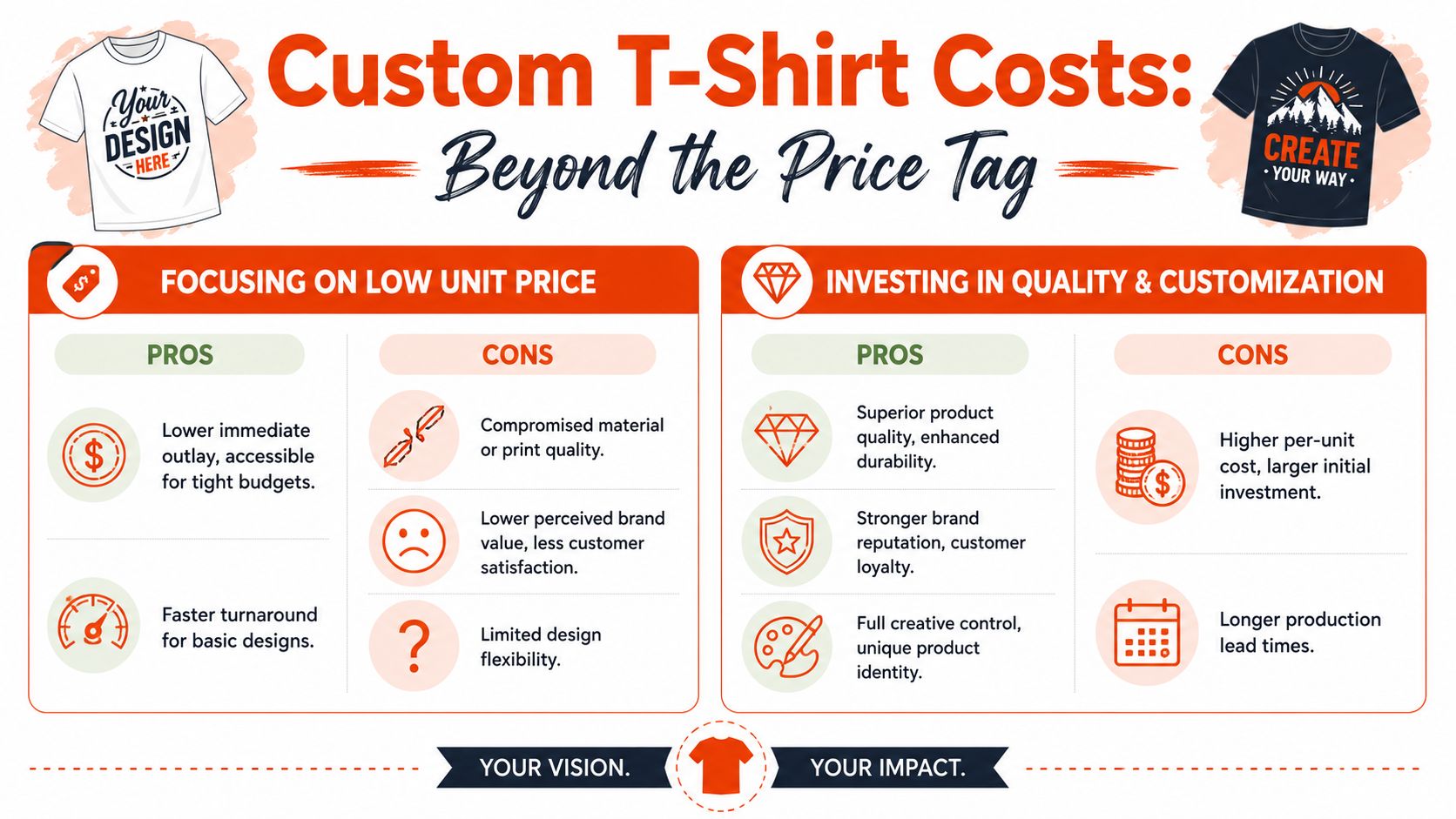
Cheap upfront can be expensive for the brand
Single-piece pricing gets distorted by convenience. Lands' End's business uniform page makes the basic point clearly. Small-batch customization often carries fees and markups that make one shirt disproportionately expensive compared with a larger run.
That would be fine if the product felt premium. A lot of the time, it does not.
POD works best for samples, test orders, and fast validation. It starts to break down when the shirt needs to represent the brand in public. The blank is often average, print placement options are tighter, and finishing details are limited. You are paying for low commitment, not for authorship.
A low-MOQ premium partner flips that trade. You accept less flexibility in exchange for better blanks, better print execution, and a product that can hold its own next to retail apparel.
What to measure instead of sticker price
Use a brand filter, not a bargain filter.
- Wear rate: Will the recipient choose it again after the first wash?
- Brand fit: Does the garment feel consistent with the standards your brand claims to have?
- Execution range: Can you create something more considered than a basic front-logo print?
- Margin on meaning: Does the extra spend create a shirt people value, or just a shirt that exists?
If you're pricing out a new merch line, this resource for custom t-shirt business is helpful for understanding how production choices affect costs beyond the obvious line items.
Then judge the base garment hard. Better fabric, weight, fit, and finish usually matter more than adding another graphic hit. This breakdown of premium blank t-shirts is a useful reference if you want a clearer standard for what premium looks like.
One shirt that gets worn for a year beats five cheap tees that never leave the drawer.
Here's the decision rule. Choose POD when you need proof, speed, or a one-off sample. Choose low MOQ when the shirt needs to carry the brand, justify a higher perceived value, or support a drop that should feel intentional instead of disposable.
Designing Merch People Actually Want to Wear
Most bad merch starts with one lazy move. Someone exports the logo, drops it on the chest, and calls it done.
That approach almost always produces apparel that looks like a giveaway instead of a piece. Good branded apparel works the opposite way. The garment comes first. Then the graphic system. Then the finishing details.
Start with the garment not the logo
A heavyweight hoodie, a washed tee, a structured cap, and a soft ringspun blank all tell different stories before decoration even enters the room. If you choose the wrong silhouette, no amount of graphic polish will save it.
Start with three questions:
- Who will wear it repeatedly: employees, creators, customers, community members
- Where will they wear it: conference floor, office, gym, travel day, daily streetwear rotation
- What should it feel like: minimal, technical, soft, structured, oversized, retail-ready
If you need visuals before production, PhotoMaxi's mockup solutions are useful for testing placement and composition without locking into a run too early.
Use decoration with intent
Every method changes the vibe.
Screen print feels bold and graphic. Embroidery adds permanence and restraint. DTG is useful when the artwork needs tonal detail or smaller runs. Patches, woven labels, puff embroidery, and inside-neck details move the piece out of “promotional” territory and into something more considered.
A strong merch brief should include:
- Primary garment choice with the exact fit and fabric direction
- Decoration logic based on the visual language, not trend-chasing
- Finishing details like custom neck labels, hang tags, hem tabs, or packaging inserts
If the logo is the only idea, the merch isn't ready yet.
The best teams treat merch like brand design in physical form. That means spacing, hierarchy, tone, and material choices all matter. If you need help translating a brand system into apparel, proper custom design services for merch can save you from spending money on pieces that looked acceptable on screen and dead on arrival in real life.
From Production to Unboxing Fulfillment and Packaging
Brands usually spend all their energy picking the garment, then treat fulfillment like admin. That is how good merch arrives looking cheap.
Production is only half the job. The other half is getting the right piece to the right person, on time, in packaging that matches the brand you claim to have built. If you ignore that part, your “no minimum” setup buys flexibility and gives back inconsistency.
The model you choose matters here. POD works well for scattered, one-off sends, remote teams, creator seeding, and unpredictable demand. It keeps inventory risk low, but you give up some control over finishing, packing consistency, and shipping speed. A low-MOQ premium partner is the better call when presentation matters, the garment quality is part of the pitch, and you want every order to feel identical from first unit to fiftieth.
Use a simple filter:
- Choose POD if you need multi-address fulfillment, rolling orders, and low-risk testing
- Choose low-MOQ premium production if branded packaging, tighter QC, and stronger perceived value matter more than maximum flexibility
- Choose stored inventory if timing is fixed, units need to match exactly, and the unboxing experience is part of the campaign
That trade-off gets ignored in basic merch guides. It should drive the whole operation.
A founder welcome kit, a paid community drop, and a conference freebie should not run through the same fulfillment logic. They have different stakes. One needs precision. One needs margin control. One just needs to arrive fast and clean.
If your program includes split shipments, recurring sends, or multiple recipient lists, tools that streamline your shipping operations can save your team from manual tracking, address errors, and missed deadlines.
Packaging decides whether the product feels considered
Packaging is branding with pressure on it. The recipient sees it before they touch the tee, check the print, or notice the fabric weight.
Generic poly mailers flatten the whole experience. Branded shippers, tissue, inserts, stickers, size labels, and a short welcome note add structure and intent. For higher-value merch, that detail is not extra. It is part of what the buyer or recipient is judging.
That matters most in a few cases:
- Onboarding kits, where the package sets the tone for the company
- Creator gifting, where presentation affects whether it gets shared
- Paid drops, where customers expect retail-level care
- Community rewards, where packaging helps the item feel earned, not leftover
The goal is not to add random extras. The goal is to make the package feel aligned with the garment. Clean outside. Good fold. No clutter. No flimsy insert that looks printed five minutes before pickup.
For teams that need that level of control at scale, specialized merch fulfillment services for branded apparel programs make more sense than treating shipping as an afterthought. The product is not finished at production. It is finished when the package shows up and everything still feels on-brand.
Your Decision Checklist for Choosing a Merch Partner
Most vendors sound good until you ask sharper questions.
“No minimum” gets used as a blanket promise, but the fine print usually lives in the decoration method. That's where weak suppliers get exposed. Tshirt Envy points out that DTG and DTF can truly support single-unit orders, while screen printing and embroidery often carry a 12-piece minimum per design. If a partner can't explain that cleanly, keep moving.
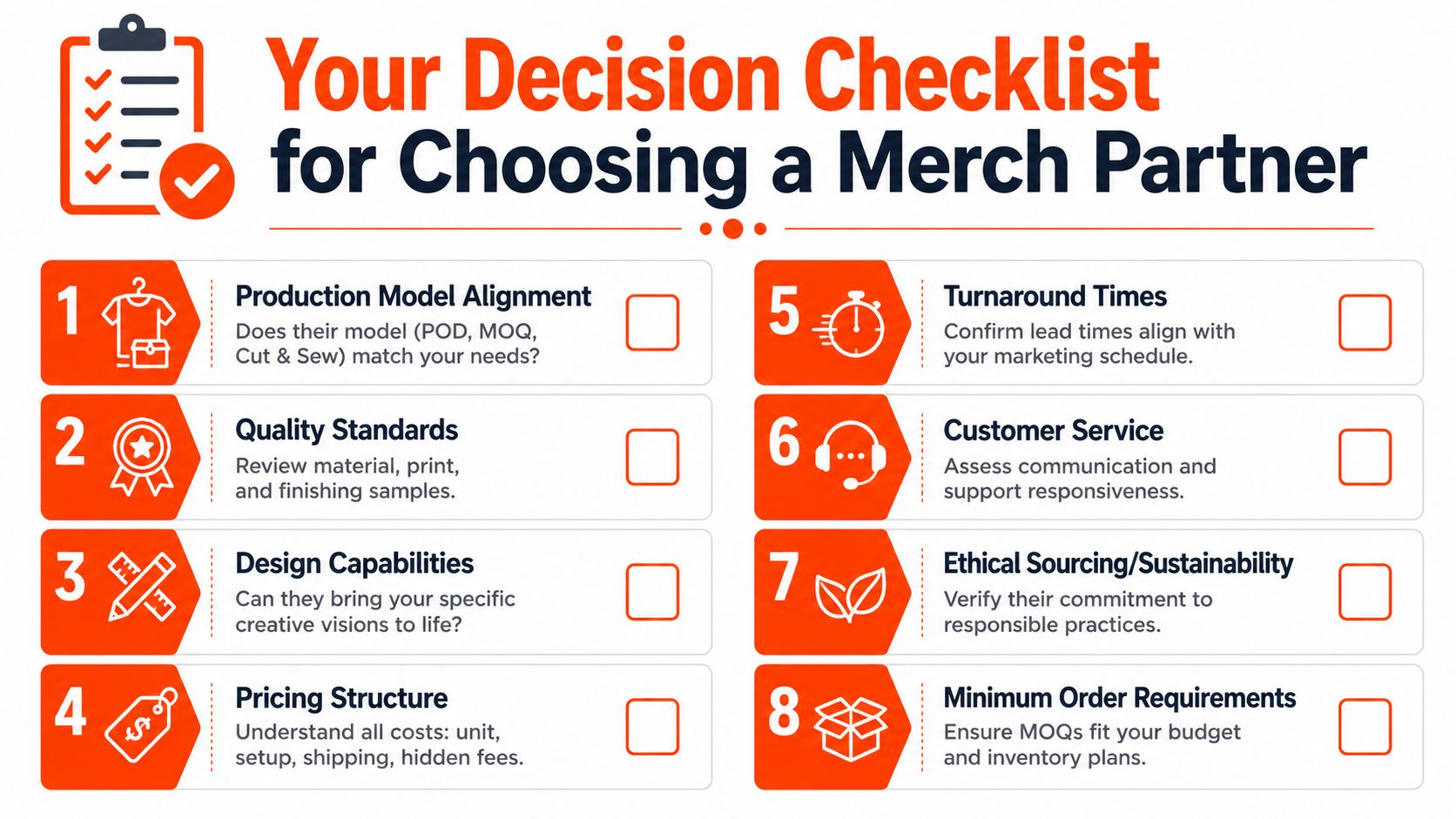
The questions that expose weak vendors fast
Ask these before you approve anything:
- What are your real minimums by decoration method? Not catalog minimums. Actual production minimums for DTG, DTF, embroidery, and screen print.
- Which blanks do you recommend for this use case? If they can't talk fit, weight, silhouette, and print compatibility, they're just order takers.
- Can I see examples of finishing details? Neck labels, hang tags, woven tabs, custom packaging, and inside branding separate real merch from basic print jobs.
- How does pricing change when I move from sampling to a small batch? This tells you whether they understand scale, not just one-off fulfillment.
- What happens if I need split shipping? Remote teams and event sends need process, not improvisation.
Then ask one question most buyers skip.
Show me the pieces people reorder, not just the pieces you can produce.
That answer reveals a lot. Reorders usually signal wearability, not novelty.
A serious partner should also help you match model to objective. A sample tee, an onboarding kit, and a premium event drop shouldn't all be pushed through the same workflow. If you're evaluating suppliers for recurring team gear, this guide to choosing a team apparel supplier is a useful benchmark.
The right partner doesn't just print your file. They protect the brand from lazy merch decisions.
Common Questions About No Minimum Apparel
Can I really order just one piece
Often, yes. Most no-minimum custom apparel providers set the floor at 1 unit per item, though some require a 10-unit minimum per apparel order to start production, according to this YouTube breakdown of no-minimum apparel ordering. The catch is that “one piece” usually works best for digital decoration, not every premium method.
What if I want premium quality in a small run
Then don't shop by minimum alone. Use one-off ordering for sampling, fit checks, and design validation. Move to a stronger low-MOQ setup when the piece is meant to represent the brand in public. That's usually the point where better blanks, stronger finishing, and more thoughtful packaging start paying off.
Can I mix sizes colors and products
Usually, yes. Many no-minimum suppliers now support mixed sizes and colors in a single order. That's useful for remote teams, gifting, and event planning where one uniform quantity split doesn't make sense. Just make sure the flexibility applies to decorated items, not only undecorated stock.
What if I don't have a finished design
That's normal. A lot of teams know the vibe they want before they know the exact execution. Start with references, your brand system, your intended audience, and the garment category. A good merch partner can help translate that into a wearable direction instead of forcing you into a generic print template.
Custom apparel no minimum is a great tool when you use it with discipline. Use it for speed when speed matters. Use low MOQ when brand value matters. Use cut and sew when the product itself is the statement.
If you want merch that feels closer to a streetwear drop than a startup freebie, Banger is built for that lane. You can request a quote, get product previews within 24h, and build merch your team wants to wear.