What Is Organic Cotton Fabric: 2026 Guide for Brands
Most advice about organic cotton is lazy. It treats the word organic like a shortcut for better quality, better ethics, and better brand taste all at once.
That's not how sourcing works.
If you're choosing fabric for hoodies, tees, or a team drop, the pertinent question isn't just what is organic cotton fabric. The better question is what that label changes for the finished garment, what it doesn't change, and how to tell the difference between a legit material choice and greenwashed copy on a product page.
Organic cotton matters. But it matters in specific ways. It changes how the cotton is farmed. It can shape which certifications a garment can carry. It can affect how your audience reads your brand. It does not magically make a hoodie feel more premium, fit better, or last longer if the yarn, GSM, knit, finishing, and factory execution are weak.
Table of Contents
- Organic is environmental, not automatically ethical
- What this means for brand risk
- A better standard for internal approvals
- Why the softest tee isn't decided by the farm
- The details that actually affect quality
- How to keep cotton merch looking good
- Is organic cotton merch always more expensive
- Will organic cotton feel different from a regular cotton tee
- Are color options more limited
- Is organic cotton enough if our brand also cares about ethics
- Should we use blanks or build custom
Why Everyone Is Talking About Organic Cotton
Organic cotton gets discussed like a quality upgrade by default. In sourcing, that shortcut causes bad decisions.
What changed is simpler than the hype. Organic cotton has become a visible shorthand for material intent. Brand teams want a cleaner story. Procurement wants fewer questions from leadership. Customers have learned enough sustainability language to notice whether a tee says “100% cotton” or says something more specific.
The label got popular faster than the understanding
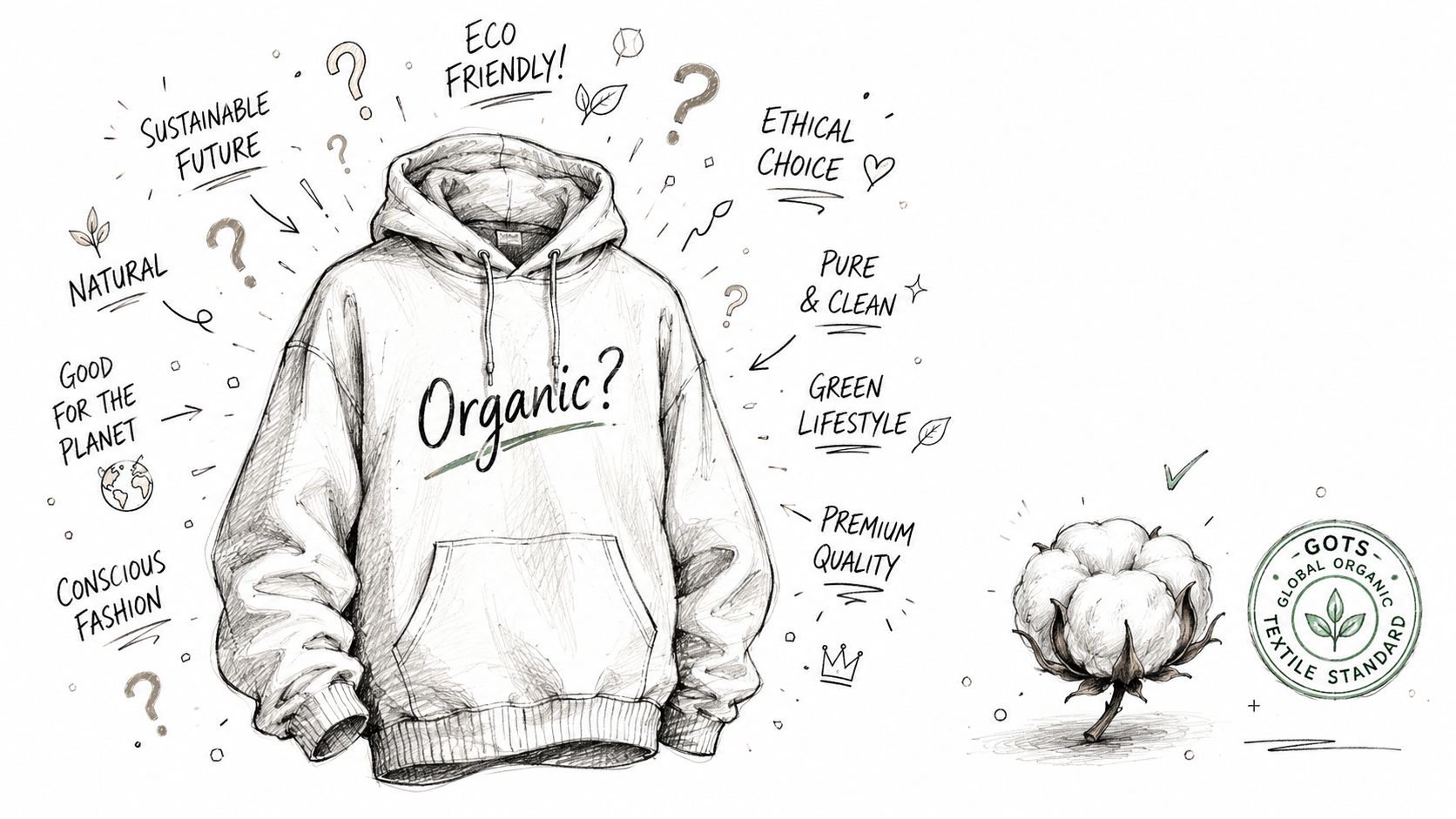
The catch is that “organic” now gets asked to do too much. Teams often use it to imply lower impact, better labor conditions, better hand feel, better durability, and better brand ethics in one shot. That is where sloppy sourcing starts.
For merch, organic cotton fabric is a raw material claim first. It can be a strong one. It can also be narrow. It says something meaningful about how the cotton was grown, but it does not automatically tell you whether the fleece is dense enough, whether the jersey will torque after wash, or whether the final hoodie feels premium on body.
That distinction matters if you are buying blanks or building a custom program. A heavyweight organic hoodie with weak knitting and average finishing will still feel cheap next to a better-engineered non-organic option. If your team is comparing premium blanks, the spec sheet and construction details matter as much as the fiber story. This is easy to see when reviewing premium hoodie blanks for merch programs.
Practical rule: Treat organic as a verified input standard, not a blanket claim about the final garment.
Why brands still care
Brands keep pushing organic cotton because the label does help. It gives marketing a cleaner materials story, gives procurement a more defensible sourcing position, and gives internal stakeholders a clearer answer when they ask what sits behind the fabric claim.
It also affects perception. If your brand wants to look considered, the fabric story has to hold up once someone asks a second question.
That does not mean organic cotton is overhyped garbage. It means the value is real only when the claim is verified and the product quality is there to support it. The smart move is to use organic cotton where it fits, then judge the garment like a garment. Weight, yarn quality, knit, finish, dye consistency, shrinkage control, and trim execution still decide whether people keep wearing it.
Organic vs. Conventional Cotton: The Agricultural Distinction
Organic cotton is a farming claim first. That sounds obvious, but plenty of merch briefs still treat it like a guarantee of softer handfeel, better drape, or higher-end build. It is none of those by default.
What organic cotton fabric refers to is the cultivation standard behind the fiber. Organic production excludes synthetic fertilizers, synthetic pesticides, and genetically modified seed inputs under the applicable standard. Conventional cotton does not operate under those restrictions. The cleanest explanation is in CBI's overview of organic cotton requirements for the EU market.
That distinction matters because sourcing teams often collapse two separate decisions into one. Decision one is the agricultural input standard. Decision two is whether the mill and factory can turn that fiber into a premium garment. Those are related, but they are not interchangeable.
Organic cotton also is not limited to rough, basic fabrics. Textile Exchange's organic cotton fiber classification guide shows a wide staple length range and yarn count range, which means the fiber can be spun into everything from simple jersey to more refined fabric programs. The catch is mill execution. Poor spinning, loose knitting, weak dyeing, or lazy finishing will still give you a disappointing hoodie, even if the cotton input was certified organic.
For premium merch, teams often get burned. Someone approves an “organic cotton” blank, assumes the sustainability claim covers product quality, and then gets a body that twists after wash or a fleece face that pills too fast. If you are comparing options, pair the fiber claim with a review of weight, yarn quality, shrink control, and silhouette. A shortlist of hoodie blanks worth comparing for premium merch programs helps more than another vague sustainability promise.
Organic Cotton vs Conventional Cotton at a Glance
| Feature | Organic Cotton | Conventional Cotton |
|---|---|---|
| Seed rules | Non-GMO under organic standards | May include genetically modified seed varieties |
| Pesticides | Synthetic pesticides are restricted under organic rules | Synthetic pesticide use may be part of standard cultivation |
| Fertilizers | Synthetic fertilizers are restricted under organic rules | Synthetic fertilizers may be used |
| What the claim covers | How the cotton was grown | Standard cotton agriculture without an organic claim |
| What the claim does not guarantee | Softness, durability, fit, or premium construction | Softness, durability, fit, or premium construction |
| Garment outcome | Still depends on spinning, knitting or weaving, dyeing, finishing, and cut-and-sew quality | Still depends on spinning, knitting or weaving, dyeing, finishing, and cut-and-sew quality |
The useful distinction is agricultural. The misleading one is aesthetic.
What changes for merch buyers
For a merch team, organic cotton usually changes the sourcing conversation in three practical ways.
- The claim is easier to defend. If certification paperwork is in place, marketing has a cleaner materials story and procurement has something verifiable behind it.
- Supplier choice gets narrower. Some mills and factories handle certified programs well. Others treat traceability like an afterthought, which creates risk the moment someone asks for documents.
- Cost pressure can shift. Organic programs can limit fabric and factory options, especially if you need specific weights, colors, finishes, or low minimums.
What stays the same is product development discipline. You still need to review GSM, yarn consistency, knit stability, shrinkage results, print performance, and trim quality before calling the garment premium. Organic cotton can improve the material story. It does not rescue mediocre product.
Decoding Certifications GOTS and Beyond
A lot of teams buy “organic cotton” when what they bought was vague wording on a sales sheet. If you don't know the certification language, you can't tell whether the claim covers the raw fiber only or the whole textile process.
The label that matters most in branded apparel is usually GOTS.
What GOTS actually tells you
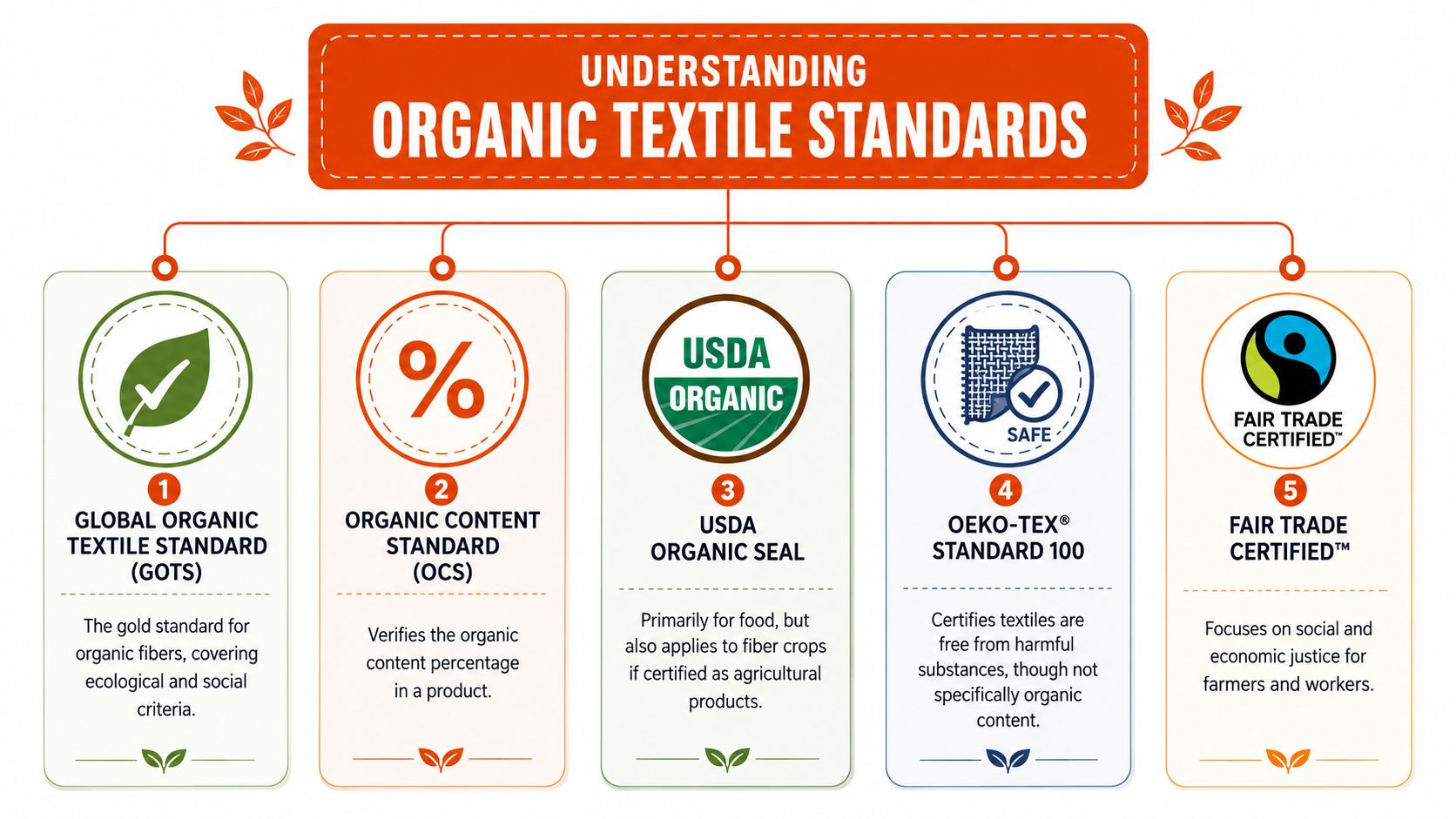
Under GOTS, a textile product can carry the “organic” label grade only if it contains at least 95% certified organic fibers, while “made with organic” requires at least 70%, as set out in GOTS key features for organic fibres. The remaining portion is also controlled under the standard.
That distinction matters more than most merch briefs acknowledge. A product labeled “organic” is not the same thing as a product that contains some organic content. Those are different claims with different thresholds.
GOTS also matters because it goes beyond cultivation. It covers the textile supply chain from raw material harvesting through manufacturing, packaging, and labeling. If you're approving apparel, that's the difference between a farm-level story and a finished-garment standard.
To make the standards easier to visualize, this explainer is worth a quick watch:
What other labels do and don't mean
Not every certification answers the same question.
- USDA Organic or EU Organic: These mainly speak to cultivation criteria. They tell you the cotton was grown under organic agricultural rules.
- GOTS: This is broader. It covers the textile chain and sets rules on processing inputs, environmental criteria, and minimum social conditions.
- OEKO-TEX Standard 100: Useful, but different. It addresses harmful substances in finished textiles, not whether the cotton is organic.
- Fair Trade Certified: Primarily social and economic in focus, not the same as an organic fiber claim.
A related distinction from Organics Europe's position on organic textiles is worth knowing. A product can only claim to be organic textiles, rather than merely containing organic fibres, if it contains at least 70% organic fibres and is processed according to a recognized standard such as GOTS.
If a supplier says “organic cotton” but can't explain whether the claim applies to the fiber, the fabric, or the finished garment, assume the story is incomplete.
The sourcing takeaway
If you only remember one thing, remember this. Certification scope matters more than the adjective on the hangtag. “Organic” without chain-of-custody clarity is just copy.
When buyers get this wrong, they usually overpay for a story they can't defend.
Environmental and Social Impact
Organic cotton has real environmental value. It also creates one of the most common sourcing mistakes in merch. Teams assume environmental claims and labor claims are bundled together. They aren't.
Organic is environmental, not automatically ethical
One of the most important distinctions in cotton sourcing is that “organic” and “ethical” are separate certification ideas. Organic certification focuses on environmental standards like reduced chemical use and soil health. Ethical certification focuses on labor conditions such as wages and worker safety. As Transparentem's analysis of organic and ethical cotton makes clear, organic cotton can still be produced with unethical labor if it isn't also covered by a standard such as Fairtrade.
That sounds obvious once you say it plainly. In practice, a lot of buyers still miss it.
If your campaign says the merch reflects your team's values, you need to know whether you're talking about environmental inputs, social conditions, or both. Those are not interchangeable claims.
What this means for brand risk
This is how greenwashing creeps in. A supplier shows an organic claim, everyone feels good, and nobody asks about who cut, dyed, sewed, or packed the garment. Then marketing copies “ethical” into the launch deck as if the word came included.
It didn't.
Organic cotton can improve the environmental side of a product story. It does not automatically clean up the human side of the supply chain.
For teams that want a concrete consumer example outside apparel merch, bedding is a good category to study because labels get tested hard there. This guide to verified organic sheets for your home is useful because it shows how certification language gets applied to a finished product rather than just a raw fiber claim.
A broader sustainability conversation also helps, especially if you're building event kits or onboarding boxes and not just tees. This roundup of environmentally friendly promotional items is a practical companion because fiber choice is only one part of the footprint and perception equation.
A better standard for internal approvals
When I look at organic cotton for premium merch, I separate the decision into two approval tracks:
- Environmental track: Was the fiber grown under organic rules, and is that claim documented?
- Social track: What standard covers labor, safety, and supply-chain conditions beyond the field?
If a vendor can only answer the first question, don't let your team imply the second.
Fabric Performance Care and Quality
Many pieces of “organic cotton” content go wrong by blurring sustainability with fabric performance, then acting surprised when people think organic automatically means softer, heavier, more durable, or more premium.
It doesn't.
Why the softest tee isn't decided by the farm
The cleanest correction comes from Ecolife's explanation of organic cotton fabric. The myth that organic cotton is naturally softer or more durable is incorrect. The finished product's physical properties come from processing and finishing, not from the organic status of the raw fiber.
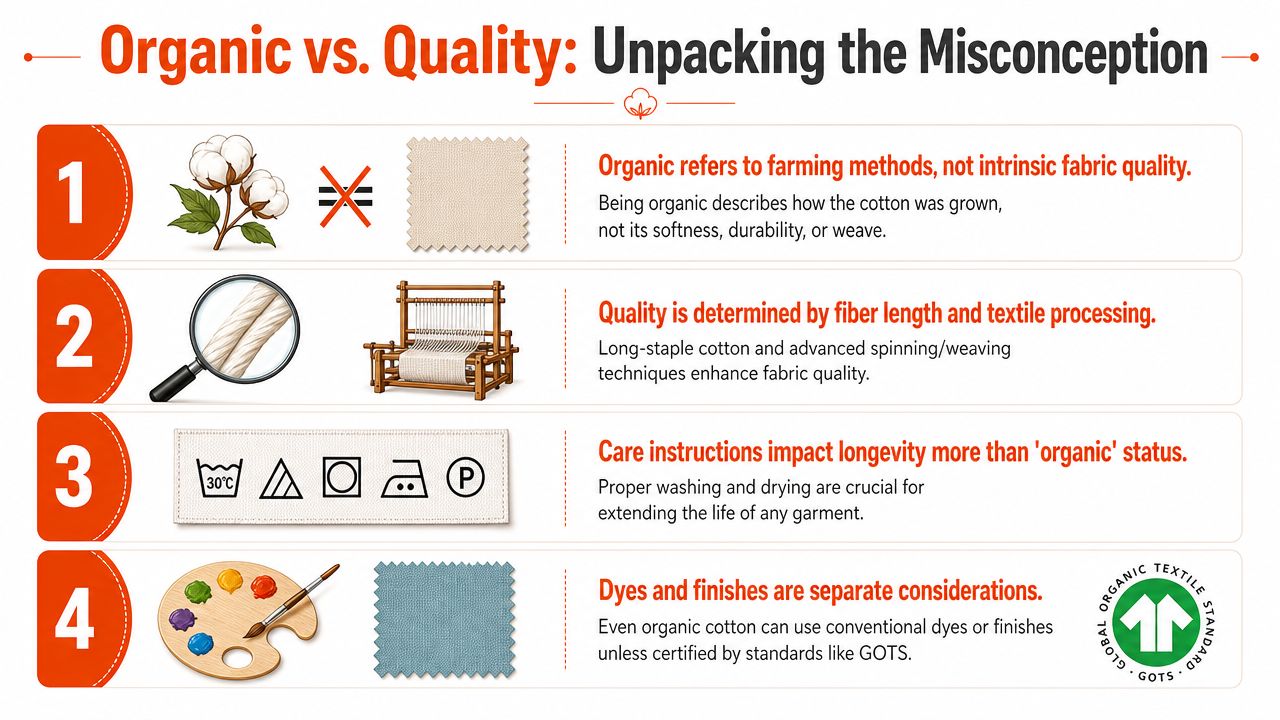
That lines up with how product development works. Fabric handfeel comes from staple quality, yarn spinning, knit or weave structure, finishing chemistry, washing, compacting, and pattern execution. A well-developed conventional tee can feel better than a weak organic tee. A strong organic tee can feel amazing. The organic claim alone doesn't settle it.
If you're comparing blanks, learn the basics of GSM fabric weight. A lightweight combed jersey and a heavyweight French terry tell very different stories, even when both are cotton.
The details that actually affect quality
Here's what I'd check before caring about the marketing adjective:
- Fiber and yarn quality: Long, consistent fibers and competent spinning usually matter more than the headline claim.
- Fabric construction: Jersey, interlock, fleece, and terry all wear differently.
- Finishing: Washes, peaching, brushing, compacting, and dye quality decide a lot of the final feel.
- Garment pattern: Shoulder shape, cuff recovery, body width, and hood structure separate premium merch from giveaway merch.
A premium result comes from the full stack. Fiber choice matters, but it's only one layer of the stack.
How to keep cotton merch looking good
Care matters more than people think, especially once you've paid for better blanks and nicer finishing.
- Wash cold: It's easier on color and helps reduce unnecessary stress on the fabric.
- Skip aggressive drying: High heat can rough up the feel and shorten the life of prints and trims.
- Store folded or well-hung: Heavy hoodies lose shape when they're treated badly.
- Follow the label: Cotton can age beautifully if people don't treat it like a disposable promo tee.
If the garment is good, care keeps it good. If the garment is bad, no fiber story will save it.
How to Verify Organic Claims for Your Merch
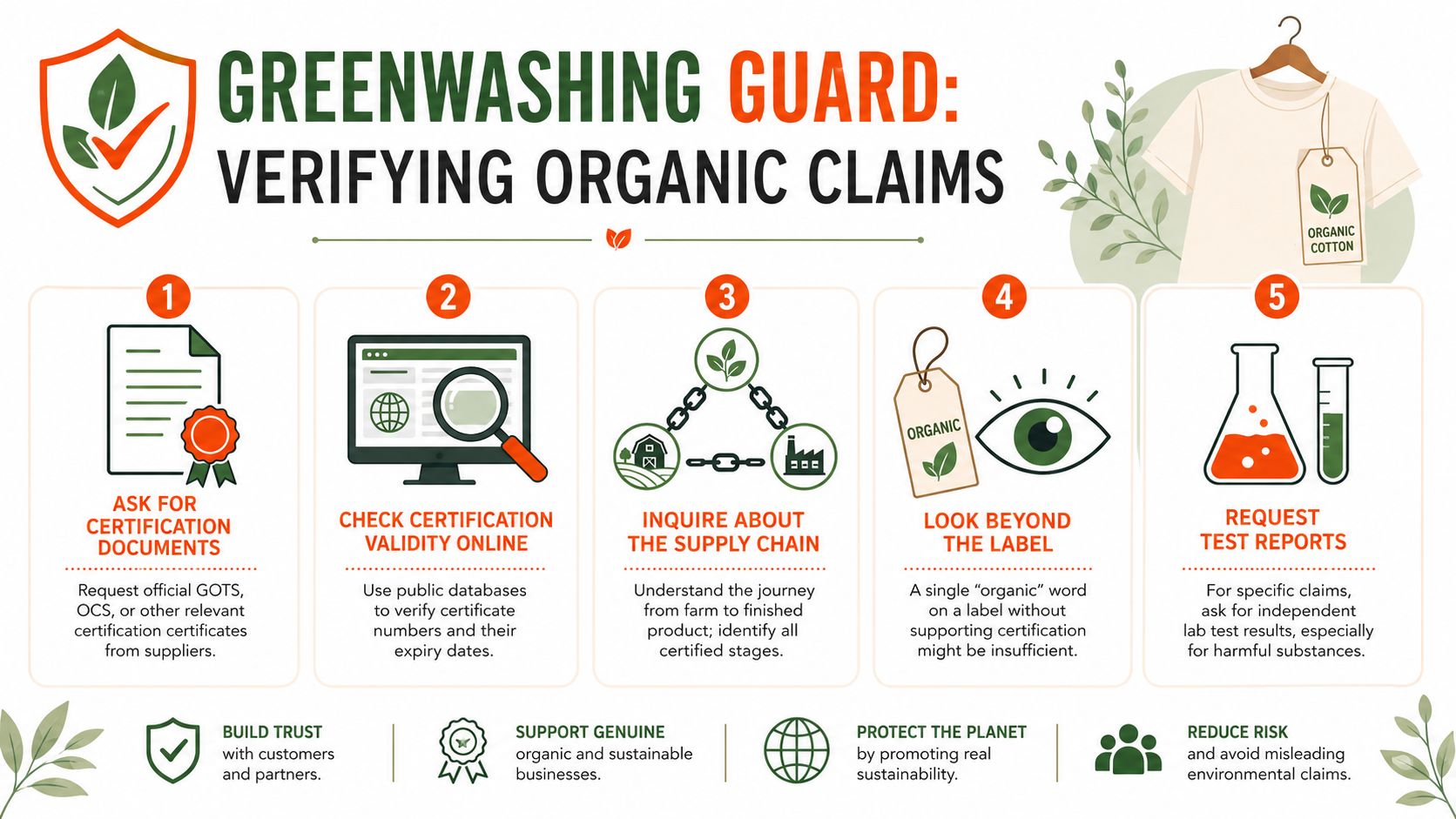
Most greenwashing survives because buyers don't ask for documents. They accept words like “eco,” “conscious,” “organic blend,” or “sustainably sourced” and move on.
That's how teams end up with soft claims and hard problems.
The supplier checklist that matters
If you're buying organic cotton merch, ask for proof in a format you can verify.
Ask for the certificate first
Don't settle for a moodboard or product card. Ask which certification applies to the product and whether it covers fiber only or the finished textile.Check what claim is being made
“Organic,” “made with organic,” and “contains organic fibers” do not mean the same thing. The exact wording matters.Map the chain of custody
Who handled the cotton at each stage. Farm, spinner, knitter or weaver, dyer, garment factory. If the supplier can't explain the path, the claim gets shaky fast.Ask about the specific product, not just the factory
A factory may have certified programs without every SKU being certified.
For teams considering a more custom route, it also helps to understand cut and sew apparel. The more bespoke the product, the more important documentation becomes because you're not hiding behind a stock blank with a familiar retail label.
Red flags that usually mean greenwashing
A few patterns show up again and again.
- Vague wording: “Eco cotton,” “responsible cotton,” and similar phrases can mean almost anything.
- No document trail: If a supplier says certification exists but won't share details, that's a problem.
- One good claim doing too much work: Organic fiber doesn't automatically prove non-toxic processing, ethical labor, or premium build quality.
- Overdesigned storytelling: If the pitch deck has more leaf icons than technical answers, slow down.
Ask for paperwork before you ask for Pantones. Verification should happen early, not after the sample gets approved.
The teams that avoid sourcing headaches aren't always the most technical. They're just disciplined enough to separate branding language from certifiable claims.
FAQ Before You Order Organic Cotton Merch
Is organic cotton merch always more expensive
Usually, yes. You're often paying for stricter farming standards, certification overhead, and a narrower supplier pool. That doesn't automatically mean the garment will feel better.
Will organic cotton feel different from a regular cotton tee
Not necessarily. The handfeel depends on yarn, knit, finishing, and wash treatment. Organic status alone doesn't decide softness.
Are color options more limited
Sometimes. This depends on the standard, the dyehouse, and the garment program. Good suppliers can still offer a strong palette, but you should confirm early if exact brand colors matter.
Is organic cotton enough if our brand also cares about ethics
No. Organic and ethical are separate claims. If labor conditions matter to your team, ask for the relevant social standard too.
Should we use blanks or build custom
That depends on volume, timeline, and how specific your fit and finish need to be. If you're weighing print-first options, this guide to custom shirt printing helps clarify where blanks make sense and where a more developed product route is smarter.
If you want organic cotton merch that holds up on fabric, fit, and sourcing clarity, Banger helps internet-native teams build custom merch people want to keep wearing. You can request a quote, get product previews within 24h, and launch a team drop with premium blanks, French ateliers, low minimums, and worldwide fulfillment.