How to Choose and Customize a Blank Dad Cap
Your team orders a batch of caps for the next conference. The logo looks clean in the mockup, the quantity seems reasonable, and everyone approves the color. Six months later, the front panel has puckered, the crown feels too shallow, and most of the caps are sitting in drawers because they look like promotional leftovers.
That failure usually starts before decoration. A blank dad cap can become a reliable wardrobe staple, but only when the blank, fit, artwork, sampling process, and fulfillment plan work together. The silhouette is forgiving. Production mistakes aren't.
Table of Contents
Why a Blank Dad Cap Is the Smartest Piece of Merch You Can Order
Most merch fails because it asks people to wear a brand before it gives them a reason to wear the product. A stiff cap with a loud logo feels like an event freebie. A soft, low-profile dad cap with thoughtful decoration feels like something someone grabbed on the way out the door.
That distinction matters for team onboarding kits, conference giveaways, community drops, creator merch, and corporate gifts. A cap doesn't require the wearer to commit to a full outfit, it works across seasons, and the relaxed silhouette suits people who would never wear a heavily branded hoodie or oversized tee.
A baseball cap is already a large global apparel category. One 2026 market report estimates the broader market at USD 22.34 billion in 2026, with a projection of USD 43.11 billion by 2035 and a long-run CAGR of 7.58%. Another report values it at USD 19.0 billion in 2024 and projects USD 35.0 billion by 2034, with a 6.3% CAGR. These are category-level figures, not blank dad-cap sales, but they show why undecorated caps remain a serious sourcing category rather than a niche accessory. Business Research Insights tracks the global baseball cap market.
The wearability calculation
A hoodie can be too warm. A tee can be too basic. A tote can become a laptop bag, or it can disappear under a desk. A cap sits in a different part of the wardrobe. It adds identity without requiring a complete style decision.
The dad cap's history helps explain that range. Fashion historians describe baggier caps made from linen, cotton poplin, tweed, herringbone wool, and corduroy by the 1920s, while the flat cap had already moved into wealthy American and British wardrobes without losing its working-class associations. This history of 1920s men's hats places the relaxed cap aesthetic in practical everyday wear, not in a short-lived trend cycle.
For a marketing team, the takeaway is simple:
- Choose a cap when repeat wear matters: The product should fit naturally into commutes, dog walks, travel days, and off-hours.
- Keep the branding restrained: A small embroidered mark often gives the wearer more permission to use it regularly.
- Plan the assortment visually: A seasonal assortment display tool can help your team review colors, decoration variants, and packaging as one collection instead of approving isolated product mockups.
- Compare the full merch mix: Use Banger's guide to the best swag ideas when the cap needs to sit inside a broader team or community drop.
The smart blank dad cap isn't the cheapest cap on a spreadsheet. It's the one that survives repeated wear, looks intentional without decoration, and gives the wearer a reason to keep reaching for it.
Anatomy of a Premium Blank Dad Cap
Before you approve a sample, read the spec sheet. “Dad cap” describes a silhouette, not a complete product specification. Two caps can share the same low-profile look and feel completely different on the head.
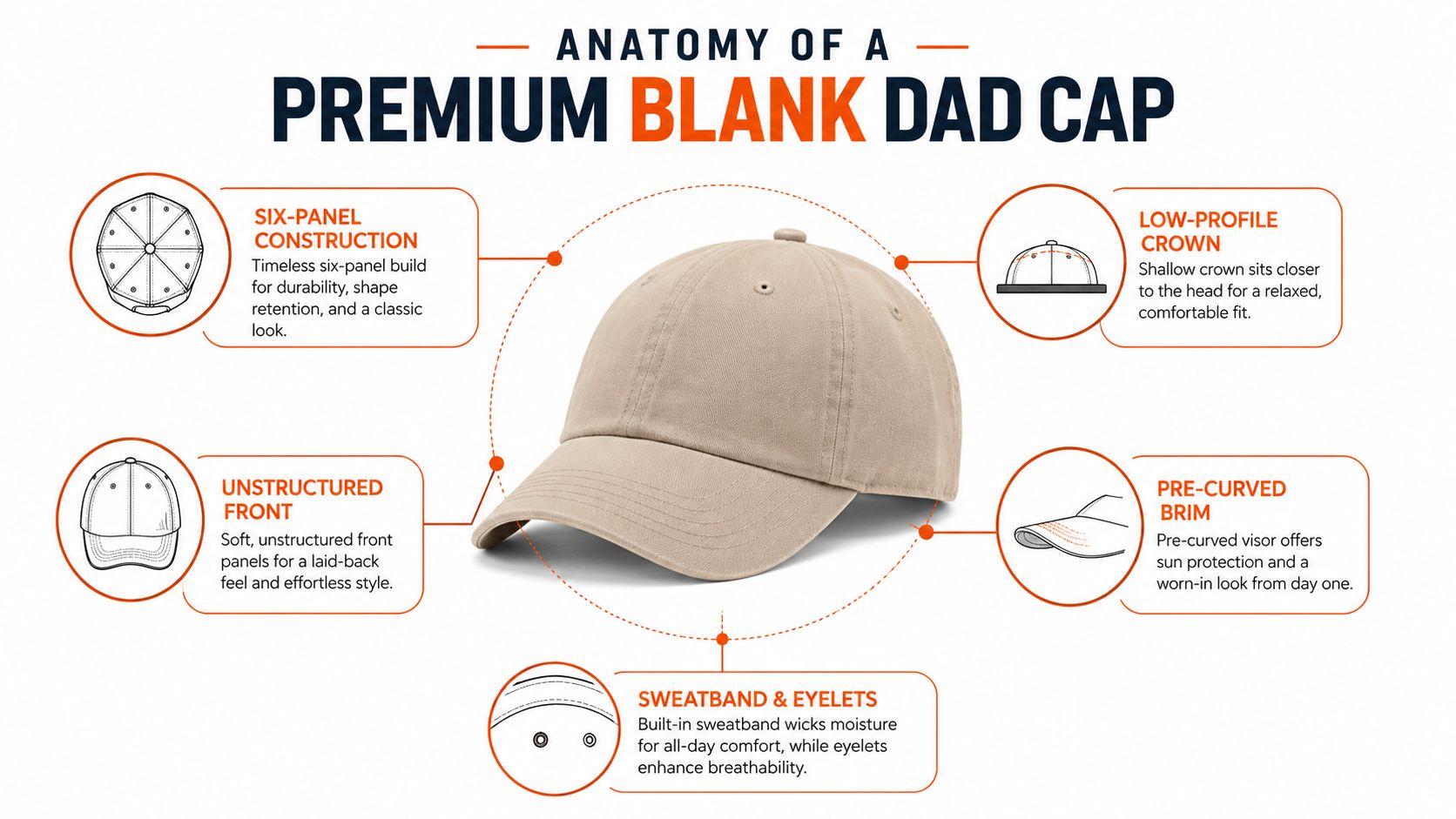
A canonical blank dad cap is usually six-panel, low-profile, unstructured, and adjustable. One documented model uses 100% cotton chino twill, a 3 1/8-inch crown, a Permacurv visor, and a buckle closure with grommet. That combination gives buyers a useful baseline for comparing blanks. The Yupoong 6245CM specification sheet shows the kind of construction detail a production team should request before ordering.
What each component does
- Six-panel construction: Six fabric sections create the rounded crown and place seams where the cap can conform to the head. The center front seam matters because detailed decoration can distort or lose clarity there.
- Low-profile crown: The crown sits close to the head rather than standing upright. A crown that's too shallow can create pressure at the temples and make larger heads feel cramped, even when the circumference seems acceptable.
- Unstructured front: The front panels don't use the internal buckram that stiffens structured caps. That softness creates the relaxed shape associated with a dad cap. It isn't a defect to correct.
- Pre-curved visor: A curved brim supports the casual profile and avoids the rigid, flat appearance of some athletic or streetwear caps.
- Adjustable buckle strap: A fabric strap, metal buckle, and grommet give the wearer more control than a fitted construction. This is the canonical strapback setup described in this dad-cap construction guide.
Spec the fit, not just the circumference
Measure head circumference just above the eyebrows and ears, then compare the result with the supplier's size information. Industry charts place many adult fitted-cap wearers around 21 5/8 to 22 1/4 inches, while adjustable caps are often expected to cover up to approximately size 7 5/8. Those figures come from the documented cap specification guidance, so use them as a starting point, not as permission to skip a physical sample.
Don't approve a crown based only on a flat product image. Put the cap on several people, check the temple pressure, inspect how the front panels collapse, and see whether the strap leaves a clean tail rather than an awkward bundle. A useful caps size chart belongs in the approval packet alongside the artwork proof.
The premium version feels soft without feeling flimsy. It keeps the low-profile identity without turning shallow, tight, or shapeless.
Picking the Right Fabric, Structure, and Closure
Fabric determines the first impression. Construction determines whether that impression survives regular use.
Brushed canvas tends to feel substantial and can support a more durable, workwear-leaning identity. Cotton chino twill is the safe production baseline because it balances a clean surface, familiar hand feel, and straightforward embroidery. Garment-washed cotton gives you a softer, already-lived-in look, but the finish can make color matching and consistency more sensitive. Lightweight breathable builds make sense for outdoor events and warm climates, though lighter unstructured caps can lose their shape sooner when worn hard.
Don't choose fabric from sustainability language alone. Material responsibility matters, but the best blank for repeated customization is the one whose hand feel, weight, breathability, and shape retention match the use case. Banger's explainer on organic cotton fabric is useful when your sourcing brief includes material standards, but it shouldn't replace a physical review of the actual blank.
Compare the configurations
| Configuration | Best For | Trade-Off |
|---|---|---|
| Brushed canvas, unstructured | Premium corporate gifts, lifestyle capsules, workwear-inspired drops | More substantial feel can be less breathable |
| Garment-washed cotton twill, unstructured | Creator merch, community drops, everyday team wear | Softer finish may show color variation and wear character |
| Lightweight cotton or breathable build, unstructured | Outdoor events, summer programs, travel kits | Can stretch or lose definition faster with frequent use |
| Structured cotton front | Logos that need a rigid presentation | Loses the relaxed dad-cap profile and can feel less natural |
| Strapback with metal buckle | Distributed teams and mixed adult sizing | Strap tails need clean finishing and careful adjustment |
| Snapback | Streetwear-led drops and quick size adjustment | More graphic and sporty, less understated |
| Fitted construction | Controlled sizing programs and uniform looks | Requires more size planning and creates more inventory risk |
Use the silhouette as a filter
For a five-person team, choose the blank that minimizes sizing friction and feels good immediately. For a large community drop, prioritize consistent color availability, repeatability, and a decoration method that handles the chosen quantity. For premium gifting, spend the budget on fabric hand feel, trim quality, packaging, and a decoration treatment that looks considered from every angle.
A rigid front panel or oversized crown can make the cap look like a standard promotional baseball cap. If the brief says “dad cap,” keep the front soft and the crown close to the head. The product should look relaxed before the logo says anything.
Decoration Methods That Actually Last on a Cap
Decoration is where a good blank either becomes a brand asset or gets ruined.
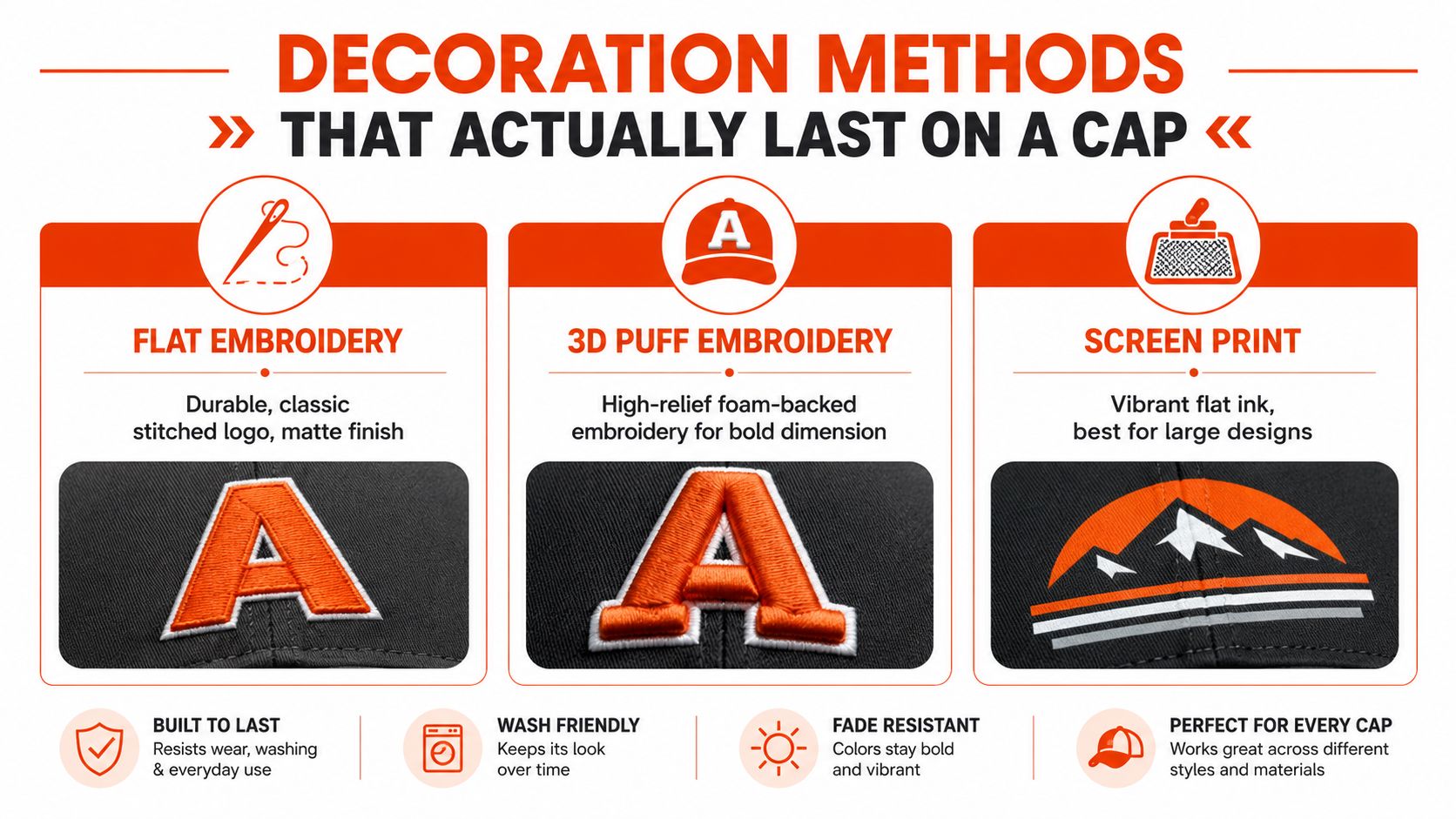
Flat embroidery is the default for a reason. It creates a durable stitched mark with a classic matte finish, and it works especially well for short wordmarks, symbols, and compact logos. The production team still needs clean digitization. Tiny lettering, crowded outlines, and artwork placed directly across the center seam can turn a sharp mark into a tangled one.
3D puff embroidery adds height and visual punch. It suits bold, simple graphics with enough scale to support the foam-backed relief. It isn't the right answer for fine type, intricate symbols, or a brand that wants quiet minimalism.
Match the process to the artwork
- Flat embroidery: Choose it for compact logos, monograms, and understated team marks. It holds up well when the stitch density and backing suit the fabric.
- 3D puff embroidery: Use it for bold, graphic branding where dimensionality is part of the point. Keep the artwork simple and avoid tiny details.
- Chenille patches: Pick them for a collegiate, nostalgic, or tactile look. They add texture and can carry shapes that would be awkward to sew directly.
- Screen printing: Use it for larger flat graphics and vibrant ink. Curved surfaces need careful placement, and oversized artwork can look distorted when the cap is worn.
- DTG and DTF: These methods can handle detailed artwork, but they need a supplier to confirm compatibility with the specific cap fabric and curved application. Don't assume a process that works on a tee will behave identically on a cap.
- Leather or woven patches: Choose these for a premium, badge-like finish. A small woven label on the back strap can outperform a large front graphic when the brand wants recognition without turning the cap into an advertisement.
Approve the sew-out, not just the mockup
A mockup won't show puckering, seam interference, thread shine, or how the cap collapses around the decoration. Ask for an actual sew-out and inspect it on the blank. Unstructured caps can shift during sewing, so backing, hooping, and stabilization are production variables, not minor technicalities. Guidance on selecting the right stabilizer type can help your team ask better questions of the decorator.
For a deeper review of logo placement and stitch options, use Banger's guide to custom logo embroidery.
See how cap decoration behaves in production before you sign off on a bulk run:
Six months of wear is the test. A clean, appropriately sized embroidery or patch will age into the cap. A dense, oversized design will emphasize every crease and make the product feel promotional.
MOQ, Sampling, and Timelines as One Decision
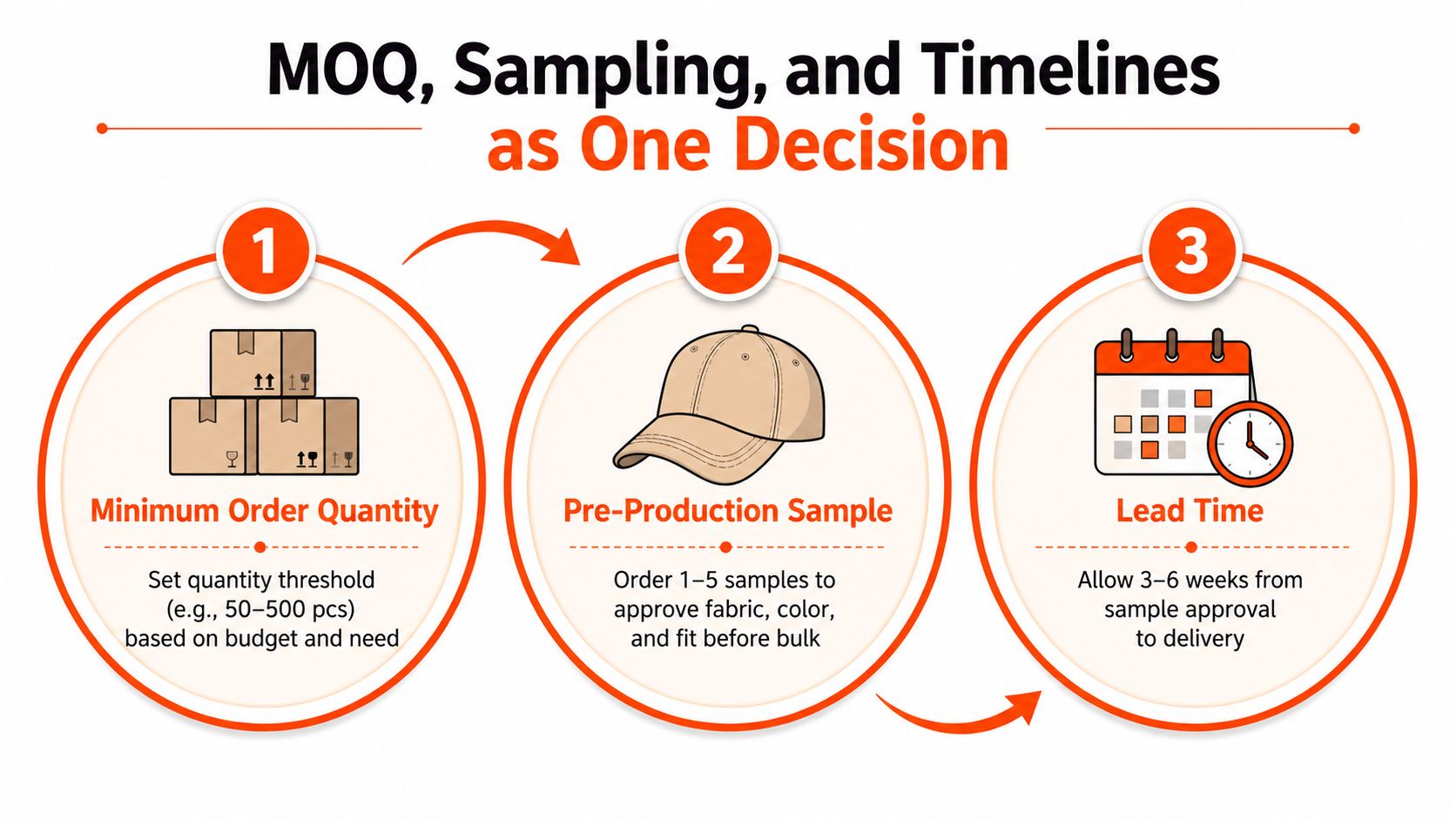
MOQ, sample approval, and lead time aren't separate boxes on a project plan. They form one production decision.
A low MOQ makes experimentation possible, but a fast timeline makes sampling essential. If the quantity is small enough to test but the approval window is too short, the team still takes unnecessary risk. If the lead time is generous but the MOQ forces a warehouse-sized commitment, the project can fail financially before production starts.
Banger's model starts at one unit per item on most products, with a 10-unit minimum per apparel order and around 50 units for cut and sew. Its stated workflow offers a free quote with product preview in 24 hours, followed by production and worldwide delivery in 10 to 15 business days end to end. Those are Banger-specific operating details from the supplied company information, so confirm the current scope and timing against your quote.
Make the approval loop explicit
- Set the quantity against the use case. A team drop, event handout, and public community release shouldn't share the same inventory logic. Estimate who will receive the cap, who will wear it, and whether a reorder is more sensible than a large first commitment.
- Sample the physical product. Check crown depth, circumference, buckle quality, visor curve, color, sweatband comfort, and decoration placement. Photograph the sample on multiple heads, not just on a table.
- Build in an approval buffer. Your calendar needs time for artwork corrections, blank substitutions, color review, and shipping. A quote is not a delivery date until the blank and decoration are approved.
Production rule: A sample answers questions that a digital mockup can't. Never use a low MOQ as an excuse to skip the physical approval.
The custom apparel no-minimum guide can help your team frame small-batch testing, but every cap order still needs a confirmed quantity, decoration method, and delivery destination before production timing means anything.
Ordering, Packaging, and Worldwide Fulfillment
The final product isn't just the cap. It's the moment someone receives it, opens it, adjusts the strap, and decides whether it belongs in their regular rotation.
Start with the blank model and color. Upload the logo, specify the intended decoration, and request a quote that includes the product preview. Review the e-proof against the physical blank, then ask for real atelier photos before approving the production run. That sequence catches the problems that polished digital artwork hides.
Treat the unboxing as part of the garment
A cap handed over loose at a booth reads like a giveaway. A cap packed with intention can feel like a gift.
Useful finishing details include:
- Branded mailer boxes: Protect the cap and make the first interaction feel deliberate.
- Tissue and stickers: Add low-cost visual cues without covering the product in branding.
- Hang tags: Explain the brand, collection, or community context without forcing a large front logo.
- Inserts: Give recipients care guidance, a launch message, or a path back to the brand.
- Multi-address routing: Send caps to offices, remote employees, creators, customers, or event venues from one coordinated order.
If your team needs custom dimensions, printed inserts, or a complete unboxing system, research bespoke packaging solutions early. Packaging choices can affect packing requirements, shipping volume, and the final delivery schedule.
Plan for distributed teams
For global teams, confirm whether duties are included, how destinations are grouped, and whether one order can ship to multiple recipients. Banger's stated fulfillment options include worldwide delivery, DDP shipping to the US, UK, Canada, Australia, Switzerland, and Norway, plus stablecoin and fiat payment routes. Those operational details belong in the quote, not in an assumption made after artwork approval.
Repeat drops also benefit from keeping the approved blank, thread colors, decoration files, and packaging specifications together. Reorders of previously approved designs are listed as shipping in 5 to 7 days, subject to confirmation for the specific project. A clean production record is what turns a one-off cap into a repeatable merch program.
A Practical Checklist Before You Order Your Caps
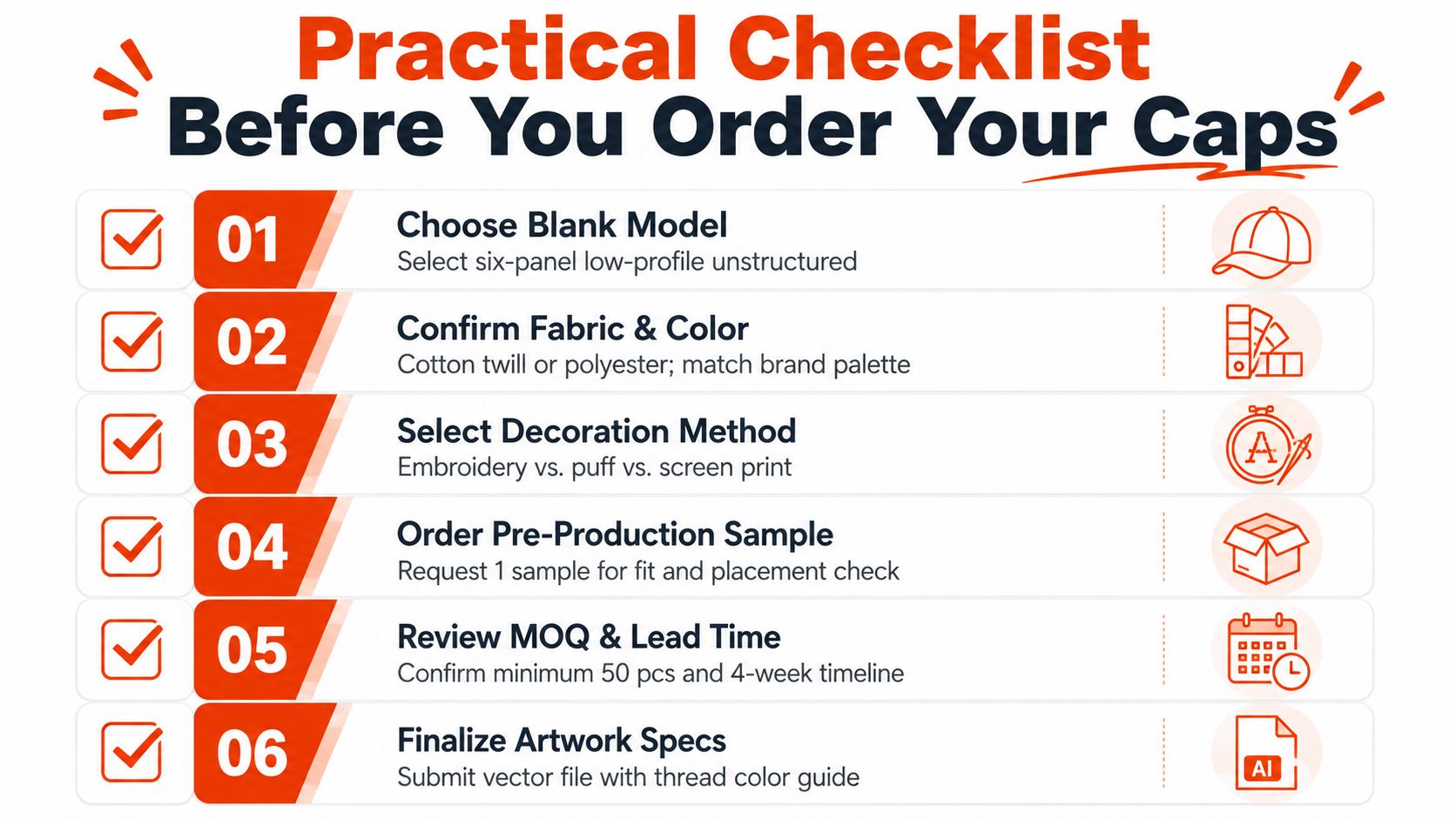
Hand this checklist to the person who owns the order. If they can't answer each point, the project isn't ready for bulk approval.
- Choose the blank model: Confirm six-panel construction, low-profile crown, unstructured front panels, visor shape, and closure type.
- Confirm fabric and color: Decide between brushed canvas, cotton twill, garment-washed cotton, or a lightweight breathable build. Approve the actual swatch or sample, not a screen color.
- Check fit range: Measure head circumference above the eyebrows and ears. Test the crown depth and strap adjustment on more than one wearer.
- Select decoration: Match flat embroidery, 3D puff, patches, screen printing, DTG, or DTF to the artwork's scale, detail, and intended feel.
- Approve the physical sample: Inspect puckering, center-seam interference, thread density, patch edges, visor curve, and strap finishing.
- Lock the order math: Confirm quantity, MOQ, reorder logic, shipping addresses, packaging, and the date the caps need to arrive.
- Finalize artwork: Supply clean vector artwork, thread or ink color references, placement dimensions, and any requirements for back-strap labels or hang tags.
- Document the approved version: Save the blank specification, decoration method, sample photos, and packaging notes for future reorders.
The strongest cap programs make one decision at a time, in the right order. Choose the fit first, test the material, simplify the decoration, approve the sample, then let quantity and fulfillment follow the actual use case.
Banger sources premium European blanks, customizes caps through French production ateliers, and supports low-minimum team drops, packaging, and worldwide fulfillment. Visit Banger to request a product preview and build a blank dad cap your team will still want to wear months after launch.