Gift for Computer Programmer: Top 2026 Picks
The most popular advice for a gift for computer programmer is usually wrong. Buy a mug with a coding joke, add a mechanical keyboard, and call it done. That approach ignores the only question that matters: will this person use it every day?
Programmers already have desks full of objects that looked clever for five minutes. The durable gifts improve a real workflow, fit the recipient's habits, or give a team something with enough identity to earn repeat wear. This guide separates those use cases by relationship, budget, and product type, then shows when custom merch makes more sense than another one-off gadget.
Table of Contents
- Should I ask the programmer first?
- What design works on engineering apparel?
- How early should I order?
- How do I handle sizing across multiple addresses?
Most Programmer Gifts Miss the Point
A coffee mug with a programming pun is the lazy default. It's easy to buy, easy to wrap, and easy to forget. Programmers already own mugs, and the joke usually loses its shine long before the cup does.
The category has history. Stack Overflow's programmer gift guide used a tongue-in-cheek claim that programmers account for at least 128KiB of global coffee consumption, while clearly presenting it as a joke rather than a real estimate. The line worked because coffee, desk objects, and long hours at a computer are familiar parts of programming culture. By 2025, Walmart's programmer-gifts page listed 402 products, while Etsy pages for programmer mugs and software engineer gifts promoted 60+ ideas, with many examples priced roughly between $17 and $34. Those figures come from the same historical category, but the category has expanded beyond novelty.
The problem isn't that mugs are always bad. A well-designed mug can work when it matches someone's taste, team identity, or daily ritual. The problem is buying one because the recipient is a programmer, without knowing anything else about them.
The real test: if the joke disappeared, would the object still earn a place on the desk?
That standard applies whether you're buying for a partner, a peer, or an entire engineering team. A partner gift should show personal knowledge. A peer gift should solve a small annoyance without creating setup work. A team gift should create belonging without looking like conference leftovers.
Fit beats novelty
Use three filters before you buy:
- Daily utility: Does it improve typing, focus, storage, organization, comfort, or commuting?
- Personal fit: Does it match the person's layout preferences, listening habits, desk size, or wardrobe?
- Identity signal: Does it feel like something they'd choose, not something a marketer printed in bulk?
That's the same logic behind better swag ideas for modern teams. Good merch carries culture, but it still has to function as clothing, equipment, or an object someone wants nearby.
A useful gift doesn't need to be expensive. It needs to remove friction or express recognition with more precision than a generic “I saw this and thought of programmers” purchase. For one person, that might mean a keyboard with the right layout. For a team, it might mean a heavyweight hoodie with a subtle mark and excellent fit.
The Four Categories Programmers Actually Care About
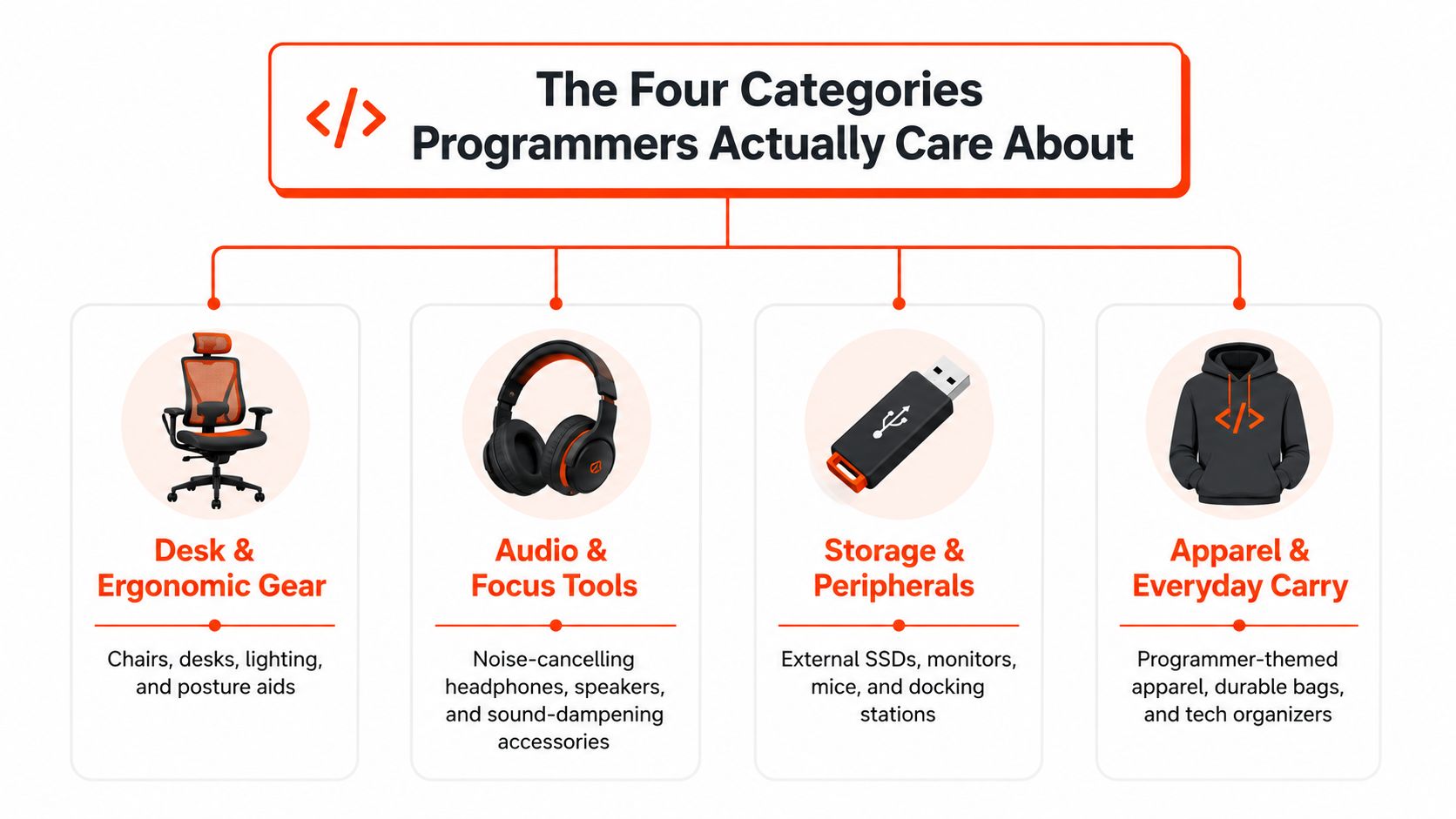
Start with the recipient's workflow, not a product list. Most useful gifts fall into four categories, and each has a different failure mode.
Desk and ergonomic gear
This is the highest-utility category for someone who codes for long stretches. A mechanical keyboard, vertical mouse, monitor arm, screen-bar light, footrest, or supportive desk accessory can earn daily use.
The buying criteria are practical. Keyboards depend on switch feel and layout. Chairs and desk accessories depend on body fit and workspace constraints. A good choice for a small desk can be a poor choice for someone with room for a full workstation.
Audio and focus tools
Noise-canceling headphones, compact speakers, and sound-dampening accessories make sense for people who work in shared spaces or switch between deep work and calls. Don't choose based on the logo alone. Weight, clamping force, ear-pad comfort, microphone quality, and multipoint connectivity matter more than a product's internet reputation.
A recipient who already has excellent headphones may prefer a desk speaker or a simple headphone stand. The safe move is to observe their environment before buying.
Storage and peripherals
External SSDs, monitors, mice, docking stations, USB hubs, and cable organizers improve the edges of a workflow. An external SSD is useful for local backups, project archives, media, and portable work. A monitor or dock can be valuable, but compatibility matters, especially across Mac, Windows, and Linux setups.
Practical gift guides often prove more useful than novelty lists. A tech swag guide for engineering teams can help you think beyond logos and toward objects that belong in a real setup.
Apparel and everyday carry
Programmer-themed apparel works when the design is restrained and the garment is good. Look for fabric weight, stitching, print or embroidery quality, wash durability, and a silhouette the recipient would wear without the reference.
A durable backpack, tech organizer, notebook, cap, or hoodie can travel between home, office, coworking space, and conference floor. Brand fit matters here: a fintech team may want a polished capsule, while an open-source community may prefer a clever mark that members recognize without a giant front print.
Safe rule: choose the category first, then inspect the product's fit, compatibility, and repeat-use potential.
Mechanical Keyboards Without the Guesswork
A mechanical keyboard is one of the most defensible gifts for a programmer, but it's also one of the easiest to get wrong. The board sits at the center of the workday, so layout, sound, switch feel, and firmware all matter.
Research on keyboard design found that alternative layouts can initially reduce productivity, while users generally recover after a short adaptation period. The ergonomic upside is reduced fatigue and better comfort during long typing sessions, as documented in the keyboard layout study indexed by PubMed. That makes the gift reasonable, but it doesn't make every layout universally appropriate.
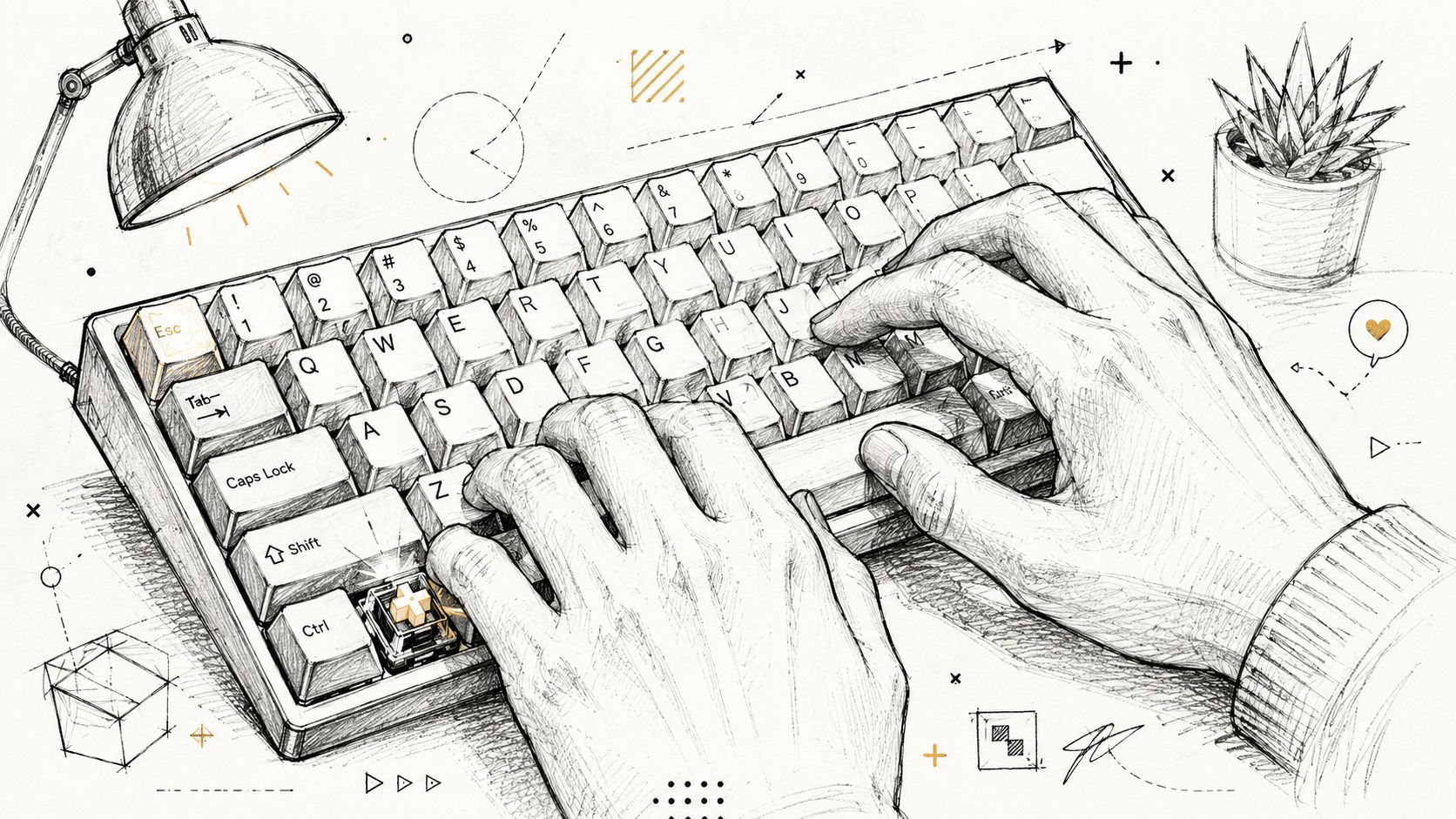
Choose the layout before the brand
- 60%: Compact and clean, but it removes dedicated arrow and navigation keys. Buy it only when you know the recipient likes layers and shortcuts.
- 65%: Keeps arrow keys in a compact footprint. It's a strong choice for someone who values desk space but still uses navigation keys.
- 75%: Adds a function row while staying efficient. This is the safest general recommendation for a first mechanical board.
- TKL: Keeps the familiar navigation cluster and function row without a number pad. It suits programmers who want a conventional layout with more mouse room.
- Split ergonomic: Designed around wrist position and fatigue reduction. It's a serious gift for someone who already mentions wrist strain, but it has the steepest personal-fit risk.
Research comparing keyboard types reported improvements in typing speed and accuracy alongside reduced wrist and hand discomfort, while split and inclined designs have been studied for reducing fatigue and musculoskeletal discomfort among keyboard operators. The ergonomic keyboard research supports choosing according to the recipient's workflow, not the board's visual appeal.
Switches and firmware decide the experience
Linear switches feel smooth. Tactile switches provide a bump during the keystroke. Clicky switches add an audible click that can annoy housemates and coworkers. For a first-time recipient, tactile is the safest starting point because it offers feedback without committing to a loud typing profile.
Look for QMK or ZMK support, hot-swappable switches, and repairable construction. Open firmware lets the recipient remap keys, create layers, and configure shortcuts. Hot-swap sockets make switch changes possible without soldering, while a documented screw-mounted PCB makes repairs and modifications less intimidating. Those criteria are covered in developer keyboard buying guidance.
If you know nothing about the recipient's preferences, buy a 65% or 75% board with tactile, hot-swappable switches and programmable firmware. Avoid an unusual split layout unless they've already expressed interest.
Matching the Budget to the Moment
Budget should match the relationship and occasion. A casual peer gift carries a different signal than a partner's milestone present or a company-funded onboarding kit. Choose for daily use first, then add personality.
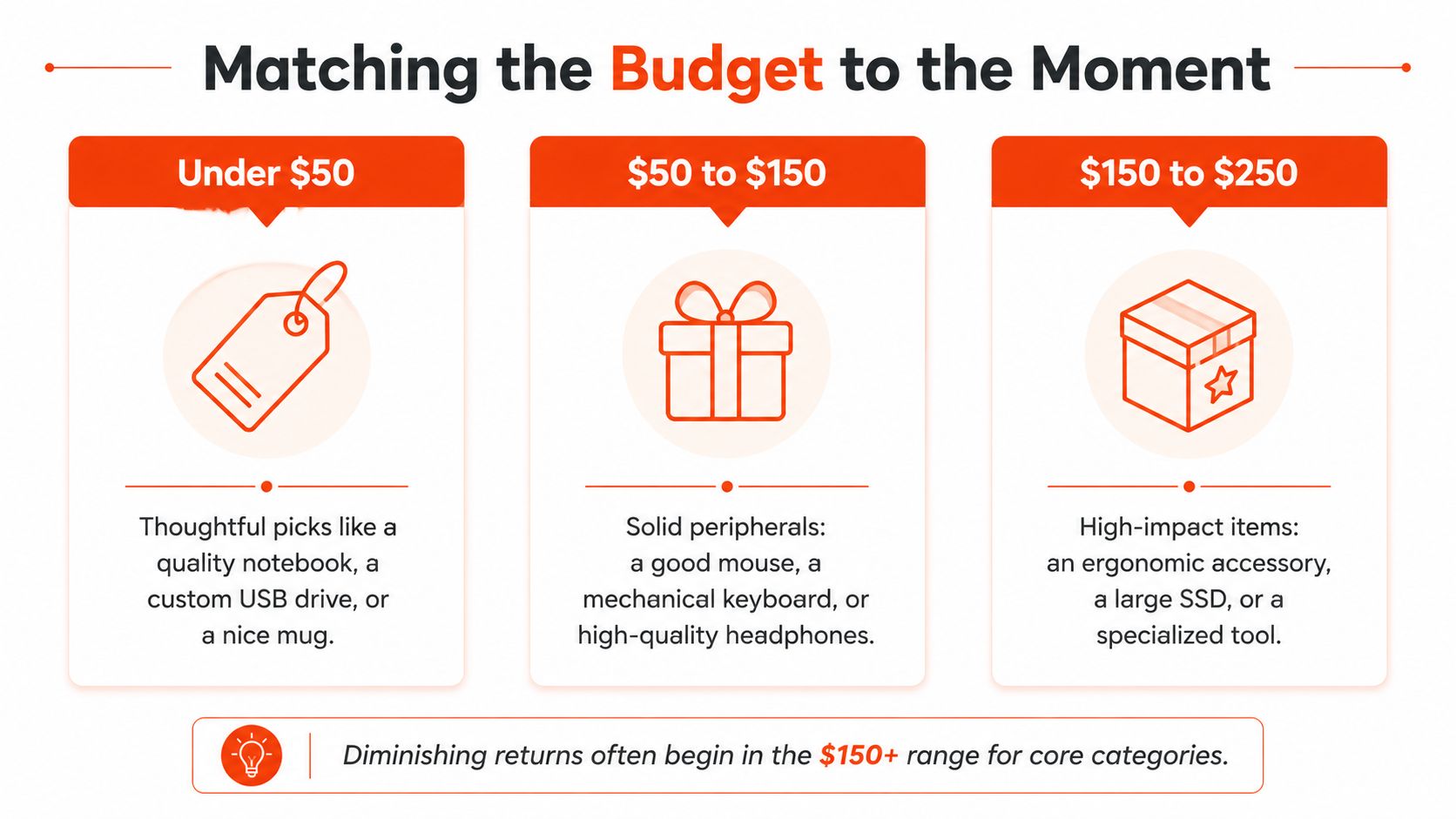
Under $50
This tier suits thoughtful, low-pressure gestures. Pick one small upgrade that earns a place in the recipient's routine:
- A quality notebook: Useful for architecture sketches, meeting notes, and ideas that should not live in another app.
- A custom USB drive: Practical for transfers, recovery tools, or a physical keepsake, if the recipient still uses removable storage.
- A refined mug: Buy one only when its design, material, and shape fit the person. The coding pun is not the value.
- A quality mouse pad: A simple desk improvement with less preference risk than a keyboard.
- A screen-bar light: A compact way to improve desk lighting without adding another floor or table lamp.
Coffee and desk items remain common retail choices. The stronger standard is utility plus identity, not novelty for its own sake. This range fits a peer gift, a thank-you, or a small recognition moment. For apparel, custom apparel with no minimum also works when you want a personal item without committing to a team order.
$50 to $150
This is the practical workhorse range. It can cover a solid mouse, a mechanical keyboard, high-quality headphones, or an external SSD, depending on the recipient's setup.
A mechanical keyboard can be a meaningful upgrade when you know the layout and switch preference. Without that information, headphones or storage carry less mismatch risk. External SSDs still require checks for capacity, connector compatibility, encryption expectations, and whether the recipient already has a backup system.
$150 to $250
At this level, the gift can become a flagship piece, though diminishing returns often begin in the $150+ range for core categories, as shown in the budget guide visual. Spend this much when the product solves a known problem. A higher price alone does not make the gesture more meaningful.
Good candidates include an ergonomic split keyboard, a large external SSD, a specialized tool, or a high-impact ergonomic accessory. A chair add-on can work when you know the recipient's chair and posture concerns. Avoid premium purchases made blind. A $200 mismatch is still a mismatch.
For team occasions, distribute the budget across several modest, well-designed items in a coherent kit. That approach can create more connection than one expensive object selected for a single person.
When the Right Gift Is Team Merch
Buying for an engineering team changes the problem. You're no longer trying to guess one person's switch preference. You're building a shared object that has to work across onboarding, peer recognition, conferences, and community moments.
A startup onboarding kit might include a well-cut hoodie, notebook, tech organizer, and a small desk item. A conference drop needs to survive public wear and crowded tables. A peer-recognition gift should feel personal enough to keep, even if the base product is consistent across the team.
Five separate marketplace gifts create five unrelated signals. A coherent team drop creates a visual language. The hoodie gets worn in public, the cap travels, and the subtle mark gives teammates a shared reference that a private keyboard never can.
What makes engineering merch land
Start with the blank. Premium European-sourced cotton, recycled materials, and a considered silhouette matter more than adding another logo placement. A heavyweight hoodie with clean proportions will outperform a thin promotional sweatshirt, even before customization begins.
Use design restraint. Engineering teams don't need a giant “code mode” graphic on every garment. A small chest mark, tonal embroidery, custom neck label, or inside joke placed with intention can signal belonging without turning the piece into a costume.
Finish the product. Embroidery, screen printing, DTG, DTF, sublimation, pad printing, laser engraving, embossing, and patches all create different results. Woven labels, hang tags, name tags, branded packaging, and a thoughtful insert can turn an ordinary delivery into a real gift.
For teams: the product should look like apparel or gear first, and branded merch second.
The throwaway print-on-demand trap is predictable. A low-quality blank, a default print area, and generic packaging tell recipients that the company optimized for distribution instead of care. If you're comparing ideas for larger quantities, CITYSHEEP bulk gift orders offers another reference point for corporate gifting formats.
The strongest team gifts balance wearability, recognition, and operational simplicity. They work for a distributed team, a new hire, a contributor reward, or a community drop without forcing every recipient into the same personal taste.
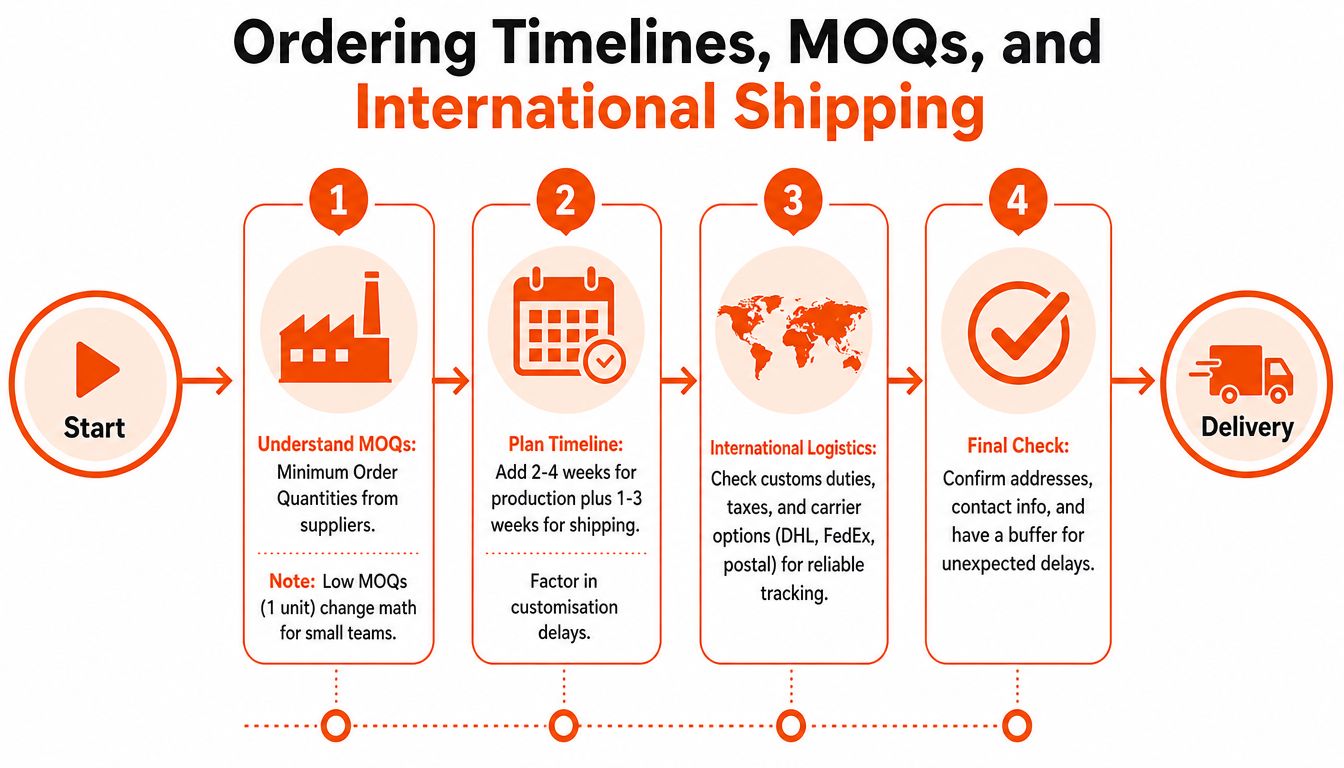
Ordering Timelines, MOQs, and International Shipping
Production problems rarely start with the artwork. They start with an incomplete brief, unclear addresses, missing sizes, or an unrealistic delivery expectation.
Minimum order quantities exist because suppliers set up materials, production runs, customization, and quality checks. Low MOQs change the math for small teams, especially when you need a few sizes, multiple destinations, or a pilot before committing to a larger drop.
Build the brief before requesting a quote
Send the vendor:
- Product direction: Garment or accessory type, preferred fabric, color, fit, and intended use.
- Brand assets: Vector logo files, color references, typography, artwork, and placement preferences.
- Recipient data: Sizes, names, phone numbers, delivery addresses, and any country-specific requirements.
- Event date: Conference, holiday, onboarding window, or launch date, with a buffer for approvals and unexpected delays.
The ordering process typically includes a quote, product preview, e-proof approval, production, and delivery. Customization changes can extend the schedule, so don't leave artwork and sizing until the final handoff.
Treat international logistics as part of the product
Confirm whether duties and taxes are included, which carrier will handle the parcel, and whether tracking continues across borders. DHL, FedEx, and postal services can suit different destinations and budgets. Ask whether the vendor supports one shipment or multiple addresses, especially for distributed teams.
A useful comparison resource for sending physical gifts across borders is free delivery gift baskets USA, particularly when you're evaluating how destination rules affect gifting. For branded team deliveries, review the details in Banger's worldwide custom merch shipping FAQ before you approve production.
Don't promise a holiday or conference delivery until the vendor confirms the schedule in writing. A reliable plan includes an address check, an approval deadline, and enough room for carrier or customs delays.
Choosing a Vendor for Premium Custom Merch
The vendor type determines what you can control.
| Vendor type | Typical MOQ | Turnaround | Blanks quality | Worldwide shipping |
|---|---|---|---|---|
| Print-on-demand platform | Often low | Usually simple and product-dependent | Varies widely | Available on selected routes |
| Traditional swag agency | Usually higher | Quote and production dependent | Varies by supplier | Often available through partners |
| Premium direct-from-factory producer | Can be low | Preview, approval, and production based | European-sourced options available | Built into the fulfillment model |
Print-on-demand is convenient for testing a design, and guides such as POD company recommendations from Trendlytic can help buyers compare platforms. The tradeoff is limited control over blanks, finishing, packaging, and the final unboxing.
Traditional agencies can coordinate larger campaigns, but they may add supplier layers and make small, highly specific orders harder. A premium direct-from-factory producer is the better fit when the brief includes garment quality, custom labels, multiple decoration techniques, low minimums, and international delivery.
A practical vendor checklist
Ask five questions before you commit:
- What blank products can I inspect?
- Which customization method suits this artwork and material?
- Can I approve a real product preview before production?
- What are the minimums for apparel, accessories, and cut-and-sew pieces?
- Can you ship to multiple addresses with duties handled where needed?
Banger combines European-sourced premium blanks, French production ateliers, direct factory pricing, low minimums from 1 unit per item on most products, and product previews in 24 hours, according to its published service information. Its catalog covers apparel, accessories, drinkware, notebooks, tech gear, packaging, and cut-and-sew work, with worldwide fulfillment and duties included for the US, UK, Canada, Australia, Switzerland, and Norway. The company also offers the premium custom merch supplier service for teams that need one partner across product, customization, manufacturing, and delivery.
For a single programmer, buy the tool they'll use. For a team, choose the vendor that can make the shared object feel intentional.
Practical Questions Buyers Always Ask
Should I ask the programmer first?
Ask indirectly if the gift is technical. A quick question about keyboard layout, headphones, or desk pain prevents an expensive mismatch. Keep the surprise for the presentation, not the specification.
What design works on engineering apparel?
Use a strong garment, restrained placement, and a reference the team understands. Small embroidery, tonal graphics, custom labels, and subtle technical details usually age better than oversized novelty prints.
How early should I order?
Order before the event date gives you room for artwork approval, sizing, production, shipping, and customs. Conference and holiday orders need extra buffer because a missed delivery date can erase the purpose of the gift.
How do I handle sizing across multiple addresses?
Collect sizes and complete shipping details in one clean sheet. Confirm names, phone numbers, country formats, and apartment information before production, then ask the vendor to validate the final recipient list.
Banger helps teams turn the idea of a gift for computer programmer into useful individual kits, premium apparel, and coordinated team drops, with custom sourcing, French atelier production, and worldwide fulfillment. Visit Banger to explore the catalog, request a quote, and build merch your engineers will keep wearing.