Factory Direct Pricing for Custom Merch Explained
Most advice on factory direct pricing starts with the wrong promise: buy direct and it's automatically cheaper. That's a nice headline, but it's not how merch sourcing works in the world. The cheaper quote is only real if the MOQ, lead time, freight, quality control, and rework don't eat the spread.
For custom merch, the smarter question is simpler and harsher, cheaper under what order size, speed requirement, and quality standard? Factory pricing moves with producer-side costs, and those costs can shift before retail quotes do, as the BLS Producer Price Index data shows. Buyers who ignore that reality usually end up comparing apples to a whole different supply chain.
Table of Contents
- Tactics that actually move the quote
- Email template for the first quote
- Email template for improving terms
- Email template for a delayed response
Why Factory Direct Pricing Is Not Always Cheaper
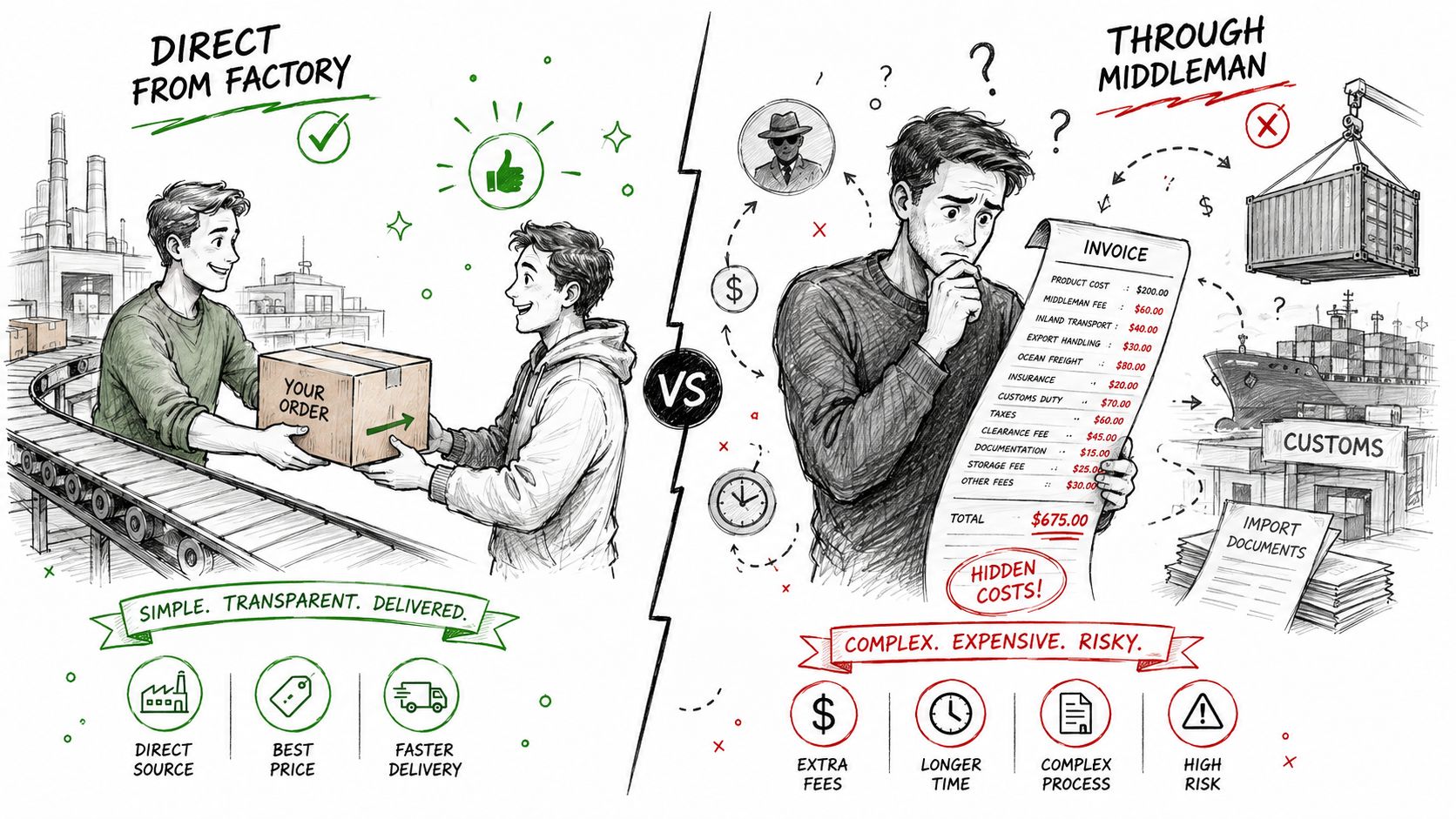
A factory-direct quote can look lean on paper and still lose on the final invoice. That happens when the buyer only sees the unit price and not the full path from factory floor to warehouse shelf. In merch, sticker price is not landed cost.
The reason is structural. A direct quote can remove intermediary markup, but it also moves more work onto the buyer, especially around freight, inspections, sampling, and delay risk. The same source that argues for direct sourcing also notes that the cost picture changes once logistics and quality control sit on your side of the table, and that's where many “cheap” quotes get expensive fast, especially when rework or delays show up (hidden costs in factory direct sourcing).
Practical rule: If a quote looks dramatically cheaper, ask what disappeared. Usually it's not cost, it's responsibility.
Factory direct pricing does have a real advantage when the order is structured well. But the economics only work cleanly when your quantities, timeline, and quality standard fit the factory's setup logic. For that reason, the better question isn't whether the factory quote is lower than a distributor quote, it's whether the quote survives freight, inspection, and your actual launch date.
If you've ever needed a lower-risk entry point, the mechanics behind custom apparel no minimum show why some buyers care less about raw price and more about flexibility. That trade-off matters more than most sourcing blogs admit.
How the Merch Supply Chain Works
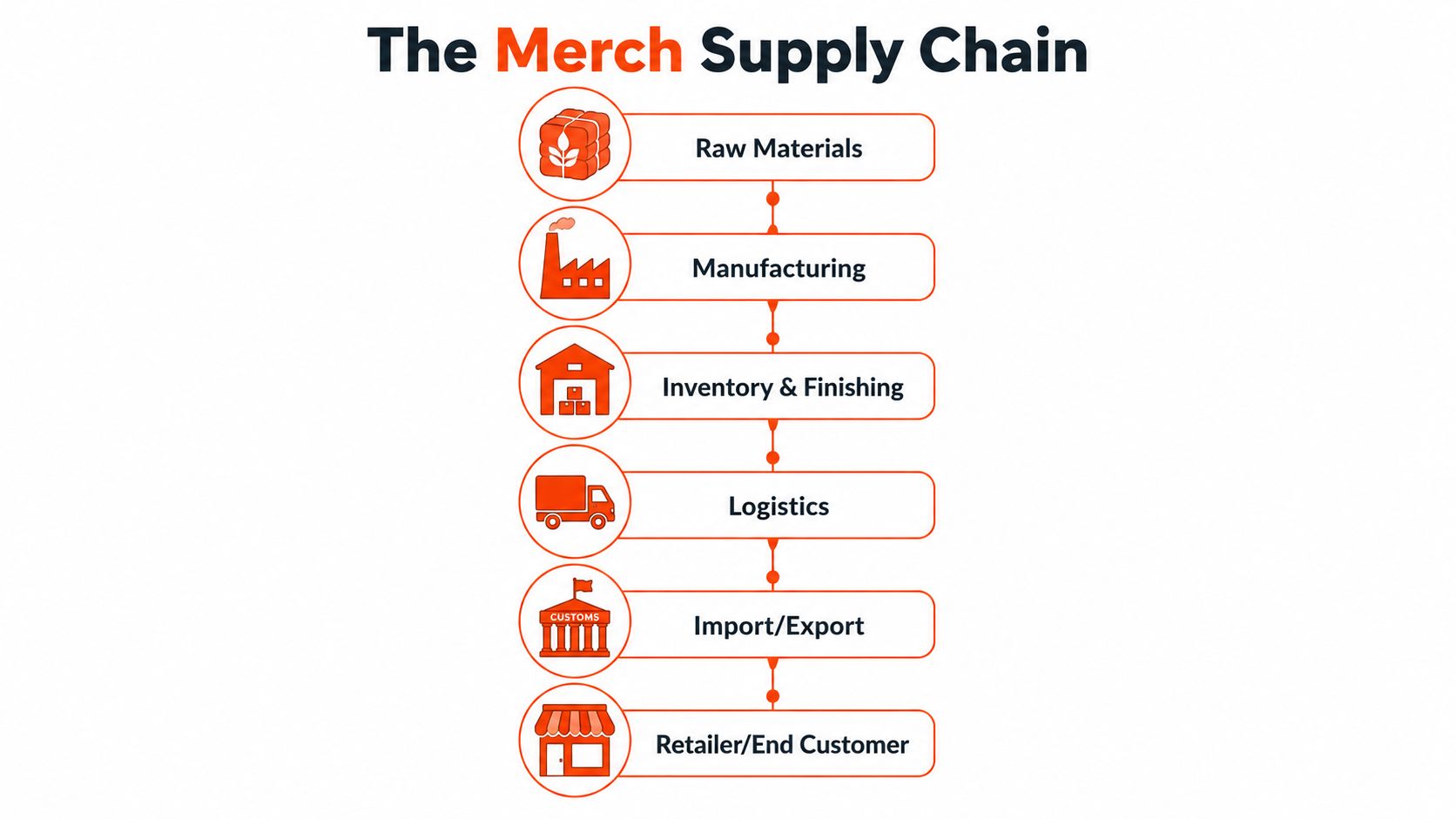
The merch supply chain stacks costs in layers, and each layer wants its own margin. A factory may quote an ex-factory price, but the buyer still has to account for freight, import handling, quality control, and any service layer attached to the order. Once that chain is clear, factory-direct pricing looks less like a slogan and more like a supply-chain decision.
One independent cost analysis estimates trading-company commissions at 5 to 15%, distributor markups at 10 to 20%, and sub-distributor margins at 5 to 10%, which can add up to roughly 20 to 45% above ex-factory price. The same analysis says a direct sourcing setup often replaces those stacked margins with a sourcing-management cost of about 3 to 8% of order value (cost structure in factory direct sourcing). That is the cleanest explanation for why two quotes for the same hoodie can look wildly different.
Ex-factory, FOB, and landed cost
Ex-factory price is the factory's number before the rest of the chain gets involved. FOB adds the point where goods are loaded for export, while landed cost is what the product costs when it reaches you. Buyers who stop at the first number usually misread the deal.
A useful mental model is to track where responsibility changes hands. Raw materials become finished goods, finished goods move into inventory and finishing, then logistics, customs, and finally retail or distribution. A sourcing partner that only talks about base price is leaving out the parts that usually decide whether the order performs.
The quote that matters is the one that survives the warehouse dock.
For teams comparing sourcing models, it helps to pair pricing with logistics thinking. A practical reference like build a resilient jewelry brand is useful because the same logic applies across categories, whether you are buying rings or premium hoodies. The chain is the chain.
If the operational side is getting messy, compare the quote against merch fulfillment services before signing off. Fulfillment does not disappear because the supplier says factory direct.
Benefits and Tradeoffs of Going Direct
Factory direct pricing has real upside when the order fits the factory's economics. You get cleaner communication with the producer, fewer markup layers, and more room for customization. That matters when the product calls for specific fabric weights, trim choices, or print placements that distributors often standardize away. It also matters when you are comparing bids across cut and sew clothing manufacturers, because the quote usually changes once you move from stock goods to a true production run.
Where direct sourcing wins
The strongest advantage is transparency. When the factory and buyer speak directly, it is easier to see what is driving cost and which change will move the quote. Volume also matters, because factory pricing usually improves in tiers rather than in a straight line. One apparel MOQ pricing tiers guide says cost can drop 10 to 15% at 100 to 250 pieces, 20 to 30% at 500+ pieces, and then flatten at 1,000+ pieces as scale kicks in. Another guide shows that a 50 to 100 piece run can be 20 to 30% more expensive per unit than standard MOQ, which is why low-volume direct sourcing can look worse than people expect.
Where direct sourcing gets annoying
The tradeoffs are real. You usually take on more coordination, more lead-time exposure, and more quality control responsibility. In apparel, the lead-time stack is not trivial because sample approval, bulk production, freight, and customs all sit in the path, and published benchmarks show total lead time commonly ranges from 5 to 16 weeks depending on sourcing country and logistics path (lead time benchmark).
A neutral sourcing guide also notes that direct buying can reduce unit prices while shifting logistics and quality-control responsibility to the buyer. That is the trade. You save on markup, then you spend attention on execution.
| Factor | Factory Direct | Distributor/Agency |
|---|---|---|
| Unit cost | Usually lower when volume clears setup thresholds | Usually higher because markup is already layered in |
| Communication | Direct with maker | Through an intermediary |
| Customization | More flexible | Often more standardized |
| MOQ | Often higher or stricter by style and color | Sometimes easier for small buys |
| Lead time | Can be longer and more variable | Sometimes faster if inventory exists |
| Quality control | More buyer involvement | Some QC may be handled upstream |
For a useful parallel in another category, the logic behind coffee farmer impact explained shows why direct trade gets talked about as a cleaner chain. It still adds work for the buyer, especially when the product needs tighter spec control, more back-and-forth on samples, or a production partner that can keep up with repeat orders.
Direct trade improves margins and adds operational complexity. If your order is small, urgent, or experimental, direct sourcing can be the wrong move. If your order is structured, repeatable, and built for scale, it can be the cleaner path.
How to Evaluate and Compare Factory Direct Quotes
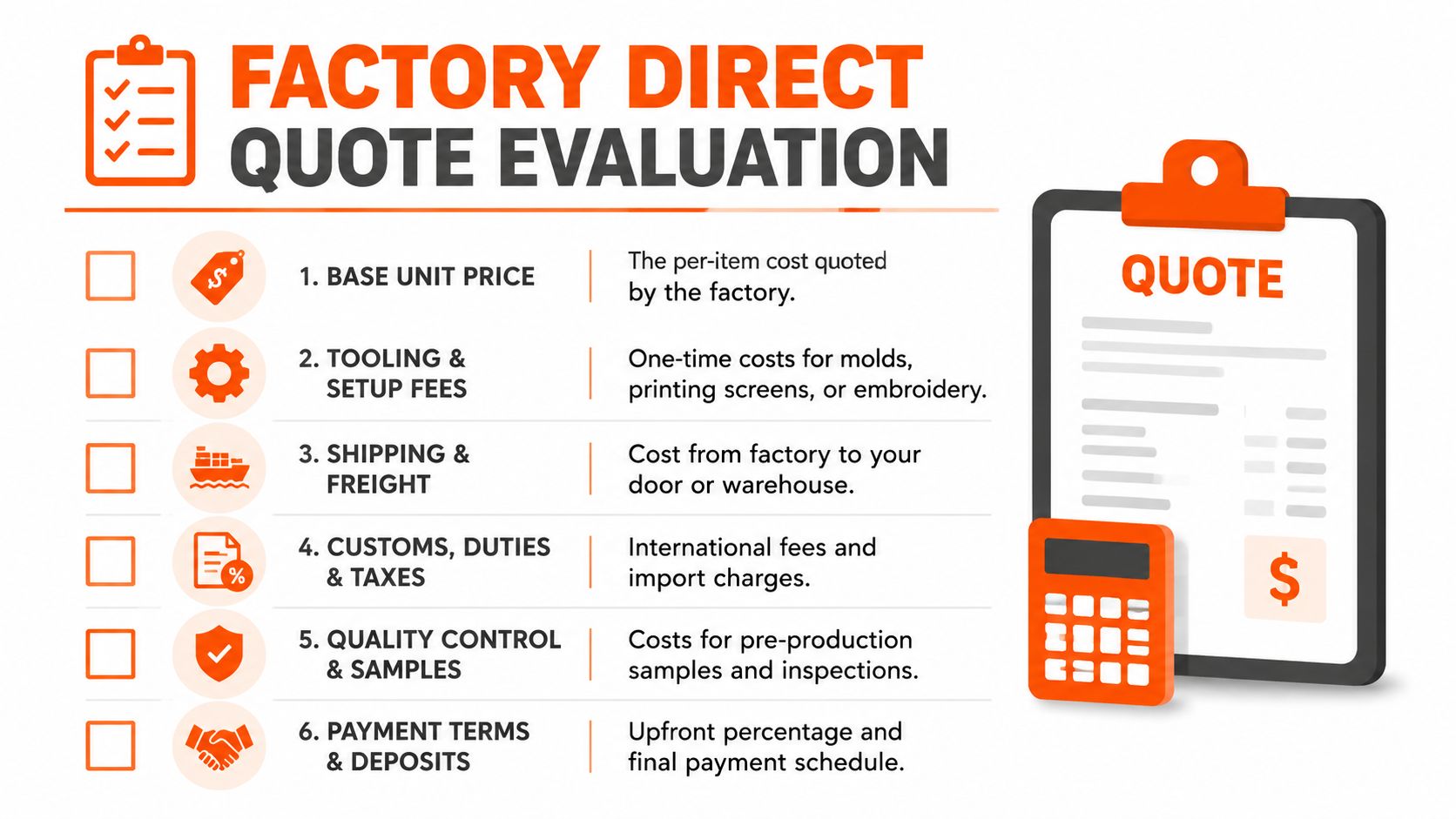
The only way to compare factory direct quotes is to force every seller into the same math. Base unit price matters, but it's just one line in the file. A good buyer turns each quote into landed cost, then stress-tests the timeline and the quality assumptions.
Start with the real total
Ask for the base unit price, then isolate shipping, duties, sampling, inspections, and rework risk. If the supplier won't separate those pieces, the quote is incomplete. That's not a stylistic preference, it's a signal that the numbers may not be comparable.
A practical way to filter quotes is to ask five questions:
- What is the MOQ by style and color? Apparel MOQs are typically set per style and often per colorway, not blended across designs.
- What's included in the quoted unit price? If finishing, labeling, or packaging are extra, the quote isn't final.
- What is the sample path? Sampling can add time before bulk production even starts.
- Who handles QC? If nobody owns inspection, you do.
- What happens if the batch misses spec? Rework rules matter more than the first quote.
MOQ is one of the biggest pricing traps in apparel. It's the smallest number of units a manufacturer will produce in a single order, and published guidance says U.S. cut-and-sew and small-batch factories commonly start at 50 to 100 units per style, while larger overseas mills often want 300 to 500 or more (MOQ basics). Another apparel guide adds that if a factory MOQ is 100 units and you want three colors, you need 100 of each color for a 300-unit total (MOQ by style and color). That detail breaks a lot of first-time merch budgets.
Watch the color split. A quote that works for one shade can turn into three separate orders the moment you add variants.
The time side needs the same discipline. A lot of teams overtrust “fast turnaround” language and forget that lead times stack across stages. If a supplier can't tell you where sample approval ends and bulk production begins, the clock is probably softer than it should be.
For teams comparing quote turnaround as part of sourcing hygiene, the process behind custom merch quote time is a decent benchmark for how fast a real quote should feel without becoming sloppy. Speed is useful only when the math is still intact.
Factory Direct Pricing in Action for Modern Teams
A startup ordering 200 hoodies for a product launch is playing a different sourcing game than a DAO shipping community rewards or a conference team filling swag bags. The pricing model is the same, but the constraints are not. Factory direct pricing works best when the order is planned with the full cost in view, not improvised around a headline unit price.
A startup with a flexible launch window can usually absorb an MOQ-driven quote if it wants better blanks, custom neck labels, and a cleaner finish. A conference team may care less about the lowest per-unit number and more about whether the boxes show up on time and look right on the table. Web3 teams sit somewhere else entirely, because the merch often has to feel collectible without becoming an ops problem.

The hidden cost is usually not the factory rate itself. It is the combination of MOQ, sampling, production lead time, quality control, freight, and any relabeling or packing work you still need to do after the goods leave the factory. If the order is bigger, the style is locked, and the timeline is realistic, the factory can spread setup cost across more units. If the order is small or the event date is already tight, a hybrid approach often makes more sense, especially when stocked blanks or local fulfillment reduce the risk of a bad landed-cost surprise.
For teams that want a cleaner look without building a sourcing operation from scratch, About Banger sits in the middle ground between fully custom development and spreadsheet-heavy vendor management. It is one example of how direct factory access can be packaged without making buyers handle every sourcing detail themselves.
The category split matters more than teams usually admit. A premium team drop can justify tighter production control and a longer approval cycle, while an event giveaway may need a simpler line and faster fulfillment. The same quote can be sensible in one context and a bad fit in another, depending on whether you are optimizing for perceived value, timing, or total landed cost.
Negotiation Tactics and Email Templates for Better Quotes
Good negotiation in merch sourcing isn't about squeezing every supplier until they hate the deal. It's about making the order easier to price correctly. That means clear specs, clear volume, and clear payment expectations.
Tactics that actually move the quote
Use volume truthfully. If you're likely to reorder, say so. Factories care about repeatability, and a realistic repeat path can help you secure better terms without fake pressure.
Push for tiered pricing when the order may grow. If you're deciding between 100 and 250 units, ask for both numbers in the same quote. That shows the cost curve and helps you avoid pretending the cheaper option is the only option.
Don't negotiate only on unit price. Sometimes a better move is to improve payment terms, lock QC expectations, or get packaging included. Those changes can matter more than shaving a small amount off the per-unit line.
Practical rule: A quote gets stronger when the supplier can see the whole order, not just the cheapest version of it.
Email template for the first quote
Hello,
We're planning a custom merch order for [product] in [quantity] units. Please share pricing by style and color, along with MOQ, sample cost, lead time, shipping estimate, and any QC or setup fees. We'd also like to understand payment terms and whether you can support reorders on the same spec.
Thanks,
[Name]
Email template for improving terms
Hello,
Thanks for the quote. We're comparing a few production options and want to stay with the cleanest total cost and delivery path. If we increase volume or simplify colorways, can you share your best revised pricing and any flexibility on deposit or final payment timing?
Best,
[Name]
Email template for a delayed response
Hello,
Just following up on the quote request below. We're moving through vendor selection this week and would like to keep your pricing in the running. Please send the full breakdown when you can, especially MOQ, lead time, and included services.
Regards,
[Name]
Avoid the classic mistake of accepting the first number because it sounds close enough. A clean comparison always beats a rushed decision, especially when the supplier controls setup, production, and export timing.
How Banger Delivers Factory Direct Without the Headaches
Banger occupies the spot buyers usually hope to find, factory direct pricing without turning the merch team into a permanent sourcing operation. The model is built on direct relationships with French manufacturers and ateliers, so the pricing path is shorter and closer to the people making the product. That matters, because factory direct only looks simple until someone has to manage the order end to end.
The value is broader than a lower unit line. It includes premium European-sourced blanks, customization depth, low minimums, and fast quoting, all of which change the total cost of a merch program. If the goal is brand expression, not filler, those pieces matter more than a small savings on paper. Banger also supports worldwide fulfillment and payment in USDC and USDT as well as fiat, which helps distributed teams that want fewer payment handoffs and less delay before production starts.
For the operational details, the company's About Banger page explains how the production model works across apparel, accessories, and fulfillment. That is the part many factory-direct pages leave out. A quote matters, but so does the path from quote to finished order.
The trade-off is straightforward. You still get direct-sourcing pricing logic, but you are not forced to manage every production step yourself. That can include sample coordination, quality checks, packaging decisions, lead-time pressure, and the cost of fixing mistakes after the order is already in motion. For startup teams, creators, and culture-driven brands, that difference often decides whether merch ships cleanly or gets stuck in review.
If you want factory direct pricing without the usual supply-chain drag, explore Banger and request a quote for your next team drop. It gives you a faster read on product options, pricing structure, and the practical work required to ship merch people will love to wear.