Creator Storefront Setup: Build Your Shop in 2026
A creator storefront isn't just a cleaner link in bio. It's the point where audience, merchandising, checkout, and fulfillment become one operating system. Deloitte projects social commerce could reach $2 trillion by 2026, while the broader creator economy serves an estimated five billion social media users and 50 million creators worldwide. Deloitte's analysis of the creator economy makes the shift clear: creators aren't only competing for attention anymore. They're building direct commercial channels.
That changes the setup entirely. A serious storefront needs a focused product edit, a platform that matches your traffic, reliable production, clear shipping economics, and analytics you can use. The link itself is the easy part.
Table of Contents
Why Creator Storefronts Matter Now
Social commerce is projected to reach $2 trillion by 2026, according to Deloitte's creator economy research. That forecast changes how creators should evaluate a storefront. It is not merely a side project or a polished link in bio. It is an operating layer for turning social attention into a repeatable buying process, with decisions around product selection, checkout, fulfillment, and customer follow-up.
The familiar alternative is simple: post a product, add an affiliate link, and send the audience to a generic product page. That can work for a single recommendation, but it leaves the creator with limited control over context, merchandising, and the next action. A dedicated storefront gives each product a place in a considered collection. Products can be grouped by routine, aesthetic, use case, or drop, so visitors can browse with a clear reason instead of sorting through disconnected links.
Independent market research estimates the global creator storefronts market reached $6.2 billion in 2025 and could reach $15.8 billion by 2034. It also estimates that creator storefront transactions represented 32% of total creator earnings in 2025, compared with 18% in 2021. Methodologies vary, but the commercial shift is clear. Commerce is taking a larger role in creator income. The creator storefronts market estimate gives useful context for deciding whether a shop is a campaign asset or a long-term brand property.
Ownership changes the economics
A storefront can run on a retailer's site, inside a creator commerce platform, or on a creator-owned domain. Each setup changes control over the customer relationship, data, checkout, and post-purchase communication. Retailer-hosted pages may reduce inventory and fulfillment work. A creator-owned shop allows more control over product presentation, packaging, customer messages, and repeat purchases, but it also makes the creator responsible for more of the operating system.
The decision matters more than visual polish. If every customer interaction ends on a generic product page owned by someone else, sales may increase without building much brand memory. A serious storefront should function as an editorial destination, with a clear product edit and an experience that supports the next purchase.
For teams building direct customer relationships, how Carti helps DTC stores offers perspective on conversational paths from discovery to purchase. Physical drops bring a separate constraint: production risk. Custom apparel with no minimums can help creators test a focused collection without committing to a large catalog or warehouse inventory.
Practical rule: Own as much of the buying experience as your current operation can support. Control without reliable fulfillment creates customer frustration, not durable commerce.
Choosing Your Storefront Platform
The right platform starts with where your traffic comes from, what you sell, and how much operational complexity you can handle. A creator selling one digital product to an audience concentrated on TikTok has different requirements from a creator running apparel, accessories, subscriptions, and international shipping.
Three common paths
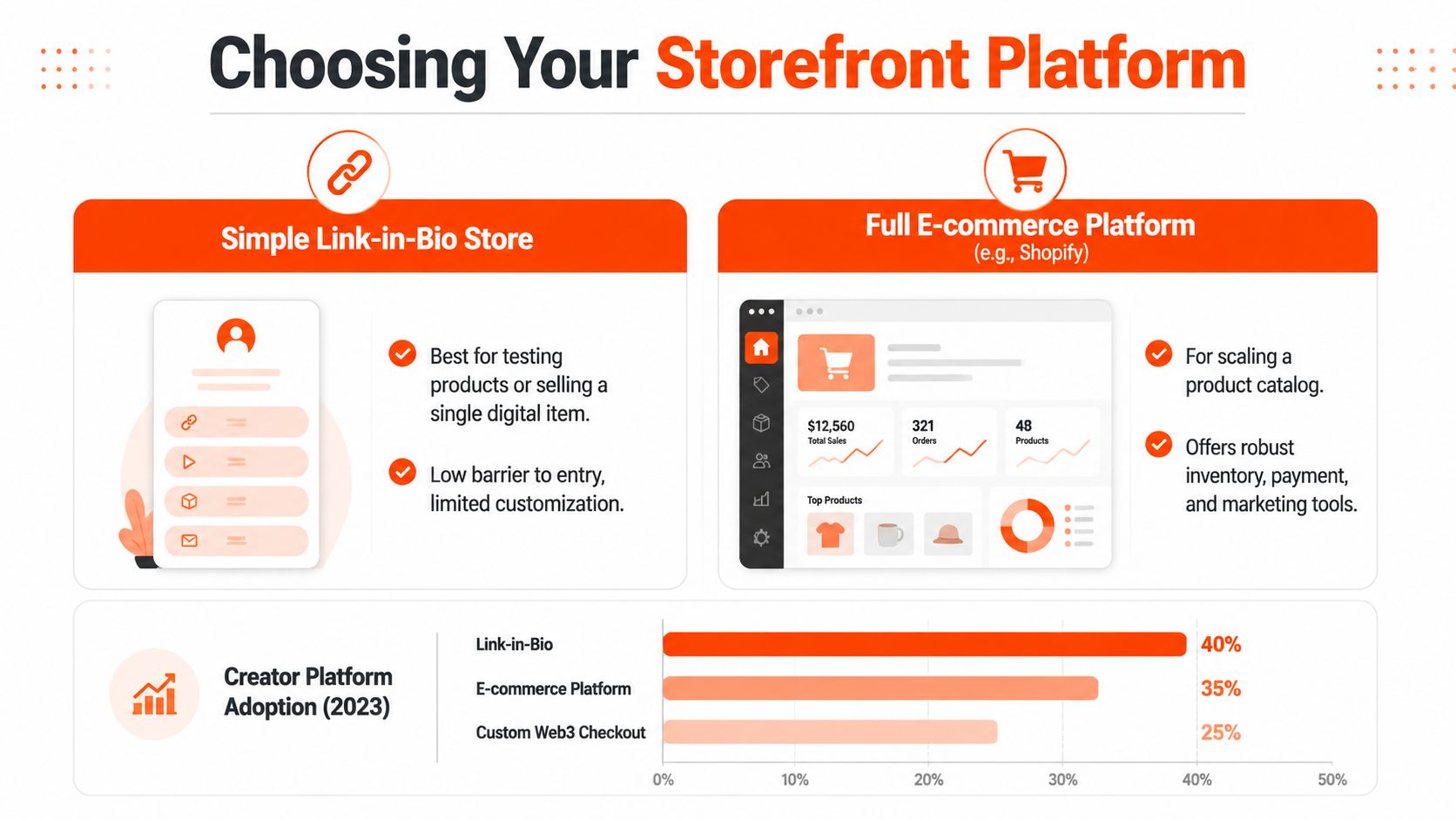
A simple link-in-bio store works for testing a narrow offer. It is quick to publish and easy to share, but gives you less control over customization, merchandising depth, and the customer journey. That limitation matters once products need clearer organization or buyers need reasons to return.
A hosted ecommerce platform, such as Shopify, fits a shop that needs product variants, inventory tracking, payment options, discount logic, email capture, and integrations. Setup takes more work, yet the result provides a stronger operating base for repeat drops and brand partnerships.
A self-hosted or custom checkout gives your team the most flexibility for unusual product logic, token-gated access, Web3 payment flows, or a custom front end. It also makes your team responsible for maintenance, security, analytics, tax handling, and failed-payment recovery. Choose custom infrastructure only when standard tools create a specific, costly constraint.
The visual comparison includes a Creator Platform Adoption chart for 2023. Treat those figures as part of the supplied visualization, not as a universal market benchmark. Your category, audience, fulfillment model, and internal capacity should decide the platform.
Match the tool to the job
Use a link-in-bio shop for a focused demand test. Choose hosted ecommerce when physical products and repeat purchasing drive the business. Consider a custom build only when you can name the workflow existing platforms cannot support.
TikTok-native sellers also need to distinguish between a storefront on their own domain and checkout inside the platform. This TikTok Shop guide for creators explains the latter. An operation handling team orders, event kits, or distributed shipping should review the requirements of a team apparel supplier before selecting software designed only for individual consumer parcels. The platform must fit the handoffs between product selection, payment, production, and delivery.
Curating Products for Maximum Conversion
A creator storefront becomes harder to shop when it tries to display everything. A broad catalog may feel complete to the operator, yet visitors usually arrive from a specific video, post, or recommendation and need a clear next choice.
Creator storefront pages with roughly 6 to 15 hand-picked products have been reported to outperform broader storefronts by about two to three times in relative conversion. Creator storefront conversion insights from Kompozy connects that result to focused merchandising. The page should reflect a point of view, not the full inventory.
Build the first collection around a promise
Start with one audience need or desire. “My everyday filming setup,” “the travel kit I use,” and “the first capsule drop” give visitors a reason to browse together. “All products” does not. Name the collection so its purpose is clear before someone opens an item.
Assign each product a job:
- The anchor: One item carries the collection's identity, such as a heavyweight hoodie, signature camera accessory, or hero skincare product.
- The easy yes: A lower-friction item gives a first-time buyer an entry point, such as a cap, tote, print, or small accessory.
- The complete look: A related product can raise basket size when it naturally belongs with the original recommendation.
- The proof item: Include something you demonstrate in content. Seeing a product in use builds more trust than an isolated product image.
The reported results point to the cost of weak merchandising. One creator-page comparison found a 214% conversion-rate lift after traffic moved from standard affiliate links to on-theme creator pages. Another reported 30% higher conversion and 78% higher average order value on dedicated creator pages than on standard product pages. Influencer Marketing Hub's landing-page analysis also warns that generic or mismatched landing pages can push creator-link conversion below 2%, while brand product pages convert at 3% to 4%.
Edit like a merchandiser
Remove anything that weakens the collection's promise. Put the most recognizable item first, use names that describe the product plainly, and keep the page visually coherent. If an item needs a long explanation to justify its place, move it to a later collection.
Operationally, check the collection against available inventory and fulfillment capacity before publishing. A product that sells well but ships late can damage trust faster than a smaller collection with dependable delivery. Merchandising should account for stock, margins, packaging, and whether the item can be shown naturally in upcoming content.
Search behavior should shape collection labels and product descriptions. The AI search for online stores offers context for making product information readable to people and discovery systems. For ideas that can inform a creator drop, review best swag ideas, then keep the final storefront selective.
A curated storefront should feel like a recommendation from a person, not a warehouse with a profile picture.
Designing Merch That Matches Your Brand
A storefront cannot rescue generic merchandise. Your audience has learned your taste through your content, community, or products. If the physical item feels thin, awkward, or disconnected from that identity, the purchase becomes a trust problem and the storefront starts behaving like a catalog rather than a brand.
Start with the garment, not the logo. European-sourced premium blanks provide a stronger base for fit, fabric, and repeat wear. Distinctive drops can use custom fabrications, cut-and-sew silhouettes, heavier weights, custom neck labels, woven patches, embroidered details, or branded packaging. The mark identifies the piece, but hand feel, proportions, and durability usually determine whether someone wears it again.
Turn content language into product language
A creator's visual identity does not need to become a giant chest print. A crypto community might translate its visual system into tonal embroidery, technical nylon, or an understated cap. A podcast could build a small capsule around a recurring phrase, studio object, or color story instead of placing the show title across every surface.
Choose customization according to the product and the intended feel:
- Embroidery adds texture and suits caps, heavyweight fleece, and small marks.
- Screen printing works for bold graphics and repeatable artwork.
- DTG or DTF supports detailed artwork and smaller batches.
- Laser engraving or embossing gives accessories and leather goods a quieter finish.
- Custom labels and packaging make the unboxing feel intentional, especially for fan drops and gifts.
The production partner sets the practical limits. Banger describes access to premium French manufacturers, low minimum orders, and worldwide fulfillment. That model can help a creator produce a more polished capsule without committing to enterprise-scale production, provided the design remains simple enough to manufacture consistently.
Design for the way people wear it
Test every piece outside the audience's feed. A strong creator garment should work with jeans, a work uniform, or an existing streetwear rotation. Avoid designs that depend entirely on launch-day attention. The drop should signal community membership without turning the buyer into a walking advertisement.
A serious storefront also needs a repeatable design system. Set rules for logo scale, colors, placement, materials, and packaging before approving samples. Then check mockups against real content, product photography, and expected margins. For creators who need help shaping that system before production, custom design services can support the shift from isolated logo placement to a coherent product collection.
Handling Production and Fulfillment
Fulfillment determines whether a creator storefront operates like a commerce business or loses margin. Before taking orders, define inventory, production timing, packaging, returns, shipping zones, and customs. A polished product page cannot fix an unclear operational plan.
A small pre-order window gives you a controlled test. Send samples to trusted creators or community members, offer existing followers early access, then open the main drop through your strongest channels. This sequence tests the product story before public demand arrives and gives the production or fulfillment partner a clearer signal.
Choose an inventory model
On-demand production limits unsold stock and suits evergreen designs with uncertain demand. The trade-off is reduced control over production timing and, in some cases, fewer options for premium finishing.
Pre-orders fund a defined production run and create genuine scarcity without requiring a blind inventory bet. Publish a clear ship window before checkout. Customers are more willing to wait when the terms are specific and visible.
Bulk production can lower unit costs and give you greater control over packaging and dispatch, but you carry the inventory risk. Reserve it for products with proven demand, repeatable sizing, or a predictable event schedule.
International checkout requires the same operational precision as the product page. DDP, or Delivered Duty Paid, means the seller delivers goods with duties and taxes paid in the destination country. The global creator economy logistics overview explains why this matters for international ecommerce. Buyers see a clearer landed cost and face less risk of an unexpected delivery charge.
Build the backend before the hype
Map every order from payment through the packing slip. Decide where inventory is stored, who corrects addresses, how returns are inspected, and which countries remain profitable after shipping and duties. For drops with multiple products, confirm that the partner can bundle items consistently instead of sending separate parcels with separate costs.
Document the handoffs, then test one complete order yourself. For teams balancing fan orders with gifting, events, or international dispatch, merch fulfillment services can help clarify the requirements before launch.
Launching Your Storefront and Optimizing Growth
A storefront launch needs a commercial reason to exist. Without a defined offer, audience, and fulfillment plan, a permanent URL waits for traffic.
Start with a drop narrative. Show the product in use, reveal its materials and finishing, explain the quantity or ordering window, and publish a clear launch date. Seed the strongest piece before release so people encounter it in real settings, not only in product renders.
Use a staged launch
- Prepare the proof. Photograph the product on people, capture fabric and finishing details, and write copy that answers fit, use, and shipping questions. Product pages should resolve uncertainty before checkout.
- Give insiders access. Send an early-access code to engaged community members, newsletter subscribers, or paid members. Watch where they hesitate, what they ask, and which products they ignore before the public release.
- Coordinate channels. Use short-form video for discovery, email or community posts for context, and the storefront for the complete collection. Each channel should perform a distinct job.
- Create a reason to act. A defined pre-order window, limited colorway, or first-drop packaging can create urgency. Use scarcity only when the offer has a limit.
After launch, track more than likes. Review conversion rate by traffic source, average order value, product mix, refund reasons, and the path from content to checkout. A source with many clicks but weak conversion may have a message or landing-page mismatch. A smaller source with stronger baskets may deserve more content and better placement.
Reorder with evidence
Separate product demand from launch noise. If an item sells because the creator wears it repeatedly, that supports its role as a core product. If another sells only with a discount, examine whether the design, price, or presentation is creating the demand.
Keep a simple post-launch review:
- Traffic quality: Which platform brought visitors who browsed?
- Merchandising: Which collection order created the clearest path to purchase?
- Basket behavior: Did buyers choose one anchor item or combine complementary products?
- Operations: Which sizes, colors, or destinations created friction?
- Next drop: What should return, evolve, or disappear?
Reorder proven items before momentum fades and the audience encounters an empty product page. Do not restock the entire collection by default. Keep the proven core, change one meaningful variable, and give the next drop a distinct reason to exist.
Banger supports creator merch through product sourcing, design, customization, French atelier production, and worldwide fulfillment, with options for apparel, accessories, packaging, and curated drops. Visit Banger to explore the catalog, request a product preview, and build merch your audience will want to wear.